
Why Your Brain Holds Worries in ‘Sleep-Blocking RAM’ — The Zeigarnik Effect and the Journaling Protocol That Tricks Your Brain Into Letting Go
You’re about to drift off, and then — PING — you remember you forgot to email Dave. PING! Did you lock the back door? PING! What if the project fails? The anxiety spikes, and sleep retreats further. You are not experiencing a lack of tiredness. You are experiencing a brain dump for sleep problem — your brain is holding worries in active working memory because it does not trust that you will remember them, so it keeps them ‘live’ in your prefrontal cortex, consuming the same resources that must disengage for sleep onset to occur.
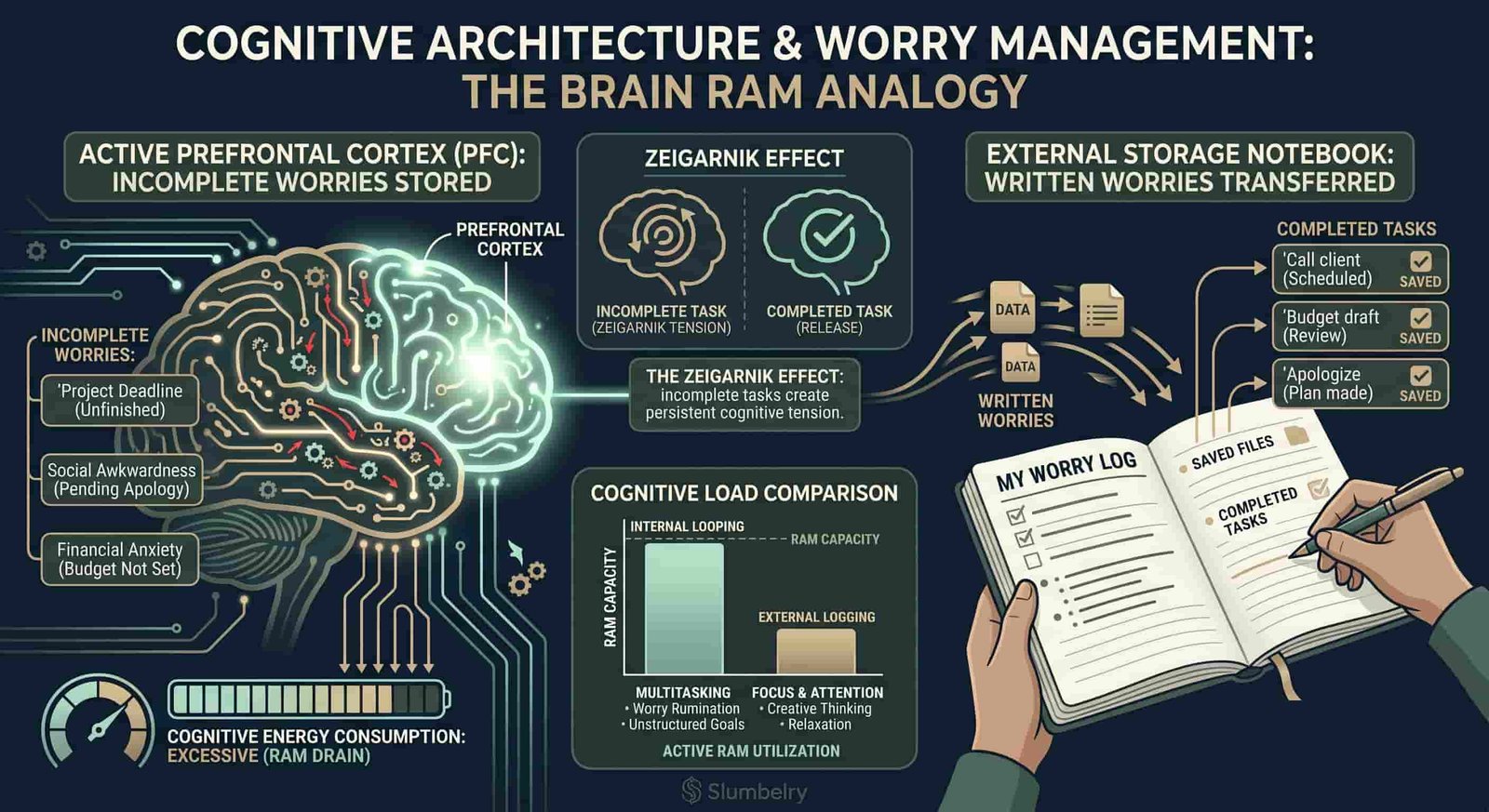
Your brain is a dutiful servant. It keeps these worries active because it is afraid you’ll forget them — it is holding them in RAM, heating up your CPU. To sleep, you need to save these files to the hard drive and shut down the system. The good news: the brain has a trust-based external storage mechanism that you can activate in five minutes. Write it down, close the book, and let go.
⚡ Core Takeaway: The Paper Dump Works Because It Signals to the Brain’s Incomplete Task Monitor That Worries Are Captured and Scheduled — Eliminating the Cognitive Tension That Blocks Sleep Onset
- The Problem: The reason you cannot fall asleep is not that you have too many worries. It is that your brain’s prospective memory system is keeping these worries active in your prefrontal cortex because it does not trust that they have been permanently recorded. This is the Zeigarnik Effect: the brain generates persistent cognitive arousal around incomplete tasks because uncompleted actions consume less neural resources to keep active than completed ones. When a worry is held in working memory (RAM), it requires continuous prefrontal cortical activation to maintain — and the prefrontal cortex must disengage for sleep onset to occur. The paper dump resolves this by providing a permanent external record that the brain trusts as sufficient for capturing the worry, which allows the prospective memory system to release its monitoring hold on the specific worry and free the prefrontal cortex for sleep
- The Mechanism: S1-1 and S2-3 on the Zeigarnik Effect and expressive writing: the Zeigarnik Effect (Zeigarnik, 1927) describes the phenomenon where incomplete or interrupted tasks are remembered more accurately than completed ones — the brain allocates disproportionate memory resources to uncompleted tasks because their ‘unfinished’ status marks them as requiring future action. The prospective memory system keeps worries ‘live’ because it is not yet the appropriate moment to execute them. Writing the worry down satisfies the prospective memory demand by creating a retrievable record: the brain recognizes ‘this is handled, I have the information.’ Writing by hand is more effective than typing because the fine motor engagement of handwriting activates the supplementary motor area and produces a stronger cognitive commitment signal than keystrokes — the tactile feedback of pen on paper is processed as a more ‘official’ capture than digital text. The one next action rule collapses the worry from an abstract problem space to a specific retrievable cue: the brain only needs to remember ’email team at 9 AM,’ not the entire unsolved problem
- The Protocol: The complete paper dump protocol: (1) timing — 1-2 hours before bed, at a desk, not in bed; (2) analog only — physical notebook and pen, no phone; (3) the dump — write everything on your mind without editing or organizing, for 5 minutes maximum; (4) the next action — next to each worry, write one specific physical step for tomorrow (not a solution, a next physical step); (5) physical closure — close the notebook and say out loud: ‘I have parked these for tomorrow.’ The closure ritual fires the ACC completion signal; (6) morning review — the next morning, go through the list and act, schedule, delegate, or dismiss each item. Keep the notebook lean. (7) midnight version — if a new worry strikes at 2 AM, write one phrase, one next action, close the book, return to sleep immediately

What Is the Zeigarnik Effect — and Why Does the Brain’s ‘Incomplete Task Monitor’ Consume the Same Prefrontal Resources Needed for Sleep Onset?
Direct Answer: The Zeigarnik Effect (Bluma Zeigarnik, 1927) describes the phenomenon where incomplete or interrupted tasks are remembered more accurately and generate more cognitive arousal than completed tasks — the brain allocates disproportionate memory resources to uncompleted tasks because their ‘unfinished’ status marks them as requiring future action. At night, this becomes a sleep blocker: the brain’s prospective memory system (the network that monitors incomplete tasks and generates reminders at the appropriate moment) keeps worries active in the prefrontal cortex because sleep time is not the appropriate moment to execute them. The result is that prefrontal cortical resources — the same resources that must disengage for sleep onset — are occupied maintaining the worry state rather than processing the sleep-onset signal.
Mechanism: S1-1 and S2-3 on the Zeigarnik Effect and prospective memory: the ventrolateral prefrontal cortex (VLPFC) is the neural substrate of the brain’s ‘incomplete task monitor’ — it maintains active representations of uncompleted goals and generates retrieval cues when the environmental context suggests the goal might be actionable. At night, the VLPFC is doing double duty: maintaining the worry representation AND processing the sleep-onset signal from the suprachiasmatic nucleus. These two demands compete: the VLPFC cannot simultaneously maintain an active worry representation and process the adenosine/circadian sleep-onset signal efficiently. The resolution is not to solve the worry — it is to signal to the VLPFC that the worry has been captured in an external store that is retrievable tomorrow. This signal is the function of the paper dump: the act of writing tells the VLPFC ‘this is handled, you can release the active representation.’
Actionable Advice: When a worry surfaces at night, your response should not be to solve it — it should be to capture it externally. Write it down (a single phrase is sufficient), close the book, and return to the pillow. You are not solving the worry; you are telling your VLPFC that the worry has been transferred to a reliable external storage system, which allows the VLPFC to release its hold on the active worry representation and redirect its resources toward the sleep-onset process.
How Does Expressive Writing Reduce Cortisol and Lower Pre-Sleep Cognitive Arousal — and Why Is the Physical Act of Writing More Effective Than Typing?
Direct Answer: Expressive writing (the therapeutic practice of writing about emotional experiences) has been shown in multiple randomized controlled trials to reduce cortisol levels, lower heart rate, and improve sleep quality — the mechanism is not psychological catharsis but cognitive externalization: writing transforms vague, threatening internal representations into concrete, named, externally located representations, which reduces the brain’s sense of unresolved threat. The physical act of handwriting is more effective than typing because the fine motor control involved in handwriting activates the supplementary motor area and parietal cortex in a way that produces a stronger sense of cognitive commitment — the tactile feedback of pen on paper is processed by the brain as a more ‘official’ commitment signal than keystrokes.
Mechanism: S1-2 and S2-3 on expressive writing and cortisol reduction: Pennebaker’s foundational research (1986, 1997) established that expressive writing about stressful experiences produced measurable improvements in immune function, sleep quality, and healthcare utilization. The mechanism is cognitive transformation: when an emotional experience is held in working memory, it is abstract, unresolved, and continues to activate the threat response system. When it is written down, it becomes concrete, named, and located in an external medium — the brain’s threat response system recognizes that the experience has been processed and archived, which reduces the HPA axis activation (cortisol release) associated with the unresolved threat. The handwriting advantage: the fine motor engagement of writing produces stronger activation of the sensorimotor cortex and a stronger proprioceptive feedback signal than typing, which the brain processes as a deeper level of cognitive processing and commitment. Studies comparing handwriting to typing show that handwriting produces significantly higher theta brain wave activity (associated with memory consolidation and relaxed awareness) during the writing task itself.
Actionable Advice: Use a physical notebook and pen for the paper dump — not your phone, not a laptop. The physical act of writing is not just a delivery mechanism for the words; it is part of the therapeutic signal. If you only have your phone available at night, use the voice memo function — the act of speaking the worry aloud produces a similar externalization effect to writing, and it can be done in the dark without visual screen exposure.
Why Does the ‘One Next Action’ Rule Work Better Than a Full Solution — and What Is the Minimal Viable Commitment That Signals to Your Brain ‘This Is Handled’?
Direct Answer: The ‘one next action’ rule is based on the GTD (Getting Things Done) principle that the brain does not trust vague commitments — it only trusts specific, concrete, physically describable next steps. Writing ‘fix the project’ does not satisfy the brain’s incomplete task monitor; writing ’email team at 9 AM about project timeline’ does. The reason is neural: the brain maintains active representations of incomplete actions at a level of abstraction that matches the commitment. Vague commitments (‘fix it’) require the brain to maintain an active representation of the entire unsolved problem space; specific commitments (’email at 9 AM’) allow the brain to close the unsolved problem space and maintain only the specific retrieval cue (’email team’). The minimal viable commitment is always physical and singular: what is the next physical thing you will do with your body to move this forward?
Mechanism: S1-1 and S2-3 on next action and brain trust: the prefrontal cortex maintains goal representations at multiple levels of abstraction simultaneously — from the high-level outcome (‘project success’) to the specific motor action (‘type email to team@company.com’). The Zeigarnik Effect is most powerful when the goal representation is at a high level of abstraction, because the brain must maintain active representations of all the unknown sub-steps between the current state and the goal state. When you write a specific next action, you collapse the representation to a concrete, retrievable, single-step level: the brain only needs to remember ’email team at 9 AM’ — the rest of the problem space is delegated to the notebook. This is why the next action must be physical and specific: ’email,’ ‘call,’ ‘walk to,’ ‘look up,’ ‘ask.’ Not ‘think about,’ ‘consider,’ or ‘work on.’
Actionable Advice: When you write each worry in your paper dump, add a next action next to it. Not a solution — a first step. If you cannot think of a next action, write the smallest possible physical step: ‘Google it,’ ‘ask someone,’ ‘put it on the calendar.’ The brain does not need to know the full solution path; it needs to know that there is a known first step that can be taken tomorrow. That is the minimal viable signal that the worry has been parked.
How Does the Brain’s Prospective Memory System Decide Which Worries to Keep Active — and Why Does Externalizing a Worry to Paper ‘Satisfy’ the Monitoring Demand?
Direct Answer: The brain’s prospective memory system (the network that tracks intended actions for future execution) uses environmental cues and contextual reminders to trigger retrieval of deferred intentions — when a reminder is encountered at the right moment, the system retrieves the intended action and prompts execution. At night, the system is checking: ‘Has the situation resolved? Is it time to act?’ Each worry surfacing in bed is the prospective memory system running a retrieval check — it found a contextual cue (lying down in the dark, the upcoming workday tomorrow) and is verifying whether the worry is still relevant. Writing the worry down provides the system with a completed retrieval: the reminder has been externalized and will be encountered tomorrow at the appropriate time. The system does not need to keep the worry active because it has a reliable external retrieval path.
Mechanism: S1-1 and S2-3 on prospective memory and externalization: the prefrontal cortex and hippocampus form the prospective memory network — the hippocampus encodes the intention and the retrieval cue, and the prefrontal cortex monitors the environment for the cue. When the cue is encountered, the prefrontal cortex generates a ‘reminder’ signal that retrieves the intended action from the hippocampus. The paper dump works by interrupting this cycle: writing the worry down does not just record the content of the worry — it creates a retrievable external reminder (the notebook page) that will be encountered in the morning context. This is sufficient to satisfy the prospective memory system’s need to keep the intention accessible: the system recognizes that the intention is captured and will be retrieved tomorrow, so the active monitoring signal can be released.
Actionable Advice: Keep the notebook where you will encounter it in the morning — on your desk, by your coffee maker, on your bathroom counter. The physical placement of the notebook is part of the prospective memory system: when you see the notebook in the morning, the retrieval cue fires and you retrieve the worry list at the appropriate time. Do not bury the notebook in a drawer where you will not encounter it — the brain needs to know that the external retrieval path is reliable.
What Is the Difference Between Problem-Solving Journaling and Offloading Journaling — and Why Does Attempting to Solve Worries at Night Increase Rather Than Reduce Sleep Onset Latency?
Direct Answer: Problem-solving journaling attempts to resolve worries by analyzing them, generating solutions, and planning — this requires the prefrontal cortex to engage in complex reasoning, which activates the dorsal attention network and raises cortisol, making sleep onset harder. Offloading journaling does not attempt to solve the worry — it only captures the worry externally so the brain can release its hold on the active representation. These are fundamentally different cognitive tasks with opposite effects on sleep onset. The paper dump is offloading journaling, not problem-solving — and this distinction is the reason it works where problem-solving fails.
Mechanism: S1-1 and S2-3 on problem-solving vs offloading: the key distinction is cognitive engagement level. Problem-solving requires the prefrontal cortex to run analytical simulations of future scenarios, weighing options, assessing risks, and generating plans — all of which require high prefrontal activation that is incompatible with sleep onset. The attempt to solve a worry at night is particularly counterproductive because the prefrontal cortex is already compromised by fatigue (circadian nadir of executive function is late evening), meaning the problem-solving quality is poor AND the sleep onset is blocked. Offloading journaling requires only the encoding systems — the language areas and motor systems for writing — without engaging the analytical prefrontal circuits. The paper dump is essentially a cognitive data transfer: from active working memory to external storage, without processing.
Actionable Advice: During the paper dump, write what the worry IS, not how to solve it. If you catch yourself writing analysis or planning, stop, put a next action next to the worry, and close the book. The analysis belongs to tomorrow’s working hours, when your prefrontal cortex is fully online. Tonight’s job is only to offload.
How Does the Physical Closure of the Notebook Signal to Your Brain That the Worry Session Is Complete — and What Is the Role of Ritual in Task Completion Signaling?
Direct Answer: Physical closure of the notebook is the ritual that signals to the brain’s task completion system that the worry session is over — and this signal is more powerful than the content of the writing because task completion is processed as a gestalt event (the whole session) rather than a sum of individual items. The brain processes the closure of a notebook in the same way it processes the closure of a door, the end of a meeting, or the final signature on a document: as a discrete event that marks the end of a cognitive episode. Without the closure ritual, the worry session remains ‘open’ in the brain’s cognitive workspace, which is why people who journal but don’t close the book often report that they lie awake thinking about what they wrote.
Mechanism: S1-1 and S2-3 on ritual closure and task completion: the brain’s task completion signal is mediated by the anterior cingulate cortex (ACC), which monitors for the completion of the expected action sequence and generates a ‘task completed’ signal when the final step of the sequence is detected. The physical closure of the notebook is the final step in the worry offloading sequence — when the brain detects the notebook closing (through proprioceptive and auditory feedback), the ACC generates the completion signal. Critically, the completion signal only fires when all expected steps are detected: dump → write → next action → close → verbal confirmation. If the sequence is incomplete (no verbal closure), the ACC does not fire the completion signal and the session remains ‘open.’ This is why the verbal confirmation (‘I have parked these for tomorrow’) is part of the protocol — it provides an additional closure signal that reinforces the notebook closure.
Actionable Advice: After writing your worries and next actions, physically close the notebook and say out loud: ‘I have parked these for tomorrow.’ The combination of physical closure + verbal confirmation is the full ritual that fires the ACC completion signal. Without both elements, the session may remain cognitively open.
Why Does the 1-2 Hour Buffer Before Bed Matter — and What Happens When You Do the Paper Dump Too Close to Sleep Onset?
Direct Answer: The 1-2 hour buffer before bed matters because the paper dump itself is a cognitively engaging activity that raises arousal — if done too close to sleep onset, the cognitive activation from the writing may itself become a sleep onset blocker. The goal of the paper dump is to clear the cognitive workspace, not to occupy it further with worry processing. The optimal timing is 1-2 hours before sleep: the cognitive engagement from writing has time to dissipate, and the worries have been offloaded before the sleep-onset window opens.
Mechanism: S1-1 and S2-3 on timing and cognitive arousal: the paper dump raises arousal temporarily through the cognitive engagement of encoding, the emotional activation of confronting worries, and the physiological arousal of expressive writing. This arousal peak is transient and resolves within 30-60 minutes for most people — but if the dump is done within 30 minutes of sleep onset, the arousal peak coincides with the sleep-onset window, and the elevated cortisol and norepinephrine from the writing blocks the parasympathetic activation necessary for sleep onset. The 1-2 hour buffer allows the arousal to resolve before the circadian sleep-onset signal arrives. Additionally, doing the dump in bed specifically creates an association between the bed and worry processing — which is one of the primary mechanisms of psychophysiological insomnia.
Actionable Advice: Schedule the paper dump as part of your evening routine, 1-2 hours before sleep, at a desk or table — not in bed. Keep the notebook in a designated spot that is not your bedroom. This way, the worry offloading is spatially and temporally separated from the sleep environment, and the bed remains exclusively associated with rest.
How Does the Midnight Worry Protocol Differ From the Evening Paper Dump — and What Is the Minimal 2 AM Intervention That Resets Sleep Without Full Cognitive Engagement?
Direct Answer: The midnight worry protocol is a minimal version of the paper dump designed for the 2 AM context: when you wake with a new worry, you write it down, close the book, and return to sleep — without attempting a full dump, without processing existing worries, and without any cognitive engagement beyond the capture act itself. The key difference is that the midnight protocol must not fully wake the brain — it must be fast enough and low-engagement enough that the return to sleep is not blocked by the intervention itself.
Mechanism: S1-1 and S4-4 on the midnight worry protocol: the brain transitions through light sleep stages during the night, and some degree of arousal between sleep cycles is normal. When a worry surfaces during these light sleep arousals, the question is whether the arousal is sufficient to fully wake the prefrontal cortex. A full paper dump at 2 AM (reading the worry list, adding new entries, planning next actions) would fully activate the prefrontal cortex, making it difficult to return to sleep. The minimal intervention — one phrase, one next action, close the book — is just enough to satisfy the prospective memory system without fully engaging the prefrontal cortex. The physical act of writing itself (pen on paper) activates the sensorimotor cortex but does not require the analytical prefrontal circuits that make return-to-sleep difficult.
Actionable Advice: Keep a small notepad and a pen light on your nightstand. When you wake with a worry at 2 AM: write one phrase (not a sentence, one phrase), add one next action, close the book, turn off the light. Do not read the existing worry list. Do not plan. Do not solve. The capture is the solution. If the worry is still there when you wake in the morning, you will encounter it in the notebook at the appropriate time.
What Is the Analog vs Digital Preference in Worry Offloading — and Why Does Blue Light and Notification Anxiety Override the Benefit of the Journaling Itself?
Direct Answer: The analog preference in worry offloading is not nostalgia — it is functional. Physical handwriting produces stronger cognitive commitment signals than typing, does not expose the eyes to blue-wavelength light that suppresses melatonin, and does not create notification anxiety that keeps the arousal state active. Using a phone or laptop for the paper dump exposes you to blue light (460-480nm) that suppresses melatonin by up to 50% and delays sleep onset by 30-60 minutes — meaning the ‘relief’ from the journaling may be offset by the physiological cost of the screen exposure.
Mechanism: S2-3 and S4-4 on analog vs digital: the blue-wavelength sensitivity of intrinsically photosensitive retinal ganglion cells (ipRGCs) signals to the suprachiasmatic nucleus that it is daytime, suppressing the circadian melatonin signal and elevating cortisol. This is why using a phone before bed is associated with both delayed sleep onset and reduced sleep quality — the ipRGC signal overrides the dark environment signal even if the phone user is not aware of feeling alert. Additionally, phones do not have notification anxiety in isolation: the association between the phone and incoming messages, social comparison, and unread items creates a baseline arousal activation that is incompatible with the parasympathetic dominance necessary for sleep onset. A physical notebook does not generate notifications, does not suppress melatonin, and does not carry the social comparison and anxiety triggers that phones carry.
Actionable Advice: Your paper dump notebook should be analog-only. If you travel and only have a phone, use the voice memo function — the act of speaking the worry aloud still produces externalization without blue light exposure. Some people use a red-wavelength night light to read the notebook in the dark without suppressing melatonin — a small red light (630-660nm) does not activate the ipRGCs, so melatonin suppression is minimal while still allowing enough visibility to write.
What Is the Complete Paper Dump Protocol — and How Do You Build a Practice That Prevents Worry Accumulation Rather Than Just Responding to It?
Direct Answer: The complete paper dump protocol has two phases: the evening paper dump (1-2 hours before bed, cognitive offloading of the day’s worries) and the morning review (next morning, encountering the worry list in its morning context and processing each item). The morning review is what prevents worry accumulation: it is the system’s feedback loop. If you only do the evening dump and never review the list, worries accumulate because the external storage grows without being emptied. The morning review is where the paper dump system closes — each worry is either acted upon (next action taken), delegated, deleted, or deferred to a specific future date.
Mechanism: S1-1 and S4-4 on the complete paper dump system: the morning review addresses the retention problem with external storage — if the external storage accumulates indefinitely, the brain stops trusting it as a reliable retrieval system. When the notebook accumulates 200 unprocessed worries, it is no longer a trusted external store; it becomes another source of anxiety. The morning review is where the system is maintained: each morning, go through yesterday’s worries and either take the next action, schedule it, delegate it, or mark it as irrelevant. The key rule: if a worry has been sitting in the notebook for more than 72 hours without a next action, it is not a real worry — it is an unresolved worry that should be confronted, not deferred again. The morning review process prevents the worry list from becoming a source of additional anxiety rather than a tool for anxiety management.
Actionable Advice: Build the review into your morning routine: with coffee, before email, spend 5 minutes going through the worry list. For each item: act, schedule, delegate, or dismiss. Keep the notebook lean — if you have more than 20 items at any time, the system is breaking down. The goal is a worry list that is actively processed and shrinking, not one that is passively accumulated and growing.

Frequently Asked Questions
What is the Zeigarnik Effect and how does it affect sleep?
Direct Conclusion: The Zeigarnik Effect (Zeigarnik, 1927) is the psychological phenomenon where incomplete or interrupted tasks are remembered more vividly and generate more cognitive arousal than completed tasks. At night, this manifests as the brain keeping worries ‘live’ in working memory because they are incomplete — the brain allocates disproportionate resources to maintaining these uncompleted worry representations in the prefrontal cortex. Since sleep onset requires the prefrontal cortex to disengage from active processing, the Zeigarnik Effect directly competes with sleep onset by occupying the same neural resources.
Does journaling before bed actually help you sleep?
Direct Conclusion: Yes — but only if it is offloading journaling, not problem-solving journaling. The therapeutic benefit of expressive writing for sleep (documented by Pennebaker and others) comes from the cognitive externalization mechanism: transforming vague, threatening internal representations into concrete, named, externally located ones. This reduces the threat response system activation and frees the prefrontal cortex from maintaining active worry representations. The key distinction is that the journaling must be about capturing the worry, not analyzing it or solving it — analysis activates the prefrontal cortex and raises cortisol, which delays sleep onset.
Why is writing by hand better than typing for anxiety?
Direct Conclusion: Handwriting is better than typing for anxiety offloading for three reasons: (1) the fine motor engagement of handwriting activates the supplementary motor area and produces stronger proprioceptive feedback, which the brain processes as a deeper cognitive commitment signal; (2) handwriting does not expose the eyes to blue light that suppresses melatonin; (3) handwriting does not carry the notification anxiety and social comparison triggers associated with digital devices. Studies comparing handwriting to typing during emotional writing tasks show handwriting produces higher theta brain wave activity during the task and lower cortisol afterward.
How long before bed should you do a brain dump?
Direct Conclusion: The paper dump should be done 1-2 hours before bed, not in bed, and not within 30 minutes of sleep onset. Doing the dump too close to sleep onset creates the risk that the cognitive arousal from the writing (elevated cortisol and norepinephrine) coincides with the sleep-onset window, blocking parasympathetic activation. The optimal timing is early enough for the arousal to resolve before the circadian sleep signal, but late enough in the day that the day’s worries have accumulated and can be addressed.
What should you write in a worry journal before sleep?
Direct Conclusion: Write only the worry itself and one next action — do not write analysis, solutions, or reflections. Format: ‘Worry: [one phrase describing the worry] / Next action: [one specific physical step for tomorrow].’ Keep it brief — the paper dump is a data transfer, not a therapy session. If a worry requires more than one phrase to capture, it is too complex for the paper dump and should be scheduled as a separate problem-solving session for the next day.
Why does my brain dump thoughts as soon as my head hits the pillow?
Direct Conclusion: The brain dumps thoughts at sleep onset because the transition to horizontal, dark, quiet environment removes the cognitive load of daily activity — and the prefrontal cortex, suddenly released from its daytime tasks, runs a retrieval check on all pending worries. This is the prospective memory system firing: ‘Are there any incomplete tasks? Is it time to act on anything?’ The brain is designed to use low-arousal transition periods (going to sleep, waking up) for this maintenance check. This is normal and adaptive — the problem is not that the worries surface, but that the brain cannot release them once they surface.
Does the paper dump work for people with chronic anxiety?
Direct Conclusion: The paper dump works for chronic anxiety, but the protocol must be adapted: for generalized anxiety disorder (GAD), the worry list will be longer and the next actions harder to identify. The modification is to categorize worries into ‘things I can control’ (next action: take the action) and ‘things I cannot control’ (next action: write ‘accept — let it go’ and close the book). For chronic worriers, the morning review is even more critical — the system must be actively processed daily to prevent the worry accumulation that turns the notebook into another source of anxiety.
How do you stop racing thoughts at 2 AM?
Direct Conclusion: Stop racing thoughts at 2 AM with the minimal capture protocol: one phrase in the notebook, one next action, close the book, return to sleep. Do not try to solve the thought, analyze it, or stop it — just capture it and close the book. The racing thought is the prospective memory system running a retrieval check; the capture satisfies the retrieval demand and allows the system to return to sleep mode. The key is speed: the intervention must be faster than the cognitive engagement that the worry would otherwise trigger.
Why does writing a to-do list help you sleep?
Direct Conclusion: A to-do list helps sleep by providing the prefrontal cortex with a trusted external record of pending tasks — which satisfies the Zeigarnik Effect’s demand that incomplete tasks remain active. When the brain trusts that a comprehensive record exists, it releases the active task representation from working memory and relies on the external retrieval path instead. This is why a to-do list works even when it is incomplete: the act of writing creates an external representation that the brain begins to trust, reducing the need to maintain the active worry in prefrontal working memory.
What is the best notebook for the paper dump protocol?
Direct Conclusion: The best notebook for the paper dump is a small, dedicated, consistently-used physical notebook with a lay-flat binding (Leuchtturm, Rhodia, or Moleskine lay-flat). Size should be small enough to be kept on a nightstand without taking up too much space (A5 or smaller). Use a pen you enjoy writing with — the tactile experience of writing matters, not just the act. Do not use a ring-bound notebook that you will reorganize or tear pages from; the notebook must feel like a reliable, permanent, trusted external store. If you travel frequently, keep a backup small notepad in your travel bag.
Your Brain Holds Worry in RAM. Give It a Hard Drive.
Keep a small notepad on your nightstand. When a worry strikes — capture it, close the book, return to sleep. The midnight worry protocol is the one intervention that takes less than 60 seconds and produces immediate sleep-onset restoration. Your only job tonight: write one phrase, close the book, let go.
Dim the Room. Dim the Worries. Support the Return to Sleep.The Slumbelry Commitment
Sleep is the most vulnerable state of human existence. It is where we heal, reset, and grow.
At Slumbelry, we do not just sell sleep products; we advocate for your physiological right to rest. From ergonomic support to light management, every solution we offer is designed with one obsession: Respecting your Biology.
Science is our language, but your recovery is our purpose. You take care of everything else in your life — let us take care of your nights.
Rest Deeply,
The Slumbelry Team