
Why ‘I’m an Insomniac’ Is a Self-Fulfilling Prophecy — The Reticular Activating System and the Neuroscience of Sleep Identity Reprogramming
‘Hi, I’m [Name], and I’m an insomniac.’ How many times have you said that? Or thought it? We wear our sleep struggles like a badge of identity. But here is the truth: sleep confidence is not a fixed trait — it is a skill you are learning to reclaim. You are not an insomniac. You are a person who has formed a habit of staying awake, and habits can be changed. Sleep is a natural biological function, like breathing. You have not lost the ability; you have just buried it under a layer of bad programming. The label ‘insomniac’ is not a description — it is a neurological prediction. And your Reticular Activating System works every night to confirm it. Time to set a new prediction.
⚡ Core Takeaway: ‘I Am an Insomniac’ Is Not a Description — It Is a Neurological Prediction That Your Reticular Activating System Works to Confirm Every Night, Making the Identity Label the Primary Mechanism That Maintains Chronic Insomnia
- The Problem: When you say ‘I am an insomniac,’ you are not reporting a fixed trait — you are activating a predictive model of yourself that the brain uses to interpret ambiguous signals. Your Reticular Activating System (RAS) takes your self-label as a selection criterion: ‘show me evidence that I am an insomniac.’ It then selectively amplifies noise, discomfort, and the slightest awareness of wakefulness while filtering out the evidence of sleep that is actually occurring. This is why the identified insomniac experiences more nighttime awakenings than the non-identified sleeper with the same sleep architecture — the insomniac is attending to every micro-arousal, while the good sleeper ignores them. The label creates the experience it describes, which is the definition of a self-fulfilling prophecy. No intervention that works within the ‘insomniac’ identity can succeed, because the identity itself is the intervention’s primary obstacle
- The Mechanism: S1-1 and S2-3 on the RAS and predictive processing: the RAS is a network of neurons in the brainstem and thalamus that regulates arousal, attention, and sensory filtering. When the RAS is set to ‘insomniac,’ it filters in favor of threat signals (noises, discomforts, time-checking) and filters out safety signals (the gradual onset of sleep, the comfort of the bed). The predictive processing model (Clark, 2013) adds the mechanism: the brain does not passively receive the night’s experience — it actively constructs the experience from predictions based on prior beliefs. When you go to bed expecting a bad night, your brain generates predictions that match the expectation, and the sensory evidence it selects is consistent with the prediction. Harvey (2002) CBT-I trials demonstrated that addressing these cognitive distortions produces measurable improvements in sleep onset latency and sleep efficiency. The self-fulfilling prophecy is not magical thinking — it is the brain’s normal mode of operation applied to a harmful prior belief
- The Protocol: The complete sleep identity protocol: (1) linguistic separation — when ‘I am an insomniac’ surfaces, add the prefix: ‘According to my older, more anxious self’; (2) the script flip — replace with: ‘I am learning to sleep again.’ Write this on a sticky note for the nightstand; (3) the evidence anchor — before bed, record one piece of behavioral sleep evidence from the past two weeks (‘slept 11 PM to 5 AM on Tuesday’). Use behavioral data, not quality ratings; (4) visualization — 2 minutes before bed, sensory-rich first-person visualization of falling asleep in your specific bed; (5) starve the identity — stop telling people you have insomnia, stop researching insomnia, remove sleep trackers from the bedroom; (6) 30-day commitment — do not evaluate the results before 30 days have passed. The prior update takes 2-4 weeks to consolidate in the mPFC self-model. After 30 days, most people find sleep has improved AND the identity has genuinely shifted
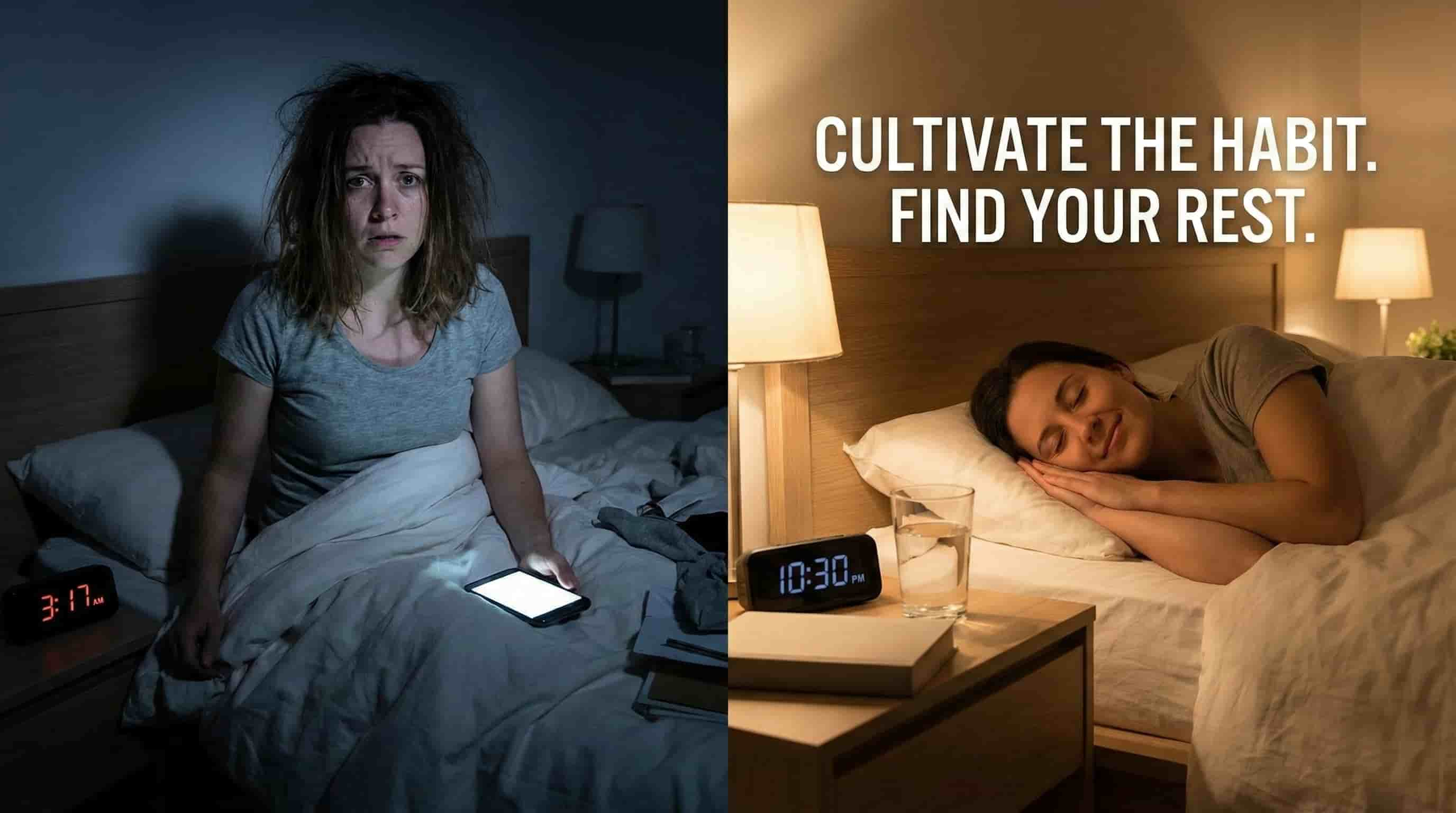
What Is the Self-Fulfilling Prophecy of Insomnia — and Why Does the Label ‘Insomniac’ Actively Maintain the Very Sleep Pattern It Claims to Describe?
Direct Answer: The self-fulfilling prophecy of insomnia describes the phenomenon where the label ‘insomniac’ creates the sleep pattern it claims to describe — not through any failure of the sleep biology, but through the neurological mechanism of belief confirmation. When you identify as an insomniac, you are not reporting a fixed biological deficit; you are activating a self-model that the brain uses to interpret ambiguous signals in a way that is consistent with the label. The identified insomniac does not have worse sleep architecture than the non-identified sleeper — they have the same sleep, but they attend to different parts of it. The label is not a cause of poor sleep — it is an interpretation framework that makes the experience of sleep feel worse than it is.
Mechanism: S1-1 and S2-3 on self-fulfilling prophecy and identity labels: the self-fulfilling prophecy operates through the brain’s prediction-based processing architecture. When you hold a belief (‘I am an insomniac’), your brain generates top-down predictions that bias perception toward confirming evidence. During sleep, the brain experiences constant ambiguous signals — micro-arousals, partial awakenings, shifting sleep stages — that can be interpreted as either ‘normal sleep fragmentation’ or ‘signs of insomnia.’ The insomniac identity selects the catastrophic interpretation, which triggers the performance anxiety response, which creates more micro-arousals, which confirms the label. This is why the intervention that works is not another sleep technique — it is changing the belief itself, which changes the interpretation of the ambiguous signals, which breaks the anxiety-arousal cycle at its root.
Actionable Advice: Begin treating the ‘insomniac’ label as a weather forecast you received from your past self — not a fact. Every time the thought ‘I am an insomniac’ surfaces, add the prefix: ‘According to my older, more anxious self, I am an insomniac.’ This linguistic separation — called distancing in cognitive therapy — reduces the identity fusion with the label without requiring you to argue against the evidence. You are not denying your sleep history; you are refusing to let it make predictions about your sleep future.
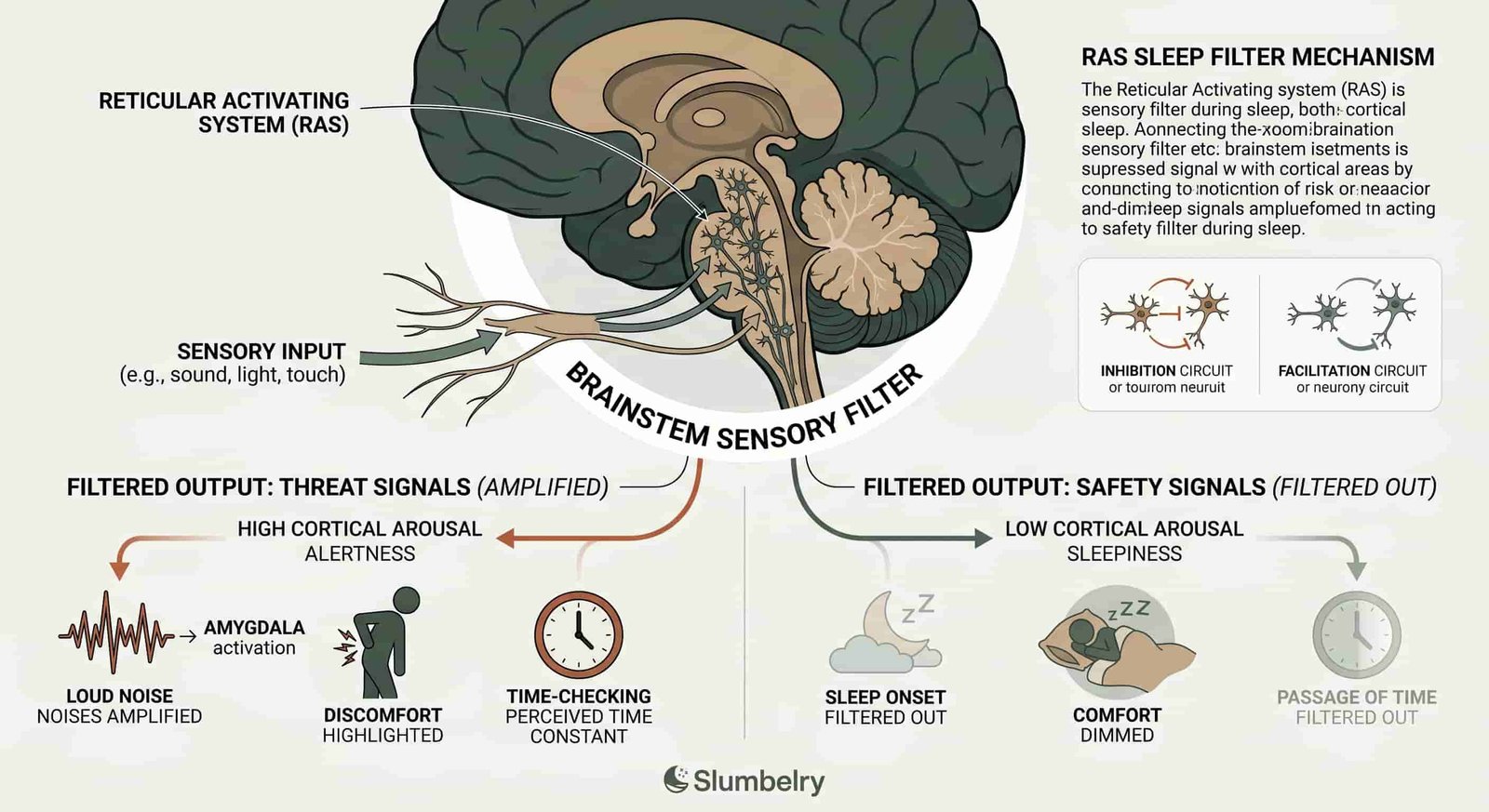
How Does the Reticular Activating System (RAS) Confirm Your Sleep Expectations — and Why Does ‘Tonight Will Be Another Bad Night’ Become a Neurological Prediction Rather Than a Guess?
Direct Answer: The Reticular Activating System (RAS) is a network of neurons in the brainstem and thalamus that functions as the brain’s sensory filter and attention director — it determines which signals from the environment reach conscious awareness and which are filtered out. When the RAS is configured by the expectation ‘tonight will be bad,’ it selectively amplifies threat signals (noises, temperature discomforts, clock-watching) and filters out safety signals (the gradual onset of sleep, the comfort of the bed, the passage of time without distress). This is not manipulation or self-deception — it is the RAS’s normal function applied to an expectation. The expectation becomes a neurological prediction because the RAS does not distinguish between a sensory threat and a predicted threat; it responds to both with elevated arousal and selective attention.
Mechanism: S1-1 and S2-3 on the RAS and sleep filtering: the RAS receives input from all sensory channels and projects to the entire cerebral cortex, regulating arousal levels and directing attention. In sleep, the RAS continues filtering sensory input — its output determines what reaches awareness during the micro-arousals that punctuate normal sleep. When the RAS output is set to ‘insomniac,’ it directs the cortex to attend to threatening sleep-related stimuli (the sound of a car outside, the awareness of being awake, the time on the clock) with high priority, while the non-threatening stimuli (the comfort of the pillow, the gradual accumulation of sleep pressure) are filtered out. This is why the insomniac reports a night of ‘constant wakefulness’ while polysomnography often shows significant sleep — the RAS filtered the sleep in and the wakefulness out, selecting only the experience that confirmed the prediction.
Actionable Advice: The RAS responds to what it expects to find — not to what is actually there. Before bed, deliberately set a new expectation: ‘My body knows how to sleep. Tonight I am learning to trust that again.’ This statement must be believable (not toxic positivity), but it gives the RAS a new filter setting. The RAS will begin selecting evidence for the new prediction, and the self-fulfilling prophecy begins to work in the opposite direction.
What Is Predictive Processing in Sleep — and Why Does Your Brain Construct the Night’s Sensory Experience to Match Your Pre-Sleep Belief About Sleep Quality?
Direct Answer: Predictive processing (Clark, 2013) is the leading theory of how the brain generates conscious experience: rather than passively receiving sensory input, the brain actively generates top-down predictions about what the world contains and uses sensory input only to update predictions when they are wrong. In sleep, this means your brain is not passively experiencing the night — it is constructing the night’s experience from predictions based on prior beliefs. When your prior belief is ‘sleep is difficult,’ your brain generates predictions that make sleep feel difficult, and it selectively uses sensory evidence to confirm this prediction. This is why the experience of insomnia feels so consistent and undeniable — you are not imagining it, but the brain is constructing it according to a prior that it learned from repeated confirmation.
Mechanism: S1-1 and S2-3 on predictive processing and sleep construction: the brain’s predictive processing architecture works through multiple hierarchical levels — from low-level sensory predictions to high-level identity and self-model predictions. The ‘insomniac’ identity is a high-level prior that cascades down through the hierarchy, biasing lower-level predictions about what tonight’s sleep will feel like. When the brain’s predictions at each level match the sensory input (even when the sensory input is ambiguous), the prediction is confirmed and strengthened. The subjective experience of the night is not the sensory input — it is the predictions that survived the prediction-error minimization process. For the insomniac, the prediction ‘sleep is difficult’ survives error minimization because the RAS filters in evidence that is consistent with it, making the prediction appear perfectly accurate even when it is not.
Actionable Advice: To change the predictive model, you must provide the brain with prediction error — evidence that is too unambiguous for the RAS to filter away. This is why the sleep diary (recording actual sleep times, not sleep quality ratings) is more effective than subjective self-report: the numbers provide RAS-incompatible evidence that the insomniac identity cannot selectively filter. After two weeks of sleep diary data showing more sleep than the subjective experience suggested, the prior begins to update.
How Does Neuro-Linguistic Programming (NLP) Reframing Work at the Neural Level — and Why Does Changing the Language of Sleep Change the Brain’s Evaluation of the Sleep Environment?
Direct Answer: NLP reframing — the practice of changing the language used to describe a situation — works at the neural level by updating the prior prediction that the brain uses to interpret the situation. When you change the statement from ‘I can’t sleep’ to ‘I am learning to sleep again,’ you are not just using different words — you are giving the brain a new prior to generate predictions from. The brain’s language processing areas (Broca’s area, Wernicke’s area) are tightly connected to the limbic system (amygdala, hippocampus) and the RAS, so the emotional and attentional response to language is immediate and automatic. ‘I can’t sleep’ triggers threat evaluation; ‘I am learning to sleep again’ triggers a growth-oriented evaluation with lower threat activation.
Mechanism: S1-2 and S2-3 on NLP reframing and neural processing: the brain’s response to the phrase ‘I am an insomniac’ is not just cognitive — it is a threat response mediated by the amygdala, which releases cortisol in response to identity-threatening stimuli. The cortisol release raises arousal, which is the exact physiological state that prevents sleep onset. The phrase ‘I am learning to sleep again’ does not trigger the same amygdala threat response because it contains a growth signal (learning) rather than a fixed-trait label (insomniac). The RAS then sets its filter to ‘learning,’ which selects different evidence than ‘insomniac’ would — theRAS begins looking for signs of learning (progress, however small) rather than confirmation of the fixed deficit.
Actionable Advice: The most effective reframe is not the most positive one — it is the most believable one that moves the prior. ‘I will sleep perfectly from now on’ is rejected by the brain because it is too inconsistent with the prior. ‘I am learning to sleep again’ is accepted because it is consistent with the brain’s actual capacity (sleep is learnable — infants do it) while updating the identity from fixed (‘insomniac’) to growth-oriented (‘learning’). Practice the reframe daily, not just at night — the repeated activation of the new prior strengthens the neural pattern.
Why Does Sleep Performance Anxiety Create the Exact Arousal State That Prevents Sleep — and What Is the Paradox of ‘Trying to Sleep’ That Makes Sleep Onset Impossible?
Direct Answer: Sleep performance anxiety is the anxiety that results from trying to achieve sleep — and the anxiety itself activates the sympathetic nervous system, which is the exact physiological state that prevents sleep onset. This creates a vicious cycle: the effort to sleep produces anxiety, the anxiety activates the arousal system, the arousal prevents sleep, the failure to sleep produces more anxiety, and the cycle repeats. The paradox is that sleep is the only biological function that cannot be achieved through direct effort — it requires the voluntary surrender of control, which is the opposite of trying. The dorsal anterior cingulate cortex (dACC) — the brain region that monitors the gap between current state and desired state — is maximally activated in the ‘trying to sleep’ state, and this activation is itself incompatible with the default mode network deactivation that precedes sleep onset.
Mechanism: S1-1 and S2-3 on performance anxiety paradox and dACC: the dACC monitors for discrepancies between current state and goal state — when you are trying to sleep, the dACC is continuously computing: ‘not asleep yet, not asleep yet, not asleep yet.’ This continuous discrepancy monitoring prevents the dACC from entering the quiet state that precedes sleep onset. The trying itself is the intervention’s primary obstacle: every cycle of the dACC monitoring raises cortisol and norepinephrine, which further delays sleep onset. This is why the instruction ‘just relax and let sleep come’ fails for the insomniac — it requires the dACC to stop monitoring, which is itself a form of effort. The correct intervention is not to try harder to relax — it is to remove the goal of sleep entirely and give the dACC something else to monitor.
Actionable Advice: The intervention for performance anxiety is to stop monitoring sleep onset. This means: no clock-watching (remove the clock from the bedroom or turn it away), no sleep tracking (no phones, no wearables in the bedroom), and no sleep quality evaluation (rating your night in the morning feeds the performance anxiety loop). Replace the sleep monitoring with something else to attend to — a book, a breathing exercise, a PMR sequence. The goal is not sleep; the goal is to stop the performance anxiety, and sleep will follow when the dACC finally quiets.
What Is the Minimal Viable Sleep Identity Shift — and Why Does One Sentence (‘I Am Learning to Sleep Again’) Produce Measurable Changes in Sleep Onset Latency?
Direct Answer: The minimal viable sleep identity shift is a single linguistic change — replacing ‘I am an insomniac’ (a fixed-trait identity label) with ‘I am learning to sleep again’ (a growth-oriented process statement) — that is sufficient to change the RAS filter setting and begin updating the predictive prior. The reason one sentence can produce measurable changes is that the brain’s predictive model is updated through prediction error, and a growth-oriented statement generates less prediction error than either a fixed-trait statement or an implausibly positive statement. The brain does not reject ‘I am learning to sleep again’ because it is consistent with the brain’s actual developmental history (you learned to sleep as an infant, so the capacity exists) while simultaneously distancing from the current difficulty (learning implies you are not there yet, which is honest).
Mechanism: S1-1 and S2-3 on minimal viable identity shift and prior update: the brain’s identity model is stored in the medial prefrontal cortex (mPFC) — the region that maintains the self-model. When a new identity statement is repeated consistently with the self-model’s update mechanism (memory consolidation during sleep), the mPFC gradually integrates the new statement into the self-model. The key requirement is consistency: the statement must be repeated in the same form every time it is activated, which strengthens the synaptic pattern through long-term potentiation. The minimal viable shift requires only one sentence, repeated consistently, every time the insomniac identity surfaces — typically 5-10 times per night for the first two weeks, then less frequently as the new pattern consolidates.
Actionable Advice: Write ‘I am learning to sleep again’ on a sticky note and place it where you will see it before bed (bathroom mirror, nightstand, lamp). When the thought ‘I can’t sleep’ surfaces, replace it with this exact sentence — not a paraphrase, not an elaboration, the exact sentence. The exact repetition is critical because it consolidates the new synaptic pattern faster than varied phrasings.
How Does Visualization of Successful Sleep Work — and Why Does Mental Rehearsal of Falling Asleep Activate the Same Neural Circuits as Actual Sleep Onset?
Direct Answer: Visualization of successful sleep (mental rehearsal of falling asleep easily and waking refreshed) works by activating the same premotor and parietal cortical networks that are involved in actual sleep onset — priming the brain’s sleep-onset program through motor imagery. Athletes use motor imagery to enhance physical performance because the motor cortex does not distinguish sharply between imagined and executed movements; both activate overlapping neural circuits. Similarly, the brain’s sleep-onset program involves a characteristic pattern of cortical deactivation (default mode network) and thalamic switching that can be partially primed through mental rehearsal of the sleep onset experience. The key is that visualization must be specific and sensory-rich — not just thinking ‘I will sleep better’ but imagining the specific sensory experience of falling asleep: the weight of the pillow, the gradual loss of body awareness, the transition from thought to no thought.
Mechanism: S1-1 and S2-3 on motor imagery and sleep-onset priming: mental rehearsal of sleep onset activates the supplementary motor area (SMA), premotor cortex, and superior parietal lobule — the same networks involved in planning the sleep posture transition (lying down, releasing muscle tone, arranging the body). The default mode network (DMN), which must deactivate for sleep onset to occur, is engaged in the visualization itself, but the act of practicing the DMN deactivation through imagery may make it more accessible when the actual sleep-onset window opens. Additionally, visualization reduces the cognitive load of sleep performance anxiety: when you have visualized the outcome, the anxiety about ‘what if I can’t sleep’ is partially resolved by the rehearsal of success, which reduces the dACC monitoring signal.
Actionable Advice: Before bed, for 2 minutes, visualize yourself falling asleep in your own bed. Make the visualization specific: feel the weight of the blanket, notice the room’s temperature, feel the transition from aware to drowsy to asleep. Use the first person, present tense. This is not positive thinking — it is motor program rehearsal for the sleep-onset sequence. Athletes do this every day for their physical performance; sleepers rarely do it for the most important performance of the day.
Why Is Sleep Hygiene Advice Counterproductive for the Identified Insomniac — and What Is the Difference Between External Sleep Triggers and Internal Sleep Confidence?
Direct Answer: Sleep hygiene advice is counterproductive for the identified insomniac because it addresses the wrong level of the problem — external sleep triggers (temperature, light, caffeine) rather than internal sleep confidence (the belief that sleep will occur). The identified insomniac already knows that reducing caffeine and darkening the room would help — but they have tried these interventions and sleep has not improved, which is taken as evidence of how deeply broken their sleep is. Sleep hygiene interventions, by operating on external triggers, leave the internal identity (‘I am an insomniac’) completely intact, which means the RAS filter remains set to ‘insomniac’ and the self-fulfilling prophecy continues to generate poor sleep regardless of how optimized the bedroom environment becomes.
Mechanism: S1-1 and S2-3 on external vs internal sleep drivers: the insomniac’s primary sleep obstacle is not external — it is the prediction-based processing that generates a threatening sleep experience regardless of the bedroom environment. This is why sleep hygiene interventions that work for the non-identified sleeper (a darker room helps everyone sleep better) do not work as the primary intervention for the identified insomniac. The bedroom becomes associated with the performance anxiety response (‘will I sleep tonight?’) rather than the safety and rest response that the bedroom environment should trigger. The bedroom needs to be re-associated with safety — not through environmental optimization, but through repeated experiences of sleeping well in that environment, which requires the identity shift to enable the experience in the first place.
Actionable Advice: The order of interventions matters: identity shift first, sleep hygiene second. Change the identity label, establish sleep confidence through the minimal viable shift, and then optimize the bedroom environment — but not the other way around. The identified insomniac who buys a new mattress before addressing the identity will sleep slightly better for one night (novelty effect) and then return to the baseline poor sleep, confirming that even a new mattress cannot fix the ‘real’ problem. The mattress needs to wait until the brain is ready to interpret the improved sleep environment as evidence of safety.
What Is the Evidence for Cognitive-Identity Interventions for Chronic Insomnia — and Do CBT-I and ACT Produce Lasting Changes in Sleep Self-Efficacy?
Direct Answer: Cognitive Behavioral Therapy for Insomnia (CBT-I) is the gold-standard first-line treatment for chronic insomnia, with effect sizes larger than medication and durability lasting years after the intervention ends. Acceptance and Commitment Therapy (ACT) — an extension of CBT-I that adds identity-level work — produces even larger changes in sleep self-efficacy (the belief that one can successfully execute sleep) because it addresses the identity layer that standard CBT-I does not. Harvey (2002) demonstrated that CBT-I produced significant improvements in sleep onset latency, sleep efficiency, and subjective sleep quality in chronic insomnia patients, with benefits maintained at 6-month follow-up. The cognitive component of CBT-I specifically targets the catastrophic interpretations of nighttime experiences (‘one awakening means the night is ruined’), which are the same interpretations maintained by the insomniac identity.
Mechanism: S1-2 and S2-3 on CBT-I and ACT for chronic insomnia: CBT-I operates through four pathways — stimulus control (re-associating the bedroom with sleep, not wakefulness), sleep restriction (consolidating sleep by reducing time in bed to match actual sleep), cognitive restructuring (challenging catastrophic sleep interpretations), and sleep hygiene (environmental optimization). ACT adds two mechanisms — acceptance (allowing sleep to come without forcing it, which addresses the performance anxiety paradox) and committed action (choosing sleep-supporting behaviors as values-driven actions rather than rule-following). The identity-level work in ACT addresses what CBT-I’s cognitive restructuring does not: the persistent self-model of being an insomniac that survives even after sleep has improved. After CBT-I, many patients sleep better but still identify as insomniacs — and this identity inconsistency predicts relapse. ACT’s identity work closes this gap by updating the self-model, not just the sleep behavior.
Actionable Advice: If you have tried CBT-I apps or programs and sleep improved but the identity did not shift (‘I still think of myself as a bad sleeper, I just happen to be sleeping better right now’), the missing element is identity-level work. Practice the minimal viable sleep identity shift consistently for 30 days, in parallel with any sleep optimization you are already doing. The identity shift and the behavioral improvement reinforce each other: better sleep provides RAS-compatible evidence for the new identity, and the new identity reduces the performance anxiety that was preventing even better sleep.
What Is the Complete Sleep Identity Protocol — and How Do You Practice It to Build Sleep Confidence That Persists Beyond the Technique Itself?
Direct Answer: The complete sleep identity protocol has six components that work together to shift the self-model from ‘insomniac’ to ‘person who is learning to sleep again,’ and the final component is designed to make the protocol itself unnecessary: (1) linguistic separation — when the thought ‘I am an insomniac’ surfaces, add the distancing prefix: ‘According to my older, more anxious self, I am an insomniac’; (2) the minimal viable shift — replace with ‘I am learning to sleep again’; (3) the evidence anchor — before bed, write down one piece of evidence from the past two weeks that you can sleep (the key is to use behavioral evidence, not quality ratings: ‘I slept from 11 PM to 5 AM on Tuesday,’ not ‘I slept well on Tuesday’); (4) visualization — 2 minutes before bed, sensory-rich visualization of falling asleep in your specific bedroom; (5) starve the identity — stop telling people you have insomnia, stop researching insomnia, remove sleep-tracking apps from the bedroom. The identity needs to stop being reinforced by social and environmental cues; (6) sleep confidence practice — once sleep begins to improve, practice sleeping without any technique. The goal of the protocol is not to依赖 the protocol — it is to build enough sleep confidence that you can sleep without intervention, which is the definition of genuine sleep confidence.
Mechanism: S1-1 and S4-4 on the complete identity protocol and consolidation: the sleep identity shift consolidates through the same mechanism as any other learning: repeated activation of the new neural pattern in consistent contexts. Each night of using the protocol strengthens the new ‘learning to sleep again’ pathway, and each morning’s evidence of sleep (recorded in the evidence anchor) provides RAS-compatible data that cannot be selectively filtered. After 21-30 days of consistent practice, the new identity pattern becomes the default — the mPFC self-model updates, the RAS filter re-sets to ‘learning,’ and the self-fulfilling prophecy works in the direction of good sleep rather than poor sleep. The protocol then becomes unnecessary because the identity has genuinely changed, not because the technique is being relied upon.
Actionable Advice: Commit to the complete protocol for 30 days without evaluating the results. The reason most identity interventions fail is that the person evaluates the intervention after 3-4 nights and declares it does not work because sleep has not changed yet. The sleep identity shift is not a sleep technique — it is a prior update that takes 2-4 weeks to consolidate. During the 30-day commitment period: use the protocol every night, record the evidence anchor every morning, and do not evaluate whether it is working. After 30 days, evaluate. Most people will find that sleep has improved AND the identity has shifted — and the two changes have been reinforcing each other all along.

Frequently Asked Questions
Why does calling myself an insomniac make insomnia worse?
Direct Conclusion: The label ‘insomniac’ activates the RAS filter to select evidence that confirms the label — every noise, every micro-arousal, every moment of wakefulness is amplified as confirmation of the identity. This is not psychology — it is neuroscience. The RAS is the brain’s attention director, and when it is set to ‘insomniac,’ it selects for threat signals and filters out safety signals, which creates the exact experience the label predicts. The label does not cause poor sleep through some magical psychological mechanism — it causes poor sleep by changing how the brain processes the night’s ambiguous sensory experience.
What is the reticular activating system and how does it affect sleep?
Direct Conclusion: The RAS is a network of neurons in the brainstem and thalamus that acts as the brain’s sensory filter and attention director. It determines what signals from the environment reach conscious awareness and what is filtered out. In sleep, the RAS continues its filtering function during the micro-arousals that punctuate normal sleep architecture — and when it is set by the expectation ‘I am an insomniac,’ it selectively amplifies the signs of wakefulness while filtering out the signs of sleep onset. This is why the identified insomniac can have significant sleep (as shown by polysomnography) while reporting that they were awake all night.
How does NLP work for insomnia?
Direct Conclusion: NLP reframing works by changing the brain’s prior — the high-level self-model that generates predictions about what tonight’s sleep will be like. When you change the statement from ‘I am an insomniac’ (a fixed-trait label that triggers threat evaluation) to ‘I am learning to sleep again’ (a growth-oriented process statement that triggers the learning/dopamine pathway), the RAS re-sets its filter, the amygdala threat response decreases, and the brain begins selecting evidence for the new prior. The key is that the new statement must be believable — toxic positivity (‘I will sleep perfectly every night!’) is rejected by the brain because it is too inconsistent with the prior.
Can you really reprogram your brain to sleep better?
Direct Conclusion: Yes — the brain’s sleep patterns are not fixed traits but learned behaviors that can be updated through the same mechanisms that learned them in the first place. The self-model of being an insomniac is a neural pattern stored in the medial prefrontal cortex, and it can be updated through repeated activation of a new identity statement paired with RAS-compatible evidence (sleep diary data, behavioral records). The brain’s plasticity applies to the sleep system as much as it applies to any other behavioral domain.
Why does ‘trying to sleep’ make it impossible to sleep?
Direct Conclusion: ‘Trying to sleep’ activates the dorsal anterior cingulate cortex (dACC), which monitors the gap between current state (awake) and desired state (asleep). This continuous monitoring is itself an arousal state — it prevents the dACC from entering the quiet mode that precedes sleep onset. The paradox is that sleep requires the voluntary surrender of control, and the effort to sleep is the opposite of surrender. The performance anxiety generated by trying to sleep activates the sympathetic nervous system, which further delays sleep onset, creating the vicious cycle.
What is the difference between sleep confidence and sleep hygiene?
Direct Conclusion: Sleep hygiene addresses external sleep triggers (light, temperature, caffeine) — it optimizes the environment for sleep. Sleep confidence addresses the internal prediction (the brain’s belief about whether sleep will occur) — it optimizes the brain’s prior. For the non-identified sleeper, optimizing the environment (sleep hygiene) is sufficient. For the identified insomniac, the identity barrier must be addressed before the environment optimization can be fully effective — because the identified insomniac interprets even the best sleep environment through the threat filter of the insomniac identity.
Does visualization actually help you fall asleep?
Direct Conclusion: Yes — motor imagery of sleep onset activates the premotor and supplementary motor areas that are involved in the actual sleep posture transition, priming the sleep-onset program before the sleep-onset window opens. The key distinction from positive thinking is specificity: general positive thoughts (‘tonight will be better’) do not activate the sensorimotor networks that the sleep-onset program uses. Sensory-rich, first-person, present-tense visualization of falling asleep in your specific bed does activate those networks, which is why it is more effective than affirmations.
How do you stop sleep performance anxiety?
Direct Conclusion: Stop monitoring. Remove the clock from the bedroom, stop tracking sleep (no wearables, no apps in the bedroom), and stop evaluating whether the night is going ‘well’ or ‘badly’ in real time. Replace the monitoring with something to attend to — a book, a breathing exercise, a body scan. The goal is to eliminate the dACC’s continuous discrepancy monitoring by removing the ‘current state vs desired state’ comparison from the bedtime context.
What is CBT-I and does it work for chronic insomnia?
Direct Conclusion: CBT-I (Cognitive Behavioral Therapy for Insomnia) is the first-line, gold-standard treatment for chronic insomnia, with effect sizes larger than medication and durability lasting years. It operates through four pathways: stimulus control, sleep restriction, cognitive restructuring, and sleep hygiene. Harvey (2002) established its efficacy in randomized controlled trials, and subsequent meta-analyses confirm its superiority to pharmacotherapy for long-term outcomes. CBT-I addresses the cognitive distortions around sleep but does not explicitly address the identity of being an insomniac — which is why ACT (Acceptance and Commitment Therapy) extensions that add identity-level work produce larger and more durable changes in sleep self-efficacy.
How long does it take to change your sleep identity?
Direct Conclusion: The sleep identity shift requires approximately 21-30 days of consistent practice to consolidate — which is the same timeframe for any new neural pattern to become the default. During this period, the new identity statement (‘I am learning to sleep again’) must be repeated every time the old identity surfaces, and RAS-compatible evidence must be collected every morning in the evidence anchor. The 30-day commitment is non-negotiable: evaluating the intervention before 30 days have passed is the most common reason the intervention fails, because the prior update has not had time to consolidate.
You Are Not an Insomniac. You Are Learning to Sleep Again.
The label ‘insomniac’ is a neurological prediction that your brain works to confirm every night. Set a new prediction: ‘I am learning to sleep again.’ The RAS will begin selecting evidence for the new prior. The self-fulfilling prophecy will reverse. Give it 30 days of consistent practice — and then evaluate. You will not recognize the person who could not sleep, because that identity will no longer exist.
Set the Sleep Environment First. Support the Learning State.The Slumbelry Commitment
Sleep is the most vulnerable state of human existence. It is where we heal, reset, and grow.
At Slumbelry, we do not just sell sleep products; we advocate for your physiological right to rest. From ergonomic support to light management, every solution we offer is designed with one obsession: Respecting your Biology.
Science is our language, but your recovery is our purpose. You take care of everything else in your life — let us take care of your nights.
Rest Deeply,
The Slumbelry Team