
Why the Harder You Try to Fall Asleep, the Less You Can — And What Actually Works
⚡ Core Takeaway: Sleep Anxiety Is a Paradox
- The paradox: The more you try to force sleep, the more your sympathetic nervous system activates — making sleep less possible. Sleep is not something you force; it is something you allow.
- The fix is not relaxation: Trying to relax is still trying. The actual intervention is paradoxical intention — accepting wakefulness until the anxiety about wakefulness dissolves.
- The single most effective tool: CBT-I (Cognitive Behavioral Therapy for Insomnia) is the only clinically validated treatment for sleep anxiety. Medications are a distant second option.
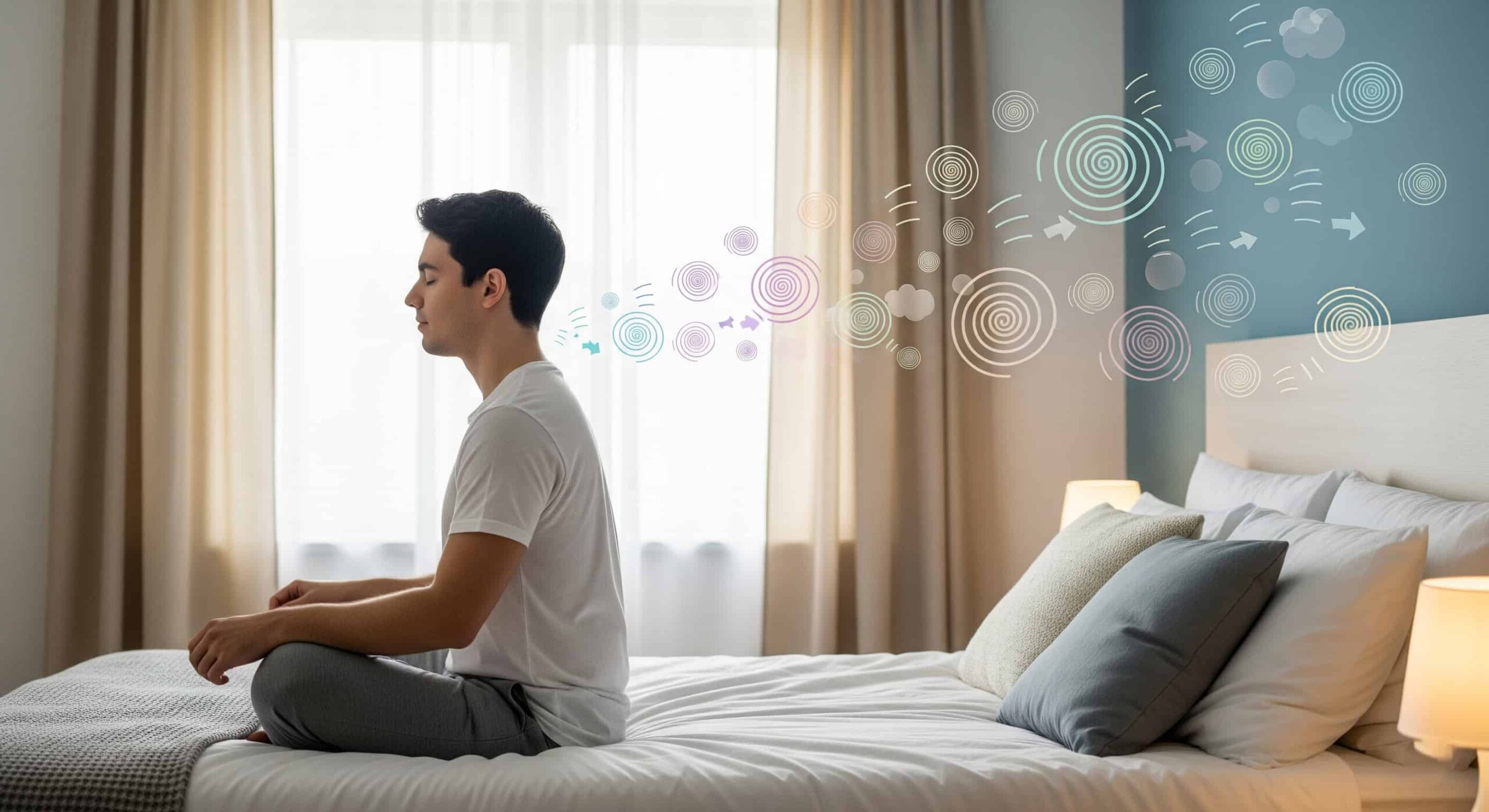
Sleep anxiety is the most insidious sleep disruptor because the thing you are most afraid of — not sleeping — is made more likely by the fear itself. Every attempt to try harder activates the sympathetic nervous system. Every moment of effort tells your brain this is a threat situation that requires alertness, not rest. This guide covers the complete neuroscience of why anxiety prevents sleep, and the 10 evidence-based techniques — including CBT-I, paradoxical intention, and vagus nerve breathing — that actually break the cycle permanently.
What Is Sleep Anxiety — And Why Trying Harder Makes It Worse
Sleep anxiety — also called pre-sleep anxiety or bedtime anxiety — is the experience of elevated cortisol, racing thoughts, and physical tension that prevents sleep onset at a time when sleep is desired. It is distinct from general insomnia in its mechanism: it is not that you cannot sleep. It is that your fear of not sleeping activates the same sympathetic nervous system state that prevents sleep from arriving.
The vicious cycle is specific: you lie down hoping to sleep → you notice you are not sleeping yet → you try harder to sleep → the effort activates your alert system → you notice you are more awake → you try even harder. Each iteration of trying deepens the sympathetic activation. The bedroom, which should signal safety and rest, becomes associated with effort, failure, and frustration.
Why “Just Relax” Doesn’t Work as Advice
When someone experiencing sleep anxiety is told to “just relax,” they are being told to do the one thing the anxious brain cannot voluntarily do — because relaxation is not an act of will. The prefrontal cortex (responsible for willful relaxation) is suppressed by cortisol and adrenaline. The sympathetic nervous system is in charge. Telling an anxious person to relax is like telling a person in a panic attack to “just calm down.” The advice is not wrong; it is just impossible to execute under the conditions that make it necessary.
The Neuroscience: Why Your Anxious Brain Cannot “Just Relax”
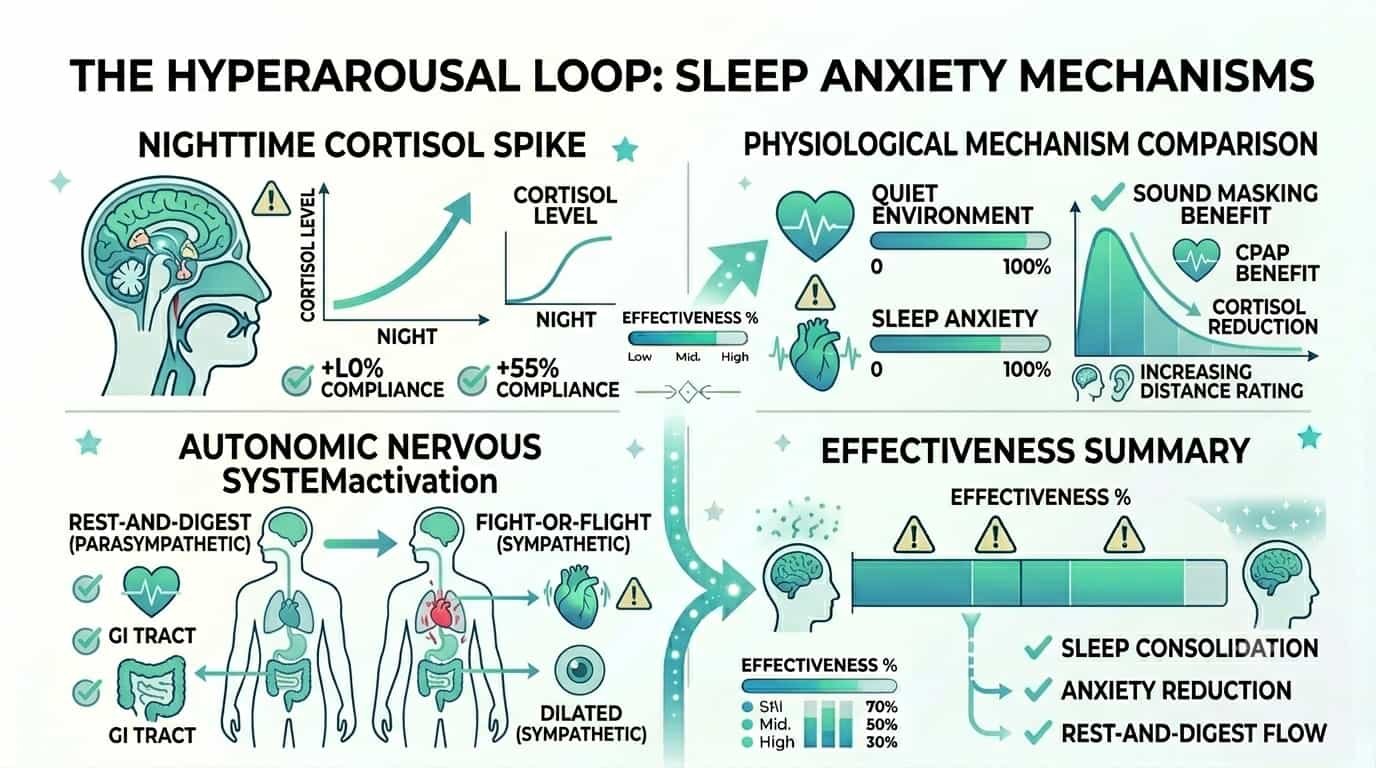
Sleep onset is governed by the parasympathetic nervous system — the “rest and digest” mode activated when the brain perceives safety, low threat, and low physical demand. Sleep anxiety reverses this: the anticipation of not sleeping is perceived as a threat, activating the sympathetic nervous system, releasing cortisol and adrenaline, raising heart rate, increasing muscle tension, and suppressing the very parasympathetic state required for sleep onset.
The Cortisol-Anxiety-Sleep Cycle
Elevated evening cortisol (often driven by HPA axis dysregulation from chronic stress) disrupts the normal circadian cortisol curve — which should be at its lowest point in the late evening. When cortisol remains elevated at bedtime, sleep onset is directly inhibited. The anxiety about sleep further elevates cortisol, which further inhibits sleep, which further elevates the anxiety. Breaking this cycle requires interrupting the cortisol response — not through relaxation attempts, but through acceptance and paradoxical intention.
The Paradox of Intentional Wakefulness: How Acceptance Unlocks Sleep
The counterintuitive technique used successfully in CBT-I is paradoxical intention: rather than trying to fall asleep, intentionally stay awake. This removes the pressure and anxiety about sleep onset, allowing the sympathetic nervous system to stand down. The paradoxical result: by accepting wakefulness, you create the conditions for sleep to arrive unforced.
⚡ How to Practice Paradoxical Intention
- Lie in bed with the lights dim, eyes open or half-closed
- Give yourself permission to stay awake — not as resignation, but as strategy
- Repeat silently: “If I fall asleep, I fall asleep. If I don’t, that’s fine too.”
- Notice where the anxiety about wakefulness begins to dissolve
- When sleep arrives, let it — without celebration or record of how long it took
4-7-8 Breathing and the Vagus Nerve: Activating the Parasympathetic System
Dr. Andrew Weil’s 4-7-8 breathing technique is one of the most accessible parasympathetic activation tools available without equipment or training. The mechanism is vagal nerve stimulation: the exhale phase of the breath cycle activates the parasympathetic branch of the autonomic nervous system, directly counteracting the sympathetic activation of anxiety. Prolonged exhales (8 counts vs. 4 counts inhale) signal safety to the brainstem, reducing cortisol and slowing heart rate within 60-90 seconds.
⚡ The 4-7-8 Protocol
- Inhale through the nose for 4 counts (1-2-3-4)
- Hold the breath for 7 counts (1-2-3-4-5-6-7)
- Exhale completely through the mouth for 8 counts (make a soft “whoosh” sound)
- Repeat for 3-4 cycles at bedtime, and again if you wake during the night
- Start with 4 cycles; most people find 3-4 cycles sufficient for measurable calming
Progressive Muscle Relaxation: Releasing the Physical Layer of Anxiety
Anxiety has a physical substrate — elevated muscle tone, particularly in the neck, shoulders, jaw, and upper back. Progressive Muscle Relaxation (PMR), developed by Dr. Edmund Jacobson in the 1920s, works by systematically tensing and releasing muscle groups, giving the anxious brain a concrete physical task to focus on while simultaneously producing a measurable reduction in physical tension. Research shows PMR reduces sleep onset latency by an average of 10-15 minutes when practiced consistently over 2-3 weeks.
PMR Protocol
Starting from your toes and moving upward: tense each muscle group for 5 seconds, then release fully and notice the contrast between tension and relaxation for 20-30 seconds. Work through: feet → calves → thighs → abdomen → chest → hands → forearms → biceps → shoulders → jaw → face. The goal is not to feel relaxed from the tensing — it is to develop awareness of what relaxation actually feels like, which most chronically anxious people have lost track of.
The 5-4-3-2-1 Grounding Technique: Breaking the Catastrophic Thought Spiral
Anxious thoughts about sleep follow a specific catastrophic pattern: “I won’t fall asleep → if I don’t sleep I’ll be exhausted tomorrow → being exhausted will ruin my performance → if I ruin my performance it means I’m failing.” Each step amplifies the threat perception, activating the sympathetic nervous system further. The 5-4-3-2-1 grounding technique interrupts this spiral by pulling the brain out of its catastrophizing loop and into the present sensory moment.
⚡ 5-4-3-2-1 Practice
When you notice anxious thoughts beginning: name 5 things you can see in the bedroom, 4 things you can physically touch (the sheet, the pillow, your hand, your arm), 3 things you can hear (breathing, a distant sound, the hum of silence), 2 things you can smell, 1 thing you can taste. By the time you complete the sequence, the catastrophic thought spiral has been replaced by present-moment sensory awareness — the brain’s natural calm state.
The Worry Window: Moving Anxiety Out of the Bedroom and Into the Schedule
One of the most effective CBT-I interventions is the worry window: designating a specific 15-20 minute period earlier in the evening (at least 2 hours before bed) as the only time you are allowed to worry, problem-solve, or journal about anxieties. When worries arise in bed, you note them mentally and remind yourself: “I’ll address this in my worry window.” The brain learns that the bed is not the place for problem-solving — which means the bed can become the place for sleep.
⚡ Implementing a Worry Window
- Set a specific time each evening (e.g., 8:00-8:20 PM) for structured worry time
- Write down everything causing anxiety — including the anxiety about sleep
- If worries arise in bed, note them mentally and defer to the next evening’s window
- After 2-3 weeks of consistent use, the brain begins to trust that worries will be addressed — and stops raising them at bedtime
CBT-I for Sleep Anxiety: The Only Clinically Validated Treatment
Cognitive Behavioral Therapy for Insomnia (CBT-I) is the first-line clinical treatment for chronic insomnia and sleep anxiety — recommended by the American College of Physicians ahead of any medication. It works through four core interventions: stimulus control (strengthening the association between bed and sleep), sleep restriction (reducing time-in-bed to actual sleep to increase sleep pressure), cognitive restructuring (challenging catastrophizing thoughts about sleeplessness), and sleep hygiene optimization. CBT-I produces outcomes that match or exceed medication use, without the dependency risk.
The CBT-I Paradox: Restricting Sleep to Improve It
Sleep restriction therapy — a core CBT-I component — sounds counterintuitive: to sleep better, spend less time in bed. The mechanism: chronic sleep anxiety typically produces excessive time-in-bed (lying awake for hours hoping to sleep). This weakens the association between bed and sleep. By restricting time-in-bed to actual sleep opportunity (e.g., only 6 hours instead of 8), sleep pressure increases dramatically. Sleep onset becomes faster and more reliable. Once sleep efficiency improves, the time-in-bed window is gradually extended. The result is consistently faster sleep onset without medication.
Bedroom as Sanctuary: Designing an Environment That Signals Safety
Your bedroom should be a place where the brain perceives safety — and safety is signaled through specific environmental conditions. The anxious brain scans the bedroom for threats: Is the temperature right? Is there light intrusion? Is the bed comfortable enough? Does the bedroom look like a place for work or a place for sleep? Each threat the brain detects elevates cortisol slightly, fragmenting the parasympathetic onset.
⚡ The Sanctuary Checklist
- Temperature: 18-20°C (65-68°F) — cooler than you think is comfortable
- Light: Complete blackout (no LED lights from devices, no streetlight leakage)
- Sound: Consistent low-level sound (fan, white noise, or acoustic masking) that prevents startle responses to random noise
- Association: No work, no screens, no problem-solving in the bedroom. Bed = sleep and intimacy only.
- Bedding: A mattress that does not require you to “adjust” to it — you should feel immediately comfortable
The Slumbelry Framework: Rest Is Not Something You Force — It’s Something You Allow
Slumbelry’s approach to sleep anxiety is grounded in the same principle as the rest of our Sleep System: the goal is not to force biology to comply with a schedule. The goal is to remove the obstacles that prevent biology from doing what it already knows how to do. Sleep is not a performance achievement. It is a biological process that has operated without intervention for 200,000 years. Your job is to stop interfering with it — through anxiety, through effort, through pressure. The bedroom environment, the worry window, the breathing technique, the paradox: all of these are not sleep-inducing tricks. They are anxiety-removal systems. Remove enough anxiety, and sleep — which was always waiting — arrives on its own.
Slumbelry’s Sleep Anxiety Protocol
Three steps before any sleep intervention: (1) audit your bedroom for environmental threats (temperature, light, sound) and fix them first. (2) Establish a worry window at least 2 hours before your scheduled bedtime so the brain trusts that concerns will be addressed — and stops raising them at night. (3) Practice the 4-7-8 breathing technique every night for 21 days — it is a training program, not a pill. Within 3 weeks of consistent practice, most people develop a conditioned parasympathetic response to the breath pattern, making it an always-available anxiety management tool without any dependency risk.
Action step: Tonight, before you lie down, open a notebook and write down every worry for 15 minutes. Close the notebook. Then breathe 4-7-8 for 3 cycles. Then lie down. You have moved the worry out of the bedroom and activated your parasympathetic system. Sleep, when it comes, will come on its own terms.
Frequently Asked Questions About Sleep Anxiety
What is sleep anxiety and how is it different from insomnia?
Sleep anxiety — also called pre-sleep anxiety or bedtime anxiety — is the experience of elevated cortisol and racing thoughts that prevent sleep onset at a time when sleep is desired. It is distinct from general insomnia in its mechanism: it is not that you cannot sleep due to a primary sleep disorder. It is that your fear of not sleeping activates your sympathetic nervous system, which is precisely the opposite physiological state required for sleep onset. The vicious cycle: you try to sleep → you notice you are not sleeping yet → you try harder → the effort activates your alert system → you become more awake. Insomnia can have many causes; sleep anxiety is specifically the anxiety-driven form that CBT-I treats most effectively.
Why does ‘just relax’ not work as advice for sleep anxiety?
When someone experiencing sleep anxiety is told to ‘just relax,’ they are being told to do the one thing an anxious brain cannot voluntarily do — because relaxation is not an act of will. The prefrontal cortex responsible for willful relaxation is suppressed by elevated cortisol and adrenaline. The sympathetic nervous system is in charge. Telling an anxious person to relax is like telling a panic attack victim to ‘just calm down.’ The advice is not wrong; it is just impossible to execute under the conditions that make it necessary. This is why paradoxical intention — accepting wakefulness rather than trying to relax — outperforms relaxation-based interventions in clinical trials.
What is the 4-7-8 breathing technique and how does it work?
The 4-7-8 breathing technique, developed by Dr. Andrew Weil, is a structured breath pattern that activates the parasympathetic nervous system through vagal nerve stimulation. The exhale phase (8 counts) specifically triggers the parasympathetic branch of the autonomic nervous system, directly counteracting the sympathetic activation of anxiety. Inhale through nose for 4 counts, hold for 7 counts, exhale through mouth with a soft whoosh for 8 counts. Three to 4 cycles at bedtime, and repeated if you wake during the night, produce measurable reductions in heart rate and cortisol within 60-90 seconds. The key is consistent practice — after 21 days of nightly use, most people develop a conditioned parasympathetic response to the breath pattern.
What is paradoxical intention in CBT-I?
Paradoxical intention is a CBT-I technique that involves intentionally staying awake rather than trying to fall asleep. The mechanism: sleep anxiety is driven by the pressure and fear around sleep onset. By giving yourself explicit permission to stay awake, you remove that pressure — and by removing the pressure, you remove the sympathetic activation. Paradoxical intention works because it targets the anxiety mechanism that perpetuates sleeplessness, not the sleep process itself. Research shows it is particularly effective for people with high sleep-onset anxiety who have tried and failed relaxation-based approaches. It is not about resignation; it is about using acceptance as an active intervention.
What is progressive muscle relaxation (PMR) and how effective is it?
Progressive Muscle Relaxation (PMR), developed by Edmund Jacobson in the 1920s, is a technique that systematically tenses and releases muscle groups to produce measurable reductions in physical tension and anxiety. Starting from the toes and moving upward, each muscle group is tensed for 5 seconds then released for 20-30 seconds, with attention paid to the contrast between tension and relaxation. Research shows PMR reduces sleep onset latency by an average of 10-15 minutes when practiced consistently over 2-3 weeks. It works through two mechanisms: (1) the physical act of tensing and releasing reduces actual muscle tone, and (2) the focused attention on physical sensation interrupts anxious thought spirals. It is particularly effective for people whose sleep anxiety has a strong physical (rather than cognitive) component.
How does CBT-I work for sleep anxiety?
Cognitive Behavioral Therapy for Insomnia (CBT-I) is the first-line clinical treatment for chronic insomnia and sleep anxiety, recommended by the American College of Physicians ahead of medication. It operates through four core interventions: (1) Stimulus control — strengthening the association between bed and sleep by eliminating non-sleep activities in the bedroom; (2) Sleep restriction — reducing time-in-bed to actual sleep to build sleep pressure, then gradually extending it; (3) Cognitive restructuring — challenging catastrophic thoughts about sleeplessness; (4) Sleep hygiene optimization. CBT-I produces outcomes equivalent to or better than medication without dependency risk, and its effects persist after treatment ends. The American Academy of Sleep Medicine rates CBT-I as the most effective available treatment for chronic insomnia.
What is the worry window technique?
The worry window is a structured CBT-I technique that designates a specific 15-20 minute period earlier in the evening (at least 2 hours before bed) as the only time you are allowed to worry or problem-solve. You write down everything causing anxiety — including the anxiety about sleep. When worries arise in bed, you note them mentally and remind yourself: ‘I’ll address this in my worry window.’ Over 2-3 weeks of consistent use, the brain learns to trust that concerns will be handled at a scheduled time — and stops raising them at bedtime. This directly reduces the cortisol elevation at bedtime that prevents sleep onset. The worry window is particularly effective for people whose sleep anxiety is driven by rumination and anticipatory worry.
What bedroom conditions best support parasympathetic sleep onset?
The bedroom should signal safety to the anxious brain through specific environmental conditions: (1) Temperature: 18-20°C (65-68°F) — cooler than most people expect; (2) Light: complete blackout, including eliminating LED lights from devices and streetlight leakage through curtains; (3) Sound: consistent low-level sound (fan, white noise, or acoustic masking) that prevents startle responses to random noises; (4) Association: no work, no screens, no problem-solving in the bedroom — bed is exclusively for sleep and intimacy; (5) Bedding: a mattress that provides immediate comfort without requiring adjustment. Each threat the anxious brain detects elevates cortisol slightly, fragmenting parasympathetic onset. Eliminate all five categories before trying any other intervention.
When should someone seek professional help for sleep anxiety?
Seek professional support when: (1) Sleep anxiety persists for more than 3-4 weeks despite consistent application of self-help techniques (CBT-I protocols, breathing, worry window); (2) Anxiety significantly impacts daytime functioning, mood, or relationships; (3) You experience panic attacks at bedtime (this indicates a possible panic disorder requiring specific treatment); (4) Sleep problems are significantly affecting work performance, physical health, or emotional stability; (5) You are relying on alcohol, sedatives, or other substances to cope with sleep anxiety. The appropriate professional intervention is typically CBT-I (conducted by a sleep therapist or psychologist) — not medication as a first-line treatment. A healthcare provider can also rule out underlying conditions (thyroid disorders, sleep apnea) that may be contributing to sleep anxiety.
How long does it take for CBT-I techniques to work on sleep anxiety?
CBT-I typically shows measurable improvement within 2-4 weeks of consistent application. The most immediate intervention is stimulus control — removing clocks, phones, and problem-solving from the bedroom — which begins working from night one. Paradoxical intention can produce results in the first session of use. The worry window takes 2-3 weeks to fully condition the brain’s association between bedtime and worry-free sleep. Progressive muscle relaxation and 4-7-8 breathing both show measurable effects within 2-3 weeks of nightly practice. Sleep restriction therapy (a CBT-I component) produces the fastest and most dramatic improvements in sleep onset speed, often within 1-2 weeks, by building strong sleep pressure through controlled time-in-bed restriction. Unlike medication, CBT-I effects persist after treatment ends — there is no dependency and no withdrawal.
Ready to Break the Sleep Anxiety Cycle?
The techniques in this guide work — but only if you use them consistently. Start with the worry window and 4-7-8 breathing tonight.
Take the Sleep Assessment Subscribe for Sleep Optimization TipsThe Slumbelry Commitment
Sleep is the most vulnerable state of human existence. It is where we heal, reset, and grow.
At Slumbelry, we do not just sell sleep products; we advocate for your physiological right to rest. From ergonomic support to light management, every solution we offer is designed with one obsession: Respecting your Biology.
Science is our language, but your recovery is our purpose. You take care of everything else in your life — let us take care of your sleep.
Rest Deeply,
The Slumbelry Team
Medical References:
1. Walker, M. (2017). Why We Sleep. Scribner.
2. Morin, C. M. (2010). Chronic Insomnia: Recent Advances and Innovations in Treatment Developments. Sleep Medicine Reviews.
3. Weil, A. (2015). Breathing. Hay House.