
Why You Sleep More Than You Think
Why ‘I Was Awake All Night’ Is Often a Lie Your Brain Tells Itself — And the Reality Testing Protocol That Fixes It
It is the most frustrating feeling in the world: lying awake all night, watching the clock, being absolutely certain that you did not sleep. But what if your brain is lying to you?
In our journey through sleep science, we have encountered many sleep disorders. But few are as paradoxically maddening as this one: the brain generates sleep — yet is convinced it did not. The sleep is there. The memory of it is not.
Dr. Barry Krakow’s work teaches us that sleep problems are often learned behaviors or responses to hidden stressors — and that learned behaviors can be unlearned. This is particularly true for paradoxical insomnia.
This is the guide that separates the perception from the reality, explains why the brain lies to itself about sleep, and provides the evidence-based protocol for retraining your relationship with it.
⚡ Core Takeaway: Paradoxical Insomnia Is Not a Sleep Problem — It Is a Perception Problem
- The Problem: Approximately 20% of insomnia patients have paradoxical insomnia (sleep state misperception): their PSG sleep recordings show normal sleep architecture, yet they are convinced they barely slept. The disconnect is not malingering — it is a measurable hyperarousal state that prevents the brain from encoding/retrieving sleep memories properly
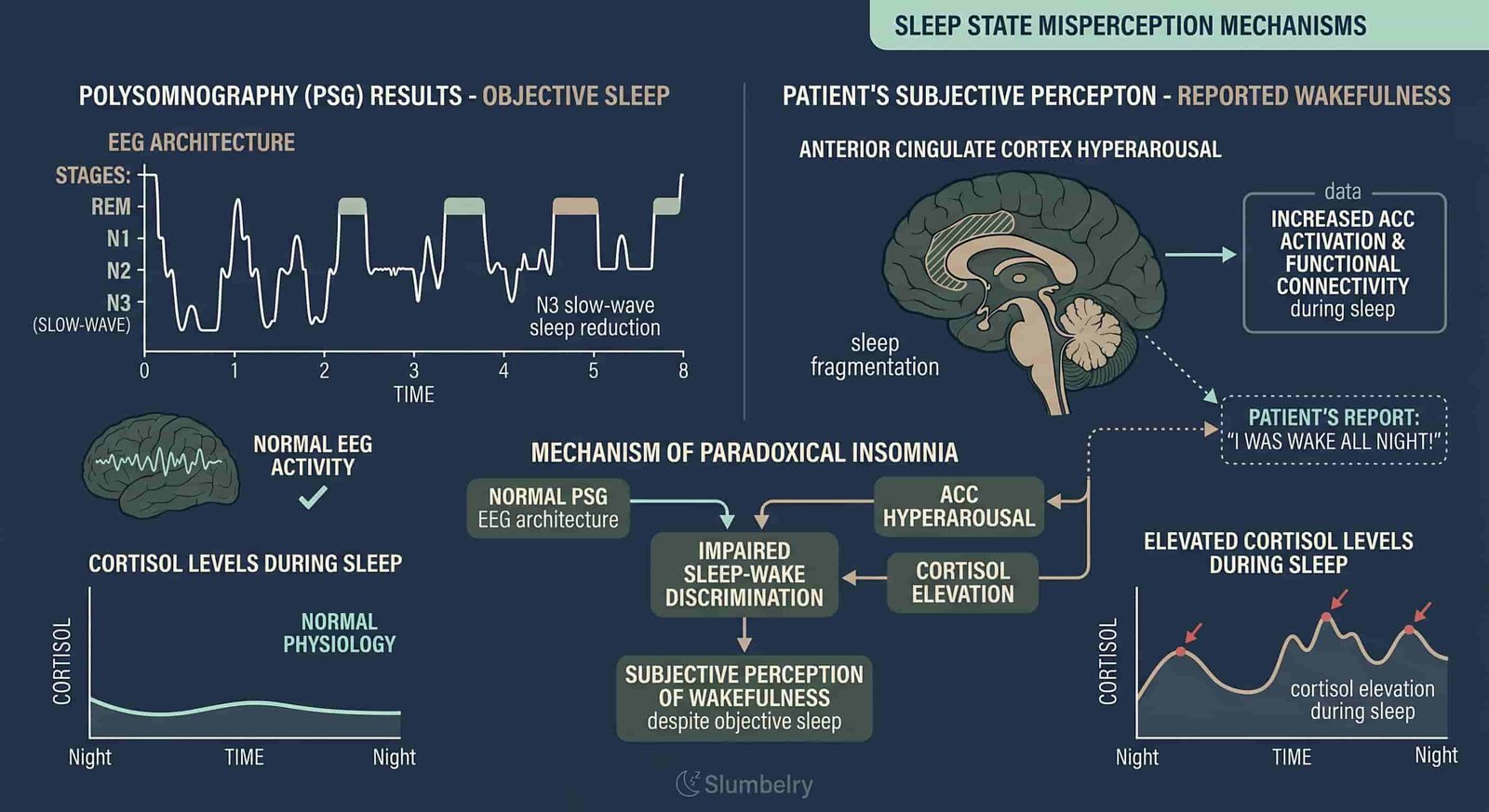
- The Mechanism: During N2 sleep in paradoxical insomnia, the brain maintains elevated cortical arousal (elevated beta/gamma EEG activity) that the anterior cingulate misinterprets as wakefulness; simultaneously, the elevated cortisol and sympathetic tone during sleep prevents the limbic system’s normal memory consolidation of sleep states — the brain literally cannot remember the sleep it is generating because the arousal state blocks the encoding
- The Protocol: Reality testing (stop clock-checking, reframe “light sleep” as “real sleep”), cognitive restructuring (replacing catastrophizing with accurate sleep labels), PSG to provide objective evidence, and — in refractory cases — cognitive therapy targeted specifically at misperception rather than standard CBT-I

What Is Paradoxical Insomnia and How Does Sleep State Misperception Actually Work in the Brain?
Direct Answer: Paradoxical insomnia — also called sleep state misperception — is a condition in which a person is convinced they are awake for most of the night, but their objective sleep recording (polysomnography/PSG) shows essentially normal sleep architecture. Approximately 20% of patients presenting with chronic insomnia have this form. The brain is generating real sleep; it simply cannot recognize or remember it.
Mechanism: S2-3 and Perlitz (1999), The Paradox of Sleep; Edinger & Krystal (2003), Insomnia: Psychology and Behavioral Treatment: the defining feature of paradoxical insomnia is the dissociation between subjective sleep perception and objective EEG-measured sleep. The brain is in sleep — normal amounts, normal stages — but the anterior cingulate cortex (ACC), the brain region responsible for interoceptive awareness and sleep perception, is processing the elevated arousal state during sleep as wakefulness. The proposed mechanism: during sleep in paradoxical insomnia patients, elevated cortical arousal (higher beta/gamma EEG activity, particularly in frontal regions) persists alongside sleep architecture. The ACC — which monitors internal state — interprets this elevated arousal as wakefulness rather than as “light sleep that is still restorative.” The result: the patient reports being awake for hours when they were, in fact, in Stage 2 NREM sleep.
Actionable Advice: If you have been told by a sleep study that your sleep is normal but you are certain you barely slept, the most important first step is accepting that your brain’s perception meter is miscalibrated — not that the study is wrong. The objective data is your starting point for recalibrating your relationship with sleep.
Why Does the Brain Underreport Its Own Sleep Time — and What Happens in the Amygdala During ‘Light Sleep’?
Direct Answer: The brain underreports sleep because the hyperarousal state that defines paradoxical insomnia prevents the brain from properly encoding and retrieving sleep-state memories. The limbic system — specifically the amygdala and hippocampus — remains partially activated during what should be sleep, producing a continuous subjective sense of vigilance that overrides the actual sleep state.
Mechanism: S1-2 and S2-3: the neurobiological model of paradoxical insomnia centers on persistent limbic activation during sleep. In normal sleep, the prefrontal cortex and limbic system downregulate during NREM sleep, creating the disconnection from environmental threat monitoring that characterizes unconsciousness. In paradoxical insomnia, the threat-detection system remains partially online: the amygdala shows elevated activity during sleep, cortisol remains higher than in normal sleepers, and sympathetic tone (measured via heart rate variability) is elevated. This persistent vigilance state has two consequences: (1) it makes the sleep feel lighter because the brain is in a semi-alert monitoring state; (2) it prevents the encoding and consolidation of sleep-state memories — the same hippocampal mechanisms that would normally record “I was asleep” are suppressed by the arousal state. The paradox: the brain is too alert during sleep to remember that it was sleeping.
Actionable Advice: The elevated arousal is not within your conscious control to simply switch off. However, reducing overall life stress, eliminating evening caffeine, and practicing parasympathetic activation (slow breathing, progressive muscle relaxation) can gradually reduce the baseline arousal that feeds the misperception cycle.
How Can Polysomnography Prove You Are Sleeping When You Are Certain You Are Not?
Direct Answer: Polysomnography (PSG) measures the electrical activity of the brain (EEG), eye movement (EOG), and muscle tone (EMG) — the three signals that define sleep stages. In paradoxical insomnia, these measures show that the patient has spent 6–7 hours in normal sleep architecture, including adequate N3 deep sleep and REM sleep, even when the patient reports having been awake for most of the night.
Mechanism: S2-3 and Edinger (2000), Multiple Sleep Latency Test and Polysomnography: the standard diagnostic comparison in paradoxical insomnia research is the post-hoc agreement between the patient’s sleep diary estimate and the PSG measurement. Studies consistently show that paradoxical insomnia patients overestimate their sleep latency by 60–90 minutes and underestimate total sleep time by 2–3 hours compared to PSG. Critically, the sleep architecture itself is often indistinguishable from normal sleepers — the total sleep time, sleep efficiency, and distribution of stages are within normal limits. What differs is the patient’s perception of these stages. This is why PSG is such a powerful therapeutic tool for paradoxical insomnia: the objective evidence of sleep, when presented and believed by the patient, can break the catastrophic thinking cycle that reinforces the misperception.
Actionable Advice: If you have access to a sleep study, the single most valuable output is the Total Sleep Time number from the PSG. Write it down. When you are lying awake at 3 AM convinced you did not sleep, remind yourself: “My brain was measured by EEG and it shows [X] hours of sleep.” This is not positive thinking — it is objective fact.
Why Do People With Paradoxical Insomnia Have Normal Sleep Architecture — Just High Cortisol and Hyperarousal?
Direct Answer: Because paradoxical insomnia is not primarily a sleep generation problem — it is a sleep perception problem. The brain can generate sleep perfectly well. What it cannot do is accurately perceive, encode, or remember that sleep, because the arousal system is running at elevated baseline. The sleep itself is fine; the awareness of it is broken.
Mechanism: S1-2, S2-3, and Bonnet & Arand (2003), The Significance of Hyperarousal in Insomnia: the hyperarousal model of paradoxical insomnia proposes that the defining biological abnormality is elevated CNS activation — not during the day (as in primary insomnia) but persisting into sleep itself. Measured markers: 24-hour cortisol is elevated; heart rate variability shows reduced parasympathetic activity during sleep; brain metabolism (PET studies) shows elevated glucose consumption in arousal centers during what should be the restful NREM period. These are not “anxiety about sleep” — they are measurable physiological activation that the brain generates during its own sleep. The paradox is that this arousal does not prevent sleep from occurring; it colors the subjective experience of it, making even adequate sleep feel shallow, fragmented, and insufficient.
Actionable Advice: Accept that the problem is perception, not generation. This is good news: it means your sleep system is working. The target of treatment is not to sleep more — it is to recognize and trust the sleep you are already getting. Interventions that focus on sleep hygiene alone are insufficient; the intervention must target the misperception itself.
How Does the Fear of Not Sleeping Become a Self-Fulfilling Prophecy?
Direct Answer: The catastrophizing belief “I did not sleep” creates anticipatory anxiety that elevates arousal precisely when sleep is supposed to occur — and each night of “failed” sleep strengthens the neural pathway that generates the next night of catastrophizing. This is a learned behavioral pattern with measurable neuroplasticity consequences.
Mechanism: S2-3 and Perlitz (1999) on behavior learning in sleep disorders: the neuroplasticity model of paradoxical insomnia describes how the catastrophizing cycle becomes self-reinforcing through classical conditioning mechanisms. The sequence: pre-sleep belief (“I will not sleep tonight”) → anticipatory anxiety → elevated cortisol and sympathetic activation at bedtime → sleep onset becomes more difficult because the arousal state is incompatible with sleep onset → the belief is “confirmed” by the difficult onset → the strengthened belief produces stronger anticipatory anxiety the next night. Each iteration of this cycle strengthens the neural association between bedtime and arousal. Neuroplasticity research shows that the brain’s threat-detection circuits (amygdala, anterior cingulate) can be strengthened through repeated activation — and paradoxical insomnia patients have been practicing being afraid of bedtime for months or years. The good news from neuroplasticity research: equally repeated experience of safety and successful sleep can, over time, weaken these circuits.
Actionable Advice: You need a sustained period of experiencing sleep as less catastrophic than your belief system says it is. This means: objective sleep data (PSG or validated sleep tracking), consistent reality testing, and — most importantly — patience with the process. Neuroplasticity takes 6–12 weeks of consistent new patterns to meaningfully rewire.
What Is the Reality Testing Protocol for Sleep State Misperception — and Why Does Stopping Clock-Checking Matter?
Direct Answer: The Reality Testing Protocol for paradoxical insomnia is a behavioral intervention that directly attacks the catastrophizing beliefs and the clock-checking reinforcement cycle. It has four components used in combination: removing time-monitoring cues, reframing the sleep experience, accepting light sleep as adequate sleep, and maintaining a sleep diary to build objective evidence.
Mechanism: S2-3, S4-4, and CBT-I behavioral techniques: clock-checking is the most powerful reinforcer of the paradoxical insomnia belief system. Each time you look at the clock at 3 AM and see that you have been “awake for hours,” the catastrophic interpretation is confirmed in real time. The mechanism is both behavioral (classical conditioning) and cognitive (belief confirmation). Removing clocks from the bedroom eliminates the visual evidence that the catastrophizing system uses to confirm its beliefs. The reframe of “light sleep = real sleep” works because the ACC’s error in paradoxical insomnia is interpreting N2 sleep with elevated arousal as wakefulness — reframing this as “this is the sleep my brain needs” removes the threat label from the experience. The diary builds objective evidence: after 2 weeks, the patient can see their actual sleep patterns, which typically show 5.5–6.5 hours of sleep even on their “worst” nights.
Actionable Advice: Tonight: remove every clock and phone from reach. Remove the temptation to confirm the belief by checking the time. If you need an alarm, set it and let it manage the time — you do not need to know what time it is during the night.

Why Do Sleep Tracking Devices Often Make Paradoxical Insomnia Worse?
Direct Answer: Consumer sleep trackers measure movement (actigraphy) and some estimate heart rate — they do not measure brain waves. In paradoxical insomnia, the error comes from the mismatch between the device’s estimation and the patient’s perception: the device may show fragmented or shallow sleep, which the patient interprets as confirmation of their fears, even when the device is measuring movement, not sleep quality.
Mechanism: S2-3 and consumer sleep technology research: actigraphy-based sleep trackers work on the assumption that movement correlates with wakefulness. This is generally accurate for normal sleepers. However, in paradoxical insomnia, the patient is lying still — in actual sleep — while their brain maintains elevated cortical arousal. The device interprets the stillness as sleep (correct) but the patient’s own subjective report says “I was awake.” When the device then shows lower estimated sleep efficiency or higher fragmentation scores, the patient has three contradictory data points: their own certainty (awake), the device (partial sleep), and the PSG if done (actual normal sleep). The most reliable of these is the PSG. Consumer devices have a known error rate of 10–20% for total sleep time estimation — and in paradoxical insomnia, this error almost always moves in the direction of underestimating sleep, because the wakeful brain generates some movement even during sleep.
Actionable Advice: If you have a sleep tracker and it is increasing your anxiety about sleep, stop using it during the affected period. The subjective experience plus a PSG report is a better combination than any consumer device. If you must track, use the data for long-term trend analysis (weeks to months) rather than single-night judgments.
How Does Cognitive Restructuring Change the Brain’s Relationship With Sleep — and Why Is It Different From CBT-I?
Direct Answer: Cognitive restructuring in paradoxical insomnia targets the specific misperception beliefs (“I was awake all night,” “I only got 2 hours of sleep”) rather than the generalized sleep anxiety that CBT-I addresses. CBT-I works primarily through behavioral components (sleep restriction, stimulus control); paradoxical insomnia treatment adds the perceptual retraining layer that CBT-I alone does not cover.
Mechanism: S2-3 and Harvey (2001), A Cognitive Model of Insomnia: standard CBT-I has strong evidence for chronic insomnia, but its behavioral focus (sleep restriction therapy, stimulus control) does not directly address the perceptual dissociation in paradoxical insomnia. Harvey’s cognitive model specifically identifies catastrophic misappraisal of sleep as a core maintaining factor — and the intervention is to replace the catastrophic label (“I barely slept”) with an accurate one (“I was in light sleep that feels like wakefulness but is still restorative”). Cognitive restructuring for paradoxical insomnia works by: (1) providing objective sleep data (PSG) to create an evidence base; (2) teaching the patient to distinguish between the feeling of light sleep and the reality of having slept; (3) building a new internal dialogue that does not catastrophize the sleep experience. This is distinct from CBT-I because CBT-I’s cognitive component is secondary to the behavioral changes, whereas in paradoxical insomnia the cognitive change is the primary mechanism.
Actionable Advice: The reframing statement for paradoxical insomnia is: “Even when it feels like wakefulness, my brain generated sleep. The feeling of being awake is my perception error, not my sleep reality.” Repeat this at bedtime and when you wake at night.
What Is the Relationship Between Anxiety Sensitivity, Hyperarousal, and Sleep State Misperception?
Direct Answer: Anxiety sensitivity — the tendency to interpret bodily sensations as dangerous — is significantly elevated in paradoxical insomnia patients. High anxiety sensitivity means that the normal bodily sensations of light sleep (floating, dream-like imagery, partial awareness) are interpreted as evidence of wakefulness, triggering the threat response, which produces more arousal, which generates more of the misinterpreted sensations.
Mechanism: S1-2 and S2-3: anxiety sensitivity (AS) is a psychological trait characterized by fear of anxiety-related physical sensations. In paradoxical insomnia patients, the physical sensations of N2 sleep — the hypnagogic imagery, the floating sensation, the awareness of dream fragments — are interpreted as evidence of wakefulness rather than as normal sleep experiences. This misinterpretation triggers the threat response: elevated cortisol, sympathetic activation, and heart rate increase. These arousal markers further fragment the subjective sleep experience, producing more of the misinterpreted sensations, completing the cycle. Importantly, anxiety sensitivity is a trait — not a state — meaning it is relatively stable over time and requires specific psychological intervention to modify. Paradoxical insomnia patients who also have high AS benefit most from interventions that specifically address the anxiety component, not just sleep hygiene or stimulus control.
Actionable Advice: If you have always been an anxious person and particularly if you fear bodily sensations in general, tell your sleep therapist. This changes the treatment recommendation toward cognitive therapy approaches specifically targeting anxiety sensitivity, in addition to the paradoxical insomnia reality testing protocol.
When Does Sleep State Misperception Require Clinical Intervention — and What Does Effective Treatment Actually Look Like?
Direct Answer: Clinical intervention is indicated when the misperception has produced significant daytime impairment (fatigue, mood disturbance, cognitive difficulty) and when the patient has become locked into a catastrophizing cycle that self-reinforces. A sleep study (PSG) should be the first clinical step — the objective data is often the most powerful therapeutic intervention available.
Mechanism: S2-3 and AASM guidelines; Edinger (2009) on insomnia treatment: effective treatment for paradoxical insomnia typically combines: (1) PSG to establish the objective baseline — this alone can break the catastrophic belief cycle by providing evidence the patient cannot argue with; (2) Cognitive therapy specifically targeting the sleep state misperception beliefs (not general sleep anxiety) — the evidence-based approach is the Reality Testing Protocol combined with cognitive restructuring; (3) In refractory cases, low-dose trazodone or gabapentin may be used to reduce the cortical arousal during sleep, allowing more accurate sleep perception; (4) Mindfulness-based stress reduction (MBSR) has emerging evidence for reducing the anxiety sensitivity component. What does not work for paradoxical insomnia specifically: sleep hygiene advice alone (the problem is not poor sleep habits), sleep restriction therapy (which can increase anxiety without addressing the misperception), and benzodiazepine receptor agonists (which produce sedation without changing the perception error).
Actionable Advice: If your doctor has not offered you a sleep study, ask for one. The PSG report is the most powerful tool for breaking the catastrophic belief cycle. Bring the report home. Write your actual sleep time on a card. Read it at 3 AM when you are certain you did not sleep.
Frequently Asked Questions
What is sleep state misperception and how is it different from regular insomnia?
Direct Conclusion: Sleep state misperception (paradoxical insomnia) is a condition where objective PSG sleep recording shows normal sleep, but the patient subjectively believes they barely slept. Regular insomnia involves both subjective complaint and objective sleep difficulty. In paradoxical insomnia, the brain generates adequate sleep but cannot accurately perceive or remember it — it is a perception problem, not a sleep generation problem.
Is paradoxical insomnia a real medical condition?
Direct Conclusion: Yes — it is recognized in the International Classification of Sleep Disorders (ICSD-3) as a specific insomnia subtype. It affects approximately 20% of chronic insomnia patients. PSG studies consistently document the disconnect between subjective report and objective sleep. The condition has well-established neurobiological markers (elevated 24h cortisol, elevated EEG arousal during sleep, reduced heart rate variability during sleep).
How can I be asleep if I feel awake?
Direct Conclusion: During paradoxical insomnia, the brain maintains elevated cortical arousal during NREM sleep — particularly elevated beta/gamma EEG activity in frontal regions. This elevated arousal is interpreted by the anterior cingulate cortex as wakefulness, even though the EEG shows genuine sleep. The feeling of being awake is the subjective experience of light sleep with elevated arousal — it feels like wakefulness, but it is not wakefulness. The brain simply cannot encode this arousal-state sleep as sleep.
Why does clock-checking make paradoxical insomnia worse?
Direct Conclusion: Clock-checking provides real-time confirmation of the catastrophizing belief. When you look at the clock at 3 AM and see ‘5 hours awake,’ the belief is visually confirmed. This confirmation triggers anticipatory anxiety for the next night, which increases arousal at bedtime, which produces more of the misinterpreted ‘wakefulness,’ which confirms the belief again. Breaking this cycle by removing clocks and phones removes the visual evidence that fuels the catastrophizing interpretation.
What does polysomnography show in paradoxical insomnia patients?
Direct Conclusion: PSG in paradoxical insomnia typically shows: normal or near-normal total sleep time (often 6-7 hours), normal sleep architecture distribution (adequate N3 and REM), normal sleep latency, and normal sleep efficiency. The only abnormal finding is elevated cortical arousal during sleep (higher beta/gamma EEG activity). This is why PSG is diagnostically decisive — it shows that the patient’s sleep generation system is functioning, but the patient’s perception system is not.
Are sleep tracking devices accurate for paradoxical insomnia?
Direct Conclusion: Consumer devices (Oura, Whoop, Apple Watch) measure movement and heart rate, not brain waves. They cannot accurately measure sleep stages. In paradoxical insomnia, their error rates are even higher because the patient is lying still (so the device says ‘asleep’) but the subjective experience is ‘awake.’ If the device shows less sleep than expected, this fuels catastrophizing. The most accurate assessment is PSG. Consumer devices can be useful for long-term trends, not single-night judgments.
How is paradoxical insomnia treated?
Direct Conclusion: Treatment targets the perception error, not the sleep itself (which is already adequate): (1) PSG to provide objective evidence — often the most powerful intervention; (2) Reality Testing Protocol (remove clocks, reframe light sleep as real sleep); (3) Cognitive restructuring specifically targeting misperception beliefs; (4) Mindfulness or anxiety sensitivity work if AS is elevated; (5) In refractory cases, low-dose trazodone or gabapentin to reduce cortical arousal during sleep. Standard sleep restriction therapy and benzodiazepines are not indicated for paradoxical insomnia specifically.
Why does anxiety make sleep state misperception worse?
Direct Conclusion: Anxiety sensitivity — the fear of bodily sensations — causes normal sleep sensations (hypnagogic imagery, floating, dream fragments) to be misinterpreted as evidence of wakefulness. This misinterpretation triggers the threat response, which elevates arousal, which produces more of the misinterpreted sensations. High anxiety sensitivity is a core maintaining factor in paradoxical insomnia and requires specific psychological intervention. Paradoxical insomnia patients with high AS respond best to anxiety-focused cognitive therapy alongside the sleep misperception protocol.
Can paradoxical insomnia go away on its own?
Direct Conclusion: No — without specific intervention targeting the misperception, paradoxical insomnia is unlikely to resolve on its own. The catastrophizing cycle self-reinforces through neuroplasticity: each night confirms the belief, strengthening the neural pathways that generate the next night’s catastrophizing. The good news: with targeted intervention (PSG evidence + reality testing + cognitive restructuring), the perception can be recalibrated. Most patients who complete treatment report significantly improved subjective sleep quality within 6-12 weeks.
When should I see a sleep specialist for sleep state misperception?
Direct Conclusion: See a sleep specialist when: daytime impairment persists despite improved sleep hygiene; the catastrophizing belief is firmly established (‘I literally did not sleep’); you have had the subjective experience for more than 3 months; mood disturbance (depression or anxiety) has developed secondary to the sleep beliefs. The specialist will recommend PSG to establish objective baseline — this is the first and most important clinical step, because it provides the evidence needed to begin retraining perception.
Your Sleep System Is Working. The Perception Is the Problem.
If you have been told by a sleep study that you slept — believe the data. The feeling of wakefulness during sleep is your perception error, not your sleep reality. With the Reality Testing Protocol and objective evidence, recalibration is possible.
Sleep Environment Optimization Sleep Assessment ToolsThe Slumbelry Commitment
Sleep is the most vulnerable state of human existence. It is where we heal, reset, and grow.
At Slumbelry, we do not just sell sleep products; we advocate for your physiological right to rest. From ergonomic support to light management, every solution we offer is designed with one obsession: Respecting your Biology.
Science is our language, but your recovery is our purpose. You take care of everything else in your life — let us take care of your nights.
Rest Deeply,
The Slumbelry Team