
Aging Doesn’t Mean Less Sleep
Why the Myth That Older Adults Need Less Sleep Is Costing Seniors Their Health — And What Actually Works
Ask anyone over 65 and they will tell you: sleep gets harder. You wake up earlier. You wake up more often. You feel less restored.
There is a pervasive myth that older adults “need less sleep.” This is false. Our need remains constant at 7–9 hours. What deteriorates is our ability to generate that sleep. It is not a preference — it is a physiological challenge, and it can be managed.
This is the sleep for seniors guide: why sleep architecture changes with age, what actually works to protect the sleep you need, and when the changes in your sleep are signs that something more specific is wrong and needs clinical attention.
⚡ Core Takeaway: Sleep Need Stays Constant — Sleep Ability Deteriorates
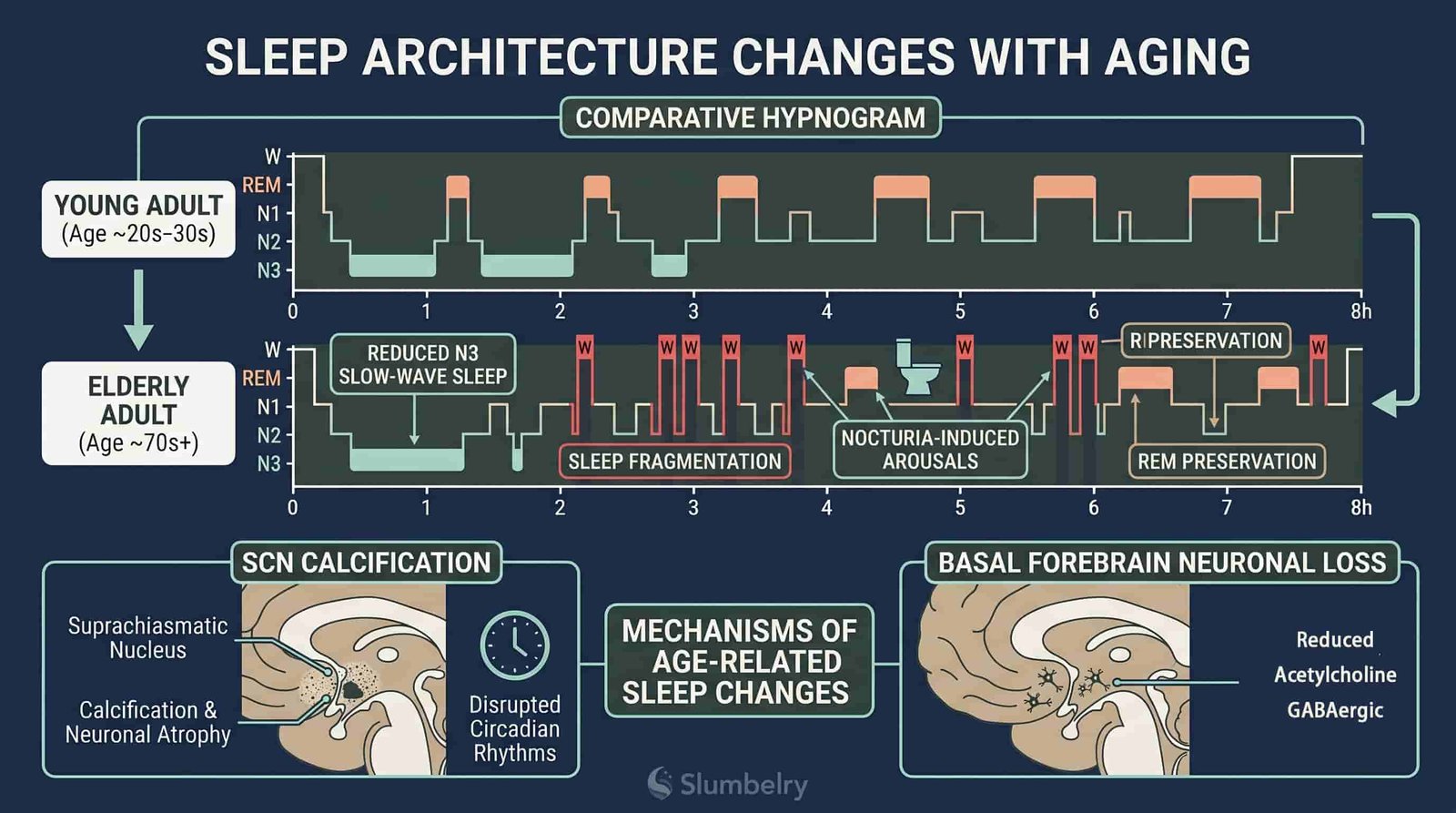
- The Problem: Older adults do NOT need less sleep — their sleep NEED remains 7–8 hours. What deteriorates is the ABILITY to generate that sleep due to N3 deep sleep loss (up to 70% reduction by age 70), advanced sleep phase timing (waking at 4 AM), melatonin production decline, and nocturia-induced arousals — all of which fragment sleep architecture without changing the underlying requirement
- The Mechanism: The SCN undergoes calcification with age, weakening its circadian amplitude and making it more susceptible to zeitgeber drift; N3-generating neurons in the basal forebrain are among the first to be lost in normal aging; peripheral temperature regulation degrades, disrupting the core temperature drop required for sleep onset — the net result is the same number of required hours but dramatically reduced sleep efficiency
- The Strategy: Strengthen zeitgebers (morning light, consistent schedule, temperature management) to compensate for the weaker internal circadian signal; optimize the sleep environment for N3-protective conditions; avoid medications that suppress N3; maintain daytime activity and sleep pressure; use low-dose melatonin only with physician guidance
Does Sleep Need Actually Decrease With Age, or Is the ‘Need Less Sleep’ Myth Destroying Senior Health?
Direct Answer: No — sleep need does not decrease with age. The requirement for 7–8 hours of sleep per night remains constant from adulthood through the entire lifespan. What changes is the physiological capacity to generate that sleep. The myth that older adults need less sleep is not just wrong — it is actively harmful, because it gives seniors permission to accept chronically insufficient sleep, accelerating cognitive decline, cardiovascular risk, and falls.
Mechanism: S1-1 and S2-3 of the whitepaper: the sleep need requirement is biologically invariant — it is encoded in the homeostatic sleep pressure system (Process S) that accumulates during wakefulness and discharges during N3 slow-wave sleep. This system does not diminish with age. What does diminish is the brain’s capacity to implement the sleep that the homeostatic system demands: the basal forebrain neurons that generate N3 are among the first casualties of normal aging, and the SCN’s circadian amplitude weakens, reducing the strength of the circadian sleep promotion signal. The result: an older adult who goes to bed at the same time as a younger adult will generate fewer hours of actual sleep because the brain cannot sustain N3 for as long and is more easily fragmented by environmental and biological noise. The CDC and AASM both maintain the 7–9 hour recommendation for adults 65 and older with no reduction for age.
Actionable Advice: Reject the “need less sleep” framing — it is a myth. If you are over 65 and sleeping 5–6 hours without difficulty, it is not because you need less sleep; it is because your brain can no longer generate the sleep it actually requires. The goal is to restore as much sleep-generating capacity as possible, not to accept a reduced requirement.
What Happens to Deep Sleep and N3 When You Turn 60 — And Why the 70% N3 Loss Matters More Than You Think?
Direct Answer: By age 70, most adults have lost 60–70% of their N3 deep sleep compared to young adults. This is not a minor adjustment — it is the stage of sleep that performs the most critical biological functions: growth hormone release, immune system activation, metabolic waste clearance (the glymphatic system), and memory consolidation. Losing it disproportionately affects the health outcomes that seniors care about most.
Mechanism: S1-2, S2-3, and Ohayon (2004), Sleep and Aging, Sleep Medicine: the N3 decline in aging is one of the most replicated findings in sleep science. N3 begins declining in the early 20s at approximately 2% per decade and accelerates after 50. By age 70, the typical hypnogram shows minimal N3 — the “tower” of deep sleep that dominates young sleep architecture has largely collapsed into Stage 1 and Stage 2. The functional consequences: growth hormone (which is released in pulses during N3) declines, impairing tissue repair and muscle maintenance; the glymphatic system — which clears amyloid-beta and tau proteins during N3 — operates at reduced efficiency, increasing amyloid burden and Alzheimer risk; immune function weakens because cytokine release (IL-1, TNF-alpha) occurs primarily during N3; and memory consolidation — particularly for declarative memories requiring the hippocampus-N3-neocortical dialogue — is impaired, accelerating age-related cognitive decline.
Actionable Advice: Protecting N3 is the single most important sleep health goal for older adults. Key interventions: cool bedroom (warm sleeping environments suppress N3 disproportionately), consistent sleep schedule (the circadian system provides a secondary N3 boost at the biological night), alcohol elimination (alcohol suppresses N3 more severely in older adults), and addressing sleep apnea (which fragments N3 almost completely).
Why Do Older Adults Wake Up at 4 AM and Cannot Fall Back Asleep — The Advanced Sleep Phase Mechanism?
Direct Answer: This is called Advanced Sleep Phase Disorder (ASPD) — the circadian clock drifts earlier with age, causing earlier sleep onset and earlier wake time. By their 70s, many adults have a core sleep period of 7–8 PM to 1–2 AM, then wake and cannot return to sleep until the next early evening. The result is a fragmented night’s sleep that appears as “insomnia” but is actually a circadian timing problem.
Mechanism: S1-1 (SCN phase advance) and S2-3: the SCN undergoes structural changes with aging — notably calcification and reduced neuronal count — that weaken its amplitude and make it more susceptible to drift. The phase response curve to light shifts toward an earlier schedule: the biological morning advances, the core body temperature minimum (the circadian nadir) occurs earlier, and melatonin onset (dim light melatonin onset, DLMO) moves earlier. The practical consequence: older adults feel sleepy earlier in the evening (often 7–8 PM) and wake earlier in the morning (3–5 AM) — a 4–5 AM core sleep window that is biologically too early relative to the actual social day. When they fight this by staying up later, they end up with insufficient total sleep because the circadian wake signal activates before they have accumulated enough sleep hours. The SCN calcification finding is particularly important: the SCN is the body’s master clock, and its structural deterioration is not reversible — but its outputs can be reinforced through strong zeitgebers.
Actionable Advice: If you are over 65 and consistently falling asleep by 7–8 PM and waking by 3–4 AM, do not fight the early sleep onset — lean into it. A split sleep schedule (core sleep 7–10 PM + nap 2–4 PM) may better match your circadian biology than an attempted 11 PM–7 AM pattern. Use the evening hours for low-stimulation wind-down, not forced wakefulness.
How Does Nocturia (Nighttime Urination) Fragment Senior Sleep, and What Actually Helps Beyond Medication?
Direct Answer: Nocturia — waking to urinate two or more times per night — is the leading cause of sleep fragmentation in adults over 65, ahead of pain, apnea, and insomnia. Each nocturia-related awakening fragments N3 and REM sleep, resetting the sleep cycle and reducing the proportion of the most restorative stages.
Mechanism: S2-3 and S4-3: nocturia in older adults has multiple overlapping mechanisms: (1) Reduced bladder capacity — the detrusor muscle weakens with age, reducing functional bladder capacity from 400–500ml to 150–200ml; (2) Nocturnal polyuria — the kidney’s circadian rhythm reverses with age, producing more urine at night than during the day; (3) Antidiuretic hormone (ADH/vasopressin) decline — ADH normally suppresses nighttime urine production, and this declines with age; (4) Prostate enlargement (in men) further reduces bladder capacity and increases nighttime frequency. Each nighttime awakening — even if it takes only 2–3 minutes — fragments sleep architecture and produces a cortisol microactivation (the stress response to waking) that reduces subsequent sleep quality. After a nocturia awakening, returning to N3 is difficult because the cortisol activation has partially satisfied the homeostatic sleep pressure.
Actionable Advice: Non-pharmacological interventions first: fluid restriction 3 hours before bed, leg elevation in the late afternoon to reduce dependent edema, avoiding bladder irritants (caffeine, alcohol, artificial sweeteners) after 2 PM. If these are insufficient, discuss desmopressin (a synthetic ADH) with your physician — it is more targeted than diuretic timing changes.
Why Is Morning Light the Single Most Powerful Sleep Intervention for Older Adults?
Direct Answer: Because the SCN in older adults is weaker — and light is the only zeitgeber strong enough to compensate for that weakness. Morning light exposure at the right time and intensity is not just helpful; it is the most evidence-based single intervention for improving senior sleep quality and consolidating nighttime sleep.
Mechanism: S1-1 (SCN 光夹带强化) and S2-3: the SCN requires a daily light signal to maintain its amplitude — the strength of its 24-hour rhythm. In young adults, even incidental light exposure (going outside for coffee, sitting near a window) is sufficient to maintain SCN amplitude. In older adults, the SCN requires a much stronger, more intentional light signal because its sensitivity to light is reduced (fewer retinal ganglion cells, reduced lens transmittance from cataracts, reduced pupil diameter). Research from the Lights Out program and Brigham and Women’s Hospital shows that 30 minutes of bright outdoor light in the first 2 hours after waking significantly reduces sleep onset latency and increases N3 proportion in adults over 65 — with effects observable within 1 week. The critical timing: the light must be within 2 hours of the natural wake time, not later in the day, because the SCN phase response curve shows maximum sensitivity in the early morning. Evening light is counterproductive for older adults with ASPD — it further advances an already advanced clock.
Actionable Advice: Get outside (or in front of a light therapy box at 10,000 lux) within 30–60 minutes of waking, for 20–30 minutes. This single behavior, done consistently, strengthens the circadian signal enough to meaningfully shift your sleep window and reduce fragmentation. The effect compounds over 1–2 weeks — do not expect results overnight.
What Is the Melatonin Decline With Age and Does Supplementation Actually Work for Seniors?
Direct Answer: Melatonin production declines substantially with age — the dim light melatonin onset (DLMO) occurs earlier and peak nocturnal melatonin levels fall by 50–75% by age 70. Low-dose melatonin supplementation (0.3–1mg, taken at the beginning of the target sleep window) is effective for circadian phase shifting and sleep onset in older adults — but only when timed correctly to the biological clock, not taken arbitrarily at bedtime.
Mechanism: S1-2, S2-3, and Ferracane-Oesch (2019) on melatonin and aging: melatonin is not a “sleep hormone” in the direct pharmacological sense — it does not induce sleep. Instead, it is a circadian signal: it tells the SCN and peripheral clocks that biological night has arrived, facilitating the transition to sleep. With age, the pineal gland’s capacity to produce melatonin declines, and the timing of DLMO advances (earlier onset), which is consistent with ASPD. Exogenous melatonin works when it is taken at a time that reinforces the desired circadian phase — typically 1–2 hours before the target sleep onset time. Taking melatonin at 10 PM when your DLMO is 6 PM has minimal effect; taking it at 7 PM (the correct time for someone with ASPD) meaningfully shifts the circadian phase. The dose matters critically: doses above 1mg can produce supraphysiological levels that downregulate melatonin receptors and reduce efficacy over time.
Actionable Advice: If using melatonin, start at the lowest effective dose (0.3–0.5mg), taken 1–2 hours before your target sleep onset time — not before your target wake time. Discuss timing with your physician. Melatonin is a tool for circadian phase management, not a sedative — used incorrectly, it has minimal effect.
Why Does Thermoregulation Degradation Fragment Senior Sleep — and How Can Simple Interventions Like Socks Help?
Direct Answer: Core body temperature must drop 1–2°C to initiate sleep — this is the thermoregulatory prerequisite for sleep onset. Older adults have impaired peripheral vasodilation, meaning their hands and feet do not dilate as effectively to release heat, slowing the core temperature drop that signals bedtime. Wearing socks to bed accelerates this process and is one of the simplest evidence-based sleep interventions available.
Mechanism: S1-2, S4-3, and sleep physiology: the sleep onset process requires peripheral heat dissipation — warm core, cool extremities. This is accomplished through vasodilation of the hands and feet, which radiates heat from the high-metabolic-rate core to the low-metabolic-rate extremities. In older adults, peripheral vascular function declines, reducing the efficiency of this heat transfer. The result: a longer latency to sleep onset (lying in bed unable to fall asleep despite feeling tired) and more fragmented sleep architecture. Research studies show that warming the feet (via socks, a foot bath, or a heating pad) before bed accelerates sleep onset by approximately 10–15 minutes and improves subjective sleep quality. The mechanism is straightforward: if the feet are already warm, vasodilation is already underway, and core temperature drop begins faster. This is a simple, non-pharmacological intervention that works by working with — not against — the biology of sleep onset.
Actionable Advice: Wear socks to bed, or do a 10-minute warm foot bath 1 hour before target bedtime. Keep the bedroom at 18–20°C (cooler than you might prefer), and wear lightweight, breathable sleepwear that does not trap heat. The combination of warm feet and a cool room is the thermoregulatory sweet spot for senior sleep onset.

How Does Daytime Napping Help or Hurt Senior Sleep Architecture?
Direct Answer: For older adults, strategic napping — one nap of 20–30 minutes in the early afternoon — can compensate for reduced nighttime sleep efficiency. Excessive napping (multiple naps, naps over 60 minutes) destroys nighttime sleep pressure and worsens insomnia. The distinction between beneficial napping and harmful napping is duration and timing, not the nap itself.
Mechanism: S2-3 and S4-4: the napping evidence in older adults is nuanced. A single afternoon nap (scheduled 12–2 PM, ending at least 6 hours before target nighttime bedtime) provides a measurable cognitive and physical restoration benefit without significantly reducing nighttime sleep pressure. The cognitive benefit is primarily in the first 30 minutes post-nap (sleep inertia clearance produces alertness restoration). However, naps over 60 minutes suppress homeostatic sleep pressure enough to make nighttime sleep onset more difficult — particularly for seniors who already have lower sleep pressure due to N3 reduction. Multiple brief naps throughout the day (dozing in the armchair) fragment the sleep-wake architecture and reduce the incentive for consolidated nighttime sleep. The clinical evidence: napping is associated with better cognitive function in older adults when it replaces a single prolonged period of wakefulness, but is associated with worse nighttime sleep quality and higher depression rates when naps are excessive or poorly timed.
Actionable Advice: One nap, 20–30 minutes, between 12 and 2 PM. Use an alarm. The nap ends before sleep inertia becomes a problem and at least 6 hours before your target bedtime. Do not nap after 3 PM. Do not nap in bed — nap in a chair, so the bedroom remains a pure nighttime sleep cue.
What Medications Commonly Disrupt Senior Sleep — and What to Ask Your Physician at the Next Review?
Direct Answer: Many commonly prescribed medications for seniors — including some antihypertensives, SSRIs, corticosteroids, and antihistamines — are significant disruptors of sleep architecture. A medication review focused specifically on sleep effects should be a standard part of any senior’s annual medication reconciliation.
Mechanism: S2-3 and AGS Beers Criteria: the AGS Beers Criteria list medications to avoid in older adults, and several of them disrupt sleep through specific mechanisms. Key categories: (1) Sedating antihistamines (diphenhydramine/Benadryl, doxylamine) — these fragment REM sleep and produce next-day sedation, confusion, and falls. They are present in many OTC sleep aids and “PM” pain formulas; (2) SSRIs/SNRIs (sertraline, venlafaxine) — these can produce activating effects that increase sleep latency and fragment REM; (3) Corticosteroids (prednisone) — these increase CNS arousal and dramatically disrupt sleep, often producing severe insomnia at doses above 20mg; (4) Diuretics (furosemide, hydrochlorothiazide) — if taken in the morning they can cause nocturia; (5) Beta-agonists (albuterol, salmeterol) — common in COPD/asthma medications, these are CNS stimulants that fragment sleep; (6) Benzodiazepines — while they sedate, they suppress N3 and produce dependence that worsens long-term sleep quality.
Actionable Advice: At your next physician review, ask specifically: “Could any of my current medications be affecting my sleep?” Ask about the timing of diuretics (can be moved to morning), the necessity of sedating antihistamines (there are alternatives), and whether any of your current medications suppress N3. This single question can lead to medication timing adjustments that meaningfully improve sleep without adding new drugs.
When Is a Sleep Study Medically Indicated for Older Adults — and What Are the Red Flags That Cannot Be Ignored?
Direct Answer: A sleep study (polysomnography or home sleep apnea test) is medically indicated for older adults when any of the following are present: witnessed apneas or gasping during sleep, excessive daytime sleepiness not explained by insufficient sleep, morning headaches (a classic OSA symptom), or cognitive decline that is accelerating faster than expected for the individual’s history.
Mechanism: S2-3 and AASM guidelines: Obstructive Sleep Apnea (OSA) prevalence in adults over 65 is approximately 45–65%, far higher than in younger populations, due to reduced upper airway muscle tone, increased soft tissue compliance, and weight changes. OSA in older adults is significantly underdiagnosed — the daytime sleepiness and cognitive slowing are often attributed to “normal aging” rather than a treatable sleep disorder. The cardiovascular consequences of untreated OSA (elevated nighttime blood pressure, increased atrial fibrillation risk, accelerated cognitive decline) are additive to the baseline aging process. A sleep study is specifically indicated when: the Berlin Questionnaire or STOP-Bang score indicates high OSA risk; the senior reports or a bed-partner reports snoring with witnessed apneas; the senior reports waking with a gasping or choking sensation; there is new-onset hypertension or atrial fibrillation without other clear cause.
Actionable Advice: If you or your bed-partner have noticed breathing pauses during sleep, morning headaches, or unrefreshing sleep despite adequate time in bed, ask your physician for a sleep study referral. OSA treatment (typically CPAP or oral appliance) reduces cardiovascular risk, improves daytime alertness, and slows cognitive decline. The evidence for OSA treatment in older adults is as strong as in any other age group — age is not a contraindication for treatment.
Frequently Asked Questions
Is it true that older adults need less sleep?
Direct Conclusion: No. Sleep requirement does not decrease with age. Adults over 65 need 7-9 hours per night, the same as younger adults. What changes is the brain’s ABILITY to generate that sleep due to N3 neuronal loss, SCN calcification, and increased sleep fragmentation. If you are sleeping less, it is because your sleep architecture has deteriorated — not because your need has declined.
How much deep sleep do older adults actually lose?
Direct Conclusion: By age 70, most adults have lost 60-70% of their N3 deep sleep compared to young adults. N3 begins declining in the early 20s at about 2% per decade and accelerates after 50. This is the stage responsible for growth hormone release, immune function, glymphatic waste clearance, and memory consolidation — the loss of N3 has direct consequences for all of these systems.
Why do older adults wake up so early in the morning?
Direct Conclusion: This is called Advanced Sleep Phase Disorder (ASPD) — the SCN drifts earlier with age, causing earlier sleep onset and earlier wake times. Core body temperature minimum, melatonin onset, and cortisol awakening response all advance, creating a biological night that ends at 3-5 AM. Fighting this by staying up late only produces more sleep debt. A split sleep schedule or early evening sleep onset may better match your biology.
What causes frequent nighttime urination in older adults and how does it affect sleep?
Direct Conclusion: Nocturia is the leading cause of sleep fragmentation in adults over 65. Mechanisms: reduced bladder capacity (detrusor weakness), nocturnal polyuria (kidney reversal), and declining ADH. Each nocturia-related awakening fragments N3 and REM, resetting sleep architecture. Non-pharmacological interventions: fluid restriction 3 hours before bed, leg elevation in late afternoon, avoiding bladder irritants after 2 PM.
Does melatonin supplementation help older adults sleep better?
Direct Conclusion: Yes, when used correctly. Melatonin production declines 50-75% by age 70. Low-dose melatonin (0.3-0.5mg) taken 1-2 hours before the target sleep onset time (not at a socially-normal bedtime) acts as a circadian phase setter. It is not a sedative. Dose matters: above 1mg can downregulate receptors. Discuss timing with your physician — the right time depends on your ASPD pattern.
Why is morning light so important for older adults’ sleep?
Direct Conclusion: Because the SCN in older adults is weaker and needs a stronger daily light signal to maintain its amplitude. Light in the first 2 hours after waking is the most potent SCN reinforcing signal. Research shows 20-30 minutes of bright outdoor light (or 10,000 lux light therapy) in the early morning significantly improves sleep quality in seniors. The timing matters: light exposure after 3 PM can worsen Advanced Sleep Phase Disorder by further advancing an already early clock.
Should older adults nap during the day?
Direct Conclusion: One strategic nap is beneficial; excessive napping destroys nighttime sleep pressure. Recommended: one nap of 20-30 minutes between 12-2 PM, ending at least 6 hours before target bedtime. Nap in a chair, not in bed, to preserve the bed as a nighttime sleep cue. Multiple naps or naps over 60 minutes fragment nighttime sleep and worsen insomnia. If you find yourself dozing in the armchair throughout the day, that is a signal of excessive daytime sleepiness that needs investigation.
Can a cooler bedroom really improve sleep quality for older adults?
Direct Conclusion: Yes — and it is particularly important for seniors. Core body temperature must drop 1-2C to initiate sleep. Older adults have impaired peripheral vasodilation (slower heat dissipation from core to extremities), meaning they have more difficulty achieving the temperature drop needed for sleep onset. A bedroom at 18-20C (cooler than typical) and wearing socks (which accelerate peripheral vasodilation) are two of the simplest, most evidence-based interventions for senior sleep onset.
Which medications commonly interfere with sleep in older adults?
Direct Conclusion: Sedating antihistamines (Benadryl, doxylamine) fragment REM and cause falls; SSRIs/SNRIs can activate and fragment sleep; corticosteroids (prednisone) at doses above 20mg cause severe insomnia; diuretics taken at night cause nocturia; beta-agonists (albuterol) are CNS stimulants; benzodiazepines suppress N3. Ask your physician at your next review: ‘Could any of my medications be affecting my sleep?’ Timing adjustments (moving diuretics to morning) are often possible without changing medications.
When should an older adult see a sleep specialist?
Direct Conclusion: A sleep study is medically indicated when: witnessed apneas or gasping during sleep; excessive daytime sleepiness not explained by insufficient sleep; morning headaches; or cognitive decline accelerating faster than expected. OSA prevalence in adults over 65 is 45-65%, and it is significantly underdiagnosed. Treatment (CPAP or oral appliance) reduces cardiovascular risk and improves cognitive outcomes — age is not a contraindication for treatment.
Your Sleep Needs Don’t Change. Your Sleep Support Should.
Aging is not a reason to accept poor sleep. With the right light exposure, temperature management, medication review, and circadian timing, quality rest is achievable at any age.
Orthopedic Sleep Systems Light Management SolutionsThe Slumbelry Commitment
Sleep is the most vulnerable state of human existence. It is where we heal, reset, and grow.
At Slumbelry, we do not just sell sleep products; we advocate for your physiological right to rest. From ergonomic support to light management, every solution we offer is designed with one obsession: Respecting your Biology.
Science is our language, but your recovery is our purpose. You take care of everything else in your life — let us take care of your nights.
Rest Deeply,
The Slumbelry Team