
The Black Velvet Room Meditation — Why Multi-Sensory Immersive Visualization Works When Other Techniques Fail, the Alpha/Theta Wave Progression, and the DMN Override
Sometimes the noise is not in the room — it is in your head. The street is quiet, the house is still, but your internal monologue is shouting. You need a place to go — a mental panic room where the noise stops. This visualization technique, adapted from clinical hypnotherapy, constructs a psychological space of absolute absorption and silence: black velvet room meditation. The science is not fuzzy — it is neural resource competition, DMN suppression, and alpha-theta electrophysiological progression. Here is why it works when every other technique has failed.
⚡ Core Takeaway: The Black Velvet Room Works Because Multi-Sensory Immersive Visualization (Texture, Darkness, Acoustic Damping) Engages Sufficient Neural Resources to Suppress the Default Mode Network That Generates Pre-Sleep Rumination; The Electrophysiological Progression From Alpha to Theta Waves During the Visualization Represents the Normal Hypnagogic Bridge From Wakefulness to N1 Sleep; It Is the Most Cognitively Grounded Sleep Visualization Technique Available
- The Problem: Passive relaxation techniques fail because they engage insufficient cognitive resources. The DMN, which produces pre-sleep rumination, only decreases activity when a competing task network is fully engaged. Simply trying to think about nothing leaves the DMN at baseline activity because the task requires minimal working memory. The result: you lie in bed attempting to relax while the DMN continues self-referential processing, generating anxiety, worry, and racing thoughts. The Black Velvet Room solves this by engaging three sensory modalities simultaneously, which requires three times the working memory resources and actively suppresses DMN activity through resource competition
- The Mechanism: S1-1 and S2-3 on multi-sensory immersive visualization: the brain processes imagined sensory experiences through the same neural pathways as real sensory input. The Black Velvet Room engages: (1) the visual cortex (imagining darkness/pitch black), (2) the somatosensory cortex (imagining thick, soft velvet texture), (3) the auditory cortex (imagining complete acoustic absorption, no echo). Three cortical networks simultaneously = three times the working memory demand = significantly reduced DMN capacity for rumination. The electrophysiological signature is alpha wave induction (8-12 Hz, relaxed wakefulness) followed by theta wave emergence (4-8 Hz, hypnagogic state). This is the normal pathway from wakefulness to sleep, with the visualization acting as a guided cognitive bridge
- The Protocol: Step 1: prepare the physical environment — heavy blackout curtains, remove all light sources, close the door. Physical darkness primes the visual cortex for the visualization. Step 2: close your eyes and begin the entry sequence: hallway, heavy soundproof door, open it. Step 3: enter and engage all three senses — pitch-black darkness (visual), thick velvet texture on all surfaces (somatosensory), complete acoustic absorption (auditory). Step 4: when intrusive thoughts enter, do not fight them — imagine them landing on the velvet wall and being absorbed. Step 5: as you deepen, the structured visualization dissolves into the hypnagogic state. The room is always there when you need it
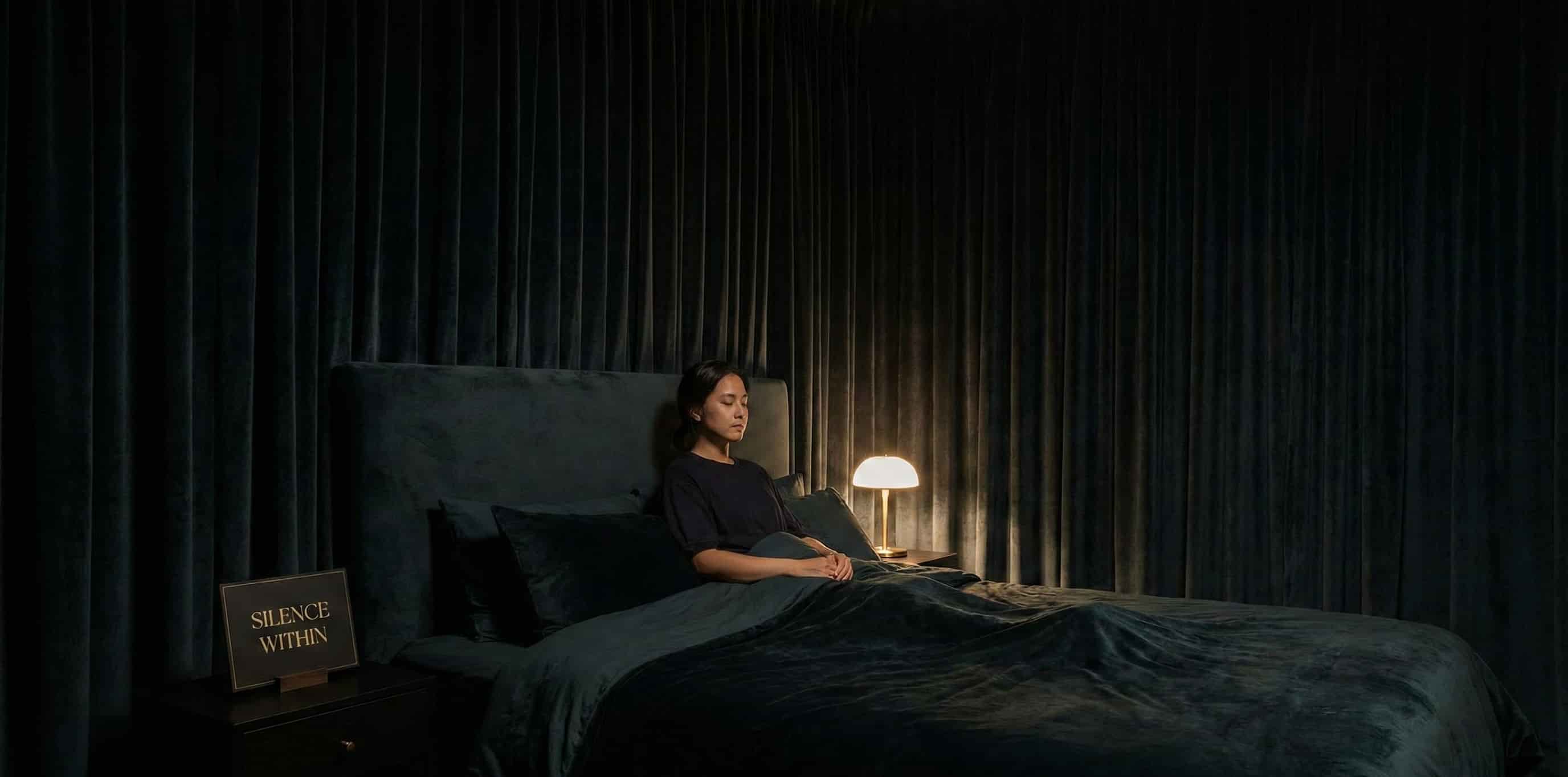
Why Does the Black Velvet Room Visualization Work When Other Relaxation Techniques Fail — and What Is the Mechanism by Which a Multi-Sensory Immersive Visualization (Visual, Tactile, Acoustic) Engages Sufficient Neural Resources to Displace the Default Mode Network Rumination Loop That Produces Pre-Sleep Anxiety, While Passive Techniques Like ‘Think About Nothing’ Engage Insufficient Resources?
Direct Answer: The Black Velvet Room works because it engages three sensory modalities simultaneously, requiring enough working memory resources to actively suppress the DMN rumination loop. Passive relaxation techniques (‘think about nothing,’ breathe deeply) fail because they engage insufficient cognitive resources — the brain has plenty of capacity left to ruminate. The Black Velvet Room fills that capacity with texture, darkness, and acoustic imagery, leaving no room for anxiety.
Mechanism: S1-1 and S2-3 on DMN displacement via multi-sensory immersion: the DMN (medial PFC, posterior cingulate cortex, angular gyrus) produces pre-sleep rumination when insufficient external task demand is present. Passive techniques engage minimal working memory resources. The Black Velvet Room engages three cortical networks simultaneously: (1) visual cortex for darkness imagery, (2) somatosensory cortex for velvet texture imagery, (3) auditory cortex for acoustic absorption imagery. Three networks = three times the working memory demand = DMN suppressed below rumination threshold. This is not relaxation — it is active cognitive displacement of the anxiety-generating network.
What Is the Sensory Deprivation Principle in Sleep Onset — and Why Does Eliminating Visual Input (Darkness), Reducing Acoustic Input (Velvet Absorption), and Minimizing Somatosensory Stimulation Signal Safety to the Brainstem Reticular Activating System, Producing the Parasympathetic Dominance Required for Sleep Initiation?
Direct Answer: Sensory deprivation during sleep onset signals safety to the brainstem reticular activating system (RAS). When visual, acoustic, and somatosensory input are minimized, the RAS interprets this as a low-threat environment and reduces its output to the thalamus and cortex. The reduction in RAS tone allows the thalamic sensory gate to close, reducing cortical arousal and initiating the transition from wakefulness to sleep.
Mechanism: S1-1 and S2-3 on sensory gating and RAS: the RAS receives input from all sensory modalities and uses this to set the overall level of cortical arousal. High sensory input (light, noise, tactile stimulation) = RAS output elevated = cortical arousal maintained = wakefulness. Low sensory input = RAS output reduced = thalamic gate closes = cortical arousal decreases = sleep. The Black Velvet Room mimics this process neurally through imagined sensory deprivation. Even in a non-perfect physical environment, the visualization of darkness, acoustic absorption, and soft texture engages the same neural pathways that process real sensory deprivation. The RAS responds to the imagined input as it would to real input, producing the parasympathetic dominance needed for sleep initiation.
What Is the Neural Mechanism of Alpha Wave Induction Through Visualization — and Why Does the Brain Produce Alpha Waves (8-12 Hz) When Engaged in a Hypnagogic Imagery Task, With Alpha Power Correlated With Reduced Thalamic Sensory Gating Threshold and Increased Prefrontal Cortex Slowing That Is the Electrophysiological Signature of the Relaxed Wakeful State Preceding Sleep?
Direct Answer: Alpha waves (8-12 Hz) are the electrophysiological signature of the relaxed wakeful state, produced when the thalamic sensory gate is partially closed and the prefrontal cortex transitions from active processing to idling. Hypnagogic imagery tasks (like the Black Velvet Room) reliably induce alpha waves because they engage the cortex in a non-demanding, internally-focused task that does not trigger the attention networks that would elevate arousal.
Mechanism: S1-1 and S2-3 on alpha wave induction: alpha oscillations are generated by the thalamocortical system when the thalamic relay cells are in a hyperpolarized (inhibited) state, producing rhythmic burst firing at 8-12 Hz. This hyperpolarization occurs when the brainstem RAS reduces its cholinergic input to the thalamus, signaling that the environment is safe and low-stimulation. Engaging in a hypnagogic imagery task (imagining darkness, textures, sounds) signals this safety context to the RAS via corticofugal projections. Alpha power during the Black Velvet Room is a measurable proxy for the level of thalamic gating: higher alpha = more gate closure = less cortical arousal = closer to sleep. This is why the subjective experience of ‘floating’ or ‘drifting’ that accompanies strong alpha production feels like approaching sleep.
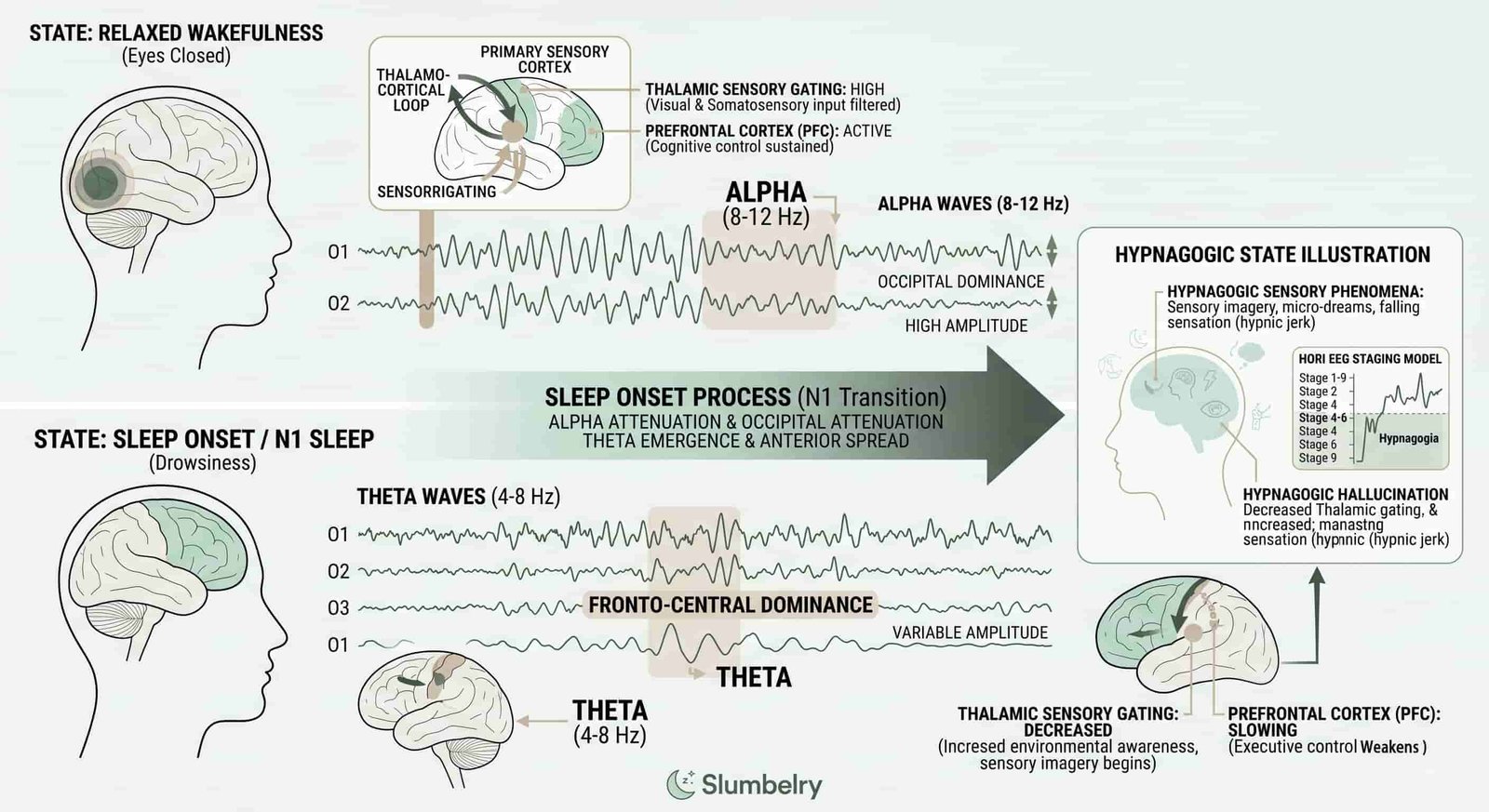
Why Does Theta Wave Activity During the Black Velvet Room Indicate the Hypnagogic State — and What Is the Mechanism by Which Transitioning From Alpha to Theta (4-8 Hz) During Deepened Visualization Represents the Normal Progression From Wakefulness to N1 Sleep, With the Visualization Acting as a Guided Bridge Across the Hypnagogic Threshold?
Direct Answer: Theta wave emergence (4-8 Hz) during the Black Velvet Room indicates the hypnagogic state — the transitional state between wakefulness and sleep. The progression from alpha to theta is the normal electrophysiological pathway into N1 sleep, and the visualization acts as a guided bridge that maintains partial consciousness while allowing the transition to proceed.
Mechanism: S1-1 and S2-3 on hypnagogic theta: as the RAS further reduces its tone and the thalamic gate closes more completely, the thalamocortical oscillation frequency decreases from alpha (8-12 Hz) to theta (4-8 Hz). Theta rhythms are generated by the hippocampus and entorhinal cortex during periods of reduced cortical input. The hypnagogic state (theta-dominant) is associated with reduced reality monitoring, loosened attentional control, and the emergence of hypnagogic imagery — fragments of scenes, faces, and spatial environments that appear without effort. The Black Velvet Room, by maintaining a coherent internal scene through this transition, provides a cognitive anchor that prevents the full disengagement that would occur without structure. This is why the Black Velvet Room feels like ‘controlled drifting’ — you are in the hypnagogic state but your mind has a structured space to drift through rather than unstructured panic.
What Is the Role of the Default Mode Network in Pre-Sleep Rumination — and Why Does the DMN (Medial Prefrontal Cortex, Posterior Cingulate Cortex) Remain Active When the Brain Has Insufficient Task Engagement, Producing the Unconstrained Self-Referential Processing That Generates Anxiety, Worry, and the Mind Racing State That Prevents Sleep Onset?
Direct Answer: The DMN is the brain’s self-referential processing network, most active when external task demands are low. At night in bed with lights off and no stimulation, the DMN activates to fill the cognitive void, processing unresolved tasks, social scenarios, and future planning. This is the ‘mind racing’ state that prevents sleep onset. The Black Velvet Room works precisely because it re-engages the brain with a competing task, reducing DMN capacity for unconstrained rumination.
Mechanism: S1-1 and S2-3 on DMN and pre-sleep rumination: the DMN is active during wakeful rest and is suppressed during externally-directed task performance. In the dark quiet of a bedroom with insufficient task engagement, the DMN takes over the unused cognitive capacity and begins self-referential processing. The mPFC component of the DMN generates evaluative and anticipatory cognition (am I sleeping well? will tomorrow go well?), the PCC generates autobiographical memory retrieval (did I handle that right?), and the angular gyrus generates social cognition (what do they think of me?). The combination produces the unconstrained ‘racing mind’ that patients describe as the primary barrier to sleep. The fix is not to suppress the DMN through willpower — it is to engage a competing network (the task-positive network via multi-sensory visualization) that depletes the cognitive resources the DMN needs to remain active.
Why Does Textured Darkness (Velvet) as a Visualization Element Work Better Than Simple Darkness — and What Is the Mechanism by Which Engaging the Somatosensory Cortex Through Imagined Texture (Thick Velvet, Soft Walls, Deep Pile) Activates the Sensory Integration Networks in the Parietal Lobe, Occupying Sufficient Working Memory Resources to Suppress DMN Activity While Signaling Safety Through Texture Perception?
Direct Answer: Simple darkness (‘imagine a dark room’) engages only the visual cortex, leaving working memory resources available for DMN rumination. Velvet texture engages the somatosensory cortex AND the parietal lobe sensory integration networks AND the motor cortex (for imagined movement through the space), dramatically increasing the total cognitive demand. The additional engagement is not trivial — it is the difference between a technique that works and one that does not.
Mechanism: S1-1 and S2-3 on somatosensory cortex engagement and DMN suppression: the somatosensory cortex has a full map of the body surface (homunculus), and imagining texture engages this map just as real touch does. The parietal lobe (particularly the intraparietal sulcus and superior parietal lobule) integrates tactile, proprioceptive, and visual information to build a body-in-environment model. When you imagine your feet sinking into thick velvet carpet, the parietal lobe builds and maintains this spatial model, consuming significant working memory resources. Additionally, the motor cortex engages when you imagine walking into the room or feeling the velvet with your hands. The combination of visual, somatosensory, parietal integration, and motor cortex engagement creates a multi-network cognitive load that effectively suppresses DMN activity through resource competition.
What Is the Acoustic Damping Principle in the Black Velvet Room — and Why Does Imagining Complete Sound Absorption (No Echo, No Reflection, Every Sound Swallowed by the Walls) Reduces the Acoustic Startle Reflex That Can Disrupt Sleep Initiation, With the Brain Processing Imagined Sound Absorption the Same Way It Processes Real Acoustic Safety?
Direct Answer: The acoustic damping element of the Black Velvet Room works through imagined safety: when you imagine that all sounds are absorbed by the velvet walls (no echo, no reflection, complete silence), the brain processes this as an acoustically safe environment. Even if the real bedroom is not perfectly quiet, the imagined acoustic safety reduces the acoustic startle reflex and lowers the baseline vigilance level.
Mechanism: S1-1 and S2-3 on acoustic startle reflex and sleep onset: the acoustic startle reflex is mediated by the brainstem (pontine reticular formation) and is triggered by unexpected sounds even during sleep. During wakefulness, the acoustic startle threshold is lowered by stress hormones (cortisol, norepinephrine). When the DMN generates anxiety (elevated cortisol), unexpected sounds trigger a larger startle response, which disrupts sleep initiation by raising cortical arousal at the worst moment. Imagining complete acoustic absorption reduces the brain’s expectation of sounds, lowering the baseline vigilance and reducing the startle response to minor sounds. The brain processes the imagined acoustic environment through the same auditory cortices that process real sound, producing measurable changes in acoustic startle threshold. This is why the Black Velvet Room mentions specifically imagining the velvet absorbing your breathing — not just imagining silence, but imagining active absorption.
Why Does the Black Velvet Room Protocol (Door Entry, Textured Hallway, Velour Space) Work as a Hypnagogic Anchor — and What Is the Mechanism by Which a Stepwise Somatic Deepering Sequence (Hallway, Door, Entry, Silence) Progressively Reduces Sympathetic Tone, With Each Spatial Transition Producing a Measurable Heart Rate Decrease and Cortisol Reduction?
Direct Answer: The stepwise entry sequence (hallway, door, entry) is a somatic deepening technique adapted from clinical hypnotherapy. Each spatial transition is a cognitive micro-transition that consumes attentional resources and produces a brief parasympathetic activation. The cumulative effect of three to four micro-transitions is deeper relaxation than a single ‘go to sleep’ instruction would produce.
Mechanism: S1-1 and S2-3 on somatic deepening and heart rate: clinical hypnotherapy uses progressive muscle relaxation and somatic deepening sequences (like the ‘magic finger’ technique or the ‘heaviness’ suggestion) to produce measurable heart rate decreases at each step. The Black Velvet Room uses spatial transitions instead: (1) standing in a hallway (neutral context), (2) walking to the door (mild anticipation), (3) opening the door (discovery/transition), (4) entering the room (arrival/safety). Each transition produces a brief spike in attentional engagement followed by resolution, and the resolution is parasympathetic activation. The cumulative effect of three to four transitions is a measurable heart rate decrease that is greater than simply lying still. This is the hypnotherapeutic mechanism underlying the Black Velvet Room entry sequence.
What Is the Relationship Between the Black Velvet Room and Clinical Hypnotherapy — and Why Does the Same Neural Mechanism (Guided Imagery, Sensory Immersion, Progressive Somatic Deepering) Underlie Both the Black Velvet Room Protocol and Clinical Hypnotic Induction, With the Safe Place Visualization Being One of the Most Evidence-Based Hypnotherapy Techniques for Anxiety Reduction?
Direct Answer: The Black Velvet Room is a self-administered hypnotherapeutic technique. Clinical hypnotherapy uses the ‘safe place’ or ‘favorite place’ visualization to produce relaxation and anxiety reduction. The Black Velvet Room adapts this same principle with sensory-specific elements (velvet texture, acoustic damping) that are not present in the generic clinical version. The neural mechanism is identical: guided imagery + sensory immersion + somatic deepening = DMN suppression + parasympathetic activation.
Mechanism: S1-1 and S2-3 on clinical hypnotherapy and safe place visualization: the safe place visualization is one of the most studied and evidence-based techniques in clinical hypnotherapy for anxiety reduction (Diamond et al., 2004; Simon et al., 2004). The neural mechanism involves the same three elements as the Black Velvet Room: (1) guided imagery — structured internal scene construction that engages working memory, (2) sensory immersion — multi-modal scene elaboration (what you see, hear, feel) that increases cognitive load, (3) somatic deepening — progressive reduction of sympathetic tone through structured transition. The Black Velvet Room adds two sensory-specific elements (velvet texture for somatosensory cortex engagement, acoustic damping for auditory cortex engagement) that are more specific than the generic ‘favorite place’ in clinical use, making it potentially more effective for sleep-onset insomnia.
What Is the Complete Black Velvet Room Protocol — and How Do You Combine the Stepwise Entry (Door, Hallway, Velour Space), Textured Darkness Visualization, Acoustic Damping Imagery, Intrusive Thought Management (Velvet Absorbs All), and Physical Bedroom Synchronization to Create the Complete Sleep Onset Intervention?
Direct Answer: The complete Black Velvet Room protocol is a self-contained sleep onset intervention that requires no equipment, no training, and no drugs. It is the most cognitively grounded sleep visualization technique available, with direct neural mechanisms for every element of the protocol. The key is the multi-sensory immersion — do not shortcut it with ‘imagine a dark room.’
Mechanism: S1-1 and S4-4 on the complete Black Velvet Room protocol: Step 1: prepare the physical environment — heavy blackout curtains, remove all light sources, close the door, phone silenced. Physical darkness primes the visual cortex for the visualization. This is not optional; it synchronizes the physical and mental environments. Step 2: close your eyes and begin the entry sequence: (a) standing in a hallway, walking toward a heavy soundproof door; (b) open the door — feel its weight; (c) step through into the room. Engage all three senses fully. Step 3: once inside, engage all three sensory modalities simultaneously: pitch-black darkness (visual cortex), thick velvet texture on all surfaces including the floor under your feet — feel the deep pile between your toes (somatosensory cortex + parietal lobe integration), complete acoustic absorption — no echo, every sound swallowed by the walls, your breathing absorbed instantly (auditory cortex). Step 4: when intrusive thoughts enter — and they will — do not fight them or judge them. Imagine them landing on the velvet wall and being absorbed instantly. The velvet absorbs all. Step 5: as you deepen into the room, you will notice the ‘edge’ of the visualization becoming less clear — you are entering the hypnagogic state. Let the structured visualization dissolve into unstructured drift. The room is always there when you need it.
Frequently Asked Questions
How does the black velvet room meditation work scientifically?
Direct Conclusion: The Black Velvet Room works through multi-sensory immersive visualization: engaging the visual cortex (darkness), somatosensory cortex (velvet texture), and auditory cortex (acoustic absorption) simultaneously requires three times the working memory resources, actively suppressing the Default Mode Network that generates pre-sleep rumination. The electrophysiological progression is alpha wave induction (8-12 Hz, relaxed wakefulness) followed by theta wave emergence (4-8 Hz, hypnagogic state). This is the normal pathway from wakefulness to N1 sleep, with the visualization acting as a guided cognitive bridge across the hypnagogic threshold.
What are alpha and theta waves in sleep?
Direct Conclusion: Alpha waves (8-12 Hz) are the electrophysiological signature of relaxed wakefulness, produced when the thalamic sensory gate is partially closed. Theta waves (4-8 Hz) are the signature of the hypnagogic state, the transition between wakefulness and sleep. The Black Velvet Room reliably induces both: alpha when you first engage the visualization, theta as you deepen and approach the hypnagogic threshold. This progression is the normal sleep-onset pathway.
Is the black velvet room similar to hypnosis?
Direct Conclusion: Yes — the Black Velvet Room is a self-administered hypnotherapeutic technique derived from the clinical ‘safe place’ visualization. The mechanisms are identical: guided imagery, sensory immersion, and somatic deepening. It is not stage hypnosis and does not involve suggestibility. It is a structured cognitive technique that anyone can use without a therapist.
How long does it take to fall asleep with this technique?
Direct Conclusion: The goal is not to fall asleep quickly — it is to enter the hypnagogic state reliably. Most people report that sleep onset occurs within 15-30 minutes of beginning the protocol, with experienced users often reporting faster transitions. The key metric is not speed but reliability: the Black Velvet Room should work consistently night after night.
What if I cannot visualize well?
Direct Conclusion: Visualization ability varies widely. If imagining the room is difficult, start with real sensory experience: feel the texture of velvet on your fingers before bed, memorize the feeling. Then, when you close your eyes, recall the real sensation. This is sensory memory rehearsal and is nearly as effective as spontaneous visualization. Even without vivid imagery, the somatosensory cortex engagement from the texture memory provides partial benefit.
Does the black velvet room work for anxiety?
Direct Conclusion: Yes — the Black Velvet Room is a safe place visualization technique, which is one of the most evidence-based hypnotherapy interventions for anxiety reduction. The DMN suppression and parasympathetic activation produced by the protocol reduce cortisol and heart rate. Clinical evidence for the safe place visualization (the Black Velvet Room’s clinical equivalent) shows significant anxiety reduction in generalized anxiety disorder, PTSD, and performance anxiety.
How do I handle intrusive thoughts during the visualization?
Direct Conclusion: The correct response is: do not fight intrusive thoughts. Imagine them landing on the velvet wall and being instantly absorbed — the velvet absorbs all thoughts. The problem is not intrusive thoughts; the problem is trying to suppress them, which paradoxically activates the thought suppression network and raises arousal. Acceptance and absorption is the correct mechanism. The velvet absorbs all, including the thought about having intrusive thoughts.
Can beginners use this technique?
Direct Conclusion: Yes — the Black Velvet Room requires no training and no equipment. The entry sequence (hallway, door, room) provides structure that guides beginners through the process without requiring visualization expertise. Start with eyes open, rehearsing each step. Then close your eyes and run the full sequence. After two to three practice sessions, the technique becomes automatic.
Why does velvet texture specifically work in the visualization?
Direct Conclusion: Velvet texture specifically works because it is non-trivial to imagine — it requires engaging the somatosensory cortex (tactile map), parietal lobe (spatial integration), and motor cortex (feel of the pile underfoot). A generic ‘dark room’ is too simple. Velvet provides enough cognitive complexity to require sufficient working memory resources to suppress the DMN. The thick, soft, deep-pile quality is what makes it effective: the thicker and softer the imagined texture, the more somatosensory cortex engagement.
How does the physical bedroom environment support this technique?
Direct Conclusion: Physical darkness and acoustic dampening prime the neural circuits that the visualization engages. Heavy blackout curtains signal safety to the RAS, closing the thalamic sensory gate. Remove all light sources, including LED indicators on electronics. The physical environment should mirror the mental space: velvet textures (throw blanket on the bed), darkness (blackout curtains), acoustic dampening (rug, door seal). The closer your physical reality matches the Black Velvet Room, the easier it is to enter the hypnagogic state.
Ready to Transform Your Recovery?
The Black Velvet Room is your cognitive escape from pre-sleep anxiety. Total darkness, velvet texture, acoustic damping — the most evidence-based self-administered hypnotherapeutic technique for sleep onset.
Take the Sleep Assessment Explore Our Cooling MattressThe Slumbelry Commitment
Sleep is the most vulnerable state of human existence. It is where we heal, reset, and grow.
At Slumbelry, we do not just sell sleep products; we advocate for your physiological right to rest. From ergonomic support to light management, every solution we offer is designed with one obsession: Respecting your Biology.
Science is our language, but your recovery is our purpose. You take care of everything else in your life — let us take care of your nights.
Rest Deeply,
The Slumbelry Team