

Why do I feel exhausted but my mind won’t shut off?
The Direct Fix: You must engage in a “Digital Sunset” 90 minutes before bed. This isn’t just about blue light; it’s about ceasing interactive information input. By dimming your lights and putting away screens, you signal to your nervous system that the “danger” of the day is over, allowing it to transition from sympathetic to parasympathetic dominance.
Insomnia is not a character flaw; it is a biological mismatch. Your body evolved over millions of years to sleep when the sun goes down and the temperature drops. The modern world has added too much noise: too much data, too much artificial light, and too much trapped heat. To fix your nights, you must learn the art of subtraction. You don’t need to “learn” how to sleep; you need to stop interfering with your body’s natural ability to rest.
The Neurochemistry of Sleeplessness: Understanding the Barrier
To understand how to deal with insomnia, you must understand **Adenosine**. Adenosine is a chemical that builds up in your brain throughout the day, creating “sleep pressure.” The longer you stay awake, the more adenosine accumulates. However, this pressure can be easily overridden by **Cortisol**—the stress hormone. When you are anxious about sleep, your brain pumps cortisol to keep you “safe” from the perceived threat of insomnia. This creates a vicious loop: the more you worry about sleep, the more cortisol you produce, and the further away sleep drifts.
The Slumbelry 7-Day Subtraction Protocol
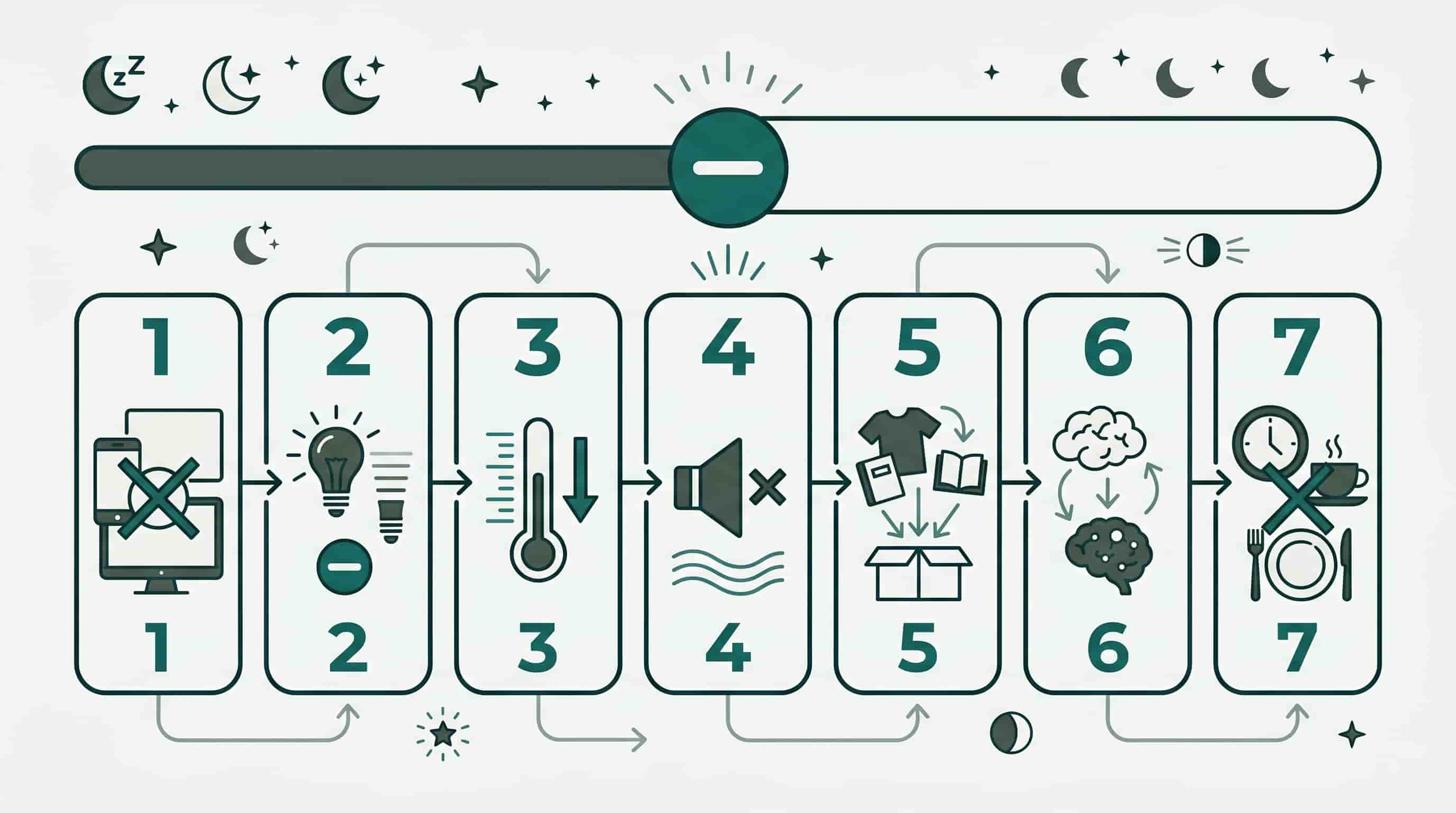
This is not a list of “hacks.” It is a structured biological reset designed to restore your natural sleep-onset signals by removing modern interferences.
Day 1–2: Light Subtraction (The Melatonin Reset)
Artificial light at the 480nm spectrum (blue light) tells your pineal gland that it is noon. Even 30 seconds of scrolling on a bright screen can delay your melatonin production by up to 3 hours. By removing interactive screens 2 hours before bed, you allow your body’s natural melatonin cascade to begin. Switch to warm, amber-toned lighting to simulate the sunset and prime your brain for Stage 1 sleep.
Day 3–4: Thermal Subtraction (The Cooling Cure)
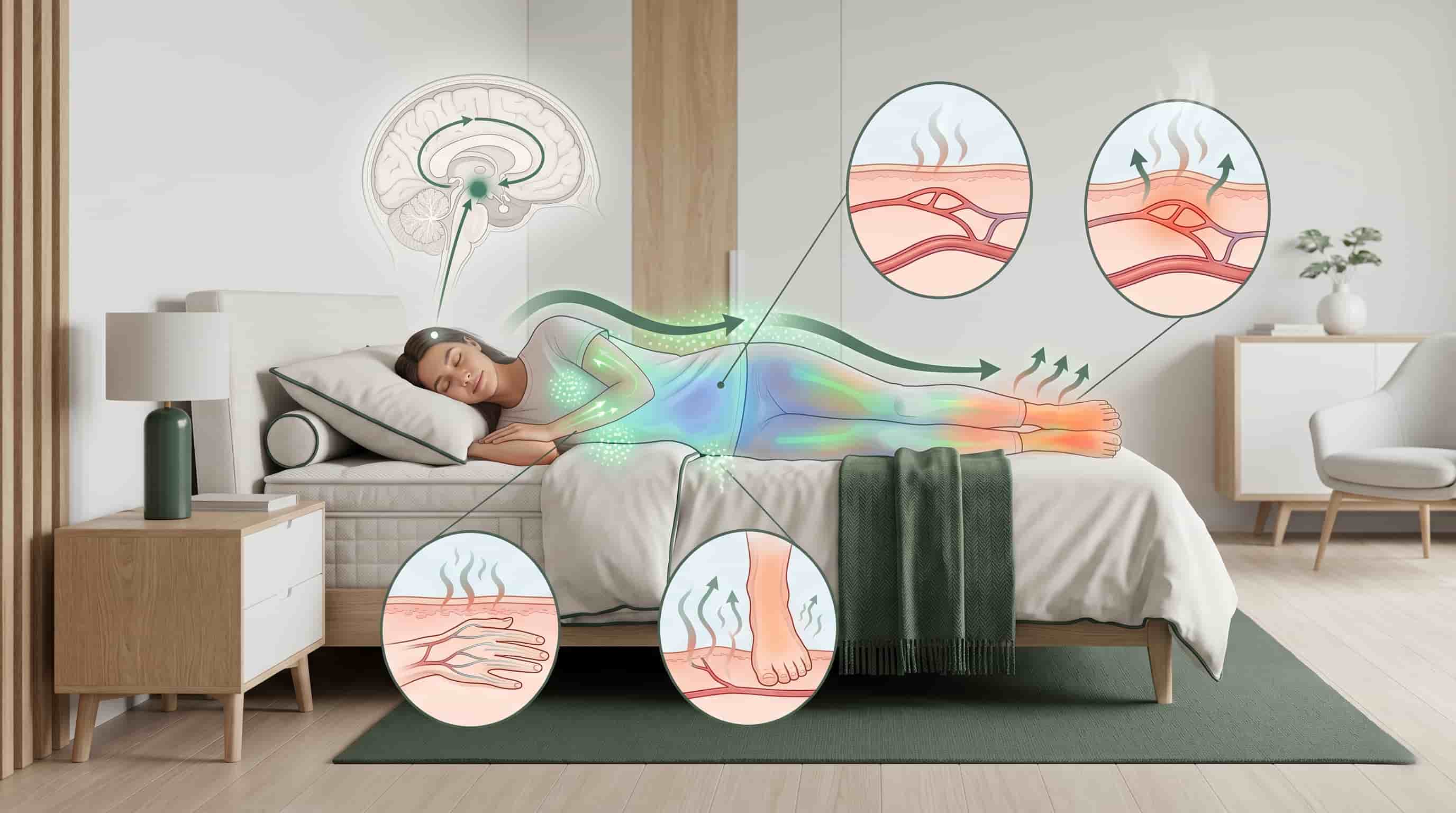
Your core body temperature must drop by 2-3°F to initiate the physiological switch to sleep. If your mattress traps metabolic heat or your room is above 68°F (20°C), you are physically blocking your brain’s “power down” signal. At Slumbelry, we emphasize breathable, cooling bedding and keeping the bedroom environment significantly cooler than the rest of the house to facilitate this crucial drop.
Day 5–6: Cognitive Subtraction (Breaking Dopamine Loops)
Cognitive interference is the primary driver of 3 AM awakenings. If your brain is still processing work emails, social media debates, or “just one more episode” at 10 PM, it will remain in a state of high-beta wave activity. Set a hard “mental cutoff” at 8 PM. No work. No social media. No data input. Use this time for analog activities like reading a physical book or practicing gentle stretching.
Day 7: Stimulus Re-Association (The Bed-Sleep Link)
If you have spent months lying awake in bed, your brain has learned to associate the mattress with frustration, anxiety, and alertness. This is “Conditional Insomnia.” On Day 7, we apply the 20-minute rule: if you aren’t asleep in 20 minutes, get out of bed. Go to another room, keep the lights low, and perform a boring task. Return only when you feel the physical “heavy eye” sensation. You must rebuild the Pavlovian connection between your bed and rest.
Where your environment quietly sabotages your sleep
In our clinical observations at Slumbelry, we’ve found that many chronic insomniacs have “perfect” habits but “broken” environments. There are three silent killers of deep rest: heat retention, poor neck support, and light leakage. Even subtle light from an alarm clock or a street lamp can disrupt the REM cycle. Similarly, if your mattress is made of materials that trap heat, your body will constantly enter “micro-awakenings” to try and cool down. The goal of environment optimization is to remove these sensory frictions so your brain feels safe enough to go offline.
Common mistakes that increase insomnia anxiety
The most dangerous thing you can do is “try harder” to sleep. Forcing sleep increases performance anxiety, which spikes the very cortisol that keeps you awake. Another common trap is **Orthosomnia**—the obsession with perfect sleep scores from wearables. These devices can be helpful, but for an insomniac, they often become a new source of stress. Furthermore, while alcohol might help you pass out, it fragments your deep sleep and completely suppresses REM, leaving you more exhausted the next day. Focus on behavioral subtraction, not chemical or digital crutches.
3 AM Deep Dive: Your Sleep Questions, Answered
1. “Should I stay in bed if I can’t sleep for an hour?”
Conclusion: No. Get out of bed immediately.
Why: Staying awake in bed trains your brain to associate that space with stress. This is the root of chronic insomnia.
Action: Move to another room in low light. Read something dull. Return only when you are truly sleepy.
2. “Is exercise at night bad for insomnia?”
Conclusion: High-intensity exercise can delay sleep.
Why: It raises your core temperature and cortisol levels right when they should be dropping naturally.
Action: Keep intense workouts before 4 PM. Gentle stretching after 8 PM is acceptable.
3. “Why do I wake up at 3 AM with a racing heart?”
Conclusion: This is a cortisol “survival” spike.
Why: Your brain enters its lightest sleep cycles then. If you are stressed, the brain uses this window to wake you up to “scan for danger.”
Action: Don’t watch the clock. Apply the 20-minute rule and practice box breathing.
4. “Can I take melatonin every night to fix my sleep?”
Conclusion: Not recommended for long-term recovery.
Why: Melatonin is a signal, not a sedative. High doses can desensitize your natural receptors.
Action: Fix your “Light Subtraction” to restore natural production instead.
5. “Can I ‘catch up’ on lost sleep during the weekend?”
Conclusion: No. This is “Social Jetlag.”
Why: Sleeping in on Sunday shifts your master clock, making Sunday night insomnia almost certain.
Action: Keep your wake-up time within a 30-minute window every day of the week.
6. “I’ve tried everything. Am I biologically broken?”
Conclusion: No. You are likely just over-stimulated.
Why: Insomnia is rarely a permanent failure of biology; it is a state of chronic hyperarousal.
Action: Commit to the 7-day protocol and remove all sleep-tracking devices for one week.
7. “Does alcohol actually help with sleep?”
Conclusion: It’s a trap.
Why: Alcohol is a sedative that mimics sleep but blocks REM and fragments deep sleep cycles.
Action: Avoid alcohol at least 4 hours before your target bedtime.
8. “What is the fastest way to drop my core temperature?”
Conclusion: A warm shower 90 minutes before bed.
Why: It triggers vasodilation, sending blood to the skin so heat can escape the core once you step out.
Action: Step out into a cool, ventilated room to maximize the drop.
9. “I’m only 35 and feel forgetful. Is this dementia?”
Conclusion: Likely “Cognitive Fragmenting” due to sleep loss.
Why: The brain clears neurotoxins only during deep Stage 3 sleep. Without it, you are “intoxicated” by metabolic waste.
Action: Prioritize 7.5 hours of sleep for 14 days and observe your clarity return.
10. “When should I seek professional help for my insomnia?”
Conclusion: If it lasts over 3 months despite behavioral changes.
Why: You may have an underlying medical issue like sleep apnea or restless leg syndrome.
Action: Consult a sleep specialist for a formal sleep study.
THE SLUMBELRY COMMITMENT
Sleep is the most vulnerable state of human existence. It is where we heal, reset, and grow.
At Slumbelry, we don’t sell sleep products; we advocate for your physiological right to rest. Every solution we offer is designed with one obsession: Respecting your Biology.
Rest Deeply,
The Slumbelry Team