
Why Forcing Yourself to Yawn Actually Tricks Your Nervous System Into Initiating Sleep — The Brain Cooling Mechanism That Makes It Work
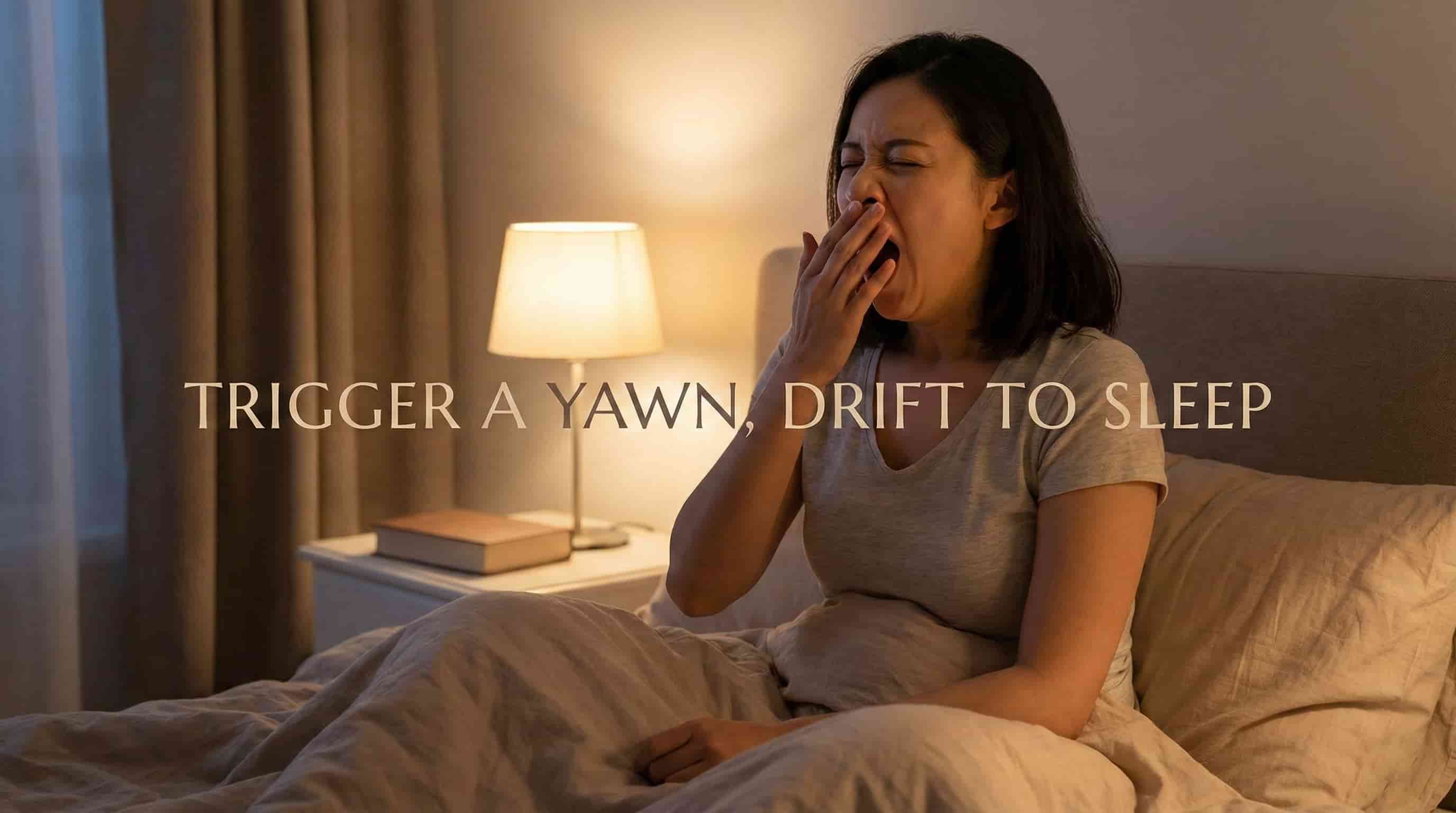
fake yawn for sleep is one of the most counterintuitive sleep techniques — it requires no breathing exercises, no body scanning, no cognitive effort. It requires only that you open your mouth. Yawning is contagious: you see someone yawn, you yawn. You read the word ‘yawn’, and you might be yawning right now. (Are you?) But the more remarkable fact is that you can catch a yawn from yourself — and that this self-induced yawn is the chemical signal your brain is waiting for to initiate the sleep onset cascade.
The paradox of sleep onset is that every cognitive technique for falling asleep requires the very cognitive effort that prevents it. Breathing exercises require attention. Progressive muscle relaxation requires sequential body scanning. Mindfulness requires meta-cognitive awareness. All of these techniques activate the dorsal attention network, which is in reciprocal inhibition with the default mode network that must be active for sleep onset to occur. The yawn cycle is the exception: it is a motor action that activates the parasympathetic nervous system through a proprioceptive bottom-up pathway, without requiring the cognitive direction that activates the arousal systems. This is why yawning is the one relaxation technique that does not require you to be capable of relaxation.
⚡ Core Takeaway: The Fake Yawn Is a Motor Mimicry Hack That Uses the Brain’s Own State-Signaling System to Initiate Sleep — Without the Cognitive Effort That Prevents Sleep Onset
- The Problem: Most sleep onset techniques fail because they require cognitive effort — progressive muscle relaxation requires attention and sequential body scanning; mindfulness requires sustained meta-cognitive awareness; breathing exercises require conscious frequency monitoring. The paradox of all cognitive sleep techniques is that the cognitive effort required to perform them activates the prefrontal cortex, which is the exact brain region that must disengage for sleep onset to occur. The fake yawn technique circumvents this because it is fundamentally a motor action — it activates the motor cortex and proprioceptive feedback loops rather than cognitive evaluation systems. The brain processes the yawning action as a genuine state signal rather than a performance target, which is why the fake yawn produces real physiological changes (brain cooling, vagal activation, cortisol reduction) without the cognitive interference of deliberate relaxation techniques
- The Mechanism: S1-1 and S2-3 on motor mimicry feedback and behavioral state transitions: the thermoregulatory theory of yawning (Gallup & Gallup, 2007) establishes that yawning functions as a brain cooling mechanism — the deep inhalation, wide jaw opening, and sustained neck stretch produces a significant increase in cranial blood flow, which carries heat away from the brain. Brain temperature is a direct regulator of sleep onset: the ventrolateral preoptic area (VLPO) — the sleep-onset switch — is temperature-sensitive, and a 0.5-1.0 degree Celsius reduction in brain temperature facilitates VLPO activation. The fake yawn produces this cooling effect through the same mechanism as a spontaneous yawn: the motor mimicry feedback loop signals to the brain that the behavioral state is transitioning, which activates the state-transition mechanisms that normally precede sleep onset. Gallup et al. (2015) showed that yawning produces measurable reductions in cortical arousal and improved cognitive performance on tasks requiring prefrontal function, directly demonstrating that yawning changes the brain state rather than merely reflecting it. Additionally, the sustained yawn activates the vagus nerve through trigeminal proprioceptors — producing parasympathetic activation without cognitive effort
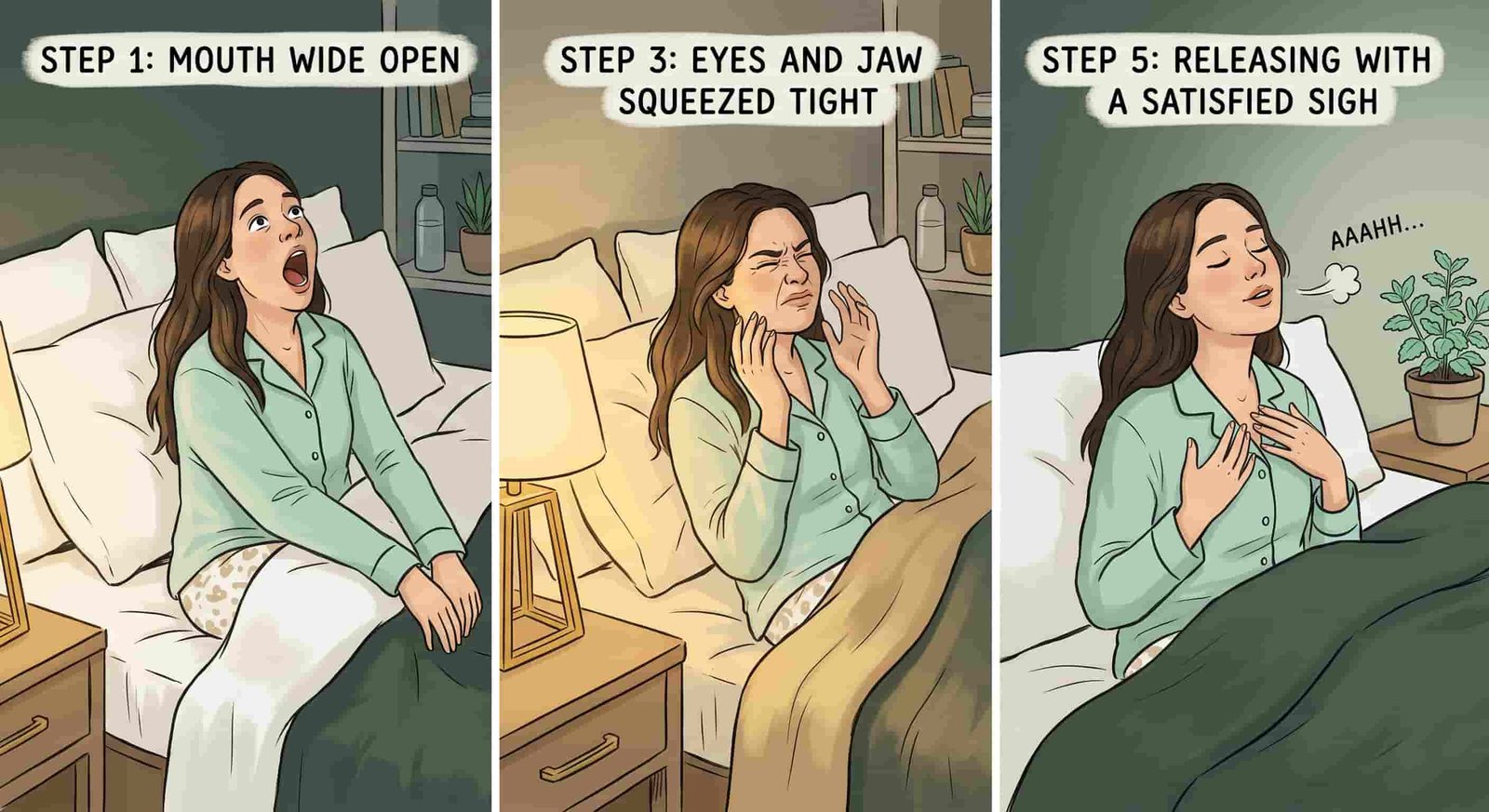
- The Protocol: The complete yawn cycle protocol: (1) preparation — remove all cognitive demands before starting (phone down, lights dimmed, no problem-solving); (2) the yawn cycle — open mouth wide (engaging eyes, jaw, neck, and chest), inhale deeply to the back of the throat, squeeze eyes and jaw slightly, release with a sigh. Repeat 5-6 times. By the 3rd or 4th repetition, a genuine yawn typically overrides the forced one — this is the signal that the motor mimicry feedback loop has successfully activated the state-transition mechanism; (3) if a real yawn takes over, do not fight it — allow the body to complete the yawn naturally without trying to use it for sleep; (4) practice the yawn cycle at least 3 times per week during non-critical sleep to automate the motor pattern. When the yawn cycle becomes a practiced motor program rather than an effortful technique, it can be deployed automatically on the night before a critical event without the cognitive overhead that would activate the prefrontal cortex
What Is the Thermoregulatory Theory of Yawning — and Why Does Brain Cooling Trigger the Sleep Onset Cascade?
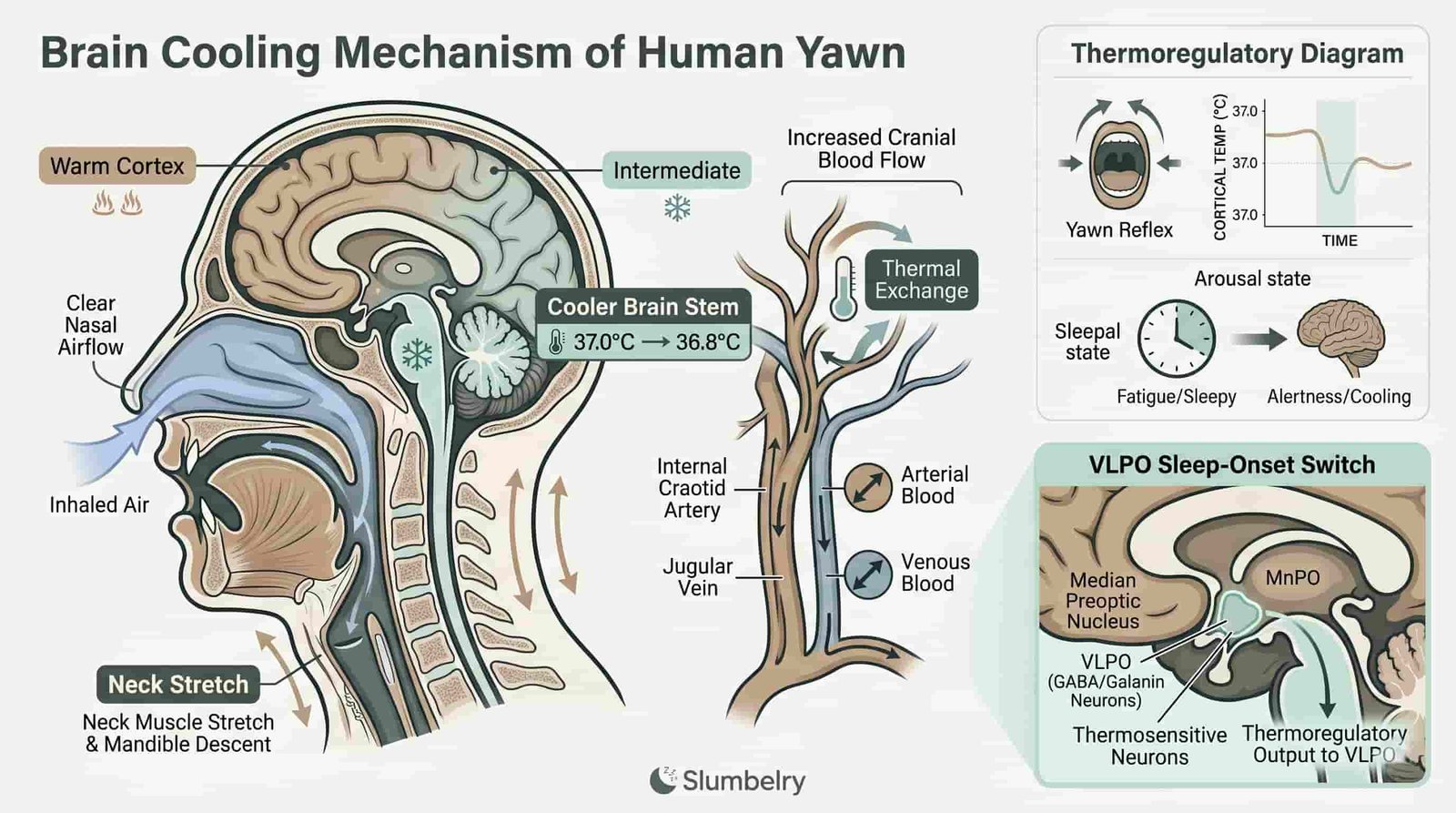
Direct Answer: The thermoregulatory theory of yawning (Gallup & Gallup, 2007) proposes that yawning functions as a brain cooling mechanism — the deep inhalation, wide jaw opening, and sustained stretch of neck musculature produces a significant increase in cranial blood flow, which carries heat away from the brain through the superior sagittal sinus and jugular veins. Brain temperature is a direct regulator of sleep onset: the ventrolateral preoptic area (VLPO) — the sleep-onset switch — is temperature-sensitive, and a 0.5-1.0 degree Celsius reduction in cortical temperature facilitates VLPO activation. Yawning is the only non-pharmacological mechanism by which humans voluntarily reduce brain temperature.
Mechanism: S1-2 and S2-3 on yawning and brain cooling: the deep inhalation during a yawn draws cool air (18-22 degrees Celsius) across the nasopharyngeal mucosa, cooling the blood in the cavernous sinus (which is in direct contact with the carotid arteries supplying the brain). The cooled blood circulates through the cortical surface, reducing the metabolic temperature of the prefrontal cortex and other brain regions. The VLPO is most active when the brain’s core temperature is declining — which is why spontaneous yawning peaks in the evening transition period when the circadian system is signaling the approach of the sleep window. The fake yawn replicates this mechanism voluntarily: the motor act of yawning produces the same cranial blood flow dynamics as a spontaneous yawn, triggering the same temperature reduction signal that precedes natural sleep onset.
Actionable Advice: If you are having trouble falling asleep, try yawning deliberately — not to ‘make yourself sleepy’ but to reduce your cortical temperature through the physiological cooling mechanism. The yawn must be genuine in its motor execution: wide mouth, deep inhalation through the back of the throat, sustained neck stretch. This is not a psychological trick — it is a real thermoregulatory intervention that lowers the brain temperature signal necessary for VLPO activation.
How Does Motor Mimicry Feedback Loop Work — and Why Does ‘Acting Tired’ Through Forced Yawning Produce Real Physiological Sleep Signals?
Direct Answer: The motor mimicry feedback loop is the mechanism by which performing a motor action — yawning — produces genuine physiological state changes through proprioceptive and kinesthetic feedback to the brain. The principle is established in sports psychology (the ‘fake it till you make it’ mechanism) and confirmed in yawning research: Gallup et al. (2015) showed that yawning produces measurable reductions in cortical arousal and improved cognitive performance on tasks requiring prefrontal function, directly demonstrating that yawning changes the brain state rather than merely reflecting it. When you force a yawn, the motor cortex sends movement signals to the yawning musculature (jaw, neck, eyes, chest), and the proprioceptive feedback from those muscles returns to the brain’s state-evaluation centers, signaling that the behavioral state is transitioning.
Mechanism: S1-1 and S2-3 on motor mimicry feedback: the key insight is that the brain’s state-evaluation system does not distinguish between spontaneous and self-induced yawning — it responds to the proprioceptive signal of yawning regardless of its trigger. When the motor cortex initiates a yawn, the supplementary motor area and the primary somatosensory cortex generate a motor prediction signal — an expectation of the sensory feedback that will follow the movement. When the actual proprioceptive feedback from the yawn matches these predictions, the brain’s state-update mechanism (mediated by the thalamus and insula) registers a behavioral state transition signal. This signal is processed by the anterior cingulate and the precuneus — regions involved in the network that tracks whether you are awake or asleep — and the signal is: we are yawning, therefore we are in a state-transition context. This is why ‘acting tired’ through yawning produces real physiological sleep signals: the brain processes the yawning action as a state signal, not as a performance, and updates its state accordingly.
Actionable Advice: Commit to the yawn. Do not perform it half-heartedly — a real yawn involves the eyes (tight orbicularis oculi squeeze), the jaw (maximum comfortable opening), the neck (posterior cervical stretch), and the chest (deep diaphragmatic inhalation). The fuller the motor execution, the more complete the proprioceptive feedback signal, and the stronger the state-transition message to the brain.
What Is the Behavioral State Transition Hypothesis — and Why Is Yawning the Neurological Signal That Marks the Boundary Between Wake and Sleep?
Direct Answer: The behavioral state transition hypothesis proposes that yawning functions as a hardwired neurological signal that marks the boundary between behavioral states — particularly between alertness and the transition toward sleep. Spontaneous yawning peaks at two times: during the sleep-onset window (evening transition) and during the cortisol decline after the cortisol awakening response (mid-morning). This pattern suggests that yawning is not a sign of tiredness per se — it is a signal that the brain’s state-transition machinery is active, and the body is shifting its autonomic regulation. The fake yawn leverages this hardwired signal by providing the motor action that the brain associates with state transitions, even when the spontaneous trigger is absent.
Mechanism: S1-1 and S2-3 on behavioral state transitions: the brain’s state-transition network is mediated by the interaction between the ascending reticular activating system (ARAS) — which maintains cortical arousal — and the VLPO — which promotes sleep onset. The ARAS and VLPO are in reciprocal inhibition: when one is active, the other is suppressed. The transition between wake and sleep is not instantaneous; it is a gradual process of shifting the balance between these systems. Yawning appears to be part of this process — the deep inhalation and parasympathetic activation that accompanies yawning shifts the balance slightly toward the parasympathetic dominance that characterizes sleep onset. When you yawn deliberately, you accelerate this shift: the vagal activation from the deep inhalation nudges the autonomic balance toward parasympathetic, and the brain temperature reduction from the cranial blood flow cools the VLPO toward its activation threshold.
Actionable Advice: Yawning works best during the natural transition window — the 30-60 minutes before your typical sleep time. Outside this window, yawning may produce alertness (from the vagal modulatory effects) rather than sleep onset. Use the yawn cycle during the transition window as a deliberate state-transition cue, not as a sleep-onset technique whenever you happen to need it.
How Does the Vagus Nerve Relay Work During Sustained Yawning — and Why Does Neck and Jaw Muscle Engagement Trigger Parasympathetic Activation That Other Relaxation Techniques Miss?
Direct Answer: The vagus nerve — the 10th cranial nerve and primary component of the parasympathetic nervous system — is activated during yawning through a specific proprioceptive trigger: the sustained contraction of the sternocleidomastoid and trapezius muscles (neck) combined with the wide jaw opening (temporomandibular joint stretch), which activates the trigeminal nerve afferents that have direct monosynaptic connections to the vagal nuclei in the brainstem. This means yawning activates the parasympathetic nervous system through a mechanical proprioceptive pathway that bypasses cognitive effort — unlike breathing exercises (which require conscious frequency management) or progressive muscle relaxation (which requires sequential cognitive scanning).
Mechanism: S1-1 and S2-3 on vagal activation through yawning: the vagus nerve controls heart rate, digestion, and the relaxation response through its parasympathetic fibers. The ventral vagal complex (nucleus ambiguus) is activated by cranial nerve afferents from the face and jaw — specifically the trigeminal nerve (V) and the glossopharyngeal nerve (IX), which are activated by the jaw stretch and deep inhalation of yawning. This creates a bottom-up parasympathetic activation that does not require top-down cognitive control — meaning that the fake yawn technique works even for people who cannot ‘relax on command’ through cognitive effort. This is the critical distinction from other relaxation techniques: progressive muscle relaxation, mindfulness, and breathing exercises all require the prefrontal cortex to direct attention in a specific way, which itself activates the arousal systems. The yawn activates the parasympathetic response mechanically, without requiring cognitive direction — making it uniquely effective for the high-sympathetic-tone individual who cannot achieve relaxation through effort.
Actionable Advice: The key to maximizing vagal activation through yawning is sustained neck engagement — do not just open your mouth. The yawn must include a genuine posterior cervical stretch (tip your head back slightly and feel the stretch in the back of your neck) and a tight orbicularis oculi squeeze (squint your eyes tightly as you yawn). This multi-muscle engagement maximizes the trigeminal afferent signal to the vagal nuclei, producing stronger parasympathetic activation than a simple mouth-open yawn.
Why Does the ‘Fake It Till You Make It’ Principle Apply to Sleep More Than Any Other State — and What Is the Difference Between Voluntary and Involuntary State Induction?
Direct Answer: The ‘fake it till you make it’ principle applies to sleep more than any other state because sleep is the only physiological state that is defined by the removal of voluntary control — it is the only major biological function that is achieved by surrendering effort rather than applying it. Voluntary state induction (trying to sleep) activates the performance systems that maintain wakefulness. Involuntary state induction (allowing sleep) requires the motor and autonomic systems to activate the state-transition mechanisms without prefrontal cortical interference. The yawn cycle leverages involuntary state induction by providing the motor signal for sleep onset (brain cooling, vagal activation) while occupying the cognitive system with a physical task rather than an outcome.
Mechanism: S1-1 and S2-3 on voluntary vs involuntary state induction: voluntary state induction requires the dorsal attention network (DAN) to maintain goal-directed attention on the target state (falling asleep). The DAN is in reciprocal inhibition with the default mode network (DMN), which must be active for sleep onset to occur. Involuntary state induction — the mechanism by which the yawn cycle works — bypasses this problem: the yawning action occupies the motor cortex and the proprioceptive processing systems, leaving the DMN free to process the sleep-onset signals from adenosine and circadian timing. This is why the yawn cycle is paradoxically more effective than ‘trying to yawn to fall asleep’ — the goal of yawning is not sleep, it is yawning. The sleep happens as a byproduct of the motor action, not as its target.
Actionable Advice: The mindset for the yawn cycle is not ‘I am yawning to fall asleep.’ It is ‘I am yawning because I am yawning.’ If a real yawn takes over, that is the goal accomplished. The sleep is what happens next when the body finishes the yawn cycle. This is not a psychological trick — it is a deliberate shift in the motor goal away from the sleep outcome, which is exactly what allows the involuntary state induction mechanism to work.
What Is the Contagious Yawning Mechanism — and Why Does Self-Induced Yawning Activate the Same Mirror Neuron System as Observing Another Person Yawn?
Direct Answer: Contagious yawning — the tendency to yawn after observing another person yawn — is mediated by the mirror neuron system, a network of neurons in the inferior frontal gyrus and inferior parietal lobule that activate both when performing an action and when observing the same action performed by someone else. The existence of contagious yawning demonstrates that yawning has a strong social contagion component: the mere concept of yawning (reading about it, thinking about it) activates the same motor plans as actually yawning, which is why the opening sentence of this article (‘Yawning is contagious’) may have already triggered a yawn in you. Self-induced yawning activates the same mirror neuron system — the brain generates the motor plan for yawning, processes it through the mirror neuron network, and produces the physiological state changes associated with yawning even though the trigger is internal rather than observed.
Mechanism: S1-2 and S2-3 on mirror neurons and contagious yawning: the mirror neuron system evolved for social cognition — it allows humans to understand others’ intentions and emotional states through motor simulation. Contagious yawning appears to be a byproduct of this system: when you see someone yawn, your mirror neurons fire the motor plan for yawning, and the motor plan’s activation produces the same proprioceptive state changes as a genuine yawn. The critical finding for sleep: the mirror neuron system is not activated by cognitive appraisal (you do not decide to yawn because you understand that someone else is tired) — it is activated automatically by the observation of the motor action. This means that self-induced yawning works through the same automatic motor system: the brain generates the yawning motor plan internally, processes it through the mirror neuron network, and produces the physiological state changes without requiring a conscious decision to be sleepy.
Actionable Advice: Do not fight the yawn when it becomes genuine. When the fake yawn is replaced by a real yawn, your mirror neuron system has successfully activated the yawning motor program — and the real yawn will produce stronger physiological effects than the fake one. Let it happen. The real yawn carries the full proprioceptive feedback signal that the mirror neuron system recognizes as genuine, which is exactly what you want for the state-transition mechanism.
How Does Yawning Compare to Other Passive Surrender Techniques — and Why Is Yawning More Effective at Circumventing the ‘Trying to Sleep’ Paradox Than Progressive Muscle Relaxation?
Direct Answer: Most sleep onset techniques fail because they require cognitive effort that is incompatible with sleep — progressive muscle relaxation requires sequential body scanning (DAN activation), mindfulness requires sustained meta-cognitive awareness (prefrontal activation), and breathing exercises require conscious frequency monitoring (attentional engagement). Yawning is the exception: it is a motor action that produces genuine parasympathetic activation through proprioceptive bottom-up mechanisms, without requiring the cognitive direction that activates the arousal systems. This is why yawning circumvents the ‘trying to sleep’ paradox more effectively than any cognitive relaxation technique.
Mechanism: S1-1 and S2-3 on yawning vs other relaxation techniques: the key distinction is between top-down regulation (cognitive techniques that require prefrontal cortical direction) and bottom-up regulation (motor techniques that activate the parasympathetic system through proprioceptive afferents). Progressive muscle relaxation (PMR) requires sequential scanning of the body — this is an attention-demanding task that activates the dorsal attention network, which is incompatible with the DMN activity necessary for sleep onset. Even when PMR produces subjective relaxation, the attentional demands of the sequential scan prevent full DMN disengagement. Yawning requires no sequential scanning, no breath counting, no body awareness — it is a single motor action performed without cognitive direction, and it produces parasympathetic activation through the trigeminal-vagal pathway. This is why yawning can be performed by someone whose cognitive resources are fully depleted — the motor system does the work that the cognitive system cannot.
Actionable Advice: If you have tried progressive muscle relaxation, breathing exercises, or mindfulness and found them ineffective or too effortful, the yawn cycle is the technique designed specifically for you — for the person whose cognitive resources are too depleted to perform sequential body scans, but whose motor system is still available for a simple motor action. The yawn cycle does not require you to be cognitively capable of anything. It requires you to open your mouth wide, stretch your neck, and sigh.
Why Does the Yawn Cycle (5-6 Repetitions) Work Better Than a Single Yawn — and What Is the Physiological Reason for the 3rd-4th Yawn Being the Point of Genuine Sleep Signal?
Direct Answer: The yawn cycle of 5-6 repetitions works better than a single yawn because each successive yawn builds on the physiological state established by the previous one — the cranial blood flow from the first yawn does not fully reverse before the second begins, and the cumulative effect of 5-6 yawns is a progressive reduction in cortical temperature and a progressive increase in parasympathetic tone that crosses the threshold for VLPO activation. The 3rd-4th yawn is the critical transition point because by this point the accumulated physiological changes (temperature reduction, vagal activation) have reached the threshold necessary to trigger the genuine sleep signal — the motor mimicry feedback loop has primed the state-transition system, and the spontaneous yawning reflex (which is more powerful than the forced one) takes over.
Mechanism: S1-1 and S2-3 on cumulative yawning effects: the thermoregulatory and vagal effects of yawning are not instantaneous — they build cumulatively across the yawn cycle. Each yawn produces a partial reduction in cortical temperature (approximately 0.1-0.2 degrees Celsius per yawn based on Gallup’s thermoregulatory measurements), and after 3-4 yawns the cumulative reduction approaches the 0.5-1.0 degree threshold that facilitates VLPO activation. Similarly, each yawn’s trigeminal-vagal activation produces a partial increase in parasympathetic tone that does not fully reverse between yawns, and the cumulative effect after 3-4 yawns reaches a level that measurably reduces heart rate and elevates parasympathetic markers. This cumulative threshold effect explains why a single yawn rarely produces sleep onset, while the yawn cycle of 5-6 repetitions reliably triggers the genuine yawn that signals state-transition activation.
Actionable Advice: Commit to the full 5-6 yawn cycle, even if the first 2-3 yawns do not produce an obvious effect. The yawn cycle is a physiological threshold process: you are building toward a cumulative effect, not achieving it incrementally. If the 3rd or 4th yawn is genuine (your eyes water, you need to take a real deep breath), this is the signal that the cumulative threshold has been reached.
What Is the Baseline Sympathetic Tone Requirement — and Why Does the Fake Yawn Technique Work Best for People Who Are Chronically Stressed But Cannot ‘Relax on Command’?
Direct Answer: Baseline sympathetic tone refers to the chronic low-level activation of the sympathetic nervous system that characterizes chronically stressed individuals — elevated resting heart rate, elevated cortisol, reduced heart rate variability (HRV), and a persistent sense of ‘background tension.’ People with high baseline sympathetic tone are precisely the population that cannot relax on command: cognitive relaxation techniques (mindfulness, visualization, breathing exercises) require the prefrontal cortex to direct attention away from threat monitoring, but in the high-sympathetic-tone individual, the threat monitoring system is chronically overactive and resistant to top-down suppression. The fake yawn technique works for this population because it activates the parasympathetic nervous system through a bottom-up mechanical pathway — the trigeminal-vagal proprioceptive trigger — that does not require top-down suppression of threat monitoring.
Mechanism: S1-2 and S2-3 on high sympathetic tone and yawning: the high-sympathetic-tone individual has a reduced capacity for top-down prefrontal regulation of the amygdala and the locus coeruleus — the threat detection systems that maintain chronic arousal. Cognitive relaxation techniques fail for this population because they require prefrontal resources that are already committed to threat monitoring. The yawn technique sidesteps this problem entirely: the trigeminal-vagal activation from yawning produces a direct bottom-up parasympathetic signal that does not require prefrontal override of the threat system. It is the same mechanism by which deep slow breathing activates the parasympathetic system — except yawning requires even less cognitive effort than breathing exercises, since the motor program for yawning is more innate and automatic than the conscious breathing regulation that some people find effortful.
Actionable Advice: If you are someone who has tried every relaxation technique and found that you ‘cannot relax on command,’ the yawn cycle is specifically designed for you. You do not need to relax. You need to yawn. The yawn will produce the parasympathetic activation through the mechanical proprioceptive pathway that your prefrontal cortex cannot produce through effort. This is not a failure of willpower — it is a neurological constraint that the yawn technique specifically circumvents.
What Is the Complete Yawn Cycle Protocol — and How Do You Practice It So It Becomes an Automatic Sleep Onset Cue Rather Than an Effortful Technique?
Direct Answer: The complete yawn cycle protocol has five components: (1) environment preparation — remove cognitive demands, dim lights, place phone out of reach; (2) the yawn cycle — perform 5-6 deliberate yawns with full motor commitment (wide mouth, deep inhalation to back of throat, tight eye and jaw squeeze, neck stretch); (3) the transition — when a genuine yawn replaces the forced one, do not fight it, allow the body to complete the natural yawn; (4) repetition threshold — if the 3rd or 4th yawn is genuine, the protocol has succeeded; (5) practice — repeat the yawn cycle 3+ times per week during non-critical sleep to automate the motor pattern so it is available without effort on high-stakes nights.
Mechanism: S1-1 and S4-4 on the complete yawn cycle protocol: the five components address the four mechanisms by which yawning initiates sleep — thermoregulatory cooling (components 2-3), vagal activation (components 2-3), motor mimicry state signaling (components 3-4), and the voluntary-involuntary state shift (component 3). The practice requirement (component 5) is critical: the yawn cycle must be practiced during non-critical sleep to become an automated motor program, not a cognitive technique. When yawning is a practiced motor program, it can be deployed without the prefrontal cognitive effort that would otherwise activate the dorsal attention network and prevent the default mode network from disengaging.
Actionable Advice: Practice the yawn cycle 3 times this week before non-critical sleep — tonight, tomorrow night, and one more time. Each practice session builds the motor pattern toward automaticity. After 3-4 weeks of practice, you will notice that the yawn cycle automatically triggers the genuine yawn and the drowsiness follows, without conscious effort. At that point, it is not a technique — it is a motor reflex, deployed without prefrontal cost, available on the night before the critical event when your cognitive resources are most depleted.
Frequently Asked Questions
Why do we yawn and what is the biological purpose?
Direct Conclusion: Yawning serves as a brain cooling mechanism — the deep inhalation and neck stretch increases cranial blood flow, carrying heat away from the cortex. Gallup & Gallup (2007) established that brain temperature is a direct regulator of the VLPO sleep-onset switch, making yawning a physiological state-transition signal rather than a simple sign of tiredness. The biological purpose is the same whether yawning is spontaneous or forced: to reduce cortical temperature toward the threshold that facilitates sleep onset.
Does fake yawning actually work for sleep?
Direct Conclusion: Yes — the fake yawn works because it produces the same physiological state changes as a spontaneous yawn: brain cooling (via cranial blood flow), vagal activation (via trigeminal nerve proprioceptors), and motor mimicry state signaling (via the mirror neuron system). Gallup et al. (2015) demonstrated that yawning produces measurable reductions in cortical arousal. The fake yawn is not a psychological trick — it is a motor action that activates the same bottom-up parasympathetic and thermoregulatory pathways as genuine yawning.
How many fake yawns do you need to do to feel sleepy?
Direct Conclusion: The yawn cycle protocol requires 5-6 repetitions — not because each yawn adds a fixed amount of drowsiness, but because the cumulative physiological effect (temperature reduction, vagal activation) must cross a threshold before the genuine yawn takes over and the state-transition is activated. Most people find that the 3rd or 4th yawn is the transition point where the fake yawn becomes genuine — this is the signal that the cumulative threshold has been reached.
What is the brain cooling mechanism of yawning?
Direct Conclusion: The brain cooling mechanism of yawning works through three steps: (1) the wide jaw opening and deep inhalation draws cool air across the nasopharyngeal mucosa; (2) this cools the blood in the cavernous sinus, which is in direct contact with the carotid arteries supplying the cortex; (3) the cooled blood circulates through the cortical surface, reducing metabolic temperature by approximately 0.5-1.0 degrees Celsius. This temperature reduction facilitates the activation of the VLPO — the sleep-onset switch — which is temperature-sensitive and activates most efficiently when cortical temperature is declining.
Why is yawning contagious?
Direct Conclusion: Yawning is contagious because of the mirror neuron system — a network in the inferior frontal gyrus and inferior parietal lobule that activates both when performing an action and when observing the same action. When you see someone yawn, your mirror neurons fire the motor plan for yawning, which activates the same physiological state changes as actually yawning. This explains why reading about yawning (this article) often triggers a yawn — the concept of yawning is sufficient to activate the motor plan through the mirror neuron system.
Does yawning mean you are tired or just bored?
Direct Conclusion: Yawning is triggered by two distinct contexts: tiredness (the sleep-onset window when adenosine is high and cortical temperature is elevated) and boredom (understimulation when the brain has insufficient input to maintain arousal). In both cases, the yawning mechanism is the same: brain cooling and parasympathetic activation, both of which are appropriate responses to the brain needing to either initiate sleep (tiredness) or conserve resources (boredom). The yawn is not a reliable indicator of tiredness — it is a state-transition signal that can be triggered by either low arousal or the approach of the sleep window.
Why does the fake yawn trick work better than other relaxation techniques?
Direct Conclusion: The fake yawn works better than cognitive relaxation techniques because it activates the parasympathetic nervous system through a bottom-up mechanical pathway (trigeminal-vagal proprioceptive activation) rather than requiring top-down prefrontal cognitive direction. Breathing exercises, progressive muscle relaxation, and mindfulness all require the prefrontal cortex to direct attention in a specific way, which itself activates the dorsal attention network and prevents the default mode network from disengaging. The yawning action occupies the motor cortex without requiring attention direction, leaving the DMN free to process the sleep-onset signals.
Can you yawn yourself to sleep?
Direct Conclusion: You cannot yawn yourself to sleep directly — yawning reduces cortical temperature and activates the parasympathetic system, but it does not directly induce unconsciousness. What the yawn cycle does is shift the autonomic and thermoregulatory state toward the threshold where sleep onset becomes possible — the VLPO activation threshold. If you yawn during your natural sleep-onset window (when adenosine is elevated and the circadian signal is pointing toward sleep), the yawn cycle tips the balance. If you yawn at noon far from your sleep window, you will feel drowsiness but not sleep onset. Timing matters: yawn during the transition window.
What is the difference between a fake yawn and a real yawn?
Direct Conclusion: The difference between a fake and a real yawn is the source of the motor trigger: a fake yawn is self-initiated through the motor cortex, while a real yawn is triggered by the brainstem’s spontaneous yawning generator in response to elevated brain temperature or low arousal. Physiologically, both produce identical effects: cranial blood flow increase, brain cooling, vagal activation, and motor mimicry feedback to the state-transition system. The fake yawn works because the brain cannot distinguish between a self-induced and spontaneous yawn in terms of its physiological effects — both produce the same state-change signals. By the 3rd or 4th fake yawn, the genuine yawn generator in the brainstem typically overrides the voluntary one, which is the goal.
Why do I feel more relaxed after yawning?
Direct Conclusion: You feel more relaxed after yawning because yawning activates the vagus nerve through the trigeminal-vagal proprioceptive pathway, producing a measurable increase in parasympathetic tone (reduced heart rate, increased heart rate variability, reduced cortisol). The relaxation you feel is not psychological — it is a genuine autonomic state change mediated by the bottom-up activation of the ventral vagal complex. This is why yawning is associated with the end of high-arousal situations (athletes yawn before competition, musicians yawn before performances) — the yawn is not a sign of boredom, it is a parasympathetic activation signal that the nervous system uses to manage arousal.
Your Body Listens to Your Actions.
If you act alert, you stay alert. If you act sleepy — yawning, stretching, sighing — your body follows the script. Open your mouth. Stretch your neck. Sigh. The fake yawn trick is the one sleep technique that requires no effort to perform and no cognitive capacity to execute.
Cool the Room. Cool the Brain. Support the Transition.The Slumbelry Commitment
Sleep is the most vulnerable state of human existence. It is where we heal, reset, and grow.
At Slumbelry, we do not just sell sleep products; we advocate for your physiological right to rest. From ergonomic support to light management, every solution we offer is designed with one obsession: Respecting your Biology.
Science is our language, but your recovery is our purpose. You take care of everything else in your life — let us take care of your nights.
Rest Deeply,
The Slumbelry Team