
Why ‘Deep Sleep’ and ‘REM’ Are Non-Negotiable
Why Missing Even 30 Minutes of REM or Deep Sleep Has Measurable Cognitive and Physical Consequences
Sleep is not a uniform state of unconsciousness. It is a complex, active process with a distinct structure — or architecture — that determines whether you wake up restored or wrecked.
Your brain cycles through different stages every 90 minutes, and these stages are not interchangeable. If you cut your sleep short, you are not just losing time. You are deleting specific, critical biological functions. Miss the last hour of sleep, and you may have lost 30-50% of your REM (dream) sleep for the night. Sleep fewer cycles, and you sacrificed the N3 deep sleep in the final cycles — the most biologically valuable portion for physical restoration and glymphatic clearance.
The sleep stages guide is the full breakdown of what each stage does, why the architecture is non-negotiable, and how to measure and optimize yours without medication.
⚡ Core Takeaway: Sleep Architecture Is Not a Luxury — It Is Infrastructure
- The Problem: Most people evaluate their sleep by duration (how many hours) rather than architecture (which stages, in what proportion). A person sleeping 7 hours with severely reduced N3 and REM will perform cognitively worse than someone sleeping 6 hours with preserved architecture — yet subjective sleep quality reporting consistently rates the 7-hour poor-architecture sleeper as ‘fine.’ Sleep architecture disruption is invisible to the person experiencing it until the cognitive and physical consequences accumulate past a threshold
- The Mechanism: A normal night cycles through NREM (N1 → N2 [sleep spindles] → N3 [slow-wave deep sleep] → return to N2) → REM, repeating approximately every 90 minutes with N3 dominating the first half and REM dominating the second. N3 is responsible for human growth hormone release, physical tissue repair, immune function, and glymphatic clearance; REM is responsible for emotional memory consolidation, creative problem-solving, and next-day stress regulation. Cutting sleep short by even 30 minutes, or fragmenting sleep with arousals, selectively destroys the N3 and REM periods at the end of each cycle — the most biologically valuable portions
- The Protocol: Optimize architecture before optimizing duration: (1) Identify your natural wake time and count backward in 90-minute increments to set your bedtime — this preserves cycle completion; (2) Eliminate alcohol (which reduces N3 by 30-50% and REM by 20-40%); (3) Cool your bedroom to 18-20°C to enable the core temperature drop required for N3 slow waves; (4) Target a minimum of 60-90 minutes of combined N3 per night and 90-120 minutes of REM per night — these are the minimum thresholds for cognitive and physical maintenance
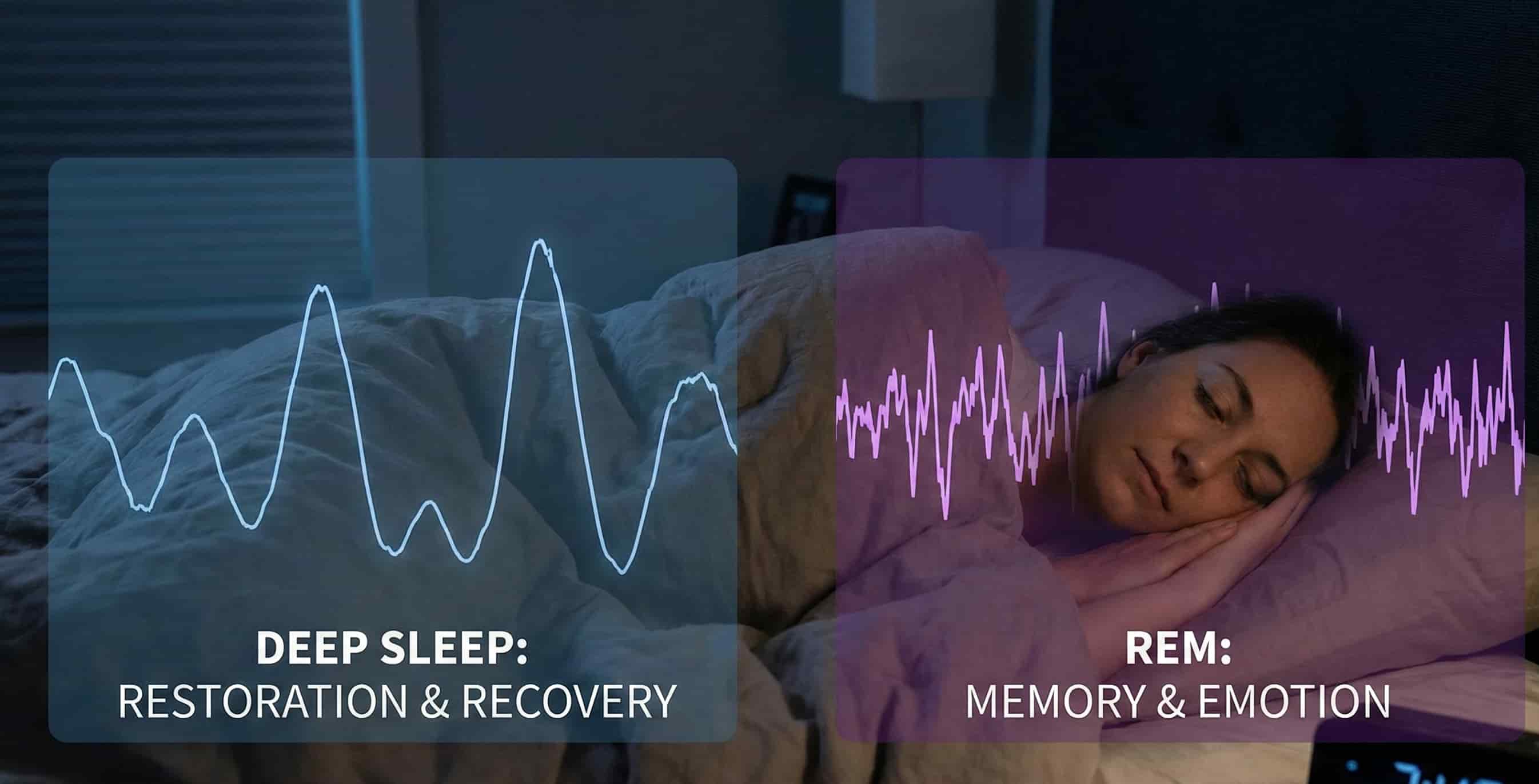
What Is the Hypnogram — and What Does a Normal Night’s Sleep Architecture Actually Look Like on a Graph?
Direct Answer: A hypnogram is a visual representation of sleep stage transitions across the night — the x-axis is time (typically midnight to 6 AM), the y-axis represents sleep depth (awake at top, N3 at bottom). A normal adult hypnogram shows a characteristic pattern: predominantly N3 in the first half of the night, progressively more N2 and increasing REM periods toward dawn, and repeated cycling through the stages approximately every 90 minutes. Seeing this graph reveals why simply counting hours of sleep misses the most important variable in sleep quality: which stages, in what proportion, and at what time of night.
Mechanism: S1-1 and S2-3 on the hypnogram and sleep architecture: the hypnogram is generated from all-night polysomnography (PSG) — EEG, EOG (eye movement), and EMG (muscle tone) recordings that together allow precise stage identification. Stage N1 is the transition from wakefulness (5% of the night in healthy adults), N2 is the dominant light sleep stage (approximately 50% of the night), N3 is the deep slow-wave sleep (15-20% of the night, concentrated in the first half), and REM constitutes approximately 20-25% of the night, concentrated in the second half. The cyclical distribution is not random — it is regulated by the circadian system, which promotes N3 at the beginning of the biological night and REM at the end, regardless of when you fall asleep. This is why going to bed late (pushing the start of sleep into the circadian N3 window) often produces surprisingly good N3 in the first part of the night — the circadian signal for N3 overrides the clock time — but severely reduces total sleep time and eliminates the morning REM periods.
Actionable Advice: Request your sleep tracker’s raw hypnogram (most provide this) and look at two things: (1) the distribution of stages across the night — do you see N3 in the first half and REM in the second half? If not, something is disrupting your architecture; (2) the number of cycles — did you complete full 90-minute cycles or were you woken mid-cycle? A complete cycle at the end of sleep is worth more than 30 extra minutes of N2 at the beginning.
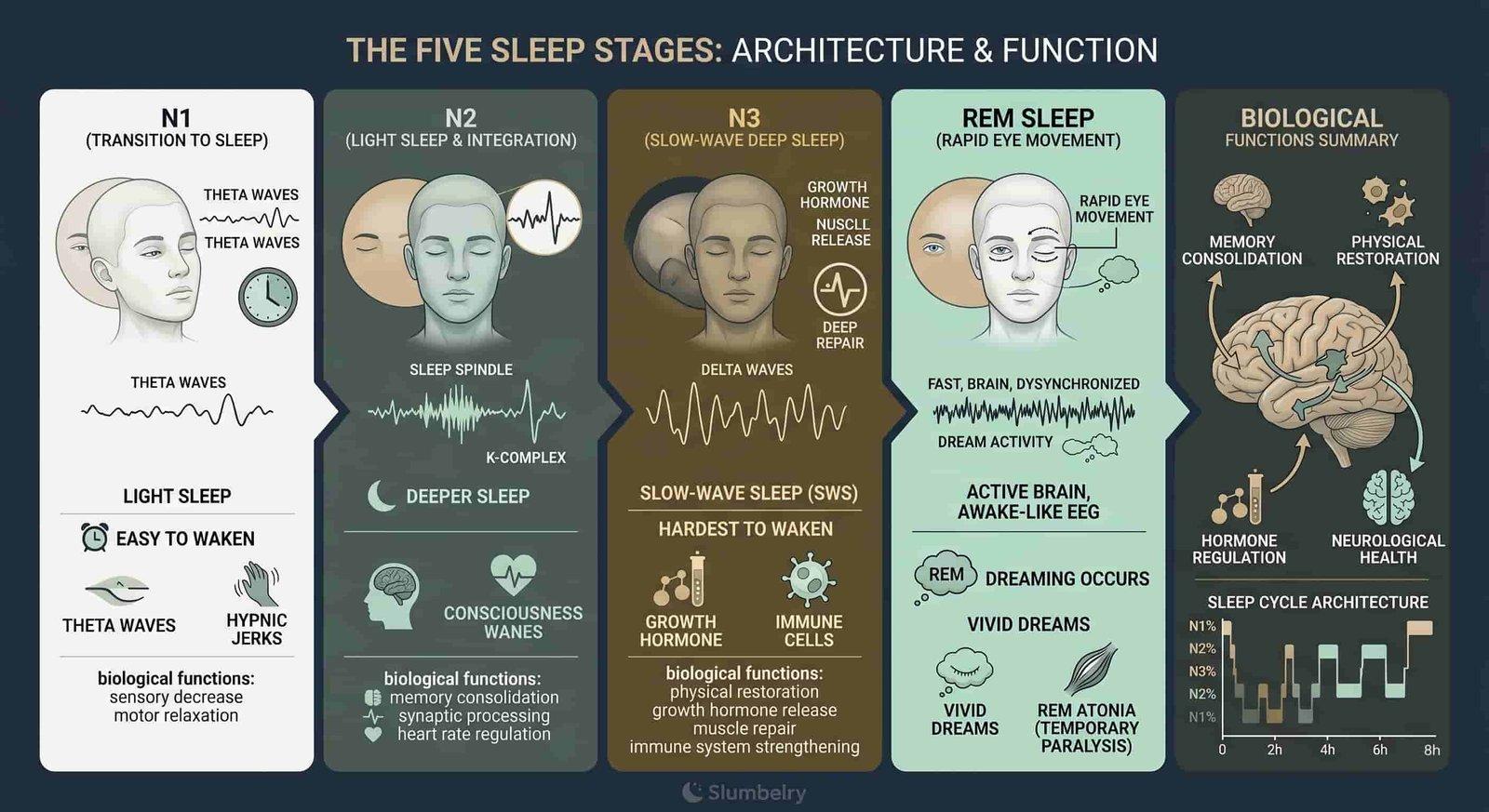
Why Is NREM Stage 2 (Sleep Spindles and K-Complexes) the Most Abundant Stage Yet Most Ignored?
Direct Answer: NREM Stage 2 constitutes approximately 50% of total sleep in healthy adults — making it by far the most abundant stage — yet it receives the least attention in popular sleep discourse, which focuses on N3 (deep sleep) and REM. This is a significant oversight: N2 is when sleep spindles (bursts of 12-15Hz neural activity) and K-complexes (large-amplitude EEG waveforms) are generated, and both perform critical memory and learning functions that are distinct from and complementary to the functions of N3 and REM.
Mechanism: S1-2 and S2-3 on sleep spindles and memory consolidation: sleep spindles are generated by thalamocortical circuitry — the thalamus fires in burst mode, triggering cortical spindle oscillations that serve as a timing signal for synaptic consolidation. Research by Diekelmann, Born, and others has shown that the density of sleep spindles during N2 correlates directly with next-day learning performance: higher spindle density = better memory encoding for new material learned the following day. The spindle is thought to temporarily strengthen synaptic connections between cortical neurons, effectively “downloading” the day’s experiences into a form ready for long-term storage. K-complexes, meanwhile, serve as the brain’s spontaneous cortical arousal suppression mechanism — they are large waveforms that appear in response to both spontaneous arousals and external sensory stimuli (a noise, a touch), and their function is to prevent the cortex from fully waking in response to minor perturbations. A night with low K-complexity is a night where the cortex is more reactive to minor stimuli, producing more full awakenings from N2. Both spindles and K-complexes are markers of healthy N2 sleep and are reduced by sleep fragmentation, alcohol, and many sedating medications.
Actionable Advice: N2 optimization is primarily about sleep continuity: fewer arousals means more time spent in N2 with preserved spindle and K-complex generation. Temperature management (keeping the room cool) is particularly important for N2 quality — warm environments suppress the N2 spindle density and increase spontaneous arousals. Spindle density naturally declines with age — by age 60, spindle generation is approximately 50% of what it was at age 20, contributing to the reduced sleep quality and memory consolidation that many older adults experience.
What Specific Biological Functions Does N3 Deep Sleep Perform That No Other Stage Can Replace?
Direct Answer: N3 slow-wave sleep is the body’s primary restoration stage — and its functions cannot be performed by N2, REM, or any waking state. It is responsible for: human growth hormone (HGH) release (the majority of daily HGH is secreted during N3), physical tissue repair and regeneration, immune system activation and maintenance, and — most critically for long-term brain health — the glymphatic clearance of metabolic waste products including beta-amyloid and tau proteins associated with Alzheimer’s disease. The brain’s glymphatic waste clearance system is approximately 60-70% more active during N3 than during any other state of consciousness, making N3 the biological non-negotiable for long-term cognitive preservation.
Mechanism: S1-2 and S2-3 on N3 functions: the slow wave sleep of N3 is characterized by the slow oscillation (0.5-1Hz) — a large-amplitude synchronized wave of depolarization (neurons firing) and hyperpolarization (neurons silenced) that spreads across the entire cortex. This synchronized firing pattern creates the convective flow of cerebrospinal fluid through the brain’s perivascular channels (the glymphatic system), flushing interstitial waste into the glymphatic vessels for clearance. During wakefulness and NREM N2, this convective flow is minimal. The N3 slow oscillation is the primary driver of the brain’s overnight metabolic maintenance cycle. Simultaneously, N3 triggers the maximal secretion of human growth hormone from the anterior pituitary — HGH is the master regulator of physical tissue repair, and the majority of daily HGH is secreted during the first N3 period of the night, typically within 30-60 minutes of sleep onset. Studies of total sleep deprivation show that two nights of missed N3 produces a 300% reduction in HGH secretion — the body simply cannot repair physical tissue adequately without N3. Additionally, N3 is the period of maximal immune activation — natural killer (NK) cell activity, cytokine production, and immune surveillance are all elevated during N3.
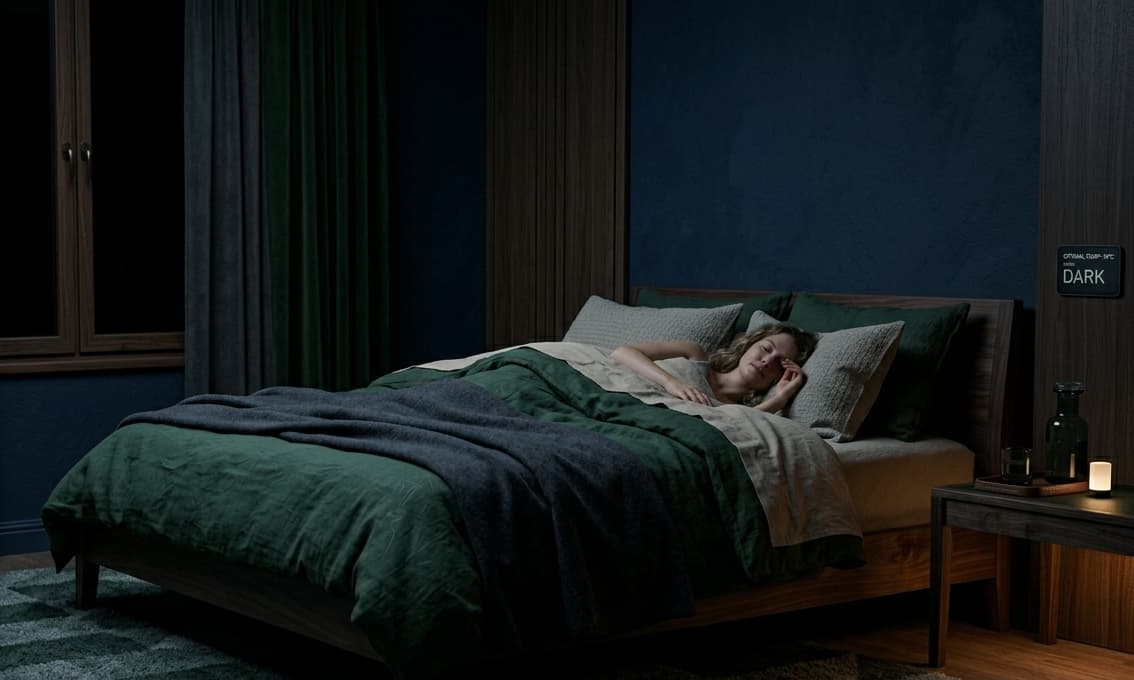
Actionable Advice: The single most important N3 optimization habit: cool your sleeping environment to 18-20°C. The core body temperature drop required for N3 initiation is triggered by peripheral vasodilation (blood vessels in the extremities dilating to release heat). A warm room prevents this mechanism, delaying N3 onset and reducing N3 duration. Even if you sleep 8 hours in a warm room, your N3 will be reduced compared to sleeping 7 hours in a cool room. Feet and hand warming (warm socks, hand warmers) accelerate peripheral vasodilation and can be used as a practical N3 optimization technique.
Why Is REM Sleep Back-Loaded in the Second Half of the Night — and Why Does Waking Early Specifically Destroy REM?
Direct Answer: REM sleep is not evenly distributed across the night — it is suppressed by the circadian system in the first half and actively promoted in the second half. This means that waking 30-60 minutes early does not just cost you a few minutes of REM — it can eliminate 30-50% of your total REM for the night, because most of the available REM periods in the second half of the night are located in the last 2-3 hours of a typical 7.5-8 hour sleep opportunity. The circadian REM promotion signal is strongest in the final third of the biological night, peaking at approximately 6-7 AM. Sleep-terminating before this window eliminates the REM-rich portion entirely.
Mechanism: S1-2 and S2-3 on REM distribution: the two-process model of sleep regulation (Borbely, 1982) explains why REM is back-loaded. Process S (homeostatic sleep pressure) is high at the beginning of the night and dissipates as you sleep — this pressure is generated by the accumulation of sleep-promoting substances (adenosine, prostaglandin D2) during wakefulness. Process C (circadian alerting signal) from the SCN counteracts Process S and is at its weakest in the early night (allowing easy sleep onset) and strongest in the morning (promoting wakefulness). REM requires minimal Process S to be present (hence it cannot dominate early in the night when S is high) but is actively promoted by Process C when Process S is low. This produces the characteristic pattern: early in the night, Process S is high, suppressing REM and allowing deep N3; toward morning, Process S is low and Process C is high, removing the barriers to REM and triggering the longest, most intense REM periods. The last 2 hours of a typical night’s sleep contain 50-60% of all REM — which is why early rising (before the full REM quota is reached) produces the cognitive and emotional deficits of REM loss.
Actionable Advice: Do not sacrifice the end of your sleep for the beginning. A 6 AM alarm that wakes you after 4 completed cycles (6 hours) is architecturally better than sleeping until 7:30 AM but waking mid-cycle at 7 AM. Identify your natural wake time without an alarm, count backward in 90-minute increments, and set your bedtime from that anchor — this preserves complete cycles regardless of total duration. The minimum viable sleep for most adults is 4 full cycles (6 hours), with 5-6 cycles (7.5-9 hours) being optimal.
What Is the 90-Minute Cycle Structure — and Why Do Sleep Architects Recommend 5 Cycles (7.5h) Over 8 Hours?
Direct Answer: Sleep cycles are approximately 90 minutes in adults, but the actual cycle length varies: early cycles (1-3) tend to be longer (100-120 minutes) with more N3 and less REM, while later cycles (4-6) are shorter (70-90 minutes) with more REM and lighter N2. The recommendation of 7.5 hours (5 cycles) over 8 hours is based on cycle completion rather than raw hours: 8 hours often produces 5.5 cycles, which means the last cycle is incomplete (wake after only 30-60 minutes of the cycle), resulting in a mid-cycle awakening that fragments the final REM period. Waking at the natural end of a cycle (after 7.5 hours) means completing all 5 cycles cleanly with no fragmentation.
Mechanism: S2-3 and S4-4 on the 90-minute cycle: the ultradian (sub-daily) rhythm of approximately 90 minutes was first described in the 1950s and is now understood to reflect a fundamental oscillation between parasympathetic-dominant (NREM) and sympathetic-dominant (REM/awake) states across the night. Each complete cycle moves through: N1 (transition, ~5 min) → N2 (light sleep, ~25-30 min) → N3 (deep sleep, ~20-30 min in early cycles, ~5 min in late cycles) → back to N2 (~5-10 min) → REM (first REM period ~5-10 min, growing to 30-45 min in later cycles). The N3-to-REM ratio shifts across cycles, with N3 dominating early and REM dominating late — this is why the first third of the night feels “deeper” and the last third feels “lighter.” The practical recommendation of 7.5 hours reflects this: 5 complete cycles is the minimum for full biological function; 6 cycles (9 hours) is optimal for full restoration, particularly for athletes, recovering from illness, or those doing heavy cognitive work.
Actionable Advice: Count your sleep in cycles, not hours. If you need to be up at 6 AM, your optimal bedtime is 10:30 PM (7.5 hours = 5 cycles). If you go to bed at 10:30 PM and wake at 6 AM naturally (without an alarm), you have completed 5 full cycles and your architecture is complete. If you go to bed at 11 PM and wake at 6 AM with an alarm, you have completed 4.7 cycles — fragments of the 5th cycle are lost, particularly the REM at the end. Even 30 minutes more in bed past your natural wake time does not fully compensate for waking mid-cycle.
How Does Sleep Architecture Change Across the Lifespan — and What Is the Normal Ratio of N3:REM at Age 20 vs. Age 60?
Direct Answer: Sleep architecture undergoes predictable, measurable changes across the lifespan — and the direction is consistent: N3 decreases and REM percentage stays relatively stable, but the total sleep time and sleep efficiency decline. At age 20, N3 constitutes approximately 20-25% of total sleep (about 90-100 minutes per night), and REM constitutes approximately 20-25% (about 90-100 minutes). By age 60, N3 has declined to approximately 5-10% of total sleep (about 30-45 minutes per night) — a 50-60% reduction — while REM remains at approximately 20% of a now-shorter total sleep time. This is not a disease; it is normal aging. However, the biological functions that N3 performs (HGH release, immune maintenance, glymphatic clearance) are reduced proportionally, which may contribute to the reduced physical resilience and increased cognitive decline observed in older adults.
Mechanism: S1-1, S1-2, and S2-3 on lifespan architecture changes: the reduction in N3 with age is primarily driven by changes in the prefrontal cortex — the slow oscillation that generates N3 is produced by prefrontal cortical neurons, and these neurons show reduced synchronization capacity with age due to normal neuronal loss, reduced dendritic arborization, and decreased myelin integrity. The thalamus (which generates sleep spindles in N2) also shows age-related changes that reduce spindle density. These are structural changes — they are not reversible through behavioral intervention, though sleep optimization (cool environment, consistent schedule, exercise) can maximize the N3 you have at any age. Critically, while total N3 decreases, the quality of N3 that remains can be preserved: studies in older adults who exercise regularly show higher N3 percentages than age-matched sedentary adults, suggesting that physical activity supports N3 maintenance. The stability of REM across the lifespan is notable — REM does not decline as dramatically as N3, which may explain why emotional memory processing (the primary function of REM) remains relatively intact in healthy aging, while physical restoration and learning (requiring N3) are more compromised.
Actionable Advice: If you are over 50, do not aim for the sleep architecture of a 20-year-old — it is not achievable. Aim to maximize the N3 you have: (1) exercise daily (particularly aerobic); (2) keep bedroom temperature low; (3) minimize CNS suppressants (alcohol, benzodiazepines) which suppress N3 further; (4) ensure adequate magnesium (involved in N3 slow oscillation generation). Targeting 60+ minutes of N3 per night (instead of the 30-40 minutes typical for your age) is a realistic and meaningful goal that preserves meaningful biological function.
What Sleep Disorders Specifically Disrupt N3 and REM — and How Do They Present as ‘Normal’ Sleep on Subjective Reports?
Direct Answer: Several sleep disorders specifically target N3 and REM while preserving the subjective sensation of sleep — meaning people with these conditions often report “I slept fine” despite having severely compromised architecture. Obstructive sleep apnea (OSA) fragments N3 and REM by triggering hundreds of micro-arousals per night. Paradoxical insomnia (sleep state misperception) produces objectively normal sleep architecture but subjective wakefulness. Sedating medications (benzodiazepines, Z-drugs, antihistamines) suppress N3 and REM by 30-50% while producing subjective sleep that feels deep. Periodic limb movement disorder (PLMD) causes leg movements every 20-40 seconds that fragment N3 without full waking.
Mechanism: S2-3 and S4-3 on sleep disorders and architecture: OSA is the most architecturally destructive common condition — each apneic event (airway closure lasting 10-60+ seconds) triggers an arousal to restore airway patency. These arousals are often subcortical (measurable on EEG without full consciousness) and can occur hundreds of times per night without the person being aware. The N3 that occurs at the beginning of the night is most affected because the progressive oxygen desaturation and respiratory effort become more severe as N3-relaxed muscle tone combines with pre-existing airway collapse. REM is particularly vulnerable in OSA because REM atonia extends to the upper airway muscles, worsening collapse. The result is severe REM-specific OSA — people with moderate-severe OSA can have almost zero REM on diagnostic sleep studies, yet report sleeping fine. Benzodiazepines (zolpidem, temazepam, clonazepam) suppress N3 by enhancing GABA — the same mechanism that makes them sedating. Zolpidem specifically reduces N3 by 40-60% while increasing N2 — the subjective feeling is one of deep, heavy sleep, but the N3-dependent functions (immune, HGH, glymphatic) are severely compromised. This is why people on chronic Z-drug therapy often show accelerated immune dysfunction, reduced physical recovery, and increased Alzheimer’s risk.
Actionable Advice: If you report sleeping 7+ hours but feel unrefreshed with reduced cognitive performance and mood stability, request a sleep study — particularly if you snore, have been told you stop breathing during sleep, or take any sleep medication regularly. What feels like “normal sleep” to you may be severely compromised architecture that responds to treatment. The PSG (polysomnography) will show the architecture breakdown that your subjective report cannot reveal.
Why Does Fragmented Sleep With ‘Normal’ Total Hours Still Produce Cognitive Impairment?
Direct Answer: Fragmented sleep — even when total sleep duration is 7+ hours — produces measurable cognitive impairment through the specific loss of consolidated N3 and REM periods. Fragmentation prevents the brain from completing the long, uninterrupted cycles that produce high-quality N3 and REM. The cognitive cost is disproportionate because the impairment is not in the quantity of sleep but in the biological quality of each stage — a person who sleeps 8 hours with 20 fragments has the same total sleep time as someone sleeping 7 hours with 2 fragments, but dramatically worse cognitive outcomes because the fragmented sleeper has 50-70% less consolidated N3 and REM.
Mechanism: S1-2 and S2-3 on sleep fragmentation: the N3 and REM functions require consolidated time to perform their biological tasks. N3 slow-wave generation requires approximately 20-30 minutes of continuous N2 before deep N3 emerges — each fragmentation resets this timer. In a fragmented night, the brain repeatedly initiates N3 but never reaches the deepest, most restorative phase before an arousal resets it to N2 or lighter. Studies comparing consolidated 8-hour sleep to fragmented 8-hour sleep (matched for total duration) show 30-40% less N3 in the fragmented condition, with corresponding deficits in next-day memory consolidation, reaction time, and executive function. The cumulative effect is significant: people sleeping 6.5 hours with no fragments regularly outperform people sleeping 7.5 hours with 15+ fragments on cognitive testing. Fragmentation sources include: OSA, periodic limb movements, noise, temperature discomfort, pets, children, nocturia (frequent nighttime urination — particularly common in men over 50 and a major cause of unidentified sleep fragmentation).
Actionable Advice: Sleep continuity is as important as sleep duration. Track your fragmentation index (most sleep trackers provide this number — the target is under 5 fragments per night). If you have high fragmentation, identify the cause: (1) if frequent urination, see a urologist — treating benign prostatic hyperplasia or overactive bladder can dramatically improve sleep continuity; (2) if noise, use white/pink noise; (3) if temperature, cool the room; (4) if partner movement, consider motion-isolating mattress. Even one night of highly fragmented sleep produces measurable next-day cognitive impairment equivalent to 24 hours of total sleep deprivation for some executive functions.
How Does N3 Deep Sleep Drive the Glymphatic System — and What Is the Implication for Alzheimer’s Prevention?
Direct Answer: The glymphatic system — the brain’s overnight waste clearance mechanism — operates primarily during N3 slow-wave sleep, powered by the convective flow of cerebrospinal fluid generated by the cortical slow oscillation. This system clears approximately 60% of the beta-amyloid and tau proteins that accumulate in the brain during waking hours. Epidemiological and biomarker studies consistently show that adults with chronically reduced N3 have significantly higher rates of cognitive decline and Alzheimer’s disease biomarkers (CSF beta-amyloid 42, PET amyloid scans). This does not prove causation, but the mechanistic link is strong: N3 drives glymphatic clearance; reduced N3 reduces clearance; accumulated neurotoxic proteins increase Alzheimer’s risk.
Mechanism: S2-3 and S1-2 on the glymphatic system: the glymphatic system was first characterized by Maiken Nedergaard and colleagues at the University of Rochester in 2012. The system works through perivascular channels (spaces around the brain’s blood vessels) that act as conduits for cerebrospinal fluid (CSF) to flow through the brain’s interstitial spaces, collecting metabolic waste products. This convective flow is driven by the bulk flow of water through aquaporin-4 (AQP4) channels on the astrocyte endfeet that line the perivascular spaces. The key activation trigger for glymphatic flow is the N3 slow oscillation: as cortical neurons synchronously depolarize and repolarize at 0.5-1Hz, they create a pumping action that drives CSF through the interstitial spaces. N2 and REM do not generate sufficient synchronized cortical activity to drive meaningful glymphatic flow — only N3 does. Studies in mice show that glymphatic clearance is 40-60% lower during wakefulness than during N3 sleep. Human studies using contrast-enhanced MRI show that the glymphatic system is active primarily during N3 and is suppressed by alcohol, sedatives, and fragmented sleep — all of which reduce N3. The implication for Alzheimer’s is that chronic N3 reduction may accelerate the accumulation of beta-amyloid plaques, which in turn further impair N3 generation (a vicious cycle where amyloid accumulation in the cortex disrupts slow-wave generation, which reduces N3, which reduces clearance, which allows more amyloid to accumulate).
Actionable Advice: Sleep architecture optimization is a long-term Alzheimer’s prevention strategy — alongside diet, exercise, and cognitive stimulation. Prioritizing N3 quality (cool room, no alcohol, consistent schedule) and protecting total sleep time are not just about tomorrow’s energy — they are about the brain’s overnight maintenance cycle that determines cognitive health at age 60, 70, and 80. This is particularly important given that N3 naturally declines with age: maintaining as much N3 as possible becomes increasingly important as the glymphatic window narrows.
What Is the Minimum Deep Sleep and REM Threshold for Cognitive and Physical Health — and How to Measure Whether You’re Getting Enough?
Direct Answer: The minimum thresholds for maintaining cognitive and physical health are approximately 60-90 minutes of N3 per night (13-15% of an 8-hour night) and 90-120 minutes of REM per night (20-25% of an 8-hour night). Below these thresholds, measurable deficits appear in memory consolidation, immune function, and next-day stress regulation within days to weeks. These are minimums — they maintain baseline function but do not produce optimal performance. For peak cognitive and physical performance, the targets are approximately 90-120 minutes of N3 and 100-130 minutes of REM per night.
Mechanism: S1-1 and S2-3 on minimum thresholds: the minimum N3 threshold of approximately 60-90 minutes is derived from the observation that below this amount, the glymphatic clearance, HGH release, and immune activation functions fall below the level required to maintain baseline physical health. Studies of partial sleep deprivation (where subjects sleep only 4-5 hours per night) show that within 1 week, N3 drops to approximately 40-60 minutes per night (reflecting a homeostatic ceiling that attempts to prioritize N3 under sleep pressure), but even with this prioritization, the N3 deficit accumulates and measurable immune dysfunction appears (reduced NK cell activity, reduced antibody response to vaccines). The REM minimum of 90-120 minutes reflects the emotional memory consolidation requirement: REM is when the limbic system processes the emotional experiences of the previous day, tagging emotionally significant memories and reducing the emotional charge of difficult experiences. Below 90 minutes of REM, emotional regulation begins to deteriorate — irritability increases, stress tolerance decreases, and next-day mood worsens. These effects are often attributed to “being stressed” rather than being sleep-deprived, which delays recognition of the real cause.
Actionable Advice: Use objective tracking, not subjective feeling, to assess your architecture. Consumer sleep trackers (Oura, WHOOP, Apple Watch, Eight Sleep) provide reasonable estimates of N3 and REM (within 10-15% of PSG-measured values). Track these numbers for 5-7 nights including nights with and without alcohol, varying bedtimes, etc. Aim for: minimum 60 min N3 per night (non-negotiable), minimum 90 min REM per night (non-negotiable). If you consistently fall below these, the cause is most likely one of three: sleep fragmentation (address first), alcohol (eliminate), or insufficient total sleep time (add 30-60 min). These two numbers — N3 and REM — are the true metrics of sleep quality. Everything else (time in bed, sleep onset latency, total sleep time) is secondary.
Frequently Asked Questions
What are the five stages of sleep and what happens in each?
Direct Conclusion: Sleep has 5 stages: N1 (5% of night, transition from wakefulness, easily disturbed); N2 (50% of night, sleep spindles and K-complexes, memory consolidation support); N3 (15-20% of night, slow-wave deep sleep, HGH release, immune function, glymphatic clearance); REM (20-25% of night, dreaming, emotional memory consolidation, creative problem-solving). Each stage is non-redundant — eliminating any stage produces specific biological deficits.
Why is deep sleep (N3) non-negotiable for physical health?
Direct Conclusion: N3 performs three functions that cannot be done by other stages or wakefulness: (1) Human growth hormone release — the majority of daily HGH is secreted during the first N3 period, regulating physical tissue repair and muscle maintenance; (2) Immune system activation — NK cell activity, cytokine production, and immune surveillance peak during N3; (3) Glymphatic clearance — the brain’s overnight waste clearance (including beta-amyloid and tau proteins) is 60-70% more active during N3 than any other state. Missing N3 means the body cannot fully repair, defend, or clean itself.
What happens if I don’t get enough REM sleep?
Direct Conclusion: Within days of REM reduction, emotional regulation deteriorates measurably: irritability increases, stress tolerance drops, and next-day mood worsens. REM is specifically responsible for processing the previous day’s emotional experiences, removing the emotional charge from difficult memories, and consolidating procedural learning (how to do things, not just what facts are). After 1-2 nights of severe REM restriction, studies show reduced emotional intelligence scores, impaired facial emotion recognition, and increased reactivity to minor stressors. Chronic REM deficit is associated with increased anxiety and depression risk.
Is 7.5 hours actually better than 8 hours?
Direct Conclusion: Yes, architecturally — if 7.5 means 5 complete cycles and 8 means waking mid-cycle. Waking at the natural end of a cycle at 7.5 hours (5 cycles) preserves all REM periods. Waking at 8 hours after going to bed at 11 PM means waking 30 minutes into the 6th cycle — the REM at the end of cycle 5 is intact but the 6th cycle is cut off. The 7.5-hour clean completion beats 8 hours with mid-cycle interruption for architecture quality. However, if 8 hours means going to bed at 10 PM and waking naturally at 6 AM, that is actually 8 hours and 5 complete cycles — the extra 30 minutes may include a partial 6th cycle, which is architecturally bonus, not harmful.
How much deep sleep and REM do I actually need?
Direct Conclusion: Minimum for health maintenance: approximately 60-90 minutes of N3 and 90-120 minutes of REM per night — roughly 13-15% and 20-25% of total sleep respectively. For optimal cognitive and physical performance: target 90-120 minutes of N3 and 100-130 minutes of REM per night. Consumer trackers provide reasonable estimates (within 10-15% of PSG values) and allow you to track these over time. If you consistently fall below the minimums, the most common causes are: alcohol (reduces both N3 and REM significantly), fragmentation, and insufficient total sleep time.
Why do I feel worse after sleeping 9 hours than after 7 hours?
Direct Conclusion: Sleep inertia and circadian disruption are the most likely causes. Sleeping 9+ hours often means waking in the middle of a circadian low point (the early afternoon dip) or allowing the circadian system to drift later, which then delays sleep onset that night and produces a cycle of social jet lag. Additionally, sleeping late often means sleeping past the natural cortisol awakening response, which can produce grogginess that takes 30-60 minutes to clear. If you consistently need 9+ hours of sleep to feel rested, it typically indicates either chronic sleep debt (you need more sleep, not less) or a sleep disorder that is reducing the quality of the sleep you are getting.
Does deep sleep decrease with age?
Direct Conclusion: Yes, significantly — and measurably. N3 declines by approximately 50-60% between age 20 and age 60: from 90-100 minutes per night to 30-45 minutes. This is driven by structural changes in the prefrontal cortex (which generates the slow oscillation) and is a normal part of aging, not a disease. However, while the quantity of N3 decreases, the quality of N3 that remains can be preserved through exercise, cool sleeping environment, and minimizing CNS suppressants. N3 at any age is better than no N3 — the 30 minutes of N3 an 80-year-old gets is still performing glymphatic clearance that is better than nothing.
Can I ‘make up’ lost deep sleep or REM on the weekend?
Direct Conclusion: Partially, but incompletely. The body can recover lost N3 through N3 rebound (more N3 than usual in the recovery night), but the recovery is not 1:1 — sleeping 2 extra hours on Sunday after a short Monday-Tuesday will provide some N3 recovery but not full compensation. REM recovery is even more limited — the homeostatic pressure for REM is lower than for N3, so recovery sleep is preferentially allocated to N3 over REM. Weekend sleep-ins can partially compensate for accumulated sleep debt but will not fully restore cognitive function if N3 and REM were severely restricted during the week. The better strategy is to prevent the debt rather than attempt to repay it.
What disrupts deep sleep and REM most?
Direct Conclusion: Top disruptors: (1) Alcohol — reduces N3 by 30-50% and REM by 20-40% in a dose-dependent manner; (2) Benzodiazepines and Z-drugs — reduce N3 by 30-60% by enhancing GABA; (3) OSA — fragments sleep with hundreds of micro-arousals per night, eliminating N3 and REM consolidation; (4) Warm sleeping environment — prevents the core temperature drop required for N3 initiation; (5) Caffeine in the afternoon/evening — extends adenosine clearance time, suppressing N3; (6) Inconsistent sleep schedule — varying bedtimes by 2+ hours disrupts the circadian timing of N3 and REM distribution.
How can I increase my deep sleep and REM without medication?
Direct Conclusion: The evidence-based non-pharmacological interventions with strongest support: (1) Aerobic exercise — increases N3 percentage within days and is the single most effective behavioral N3 enhancer; (2) Cool bedroom (18-20°C) — enables peripheral vasodilation and core temperature drop required for N3; (3) Consistent bedtime and wake time — stabilizes circadian timing of architecture; (4) No alcohol within 5 hours of sleep — eliminates the single largest architectural disruptor; (5) Valerian root or magnesium glycinate — mild evidence for N2 improvement, minimal effect on N3/REM; (6) Omega-3 fatty acids (DHA/EPA) — associated with increased REM in several studies. None of these work instantly — allow 7-14 days of consistent application to see the full effect on your sleep tracker data.
Build the Architecture. The Hours Will Follow.
Stop counting hours. Start optimizing stages. N3 and REM are the non-negotiables. Everything else is secondary. Cool your room, complete your cycles, and protect your architecture like the biological infrastructure it is.
Cooling Sleep Systems Architecture-Supporting PillowsThe Slumbelry Commitment
Sleep is the most vulnerable state of human existence. It is where we heal, reset, and grow.
At Slumbelry, we do not just sell sleep products; we advocate for your physiological right to rest. From ergonomic support to light management, every solution we offer is designed with one obsession: Respecting your Biology.
Science is our language, but your recovery is our purpose. You take care of everything else in your life — let us take care of your nights.
Rest Deeply,
The Slumbelry Team