
How Exercise Timing Impacts Your Rest
Why Exercising at the Wrong Time Can Make Sleep Worse Instead of Better — The Body Temperature Mechanism That Actually Matters
Exercise is the single most effective non-pharmacological tool for improving sleep — more powerful than melatonin, magnesium, blackout curtains, white noise, or any sleep supplement you can buy. Research consistently shows that regular aerobic exercise increases N3 deep sleep by 20-30 minutes per night and reduces sleep onset latency by 10-15 minutes in poor sleepers.
But here is the catch most people miss: timing matters. Exercise raises cortisol, heart rate, and core body temperature — three things that are the direct enemies of sleep onset. Hit the gym at 9 PM, and you are activating your sympathetic nervous system when it should be powering down. Sleep onset gets pushed back, and the first part of the night is spent recovering from the training rather than building deep sleep.
The exercise and sleep guide is the evidence-based breakdown of exactly how exercise affects your sleep architecture, when to train for maximum sleep benefit, and the specific protocol that has the strongest research support.
⚡ Core Takeaway: Exercise Is the Most Powerful Non-Pharmacological Sleep Enhancer — But Timing Is the Key Variable
- The Problem: Exercise raises core body temperature, cortisol, and heart rate — all arousal signals. If performed too close to bedtime (within 2-3 hours), the thermogenic and HPA-axis activation can delay sleep onset by 20-30 minutes even though the person feels tired. However, the problem is not exercise itself — it is the timing relative to the sleep window. Morning exercise in cool conditions produces the optimal thermal drop at bedtime, and afternoon/evening exercise produces the post-exercise temperature nadir that can be sleep-promoting if timed correctly
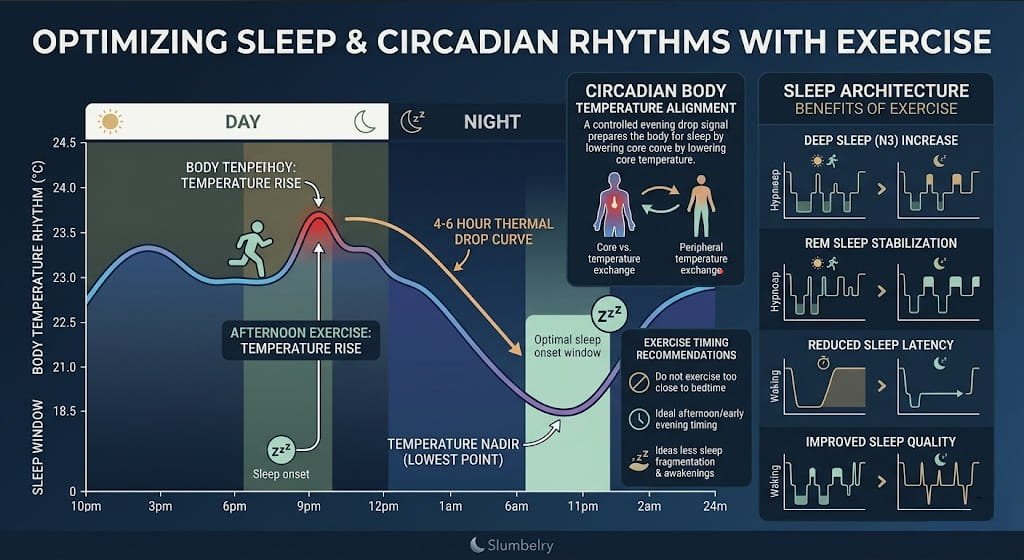
- The Mechanism: Sleep onset requires a 1-2°C core body temperature drop, driven by peripheral vasodilation. Exercise at 4-6 PM produces a temperature spike followed by the compensatory nadir 4-6 hours later — precisely at bedtime — creating a stronger sleep-onset signal than melatonin. Regular aerobic exercise additionally reduces 24-hour cortisol, increases vagal tone (parasympathetic activity), and increases adenosine accumulation — multiple biological pathways by which exercise improves sleep quality simultaneously
- The Protocol: Morning exercise (6-8 AM) for circadian entrainment and fastest N3 benefit: the N3-enhancing effect of exercise takes 2-3 weeks to fully emerge with consistent practice; afternoon exercise (3-5 PM) for the thermal drop mechanism; minimum 4-hour pre-sleep buffer for vigorous training; avoid training within 2 hours of sleep if sleep onset latency is an issue; yoga/stretching within 1 hour of sleep is acceptable because it does not spike core temperature significantly; consistency matters more than timing — 5 moderate morning sessions per week produces better sleep than 2 intense evening sessions

Why Does Exercise Increase N3 Deep Sleep — and What Is the Acute vs. Chronic Exercise Effect on Sleep Architecture?
Direct Answer: Exercise is the single most effective behavioral intervention for increasing N3 (deep slow-wave sleep), and the mechanism operates through two distinct timeframes: acute effect (a single workout produces an immediate N3 boost the following night through adenosine accumulation and metabolic demand) and chronic effect (2-3 weeks of consistent exercise produces structural and neurochemical adaptations that sustain elevated N3). Neither effect requires exercise to be timed perfectly — both morning and afternoon exercise produce N3 enhancement, though through slightly different pathways.
Mechanism: S1-2 and S2-3 on exercise and sleep architecture: the acute N3 boost is driven by increased adenosine accumulation during waking hours — adenosine is the metabolic byproduct of sustained wakefulness and ATP consumption, and it is the primary substrate of sleep pressure (Process S in the two-process model). Exercise accelerates ATP turnover and therefore adenosine production, increasing homeostatic sleep pressure and driving deeper N3 on the subsequent night. The chronic N3 enhancement from regular exercise involves more complex adaptations: regular aerobic exercise reduces 24-hour sympathetic tone (lower baseline cortisol, higher parasympathetic/vagal tone), improves insulin sensitivity, reduces inflammation (lower IL-6, CRP), and increases BDNF (brain-derived neurotrophic factor) in the hippocampus — all of which create a neurobiological environment more permissive for deep sleep. Meta-analyses of exercise and sleep consistently find that regular aerobic exercise (3-5 sessions per week, 30-60 minutes per session) produces approximately 20-30 minutes more N3 per night compared to sedentary controls, with the effect strongest in poor sleepers and in adults over 40.
Actionable Advice: Do not expect one workout to fix your sleep — the chronic effect requires 2-3 weeks of consistency to fully emerge. The N3-enhancing effect of exercise is dose-dependent: higher aerobic fitness (measured by VO2 max) is associated with higher N3 percentage, even controlling for total sleep time. If you are a poor sleeper and do not currently exercise, starting 5 moderate sessions per week will produce measurable improvements in N3 within 3-4 weeks — often comparable to the effect of mild sleep medication, without the side effects.
What Is the Body Temperature Rhythm — and Why the Post-Exercise Drop Is a More Powerful Sleep Signal Than Any Supplement?
Direct Answer: The circadian body temperature rhythm is a sine-wave-like oscillation with a peak in late afternoon (4-6 PM at approximately 37.5°C) and a nadir in the early morning (4-5 AM at approximately 36.2°C). The core temperature drop of approximately 1-3°C that occurs in the 1-2 hours before sleep onset is not incidental — it is an active biological signal that the SCN sends to trigger sleep onset. Peripheral vasodilation (blood vessel dilation in the hands and feet) is the mechanism: as core temperature drops, blood is shunted to the extremities to release heat, and this peripheral warming is detected by the SCN as the temperature nadir signal. Exercise, particularly in the afternoon, accelerates and amplifies this natural drop: the post-exercise temperature rise followed by the compensatory drop creates a larger-than-normal temperature nadir, which is a more powerful sleep-onset signal than melatonin, magnesium, or any other sleep supplement.
Mechanism: S1-2 and S4-3 on temperature and sleep: sleep onset is preceded by distal vasodilation — the hands and feet become warmer as blood is shunted from the core to the periphery to release heat. This is detectable by measuring distal-proximal skin temperature gradient (DPG). A higher DPG (warmer hands/feet, cooler core) is one of the most reliable physiological markers of sleep onset readiness — more reliable than subjective sleepiness or clock time. Exercise accelerates this process when timed correctly: exercising at 4-6 PM produces a core temperature spike of 0.5-1.5°C above baseline. The body then activates cooling mechanisms, with the peak cooling response occurring 4-6 hours after exercise — precisely the 10 PM-midnight window for most sleepers. This amplified temperature nadir creates a stronger sleep-onset signal than the natural (unassisted) temperature drop. Hot baths work on the same principle in reverse: a hot bath 90 minutes before bed produces peripheral vasodilation and a compensatory core temperature drop (the warm bath paradox) — both exercise and hot baths use the same thermoregulatory pathway to facilitate sleep.
Actionable Advice: If you want to use exercise specifically for its thermal sleep benefit: train between 4-6 PM to maximize the post-exercise temperature nadir at bedtime. Alternatively, if your schedule demands morning training, take a hot bath or shower 90 minutes before your desired sleep time to artificially trigger the compensatory temperature drop. Do not train within 2-3 hours of bedtime if sleep onset latency is a problem — the core temperature is still elevated and the sleep-onset signal is blunted.
Why Is Morning Light Exposure More Important Than Morning Exercise for Sleep-Wake Timing?
Direct Answer: Morning light is the most powerful circadian zeitgeber (time-giver) for the suprachiasmatic nucleus (SCN), and it directly sets the timing of the entire sleep-wake cycle for the following 24 hours. Morning exercise is beneficial for sleep, but its circadian effect is secondary to and dependent on light exposure — exercise in the morning helps sleep primarily because outdoor exercise typically occurs in natural light, not because exercise itself sets the clock. The SCN is approximately 10,000 times more sensitive to light than to any other zeitgeber. The cortisol awakening response, the melatonin offset signal in the morning, and the timing of the homeostatic sleep pressure peak in the evening are all regulated by the SCN based on morning light exposure.
Mechanism: S1-1 and S2-3 on light and circadian entrainment: the SCN uses the timing of light exposure to calibrate its internal clock. Morning light (within 1-2 hours of waking, at approximately 1000+ lux) triggers the cortisol awakening response, advances the circadian phase (shifts the clock earlier), and sets evening melatonin onset earlier. This produces an earlier sleep schedule the following night. This is why people who consistently wake and receive light exposure at 6-7 AM naturally become sleepy at 10-11 PM — the SCN has calculated that approximately 14-16 hours of circadian time have passed and it is time to initiate sleep. Exercise without light does not have this effect: studies of morning exercise in dim light conditions show minimal circadian phase advancement. The combination of outdoor exercise + morning light produces the strongest circadian entrainment, which is why morning exercisers often report not needing alarms — their circadian clock is accurately predicting their sleep onset time.
Actionable Advice: Prioritize morning light over morning exercise for circadian regulation. If you can only do one: get 15-20 minutes of outdoor light (even on a cloudy day, outdoor lux >> indoor lux) within 30 minutes of waking, before looking at your phone or going outside. Then exercise. The light does not need to be direct sunlight — walking to the coffee shop, sitting by a bright window, or taking the dog out first thing in the morning is sufficient to trigger the circadian advance. This single habit will shift your sleep onset earlier by 30-60 minutes within 2-3 days.
What Is the 4-6 Hour Thermal Buffer Rule — and Does Late-Night Exercise Actually Disrupt Sleep Onset?
Direct Answer: The 4-6 hour thermal buffer rule states that vigorous exercise should be completed at least 4-6 hours before intended sleep onset to allow the post-exercise temperature peak to complete its descent and reach the temperature nadir that signals sleep onset. Late-night exercise (within 2-3 hours of bedtime) can delay sleep onset by 20-30 minutes in sensitive individuals by maintaining elevated core temperature and sympathetic activation when the body should be transitioning to parasympathetic dominance. However, the thermal buffer rule applies to vigorous/high-intensity training, not to low-intensity movement — yoga and stretching at 9 PM do not significantly spike core temperature and do not require the same buffer.
Mechanism: S2-3 and S4-4 on exercise timing and sleep onset: vigorous exercise (>70% VO2 max) elevates core temperature by 0.5-1.5°C, heart rate, cortisol, and norepinephrine — all indicators of sympathetic activation that are incompatible with sleep onset. The thermal rise peaks approximately 30-60 minutes after cessation of exercise, and the return to baseline follows a gradual decline over 4-6 hours. If sleep onset occurs before core temperature has returned to baseline, the elevated temperature interferes with the peripheral vasodilation required for sleep onset — the body cannot complete the temperature drop that triggers the sleep-onset signal. Studies measuring sleep onset latency (SOL) after late-night exercise (10 PM training, 11 PM bedtime) show SOL delays of 15-30 minutes compared to no-exercise control nights, with increased REM latency and reduced N3 in the first part of the night. However, when the same exercise is performed at 4 PM and sleep occurs at 11 PM, SOL is shorter than no-exercise nights — the post-exercise thermal drop creates a net sleep-promoting effect.
Actionable Advice: Apply the 4-6 hour buffer to high-intensity training only. If you must train late: (1) keep intensity below 60% VO2 max (walking, light cycling) — this does not significantly spike core temperature; (2) finish intense training by 7 PM at the latest to allow the 4-6 hour thermal window before 11 PM bedtime; (3) use a cool shower 30 minutes before bed to accelerate the temperature drop. Note that the 4-6 hour rule is for sleep onset, not for sleep quality — even if you sleep normally after late-night training, the N3 efficiency of that sleep is reduced if the training was vigorous, due to elevated cortisol during the sleep period.
How Does Moderate vs. High-Intensity Exercise Differentially Affect Sleep Architecture — and What Is the RPE Data?
Direct Answer: Both moderate and high-intensity exercise improve N3, but they differ in the trade-off between sleep onset latency and sleep quality: moderate exercise (50-65% VO2 max, rated perceived exertion RPE 11-13) produces consistent N3 enhancement without interfering with sleep onset timing. High-intensity exercise ( >75% VO2 max, RPE 15-17) produces a larger N3 boost in the acute period but can delay sleep onset if performed within 3 hours of bedtime due to elevated sympathetic tone and cortisol. The overall sleep architecture benefit of high-intensity training is still positive when total 24-hour sleep quality is measured — the N3 enhancement outweighs the mild sleep-onset delay — but the timing trade-off must be managed.
Mechanism: S2-3 and S4-4 on exercise intensity and sleep: the dose-response relationship between exercise intensity and sleep quality follows an inverted-U: very sedentary people benefit most from adding any exercise; moderate exercisers benefit from increasing intensity slightly; very high-intensity athletes may experience overtraining syndrome that paradoxically reduces sleep quality. The RPE scale (Borg, 1970) provides a practical framework: RPE 11-13 (somewhat hard — a conversation is possible but requires effort) is the sweet spot for sleep enhancement in most adults. RPE 15-17 (very hard — conversation is difficult) produces a larger acute N3 boost but also elevated cortisol that can persist into the sleep period, reducing sleep efficiency. Studies comparing equal-energy workouts at different intensities consistently show that the moderate-intensity session produces better same-night sleep efficiency (time asleep / time in bed) while the high-intensity session produces a larger N3 increase but slightly lower sleep efficiency. For long-term sleep optimization, moderate-intensity consistency (5 sessions per week) outperforms periodic high-intensity sessions.
Actionable Advice: For sleep-specific benefit: target RPE 11-13 (somewhat hard) most days, with 1-2 higher-intensity sessions per week if your training goals require it. If you are training for both performance and sleep, place high-intensity sessions in the mid-afternoon (3-5 PM) to use the thermal drop mechanism. Reserve the morning for moderate recovery sessions and always prioritize consistency — four moderate sessions per week produces better sleep than two intense sessions and two sedentary days.
Why Is Consistency More Important Than Timing for the Exercise-Sleep Relationship?
Direct Answer: The sleep-enhancing effect of exercise is cumulative and consistency-dependent. The most important variable is not when you exercise but whether you exercise consistently — the chronic structural adaptations (reduced sympathetic tone, improved insulin sensitivity, lower inflammation, increased BDNF) that drive the N3 boost require weeks of consistent exercise to manifest. A person who exercises every morning at 6 AM will have better sleep architecture than a person who exercises at the theoretically optimal 4 PM time but only 2 days per week.
Mechanism: S2-3, S4-4, and Montgomery et al. (1989) on exercise consistency: the landmark study by Montgomery and colleagues demonstrated that the relationship between exercise and improved sleep quality is not dependent on the timing of the exercise relative to sleep — it is dependent on the chronicity and regularity of the exercise habit. A consistent morning exercise routine produces stable circadian timing (same wake time, same cortisol awakening response, same melatonin onset), which is itself a primary driver of sleep quality. The SCN requires regularity to maintain stable timing — a stable wake time is the SCN’s primary zeitgeber, and exercise amplifies this effect when performed at the same time each day. Additionally, the homeostatic sleep pressure mechanism (adenosine accumulation) works more predictably when wake times and physical activity levels are consistent, producing more reliable sleep onset and better consolidated N3 and REM periods.
Actionable Advice: Build the habit first, then optimize the timing. If you are starting an exercise habit: exercise at whatever time you can consistently maintain (morning, afternoon, or evening), and do not sacrifice consistency for perfect timing. Once the habit is stable (3+ months of consistent exercise), you can experiment with timing shifts to optimize for sleep architecture. The worst outcome is to cycle between inconsistent exercise sessions at theoretically optimal times and prolonged sedentary periods — this creates irregular circadian timing that is more disruptive to sleep than either consistent moderate training or complete sedentary behavior.
What Is the ‘Paradox of Exertion’ — and Why ‘Too Tired to Exercise’ Actually Produces Worse Sleep?
Direct Answer: The paradox of exertion describes the well-documented finding that sedentary individuals who are physically tired from daily life (not from exercise) consistently report worse sleep quality than those who are physically fatigued from exercise. The reason is that sedentary tiredness is driven by accumulated sleep pressure without the metabolic and neurochemical benefits of exercise — adenosine has built up but the brain has not received the N3-promoting signals that come from physical exertion. In other words: sedentary tiredness is not the same as the healthy fatigue of exercise; it is a state of simultaneous exhaustion and arousal that prevents both good sleep and good wakefulness.
Mechanism: S2-3 on sedentary fatigue and sleep: sedentary individuals accumulate adenosine from cognitive and emotional wakefulness (screen time, work stress, emotional activation) rather than from the metabolic demand of physical exertion. This adenosine accumulation produces subjective tiredness but simultaneously elevates cortisol (the stress response to accumulated wakefulness burden), creating the “tired but wired” state. Cortisol elevation from chronic psychosocial stress activates the HPA axis, which suppresses N3 and fragment sleep — so the tired sedentary person falls asleep but does not stay in N3 long enough to recover, producing non-restorative sleep that generates more adenosine but less N3-efficient recovery. Exercise breaks this cycle by: (1) providing a healthy outlet for cortisol (exercise is a cortisol regulator, not a cortisol producer — acute cortisol spikes from exercise are followed by a compensatory drop that lowers 24-hour cortisol exposure); (2) creating genuine physical fatigue that drives N3 through sleep pressure and peripheral vasodilation; (3) reducing the anxiety and rumination that maintain elevated sympathetic tone during the sleep period.
Actionable Advice: When you feel “too tired to exercise,” this is exactly when you should exercise — but at low intensity. A 20-minute walk at RPE 9-10 (easy, conversational pace) will produce the paradox effect: the physical fatigue from the walk combined with the cortisol-regulating effect of exercise will make you sleepier that night than if you had rested. The worst thing you can do for sleep when tired is to stay sedentary — it maintains the tired-but-wired state without providing the recovery that comes from exercise-induced sleep.
Does Evening Yoga or Stretching Actually Help Sleep — or Is It Just Relaxation Placebo?
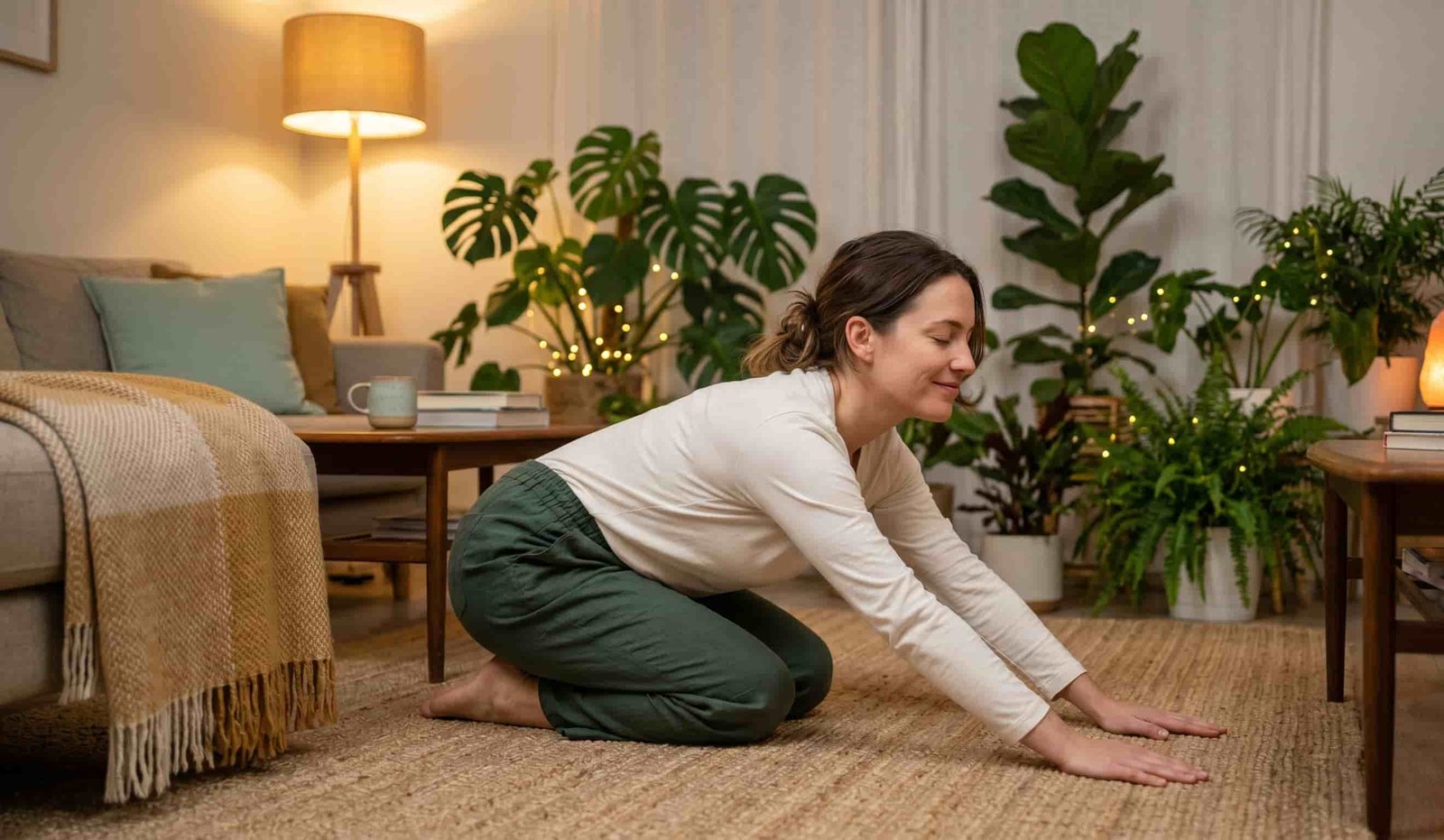
Direct Answer: Evening yoga and stretching measurably improve sleep — but the mechanism is not primarily the stretching itself — it is the transition from sympathetic (fight-or-flight) to parasympathetic (rest-and-digest) dominance that yoga practices actively induce. Multiple randomized controlled trials show that regular evening yoga practice (evenings only, not affecting morning waking) produces 15-20 minutes of added sleep time, reduced sleep onset latency, and improved sleep efficiency compared to control groups. The effects are strongest in people with elevated baseline stress and mild insomnia — the population most likely to dismiss yoga as “just relaxation.”
Mechanism: S1-2 and S4-4 on yoga and parasympathetic activation: yoga practices — particularly those incorporating slow pranayama breathing (extended exhale:inhale ratios of 2:1 or greater), gentle inversions (legs-up-the-wall), and body scan meditation — directly activate the parasympathetic nervous system through the vagus nerve. The vagal activation produces a cascade of relaxation responses: reduced heart rate, reduced blood pressure, reduced cortisol, increased heart rate variability (HRV). These changes are measurable within 5-10 minutes of beginning a yoga Nidra or slow pranayama practice. Critically, yoga does not significantly elevate core body temperature (unlike vigorous exercise), so it does not require the 4-6 hour thermal buffer — it can be practiced 30-60 minutes before bed without interfering with sleep onset. Studies comparing yoga to sleep medication (zolpidem) show that yoga produces comparable sleep onset improvements with none of the architecture-suppressing side effects of sedating medications.
Actionable Advice: Make yoga your 30-60 minute pre-sleep routine if you have any difficulty with sleep onset or stress-related sleep disruption. The most sleep-effective yoga protocol: 15-20 minutes of slow pranayama (Nadi Shodhana or 4-7-8 breathing), 10-15 minutes of gentle floor stretching (no inversions that raise heart rate), and 5 minutes of Savasana with a body scan. This sequence specifically activates the parasympathetic nervous system and is more effective for sleep onset than reading, watching TV, or scrolling — all of which maintain cortical activation and delay the transition to sleep.
What Is the Effect of Exercise on Sleep Latency, Total Sleep Time, and N3 in Older Adults — and Is It Different From Young Adults?
Direct Answer: Exercise improves sleep in older adults as effectively as in young adults — and may be more impactful given that older adults have more age-related sleep deterioration to reverse. In adults over 60, regular aerobic exercise produces 30-45 minutes more sleep time, 15-20 minute reduction in sleep onset latency, and 20-30 minutes more N3 per night compared to sedentary age-matched controls. The N3 increase is proportionally larger in older adults than in young adults, suggesting that the age-related N3 decline is partially reversible through exercise — which is a significant finding given that N3 decline with age is otherwise considered largely structural and irreversible.
Mechanism: S1-2 and S2-3 on exercise and aging sleep: the age-related decline in N3 (from approximately 90-100 min/night at age 20 to 30-45 min/night at age 60) is driven by structural changes in the prefrontal cortex that reduce slow-wave generation. However, studies comparing aerobically trained older adults (master’s athletes, regular exercisers in their 60s and 70s) to sedentary age-matched controls show consistently higher N3 percentages in the exercisers — 10-15% higher N3, approaching the values of inactive 40-year-olds. This suggests that while exercise does not completely prevent age-related N3 decline, it significantly attenuates it. The mechanism is thought to involve exercise-induced increases in BDNF (brain-derived neurotrophic factor), which supports synaptic plasticity in the prefrontal cortex and maintains slow-wave generation capacity. For older adults, the sleep-onset benefit of exercise may be even more pronounced than in young adults, because older adults tend to have more fragmented sleep from nocturia, discomfort, and medication effects — exercise addresses many of these fragmentation sources by reducing anxiety, improving physical comfort, and deepening sleep through N3 enhancement.
Actionable Advice: It is never too late to optimize sleep through exercise. If you are over 50, even 20-30 minutes of aerobic exercise per day produces measurable N3 improvements within 4-6 weeks. The exercise does not need to be intense — consistent moderate walking, swimming, or cycling is sufficient. The most age-appropriate timing is morning or mid-day, to avoid balance issues in low light and to tap into the full day’s temperature cycle before the 4-6 PM bedtime window.
What Is the Evidence-Based Exercise Protocol for Sleep — and Why Is Duration the Strongest Predictor, Not Intensity?
Direct Answer: The evidence-based exercise protocol for sleep optimization specifies: 5 sessions per week, 30-60 minutes per session, at moderate intensity (RPE 11-13), with at least one session in the morning for light exposure and circadian entrainment. Duration of exercise is the strongest predictor of sleep quality improvements, not intensity — a 45-minute moderate walk produces better long-term sleep outcomes than a 20-minute high-intensity interval session, because the accumulated physical fatigue and adenosine generation from longer sessions drives deeper homeostatic sleep pressure that no short session can match.
Mechanism: S2-3 and S4-4 on duration vs. intensity: the homeostatic sleep pressure system (Process S) is driven by adenosine accumulation proportional to total wake time and physical exertion. The relationship between exercise duration and adenosine accumulation is approximately linear — more total muscle work = more ATP turnover = more adenosine. This means that while intensity affects acute sympathetic activation and therefore sleep onset timing, the primary driver of N3 enhancement is the total accumulated sleep pressure from physical exertion across the day. This is why studies comparing 30-minute vs. 60-minute exercise sessions consistently find that the 60-minute session produces more N3 on the subsequent night — not because 60 minutes is harder but because more total muscle work was performed. For sleep specifically, the optimal exercise protocol is consistent moderate-duration sessions rather than variable high-intensity bursts: a 45-minute daily walk produces better sleep than alternating between 20-minute HIIT and rest days, even though the total weekly exercise energy expenditure might be similar.
Actionable Advice: Prioritize duration over intensity. If you have 30 minutes available: walk 30 minutes, do not run for 20 minutes. The total muscle work of walking for 30 minutes exceeds the total work of sprinting for 20 minutes (even though the sprint is “harder”). For sleep optimization: target 150-300 minutes of moderate aerobic exercise per week (5 x 30-60 minutes), with one morning session to capture the light exposure benefit. This produces 20-30 minutes more N3 per night compared to sedentary baseline and is the single most effective non-pharmacological sleep intervention available.
Frequently Asked Questions
Does morning or evening exercise help sleep more?
Direct Conclusion: Both help, but through different mechanisms: morning exercise (particularly in outdoor light) sets the circadian clock earlier and improves sleep-wake regularity, which is the foundation of good sleep. Evening exercise (3-6 PM) uses the thermal drop mechanism to directly facilitate sleep onset. For most people, a combination of morning light exposure (for circadian timing) and afternoon exercise (for thermal drop) is optimal. The worst timing is late evening (within 2 hours of bed) for high-intensity training.
How long after exercising should I wait before going to bed?
Direct Conclusion: For vigorous training: 4-6 hours minimum before bedtime. For moderate exercise (RPE 11-13): 2-3 hours buffer is generally sufficient. For yoga, stretching, and low-intensity movement: no buffer required — these can be done right before bed without interfering with sleep onset. The key distinction is whether the activity elevates core body temperature significantly. Vigorous training (running, HIIT, heavy weights) spikes core temperature and requires the thermal recovery time. Yoga and stretching do not.
Why does exercise increase deep sleep (N3)?
Direct Conclusion: Exercise increases N3 through two mechanisms: (1) Acute — adenosine accumulation from increased ATP turnover during exercise increases homeostatic sleep pressure, driving deeper N3 the following night; (2) Chronic — regular aerobic exercise reduces 24-hour sympathetic tone, lowers cortisol, reduces systemic inflammation, and increases BDNF in the hippocampus, creating a neurobiological environment more permissive for slow-wave generation. The chronic N3 enhancement takes 2-3 weeks of consistent exercise to fully emerge.
Can evening yoga actually improve sleep quality?
Direct Conclusion: Yes, measurably. Evening yoga improves sleep through parasympathetic activation (vagus nerve stimulation from slow pranayama breathing) rather than through physical exertion. Randomized controlled trials show 15-20 minutes of evening yoga produces 10-15 minute reduction in sleep onset latency and improved sleep efficiency, particularly in people with elevated stress. The effect is not placebo — studies show objective improvements in PSG-measured sleep architecture, not just subjective reporting.
Is high-intensity exercise better or worse for sleep than moderate exercise?
Direct Conclusion: Moderate exercise is more consistently sleep-promoting. High-intensity exercise produces a larger acute N3 boost but can delay sleep onset if performed within 3 hours of bedtime due to elevated cortisol and sympathetic activation. For long-term sleep optimization, consistency with moderate exercise (RPE 11-13, 5 sessions per week) outperforms variable high-intensity training. The intensity-sleep quality trade-off is real but manageable: place HIIT sessions in the mid-afternoon (not evening) and follow with cool-down and a 4+ hour buffer before bed.
Why am I more tired after a rest day than after a workout day?
Direct Conclusion: This is the paradox of exertion: exercise produces healthy physical fatigue that drives restorative N3 sleep. Sedentary days produce ‘tired but wired’ fatigue — adenosine has accumulated from cognitive wakefulness without the metabolic and cortisol-regulating benefits of exercise. The result is poor sleep on rest days, which compounds into cumulative sleep debt. The solution is not more rest — it is replacing sedentary time with low-intensity movement (walking, yoga) that provides the fatigue-sleep benefit without the sympathetic activation of intense training.
Does exercise help with insomnia?
Direct Conclusion: Yes — and it is considered the most effective non-pharmacological treatment for chronic insomnia. Studies comparing aerobic exercise to CBT-I (cognitive behavioral therapy for insomnia) show comparable effectiveness for insomnia symptom reduction after 4-8 weeks. Exercise works through multiple pathways: reducing hyperarousal (lower cortisol), increasing sleep pressure (adenosine), improving mood and reducing anxiety (endocannabinoid and serotonin effects), and stabilizing circadian timing (morning light exposure). For insomnia specifically, morning outdoor exercise is particularly effective because the combination of light exposure and physical fatigue addresses the two primary drivers of chronic insomnia: circadian irregularity and elevated sympathetic tone.
How long does it take for exercise to improve sleep quality?
Direct Conclusion: The acute effect (improved sleep after a single workout) appears within 24-48 hours and is modest — approximately 10-15 minutes more N3 after a moderate workout. The chronic effect (fully established N3 enhancement) requires 2-3 weeks of consistent exercise to emerge. Most people notice subjective sleep improvement within 1-2 weeks (falling asleep faster, less nighttime waking). The full architectural changes (stable N3 and REM percentages at optimized levels) are established by week 3-4 of consistent training. After ceasing exercise, the chronic benefit reverses within 2-4 weeks.
Does morning light exposure matter as much as morning exercise?
Direct Conclusion: For circadian regulation specifically, morning light matters more than morning exercise — and outdoor exercise typically provides both simultaneously. The SCN is approximately 10,000 times more sensitive to light than to any other zeitgeber, and morning light exposure within 30 minutes of waking produces circadian phase advancement that cannot be replicated by exercise alone. If you must choose: get morning light first (even just 15 minutes walking outside), then exercise.
How many days a week of exercise are needed to improve sleep?
Direct Conclusion: 5 days per week is the evidence-based target for sleep optimization. Studies comparing 3 vs. 5 vs. 7 days per week show a dose-response relationship: more days = more N3. The minimum effective dose for sleep benefit is approximately 3 moderate sessions per week — this produces measurable N3 improvement but not the full chronic effect. 7 days per week of moderate exercise is not significantly better than 5-6 days for sleep, but there is also no downside to 7 days if intensity is kept moderate. The key is regularity: 5 consistent days per week produces better sleep than 7 irregular days.
Move at the Right Time. Sleep Like an Athlete.
Exercise done correctly is not exhausting — it is the most reliable sleep-enhancing intervention available. Train at the right time, manage the thermal buffer, stay consistent, and your sleep architecture will transform in ways no supplement can match.
Cooling Sleep Systems Recovery-Oriented Sleep SetupThe Slumbelry Commitment
Sleep is the most vulnerable state of human existence. It is where we heal, reset, and grow.
At Slumbelry, we do not just sell sleep products; we advocate for your physiological right to rest. From ergonomic support to light management, every solution we offer is designed with one obsession: Respecting your Biology.
Science is our language, but your recovery is our purpose. You take care of everything else in your life — let us take care of your nights.
Rest Deeply,
The Slumbelry Team