
Anchoring Your Sleep in a 24/7 World
Why Shift Workers Who ‘Flip’ Between Schedules Destroy Their Health Faster Than Those Who Never Try
Society runs 24/7. Nurses, police officers, factory workers, truck drivers, air traffic controllers — shift workers are the infrastructure of the modern economy. They are also paying a heavy biological price for it.
Shift work is classified as a Group 2A probable carcinogen by the IARC. It is linked to a 40% higher rate of cardiovascular disease, 30% higher rate of metabolic dysfunction, and significantly elevated rates of depression and anxiety. The mechanism is the same for all of them: your body’s circadian clock and your work schedule are running on completely incompatible programs.
This is the shift work sleep guide that separates the practical interventions that actually work from the ones that waste your time — and explains exactly why the anchor sleep method is not optional but structural.
⚡ Core Takeaway: Anchor Sleep Is Not Optional — It Is Structural
- The Problem: Shift workers who have no consistent sleep anchor develop chronic circadian misalignment — the SCN drifts 1-2 hours later each cycle without the light reset signal — producing cumulative health risk equivalent to smoking in its long-term mortality impact (IARC 2A carcinogen classification)
- The Mechanism: Anchor sleep exploits the one thing the SCN cannot ignore: regularity. A consistent 4-hour daily sleep window (regardless of shift timing) prevents free-running circadian drift and limits the misalignment to a manageable band rather than allowing unlimited accumulation
- The Strategy: Choose a 4-hour anchor block (e.g., 2-6 PM for night workers) that overlaps with the social night; protect it like a medication; add pre-shift naps strategically; use darkness technology (blackout, eye mask, blue-light glasses) and morning light (for day-shift workers) as the two non-negotiable circadian anchors
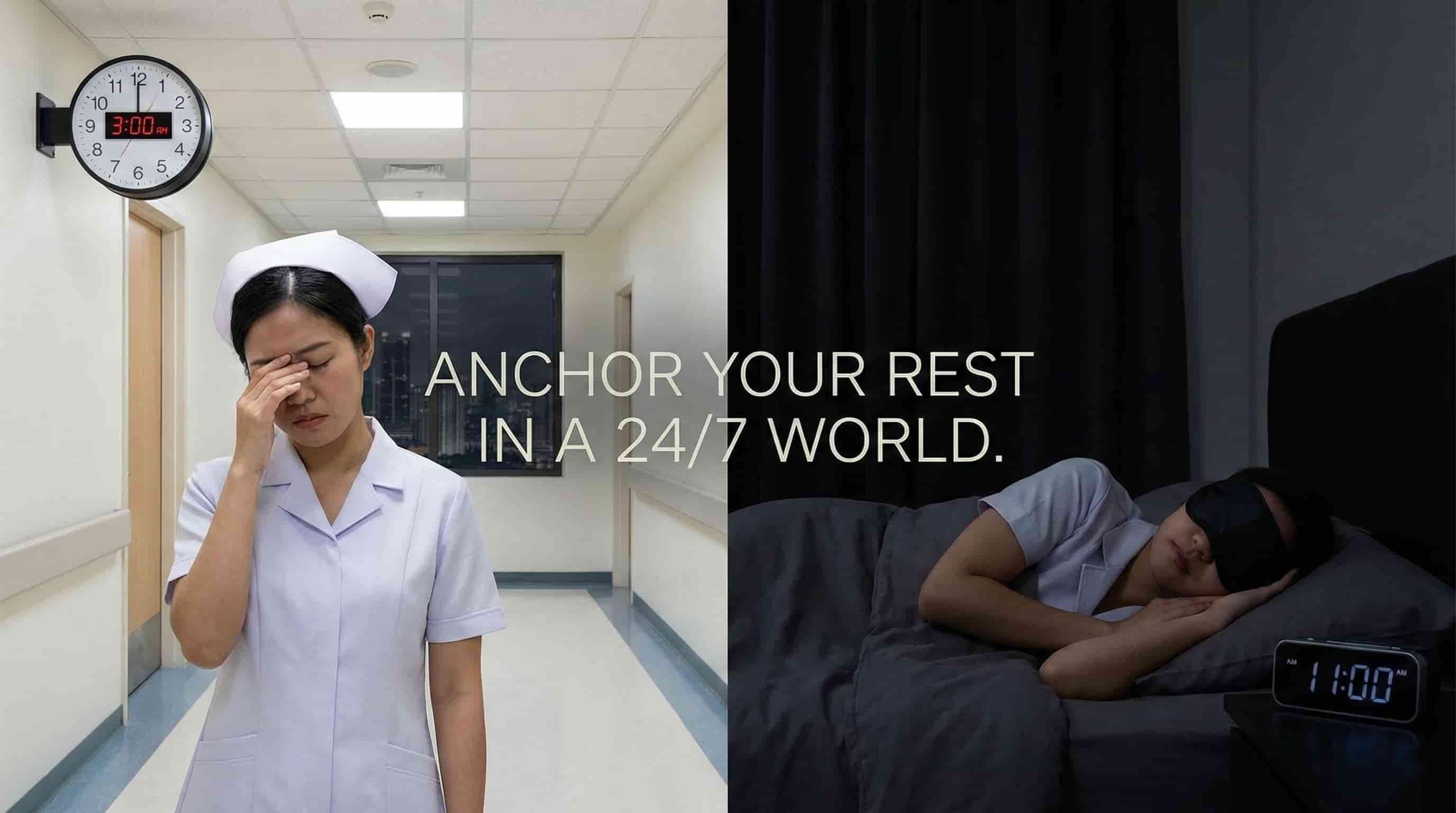
Why Does the Body Fight Daytime Sleep So Hard and What Is Happening to Your Hormones?
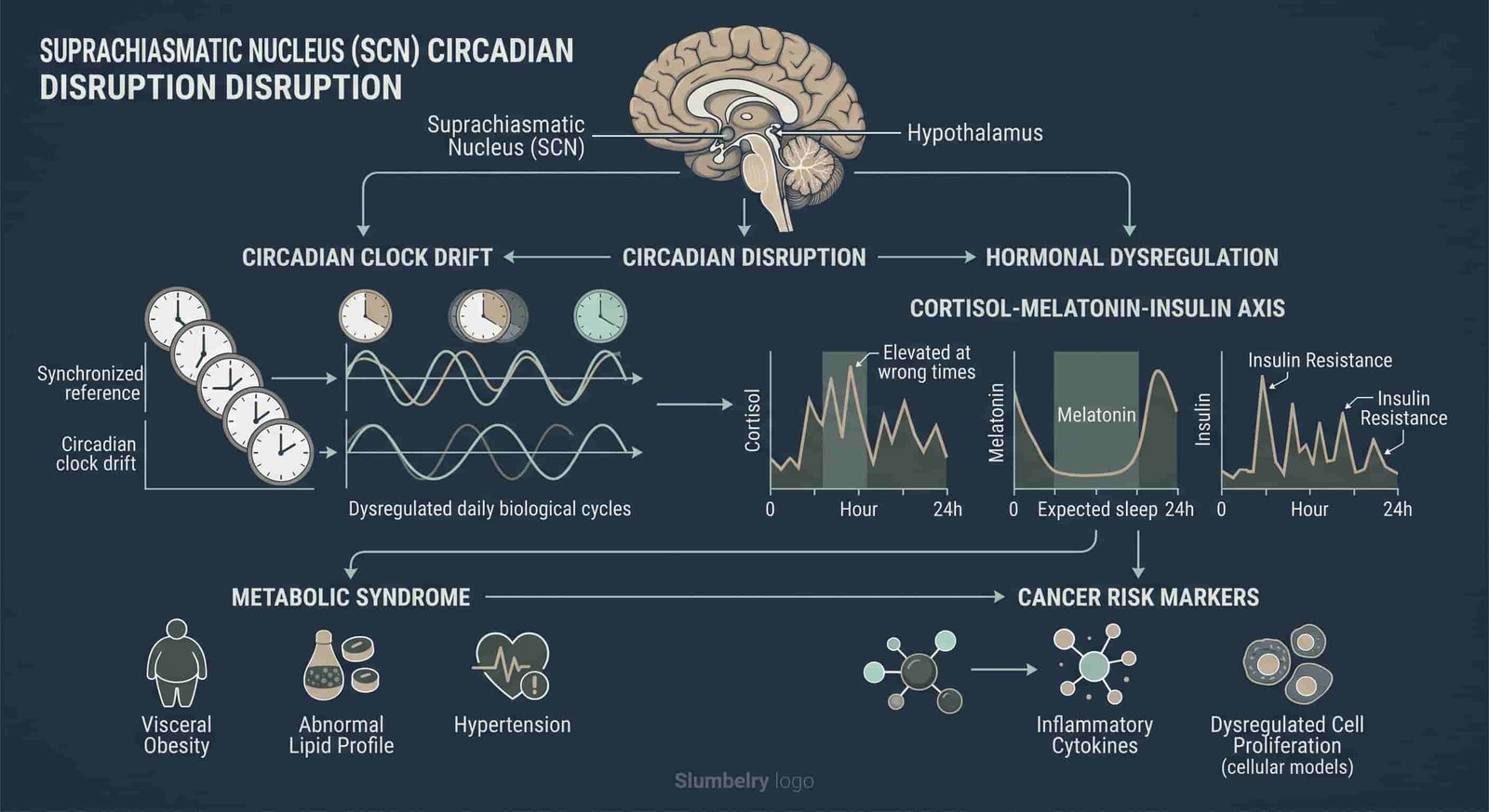
Direct Answer: The SCN runs on a circadian clock that is entrained — locked — to the local light-dark cycle. When you reverse that cycle (sleeping in daylight, being awake at night), the SCN continues operating on its old schedule, producing daytime alertness hormones when you are trying to sleep and sleep signals when you need to be awake. The result is two clocks — the SCN and behavior — running on completely different schedules.
Mechanism: S1-1 and S2-3 of the whitepaper establish the circadian biology of shift work: the SCN generates a near-24-hour rhythm using the transcriptional-translational feedback loop in its neurons, and this rhythm persists even without external time cues. Light is the primary zeitgeber that sets this clock — specifically the melanopsin-containing retinal ganglion cells that project via the retino-hypothalamic tract to the SCN. When a night shift worker sleeps during the day, the SCN is still producing its highest cortisol (the awakening hormone) in the late morning and its lowest melatonin signaling — meaning the brain is actively signaling “wake up” when the body needs to sleep. Simultaneously, the metabolic hormones insulin, leptin, and ghrelin follow the behavioral feeding schedule rather than the circadian one, producing metabolic chaos. This is not about willpower — it is about two incompatible scheduling systems.
Actionable Advice: Accept that you cannot fully eliminate the conflict. The goal is to manage the misalignment to a survivable level, not to become a natural day sleeper. Treat the hormonal opposition as a fixed constraint, not a problem to solve.
What Are the Documented Health Consequences of Long-Term Shift Work?
Direct Answer: The health data on shift work is not ambiguous: IARC classifies shift work involving circadian disruption as a Group 2A probable carcinogen; meta-analyses show a 40% increased cardiovascular disease risk, 30% increased metabolic disease risk, and significantly elevated rates of depression and anxiety.
Mechanism: S2-3 and Costa (2003), Shift Work and Health: Current Problems, Occupational Medicine: the health burden of shift work is documented across multiple large cohorts and longitudinal studies. The primary mechanisms: (1) Cardiovascular: circadian disruption elevates baseline sympathetic tone, raising blood pressure and inflammatory markers (CRP, IL-6) even at rest; (2) Metabolic: eating during the biological night produces impaired glucose tolerance and reduced insulin sensitivity because the pancreatic beta cells follow a circadian rhythm that is optimized for daytime eating; (3) Mental health: the chronic circadian misalignment disrupts the amygdala-prefrontal cortex emotional regulation circuit, producing elevated rates of depression (1.3x) and anxiety disorder (1.4x); (4) Cancer: the IARC Group 2A classification (night shift work) is based on epidemiological evidence linking shift work to elevated breast cancer and colorectal cancer risk, with proposed mechanisms involving melatonin suppression (melatonin has oncostatic properties) and immune surveillance disruption during nocturnal sleep.
Actionable Advice: The health risks are real and dose-dependent — they increase with years of shift work. If you have been doing night shifts for 5+ years, these are the conversations you should be having with your physician at every annual physical.
What Is the Anchor Sleep Method and Why Is It the Most Evidence-Based Intervention for Shift Workers?
Direct Answer: Anchor sleep is the practice of maintaining a consistent 4-hour daily sleep window regardless of shift schedule — creating a circadian reference point that prevents the SCN from free-running into complete misalignment. It is the most evidence-based and practical intervention available for shift workers.
Mechanism: S2-3, S4-4, and Barnes & Drake (2015), The circadian basis of shift work disorders, Sleep Medicine Clinics: the anchor sleep concept was developed from chronobiology research showing that the SCN requires regularity to maintain stable phase relationships with behavior. The protocol: choose a 4-hour sleep window that can be protected every 24 hours — regardless of whether it is a work day or off day — and sleep only within that window. For a permanent night shift worker, this typically means 2–6 AM (overlapping with the biological night) or 3–7 AM. For rotating shift workers, it means fixing the sleep window to the social clock rather than the work clock. The science: regularity is the SCN’s primary non-light zeitgeber. When light is unavailable (daytime sleep), the SCN uses temporal regularity as its backup synchronization mechanism. A consistent 4-hour anchor prevents the SCN from drifting — maintaining the phase relationship with behavior within a manageable band (±1–2 hours) rather than allowing unlimited accumulation. The additional sleep outside the anchor (pre-shift naps, off-day recovery sleep) is additive but secondary.
Actionable Advice: Pick a 4-hour anchor and protect it like a medication prescription. It is the single most important commitment you can make to your health as a shift worker. Put it in your calendar and treat it with the same non-negotiability as the shift itself.
Why Does Light Exposure During the Drive Home Accelerate Circadian Misalignment in Night Shift Workers?
Direct Answer: Morning light (6–8 AM for a night shift worker) is the strongest possible signal that it is daytime — and therefore that the SCN should be producing awakening signals. Driving home in sunlight after a night shift is telling your circadian system to reset to day orientation, directly fighting the adaptation you are trying to create.
Mechanism: S1-1 and S2-3: the light signal from the drive home is particularly damaging because it arrives precisely at the time when the SCN is most sensitive to phase advance signals — the biological morning. The phase response curve to light shows that light exposure during the 6 hours after the core body temperature minimum (typically 3–5 AM for night workers who have been awake) produces maximum circadian phase shifting in the wrong direction. For a night shift worker who needs to sleep during the day, morning sunlight exposure on the drive home advances the circadian clock toward day orientation — the opposite of what is needed. This is why night shift workers who drive home in daylight report the worst daytime sleep quality. The intervention is non-negotiable: blue-light filtering glasses (amber or red lenses) on the drive home are not optional — they are one of the most cost-effective health-protective interventions available for shift workers.
Actionable Advice: Wear amber or red-tinted glasses on the drive home — from clock-out to when you are in your darkened bedroom. This alone can extend daytime sleep duration by 30–60 minutes and significantly improve sleep quality by preventing the light-triggered circadian phase advance.
How Do Shift Workers Actually Sleep When the Sun Is Up — The Daytime Sleep Environment Protocol
Direct Answer: Daytime sleep requires active environmental engineering because the SCN and the environment are sending contradictory signals. The goal is to create a darkness environment that the brain reads as “night” at the biological level, overriding the sunlight signal through the retino-hypothalamic tract.
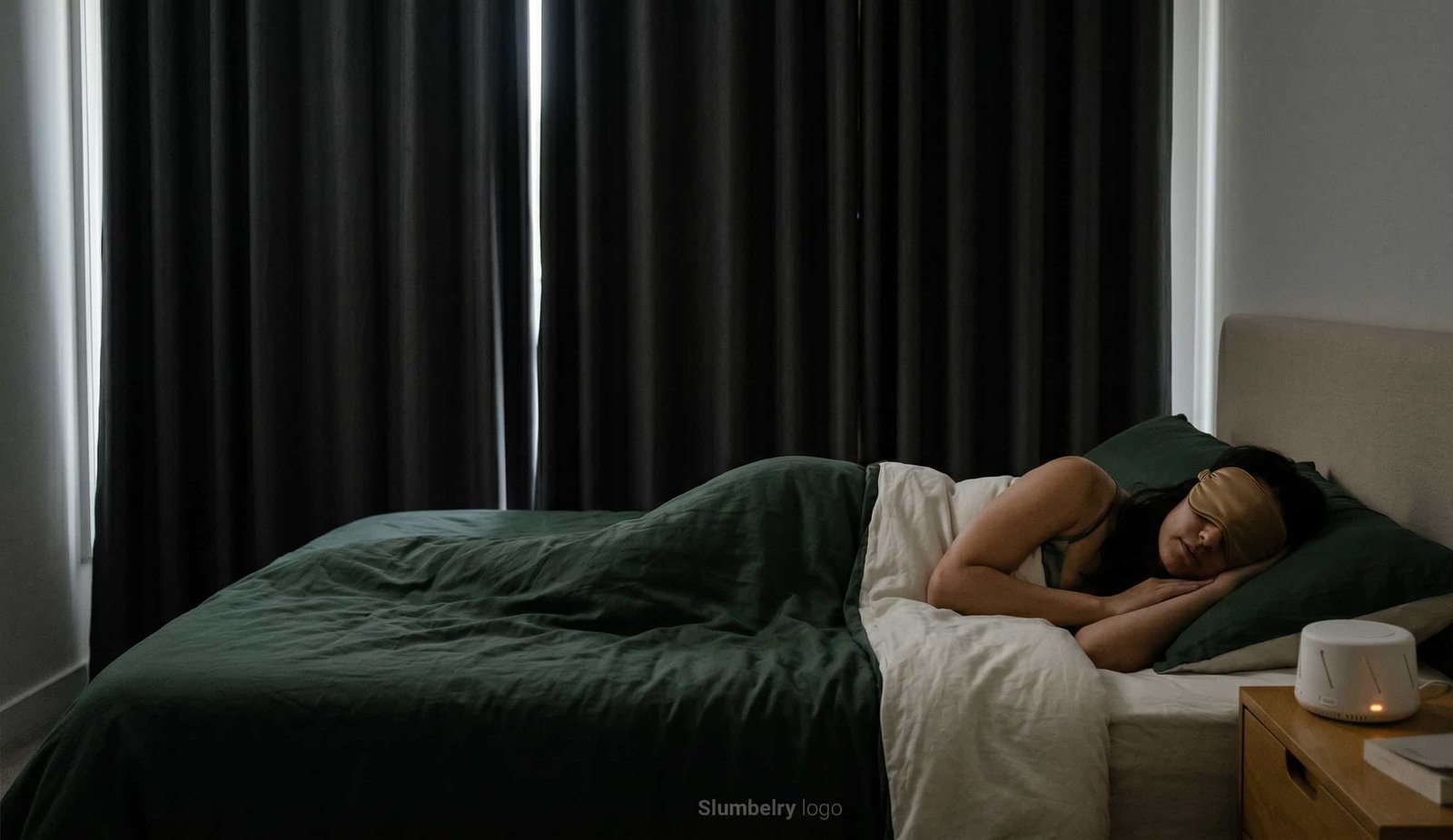
Mechanism: S1-1, S4-3, and S2-3 of the whitepaper: the daytime sleep environment has four non-negotiable elements: (1) Complete blackout — every light source (windows, LEDs, power lights) must be blocked. Even low-level ambient light (as low as 5–10 lux) suppresses melatonin and fragments sleep architecture. The combination of blackout curtains (rated to block 99%+ light) and a sealed door draft stopper is the minimum baseline; (2) Temperature — the bedroom should be 18–20°C. Daytime sleeping is associated with higher core body temperature, which is the enemy of sleep onset. A cool room accelerates the core temperature drop that initiates sleep; (3) White noise or earplugs — daytime is not quiet. Lawn mowers, neighbours, delivery vehicles — environmental noise fragments sleep even if it doesn’t fully wake you. White noise (pink or brown noise) masks these fluctuations; (4) Ritual cues — the brain needs a consistent pre-sleep signal. A 10-minute wind-down routine (no screens, no phone, reading or stretching) tells the SCN that sleep is imminent.
Actionable Advice: Treat your bedroom like a sensory deprivation chamber during the day. Slumbelry blackout curtains, an eye mask as backup, white noise, and a cool room — this combination creates the closest approximation to nighttime sleep that the environment allows.
Can Shift Workers Ever Fully Normalize Their Sleep — and Is That Even the Right Goal?
Direct Answer: Full circadian normalization — becoming a “natural night person” who sleeps perfectly during the day — is physiologically impossible for most shift workers without sustained time off. The goal of effective shift work sleep management is therefore not adaptation, but managed misalignment.
Mechanism: S1-1 and Barnes & Drake (2015): the SCN’s near-24-hour clock runs at approximately 24.2 hours on average and is genetically resistant to permanent rescheduling. Even in populations with decades of night shift work, studies of the SCN clock gene expression (measured in buccal or skin cells) show that the internal circadian period never fully shifts to match the behavioral schedule — the clock drifts back toward the natural light-dark cycle during recovery days. The practical implication: trying to “become a day person” on days off by shifting fully back to day sleep is counterproductive — it is the social jet lag (H2-8) that causes the health damage. The right goal is partial adaptation: accept that the SCN will never fully adapt, and limit the misalignment to a stable band that does not accumulate. This means protecting the anchor sleep window, not flipping the entire schedule back and forth.
Actionable Advice: Stop trying to fully adapt. The goal is managed, stable partial misalignment — not full adaptation. A consistent 4-hour anchor with consistent timing is better than attempts at full schedule reversal.
What Is the Connection Between Shift Work, Metabolic Disease, and Cancer Risk?
Direct Answer: Shift workers who eat during the biological night have impaired glucose metabolism, elevated fasting insulin, and disrupted hunger-satiety signaling — creating a metabolic phenotype that is virtually indistinguishable from pre-diabetes. The metabolic disruption combines with melatonin suppression to produce elevated cancer risk through distinct but overlapping mechanisms.
Mechanism: S1-2/S2-3 and IARC 2A classification: the metabolic consequences of shift work are severe and well-documented. Eating during the biological night activates the metabolic system at a time when the digestive tract, pancreas, and liver are in their circadian rest phase — producing impaired glucose tolerance comparable to early Type 2 diabetes within weeks of beginning night shift work. Simultaneously, the suppression of nocturnal melatonin (light at night shuts down melatonin production) removes a key oncostatic (cancer-inhibiting) signal. Melatonin suppresses tumor growth through antioxidant activity, inhibition of linoleic acid uptake (which tumors use for proliferation), and immune surveillance enhancement. With melatonin suppressed night after night, the anti-cancer protection that nocturnal sleep normally provides is absent during the critical dark hours. This dual mechanism — metabolic disruption plus melatonin suppression — is the proposed pathway for the IARC Group 2A classification of night shift work.
Actionable Advice: Do not eat during the night shift — or if you must, keep it to a small, low-glycemic snack. The combination of light-at-night plus nocturnal eating is the highest-risk metabolic pattern for shift workers. Time-restricted eating within a consistent 12-hour daytime window is the most evidence-based metabolic intervention.
Why Is Social Jet Lag — the Difference Between Workday and Free-Day Sleep — Accelerating Health Decline in Shift Workers?
Direct Answer: Shift workers experience the most extreme form of social jet lag of any occupational group — not just different sleep timing on work days vs free days, but completely reversed circadian orientation. This biweekly schedule flipping is more physiologically damaging than permanent night shift work with a consistent anchor.
Mechanism: S2-3 and Roenneberg (2012), Sleep-timing, Curr Biol: social jet lag — measured as the difference between midpoint of sleep on work days vs free days — is associated with metabolic dysfunction, elevated depression rates, and obesity in epidemiological studies. For shift workers, the social jet lag is not hours but a complete circadian inversion: the person is on night time on work days and day time on free days. Each transition is equivalent to transcontinental jet lag without the travel. The biological cost of each transition: 3–5 days of full circadian re-entrainment is required after each schedule flip, but shift workers typically flip every 2–3 days, meaning they are in a state of perpetual incomplete transition. This chronic instability in the circadian timing system produces a form of allostatic load — cumulative physiological wear from repeated stress responses — that is measurable even when total sleep hours appear adequate. The most important intervention for rotating shift workers is to maintain the anchor sleep window even on free days, accepting that social plans must accommodate the biological constraint.
Actionable Advice: Do not flip your entire sleep schedule on days off. Protect the anchor window. Accept that the social life will be different from day-workers — and that this is a medical necessity, not a lifestyle choice. The shift workers with the worst health outcomes are those who try to live like day workers on 2 days and like night workers on 5.
Why Is Morning Light Exposure the Single Most Powerful Lever for Shift Workers?
Direct Answer: Light is the primary circadian zeitgeber — the only signal powerful enough to shift the SCN in a controlled direction. For day shift workers transitioning from night shifts, strategic morning light exposure accelerates circadian re-entrainment. For night shift workers, blocking morning light is equally critical. The difference between correct and incorrect light management is the difference between successful circadian alignment and accelerating misalignment.
Mechanism: S1-1 (SCN 光夹带) and S2-3: the phase response curve to light tells us exactly when to seek or avoid light depending on the desired circadian shift. For a night shift worker who needs to maintain night orientation on free days, morning light avoidance (6–10 AM) prevents the phase advance that would push the clock toward day time — which is exactly what happened on the drive home. For a day-shift rotation returning to day life, bright morning light (7–9 AM) on free days accelerates the re-entrainment back to the day schedule. The clinical tool: light intensity matters enormously. Outdoor light on an overcast morning is approximately 10,000 lux — equivalent to a high-quality 10,000 lux light therapy box. Indoor room lighting is typically 200–500 lux, which is insufficient to produce meaningful phase shifting. This means that outdoor morning light (even briefly) is the most potent and cost-free intervention available for circadian management.
Actionable Advice: Night shift workers: amber glasses + blackout curtains + avoid morning sunlight. Day-shift rotations: 20–30 minutes of outdoor morning light (or 10,000 lux light box) within 2 hours of waking. This single behavior is the most impactful circadian lever you have.
What Are the Practical Boundaries of Shift Work Sleep — and When Is It Medically Necessary to Exit?
Direct Answer: Shift work sleep disorder — persistent insomnia, unrefreshing sleep, excessive sleepiness, and mood disturbance that does not improve with anchor sleep and environmental optimization — is a diagnosable medical condition that requires clinical intervention. When standard protocols fail, medical and occupational support is the next step.
Mechanism: S2-3 and AASM guidelines: the clinical threshold for shift work sleep disorder (SWSD) is met when symptoms cause significant daytime impairment in occupational, social, or personal functioning, and do not respond to basic sleep hygiene and anchor sleep interventions. Warning signs that standard protocols are insufficient: (1) Persistent unrefreshing sleep despite 7–8 hours in bed and consistent anchor sleep; (2) Mood disturbance (depression or anxiety) that does not resolve; (3) Hypertension or pre-diabetic metabolic markers emerging after 3+ years of night shift; (4) Workplace safety incidents related to sleepiness; (5) Inability to maintain the anchor sleep window despite multiple attempts. Clinical interventions: (1) Timed melatonin (0.3–0.5mg at the beginning of the anchor sleep window) for circadian phase anchoring; (2) Modafinil or armodafinil for excessive daytime sleepiness in SWSD (AASM-approved); (3) Bright light therapy before shift start for night-to-day transitions; (4) Occupational medicine consultation about schedule modification if health markers are deteriorating.
Actionable Advice: If you have been doing night shifts for 5+ years and your health markers (blood pressure, HbA1c, BMI, mood) are worsening, it is time for the shift work sleep conversation with your physician. There is a clinical threshold at which the occupational benefit no longer justifies the health cost.
Frequently Asked Questions
What is shift work sleep disorder and how does it differ from regular insomnia?
Direct Conclusion: Shift Work Sleep Disorder (SWSD) is a circadian misalignment condition — the internal clock and behavioral schedule are incompatible — not an insomnia disorder. Regular insomnia involves difficulty initiating or maintaining sleep despite the desire to sleep; SWSD involves the SCN producing wake signals during the sleep window. The treatment is different: insomnia responds to CBT-I and sleep hygiene; SWSD requires circadian manipulation (light, melatonin, anchor sleep) rather than sleep hygiene alone.
How many hours of sleep do shift workers actually need?
Direct Conclusion: The same as day workers: 7-9 hours per 24-hour period. However, shift workers rarely achieve this because of the conflict between the biological night (when the SCN signals ‘wake up’) and the behavioral schedule. The practical target is 7 hours minimum within the combined anchor sleep window + pre/post-shift naps, with 8-9 hours as the optimal target.
What is anchor sleep and how does it work?
Direct Conclusion: Anchor sleep is maintaining a consistent 4-hour sleep window every 24 hours regardless of shift schedule. It works because the SCN uses regularity as a backup zeitgeber when light is unavailable. A consistent 4-hour anchor prevents the circadian clock from free-running into complete misalignment. The remaining sleep hours (pre-shift nap, off-day recovery sleep) are additive to the anchor.
Why is light exposure so damaging for night shift workers on the drive home?
Direct Conclusion: Morning light (6-10 AM for night workers) is the strongest phase-advance signal for the SCN — it tells the brain it is daytime and the clock should be oriented toward morning. For a night worker trying to sleep during the day, this light exposure pushes the clock in the wrong direction and fragments daytime sleep. Amber or red-tinted glasses on the drive home block the blue-wavelength light that activates the melanopsin pathway to the SCN.
How do I create a sleep-friendly environment for daytime sleeping?
Direct Conclusion: Four non-negotiable elements: (1) Complete blackout — 99%+ light-blocking curtains, sealed door gaps, cover all LED lights; (2) Temperature 18-20°C — cooler than typical bedrooms; (3) White noise or earplugs — daytime noise fragments N3 and REM; (4) A 10-minute pre-sleep wind-down ritual without screens. This combination creates the closest approximation to nighttime sleep architecture.
Should I try to be a ‘day person’ on my days off?
Direct Conclusion: No — this is the most damaging pattern for shift workers. Trying to live like a day worker 2 days a week and a night worker 5 days a week creates a biweekly circadian inversion called social jet lag. Studies show this biweekly schedule flip is MORE damaging than permanent night shift with a stable anchor. Protect the anchor sleep window even on days off.
What are the real health risks of working night shifts?
Direct Conclusion: IARC classifies night shift work (circadian disruption) as a Group 2A probable carcinogen. Documented risks: 40% increased cardiovascular disease, 30% increased metabolic disease (insulin resistance, pre-diabetes), 1.3x depression rate, 1.4x anxiety disorder rate, elevated breast and colorectal cancer risk. These risks are dose-dependent — they increase with years of exposure.
How does social jet lag affect shift workers differently?
Direct Conclusion: Shift workers have the most extreme social jet lag of any group — not hours but a complete circadian inversion every 2-3 days (work day vs free day). Each flip requires 3-5 days of full re-entrainment, but shift workers flip every few days, producing perpetual incomplete transition. This chronic circadian instability (allostatic load) is more damaging than stable permanent night shift.
Is it possible to fully adapt to shift work?
Direct Conclusion: No — the SCN never fully adapts. Even workers with decades of night shift show persistent clock gene expression that drifts back toward the natural light-dark cycle during recovery days. The goal is not full adaptation (impossible for most) but managed, stable partial misalignment: a consistent anchor sleep window that limits the circadian drift to a survivable band.
When should a shift worker seek medical help for their sleep?
Direct Conclusion: Seek clinical help when: persistent unrefreshing sleep despite anchor sleep and environmental optimization; mood disturbance not resolving; blood pressure or metabolic markers worsening after 3+ years of night shifts; workplace safety incidents from sleepiness; inability to maintain the anchor sleep window. Interventions include timed melatonin, modafinil/armodafinil, and light therapy — all AASM-endorsed for SWSD.
Protect Your Anchor. Protect Your Health.
Shift work is a biological reality, not a personal failure. The shift workers with the worst outcomes are those who try to live like day workers 2 days a week — and the best outcomes belong to those who protect their anchor window like a medical prescription.
Blackout Solutions Sleep MasksThe Slumbelry Commitment
Sleep is the most vulnerable state of human existence. It is where we heal, reset, and grow.
At Slumbelry, we do not just sell sleep products; we advocate for your physiological right to rest. From ergonomic support to light management, every solution we offer is designed with one obsession: Respecting your Biology.
Science is our language, but your recovery is our purpose. You take care of everything else in your life — let us take care of your nights.
Rest Deeply,
The Slumbelry Team