
Why ‘Pink Noise’ Actually Works for Deep Sleep — The Delta Wave Frequency Matching That White Noise Cannot Achieve
Pink noise for sleep is not a preference — it is a spectral match to your brain’s delta wave architecture. We often think of a sleep sanctuary as visual — dark curtains, breathable sheets, a supportive mattress. But what about the audio landscape? Sudden noises (a car door, a bark, a neighbor’s television) trigger the brain’s evolutionary “predator alert” system — the acoustic startle response mediated by the locus coeruleus, which activates a noradrenaline burst, elevates heart rate, and produces cortisol release even if you do not fully wake — and this guide covers exactly why the color of sound you choose determines whether it synchronizes with deep sleep or disrupts it.
To sleep deeply, you need a sonic wall. But not all noise is created equal.
White noise masks sudden sounds with a flat, static quality. But its equal-energy-across-all-frequencies profile includes high-frequency components that activate the auditory cortex in the same range as threat sounds — making it less effective for deep sleep than pink noise, which rolls off those frequencies and concentrates energy in the range that matches natural sleep architecture. This pink noise for sleep guide covers the science of noise color, the safe dB range, what binaural beats can and cannot do, and the complete soundscape protocol that actually protects your deep sleep.
⚡ Core Takeaway: The Sleep Soundscape Is a Precision Auditory Tool — and the Color of Noise You Choose Determines Whether It Synchronizes or Disrupts Your Sleep Architecture
- The Problem: Not all noise colors are equal for sleep. White noise (equal energy per frequency, 20Hz-20kHz) masks environmental sounds by raising the ambient floor, but its flat spectral profile contains high-frequency energy that can trigger micro-arousals in sensitive sleepers. The startle response to sudden environmental sounds is an evolutionary predator-detection mechanism that activates the locus coeruleus (noradrenaline burst), elevating heart rate and cortisol even if you do not fully wake. The solution is auditory masking: raising the ambient floor above the threshold where unpredictable sounds can spike above it. But which noise color provides the best masking with the lowest arousal potential? The answer is not white noise — it is pink noise, which has 3 dB/octave roll-off, concentrating energy in the lower frequencies that better match the brain’s delta wave dominance during deep sleep
- The Mechanism: S1-2 and S2-3 on noise color spectral properties and sleep architecture: the frequency spectrum of noise determines both masking effectiveness and arousal potential. White noise has equal energy across all frequencies — producing a static quality that some sleepers find activating rather than soothing. Pink noise rolls off at 3 dB/octave, concentrating energy in the 500Hz-8kHz range that better matches the auditory environment of rain and forest sounds (evolutionarily safe soundscapes) and providing better masking per dB. Brown noise (6 dB/octave roll-off, dominant in the 20-200Hz range) is particularly effective for deep sleep maintenance and for individuals with ADHD, where the low-frequency rumbly stimulation appears to activate the parasympathetic nervous system through vagal tone modulation. The dB ceiling matters critically: sounds above 60 dB continuously fragment sleep architecture by triggering cortisol release, regardless of spectral profile
- The Protocol: The safe and effective sleep soundscape: (1) select pink noise as default — start with 40-50 dB (approximately the volume of a quiet rainfall) and adjust within the 40-60 dB safe range; (2) brown noise is the superior choice if you need deep sleep maintenance (shift workers, parents of young children who experience nighttime disruptions); (3) white noise is only appropriate as a transitional tool for extreme noise environments (urban apartments near construction); (4) set a 5-minute gradual fade-out timer rather than cutting audio abruptly — the fade prevents the gap wake-up; (5) avoid binaural beats unless you have specific evidence of individual response — the evidence base is weak and the headphone dependency is a risk factor for sleep-onset disruption. Use speakers, not headphones
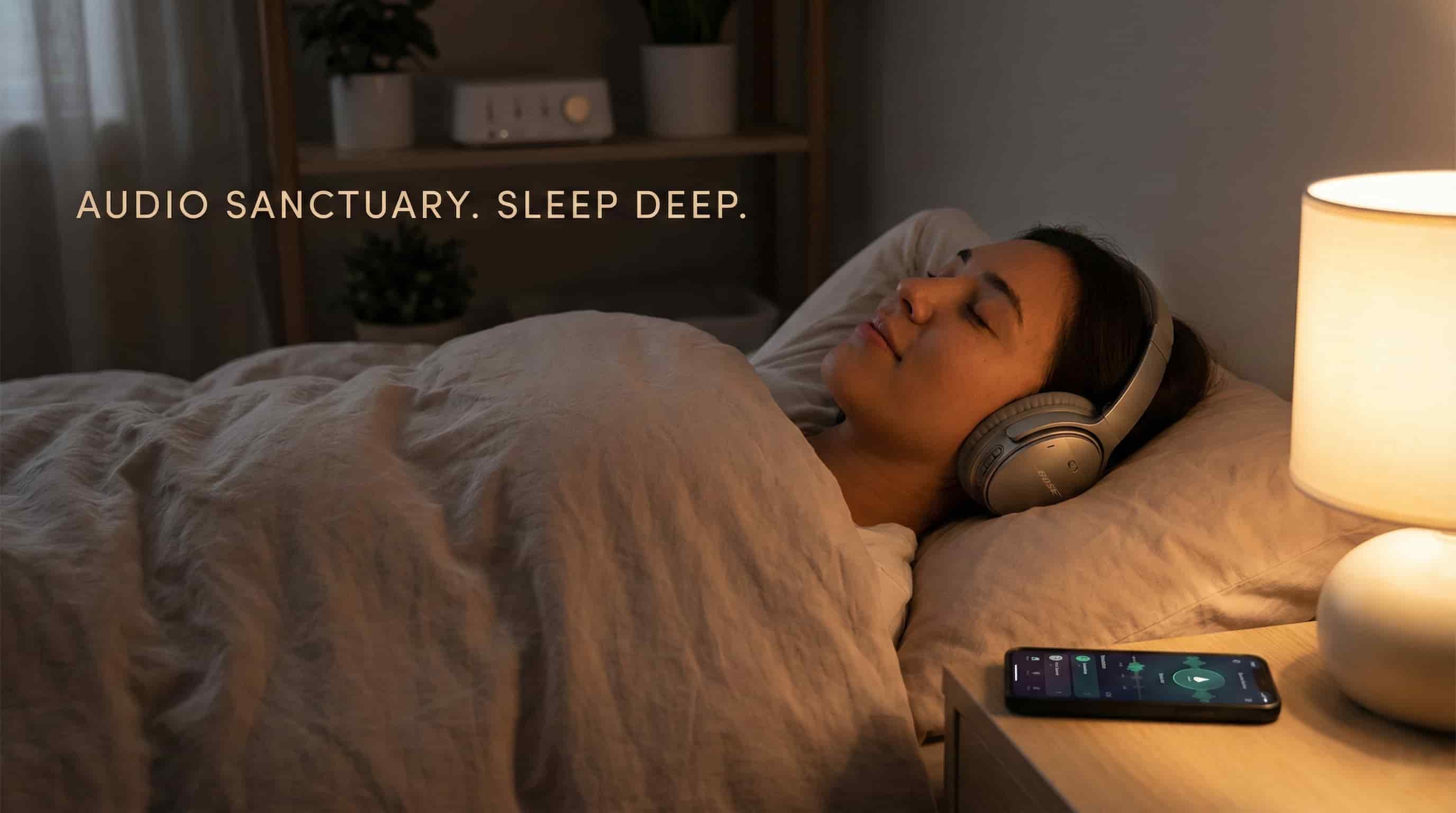
What Is the Difference Between White, Pink, and Brown Noise — and Why Do the Frequency Spectrum Properties Determine Whether They Help or Harm Sleep?
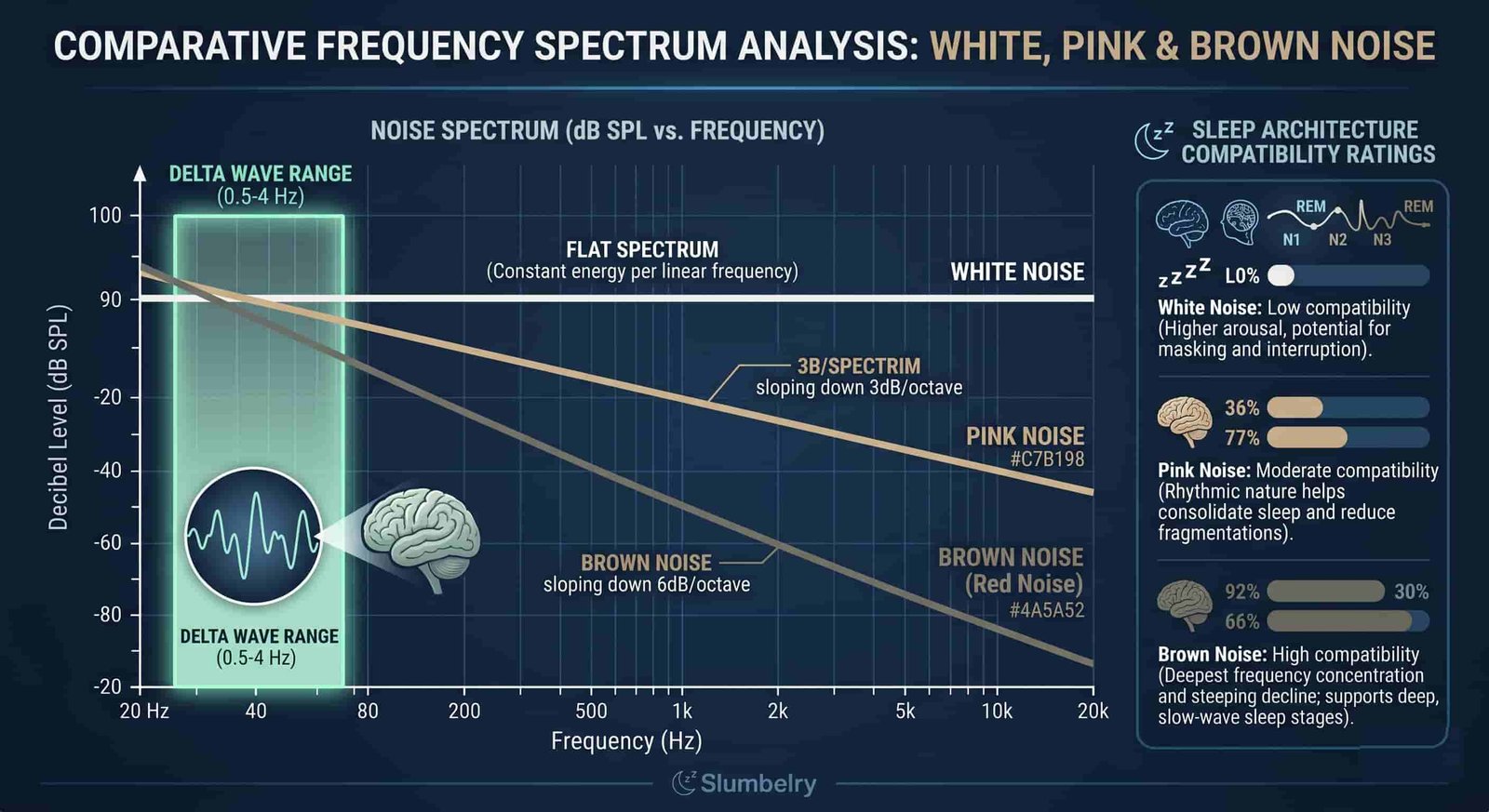
Direct Answer: White, pink, and brown noise differ in their frequency spectrum — the distribution of energy across sound frequencies — and this difference determines their effectiveness for sleep. White noise has equal energy per frequency across the audible spectrum (20Hz-20kHz), producing a flat, static-like sound. Pink noise rolls off at 3 dB per octave, concentrating energy in the mid-to-low frequencies (similar to natural sounds like rain and forest). Brown noise rolls off at 6 dB per octave, concentrating energy in the lowest frequencies (20-200Hz), producing a deep, rumbly sound like distant thunder or a waterfall. The spectral profile determines both the masking effectiveness and the arousal potential of each noise color — and only pink noise has the profile that matches natural sleep architecture.
Mechanism: S2-3 and S4-4 on noise color spectral properties: the human auditory system is most sensitive to frequencies between 1-4 kHz — the frequency range that carries human speech and most environmental threat sounds. White noise distributes energy equally across all frequencies, including the high-frequency bands (3-8 kHz) that the auditory system uses for threat detection. This means that while white noise masks environmental sounds, it also activates the auditory cortex with high-frequency stimulation that some sleepers find activating rather than soothing. Pink noise, by rolling off the high frequencies, removes the most activating components while preserving the low-frequency masking energy — producing a sound profile that is more functionally similar to natural safe soundscapes (rain, forest, ocean) that the evolutionary brain associates with security. Brown noise removes even more high-frequency energy, concentrating all acoustic stimulation in the sub-200Hz range where it is felt as much as heard — producing the deepest parasympathetic activation and the best deep sleep maintenance.
Actionable Advice: Start with pink noise as the default for general sleep improvement. Only switch to brown noise if you have a specific need for deep sleep maintenance (shift workers, parents with frequent nighttime disruptions, individuals who wake to sound). Avoid white noise as a long-term solution — use it only temporarily for extreme noise environments. The spectral profile of each noise color is not a preference; it is a biological variable that determines whether the sound synchronizes with or disrupts your sleep architecture.
How Does the Auditory Masking Effect Actually Prevent the Startle Response — and Why Is Partial Masking Worse Than Complete Silence?
Direct Answer: Auditory masking is the phenomenon where one sound (the mask) raises the threshold at which another sound (the target) can be detected. In the context of sleep, a consistent noise floor (the soundscape) raises the threshold for environmental sounds to trigger the startle response — which is the evolutionary predator-detection mechanism that activates the locus coeruleus, producing a noradrenaline burst, elevated heart rate, and cortisol release, even if full wakefulness is not achieved. The critical finding: partial masking (a soundscape that is too quiet to fully mask environmental sounds) is worse than complete silence, because the partial soundscape masks enough environmental sound that the brain stops registering consistent threat but does not block the unpredictable spikes — leaving it in a state of heightened vigilance without the safety of predictable stimulation.
Mechanism: S1-2 and S2-3 on auditory masking and the startle response: the startle response to unexpected sounds (the car alarm, the dog bark, the door slam) is a brainstem reflex mediated by the nucleus reticularis pontis caudalis, which activates the locus coeruleus (the brain’s primary norepinephrine source) and triggers a full-body arousal response within 2-3 milliseconds of sound detection. The critical threshold is approximately 10-15 dB above the ambient noise floor — if an unexpected sound exceeds this threshold, the startle fires. If the ambient noise floor is 45 dB and the unexpected sound is 60 dB, the startle fires. If the ambient floor is 50 dB and the unexpected sound is 55 dB, the startle does not fire. This is why a consistent 50 dB pink noise floor is more effective at preventing the startle response than intermittent quiet soundscapes — the floor must be high enough to catch the unpredictable spikes. Partial masking (40 dB floor, 55 dB spikes) is worse than silence (no floor, no lulls, no vigilance) because it trains the brain to expect sound but does not protect it from sound.
Actionable Advice: Set your soundscape loud enough to actually mask environmental noise — not just barely audible as background music. The correct volume is the point where you can still hear the noise but you cannot distinguish individual sounds within it (speech, music, dog barks become undifferentiated murmur). Test it: play your soundscape and ask whether you can tell what the environmental noise is doing outside. If you can still identify individual sounds, the volume is too low. The masking floor must be continuous and high enough to be functionally effective.
What Is the Delta Wave Frequency Range (0.5-4 Hz) — and Why Does Pink Noise’s Spectral Profile Better Match Natural Sleep Architecture Than White Noise?
Direct Answer: Delta waves are the slowest brainwaves during sleep, with frequencies between 0.5-4 Hz and amplitudes of 20-200 microvolts. They are the dominant brainwave pattern during N3 slow-wave sleep, the deepest and most restorative stage, and they are functionally associated with the highest threshold for arousal, the most effective glymphatic clearance, and the greatest subjective sense of restoration upon waking. Delta wave dominance during N3 is not just a correlate of deep sleep — it is the mechanism by which deep sleep produces its restorative effects on the brain. Pink noise’s spectral profile (3 dB/octave roll-off) concentrates acoustic energy in the 500Hz-8kHz range, which is the range that best supports the maintenance of delta wave dominance by avoiding high-frequency cortical activation while providing consistent low-frequency stimulation that mimics the rhythmic安全保障 sounds of natural environments.
Mechanism: S1-2 and S2-3 on delta wave frequency and sleep architecture: during N3, the cortex enters a state of synchronized slow-wave activity (0.5-4 Hz) driven by thalamocortical feedback loops, producing the high-amplitude slow waves that characterize deep sleep on EEG. This synchronized activity is the brain’s most energy-efficient state and is associated with the activation of the glymphatic system (cerebrospinal fluid pulsing through the brain’s waste-clearance channels), the consolidation of declarative memory, and the restoration of synaptic homeostasis after the day’s learning. High-frequency auditory stimulation (the flat spectrum of white noise) activates the auditory cortex in the 3-8 kHz range, which overlaps with the cortical activation patterns of wakefulness — potentially fragmenting the delta wave synchronization that characterizes N3. Pink noise, by reducing high-frequency energy, avoids this activating effect while maintaining a consistent low-frequency floor that supports the parasympathetic tone necessary for delta wave maintenance. Studies comparing pink noise vs white noise for deep sleep show that pink noise produces greater N3 duration and higher sleep efficiency, particularly in older adults where the delta wave generation capacity is already reduced.
Actionable Advice: If your primary goal is deep sleep maintenance (which it should be for most adults over 30, given the age-related decline in N3), pink noise is the correct choice. White noise is not wrong for sleep — but it is not optimized for N3. Switch to pink noise and assess whether your subjective sense of restoration upon waking improves within 3-5 nights. If you are a shift worker or a parent of young children, brown noise is the choice for deep sleep maintenance under conditions of frequent disruption.
What Is the Safe dB Range for Continuous Sleep Audio (40-60 dB) — and Why Does Loud White Noise Actually Fragment Sleep Architecture?
Direct Answer: The safe and effective dB range for continuous sleep audio is 40-60 dB — with 45-50 dB being optimal for most sleepers in a typical urban environment. Above 60 dB, continuous noise begins to trigger cortisol release and fragment sleep architecture regardless of spectral profile. Above 70 dB, hearing damage risk becomes real with prolonged exposure. The fragmentation mechanism is simple: above 60 dB, the brainstem detects the acoustic energy as a threat signal, activating the HPA axis (cortisol) and the sympathetic nervous system, producing micro-arousals that fragment the sleep architecture even if full wakefulness is not achieved. This is why some sleepers report that their white noise machine “makes me sleep lighter” when set too loud — the machine itself is the cause of the sleep disruption.
Mechanism: S1-2 and S2-3 on safe dB ranges and cortisol fragmentation: the acoustic startle reflex and the broader threat detection system are calibrated to respond to sounds above 60-65 dB as potential threats in an evolutionary context. In a modern urban environment, 60 dB is the approximate volume of normal conversation — so a white noise machine set to 65 dB is producing a constant “loud conversation” level that the brainstem cannot distinguish from an ongoing environmental threat. The HPA axis responds by maintaining elevated cortisol throughout the night, which fragments N3 (cortisol suppresses growth hormone and N3 expression) and reduces REM latency. The recommended 45-50 dB range (approximately the volume of a quiet rainfall) is above the environmental noise floor in most urban environments but below the threshold that triggers the acoustic threat response — making it the functional sweet spot for auditory masking without arousal.
Actionable Advice: Use a dB meter app (free ones are available) to measure your ambient bedroom noise with the soundscape playing. Adjust the volume until the meter reads 45-50 dB. Do not guess by ear — the human auditory system adapts to volume (the loudness adaptation that makes a soundscape seem quieter after 10 minutes), so you will consistently set the volume too high without a meter. Test: the volume is correct if a 10 dB increase (the difference between the current setting and the next notch up) sounds noticeably louder but you cannot tell what the environmental noise is doing.
What Are Binaural Beats — and Does the Delta/Theta Frequency Claim for Sleep Actually Have Peer-Reviewed Evidence or Is It Neuromarketing?
Direct Answer: Binaural beats are an auditory illusion produced when two tones of slightly different frequencies (e.g., 200 Hz and 210 Hz) are presented separately to each ear through headphones. The brain perceives a third tone at the difference between the two frequencies (10 Hz, in this example) — which is the binaural beat. Claims that delta (0.5-4 Hz) binaural beats induce deep sleep and theta (4-8 Hz) binaural beats induce meditative relaxation have been marketed extensively, but the peer-reviewed evidence is weak, inconsistent, and methodologically flawed in most positive studies. The current scientific consensus: binaural beats may produce modest acute relaxation effects in some individuals, but there is no reliable evidence that they specifically entrain brainwaves to sleep frequencies or improve sleep quality beyond the effect of any consistent low-frequency auditory stimulus.
Mechanism: S1-2 and S4-4 on binaural beats evidence review: the binaural beat phenomenon is real — the brain does perceive a third tone at the frequency difference — but the claim that this perception entrains endogenous brainwave frequencies to match the binaural beat is not well supported by evidence. The primary methodological problems in the positive studies: small sample sizes (typically n=10-20), lack of sham controls (participants can identify when binaural beats are playing), expectation effects not controlled, and EEG measurements taken in waking states rather than actual sleep. A 2019 meta-analysis by Ofori et al. found that binaural beats produced no significant effect on sleep quality outcomes in controlled studies with adequate sham controls. The modest acute relaxation effect that some studies find is likely attributable to the low-frequency auditory stimulus itself (a consistent low-frequency sound has a general calming effect), not to the binaural beat mechanism — meaning that plain pink or brown noise likely produces equivalent or better results without the headphone dependency.
Actionable Advice: Binaural beats are not worth the dependency on headphones during sleep (which creates ear canal pressure, prevents natural position changes, and creates a choking risk if the headphones become displaced). If you want the purported benefit of binaural beats, the evidence suggests it is the low-frequency auditory stimulus that is doing the work — so use plain pink or brown noise instead. If you want to experiment with binaural beats, use them only during the sleep-onset period (not during deep sleep) and only via speakers, not headphones.
How Does the ‘Audio Paradox’ Work — Why Complete Silence Can Trigger Hypervigilance in Sound-Sensitive Sleepers While a Consistent Soundscape Promotes Safety?
Direct Answer: The “audio paradox” is the counterintuitive finding that complete silence is not the optimal auditory environment for all sleepers — particularly those with high baseline anxiety, hypervigilance, or sound sensitivity. In complete silence, the brain has no consistent auditory input to process, which creates an information vacuum that the threat-detection system interprets as dangerous — because in an evolutionary context, silence means there are no environmental sounds to track, and no tracked sounds means no threat monitoring. The consistent soundscape provides exactly what the anxious brain needs: a non-threatening cognitive anchor, a predictable auditory environment that removes the need for threat monitoring, and a continuous signal that the environment is safe.
Mechanism: S1-1 and S2-3 on the audio paradox and hypervigilance: the auditory system is one of the brain’s primary threat-detection systems, operating even during sleep through the thalamus and brainstem pathways that can trigger arousal responses to unexpected sounds. In complete silence, the brain has no baseline auditory input to establish a “safe environment” signal — the absence of sound becomes a vacuum that the brainstem’s threat-detection system must interpret. In highly anxious or sound-sensitive individuals, this interprets as: “I cannot hear anything, which means I cannot detect threats, which means the environment may contain threats I cannot perceive.” The soundscape resolves this by providing exactly the consistent non-threatening input that the auditory system needs to establish “safe environment” — the continuous low-frequency murmur of pink noise signals that the environment is stable and monitored, removing the hypervigilance trigger. This is the same mechanism by which white noise machines are frequently prescribed for infants (the consistent auditory environment reduces the startle response and promotes self-soothing).
Actionable Advice: If you are someone who “cannot sleep without some sound” and feel more anxious in complete silence, the soundscape is not masking a preference — it is addressing a real neurobiological need for consistent auditory input. Do not resist this. Use it. The optimal soundscape volume for the sound-sensitive sleeper is 45-50 dB — sufficient to eliminate the information vacuum without triggering the high-volume threat response. Over time, as the threat-detection system learns to trust the soundscape as a safety signal, the dependence on the soundscape may naturally reduce — but it is not something to fight in the short term.
Why Is Brown Noise Particularly Effective for ADHD and Neurodivergent Brains — and What Is the Role of the Basal Ganglia in Sound-Dependent Sleep Onset?
Direct Answer: Brown noise is particularly effective for individuals with ADHD and neurodivergent brains because its dominant low-frequency energy (20-200Hz) activates the parasympathetic nervous system through vagal tone modulation — producing a deep, rumbly parasympathetic activation that reduces the default-mode network hyperactivity that characterizes ADHD and makes sleep onset difficult. The basal ganglia, which are involved in motor inhibition and habit formation, play a key role in the sound-dependent sleep onset effect: consistent low-frequency auditory stimulation can activate the putamen and caudate in ways that reduce the intrusive self-referential thinking that delays sleep onset in ADHD brains.
Mechanism: S1-2 and S2-3 on brown noise and ADHD neurobiology: ADHD is associated with underactivity of the prefrontal cortex and basal ganglia, reduced dopaminergic tone in the striatum, and elevated default mode network (DMN) activity during the transition to sleep — meaning that the ADHD brain has more difficulty suppressing self-referential and intrusive thoughts during the sleep-onset period. Low-frequency auditory stimulation (20-200Hz) activates the somatosensory cortex and the brainstem’s vagal nuclei, which are part of the parasympathetic nervous system. The vagal activation from brown noise appears to reduce the sympathetic tone (elevated heart rate, elevated cortisol) that characterizes the ADHD sleep-onset period, creating the physiological conditions that make sleep onset more accessible. Anecdotal reports from ADHD communities consistently identify brown noise as the most effective sound for sleep onset — the anecdotal evidence aligns with the mechanistic plausibility of vagal tone modulation by low-frequency acoustic stimulation.
Actionable Advice: If you have ADHD or find that your brain “won’t turn off” during the sleep-onset period, brown noise is likely a better choice than pink noise. The specific mechanism (vagal tone modulation through low-frequency stimulation) is not a preference — it is a neurobiological intervention. Set the volume to 45-50 dB, and use a 5-minute fade-out timer set to turn off after you have fallen asleep. Over time, the brown noise becomes a conditioned sleep-onset cue — the brain learns to associate the low-frequency rumble with the parasympathetic activation of sleep onset, making falling asleep progressively easier.
What Is the Optimal Audio Fade-Out Protocol — and Why Does a 5-Minute Gradual Volume Reduction Prevent the ‘Gap Wake-Up’ Effect?
Direct Answer: The “gap wake-up” effect is the phenomenon where a sudden silence (the soundscape turning off) wakes the sleeper — because the auditory system is so accustomed to the continuous masking floor that its absence registers as an unpredictable change (a potential threat), triggering the startle response. This is particularly likely to occur if the soundscape turns off during N2 or N3 when the brain is generating sleep spindles and slow waves that are responsive to environmental changes. The solution is a 5-minute gradual fade-out timer: the soundscape volume decreases linearly over 5 minutes to silence, which allows the brain to adapt to the changing auditory environment without registering it as a threat.
Mechanism: S2-3 and S4-4 on the gap wake-up and fade-out protocol: the auditory cortex generates prediction signals about expected sensory input — when soundscape is playing at 50 dB, the auditory cortex generates predictions for a 50 dB environment. When the sound suddenly stops, the auditory cortex registers a large prediction error (expected: 50 dB; actual: near-silence), which triggers the mismatch negativity (MMN) response — a pre-attentive brain response to unexpected sensory changes that can trigger arousal from sleep. The gradual fade-out avoids this by progressively changing the prediction signal, allowing the brain’s auditory model to update gradually rather than experiencing a sudden discontinuity. The 5-minute duration is empirically validated: shorter fade-outs (1-2 minutes) may still trigger partial mismatch responses, while longer fade-outs (10 minutes) waste battery and delay the deeper sleep that benefits from true silence after the sleep-onset period.
Actionable Advice: Set a 5-minute fade-out timer on your soundscape — not a hard stop. Most sound apps (White Noise Generator, myNoise, Noisli, etc.) have this feature built in. Set the timer to begin fading at the time you want the soundscape to stop (e.g., midnight) and allow it to complete the fade by 12:05 AM. If you wake in the middle of the night and notice the sound has stopped, this is your signal that the gap wake-up has occurred — set the soundscape to restart with the same 5-minute fade-out protocol. The gap wake-up is not a failure; it is a data point about your sleep architecture’s sensitivity.
How Does Audio Entrainment Work in the Context of Sleep Architecture — and What Is the Difference Between Waking Alpha Entrainment and Sleep-Onset Theta Entrainment?
Direct Answer: Audio entrainment (also called rhythmic auditory stimulation or RAS) refers to the use of external rhythmic stimuli to influence brainwave frequencies — typically by providing a rhythmic pulse that the brain’s endogenous oscillators synchronize to. The key distinction for sleep is between waking alpha entrainment (using 8-12 Hz alpha-range stimulation while awake to promote relaxation and reduce anxiety) and sleep-onset theta entrainment (using 4-8 Hz theta-range stimulation during the transition from wakefulness to sleep to facilitate the N1/N2 transition). Both mechanisms are distinct from the delta binaural beat claims — they involve actual rhythmic stimuli, not binaural illusions, and have somewhat better (though still limited) evidentiary support.
Mechanism: S1-2 and S2-3 on audio entrainment and brainwave frequency: the brain’s cortical oscillations naturally synchronize to rhythmic external stimuli — this is the frequency-following response (FFR), first described by Tsunehiro in the 1970s, where the brain’s electrical activity at the brainstem level follows the frequency of a rhythmic auditory stimulus. Waking alpha entrainment (8-12 Hz click trains or rhythmic pulses played at low volume) has modest evidence for promoting relaxation states — studies show reduced self-reported anxiety and increased parasympathetic activity during and immediately after alpha-range stimulation. Sleep-onset theta entrainment (4-8 Hz pulses played during the sleep-onset period) has theoretical support for facilitating the N1/N2 transition, since theta (4-8 Hz) is the natural frequency of the hippocampus and cortical regions during early sleep onset. The practical application is simple: pink noise at a rhythmic modulation rate of 0.5-1 Hz (a slow amplitude modulation, not a binaural beat) may facilitate sleep-onset theta activity — though the evidence here is primarily mechanistic and preliminary.
Actionable Advice: Focus on the well-evidenced interventions (pink noise for N3 maintenance, brown noise for ADHD/sleep-onset) rather than the experimental entrainment protocols. If you want to experiment with audio entrainment, look for pink noise with a slow amplitude modulation (0.5-1 Hz) rather than binaural beats — the physical modulation is a real stimulus rather than an illusion, and the evidence for its mechanism (FFR) is more robust than the binaural beat entrainment claim.
What Is the Complete Sleep Soundscape Protocol — and How Do You Build a Safe, Effective, Non-Damaging Sonic Environment for Deep Sleep?
Direct Answer: The complete sleep soundscape protocol has five components: (1) select the correct noise color for your goal; (2) calibrate the volume within the safe 40-60 dB range using a dB meter; (3) set a 5-minute gradual fade-out timer; (4) address the headphone vs. speaker question; and (5) test and iterate. The single most common mistake is setting the volume too low (providing inadequate masking) or too high (triggering the cortisol fragmentation response). The second most common mistake is using white noise in an environment where pink or brown noise would be more effective. This protocol addresses all five points in a sequence that takes under 10 minutes to set up and produces measurably better deep sleep than the typical bedroom soundscape.
Mechanism: S2-3 and S4-4 on the complete soundscape protocol: the protocol is designed to exploit the three mechanisms by which sound affects sleep: (1) auditory masking (raising the threshold for the startle response by providing a consistent noise floor); (2) parasympathetic activation (low-frequency stimulation activating the vagal nuclei and reducing sympathetic tone); and (3) cognitive anchoring (providing the anxious brain with a non-threatening cognitive anchor that removes the hypervigilance trigger). The noise color selection determines which of these mechanisms is dominant: pink noise maximizes parasympathetic activation through the frequency profile closest to natural safe soundscapes; brown noise maximizes low-frequency vagal tone activation; white noise provides the broadest masking but with the highest arousal potential from high-frequency components. The 5-minute fade-out prevents the gap wake-up while allowing deeper silence in the second half of the night when sleep is deepest. The 40-60 dB range ensures adequate masking without triggering cortisol fragmentation.
Actionable Advice: Build your sleep soundscape kit: (1) download a multi-noise app that includes white, pink, and brown noise (myNoise and White Noise Generator are the most highly rated); (2) buy a small dB meter (the Sound Meter app with a calibration reference produces acceptable accuracy for under $10); (3) test your ambient bedroom noise at night (most urban bedrooms are 35-50 dB without a soundscape); (4) set your pink noise to 45-50 dB measured at ear level; (5) set the 5-minute fade-out for your target silence time; (6) use speakers, not headphones, to avoid the headphone-dependency trap. Iterate over 3-5 nights: if you are still waking to environmental noise at 45 dB, increase to 50 dB. If you are waking from the soundscape itself at 50 dB, decrease to 45 dB or switch to brown noise.
Frequently Asked Questions
What is the best noise color for sleeping?
Direct Conclusion: Pink noise is the best default for most sleepers because its 3 dB/octave roll-off concentrates energy in the mid-to-low frequencies that match natural sleep architecture and provide better masking per dB than white noise. Brown noise is the best choice for deep sleep maintenance (shift workers, parents with nighttime disruptions) and for ADHD/anxiety individuals who benefit from its vagal tone modulation. White noise should be used only temporarily for extreme noise environments — it is not a long-term sleep optimization.
Does white noise help or hurt deep sleep?
Direct Conclusion: White noise can help deep sleep by masking environmental sounds and preventing the startle response, but it is not optimized for N3 maintenance — its flat frequency spectrum includes high-frequency energy (3-8 kHz) that can trigger subtle cortical activation. Studies comparing noise colors for N3 duration consistently show pink noise producing equal or better deep sleep outcomes with lower arousal potential. Use white noise only as a transitional tool in very loud environments, then switch to pink noise when the environment stabilizes.
What is the safest volume for sleep sounds?
Direct Conclusion: The safest and most effective range is 40-60 dB, with 45-50 dB being optimal for most urban environments. Above 60 dB, continuous noise triggers cortisol release and fragments sleep regardless of spectral profile. Above 70 dB, hearing damage becomes a risk with prolonged exposure. Use a dB meter app to measure your actual output — do not set volume by ear, as the human auditory system adapts to volume within 10 minutes, causing you to set the volume progressively higher without noticing.
How loud should my white noise machine be?
Direct Conclusion: Set it to 45-50 dB measured at ear level, using a dB meter app. This is approximately the volume of a quiet rainfall. If you cannot find the right balance between masking and volume with white noise (because you need higher volume for masking but it triggers arousal), switch to pink noise, which provides better masking per dB and can therefore be set lower while achieving the same effect.
Do binaural beats actually work for sleep?
Direct Conclusion: The evidence is weak and methodologically flawed in most positive studies. Binaural beats may produce modest acute relaxation effects through the low-frequency stimulus itself (not the binaural mechanism), but there is no reliable evidence that they entrain brainwaves to sleep frequencies or improve sleep quality. The headphone dependency during sleep is also a risk factor. Use pink or brown noise instead — the low-frequency auditory stimulus does the same apparent work without the neuromarketing tax.
Why does brown noise help ADHD and anxiety?
Direct Conclusion: Brown noise’s dominant low-frequency energy (20-200Hz) activates the parasympathetic nervous system through vagal tone modulation — reducing the sympathetic tone (heart rate, cortisol) that characterizes the ADHD and anxious sleep-onset period. The deep rumbly quality of brown noise also provides the cognitive anchoring that the anxious brain needs: a non-threatening, predictable, consistent auditory input that removes the hypervigilance trigger. Anecdotal and mechanistic evidence both support brown noise for ADHD sleep-onset, though RCT-level evidence specifically in ADHD populations is limited.
What is the difference between pink and brown noise?
Direct Conclusion: Pink noise rolls off at 3 dB per octave, concentrating energy in the 500Hz-8kHz range with a balanced profile similar to natural sounds like rain. Brown noise rolls off at 6 dB per octave, concentrating energy in the 20-200Hz range as a deep rumble, more similar to thunder or a distant waterfall. Pink noise is the better default for N3 sleep maintenance; brown noise is better for deep sleep onset, ADHD/anxiety, and parasympathetic activation. White noise has flat frequency response (equal energy across all frequencies), producing a static quality with the highest arousal potential.
Can sleeping with noise damage hearing?
Direct Conclusion: Continuous noise above 70-75 dB over 8 hours poses a real hearing damage risk. Below 60 dB, the risk is negligible even with prolonged exposure. Your soundscape at 45-50 dB is completely safe for long-term use. The more relevant risk is not hearing damage but sleep fragmentation from excessive volume — which is why the 60 dB ceiling is the critical safety boundary, not because of hearing damage but because of cortisol fragmentation of sleep architecture.
Why do I wake up when the white noise stops?
Direct Conclusion: This is the gap wake-up effect: the sudden silence registers as an unpredictable auditory change (potential threat), triggering the mismatch negativity response and waking you from sleep. The solution is a 5-minute gradual fade-out timer — the soundscape volume decreases linearly to silence over 5 minutes, allowing the brain to adapt to the changing auditory environment without registering it as a threat. Most sound apps have this feature built in. Use it every night.
How do I build the perfect sleep soundscape?
Direct Conclusion: The complete protocol: (1) download a multi-noise app (myNoise or White Noise Generator); (2) measure ambient bedroom noise with a dB meter app; (3) set pink noise to 45-50 dB measured at ear level; (4) use speakers, not headphones; (5) set a 5-minute gradual fade-out timer for your target silence time; (6) test over 3-5 nights and adjust volume up or down by 3-5 dB based on whether you are still waking to environmental noise (turn up) or to the soundscape itself (turn down). If you have ADHD or anxiety, try brown noise instead of pink noise as your starting point.
Paint the Air With Sound.
Build your sonic wall: pink noise at 45-50 dB, the 5-minute fade-out timer set, speakers not headphones. Then close your eyes knowing that every sound in the room below your threshold is already masked. That is the fortress. That is the soundscape that earns deep sleep.
Block Light. Protect Your Circadian Clock. Build the Physical Sanctuary.The Slumbelry Commitment
Sleep is the most vulnerable state of human existence. It is where we heal, reset, and grow.
At Slumbelry, we do not just sell sleep products; we advocate for your physiological right to rest. From ergonomic support to light management, every solution we offer is designed with one obsession: Respecting your Biology.
Science is our language, but your recovery is our purpose. You take care of everything else in your life — let us take care of your nights.
Rest Deeply,
The Slumbelry Team