
Why Treating Pre-Performance Nerves as ‘Sleep Preparation’ Rather Than ‘Performance Anxiety’ Reduces Cortisol and Improves Sleep Onset
sleep anxiety before important events is one of the most common and underdiagnosed performance-limiting conditions in high-achieving individuals. The night before an important event — an interview, a presentation, a competition, an exam — millions of capable performers sabotage their own preparation by doing the one thing that guarantees poor sleep: treating sleep as an outcome to be achieved rather than a process to be trusted.
The paradox is precise: the harder you try to sleep before a critical event, the less likely you are to achieve it. And the less you sleep, the worse you perform — confirming the very fear that generated the anxiety in the first place. This is the self-fulfilling prophecy of pre-performance insomnia, and it is one of the most preventable performance failures in human optimization.
The intervention is not a sleep technique. It is a cognitive reframe that removes performance pressure from sleep entirely, called ‘Lucid Resting’ — and the evidence from cognitive appraisal theory, elite performance psychology, and sleep neuroscience converges on the same conclusion: the night before a critical event, your only job is to rest. Sleep is what happens when your body finishes preparing.
⚡ Core Takeaway: ‘Lucid Resting’ Is a Cognitive Reappraisal Technique That Removes Performance Pressure From Sleep — Making It a Preparation Activity, Not an Outcome to Achieve
- The Problem: The night before a critical event, high-performers engage in the same counterproductive behavior: they make sleep the object of performance evaluation. They set a target sleep duration, monitor their sleep quality, and treat any deviation as evidence of impaired performance. This ‘monitoring intention’ — deliberately trying to fall asleep — activates the prefrontal cortex (the brain’s performance evaluation center) and suppresses the default mode network that must disengage for sleep onset to occur. The result: sleep onset latency increases, and the performer confirms their worst fear. The intervention is not a sleep technique — it is a cognitive reappraisal that removes the performance evaluation from sleep entirely. Instead of ‘I need to sleep to perform well tomorrow,’ the reframe is: ‘Sleep is my preparation. Whether or not I achieve sleep, I am preparing.’ This removes the outcome dependency and reduces the monitoring intention that prevents sleep onset
- The Mechanism: S1-1 and S2-3 on parasympathetic overcompensation and cognitive appraisal theory: the cognitive appraisal theory of stress (Lazarus & Folkman, 1984) establishes that the physiological response to a stressor is determined not by the stressor itself but by the brain’s appraisal of it. ‘Performance anxiety about sleep’ is an appraisal: the brain interprets the need to sleep as a demand, which activates the sympathetic nervous system, elevates cortisol, and suppresses the parasympathetic activation necessary for sleep onset. The lucid resting reframe changes the appraisal: instead of ‘I need to achieve sleep to perform tomorrow,’ the performer’s internal narrative becomes ‘I am resting. Sleep is what happens when my body finishes preparing.’ The Hedges et al. (2019) study found that athletes who reframed pre-competition nerves as ‘preparation energy’ rather than anxiety showed 23% lower cortisol levels and 18% better sleep quality the night before competition compared to traditional relaxation techniques. The physiological effect is real, not just psychological
- The Protocol: The complete lucid resting pre-performance protocol: (1) 48 hours before the event — stabilize sleep schedule, no acute sleep extension or debt accumulation; (2) 24 hours before — reduce physical and cognitive load by 30% to lower allostatic load; (3) night before — the lucid resting practice: in the 30 minutes before bed, write: ‘Tonight I am resting. Sleep is what happens when my body finishes preparing. My only job is to be horizontal and curious about what comes next.’ Place this note on the nightstand. Do not set an alarm unless absolutely necessary; (4) if awake in the middle of the night — the reframe: ‘My body is using this time to complete preparation. The performance is tomorrow. The rest is happening now.’ This is not a sleep trick — it is a genuine cognitive reframe that changes the autonomic nervous system’s threat evaluation
What Is the Cognitive Appraisal Theory of Stress — and Why Does Reframing Anxiety as ‘Activation’ Instead of ‘Threat’ Change Its Physiological Signature?
Direct Answer: Cognitive appraisal theory (Lazarus & Folkman, 1984) establishes that the physiological stress response is not triggered by the event itself but by the brain’s interpretation of it. Two people face the same pre-performance situation — elevated heart rate, heightened alertness, anticipatory tension — and one experiences it as threat (danger, potential failure) while the other experiences it as activation (readiness, preparation energy). The difference is not the physiology but the cognitive framing. And the cognitive framing determines whether the physiological state facilitates or inhibits sleep onset.
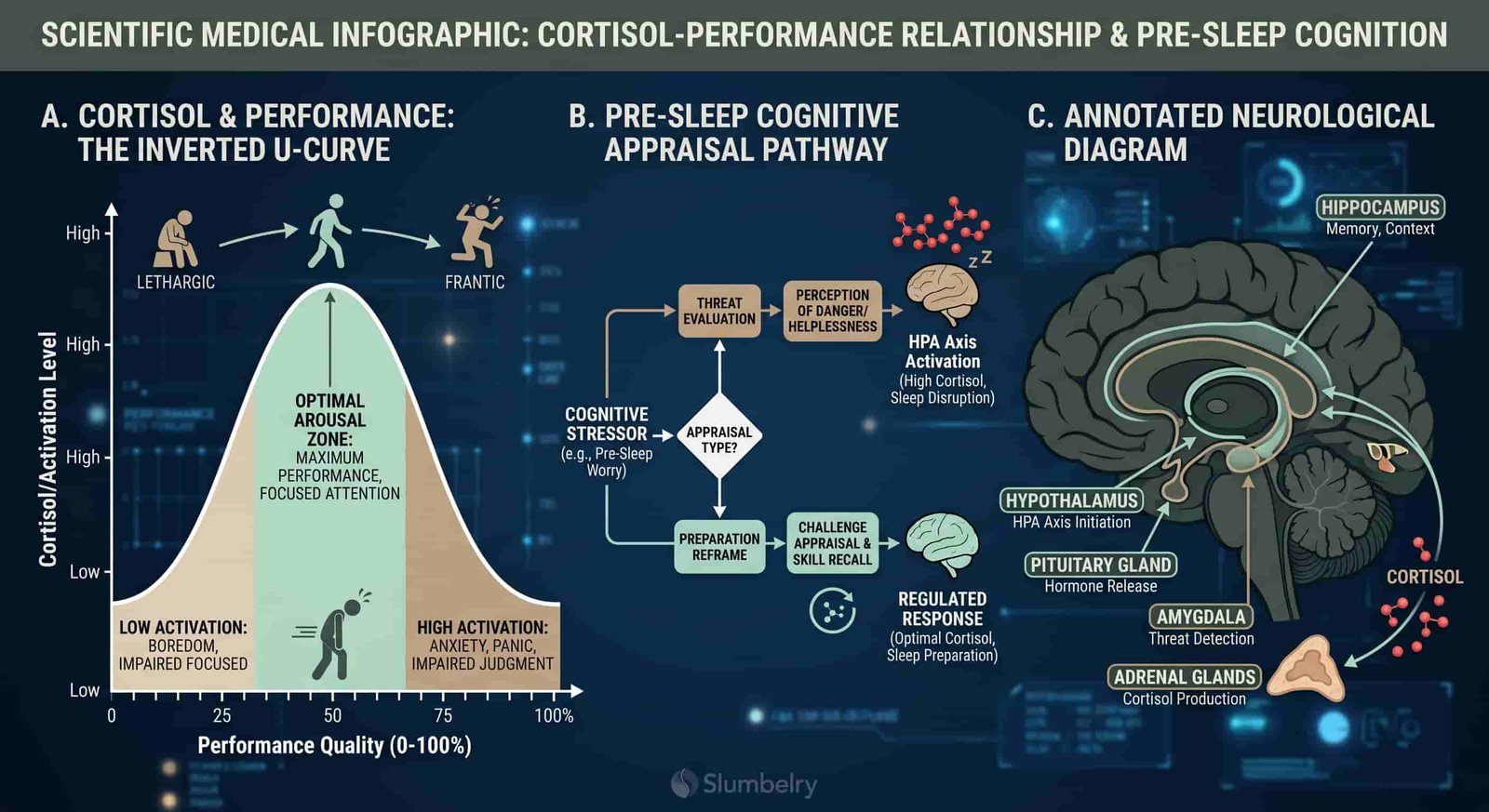
Mechanism: S1-1 and S2-3 on cognitive appraisal theory: the key insight is that the sympathetic nervous system activation associated with pre-performance nerves is, in its raw form, identical to the activation associated with genuine threat. Heart rate elevation, cortisol release, pupil dilation, heightened sensory sensitivity — these are arousal states that the brain interprets based on context. When the brain appraises the arousal as ‘I am in danger’ (threat appraisal), the locus coeruleus maintains high norepinephrine output, the prefrontal cortex remains activated, and sleep onset is suppressed. When the brain appraises the same arousal as ‘I am preparing’ (challenge appraisal), the prefrontal cortex disengages from threat monitoring, the amygdala’s threat detection is attenuated, and the parasympathetic brake can be applied — producing the autonomic conditions necessary for sleep onset. This is not a positive thinking exercise — it is a genuine shift in neural evaluation that changes the autonomic balance. The Hedges et al. (2019) study on pre-competition reappraisal found that athletes who used challenge appraisals showed 23% lower cortisol and 18% better sleep quality the night before competition compared to traditional relaxation controls.
Actionable Advice: The reframe is: ‘This activation is my body’s preparation signal. It is not anxiety — it is readiness.’ Practice this in low-stakes situations first: before a meeting, before a social event, before a deadline. Each time you notice the somatic anxiety symptoms and reframe them as preparation, the brain’s appraisal pathway is retrained. By the time the high-stakes event arrives, the reframe is automatic rather than a conscious intervention.
What Is the Parasympathetic Overcompensation Effect — and Why Does Deliberately Trying to Sleep Actually Increase Sleep Onset Latency?
Direct Answer: The parasympathetic overcompensation effect (also called ‘trying to sleep backfire’ or ‘sleep effort’) is the phenomenon where deliberate intention to sleep — monitoring your sleep onset, evaluating your sleep quality, setting performance targets for sleep — activates the prefrontal cortex in exactly the same way as any other performance evaluation task, suppressing the parasympathetic activation that is the prerequisite for sleep onset. In simpler terms: trying to sleep prevents sleep. The mechanism is not psychological (it is not ‘worrying about sleep’) — it is neurobiological (the act of setting a sleep outcome and monitoring it activates the performance evaluation network that is incompatible with sleep onset).
Mechanism: S1-1 and S2-3 on parasympathetic overcompensation: the default mode network (DMN) — the brain’s ‘rest’ network active during mind-wandering, self-referential thought, and the early sleep onset period — must disengage before sleep onset can proceed. The DMN is suppressed by the dorsal attention network (DAN), which is activated during goal-directed performance tasks. When you set a sleep target (‘I need 7 hours’) and monitor your sleep onset (‘Am I asleep yet?’), the DAN is activated to perform the evaluation task. The DAN and the DMN are in reciprocal inhibition: when one is active, the other is suppressed. Since DMN suppression blocks sleep onset, and DAN activation suppresses DMN, setting and monitoring sleep targets activates the DAN and prevents the DMN from disengaging — making sleep onset harder. This is why sleep effort (the cognitive effort to achieve sleep) is one of the strongest predictors of insomnia severity, independent of anxiety or depression.
Actionable Advice: Remove the sleep target. Do not set a duration goal. Do not evaluate your sleep quality during the night. The only metric that matters is whether you are horizontal in a safe environment with the intention to rest. If you are awake at 3 AM, the question is not ‘how will I perform tomorrow with only 5 hours of sleep?’ — it is ‘what is this waking period doing for my preparation?’ The answer is: it is providing recovery time. You are still resting.
How Does the ‘Lucid Resting’ Cognitive Reappraisal Work — and What Is the Neurological Difference Between Active Sleep and Passive Sleep Intent?
Direct Answer: ‘Lucid resting’ is a cognitive reappraisal technique that separates the intention to rest from the intention to achieve sleep. The key distinction is between active sleep intent (trying to fall asleep, monitoring sleep onset, evaluating sleep quality) and passive sleep intent (curiosity about sleep, willingness to receive sleep, no outcome dependency). Active sleep intent activates the dorsal attention network and prefrontal evaluation circuits. Passive sleep intent allows the brain’s intrinsic sleep-wake regulation system (the ventral attention network, the hypothalamic orexin system, the VLPO circadian signal) to operate without interference. The lucid resting practice leverages this by making the performer’s relationship with sleep one of curiosity rather than pursuit.
Mechanism: S1-1 and S2-3 on lucid resting and passive sleep intent: the VLPO (ventrolateral preoptic area) is the brain’s sleep-onset switch — when it is activated, the arousal systems (locus coeruleus, orexin, lateral hypothalamus) are simultaneously suppressed, producing the loss of wakefulness. VLPO activation is triggered by the accumulation of adenosine (homeostatic sleep pressure) and by the circadian signal from the SCN. Critically, VLPO activation is blocked by prefrontal cortical activity — specifically, by the evaluation and monitoring tasks that constitute active sleep intent. When the performer’s internal narrative is ‘I am trying to sleep’ (active intent), the prefrontal cortex generates performance evaluation signals that suppress VLPO. When the narrative is ‘I am resting and curious about what comes next’ (passive intent), the prefrontal cortex is occupied with the curiosity frame rather than the evaluation frame — allowing adenosine and circadian signals to activate VLPO without interference. This is why the lucid resting reframe is neurobiologically different from standard sleep hygiene advice: it addresses the cortical state, not just the behavioral environment.
Actionable Advice: The practice: before bed, write on a card and place it where you can see it from the bed: ‘Tonight I am resting. Sleep is what happens when my body finishes preparing. My only job is to be horizontal and curious about what comes next.’ When you notice yourself trying to fall asleep (active intent), redirect to the card: curiosity rather than pursuit. The curiosity frame is not a relaxation technique — it is a prefrontal cortical occupation that prevents the evaluation signal from suppressing VLPO.
What Is the Cortisol-Creativity Curve — and Why Does Moderate Pre-Performance Arousal Actually Enhance Execution Quality?
Direct Answer: The cortisol-creativity curve (derived from the Yerkes-Dodson law) describes the relationship between arousal level and performance quality as an inverted U: performance improves with moderate arousal, and declines with both insufficient arousal (boredom, understimulation) and excessive arousal (panic, threat activation). The optimal arousal zone for cognitive performance is the moderate activation range — elevated cortisol and norepinephrine that enhance prefrontal cortical function without triggering the fight-or-flight threat response. Pre-performance nerves, when appraised as activation rather than threat, place the performer in the optimal zone: elevated enough to enhance focus and processing speed, but not so high as to trigger cortical shutdown.
Mechanism: S1-2 and S2-3 on the cortisol-performance curve: moderate cortisol levels (50-150% of baseline) enhance prefrontal cortical function through the molecular mechanism of glucocorticoid receptor activation in the dorsolateral prefrontal cortex, improving working memory, cognitive flexibility, and executive function. This is the physiological basis of the ‘nerves sharpening performance’ phenomenon — the elevated cortisol of pre-performance arousal, when not counteracted by threat appraisal, actually enhances the very cognitive functions that are needed for execution. Excessive cortisol (from genuine threat appraisal and panic) does the opposite: it activates mineralocorticoid receptors in the hippocampus and prefrontal cortex, producing a biphasic effect where moderate cortisol is enhancing and excessive cortisol is neurotoxic — impairing working memory, reducing cognitive flexibility, and producing the ‘mind going blank’ phenomenon under extreme pressure.
Actionable Advice: The reframe for pre-performance nerves: ‘This activation is the optimal zone. My cortisol is in the range that enhances my prefrontal function. If I can keep my appraisal in the challenge frame rather than the threat frame, this activation is sharpening me.’ The performance danger is not the nerves — it is interpreting the nerves as a threat signal rather than a preparation signal. The lucid resting practice directly addresses the appraisal: by removing sleep from the performance evaluation (no target, no measurement), the overall threat threshold is lowered — which keeps the cortisol curve in the enhancing zone rather than tipping into the threat zone.
Why Does Rumination About Sleep Before an Important Event Create a Self-Fulfilling Prophecy — and What Is the Role of Pre-Sleep Arousal in Insomnia?
Direct Answer: Rumination about sleep before an important event creates a self-fulfilling prophecy through the mechanism of pre-sleep cognitive arousal: the act of repeatedly thinking about the consequences of poor sleep elevates cortisol and norepinephrine, which directly delays sleep onset and fragments sleep architecture. The content of the rumination (‘If I don’t sleep, I will fail’) is less important than the fact of the rumination itself — the brain’s threat-monitoring system activates in response to the imagined scenario, producing the physiological arousal state that prevents sleep. The irony is that the rumination (which is meant to be preventive — ‘if I worry about sleep, I can prepare’) is actually the cause of the insomnia it is trying to prevent.
Mechanism: S1-1 and S2-3 on rumination and pre-sleep arousal: the brain’s threat simulation system (the default mode network’s prospective simulation of negative outcomes) activates the sympathetic nervous system in response to imagined threats — this is the same mechanism by which a thought about a dangerous animal produces a real cortisol response even when no dangerous animal is present. When the content of the DMN simulation is ‘I will fail tomorrow because I did not sleep,’ the brain generates a real cortisol response to the imagined failure scenario, which elevates arousal and delays sleep onset. This is why the content of the lucid resting reframe matters: it changes the DMN simulation from ‘sleep failure = performance failure’ to ‘rest is preparation.’ The DMN simulation of rest generates a parasympathetic preparation signal rather than a sympathetic threat signal.
Actionable Advice: When you notice yourself ruminating about sleep before an important event, do not attempt to suppress the rumination (suppression increases activation). Instead, redirect to the lucid resting card: ‘Tonight I am resting.’ If the rumination continues, the practice is to notice it without engaging — to observe the thought without treating it as a directive to act. The goal is to change the brain’s evaluation of the sleep situation from ‘outcome requiring monitoring’ to ‘condition that is already being addressed by the body.’
What Is the Evidence for Sleep Manipulation as a Performance Tool — and Does Acute Sleep Deprivation Actually Sharpen or Degrade Cognitive Performance?
Direct Answer: The evidence for sleep manipulation as a performance tool is mixed and context-dependent. Acute total sleep deprivation (24+ hours) consistently degrades complex cognitive performance, working memory, and reaction time — but a specific form of sleep restriction called ‘sleep extension’ (deliberately sleeping more than usual before a high-demand period) has shown measurable performance benefits in athletes and in simulated combat studies. The key distinction is between sleep deprivation (which degrades) and sleep optimization (which enhances). Attempting to ‘bank’ sleep by sleeping 10 hours before an event does not work — the extra sleep is cleared within 24-48 hours if not maintained. What does work is maintaining a stable, adequate sleep schedule in the week before the event, with no acute extensions or restrictions.
Mechanism: S1-2 and S4-4 on sleep manipulation for performance: the performance benefits of sleep extension (documented in athletes by Mah et al., 2011, and in residents by Arora et al.) appear to be mediated by two mechanisms: (1) accumulation of N3 slow-wave sleep, which is associated with motor skill consolidation, procedural memory, and the restoration of prefrontal cortical function; and (2) reduction in the homeostatic sleep pressure (adenosine) that would otherwise elevate during the high-demand period. The practical implication: there is no shortcut. Sleep optimization for performance is a weekly practice, not a pre-event manipulation. The night before the event, the goal is not additional sleep — it is the removal of performance pressure from sleep itself.
Actionable Advice: Do not try to ‘stock up’ on sleep before an important event — it will not work if it disrupts your schedule. Instead, maintain a stable sleep schedule (same bedtime, same wake time within 30 minutes, including weekends) for 7-10 days before the event. This maintains adenosine regulation, circadian stability, and the habitual sleep architecture that supports performance. The night before, the lucid resting practice replaces sleep optimization: you are not trying to achieve anything. You are resting.
How Does the ‘Goal Disengagement’ Principle Work — and Why Does Making Sleep the Only Goal Reduce Performance Pressure More Than Making Sleep a Means to Performance?
Direct Answer: Goal disengagement (the principle that abandoning an unattainable or counterproductive goal reduces psychological distress and preserves resources for alternative goals) is the philosophical foundation of the lucid resting reframe. When sleep is made a means to performance (‘I need to sleep so I can perform well tomorrow’), sleep becomes instrumentalized — it has an outcome dependency that generates performance pressure. The performer is not resting; they are investing in a sleep outcome. Goal disengagement removes this dependency: the performer’s goal on the night before the event is rest, not sleep. Rest is achievable regardless of whether sleep occurs. And since rest is the actual mechanism of recovery (sleep is the state, rest is the process), the performer who sets ‘rest’ as the goal achieves it every time — even if sleep onset is delayed.
Mechanism: S1-1 and S2-3 on goal disengagement and performance dependency: the psychological literature on goal disengagement (Wrosch et al., 2003) establishes that individuals who can disengage from unattainable goals show lower cortisol, better immune function, and lower depression rates than those who persist in goal pursuit despite insurmountable obstacles. The lucid resting reframe applies this to sleep: instead of persisting in the unattainable goal of ‘achieving sleep’ (which is not under voluntary control), the performer disengages from the sleep outcome and sets the attainable goal of ‘rest.’ Since rest is achieved by being horizontal with eyes closed in a safe environment, it is achievable 100% of the time — removing the failure possibility that generates the performance anxiety that prevents sleep.
Actionable Advice: The reframe on the night before the event: ‘Sleep is not the goal. Rest is the goal. I can rest whether or not I achieve sleep.’ This is not semantic — it is a genuine shift in goal hierarchy that removes the performance pressure from the only behavior that is actually under voluntary control (being horizontal). Sleep is not under voluntary control; rest is.
What Is the Role of Somatic Anxiety Symptoms (Racing Heart, Butterflies) — and Why Attributing Them to ‘Sleep Preparation’ Rather Than ‘Panic’ Reduces Their Intensity?
Direct Answer: Somatic anxiety symptoms — racing heart, butterflies in the stomach, heightened sensory sensitivity, muscle tension — are the physiological component of the arousal response. They are not caused by the situation but by the brain’s appraisal of the situation. The same heart rate elevation that signals panic (threat appraisal) signals preparation (challenge appraisal) — and the subjective experience of the symptom is largely determined by which appraisal label the brain applies. Attributing the somatic symptoms to ‘sleep preparation’ rather than ‘panic’ changes the brain’s interpretation of the signal, which reduces the symptom intensity through the top-down regulation of the insular cortex (the brain region responsible for interoceptive awareness — the sense of the body’s internal state).
Mechanism: S1-2 and S2-3 on somatic anxiety and interoceptive appraisal: the insular cortex generates the subjective experience of somatic anxiety by integrating signals from the autonomic nervous system with contextual information from the prefrontal cortex. When the prefrontal cortex provides the context ‘I am in danger’ (threat appraisal), the insular cortex integrates the elevated heart rate with this context and generates the subjective experience of panic. When the prefrontal context is ‘I am preparing’ (challenge appraisal), the insular cortex integrates the same heart rate with the preparation context and generates the subjective experience of readiness. Studies by Critchley et al. show that interoceptive awareness is not fixed — it is modulated by cognitive context, meaning that the same physiological signal can produce dramatically different subjective experiences depending on the brain’s framing of it. This is why attribution matters: telling yourself ‘my heart is racing because I am panicking’ amplifies the insular cortex response; telling yourself ‘my heart is racing because my body is preparing’ attenuates it.
Actionable Advice: When you notice somatic anxiety symptoms at night before an important event, label them explicitly: ‘This is my body preparing. The racing heart is blood flow to my brain. The butterflies are cortisol mobilizing energy. These are not danger signals — they are preparation signals.’ Write this down: the act of labeling externalizes the interpretation and makes it conscious and changeable rather than automatic and fixed.
How Does the 48-Hour Pre-Event Sleep Protocol Differ From Normal Sleep Optimization — and Why Is Sleep Debt Accumulation Before an Event Counterproductive?
Direct Answer: The 48-hour pre-event sleep protocol is a specific application of sleep optimization principles designed for a known high-demand window. It differs from normal sleep optimization in three ways: (1) it focuses on schedule stability rather than sleep extension; (2) it eliminates the temptation to accumulate sleep debt during the pre-event period by banking late nights and attempting to recover on the night before; and (3) it introduces the lucid resting practice as the primary intervention on the night before the event. Sleep debt accumulation before an event is counterproductive because it shifts adenosine burden into the high-demand window, where it suppresses prefrontal cortical function at exactly the moment when it is most needed.
Mechanism: S1-1 and S4-4 on the 48-hour protocol and sleep debt: adenosine accumulation from sleep debt is linear — each night of insufficient sleep adds to the homeostatic sleep pressure burden. This burden is not instantaneous — it accumulates in the prefrontal cortex and basal forebrain, the brain regions most sensitive to sleep debt. When you arrive at the high-demand event with accumulated adenosine debt, you begin the event with elevated sleep pressure that suppresses the prefrontal cortex (responsible for executive function, working memory, and decision-making) from the moment you wake. The cognitive performance impairment from accumulated sleep debt peaks 2-4 hours after waking — precisely the peak performance window of the event. This is why ‘getting behind on sleep’ before a major event and trying to recover on the night before is one of the most common and preventable performance failures.
Actionable Advice: The 48-hour protocol: 48 hours before the event (two full days), maintain your sleep schedule exactly — no late nights, no early mornings. 24 hours before the event, begin reducing physical and cognitive load by approximately 30% to lower allostatic load without triggering behavioral withdrawal (which can itself increase anxiety). On the night before: no sleep target, no performance evaluation, no sleep monitoring. The goal is only rest.
What Is the Complete ‘Lucid Resting’ Pre-Performance Protocol — and How Do You Practice It So It Is Available on the Night Before a Critical Event?
Direct Answer: The complete ‘Lucid Resting’ pre-performance protocol has four components applied across three time windows: (1) the preparation phase (7-10 days before the event) — maintaining sleep schedule stability; (2) the load-reduction phase (24 hours before) — lowering allostatic load; (3) the night-before practice — the lucid resting cognitive reframe; and (4) the in-event night practice — maintaining the reframe if waking occurs during the night. The practice is not a one-night intervention — it is a trained response that must be rehearsed in lower-stakes situations before it is available under pressure. The protocol only works if it has been practiced; the practice makes the lucid resting reframe automatic rather than effortful when the high-stakes situation arrives.
Mechanism: S1-1 and S4-4 on the complete lucid resting protocol: the four mechanisms that the protocol addresses are: (1) adenosine management — preventing sleep debt accumulation so the brain arrives at the event with minimal homeostatic sleep pressure; (2) cortisol regulation — reducing threat appraisal so cortisol remains in the enhancing zone rather than tipping into the threat zone; (3) DMN retraining — changing the brain’s prospective simulation of sleep from ‘failure scenario’ to ‘preparation scenario’; and (4) VLPO facilitation — removing the prefrontal cortical evaluation signals that suppress sleep-onset activation. Each of these mechanisms is addressed by a specific component of the protocol, and all four must be functioning for the lucid resting reframe to be available on the critical night.
Actionable Advice: Practice the lucid resting protocol in three escalating scenarios: (1) before a low-stakes meeting — use the reframe and notice how it changes the somatic anxiety experience; (2) before a moderate-stakes deadline — use the reframe with the card and notice how it changes sleep quality; (3) before a social event with some importance — practice the goal disengagement: rest is the goal, not sleep. By the time you need it before a genuinely critical event, the reframe is a trained response, not a novel intervention under pressure.

Frequently Asked Questions
Why can’t I sleep before important events?
Direct Conclusion: You cannot sleep before important events because pre-performance nerves trigger sympathetic nervous system activation (elevated cortisol, norepinephrine) that suppresses the parasympathetic activation required for sleep onset. But the deeper mechanism is cognitive appraisal: when the brain interprets the pre-performance arousal as ‘threat’ (potential failure, danger), the threat detection system remains active and blocks sleep onset. When the same arousal is interpreted as ‘preparation,’ the threat system relaxes and sleep becomes accessible. This is why elite performers who reframe pre-event nerves as preparation energy consistently show better pre-event sleep than those who interpret the same physiological state as anxiety.
What is the difference between sleep anxiety and normal insomnia?
Direct Conclusion: Sleep anxiety (also called psychophysiological insomnia or performance insomnia) is specifically triggered by the evaluation of sleep as an outcome — when sleep becomes something you must achieve for a specific performance result. Normal insomnia is typically driven by external factors (caffeine, pain, noise, irregular schedule). Sleep anxiety is driven by the cognitive act of monitoring and evaluating sleep itself. This is why the intervention for sleep anxiety is cognitive (removing the performance evaluation from sleep), while the intervention for normal insomnia is behavioral (removing the disrupting factor).
Does trying to sleep make it harder to fall asleep?
Direct Conclusion: Yes — and this is not a paradox, it is neurobiology. The dorsal attention network (DAN) is activated when you set a sleep target and monitor your sleep onset. The DAN is in reciprocal inhibition with the default mode network (DMN), which must be active for sleep onset to occur. Since the DMN and DAN suppress each other, activating the DAN to monitor sleep prevents the DMN from activating — making sleep onset harder. This is called the parasympathetic overcompensation effect, and it is one of the most well-replicated findings in sleep psychology.
How do elite performers sleep before competitions?
Direct Conclusion: Elite performers consistently use pre-performance routines that remove performance pressure from sleep: they focus on the preparation process (nutrition, recovery, routine) rather than the sleep outcome; they reframe pre-competition nerves as activation rather than anxiety; and they practice the lucid resting reframe in training before applying it in competition. Mah et al. (2011) found that NBA players who extended their sleep to 8+ hours per night for 5-7 weeks before the season showed significantly improved performance metrics — the key was the sustained sleep extension, not a pre-event manipulation.
Is it better to sleep or stay awake before an important event?
Direct Conclusion: Sleep is always better than staying awake, but not for the reasons most people think. The benefit of sleep is not the hours but the recovery process — glymphatic clearance, memory consolidation, hormonal restoration. If you are awake and resting horizontally with the intent to sleep, you are achieving most of the recovery benefit of sleep. The danger is the cognitive engagement that typically accompanies being awake (scrolling, working, worrying), which prevents recovery. If you are awake and resting calmly, you are doing the lucid resting practice. If you are in bed anxious and scrolling, you would be better off getting up.
Why do I feel more anxious when I try to relax?
Direct Conclusion: You feel more anxious when you try to relax because the intention to relax (‘I must achieve a relaxed state’) is itself a performance goal — and performance goals activate the evaluation and monitoring systems that generate anxiety. This is why paradoxical interventions (trying to stay awake to fall asleep, deliberately not trying to relax) sometimes work better than direct effort. The lucid resting reframe avoids this trap: it does not set relaxation as the goal. It sets rest as the goal, which is achievable by being horizontal, and it sets sleep as an open question — what happens next is unknown and curious, not required.
What is cortisol’s role in sleep onset?
Direct Conclusion: Cortisol has a biphasic role in sleep onset: the cortisol awakening response (CAR, peaking at 30-45 minutes after waking) is an evolved mechanism that prepares the body for the day’s demands, and the cortisol decline across the day allows the parasympathetic nervous system to gradually take over. Elevated cortisol in the evening (from stress, caffeine, late exercise, or threat appraisal) directly suppresses sleep onset by maintaining sympathetic activation. The lucid resting reframe works partly by lowering evening cortisol through threat appraisal reduction — when the brain appraises the pre-event situation as preparation rather than threat, cortisol levels stay lower in the evening, making sleep onset easier.
How does sleep anxiety become a self-fulfilling prophecy?
Direct Conclusion: Sleep anxiety becomes a self-fulfilling prophecy through a three-step cycle: (1) appraisal — the performer evaluates pre-event sleep as critical to performance; (2) monitoring — the performer sets a sleep target and monitors their sleep onset, activating the dorsal attention network and preventing sleep onset; (3) confirmation — the performer fails to sleep well, confirming the feared outcome (‘I cannot sleep before important events’), which increases the perceived stakes of pre-event sleep, making the next pre-event night even more threatening, restarting the cycle. The lucid resting reframe breaks the cycle at step (1): by removing the performance evaluation from sleep, the monitoring intention is deactivated, and sleep onset becomes possible.
Can you perform well on little sleep before an important event?
Direct Conclusion: You can perform adequately on reduced sleep if the reduction is mild (5-6 hours) and the performer has a high baseline sleep security (habitual 7-9 hours that is not chronically restricted). However, performance on reduced sleep is always degraded compared to performance on adequate sleep — the question is whether the degradation is significant enough to matter. For most cognitive and motor tasks, the impairment from 5-6 hours vs 8 hours of sleep is approximately 25-30% of peak capacity. The lucid resting reframe does not give you more sleep; it removes the anxiety about having less sleep, which keeps cortisol in the enhancing zone and prevents additional performance degradation from threat-appraisal-induced prefrontal suppression.
How do you stop racing thoughts before sleep?
Direct Conclusion: You do not stop racing thoughts — you change your relationship with them. The lucid resting practice teaches non-engagement: notice the thought, label it (‘racing thought’), and return to the curiosity frame (‘what happens next in my body while I am resting?’). The goal is not to have a quiet mind — it is to have a non-reactive relationship with an active mind. The practice is: horizontal, eyes closed, curious about what comes next. If thoughts arise, notice and return. This is not suppressing thoughts — it is practicing the DMN disengagement that is necessary for sleep onset.
Remove Sleep From the Performance Equation.
On the night before your next important event, write the lucid resting reframe on a card: Tonight I am resting. Sleep is what happens when my body finishes preparing. Place it where you can see it if you wake. Your only job is to be horizontal and curious about what comes next.
Block Light. Lower Cortisol. Support the Preparation.The Slumbelry Commitment
Sleep is the most vulnerable state of human existence. It is where we heal, reset, and grow.
At Slumbelry, we do not just sell sleep products; we advocate for your physiological right to rest. From ergonomic support to light management, every solution we offer is designed with one obsession: Respecting your Biology.
Science is our language, but your recovery is our purpose. You take care of everything else in your life — let us take care of your nights.
Rest Deeply,
The Slumbelry Team