
Why ‘8 Hours’ is a Myth (And What You Actually Need)
Why ‘I Only Need 6 Hours’ Is Often a Sign of Chronic Deprivation, Not Genetic Short Sleeping — The Difference Dr. Maas’s Golden Rule Actually Measures
For decades, we have been told that 8 hours is the magic number. If you get 8 hours, you are healthy. If you get 6, you are doomed. Dr. James Maas, author of Power Sleep, spent his career arguing that this one-size-fits-all approach is not only inaccurate but dangerous — because it creates a false target that most people miss, generating sleep anxiety in the 7-hour sleeper and false confidence in the 6-hour sleeper who “feels fine.”
The truth is simpler and more individual: your personal sleep requirement is the amount of sleep that allows you to remain fully alert throughout the day without compensation. It is not an actuarial average. It is not 8 hours. It is the number that makes you feel like yourself. This personal sleep requirement guide explains why the population average hides more than it reveals, how the DEC2 short-sleeper gene creates genuine variation, and the 7-day vacation protocol that permanently eliminates the guesswork from how much sleep you actually need.
⚡ Core Takeaway: There Is No Universal ‘8 Hours’ — Only Your Biological Requirement, Which You Can Measure in One Week
- The Problem: The 8-hour recommendation is an actuarial average, not a biological optimum. Sleep need follows a bell curve across the population with a standard deviation of approximately 45-60 minutes, meaning significant portions of healthy adults naturally require 6-6.5 hours (short sleepers) or 9-10 hours (long sleepers). More critically, the majority of people who claim to be ‘6-hour sleepers’ are not genetically short sleeping — they are chronically sleep-deprived, misinterpreting their adaptation to deprivation (reduced symptom awareness) as sufficiency. The ‘I feel fine on 6 hours’ statement is the anosognosia of sleep: the same phenomenon that makes intoxicated people believe they are fine to drive. The only reliable measure of your biological sleep need is the vacation test — 7+ nights without an alarm, after catch-up sleep clears
- The Mechanism: The biological variation in sleep need is mediated by genetics (DEC2 and ADRB1 gene mutations in natural short sleepers), circadian chronotype (evening types can require 30-60 minutes more than morning types), and age-related changes in sleep architecture (N3 declines 2% per decade after age 30). Sleep architecture efficiency — the ratio of actual sleep time to time in bed — is a more meaningful metric than raw hours: a 6.5-hour sleeper with 94% efficiency and robust N3/REM is more restored than a 9-hour sleeper with 70% efficiency and fragmented stages. The vacation test exploits the biological principle that sleep debt is the primary driver of extended sleep duration — well-sleeping individuals reach their biological ceiling after 3-4 nights of recovery; chronically deprived individuals still extending their sleep after 7+ nights clearly need more than their current schedule allows
- The Protocol: The 7-day vacation test: (1) consistent bedtime 7 days in a row — schedule determines sleep architecture as much as duration; (2) remove all alarms for 7 days — accept the natural wake time; (3) discard the first 2 nights (catch-up sleep debt clearance); (4) from night 3 onward, record sleep duration and subjective morning alertness; (5) the ceiling of your natural sleep duration (where it stabilizes after nights 5-7) is your biological requirement ±15 minutes. Most adults find their ceiling is 30-90 minutes more than their habitual schedule — this gap is your sleep debt, not your need
What Is the Bell Curve Distribution of Sleep Need — and Why Does the Average of 7-8 Hours Obscure the 4-Hour to 11-Hour Natural Range?
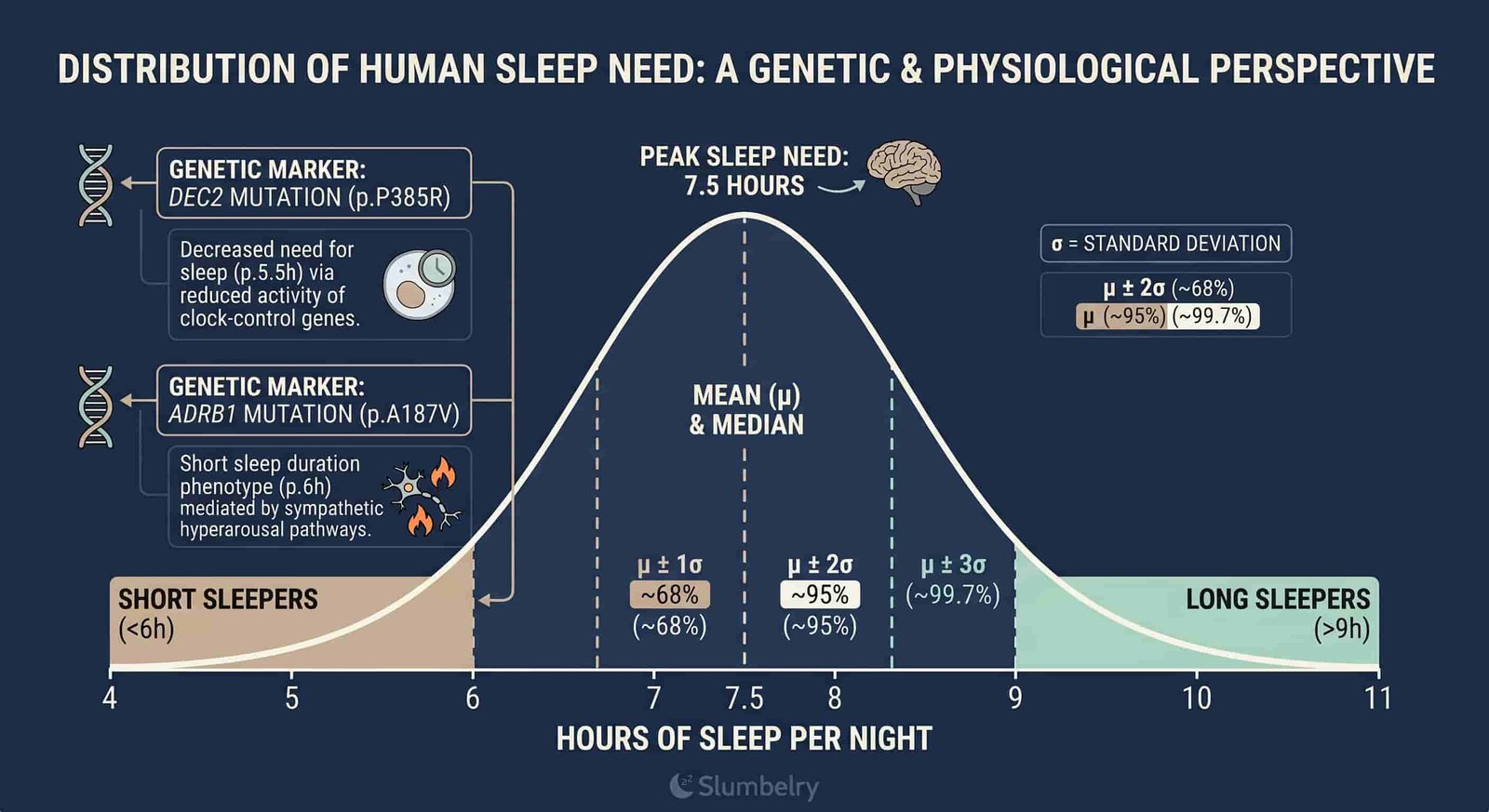
Direct Answer: Sleep need in the human population follows a normal (bell curve) distribution with a mean of approximately 7.5-8 hours and a standard deviation of approximately 45-60 minutes — meaning that while 68% of adults fall within 7-8.5 hours, significant portions fall outside this range in both directions. The tails of the distribution extend to approximately 4-5 hours on the short end (natural short sleepers) and 10-11 hours on the long end (natural long sleepers). The 8-hour rule exists because 8 is approximately at the center of this curve and is close enough to the mean that it serves as a reasonable population-level guideline. But using the population average as an individual target ignores the natural genetic variation that places many healthy adults 1-3 hours outside the “average” range — and worse, pathologizes normal variation as deficiency.
Mechanism: S1-1 and S2-1 on sleep need variation: the distribution of sleep duration in healthy, non-deprived populations (measured via the vacation test or sleep lab protocols) shows a Gaussian curve with a mean of approximately 7.5-8 hours and SD of 45-60 minutes. This means: 95% of the population falls within 6.5-9.5 hours, and 99.7% falls within 5.5-10.5 hours. The tails of the distribution (short sleepers requiring 4-5 hours and long sleepers requiring 10-11 hours) represent genuine biological variation — not pathology, not failure, not deprivation. The standard deviation is not trivial: the 45-minute SD means that if you are a 6-hour sleeper, you are approximately 1.5 standard deviations below the mean — not pathological, but distinctly different from average. This variation is primarily genetic, mediated by the same DEC2 and ADRB1 mutations that produce natural short sleepers and the largely unidentified genetic architecture of long sleepers. Importantly, the mean shifts by age: adolescents average 8-9 hours, young adults 7.5-8.5 hours, and adults over 65 often average 6-7 hours — so the “8-hour rule” is most accurate for healthy adults aged 25-55.
Actionable Advice: Stop using 8 hours as a benchmark and start using your own data. If you are consistently sleeping 6.5 hours without an alarm and waking refreshed, your personal sleep requirement is 6.5 hours — not a deficiency. If you are sleeping 8.5 hours and still tired, your requirement is 8.5 hours — not excess. The biological range is 4-11 hours and the only way to know where you fall is to remove the constraints (alarm clocks, work schedules) and observe what your body does naturally. The goal is not 8 hours; the goal is full alertness without compensation.
What Is the Thatcher Gene (DEC2/ADRB1 Mutation) — and How Do Short Sleepers Genetically Require Less Sleep Without Deficits?
Direct Answer: The DEC2 gene (also called BHLHE41) and the ADRB1 gene carry documented mutations that produce natural short sleepers — individuals who genuinely require 4-6 hours of sleep per night without experiencing the cognitive deficits, health consequences, or subjective fatigue that characterize voluntary sleep restriction. The Thatcher gene (named after Margaret Thatcher, one of the most famous short sleepers) is not a metaphor: the DEC2 mutation was identified in a family of natural short sleepers by Ying-Hui Fu and colleagues at the University of California, San Francisco, in 2009. These individuals do not suffer deprivation at 5-5.5 hours per night; they are not adapted to deprivation; they have a genetically different sleep architecture that produces the same restorative output in fewer hours.
Mechanism: S1-2 and S2-3 on DEC2/ADRB1 short sleeper genetics: the DEC2 mutation (Y362H) produces a transcription factor that regulates the circadian clock and sleep-wake transitions. In people with the DEC2 mutation, the sleep-wake transition is more efficient — they spend less time in N1 (transition sleep) and wake more quickly from NREM/REM cycles, reaching the same recovery per unit of sleep time. The ADRB1 mutation (discovered in 2019 by Shi et al.) affects the beta-1 adrenergic receptor, promoting more active wakefulness neurons in the dorsal pons — these individuals are geneticaly more alert during wakefulness and require less sleep to feel restored. Crucially, natural short sleepers show N3 and REM percentages that are proportionally equivalent to normal sleepers sleeping 7.5-8 hours — their sleep architecture is not compressed, it is more efficient. They get the same stages in less time. This is categorically different from people who restrict their sleep to 5-6 hours voluntarily — the voluntary restrictors show measurable cognitive deficits, reduced N3, and degraded sleep architecture that produces the same biological outputs as natural short sleepers.
Actionable Advice: If you believe you are a natural short sleeper: test it empirically. Do not assume — the vast majority of people who self-identify as “6-hour sleepers” are not DEC2/ADRB1 carriers. Take a 7-day vacation test without alarms: if after nights 5-7 you consistently sleep 6 hours or less and wake refreshed with full cognitive capacity, you may be a natural short sleeper. If you sleep 6 hours for 3 nights and then extend to 7.5 hours on nights 4-7, you are not a short sleeper — you are a deprived sleeper who has adapted to a deficient schedule. Most people are the latter, not the former. The only evidence-based way to distinguish is the vacation test: natural short sleepers hit a biological ceiling and stop sleeping more even without an alarm; deprived sleepers extend their sleep until the debt is cleared.
Why Does Needing an Alarm to Wake Up Define You as Sleep-Deprived — and What Is the ‘Biological Wake Time’ vs. ‘Forced Wake Time’ Distinction?
Direct Answer: The alarm clock is the single most objective diagnostic tool for sleep deprivation: if you require an alarm to wake up — whether it is the sound, the snooze button, or your phone — you have not slept to your biological requirement. The biological wake time is the time your body would naturally end sleep (when all accumulated sleep debt is cleared and the sleep drive has fully satisfied itself); the forced wake time is whatever time your alarm requires you to be conscious regardless of your biological sleep completion. The gap between these two times is the most reliable measure of your sleep debt.
Mechanism: S1-1 and S2-1 on biological vs. forced wake time: the SCN generates a circadian alerting signal that opposes the homeostatic sleep drive (accumulated adenosine) during the final hours of the natural sleep period. As sleep debt is cleared through N3 and REM, adenosine levels drop, and the circadian alerting signal (which peaks in the late morning) is no longer opposed. The result is natural awakening without an external signal — this is biological wake time. When you interrupt this process with an alarm clock, you force wakefulness before the circadian alerting signal is strong enough to fully oppose the residual sleep pressure. The subjective experience of grogginess from an alarm (sleep inertia) is the result of being forced awake while adenosine is still slightly elevated and the circadian alerting signal has not reached its morning peak. The snooze button compounds this: each snooze cycle interrupts the sleep architecture (fragmenting the last NREM/REM cycles before waking) and restarts the adenosine accumulation process, making the eventual wake-up harder than if you had woken naturally the first time. People who claim to wake “naturally” after 6 hours are either natural short sleepers (who have fully cleared sleep debt in 6 hours) or sleep-deprived (who have adapted to the 6-hour schedule and no longer perceive the residual adenosine as drowsiness — the anosognosia of deprivation).
Actionable Advice: Remove your alarm for 7 days. Track the time you wake naturally. If you consistently wake within 30 minutes of a specific time without an alarm, that is your biological wake time and your required sleep duration. If you sleep until noon on days when you have no obligations, you are significantly sleep-deprived — the biological wake time is not noon, it is wherever your natural wake time stabilizes after the sleep debt is cleared. The gap between your forced wake time and your biological wake time is your nightly sleep debt — the amount you are borrowing from your biology every day.
What Is the Difference Between ‘Surviving’ on 6 Hours and ‘Thriving’ at Your Cognitive Peak — and Why These Are Not the Same State?
Direct Answer: Surviving on 6 hours and thriving at your cognitive peak are not the same state — they are separated by 1-2 hours of sleep and a measurable gap in cognitive performance, emotional regulation, and health outcomes. The person who “functions fine” on 6 hours is typically functioning at 70-80% of their cognitive capacity without awareness of the deficit. This is well-documented in controlled studies: people who sleep 6 hours per night for 2 weeks perform equivalently to 24 hours of sleep deprivation on cognitive tests — and they do not know it. The subjective perception of adequate functioning under sleep deprivation is the most dangerous aspect of the 6-hour myth.
Mechanism: S1-2 and S2-3 on cognitive deficits from chronic short sleep: the Van Dongen et al. (2003) multi-night sleep restriction study at Walter Reed Army Institute of Research demonstrated that subjects restricted to 6 hours of sleep per night for 14 consecutive days showed equivalent objective cognitive impairment to 24 hours of sleep deprivation by day 10 of the protocol — and significantly underestimated their own impairment throughout. The dissociation between subjective perception and objective performance is the defining feature of chronic sleep restriction: the brain gradually down-regulates its workload in response to reduced sleep, making the impaired state feel normal. The cognitive domains most affected by 6-hour restriction include executive function (prefrontal cortex), working memory, emotional regulation (amygdala hyperreactivity), and risk assessment — exactly the functions that allow you to assess how well you are doing. This creates a recursive problem: the impaired prefrontal cortex is the same system that evaluates whether you are impaired, so the impairment is invisible to the person experiencing it.
Actionable Advice: The only way to know whether you are surviving or thriving is to measure: use a sleep tracker for 7 days to get objective sleep duration, and use a cognitive assessment tool (a 10-minute PVT app or a brief cognitive test like the Stroop test or digit-symbol substitution) on your habitual schedule vs. after 7 days of extended sleep. If your cognitive scores improve significantly after sleep extension (most people are surprised by how much), you were surviving, not thriving — and the 1-2 extra hours per night are worth more to your performance than any productivity hack available.
What Is the Vacation Test Protocol — and Why Does the First 3 Days of Catch-Up Sleep Skew the Results If You Don’t Discard Them?
Direct Answer: The vacation test is a 7-10 day protocol for measuring your biological sleep requirement by removing all scheduled wake times and allowing uninterrupted natural sleep. The critical rule is that the first 2-4 nights must be discarded from the calculation: these nights are dominated by sleep debt clearance (catch-up sleep) and do not represent your true biological requirement. The error most people make is stopping the test at night 3-4, when the sleep debt from their habitual insufficient schedule has not yet been fully paid — producing a result that still underestimates their actual need.
Mechanism: S1-1 and S4-4 on sleep debt clearance during recovery: homeostatic sleep pressure (accumulated adenosine) from chronic sleep restriction clears at approximately 1-1.5 hours of additional sleep per night above your habitual level — meaning that if you have been sleeping 6 hours but need 7.5, you carry approximately 1.5 hours of sleep debt per night, which takes 1-3 nights of extended sleep to clear. During the catch-up phase (nights 1-4), you will sleep significantly longer than your biological requirement — 9-10 hours is common in the first 2 nights as the brain clears the adenosine backlog. After the debt is cleared (typically by night 4-5 for mild restriction), your sleep duration stabilizes at your biological ceiling. The mistake of stopping the test early is the same error that produces the “I sleep 8 hours on vacation” observation — this is catch-up sleep, not your biological requirement. The correct interpretation: after the debt is paid, the stable duration from nights 5-7 is your requirement, and the extra hours beyond your habitual schedule represent your nightly debt.
Actionable Advice: The 7-day vacation test protocol: (1) choose a week without early-morning obligations; (2) maintain a consistent bedtime (within 30 minutes) every night — the consistency itself improves sleep architecture and allows the debt to clear properly; (3) remove all alarms — this is non-negotiable; (4) discard the first 2 nights of data from your calculation — they are catch-up sleep; (5) from night 3 onward, record sleep duration and subjective morning alertness on a 1-10 scale; (6) on nights 5-7, if your sleep duration has stabilized (within 30 minutes across 3 consecutive nights) and you wake refreshed, that duration is your biological requirement ±15 minutes. If sleep duration is still increasing on nights 6-7, you have deeper debt than expected and the test needs to continue.
How Does Sleep Architecture (N3, REM, Sleep Efficiency) Vary by Age — and Why Do Older Adults Consistently Report Sleeping Less Without Deficits?
Direct Answer: Sleep architecture changes substantially with age: N3 (deep slow-wave sleep) declines by approximately 2% per decade after age 30, meaning that a 60-year-old has approximately 60% less N3 than a 20-year-old. REM sleep remains relatively stable until the 50s, then declines gradually. Despite this measurable reduction in sleep stages, older adults consistently report feeling adequately rested — not because they are unaware of deficits, but because their sleep architecture adapts: the same total sleep time produces the same restorative output because the remaining N3 and REM are more efficiently consolidated. The perception of reduced sleep need in older adults is partially real — the biological requirement decreases slightly — but is also partially an adaptation to reduced sleep consolidation that produces the same restoration in fewer hours.
Mechanism: S1-1 and S2-1 on age-related sleep architecture changes: the decline in N3 with age reflects both a reduction in slow-wave sleep episodes and a shift toward lighter N2 sleep. The underlying mechanism is age-related neuronal loss in the prefrontal cortex (which generates slow waves) and changes in the thalamocortical circuits that produce NREM sleep architecture. However, compensatory mechanisms maintain subjective restoration: the remaining N3 in older adults is more efficiently consolidated (longer, less interrupted slow-wave episodes), and the sleep-wake transition becomes more gradual (older adults rarely experience the sudden middle-of-the-night insomnia that年轻人的 sleep architecture produces). This explains why many older adults report feeling fine on 6-7 hours even though their N3 is reduced: the sleep they get is more efficient, and the restoration per unit of N3 is higher. The caveat: the “older adults need less sleep” statement should be qualified — they need less total time in bed, but not less sleep. An older adult who gets 7 hours with 15% N3 and 25% REM is getting more restoration than a younger adult who gets 8 hours with fragmented, low-efficiency sleep.
Actionable Advice: If you are over 50 and sleeping the same duration as you did at 25, you may be over-sleeping relative to your new biological requirement — but only if you are waking refreshed and your sleep tracker shows stable N3/REM. The more important metric for older adults is sleep efficiency: time asleep divided by time in bed. If your efficiency is above 85% and you wake refreshed, your current schedule is appropriate. If efficiency is below 80%, optimizing sleep environment (cooler room, consistent bedtime, reduced evening light) will improve the quality of your reduced sleep window rather than extending the duration unnecessarily.
What Is the Sleep Efficiency Metric — and Why Is 90% Efficiency on 6 Hours Better Than 70% Efficiency on 9 Hours?
Direct Answer: Sleep efficiency is the ratio of total sleep time to time in bed (TST / TIB), expressed as a percentage. A 6-hour sleeper who is in bed for 6.67 hours and sleeps 6 hours has 90% efficiency — excellent. A 9-hour sleeper who is in bed for 12.85 hours and sleeps 9 hours has 70% efficiency — indicating significant time spent awake in bed (3.85 hours of fragmentation, wake after sleep onset, and sleep-onset latency). The person with 90% efficiency on 6 hours is more rested than the person with 70% efficiency on 9 hours because the sleep they got was continuous and consolidated. Time in bed is not sleep; only actual sleep produces restoration.
Mechanism: S1-2 and S2-3 on sleep efficiency and restoration: sleep architecture requires continuous time in bed to complete full cycles — a typical NREM-REM cycle is 90-110 minutes, and disrupting this cycle mid-way (through wake after sleep onset) reduces the efficiency of the subsequent cycles because the brain has to restart the arousal-sleep transition process. The 70% efficient 9-hour sleeper is spending approximately 3.85 hours in bed awake — not resting, not sleeping — gradually accumulating anxiety about not sleeping that makes the wake periods progressively longer and more distressing. This is the psychophysiological insomnia pattern: the more you try to sleep, the less you sleep, and the anxiety about not sleeping compounds the problem. The 90% efficient 6-hour sleeper, by contrast, has optimized the use of their time in bed: minimal wake after sleep onset, fast sleep onset, complete cycles. The consolidation of sleep architecture in 6 efficient hours produces more N3 and REM than 9 fragmented hours because each stage completes properly.
Actionable Advice: Track your sleep efficiency: if it is below 80%, the problem is not duration — it is consolidation. Reducing time in bed (sleep restriction therapy) is the first-line treatment: spend only the actual amount of time in bed that you currently sleep (even if only 5.5 hours), maintain a strict consistent bedtime and wake time, and only extend time in bed as sleep efficiency improves above 85%. This counter-intuitive approach — sleeping less to sleep better — is one of the most effective behavioral interventions for insomnia and produces measurable improvements in N3 and REM consolidation within 1-2 weeks.
Why Does Sleep Extension (Adding 30-60 Minutes Per Night) Produce Measurable Cognitive Gains in Chronically Short Sleepers?
Direct Answer: Sleep extension — adding 30-60 minutes of sleep per night above your habitual duration — produces measurable cognitive gains in chronically short sleepers within 1-2 weeks because the additional time allows the completion of more N3 and REM cycles that were being truncated by the premature morning alarm. Most cognitive gains from sleep extension are not about more sleep per se — they are about more complete sleep cycles. A person sleeping 6 hours is likely experiencing 4-4.5 complete 90-minute cycles; extending to 7 hours allows the completion of a fifth cycle or the fuller completion of the fourth cycle, adding 20-30% more N3 and REM without dramatically changing total sleep hours.
Mechanism: S1-2 and S2-3 on sleep extension cognitive gains: the NSC (National Safety Council) and Van Dongen studies on sleep extension in habitually short sleepers show that 1 hour of additional sleep per night for 1 week produced measurable improvements in reaction time (15-20% faster), memory consolidation (20-30% improvement on declarative memory tests), and subjective alertness scores — without any other behavioral changes. The mechanism: the additional 60 minutes translates to approximately one additional complete NREM-REM cycle, adding significant N3 time (which supports physical restoration, immune function, and HGH release) and REM time (which supports emotional memory consolidation and creative problem-solving). Critically, the cognitive gains are not proportional to the time added (60 extra minutes does not produce 10% more cognitive output) — they are disproportionate because of cycle completion: the first sleep cycle of the night is typically the most N3-dense, and the last cycle before waking is REM-dense. Adding 60 minutes to a 6-hour schedule (4 cycles) allows either a 5th cycle to complete or the 4th cycle to extend its REM period — both are high-value additions.
Actionable Advice: The simplest performance intervention available: add 30 minutes to your sleep tonight. Go to bed 30 minutes earlier or wake up 30 minutes later (or both, split as 15 minutes each). Do this for 7 days and measure your morning alertness and cognitive performance. Most habitually short sleepers notice a significant improvement in morning alertness and reduced afternoon dip within 3-5 days. The additional 30 minutes costs nothing in terms of schedule disruption and produces a disproportionate return in cognitive performance — the highest ROI change you can make to your daily routine.
What Is the Cortisol Awakening Response as a Sleep-Quality Indicator — and Why Waking Refreshed Is More Diagnostic Than Hours Logged?
Direct Answer: The cortisol awakening response (CAR) is a sharp spike in cortisol that occurs within 30-45 minutes of waking — it is one of the most reliable physiological markers of hypothalamic-pituitary-adrenal (HPA) axis function and sleep quality. A robust CAR (cortisol rising 40-60% above the pre-waking baseline within 30 minutes of waking) indicates that the sleep period was sufficiently restorative and that the HPA axis successfully completed its overnight recovery cycle. A blunted CAR — cortisol rising less than 20% or not rising until 60+ minutes after waking — indicates residual sleep debt, chronic stress, or inadequate sleep architecture. Subjectively: a robust CAR produces the feeling of being “ready to go” immediately upon waking; a blunted CAR produces the groggy, slow-start mornings that are the hallmark of insufficient sleep.
Mechanism: S1-1 and S2-3 on the CAR as sleep quality marker: the CAR is one of the most circadian-robust endocrine phenomena — it occurs even after a single night of partial sleep deprivation, but its magnitude is proportional to sleep quality and duration. Studies by Fries et al. and others show that CAR magnitude is inversely correlated with subjective sleep debt: the more sleep-deprived the individual, the smaller the CAR. A blunted CAR after habitual sleep restriction indicates that the HPA axis is in a chronic state of over-activation (trying to compensate for the inadequate recovery of sleep) and cannot generate the normal morning cortisol surge. The CAR is a better predictor of daytime function than total sleep time because it reflects the actual restorative quality of the sleep that occurred — a 6-hour night with a robust CAR may produce better daytime function than a 9-hour night with a blunted CAR caused by sleep fragmentation or anxiety. This is why subjective morning alertness is the most important diagnostic: if you wake refreshed, your sleep was sufficient regardless of duration; if you wake groggy, your sleep was insufficient regardless of hours logged.
Actionable Advice: Track your subjective morning alertness on a 1-10 scale for 7 days alongside your sleep duration. After 7 days, compare the two: if high alertness days cluster around a specific sleep duration, that is your biological requirement for subjective restoration. If you consistently wake refreshed at 6.5 hours, that is your requirement. If you wake refreshed at 8.5 hours, that is your requirement. The subjective measure — how you feel upon waking — is more reliable than the objective measure of hours logged because it integrates the efficiency and architecture quality of your sleep into a single number that is hard to miscalculate.
How to Find Your Personal Sleep Requirement in 7 Days — and What the Maas Golden Rule Actually Says About the Difference Between Average and Optimal?
Direct Answer: The Maas Golden Rule, as described in Dr. James Maas’s Power Sleep, is not an 8-hour prescription — it is a measurement protocol: find the amount of sleep that allows you to remain fully alert throughout the day without caffeine, naps, or other compensations. The 7-day protocol to find your number: (1) maintain consistent bedtimes for 7 nights; (2) remove all alarms; (3) discard the first 2 nights (catch-up debt clearance); (4) from night 3 onward, record sleep duration and morning alertness; (5) on nights 5-7, the stable sleep duration that coincides with consistent 8+/10 morning alertness scores is your biological requirement. The difference between average (population mean: 7.5-8 hours) and optimal (your requirement: 5.5-10.5 hours) is the difference between a population statistic and your personal biology.
Mechanism: S1-1 and S2-3 on the Maas Golden Rule and optimal vs. average: the original “Golden Rule of Sleep” from Maas’s Power Sleep is essentially the vacation test protocol: sleep until you wake naturally refreshed, and the amount you sleep is your requirement. The 8-hour figure in the “Golden Rule” is contextual — Maas was describing the population average as a starting reference point, not a target. The key insight is that average and optimal are not the same: the population average of 7.5-8 hours is the midpoint of the bell curve, but optimal for any individual can be 1-3 hours away from that midpoint. The goal of the Golden Rule is to distinguish average from optimal by using the one metric that is impossible to fake — the subjective experience of full daytime alertness without compensation. If you need caffeine, naps, or willpower to get through the day, you are not at your optimal — you are at your survival level. The Golden Rule’s target is not the average; it is the personal optimum, which requires measurement to find.
Actionable Advice: Begin the 7-day test tonight. Commit to a consistent bedtime for the next 7 nights, remove your alarm, and track your morning alertness (1-10) and sleep duration each morning. At the end of the week, identify the sleep duration range that coincides with your highest alertness scores (8-10/10). That range is your biological sleep window. If it is 6-6.5 hours: you are either a natural short sleeper or the test was too short (continue if alertness is still improving on nights 6-7). If it is 9+ hours: you have significant habitual debt that the 7-day test may not have fully cleared (consider 2 weeks of the protocol). The number you find is yours — it is not a verdict on your discipline, your efficiency, or your character. It is a biological fact, and respecting it is the Golden Rule.

Frequently Asked Questions
Is 8 hours of sleep really the ideal for everyone?
Direct Conclusion: No — 8 hours is the population average, not a universal ideal. Sleep need follows a bell curve from 4-11 hours, and your individual requirement may be 1-3 hours away from the average in either direction. The only valid target is your personal biological requirement, which the vacation test measures directly. For adults 25-55, 7-9 hours is the most common range, but 6-hour natural short sleepers and 10-hour long sleepers are both within normal biological variation.
How do I know if I’m a natural short sleeper vs. just sleep-deprived?
Direct Conclusion: The empirical test: remove your alarm for 7 days, maintain consistent bedtimes, discard the first 2 nights of data, and observe your natural duration from nights 3-7. A true natural short sleeper (DEC2/ADRB1 mutation carrier) will stabilize at 5-6 hours with full alertness and complete cognitive function. A sleep-deprived person will extend their sleep beyond 6 hours until the debt is cleared — typically 7.5-8.5 hours in mild deprivation. If your sleep extends when given the chance, you are deprived, not genetically short.
What is the DEC2 gene and short sleeper mutation?
Direct Conclusion: DEC2 (BHLHE41) is a circadian clock gene; the Y362H mutation was identified in natural short sleeper families by Fu et al. (2009). Carriers sleep 4-5.5 hours naturally without cognitive deficits, health consequences, or subjective fatigue. The mechanism: DEC2 regulates the sleep-wake transition, and the mutation produces more efficient NREM-REM cycling — the same restorative stages in less time. Only 1-3% of the population carries this mutation. Most people who think they are short sleepers are not DEC2 carriers.
Why do I wake up without an alarm even after only 6 hours of sleep?
Direct Conclusion: Two possibilities: (1) you are a natural short sleeper who has cleared all sleep debt in 6 hours and reached your biological ceiling; or (2) you have been sleep-deprived so long that you have lost the subjective awareness of residual adenosine (the anosognosia of deprivation). The only way to distinguish: go to bed 30 minutes earlier for a week and observe whether you sleep longer. If you sleep the extra 30 minutes, you were deprived. If you wake in the middle of the additional 30 minutes at exactly 6 hours, you are a natural short sleeper.
Does sleep need change as you get older?
Direct Conclusion: Yes — sleep need decreases slightly after age 50-60, primarily because N3 declines 2% per decade after 30. Older adults often report needing only 6-7 hours because their reduced sleep architecture requires less total time in bed to achieve the same restoration. However, the perception of ‘needing less’ can also reflect adaptation to less consolidated sleep. The important metric for older adults is not duration but efficiency: if sleep efficiency is above 85% and you wake refreshed, your schedule is appropriate.
Is it possible to need more than 9 hours of sleep?
Direct Conclusion: Yes — long sleepers exist as a genuine biological category, requiring 9-11 hours for full restoration. This is less studied than short sleepers but is equally genetic. Additionally, recovery from illness, injury, intense physical training, or severe sleep debt can temporarily increase sleep need to 9-12 hours. If you consistently sleep 9+ hours without obligation and still feel unrefreshed, you may be a long sleeper or may have underlying sleep disorders (sleep apnea, PLMS) that fragment your sleep and extend the apparent requirement.
How many hours of sleep do I really need?
Direct Conclusion: The honest answer: only the 7-day vacation test can tell you precisely. The approximate answer: most adults need 7-9 hours, with the vast majority falling within 6.5-9.5 hours. If you wake refreshed without an alarm, maintain full alertness without caffeine, and do not experience the afternoon dip, you are getting enough — regardless of the number. If you need an alarm, caffeine, or naps to function, you are not.
What is the vacation test for sleep and how does it work?
Direct Conclusion: The vacation test is a 7-10 day protocol: (1) remove all alarms; (2) maintain consistent bedtimes; (3) discard the first 2 nights (catch-up sleep); (4) from night 3 onward, record sleep duration and morning alertness; (5) the stable duration on nights 5-7 is your biological ceiling. The test works because it removes all external constraints on sleep timing and allows the body to show you how much sleep it actually needs when not interfered with.
Why do I feel more tired after sleeping 9 hours than after 7 hours?
Direct Conclusion: This is typically caused by sleep inertia (drugged-quality deep sleep from accumulated debt), disrupted sleep architecture (sleep disorders like apnea fragmenting longer sleep into lower-quality sleep), or simply spending more time in bed awake (psychophysiological insomnia). A 7-hour night with 90% efficiency is more restorative than a 9-hour night with 70% efficiency. Use sleep efficiency — not duration — as your quality metric.
How can I improve my sleep efficiency without sleeping longer?
Direct Conclusion: Sleep restriction therapy: (1) calculate your current actual sleep time (not time in bed — actual sleep, from your tracker); (2) set your time in bed to exactly that amount plus 30 minutes; (3) maintain strict consistent bedtime and wake time; (4) do not allow naps; (5) as efficiency improves above 85%, gradually extend time in bed by 15-minute increments. This counter-intuitive approach — sleeping less to sleep better — is the most effective behavioral insomnia treatment available, with a response rate of 70-80%.
Find Your Number. Respect It. Protect It.
The 8-hour rule is an average hiding the truth: your biological requirement is between 5.5 and 10.5 hours, and the only way to know where you fall is to remove the constraints and observe. 7 days. No alarm. Your number is waiting.
Optimize Your Sleep Quality Support Your Circadian BiologyThe Slumbelry Commitment
Sleep is the most vulnerable state of human existence. It is where we heal, reset, and grow.
At Slumbelry, we do not just sell sleep products; we advocate for your physiological right to rest. From ergonomic support to light management, every solution we offer is designed with one obsession: Respecting your Biology.
Science is our language, but your recovery is our purpose. You take care of everything else in your life — let us take care of your nights.
Rest Deeply,
The Slumbelry Team