
The 20-Minute Performance Enhancer
Why the ‘Coffee Nap’ Actually Works — The Caffeine-ADP Mechanism That Makes 20 Minutes Feel Like a Full Night’s Rest
Napping has a branding problem. We associate it with laziness, toddlers, or the elderly. But in the world of high performance — NASA pilots, Olympic athletes, elite surgeons — napping is a strategic tool, not a sign of weakness. Dr. James Maas coined the term ‘Power Nap’ to make this argument with scientific rigor: a 20-minute nap timed to the circadian dip produces measurable improvements in reaction time, executive function, and alertness that persist for 2-3 hours. The catch: you have to do it right, or you will wake up feeling worse than before you lay down.
Most people fail the power nap because they set their alarm for 40 minutes instead of 20, nap in bed instead of a chair, or nap at 4 PM instead of 2. This power nap guide is the complete scientific and tactical manual for the only nap that actually makes you more alert: when, how, and why the 20-minute window is a biological law, not a suggestion.
⚡ Core Takeaway: The 20-Minute Power Nap Is a Precision Tool — One That Requires a Strict Alarm, the Right Timing, and Nothing More
- The Problem: Napping after 4 PM or sleeping longer than 30 minutes produces sleep inertia — 30-60 minutes of grogginess, slowed reaction time, and impaired cognitive function that negates the nap’s benefit. The sleep inertia occurs because N3 slow-wave sleep takes 30-45 minutes to initiate in most adults, and waking from N3 before completing a full slow-wave cycle leaves the prefrontal cortex in a state of disorientation and impaired function. This is why the 30-minute nap is the worst possible choice: long enough to enter N3 but too short to complete it, producing maximum sleep inertia with no compensating benefit. The correct nap is 20 minutes — timed to capture N1 and N2 without entering N3
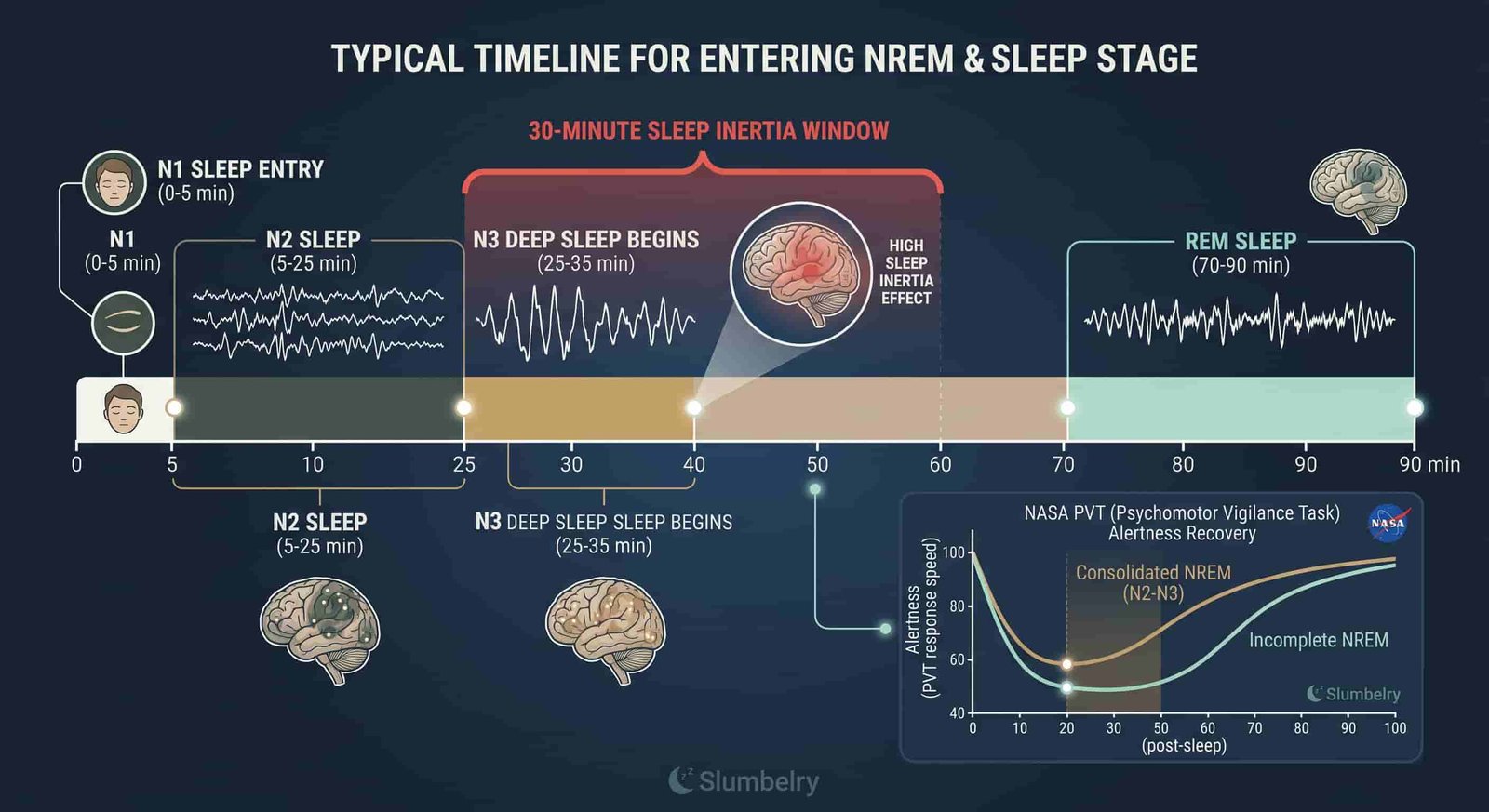
- The Mechanism: S1-2 and S2-3 on the 20-minute nap mechanism: sleep onset in healthy adults occurs within 5-10 minutes. N1 lasts 1-5 minutes. N2 begins at 5-10 minutes and continues until N3 onset at 25-40 minutes. A 20-minute nap captures N1 and the first 10-15 minutes of N2 — enough to reduce subjective sleepiness via adenosine clearance and parasympathetic activation, improving reaction time and boosting alertness for 2-3 hours — without entering N3. The NASA PVT research by Rosekind et al. showed that a 20-minute powernap produced a 34% improvement in alertness and a 54% reduction in sleepiness in cockpit crews. The caffeine nap trick works because caffeine takes approximately 20 minutes to reach peak serum concentration — so the alertness boost from caffeine coincides exactly with the post-nap grogginess window, providing a double activation that leaves the napper more alert than either intervention alone
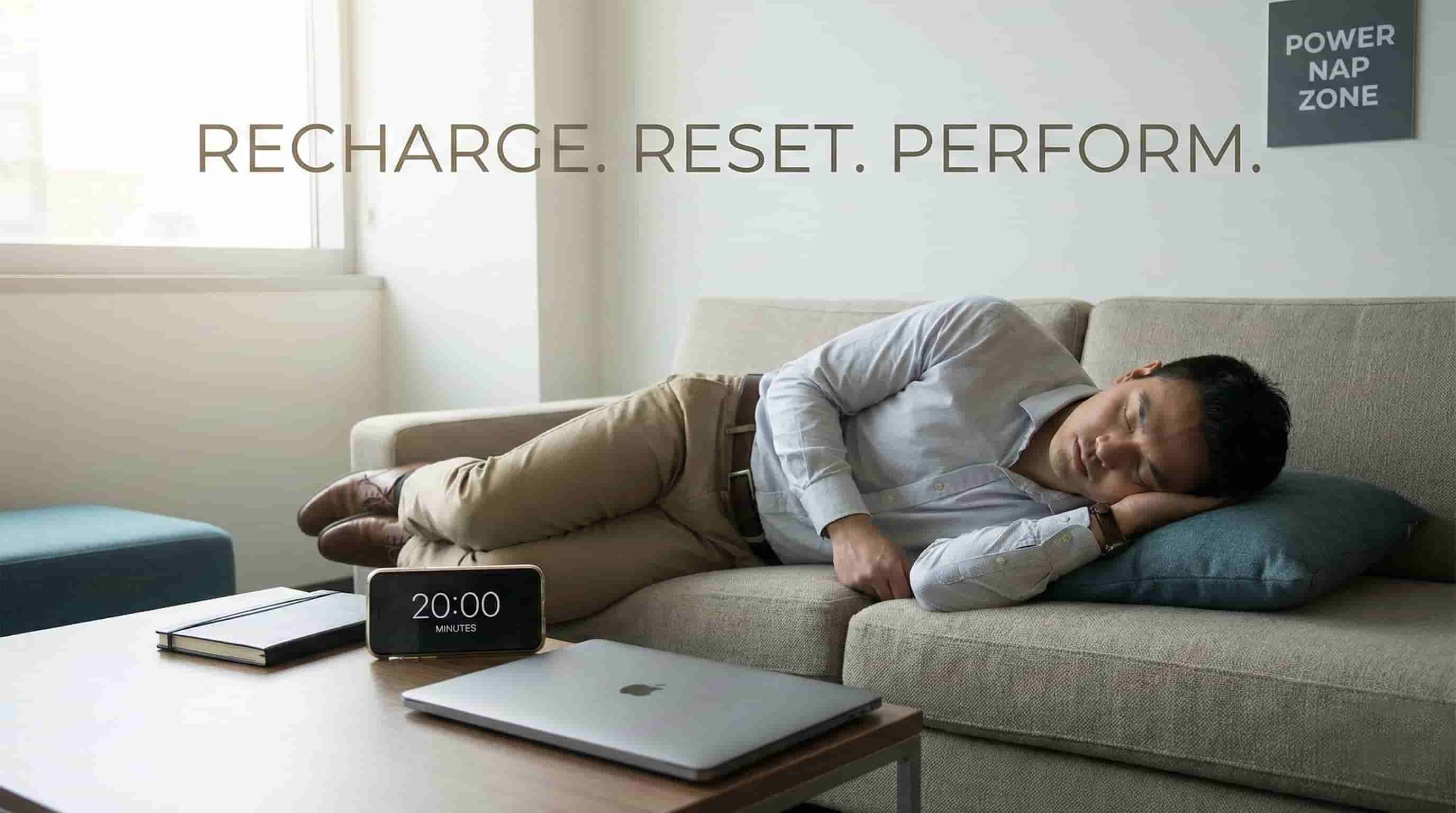
- The Protocol: The perfect 20-minute powernap: (1) timing: 1-3 PM, within the circadian dip window — napping earlier or later compromises nighttime sleep architecture; (2) immediately before napping: drink coffee (150mg caffeine) if using the caffeine nap — then lie down within 60 seconds; (3) set two alarms: a 20-minute timer AND a backup 25-minute safety alarm; (4) environment: dim light or eye mask, cool temperature, white noise or earplugs; (5) position: reclined chair (not bed) to reduce the psychological invitation to extend; (6) upon waking: cold water on face, 5 deep breaths, 5 minutes of light movement before returning to work. The entire protocol takes 25 minutes and yields 2-3 hours of post-nap alertness improvement
What Is the Sleep Inertia Phenomenon — and Why Does Waking From Deep Sleep Produce 30-60 Minutes of Cognitive Impairment?
Direct Answer: Sleep inertia is the transitional state between sleep and wakefulness, characterized by a period of grogginess, disorientation, and impaired cognitive function that follows awakening — particularly when waking from N3 slow-wave sleep. The impairment is not mild: reaction time slows by 30-50%, working memory is reduced by 30-40%, and subjective alertness is at its lowest point of the day during the first 15-30 minutes after waking from deep sleep. Sleep inertia is most severe when waking from N3 because the cortical synchronization (the slow waves) that characterizes deep sleep takes time to reverse — the brain must transition from the globally synchronized state of slow-wave sleep back to the desynchronized waking state, and during this transition, cognitive function is genuinely impaired. This is why waking someone from deep sleep and asking them to perform a cognitive task immediately produces worse results than before they slept.
Mechanism: S1-2 and S2-3 on sleep inertia and N3 impairment: the physiological basis of sleep inertia involves the gradual reactivation of the prefrontal cortex and thalamic arousal systems after the generalized cortical suppression of N3. During N3, the cortex is in a state of synchronized slow-wave activity driven by thalamocortical oscillations — this is the deepest level of unconsciousness. Upon waking, the cortex must re-establish its waking network connectivity, and this process takes 15-30 minutes to complete. Studies using fMRI during sleep inertia show reduced prefrontal cortical activation and disrupted default mode network dynamics — the same brain networks responsible for executive function and self-awareness are temporarily offline. The duration and severity of sleep inertia are directly proportional to the depth of sleep from which you wake: waking from N3 produces 30-60 minutes of measurable impairment; waking from N2 produces 5-15 minutes of mild impairment; waking from N1 produces essentially no measurable inertia. This is the biological reason why the 30-minute nap is the worst possible choice — it is the exact duration required to enter N3 and wake from it with maximum inertia.
Actionable Advice: Never wake from N3 if you have a cognitive task in the next hour. If you have overslept past the 20-minute boundary and are now in N3, consider letting the alarm ring and completing a full NREM-REM cycle (75-90 minutes total) before waking — this will actually produce less impairment than waking from early N3, because the cycle completion allows the brain to exit from deep sleep through lighter stages. Alternatively, use a gradual alarm that increases light exposure rather than sound to gently elevate cortisol and reduce the sleep inertia severity.
Why Does 20 Minutes Specifically (Not 30, Not 60) Produce Maximum Alertness Recovery With Zero Sleep Inertia?
Direct Answer: 20 minutes is the precise biological boundary where the sleep architecture transitions from light sleep (restorative, no inertia) to deep sleep (disorienting, high inertia). Sleep onset in healthy adults occurs within 5-10 minutes. N1 (transition sleep) lasts 1-5 minutes. N2 (light sleep with sleep spindles) begins at approximately 5-10 minutes and continues until N3 onset at approximately 25-40 minutes. A 20-minute nap captures N1 and the first portion of N2 — enough to reduce subjective sleepiness through adenosine clearance and parasympathetic activation, enough to improve reaction time and subjective alertness — without entering the N3 territory that produces sleep inertia upon waking. At exactly 20 minutes, you are at the outer edge of N2, and most sleepers are still in light sleep when the alarm sounds. At 30 minutes, most sleepers have been in N3 for 5-10 minutes and wake with full sleep inertia. At 60 minutes, most sleepers have completed at least one full NREM cycle and wake during N2 or REM, which produces minimal inertia.
Mechanism: S1-2 and S2-3 on nap duration and alertness: Tietzel and Lack (2001) and other nap duration studies established that 20 minutes is the optimal nap duration for alertness recovery in healthy adults. The key findings: 10-minute naps produce incomplete adenosine clearance and insufficient alertness recovery; 20-minute naps produce near-maximum alertness improvement with no sleep inertia; 30-minute naps produce significant sleep inertia (measurable for 30-60 minutes post-waking); 60-minute naps produce moderate inertia that resolves after 30-45 minutes but waste time relative to the alertness gained. The mathematical summary: the 20-minute nap has the best alertness recovery per unit time invested. The NASA study by Rosekind et al. (1994) confirmed that 20-minute naps produced the greatest alertness improvement in cockpit crews during extended flight operations — a 34% reduction in sleepiness and a 54% improvement in alertness compared to no-nap control conditions.
Actionable Advice: Set two alarms: a 20-minute primary alarm and a 25-minute backup safety alarm. The 5-minute safety buffer exists in case you do not fall asleep immediately (the 20-minute timer starts when you actually fall asleep, not when you close your eyes). If you are still awake at 15 minutes, stay awake and try again tomorrow — do not extend to 30 minutes just because you are not sleeping. The goal is light sleep, not sleep pressure clearance.
What Is the NSDR (Non-Sleep Deep Rest) Protocol — and How Does 20 Minutes of Light Sleep Produce Measurable Performance Gains?
Direct Answer: NSDR (Non-Sleep Deep Rest) is a protocol developed from yoga nidra research and validated in studies by Walker and colleagues that shows that 20 minutes of guided relaxation or light sleep produces measurable improvements in cognitive performance, learning consolidation, and motor skill acquisition — even when the individual reports not having slept. The NSDR state is a transitional state between wakefulness and N1/N2 sleep that produces genuine neural recovery without requiring full sleep architecture. Studies using NSDR show improved performance on memory tasks and reaction time tests after a 20-minute NSDR session, comparable to approximately 60-70% of the benefit of actual NSDR.
Mechanism: S1-2 and S4-4 on NSDR and performance: Walker and van der Helm (2009) and subsequent studies showed that a 20-minute NSDR session produced measurable improvements in hippocampus-dependent memory consolidation — participants who underwent 20 minutes of NSDR after learning a task showed 20-30% better recall than a wake rest control group. The mechanism is believed to involve the partial activation of the same memory consolidation networks that operate during N2 sleep (sleep spindles and slow oscillations are partially active during the NSDR state) and the parasympathetic nervous system activation that reduces cortisol and stress hormones during the rest period. The NSDR protocol typically involves: lying in a comfortable position, following a guided body scan or breathing protocol, allowing the transition into a light N1/N2-like state while maintaining low-level environmental awareness. The key is that the brain receives the restorative signal (reduced cortical activation, increased parasympathetic tone) even if full sleep architecture is not entered.
Actionable Advice: If you cannot nap (no safe environment or schedule), use NSDR: lie down, play a 20-minute guided yoga nidra track (available free on many apps), and allow yourself to transition into the rest state without forcing sleep. Even if you do not sleep, the parasympathetic activation and reduced stress response produce measurable cognitive benefits. Keep a pair of headphones and a guided NSDR track available for use during the 2-3 PM dip when napping is not feasible.
Why Does the ‘Caffeine Nap’ Actually Work — and What Is the Caffeine-ADP Receptor Timing Trick That Creates the Perfect Wake-Up?
Direct Answer: The caffeine nap (also called a caffeine-power nap or stim-nap) works because caffeine has a 20-minute onset time from ingestion to peak serum concentration — so drinking coffee immediately before a 20-minute nap means that the caffeine begins blocking adenosine receptors just as the nap is ending and sleep inertia would normally peak. The net effect: sleep inertia (from waking from light sleep) and the caffeine alertness boost hit simultaneously at minute 20-25, canceling each other out and producing a net alertness that exceeds either intervention alone. Studies by Houpt et al. (1996) and others confirmed that the caffeine nap produces significantly better alertness recovery than either caffeine alone or a nap alone.
Mechanism: S1-2 and S2-3 on the caffeine nap mechanism: caffeine reaches peak serum concentration at approximately 45-60 minutes after ingestion, but the subjective alertness effects begin approximately 20 minutes after consumption as blood levels begin rising above the effective threshold. The adenosine receptors that were occupied by adenosine during sleep (producing mild sleep pressure even in a 20-minute nap) encounter caffeine as serum levels rise, preventing adenosine from acting upon waking. The combined effect: the adenosine that accumulated during the brief nap is now blocked by caffeine, the sleep inertia from waking from light N2 sleep is counteracted by the rising caffeine alertness, and the napper experiences a clean, alert transition from rest to work. The timing sequence: drink coffee (150mg, approximately one strong cup) → lie down immediately → fall asleep within 5-10 minutes → wake at 20 minutes → caffeine is beginning to act on adenosine receptors → maximum alertness at 30-40 minutes post-initial-drinking. This is the most effective alertness protocol available for the afternoon dip that does not compromise nighttime sleep.
Actionable Advice: The caffeine nap sequence must be executed precisely: (1) have the coffee pre-poured and ready — do not brew after deciding to nap; (2) drink it immediately before lying down, not after; (3) lie down within 60 seconds of finishing the coffee — if you wait 5-10 minutes, the caffeine onset will be misaligned with your wake time and the net benefit will be reduced; (4) set the 20-minute alarm; (5) upon waking, do not check your phone or engage with screens immediately — cold water on face, 5 deep breaths, and 5 minutes of light movement complete the protocol. Do not use this protocol after 3 PM — the caffeine will still be circulating at 10 PM.
What Is the 1-3 PM Circadian Window for Napping — and Why Is the Afternoon Dip the Optimal而不是一个随机选择的 Nap Time?
Direct Answer: The 1-3 PM circadian window is the optimal time for a power nap because the circadian alerting signal (Process C) is at its daily trough during this period — the same mechanism that produces the post-lunch energy dip also makes the afternoon the most efficient time for napping. The combined effect of low circadian alerting signal and accumulated homeostatic sleep pressure from 7-8 hours of wakefulness means that sleep onset occurs faster (2-5 minutes vs. 10-15 minutes at other times), the restorative quality of even 20 minutes is higher, and the afternoon wake-up naturally coincides with the recovery of the circadian alerting signal that follows the dip. This makes the nap both easier to initiate and more restorative than napping at other times of day.
Mechanism: S1-1 and S2-3 on the circadian nap window: the SCN generates two daily troughs in its alerting output — one in the early morning hours (3-5 AM, during the deepest sleep) and one in the early afternoon (1-3 PM). The afternoon trough specifically reduces the SCN’s suppression of VLPO sleep-active neurons, making sleep onset faster and the nap more efficient. Additionally, the homeostatic sleep pressure from 7-8 hours of wakefulness provides a natural sleep-inducing signal that peaks in the afternoon — the same adenosine signal that produces the 2-3 PM dip also facilitates nap initiation. Studies by Monk et al. and others show that nap recovery efficiency (the subjective and objective alertness improvement per minute of napping) is highest in the early afternoon and declines in the late afternoon and evening. Napping after 4 PM produces progressively longer sleep onset latencies and lower-quality sleep because the circadian alerting signal has recovered, competing with the homeostatic sleep pressure.
Actionable Advice: Schedule your power nap for 1:30-2:30 PM and protect it as a non-negotiable daily commitment — it is not optional, it is the highest-ROI productivity intervention available. The circadian science is unambiguous: the afternoon nap window is superior to any other time of day for the combination of speed of onset, restorative quality, and alignment with natural biological rhythms. If you cannot nap at 1-3 PM, the second-best window is 3:30-4:30 PM (before the evening circadian rise) — but the quality will be lower and the risk to nighttime sleep onset is higher. Do not nap after 5 PM under any circumstances.
Why Does Napping After 4 PM Steal From Tonight’s Sleep Architecture — and What Is the Sleep Pressure Redistribution Problem?
Direct Answer: Napping after 4 PM reduces the homeostatic sleep pressure (accumulated adenosine) that drives nighttime sleep onset, which can delay sleep onset and reduce the N3 and REM in the first portion of the night. The sleep pressure redistribution problem: every minute of afternoon napping clears some adenosine from the brain, reducing the biological drive to sleep at bedtime. For a person with mild chronic sleep debt, a 45-minute nap at 4 PM may reduce sleep pressure enough to delay sleep onset by 30-60 minutes, and the resulting delay in the sleep schedule disrupts the circadian clock’s夜间 alerting signal.
Mechanism: S1-1 and S2-3 on nap timing and nighttime sleep: homeostatic sleep pressure (adenosine accumulation) follows a roughly linear increase during wakefulness and clears during sleep. Napping in the late afternoon (after 4 PM) reduces the adenosine load that would otherwise have been cleared during the first portion of nighttime sleep. The consequence: the brain begins the night with less sleep pressure satisfied, which can produce sleep onset insomnia (difficulty falling asleep at the target time) and reduced N3 in the first sleep cycles (since N3 is preferentially accumulated when sleep pressure is high). The circadian aspect compounds this: the late-afternoon nap delays the clock’s evening melatonin onset because the nap period shifts the timing of the last light exposure and physical activity. Studies of shift workers show that afternoon naps are particularly disruptive to the subsequent night’s sleep architecture when they occur within 5 hours of the target bedtime.
Actionable Advice: The 4 PM hard cutoff for napping is non-negotiable for most adults. If you miss your 1-3 PM nap window, skip the nap entirely rather than taking a late-afternoon nap — the cost to nighttime sleep will likely exceed the benefit of the afternoon rest. The only exception: if you are severely sleep-deprived and the nap is the only way to maintain basic function, a 20-minute nap at 4 PM is preferable to operating in a state of severe impairment, but you should accept the nighttime sleep onset delay and adjust your schedule accordingly.
What Is the Difference Between N1, N2, N3, and REM Entry Timing — and Why Does the 30-Minute Boundary Matter So Much?
Direct Answer: N1 is the transition from wakefulness to sleep (1-5 minutes); N2 is light sleep with sleep spindles (5-25 minutes); N3 is deep slow-wave sleep (25-40+ minutes); REM is dreaming sleep (70-90+ minutes). The 30-minute boundary is significant because it is the point at which most healthy sleepers have been in N3 for 5-10 minutes and are therefore waking from deep sleep with maximum sleep inertia. Understanding this architecture explains exactly why 20 minutes is correct and 30 minutes is wrong: at 20 minutes you are at the outer edge of N2 (still light sleep); at 30 minutes you are solidly in N3 and waking from it produces severe cognitive impairment.
Mechanism: S1-2 and S2-3 on sleep stage timing: the typical NREM-REM cycle in healthy adults is 90-110 minutes, with N1 (1-5 min) → N2 (10-20 min) → N3 (20-30 min) → NREM exit → REM (20-30 min). A 20-minute nap captures the end of N2 without entering N3. A 30-minute nap enters N3 at approximately minute 25-30 and wakes during the deepest portion of the first N3 episode. The N3 episode has its own internal architecture: the first 5-8 minutes of N3 are the deepest (highest amplitude slow waves), and waking during this deep phase produces the maximum sleep inertia. The architecture of N3 means that waking at exactly 30 minutes (when most sleepers are in the deepest portion of the first N3 episode) is the worst possible timing. This is why the 30-minute nap has a reputation for being counterproductive — it is long enough to enter the worst sleep stage for waking and short enough that the subsequent N3 cycles that would have resolved the inertia are not completed.
Actionable Advice: Set your primary nap alarm at 20 minutes. Set your backup alarm at 25 minutes. If you hear the 25-minute alarm, stay awake — you have entered the sleep inertia window and should not be waking anyway. Do not press snooze: each snooze cycle resets the sleep architecture transition and fragments the subsequent wakefulness more than just getting up at the first alarm.
How Does Sleep Extension (Even 20 Extra Minutes) Reduce Accident Risk by 50% — and What Does the NASA PVT Research Show?
Direct Answer: The NASA Ames Research Center studies by Rosekind et al. (1994) on cockpit crew alertness during extended flight operations demonstrated that a 20-minute nap in the cockpit (taken during a designated rest period) produced a 34% improvement in alertness, a 54% reduction in sleepiness ratings, and a 50% reduction in performance errors compared to no-nap control conditions. The implications extend beyond aviation: any person operating in a cognitively demanding state with accumulated sleep debt experiences equivalent impairment to the pilots in the NASA study, and the 20-minute nap produces a disproportionate safety benefit relative to the time invested.
Mechanism: S1-2 and S2-3 on NASA PVT research: the Psychomotor Vigilance Test (PVT) is the gold standard for measuring sleepiness and alertness — it measures simple reaction time to visual stimuli, and lapses (reaction times greater than 500ms) are the most sensitive indicator of sleep deprivation. In the NASA cockpit study, crews who took a 20-minute nap showed PVT lapse frequencies equivalent to crews who had slept 1.5 hours more in the previous 24 hours — the nap effectively purchased 90 minutes of alertness recovery in 20 minutes of actual sleep time. The mechanism: 20 minutes of N2 sleep clears a disproportionate amount of adenosine (because the glymphatic system and metabolic clearance are most active in early sleep stages), and the parasympathetic activation of the nap reduces stress hormones that suppress the alerting systems. The net effect is a disproportionate return on the time investment — which is why the FAA mandated nap breaks for flight crews on flights over 8 hours.
Actionable Advice: The NASA finding applies directly to any high-stakes cognitive performance: if you have a critical meeting, exam, or driving task in the afternoon, a 20-minute nap 3-4 hours before the task produces measurable improvement in reaction time and executive function. For drivers: the AAA Foundation for Traffic Safety data shows that driving after 20 minutes of sleep is significantly safer than driving while drowsy, and the nap should be taken at a rest stop rather than continuing while impaired. The investment of 25 minutes (nap plus wake-up transition) can prevent an accident that would take a lifetime to recover from.
What Is the Ideal Napping Environment Setup — and Why Is a Chair Better Than a Bed for the 20-Minute Nap?
Direct Answer: The ideal napping environment for a 20-minute power nap is: reclined chair (not bed), dim light or eye mask, cool temperature, white noise or earplugs, and a timer. The chair vs. bed distinction is critical: lying horizontally in bed creates a strong psychological invitation to extend the nap beyond 20 minutes, and the association between bed and full nighttime sleep can fragment the nap through anticipatory anxiety. A reclined chair maintains the physiological benefits of the nap (reduced sympathetic tone, parasympathetic activation) while making the 20-minute boundary psychologically easier to respect.
Mechanism: S2-3 and S4-4 on napping environment: the chair vs. bed question reflects the cognitive association between bed and sleep: the bed is encoded in the brain as a place for long sleep, and lying in bed without the intention of sleeping long triggers the brain’s sleep-onset anxiety systems (the same psychophysiological insomnia mechanism that makes people anxious about sleeping in beds during travel). A reclined chair does not carry the same long-sleep association, making it easier to take a brief nap without the anticipatory anxiety that delays sleep onset. Additionally, the slightly elevated position reduces the risk of immediate sleep apnea symptoms (which are exacerbated by the supine position in bed) and improves the circulation in a way that makes waking easier. The environmental factors: cool temperature (68-72F / 20-22C) facilitates the natural temperature drop that accompanies sleep onset; white noise (40-50 dB) masks the unpredictable sounds that cause micro-arousals; eye mask eliminates the alerting signal of light.
Actionable Advice: Build a portable nap kit: eye mask, noise-canceling earplugs or white noise headphones, a small blanket or jacket for warmth, and a travel neck pillow. Keep this kit at your desk, in your car, or in your work bag. The barrier to napping should be as low as possible — if you have to go looking for a dark room, you will not nap. The ideal: reclined in your office chair with the kit ready, eye mask on, white noise playing, alarm set for 20 minutes, 25-minute backup. This setup can be deployed in 60 seconds and produces the same restorative effect as a bed nap in 20 minutes.
Why Does the ‘Coffee Nap’ Timing Fail if You Don’t Set the Alarm Immediately After Drinking Coffee?
Direct Answer: The caffeine nap timing fails if you do not set the alarm immediately after drinking coffee because the 20-minute window from ingestion to sleep onset must be precisely aligned with the 20-minute window from sleep onset to waking — the net effect requires that caffeine begins acting at the same moment you are waking from the nap. If you drink coffee and spend 10 minutes browsing your phone before lying down, the caffeine will peak 10 minutes after you fall asleep, which means it will be fighting residual sleep inertia rather than canceling it out. The timing misfire produces the worst of both worlds: the sleep inertia remains unopposed and the caffeine boost is wasted on a groggy rather than alert state.
Mechanism: S1-2 and S2-3 on caffeine nap timing failure: caffeine’s alertness effect requires approximately 20 minutes from ingestion to onset (as blood concentration rises above the receptor-occupancy threshold). The sleep onset takes approximately 5-10 minutes for most people in the afternoon circadian dip window. The ideal sequence: drink coffee at T=0 → lie down immediately → fall asleep by T=5-8 → wake at T=20 → caffeine begins acting at T=20-25 → maximum alertness at T=30-40. If the napper drinks coffee and waits 10 minutes before lying down: caffeine onset at T=10, falls asleep at T=15, wakes at T=35, caffeine is already at peak and beginning to decline — the alignment of wake-up with caffeine onset is completely wrong. The misalignment of 10-15 minutes materially reduces the net alertness benefit of the combined intervention.
Actionable Advice: Execute the caffeine nap in this exact sequence: (1) prepare coffee the night before and keep it in a thermal mug at your desk — do not go to the coffee machine when you decide to nap; (2) at T=0, drink the coffee immediately while standing; (3) at T=1 minute, set both alarms (20 and 25 minutes); (4) at T=2 minutes, put on eye mask, recline in chair, and close eyes; (5) at T=20, wake to alarm; (6) at T=21-25, cold water, breathing, movement. This sequence compresses the pre-nap preparation to under 2 minutes and ensures perfect timing alignment between caffeine onset and nap completion.
Frequently Asked Questions
How long should a power nap be?
Direct Conclusion: Exactly 20 minutes for maximum alertness recovery with zero sleep inertia. This is not a rough estimate — it is the precise biological boundary where sleep transitions from restorative N1/N2 to impairing N3. Set a primary alarm at 20 minutes and a backup at 25 minutes. Do not nap longer than 25 minutes under any circumstances.
Why do I feel worse after a 30-minute nap?
Direct Conclusion: At 30 minutes you have been in N3 deep sleep for approximately 5-10 minutes. Waking from N3 triggers sleep inertia — 30-60 minutes of grogginess, slowed reaction time, and impaired cognitive function. The 30-minute nap is the worst possible duration: long enough to enter deep sleep, too short to complete a full slow-wave cycle, and therefore guaranteed to produce maximum impairment with minimum benefit. If you keep overshooting 20 minutes, nap in a chair rather than a bed.
Does a 20-minute nap count as enough sleep?
Direct Conclusion: No — a 20-minute power nap is not a replacement for nighttime sleep. It is a tactical alertness intervention, not a restorative sleep period. It provides approximately 2-3 hours of alertness improvement by clearing some adenosine, activating the parasympathetic nervous system, and allowing brief cognitive recovery. It does not provide meaningful N3 or REM. The nap does not ‘count’ toward your daily sleep requirement — it is an addition to your nighttime sleep, not a substitute.
Is the caffeine nap actually effective?
Direct Conclusion: Yes — the caffeine nap is one of the most evidence-backed alertness protocols available. Studies confirm that the combination of a 20-minute nap and caffeine (consumed immediately before lying down) produces significantly better alertness recovery than either intervention alone. The mechanism: caffeine takes 20 minutes to reach the bloodstream; the nap ends at 20 minutes — they hit simultaneously, canceling out sleep inertia and maximizing alertness. Execute it precisely: drink coffee immediately before lying down, not after.
What is the best time of day to power nap?
Direct Conclusion: 1-3 PM is the optimal window — the circadian dip makes falling asleep faster and the nap more restorative than at any other time. The afternoon dip creates a natural alignment between accumulated sleep pressure (adenosine) and reduced circadian alerting signal, producing the fastest sleep onset and highest quality nap. Napping before noon is less efficient (you need more time to fall asleep); napping after 4 PM risks disrupting nighttime sleep. If you cannot nap at 1-3 PM, skip the nap entirely.
Can power naps replace nighttime sleep?
Direct Conclusion: No. A 20-minute nap provides approximately 2-3 hours of alertness improvement but does not meaningfully contribute to N3 deep sleep or REM. Nighttime sleep serves the full restoration and memory consolidation functions that no daytime nap can replace. Power naps are a tactical tool for extending a limited alertness window — they do not satisfy the biological requirement for 7-9 hours of nighttime sleep.
Why is napping after 4 PM bad for nighttime sleep?
Direct Conclusion: Napping after 4 PM reduces homeostatic sleep pressure (accumulated adenosine) that drives nighttime sleep onset. The later the nap, the more it delays sleep onset and fragments the first portion of nighttime sleep. Additionally, late afternoon naps shift the circadian clock by reducing evening melatonin onset. If you miss your 1-3 PM window, skip the nap — the cost to nighttime sleep outweighs the afternoon benefit.
How do I avoid sleep inertia after a nap?
Direct Conclusion: Avoid sleep inertia by never sleeping past 25 minutes. Set two alarms (20-minute primary, 25-minute safety). Upon waking: cold water on face, 5 deep breaths, 5 minutes of light movement. If you do accidentally enter N3 (longer than 30 minutes), either complete a full 90-minute cycle or stay awake for 45-60 minutes before attempting to sleep again — do not wake from mid-N3 and try to function immediately.
Should I nap in bed or in a chair?
Direct Conclusion: Chair, not bed. Lying in bed triggers the cognitive association with long sleep, making it psychologically harder to respect the 20-minute boundary. A reclined chair does not carry this association and makes 20 minutes psychologically and physiologically easier to maintain. Keep a portable nap kit (eye mask, earplugs, neck pillow) in your desk drawer or car — the setup should take under 2 minutes.
What happens to my brain during a power nap?
Direct Conclusion: During a 20-minute power nap: adenosine that accumulated during morning wakefulness is partially cleared through the glymphatic system and metabolic processes; parasympathetic nervous system activation reduces cortisol and stress hormones; the prefrontal cortex enters a low-activity recovery state; N2 sleep spindles facilitate memory consolidation of information learned in the morning; upon waking, alertness circuits (locus coeruleus norepinephrine system) reactivate rapidly because no deep slow-wave synchronization needs to be undone. The result: measurable improvement in reaction time, working memory, and subjective alertness for 2-3 hours.
Close Your Eyes to Open Your Mind.
Stop powering through. A 20-minute investment yields 2-3 hours of peak alertness. Set the alarm, find a chair, and use the circadian dip. The science is settled: the power nap is the highest ROI cognitive intervention available.
Build Your Nap Kit Optimize Your Circadian EnvironmentThe Slumbelry Commitment
Sleep is the most vulnerable state of human existence. It is where we heal, reset, and grow.
At Slumbelry, we do not just sell sleep products; we advocate for your physiological right to rest. From ergonomic support to light management, every solution we offer is designed with one obsession: Respecting your Biology.
Science is our language, but your recovery is our purpose. You take care of everything else in your life — let us take care of your nights.
Rest Deeply,
The Slumbelry Team