
Why Your 2 PM Coffee Ruins Your 10 PM Sleep
Why That 2 PM Coffee Is Still in Your Brain at 10 PM — The Adenosine Receptor Blockage Science Nobody Tells You
We love coffee. It is the fuel of the modern world. We think that if we can fall asleep after a 4 PM espresso, the coffee did not affect us. We think that if we need only one cup now instead of three, we have built healthy tolerance. We think that the afternoon slump is about lunch, not about the 2 PM coffee we have been told is fine.
All of these assumptions are wrong. Caffeine has a half-life of 5-7 hours. A 2 PM coffee is still actively blocking your adenosine receptors at 10 PM. You feel fine. Your deep sleep is silently compromised. You wake up groggy and reach for more coffee, starting the cycle again. This caffeine and sleep guide is the full scientific explanation of exactly what caffeine does to your brain, your sleep architecture, and your adenosine system — and the evidence-based protocol for using caffeine without paying for it in sleep quality.
⚡ Core Takeaway: Caffeine Does Not Give You Energy — It Borrows Tomorrow’s Deep Sleep at Full Interest Rate
- The Problem: Caffeine is an adenosine receptor antagonist — it does not provide energy, it prevents adenosine from activating the sleep pressure signal. With a half-life of 5-7 hours, a 200mg cup at 2 PM leaves 100mg in your bloodstream at 8-9 PM and approximately 50mg at 10 PM-midnight. That residual caffeine is actively blocking A1 and A2A adenosine receptors during your first sleep cycles — reducing N3 deep sleep by 10-15% and fragmenting REM — even though you fell asleep normally. You feel fine. Your sleep architecture is compromised. This is why you wake up groggy after what felt like a full night’s sleep: you got the hours but not the stages
- The Mechanism: Adenosine accumulates during wakefulness as a byproduct of ATP consumption and is the primary substrate of homeostatic sleep pressure. When adenosine binds to A1 receptors, it suppresses arousal and initiates sleep onset. Caffeine is a competitive antagonist at both A1 and A2A receptors: it blocks adenosine from binding, removing the sleep pressure signal. But caffeine does not clear adenosine — it merely prevents adenosine from acting. During sleep, as caffeine is metabolized (5-7h half-life), the accumulated adenosine suddenly floods the now-unblocked receptors, fragmenting the deep sleep architecture. A2A receptor blockade specifically suppresses REM — which is why caffeine-consumed sleep is characteristically light on dreams
- The Protocol: Set a 12-1 PM caffeine curfew for moderate metabolizers (10-12 hours before 11 PM bedtime) — the real cutoff for uninterrupted N3 and REM is not 2 PM. Morning coffee timing: 90 minutes after waking, after the cortisol awakening response clears naturally, to extend an existing alertness window rather than compete with it. For the afternoon energy replacement: 5-10 minutes of outdoor bright light, a cold face wash, and a 10-minute walk address the afternoon dip through the same alerting pathways as caffeine — with no sleep architecture cost
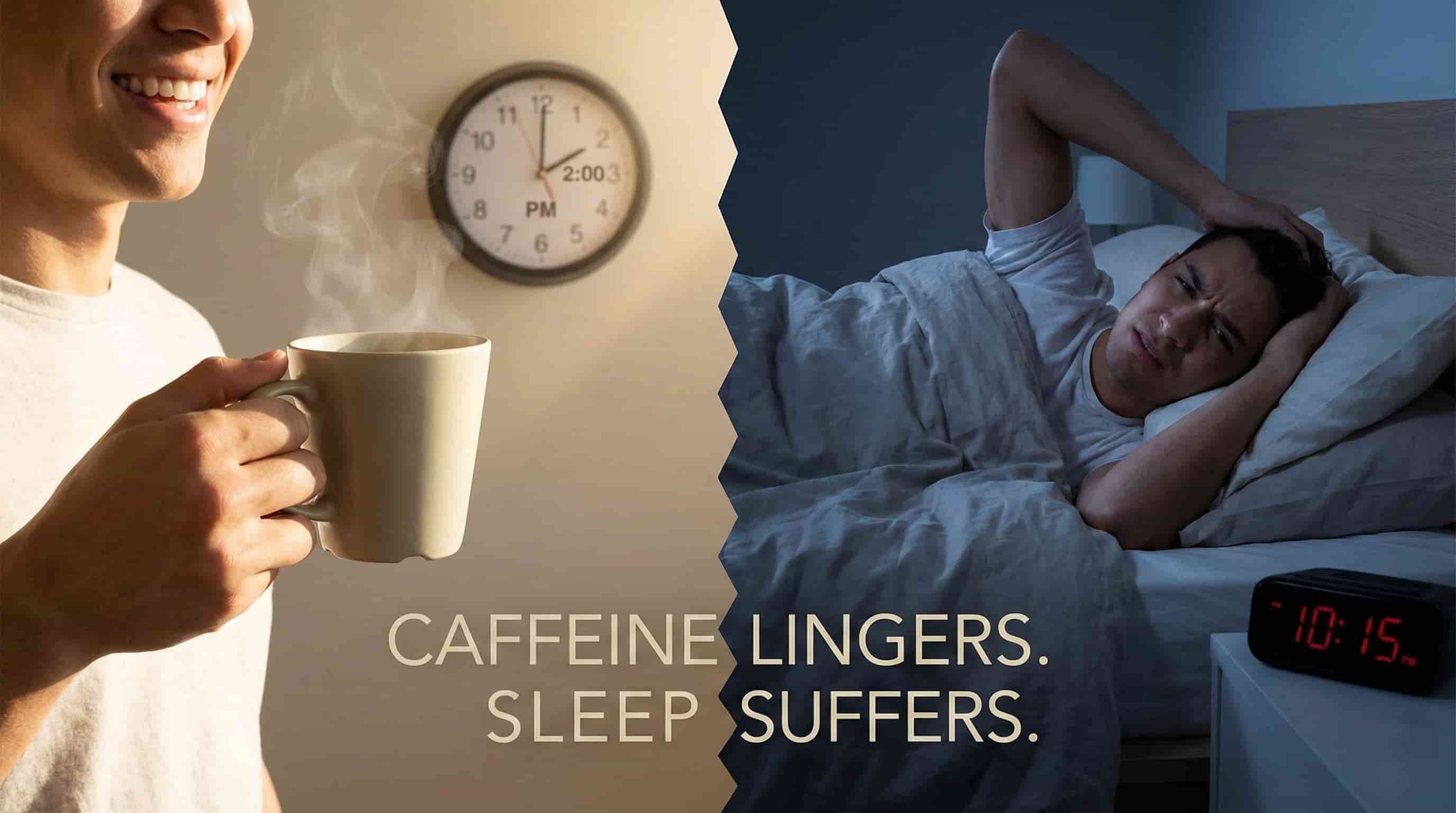
What Is Caffeine’s Half-Life — and Why Does a 6-Hour Half-Life Mean You Have a Full Cup in Your Bloodstream at 10 PM?
Direct Answer: Caffeine’s half-life is the time it takes for your body to eliminate 50% of the caffeine in your bloodstream — approximately 5-7 hours in healthy adults, with significant individual variation based on genetics, liver function, and other factors. This means that a 200mg cup of coffee (approximately two espresso shots) consumed at 2 PM leaves 100mg still circulating at 8 PM and approximately 50mg still active at 10-11 PM. That 50mg is pharmacologically significant — it is equivalent to a half-cup of strong coffee — and it is actively blocking adenosine receptors during your sleep onset and first sleep cycles. The half-life is not a metaphor for “feeling tired” — it is a measurable blood concentration curve.
Mechanism: S1-2 and S2-3 on caffeine pharmacokinetics: caffeine is metabolized primarily by the CYP1A2 enzyme in the liver, which follows first-order kinetics — meaning the elimination rate is proportional to the concentration remaining. A 200mg dose produces an initial blood concentration of approximately 8-10 mg/L; after one half-life (5-7h) it is 4-5 mg/L; after two half-lives (10-14h) it is 2-2.5 mg/L. Even at 2-3 mg/L (still present 10-14 hours after a 2 PM coffee), caffeine is producing measurable adenosine receptor blockade. The threshold for subjective alertness effects is approximately 2.5-3 mg/L; the threshold for sleep architecture disruption is lower — 1.5-2 mg/L is sufficient to reduce N3 and fragment sleep. This means that even the residual 25mg in your bloodstream at midnight (three half-lives after a 2 PM 200mg coffee) is sufficient to suppress deep sleep. The mathematical certainty of caffeine’s half-life is why sleep specialists universally recommend a caffeine cutoff of 8-10 hours before bedtime, not the commonly cited “2 PM.”
Actionable Advice: The practical cutoff for most adults is 12-1 PM if bedtime is 10-11 PM — not 2 PM as commonly recommended. If you must have afternoon caffeine: a single small green tea (30-50mg caffeine) at 1 PM will clear to near-zero by 10 PM. A standard coffee (200mg) at 2 PM will not clear to near-zero until 12-2 AM. Track your sleep quality as a function of your last caffeine time and you will see the pattern: caffeine after 1 PM consistently produces reduced N3 even when total sleep time appears normal.
How Does Caffeine Actually Block Adenosine — and Why the Feeling of ‘Energy’ Is a Neurological Illusion?
Direct Answer: Caffeine produces the subjective feeling of energy by blocking adenosine receptors in the brain — not by providing any energy. Adenosine is the biological signal of sleep pressure: as your brain expends energy during wakefulness, ATP is broken down to ADP and eventually adenosine, which accumulates in the basal forebrain and prefrontal cortex. When adenosine binds to A1 receptors, it suppresses arousal and initiates sleep onset. Caffeine is a competitive antagonist at A1 and A2A adenosine receptors — it binds to the same receptors that adenosine would bind to, but produces no biological response other than blocking adenosine. The subjective feeling of alertness after coffee is not energy — it is the absence of the sleepiness signal, created by the absence of adenosine action. This is a critical distinction: caffeine does not add anything to your system; it removes something (the adenosine signal) from your system.
Mechanism: S1-2 and S2-3 on adenosine receptor antagonism: the A1 adenosine receptor is the primary mediator of sleep pressure — when adenosine binds to A1 receptors in the basal forebrain, it inhibits the wake-promoting cholinergic neurons, reducing cortical activation and promoting sleep onset. Caffeine’s competitive antagonism at A1 receptors prevents this inhibitory signal from being transmitted, effectively maintaining the “awake” neural state artificially. The A2A receptor blockade contributes to the cardiovascular and subjective alerting effects — A2A is involved in dopamine modulation and cardiovascular tone. Importantly, caffeine does not prevent adenosine accumulation — it merely prevents adenosine from acting. The adenosine continues to build up throughout the day, and when caffeine wears off (or is metabolized below the effective threshold), the accumulated adenosine suddenly floods the now-unblocked receptors. This is why the “caffeine crash” at 4-6 PM — following a morning coffee — feels more intense than normal afternoon drowsiness: it is the adenosine signal that was artificially suppressed all morning arriving all at once.
Actionable Advice: Understanding caffeine as a mask rather than fuel changes your relationship with it: the afternoon energy you feel after coffee is borrowed, not earned. The afternoon crash that follows is the interest payment on that loan. If you must use caffeine: use it strategically — in the morning, after your cortisol awakening response has peaked, to extend the natural morning alertness window. Do not use it to compensate for sleep debt or to push through the afternoon dip. The best outcome is to gradually reduce your total caffeine consumption to the point where you have genuine natural energy without any pharmacological assistance.
What Is Adenosine — and Why Is Its Accumulation During Wakefulness the Most Important Sleep Signal You Are Silencing With Every Cup?
Direct Answer: Adenosine is the primary biochemical substrate of homeostatic sleep pressure — the longer you are awake, the more adenosine accumulates in your brain, and the stronger the biological drive to sleep becomes. It is not cortisol, not serotonin, not melatonin — adenosine is the direct, quantifiable measure of how badly your brain needs sleep. Every cup of caffeine you consume delays your awareness of this signal without reducing the actual sleep pressure building up underneath. By evening, you have 16-18 hours of accumulated adenosine that has been prevented from acting by caffeine — and when the caffeine finally clears enough to let adenosine through, it arrives all at once, fragmenting your sleep.
Mechanism: S1-2 and S2-3 on adenosine accumulation and homeostatic sleep pressure: adenosine is the final product of the ATP breakdown cascade. Each time a neuron fires, ATP is consumed and adenosine is produced. During wakefulness — particularly cognitively demanding wakefulness — ATP turnover is high and adenosine accumulates progressively in the basal forebrain, prefrontal cortex, and hippocampus. Adenosine acts as an inhibitory neuromodulator: it hyperpolarizes neurons by increasing potassium conductance, reducing their firing rate and producing the subjective sense of drowsiness. The accumulation is approximately linear during wakefulness, doubling every 12-16 hours of sustained wakefulness — which is why 24 hours of sleep deprivation produces an adenosine load equivalent to a deeply sleep-deprived state. During sleep, adenosine is cleared through the glymphatic system and enzymatic conversion (adenosine deaminase), restoring the brain to a low-adenosine state by morning. Caffeine interrupts this cycle by preventing adenosine from acting during the day — the adenosine builds up anyway — and then, when caffeine is metabolized at night, the accumulated adenosine arrives at the receptors all at once, fragmenting the very sleep architecture that adenosine’s clearance during sleep would have normally enabled.
Actionable Advice: Respect adenosine as your most reliable sleep signal. When you feel drowsy at 9 PM but push through with coffee, you are not eliminating the drowsiness — you are delaying it, and it will be there in the morning with interest attached. The only effective way to manage adenosine is: (1) sleep — which clears it; (2) do not suppress it with caffeine after 12 PM, so that it can do its job of initiating sleep onset naturally. If you want to know your actual sleep pressure independent of caffeine: go caffeine-free for 3 days and observe when natural drowsiness arrives in the evening. That is your real adenosine-driven sleep window, unobscured by pharmaceutical interference.
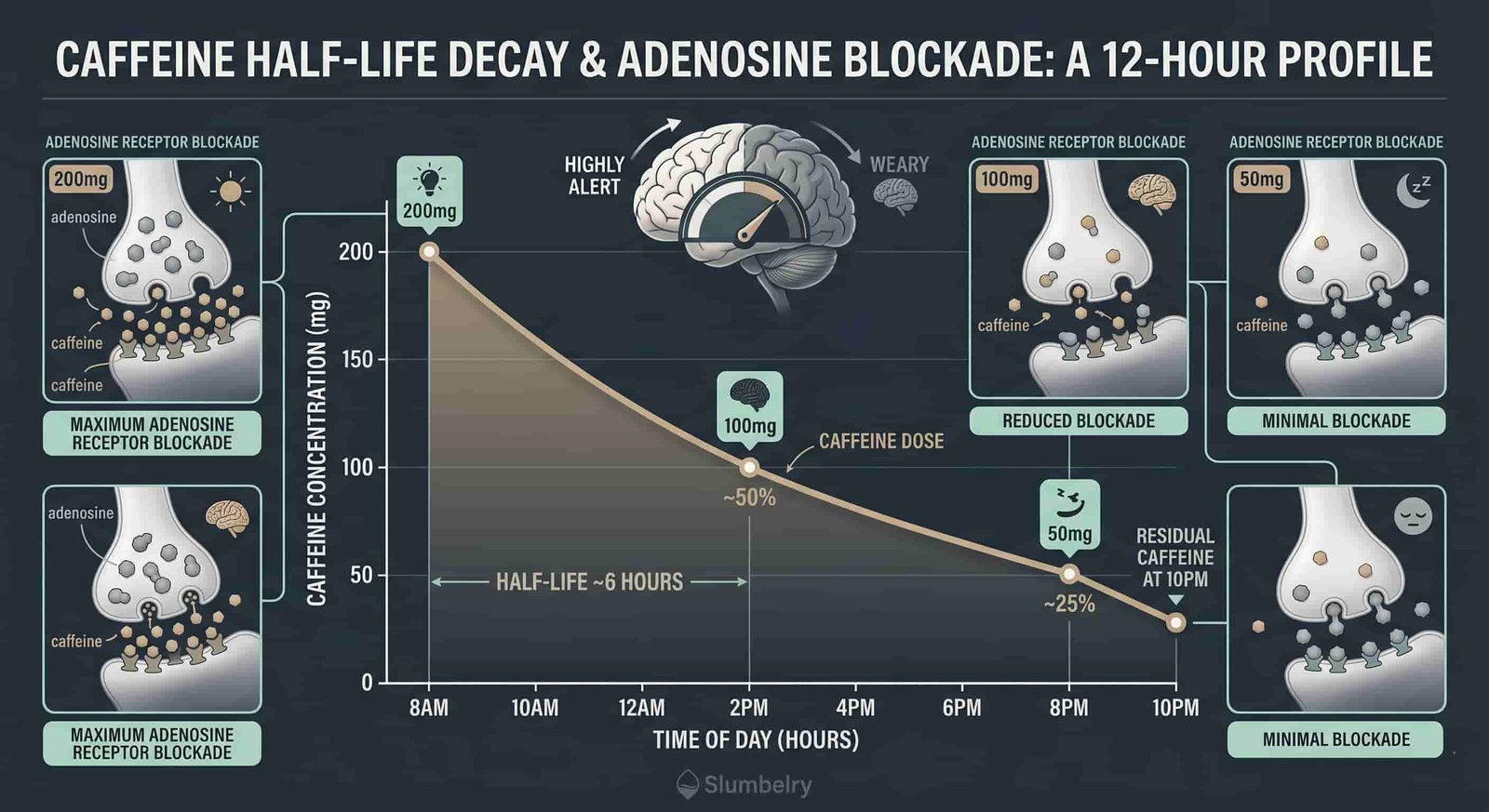
What Is the Difference Between A1 and A2A Adenosine Receptor Blockade — and Why Both Disrupt Different Aspects of Sleep Architecture?
Direct Answer: The A1 and A2A adenosine receptors have distinct distributions and functions in the brain, and caffeine’s blockade of both receptors simultaneously produces a compound disruption of sleep architecture that is more damaging than either receptor type alone. A1 receptor blockade primarily disrupts sleep onset and NREM sleep consolidation; A2A receptor blockade specifically suppresses REM sleep and affects cardiovascular regulation during sleep. Caffeine’s competitive antagonism at both receptors is non-selective — it blocks both with roughly equal potency, which is why caffeine-consumed sleep is characteristically light on both deep sleep and dream sleep.
Mechanism: S1-2 and S2-3 on A1 vs. A2A receptor functions: A1 receptors are widely distributed throughout the brain — in the basal forebrain, hippocampus, cortex, and brainstem — and are the primary mediators of sleep pressure and the sedative effects of adenosine. A1 activation promotes sleep onset and supports the maintenance of NREM sleep. A2A receptors are concentrated in the striatum, nucleus accumbens, and blood vessels — A2A activation promotes arousal and dopaminergic transmission, which is why A2A blockade by caffeine produces both alertness (dopamine pathway) and the cardiovascular stimulation (blood vessel constriction) associated with caffeine. Critically, A2A receptor activation specifically promotes REM sleep — studies in A2A knockout mice show severely disrupted REM with preserved NREM. This means caffeine’s A2A blockade specifically targets REM — which is why dream recall is often reduced in caffeine-consumed sleep and why emotional regulation the following day is compromised (REM is the primary stage for emotional memory consolidation). The dual-receptor blockade is why caffeine’s sleep-disrupting effect is broader than simple sleep onset delay.
Actionable Advice: The goal is not to avoid adenosine signaling entirely — adenosine is the signal that tells your brain it has been awake long enough. The goal is to allow the adenosine signal to operate on its natural schedule: suppressed during the morning alertness window, active in the afternoon and evening to initiate sleep onset. Caffeine after 12 PM interferes with the evening adenosine signal, which is why sleep onset is often delayed even though the person “feels fine” — the adenosine signal that normally facilitates sleep onset is partially blocked. If you want to know whether your caffeine consumption is affecting your sleep architecture: take 3 days completely caffeine-free and compare your dream recall, morning alertness, and N3/REM percentages on a sleep tracker to your normal caffeine-consuming baseline.
Why Does Caffeine Reduce N3 Deep Sleep by 10-15% and Fragment REM — Even When You Report Falling Asleep Normally?
Direct Answer: Caffeine reduces N3 deep sleep by 10-15% and fragments REM even in people who report falling asleep normally because the subjective experience of sleep onset is controlled primarily by the circadian alerting signal (Process C), which is largely intact in caffeine consumers. The sleep-disrupting effects of caffeine occur during the sleep period itself, after subjective sleep onset — the person is asleep and unaware of the architecture disruption. Polysomnography (PSG) studies measuring EEG during caffeine-consumed sleep consistently show: reduced N3 slow-wave amplitude (indicating shallower deep sleep), reduced REM percentage, increased N1/N2 transitions, and more frequent micro-arousals. The person reports “I slept fine.” The PSG shows 10-15% less N3.
Mechanism: S1-2 and S2-3 on caffeine and sleep architecture disruption: the primary mechanism is residual adenosine receptor blockade during sleep. When caffeine is still circulating at significant levels during the first sleep cycles (as it is when consumed after 12 PM), the adenosine that accumulated during the day’s wakefulness cannot bind effectively to A1 receptors — A1 receptors are the primary mediators of N3 slow-wave generation. The N3 slow wave requires a specific pattern of cortical neuronal synchronization driven by the thalamocortical circuit, and A1 receptor activation is part of the natural regulatory mechanism that supports this synchronization. With A1 partially blocked by caffeine, N3 slow waves are shallower and less efficient. For REM: the A2A receptor blockade prevents the dopaminergic and cholinergic activation required for REM onset, reducing REM duration and increasing REM fragmentation. The combined effect: caffeine-consumed sleep is shallower (less N3), lighter (more N1/N2 transitions), and has less dreaming (less REM) — even when the person is unaware and reports normal sleep quality. This is why morning grogginess after a “full night’s sleep” that included afternoon caffeine is so common: the sleep was missing its deepest and most restorative stages.
Actionable Advice: Use a sleep tracker to compare your N3 and REM percentages on caffeine days vs. caffeine-free days. Most people find a 10-20% reduction in both stages on caffeine days. If your morning alertness is lower than it should be despite adequate sleep hours, caffeine is the most likely culprit — particularly if you consumed any caffeine after noon. The fix: shift your last caffeine to before 12 PM, and allow 10-12 hours before bed for the residual concentration to fall below the sleep-architecture-disruption threshold.
What Is the CYP1A2 Gene — and Why Do Slow Metabolizers Have 3x the Sleep Architecture Disruption From the Same Coffee?
Direct Answer: The CYP1A2 gene encodes the enzyme responsible for metabolizing approximately 95% of caffeine in the liver, and genetic variation in this gene produces dramatic differences in caffeine half-life between individuals — slow metabolizers have half-lives of 7-10 hours (vs. 5-7 hours in fast metabolizers), meaning their 2 PM coffee leaves approximately 100mg still circulating at 10 PM (vs. 50mg in fast metabolizers). For slow metabolizers, the commonly recommended “2 PM caffeine cutoff” leaves enough residual caffeine at midnight to significantly disrupt N3 and REM. These individuals may need a noon or even 11 AM cutoff to achieve the same sleep architecture protection that fast metabolizers get from a 2 PM cutoff.
Mechanism: S1-2 and S2-3 on CYP1A2 and caffeine metabolism: CYP1A2 activity is determined by genetic polymorphisms in the CYP1A2 gene, specifically the -163C>A (rs762551) variant. Individuals with the AA genotype are fast metabolizers — their CYP1A2 enzyme clears caffeine rapidly, producing a half-life of approximately 5 hours. Individuals with the AC or CC genotype are slow metabolizers — their enzyme activity is reduced by 30-50%, producing half-lives of 7-10 hours. The practical consequence: a 200mg coffee at 2 PM produces a midnight blood concentration of approximately 25mg in fast metabolizers but approximately 100mg in slow metabolizers — four times the receptor occupancy at midnight. Slow metabolizers also have higher daytime caffeine concentrations from the same dose, meaning more sustained receptor blockade throughout the day. This explains why some people can have an afternoon coffee with no apparent sleep disruption while others are severely affected by the same timing — it is not about tolerance or sensitivity in the subjective sense, it is about a measurable metabolic difference that produces different drug concentrations from identical doses.
Actionable Advice: Know your CYP1A2 status through a genetic test (23andMe, AncestryDNA) or an empirical test: take 100mg caffeine at 8 PM on a weekend and track your sleep onset time and architecture that night. If sleep onset is delayed by more than 15 minutes or N3 is significantly reduced, you are likely a slow metabolizer and need an earlier cutoff. Slow metabolizers benefit most from morning-only caffeine consumption (before 10 AM) and may need a 10-12 hour pre-sleep caffeine-free window rather than the standard 6-8 hour recommendation.
What Is the Caffeine Tolerance Paradox — and Why Needing More Coffee to Wake Up Means Your Sleep Architecture Is Getting Worse?
Direct Answer: The caffeine tolerance paradox describes the situation where regular caffeine consumers develop tolerance to the subjective alerting effects of caffeine (requiring more coffee to achieve the same morning wakefulness) while simultaneously becoming less tolerant of the sleep-disrupting effects (their sleep architecture continues to deteriorate with each increment of caffeine consumption). This creates a destructive cycle: needing more coffee in the morning to overcome the grogginess that afternoon caffeine produced the previous night, which then disrupts tonight’s sleep, requiring more coffee tomorrow, and so on. The tolerance to the subjective effect does not extend to the sleep-disrupting effect because they operate through different receptor mechanisms.
Mechanism: S1-2 and S2-3 on caffeine tolerance: adenosine receptor density increases (upregulation) in response to chronic caffeine consumption as the brain attempts to maintain homeostasis against the persistent receptor blockade. This upregulation means more receptors are available to bind adenosine when caffeine is not present — which is why skipping a day of coffee produces severe withdrawal symptoms (headache, fatigue, depression) in regular consumers. However, the upregulation does not restore normal sleep architecture during caffeine consumption: even with more adenosine receptors, the caffeine still occupies a significant percentage of them, suppressing N3 and fragmenting REM. The paradox is that the subjective tolerance (needing more coffee for the same alertness) develops alongside unchanged or worsening objective sleep disruption. The regular consumer needs more coffee because their baseline adenosine receptor signaling is disrupted, not because their adenosine levels are lower. The worsening sleep architecture from tolerance means more sleep debt, more adenosine accumulation, and therefore more severe caffeine-withdrawal symptoms when they try to quit — making the habit progressively harder to break.
Actionable Advice: Break the cycle deliberately: the fastest way is a 5-day complete caffeine fast — accept the 2-day withdrawal period (headache, fatigue, low mood) and emerge with restored sensitivity to adenosine signaling and significantly improved sleep architecture. During the withdrawal: use light exposure, cold water, and short walks for morning alertness — these activate the alerting system without pharmaceutical interference. After the fast: limit caffeine to 100-200mg in the morning only (ideally 90 minutes after waking, after the cortisol awakening response), never after 12 PM. This prevents the tolerance paradox from rebuilding and maintains both subjective sensitivity and sleep architecture quality.
Why Does Morning Coffee Delay the Cortisol Awakening Response — and Is 90 Minutes After Waking the Optimal Time for the First Cup?
Direct Answer: The cortisol awakening response (CAR) is the natural alertness surge that occurs in the first 30-60 minutes after waking — driven by the HPA axis activating in anticipation of the day’s demands. Consuming caffeine during the CAR competes with the brain’s own natural alerting mechanism and may blunt the development of natural morning alertness. The optimal timing for the first coffee is approximately 90 minutes after waking, when the CAR has naturally peaked and begun to decline — at this point, caffeine extends the alertness window rather than competing with it. Coffee consumed within 30 minutes of waking both blunts the CAR development (reducing the natural cortisol-driven alertness) and creates a dependency cycle where the morning coffee becomes necessary to achieve the alertness that the body would have produced naturally.
Mechanism: S1-1 and S2-3 on the cortisol awakening response and caffeine: the CAR is one of the most robust circadian phenomena — cortisol peaks at approximately 30-45 minutes after waking, typically at 50-160% above the pre-waking baseline. This surge is driven by the HPA axis activating in anticipation of the day, and it is one of the two primary alerting signals (along with the circadian SCN output) that get healthy adults out of bed in the morning. When caffeine is consumed during the CAR peak, it produces a combined alerting effect that is subjectively greater than either alone — but this combined effect also produces faster tolerance development, because the brain’s natural alerting mechanism is being supplemented by a pharmaceutical one. The result: the natural CAR amplitude gradually decreases as the brain reduces its own cortisol response to compensate for the regular pharmacological augmentation. This is one mechanism behind the “needing more coffee to wake up” phenomenon in chronic users. Studies by Lovallo et al. and others show that regular caffeine consumers have blunted CAR amplitudes compared to non-consumers — the cortisol awakening response is partially suppressed by the habitual presence of caffeine.
Actionable Advice: Wait 90 minutes after waking before your first coffee. In that first 90 minutes: expose yourself to bright light (outdoor morning light is best), drink a large glass of water, and do light physical movement. These activate your natural alerting system and build the natural cortisol response that caffeine augments rather than replaces. The 90-minute delay also ensures that the caffeine’s peak effect (approximately 45-60 minutes after consumption) aligns with the natural morning alertness decline that occurs at approximately 2-3 hours after waking — timing it so that coffee extends an existing alertness window rather than creating a dependency.
Why Does the ‘2 PM Curfew’ Not Solve the Problem — and What Does the Evidence Say About the Real Caffeine-Shutdown Time?
Direct Answer: The 2 PM curfew is insufficient for most adults because caffeine’s half-life (5-7 hours) means significant residual caffeine is still circulating at 10 PM. For the standard 200mg dose, the 2 PM curfew leaves approximately 50mg in your bloodstream at 10 PM — enough to suppress N3 deep sleep and fragment REM. The evidence-based caffeine cutoff for someone sleeping at 10-11 PM is 12-1 PM, not 2 PM. For slow metabolizers (CYP1A2 slow variants), the real cutoff may need to be as early as 10-11 AM to achieve equivalent sleep architecture protection.
Mechanism: S2-3 and S4-4 on evidence-based caffeine cutoff: the sleep architecture disruption threshold for caffeine is approximately 1.5-2 mg/L blood concentration. At 200mg caffeine consumed at 2 PM, blood concentration is approximately 8 mg/L at 3 PM, 4 mg/L at 8 PM, 2 mg/L at midnight, and 1 mg/L at 4 AM. The 2 mg/L at midnight is above the disruption threshold. Pushing the cutoff to 12 PM produces approximately 3 mg/L at 6 PM, 1.5 mg/L at midnight — just at the threshold. Pushing to 1 PM: 4 mg/L at 7 PM, 2 mg/L at 11 PM, 1 mg/L at 3 AM. The conclusion is clear: 2 PM is too late for the standard sleep window. The 2 PM recommendation persists because it sounds more achievable than a 12 PM cutoff and because it addresses the most egregious cases (late-night espresso consumption). But for the person who wants to optimize sleep architecture, 12-1 PM is the evidence-based cutoff for a 10-11 PM sleep schedule.
Actionable Advice: Calculate your personal caffeine curfew: identify your bedtime, count back 10 hours, and that is your hard caffeine cutoff. If bedtime is 10 PM, cutoff is 12 noon. If bedtime is 11 PM, cutoff is 1 PM. This is the minimum window for moderate metabolizers; slow metabolizers need to add 2-3 more hours. Use this math to make an informed decision about your afternoon coffee, not a generalized rule that was designed for the average case rather than your specific metabolism.
What Is the Non-Caffeine Afternoon Energy Protocol — and How Do Light, Cold Water, and Movement Replace the Afternoon Pick-Me-Up?
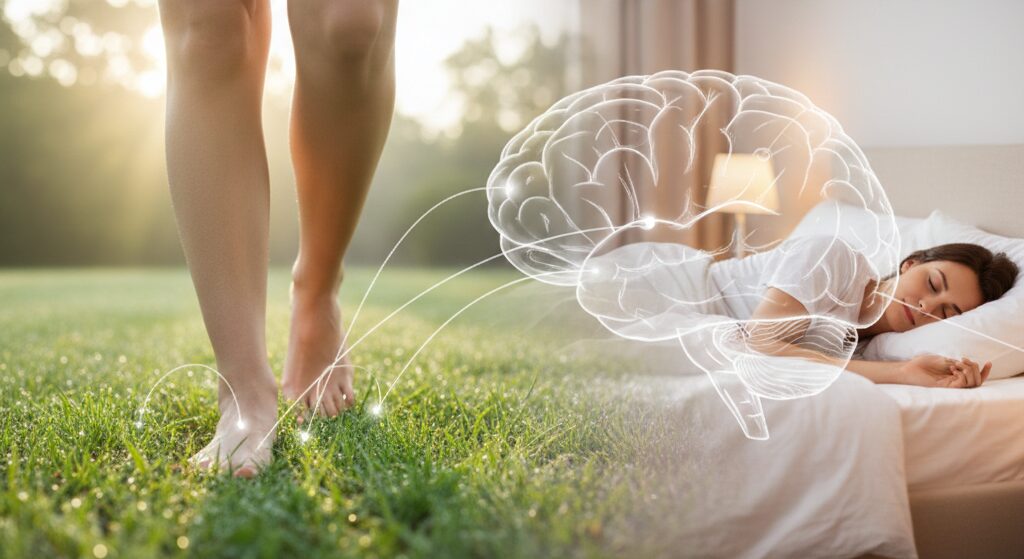
Direct Answer: The non-caffeine afternoon energy protocol uses three mechanisms that are as effective as caffeine for afternoon alertness without any sleep architecture cost: bright light exposure (activating the SCN alerting signal), cold water face immersion (activating the trigeminal alerting reflex), and brief physical movement (raising cortisol and epinephrine naturally). These three interventions address the afternoon dip through the same physiological pathways that caffeine targets — but without the residual nighttime sleep disruption. Used together, they provide 2-3 hours of alertness improvement that is equivalent to 100mg of caffeine.
Mechanism: S1-2 and S4-4 on non-pharmacological alertness interventions: bright light (10,000+ lux, outdoor on a cloudy day) activates the SCN alerting signal via the ipRGC pathway — the same pathway that produces morning alertness. 10 minutes of outdoor light at 2 PM raises cortisol and suppresses melatonin for 60-90 minutes, producing a measurable alertness improvement equivalent to 75-100mg caffeine without any pharmaceutical intervention. Cold water face immersion activates the trigeminal nerve alerting reflex — the same startle response mechanism that keeps mammals alert in cold water. 30-60 seconds of cold water on the face produces a 20-30 minute alertness window of improved reaction time and reduced subjective drowsiness. Brief physical movement (5-10 minute walk) raises cortisol and epinephrine through the HPA axis and sympathetic nervous system, producing a natural alertness response that peaks at approximately 10 minutes post-exercise and lasts 30-45 minutes. Combined — 5 minutes outdoor light, a cold face wash, and a brisk walk — these interventions produce an alertness equivalent to 150mg caffeine without any sleep cost.
Actionable Advice: Build the 2 PM non-caffeine energy protocol into your daily routine: at 1:45 PM, go outside for 5 minutes of bright light (even on cloudy days); at 2 PM, wash your face with cold water or drink a large glass of ice water; at 2:15 PM, take a 5-10 minute brisk walk outside. This three-step protocol activates all three natural alerting systems and produces 2-3 hours of alertness that is completely caffeine-free. If you do this consistently for 5 days, the afternoon energy will feel natural rather than pharmaceutical — and you will sleep significantly better at night because your brain received no residual adenosine blockade from afternoon caffeine.
Frequently Asked Questions
How long does caffeine stay in your system?
Direct Conclusion: Caffeine has a half-life of 5-7 hours in healthy adults — meaning 50% of the caffeine in your bloodstream is eliminated every 5-7 hours. A 200mg cup at 2 PM leaves approximately 100mg at 8 PM and 50mg at midnight. For slow metabolizers (CYP1A2), the half-life can be 7-10 hours, meaning the same coffee leaves 100mg at midnight. It takes approximately 5 half-lives (25-35 hours for normal metabolizers) for caffeine to be essentially fully cleared from the system.
Why can I fall asleep after coffee if caffeine is still in my system?
Direct Conclusion: You fall asleep because caffeine’s sleep-disrupting effects are primarily architectural — it disrupts N3 and REM during sleep, not sleep onset itself. The circadian alerting signal (Process C) and the accumulated sleep pressure (adenosine) are usually sufficient to initiate sleep onset even with residual caffeine. However, once asleep, the caffeine actively suppresses deep sleep and fragment dreams. You get the hours but not the stages. The morning after, you feel unrefreshed despite sleeping the full duration — that is the architectural cost showing up.
What does caffeine actually do to deep sleep (N3)?
Direct Conclusion: Caffeine reduces N3 deep sleep by 10-15% in polysomnography studies — even when total sleep time appears normal. The mechanism: residual caffeine during the first sleep cycles blocks A1 adenosine receptors, preventing the natural cortical synchronization that produces N3 slow waves. The N3 slow wave is the primary driver of physical restoration, HGH release, immune activation, and glymphatic clearance. Reduced N3 means reduced recovery across all these systems — the morning after afternoon caffeine, your body has done less biological maintenance.
How much does a 2 PM coffee affect my 10 PM sleep?
Direct Conclusion: A standard 200mg coffee at 2 PM leaves approximately 50mg still circulating at 10 PM-midnight — enough to measurably suppress N3 deep sleep and fragment REM. The sleep architecture disruption at this concentration is approximately 10-15% less N3 and 5-10% less REM compared to a caffeine-free night. For slow metabolizers, the effect is roughly double. The sleep onset itself may not be delayed, but the quality of the deep sleep that follows is significantly compromised.
Am I a slow or fast caffeine metabolizer?
Direct Conclusion: You can determine this genetically (CYP1A2 gene testing via 23andMe or similar) or empirically: take 100mg caffeine at 8 PM and track how it affects your sleep that night. A more practical field test: if you regularly drink coffee after 2 PM and experience any sleep onset delay or morning grogginess, you are likely a moderate-to-slow metabolizer and should move your cutoff earlier. Fast metabolizers can sometimes consume caffeine at 4 PM with minimal sleep impact; slow metabolizers need an 11 AM cutoff for the same sleep protection.
Does caffeine tolerance mean my sleep isn’t affected?
Direct Conclusion: No — tolerance develops to the subjective alerting effects of caffeine, not to the sleep-architecture-disrupting effects. This is the caffeine tolerance paradox: you need more coffee for the same alertness boost, but your sleep architecture is just as disrupted (or worse) as it was before you developed tolerance. The brain upregulates adenosine receptors in response to chronic caffeine use, which worsens withdrawal symptoms but does not protect sleep architecture during caffeine consumption. In fact, chronic afternoon caffeine users often have worse objective sleep than occasional users, even though the occasional user reports more subjective sleep disruption.
What is the best time to stop drinking coffee for good sleep?
Direct Conclusion: The evidence-based cutoff is 10-12 hours before your bedtime for moderate metabolizers, 12-14 hours for slow metabolizers. If you sleep at 10-11 PM: your cutoff is 12-1 PM. If you sleep at midnight: your cutoff is 2-3 PM at the latest, but earlier is better. Morning-only caffeine (consumed before 10 AM) is the optimal pattern for both sleep architecture and natural alertness — it avoids the afternoon dip, supports the morning alertness window, and leaves the evening free of pharmaceutical interference.
Is decaf coffee actually caffeine-free?
Direct Conclusion: No — decaf is not caffeine-free. A standard 8oz cup of decaf coffee contains 5-30mg of caffeine (vs. 80-200mg in regular coffee). If you drink 3 cups of decaf per day, you may be consuming 15-90mg of caffeine — enough to affect sleep architecture in sensitive individuals. Decaf espresso drinks (like decaf lattes) are particularly inconsistent — some contain 30-50mg per shot. For complete caffeine elimination, use herbal tea, golden milk, or mushroom coffee alternatives.
How does caffeine interact with the cortisol awakening response?
Direct Conclusion: Caffeine consumed during the cortisol awakening response (the first 30-60 minutes after waking) competes with and may blunt the natural cortisol surge. Over time, habitual morning caffeine use is associated with a reduced cortisol awakening response amplitude — the body’s natural alerting system is being partially replaced by pharmaceutical augmentation. The optimal timing is approximately 90 minutes after waking, when the CAR has peaked and begun to decline. At this point, caffeine extends an existing alertness window rather than competing with a natural process. This timing also reduces the development of tolerance, because the caffeine aligns with the natural rhythm rather than overriding it.
What can I drink instead of coffee in the afternoon for energy?
Direct Conclusion: Four evidence-based alternatives: (1) sparkling water with lemon — provides sensory stimulation and mild sympathetic activation without caffeine; (2) green tea (decaffeinated or lightly caffeinated) — L-theanine provides mild calm alertness without the adenosine receptor blockade of caffeine; (3) cold water or ice drink — activates the trigeminal alerting reflex for 20-30 minutes of alertness; (4) protein-rich snack — amino acids from protein support dopamine and norepinephrine synthesis without pharmaceutical intervention. None of these produce adenosine receptor blockade, which means none of them disrupt sleep architecture — regardless of when they are consumed.
Respect the Half-Life. Protect Your Deep Sleep.
Caffeine is a loan, not a gift. Every afternoon cup borrows from tomorrow’s recovery at a compounding interest rate. Set the curfew at 12-1 PM, delay your morning coffee 90 minutes after waking, and use light and movement to replace the afternoon pick-me-up. Your N3 deep sleep will thank you in the morning.
Light Management Systems Sleep Architecture OptimizationThe Slumbelry Commitment
Sleep is the most vulnerable state of human existence. It is where we heal, reset, and grow.
At Slumbelry, we do not just sell sleep products; we advocate for your physiological right to rest. From ergonomic support to light management, every solution we offer is designed with one obsession: Respecting your Biology.
Science is our language, but your recovery is our purpose. You take care of everything else in your life — let us take care of your nights.
Rest Deeply,
The Slumbelry Team