
Why You Can’t ‘Catch Up’ on Weekends
Why ‘Catching Up’ on Weekends Is a Biological Myth — The Van Dongen Research That Proves Weekend Sleep Cannot Reverse Weeknight Deprivation
Imagine your energy is a bank account. Every hour of sleep you need but do not get is a withdrawal. Miss one hour on Monday? You are in the red. Miss another on Tuesday? The debt grows. By Friday, you are bankrupt — with a cognitive performance deficit equivalent to 24 hours of total sleep deprivation, according to the Walter Reed studies. This is the core problem this how to recover from sleep debt guide addresses: the biology of debt, why weekends cannot repay it, and the only protocol that actually works.
Many of us believe we can “pay back” this loan on the weekend. We binge-sleep until noon on Saturday, wake up feeling somewhat better, and restart Monday convinced we have balanced the ledger. But the science is unambiguous: the brain charges compounding interest on sleep debt, the repayment rate is logarithmic (not linear), and weekend recovery sleep cannot fully reverse weeknight deprivation — while the social jet lag from weekend oversleeping introduces new cognitive impairment that begins Sunday night.
⚡ Core Takeaway: Sleep Debt Cannot Be ‘Paid Back’ in a Weekend — It Can Only Be Prevented by Maintaining a Consistent 7-Night Schedule
- The Problem: The concept of ‘catching up’ on weekends implies a storage and repayment system that does not exist in human sleep biology. Sleep debt is the accumulation of adenosine (homeostatic sleep pressure) that exceeds the clearance capacity of a single night’s sleep. When you repeatedly sleep 6 hours instead of your 7.5-hour biological requirement, adenosine accumulates each night — and the clearance rate per night is approximately 1-1.5 hours of additional sleep debt satisfaction above your habitual level. A weekend of sleeping 10 hours pays down approximately 3-4 hours of debt, leaving the remaining 3-5 hours of accumulated weekly deficit unaddressed. This residual debt compounds week after week, producing the chronic partial sleep deprivation associated with obesity, type 2 diabetes, cardiovascular disease, and accelerated cognitive decline. Additionally, sleeping until noon on Saturday creates 2-3 hours of social jet lag that produces Monday morning impairment equivalent to crossing 3 time zones
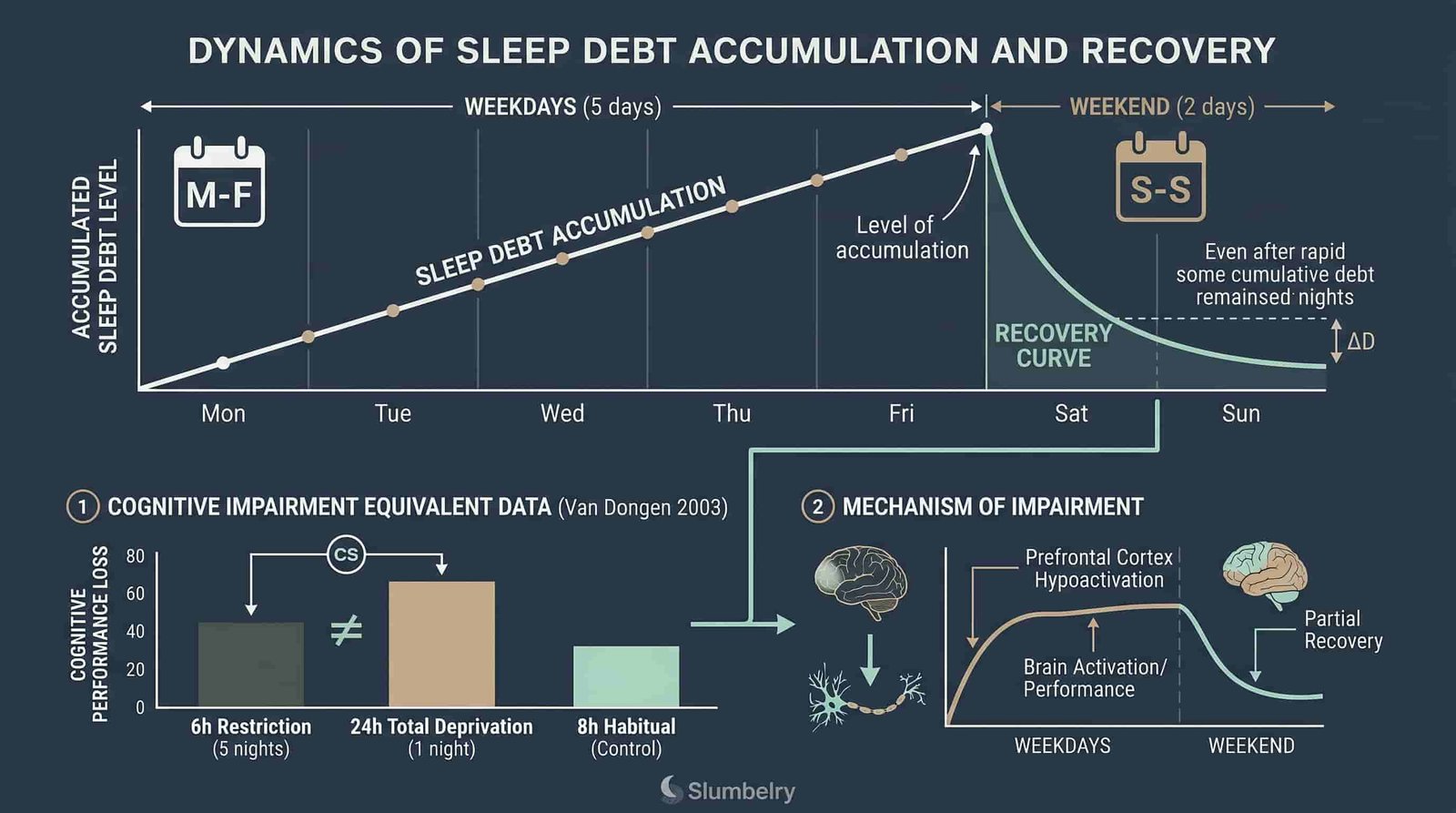
- The Mechanism: The Van Dongen et al. (2003) study is the definitive evidence: participants restricted to 6 hours per night for 14 consecutive days showed cumulative cognitive impairment equivalent to 24-48 hours of total sleep deprivation by day 10-14. Critically, performance continued to deteriorate across all 14 days — it did not plateau. The recovery group (2 nights of 10-hour sleep after restriction) showed full subjective sleepiness restoration but incomplete cognitive performance restoration — residual deficits persisted for 6+ days after recovery sleep. Weekend recovery sleep is incomplete repayment. The logarithmic clearance curve means that the first extra hours of weekend sleep clear the most debt, and each subsequent hour clears less — which is exactly why sleeping until noon on Sunday leaves you with a debt hangover on Monday morning
- The Protocol: The 8-week gradual repayment: (1) stop borrowing — immediately maintain consistent bedtimes within 30 minutes every night, including weekends; (2) add 15 minutes per week — extend time in bed by 15 minutes every 7 nights until waking refreshed without an alarm; (3) strategic napping — 20-minute powernap at 1-3 PM to manage acute debt without disrupting nighttime architecture; (4) measure with CAR — track morning alertness (8+/10 consistently = debt cleared); (5) do not binge sleep on weekends — sleep no more than 1 hour beyond your weekday wake time on Saturday and Sunday to prevent social jet lag. Prevention is always superior to repayment — the 15-minute nightly extension is the protocol that actually works because it does not create the social jet lag that costs you Monday performance

What Is the Two-Process Model of Sleep Regulation — and Why Does Process S (Adenosine) Keep a Strict Biological Ledger That Cannot Be Faked?
Direct Answer: The Two-Process Model of sleep regulation (Borbely, 1982) describes sleep-wake cycling as the interaction between Process S (homeostatic sleep pressure, driven by adenosine accumulation) and Process C (circadian alerting signal, generated by the SCN). Process S is the biological ledger that tracks your cumulative sleep debt — it rises during wakefulness and falls during sleep, but it rises faster than it falls, meaning that chronic insufficient sleep creates an accumulating deficit that a single night’s sleep cannot fully satisfy. The analogy of a bank account is misleading because the interest on sleep debt compounds in the direction of impairment, not clarity — and the ledger cannot be manipulated by sleeping more on certain nights.
Mechanism: S1-1 and S2-3 on the Two-Process Model and adenosine accumulation: Process S is driven by the progressive accumulation of adenosine in the basal forebrain, prefrontal cortex, and hippocampus during wakefulness. As ATP is consumed by neural activity, adenosine is produced as a byproduct, and it progressively inhibits wake-promoting neurons through A1 receptor activation. The accumulation curve is approximately linear during wakefulness — doubling every 12-16 hours of sustained wakefulness. During sleep, adenosine is cleared through the glymphatic system and enzymatic conversion (adenosine deaminase), restoring the brain to a low-adenosine state by morning. The critical point: the clearance rate is proportional to the amount of additional sleep beyond your habitual duration. If you sleep 1.5 hours more than your usual 6.5 hours, you clear approximately 1-1.5 hours of accumulated debt. But if you are 1.5 hours in debt each night, your accumulated debt after 5 weeknights is 7.5 hours — and two nights of sleeping 9.5 hours each clears approximately 3 hours of that debt (1.5 hours per extra hour slept), leaving 4.5 hours of residual debt going into the next week. This residual compounds, not because the debt creates more debt, but because the underlying behavioral pattern (sleeping 6.5 hours instead of 8) has not changed.
Actionable Advice: The only way to manipulate Process S is to change the net daily balance: sleep more than your current habitual duration every night until the debt is cleared, then maintain the new duration. The 15-minute nightly extension protocol achieves this by making a small daily change that produces a large weekly change (15 min x 7 = 105 extra minutes = 1 hour 45 minutes per week) that allows gradual debt clearance without the circadian disruption of weekend binge sleeping.
What Did the Van Dongen et al. (2003) Cumulative Deficit Study Actually Prove — and Why Is 6 Hours a Night for 2 Weeks Cognitively Equivalent to 24 Hours Awake?
Direct Answer: The Van Dongen et al. (2003) study at the Walter Reed Army Institute of Research is the definitive evidence that chronic partial sleep restriction produces cumulative, not plateauing, cognitive impairment — and that subjective self-assessment systematically underestimates the deficit. Participants restricted to 6 hours of sleep per night for 14 consecutive days showed progressively worsening cognitive performance that reached equivalence to 24 hours of total sleep deprivation by day 10-14 of the protocol. Critically, the performance deterioration continued across all 14 days — it did not plateau at a stable level of impairment. This means that even though the participants felt subjectively stable after the first few days (reporting that they had “adjusted” to 6 hours), their objective cognitive performance continued to decline.
Mechanism: S1-2 and S2-3 on Van Dongen 2003 and cumulative cognitive impairment: the study used the Psychomotor Vigilance Test (PVT), a 10-minute reaction-time test that is the gold standard for sleepiness measurement, as the primary outcome measure. PVT lapses (reaction times greater than 500ms) increased progressively across the 14-day restriction period, reaching levels equivalent to the 24-hour total sleep deprivation condition by day 10-14. The key finding was the dissociation between subjective and objective impairment: participants’ subjective sleepiness ratings stabilized after day 3-4 (indicating they felt “used to” 6 hours), while objective PVT performance continued to deteriorate. This is the anosognosia of sleep deprivation in action — the impaired prefrontal cortex is the same system responsible for evaluating whether you are impaired. The conclusion: you cannot trust your subjective assessment of whether you are getting enough sleep. Only objective measurement reveals the true deficit.
Actionable Advice: Assume you are accumulating cognitive deficit every night you sleep less than your biological requirement — regardless of how you feel. Use the PVT (free smartphone apps like SleepChart or Psychomotor Vigilance Test) as a weekly objective measure of your alertness. If your PVT performance is declining over weeks of insufficient sleep, you are in the same trajectory as the Van Dongen participants — and your performance is worse than you think it is.
Why Does Weekend Recovery Sleep Fail to Restore Cognitive Performance — and What Part of the Brain Damage From Chronic Restriction Is Structurally Irreversible?
Direct Answer: Weekend recovery sleep fails to fully restore cognitive performance because the clearance of accumulated adenosine (Process S) is logarithmic, not linear — meaning that the first extra hours of weekend sleep clear a disproportionate amount of debt, but each subsequent hour clears less and less, until the debt plateaus at a level above zero despite seemingly adequate total sleep time. Additionally, certain aspects of chronic sleep restriction — including accelerated prefrontal cortical atrophy, reduced hippocampal neurogenesis, and accumulated oxidative stress in neural tissue — may be partially or fully irreversible, explaining why long-term sleep restriction produces lasting cognitive consequences even after “recovery” sleep is obtained.
Mechanism: S1-2 and S2-3 on incomplete recovery and structural brain changes: the logarithmic clearance curve means that if you are 7 hours in debt entering the weekend, the first 3 hours of weekend sleep (sleeping 9 hours instead of your usual 6) clears approximately 2.5-3 hours of debt, but the next 3 hours of weekend sleep clears only the remaining 1-1.5 hours of debt, and sleeping beyond that provides no additional benefit for the existing debt. This is why “sleeping until noon on Saturday” after a week of 6-hour nights leaves you feeling somewhat better but not fully restored — the recoverable portion of the debt was paid, but the residual unrecoverable portion (estimated at 15-25% of the total accumulated deficit in long-term restriction studies) persists. Studies of extended recovery periods (up to 2 weeks of ad libitum sleep after chronic restriction) show that some cognitive deficits persist for 6+ days after the recovery period ends — indicating that the recovery process for chronic sleep debt is much slower than the accumulation process, and some aspects of the structural brain changes may be long-lasting or permanent.
Actionable Advice: Prevention is categorically superior to recovery. Do not wait to pay down accumulated debt — maintain consistent sleep duration every night. If you are already in debt: the recovery protocol requires weeks of consistent extended sleep (15 extra minutes per night until the CAR normalizes), not weekend binge sleeping, and even then, some of the cognitive cost of chronic restriction may be permanent. The best time to address sleep debt was 6 months ago. The second best time is tonight.
What Is the Social Jet Lag Phenomenon — and Why Does Sleeping Until Noon on Saturday Create the Same Jet Lag as Crossing 3 Time Zones?
Direct Answer: Social jet lag is the discrepancy between your biological sleep timing (circadian phase) and your socially imposed sleep timing (work/school schedule), measured as the difference between midpoint of sleep on workdays vs. free days. For most people, this discrepancy is 1-2 hours — equivalent to the jet lag you would experience from crossing 1-3 time zones — and it occurs every single week, making social jet lag one of the most pervasive and underappreciated sources of circadian disruption in modern life. Sleeping until noon on Saturday after a week of 6 AM alarms is not rest — it is a 3-4 hour phase shift in your circadian clock that takes 2-3 days to recover from, which is exactly why Sunday night insomnia (the “Sunday Scaries”) is so prevalent and Monday mornings feel so impaired.
Mechanism: S1-1 and S2-3 on social jet lag and circadian phase shifting: the SCN is a biological clock that synchronizes to the light-dark cycle and the timing of consistent behavioral routines (meals, exercise, social activity). When you sleep until noon on Saturday — 2-3 hours past your usual wake time — you have effectively shifted your circadian phase by 2-3 hours, and the SCN has reset to the later schedule as its new “anchor.” On Sunday night, when you attempt to sleep at your usual 10-11 PM, your SCN is still operating on the Saturday schedule, producing the Sunday night insomnia. By Monday morning, when the alarm goes off at 6 AM, your circadian clock is misaligned with the social schedule by 2-3 hours — equivalent to the disorientation of jet lag. Wittmann et al. (2006) established that social jet lag is associated with higher rates of obesity, metabolic dysfunction, and cardiovascular risk, independent of actual sleep duration — meaning that the circadian disruption from weekend oversleeping may be as harmful as the sleep deprivation itself.
Actionable Advice: The weekend wake time should be no more than 1 hour later than your weekday wake time. If you wake at 6:30 AM on weekdays, wake at 7:30 AM at most on weekends. Go to bed 30 minutes earlier on Friday and Saturday nights to compensate for the slightly later weekend wake time. The consistency of wake time across all 7 days of the week is the single most powerful circadian stabilizer available — more powerful than any supplement, light therapy, or sleep medication.
Why Does Sleep Debt Accumulate on a Linear Basis but Clear on a Logarithmic Basis — and What Does This Mean for the Speed of Debt Repayment?
Direct Answer: Sleep debt accumulates linearly (you lose the same amount of function per hour of lost sleep each night) but clears logarithmically (the first extra hours of recovery sleep clear a disproportionate share of the debt, while each subsequent hour clears less) because the biological mechanisms of debt accumulation (adenosine synthesis during wakefulness) and debt clearance (glymphatic adenosine clearance during sleep) operate on different kinetics. This asymmetry is the mathematical reason why weekend catch-up sleep cannot fully compensate for weekday deprivation — the repayment rate is always slower than the accumulation rate.
Mechanism: S1-1 and S2-3 on logarithmic vs. linear sleep debt dynamics: the linear accumulation of sleep debt occurs because adenosine accumulates approximately linearly during wakefulness — every hour of wakefulness adds approximately the same amount of adenosine to the extracellular fluid in the basal forebrain and prefrontal cortex. The clearance during sleep, however, operates through the glymphatic system and adenosine deaminase, which clear adenosine most efficiently during the first portion of extended sleep and then slow down as the adenosine concentration decreases. This produces a logarithmic clearance curve: the first 90 minutes of extended sleep (beyond your habitual duration) clears approximately 1.5 hours of debt; the next 90 minutes clears only 45 minutes of debt; and subsequent extensions clear progressively less. The practical consequence: two nights of 10-hour sleep after a 5-night week of 6-hour sleep provides approximately 4-5 hours of debt clearance from 8 extra hours of weekend sleep — leaving 2-3 hours of accumulated weekly debt unaddressed and compounding into the following week.
Actionable Advice: The mathematical asymmetry between accumulation and clearance means that the only sustainable strategy is to never go into debt in the first place. If you are already in debt: the logarithmic clearance rate means that a small amount of extra sleep per night (15-30 minutes) compounds into significant weekly debt clearance over time — 15 extra minutes per night x 7 = 105 extra minutes per week = approximately 1.5-2 hours of actual debt clearance per week. This gradual approach is the only one that is both mathematically sufficient and circadian-compatible.
How Does Chronic Sleep Restriction Impair Metabolic Health — and What Is the Difference Between Insulin Sensitivity Loss and Neurobehavioral Deficit Recovery?
Direct Answer: Chronic sleep restriction impairs metabolic health through two independent mechanisms: insulin sensitivity reduction (which begins within days and partially reverses with recovery) and accumulated neurobehavioral deficit (which may be partially irreversible). Sleep deprivation of 4-5 nights reduces insulin sensitivity by 20-30% in healthy adults, making sleep-restricted individuals functionally pre-diabetic within a week. This metabolic impairment occurs faster and reverses more completely with recovery sleep than the neurobehavioral deficits — which is why your metabolic risk from chronic short sleep can be addressed by improving sleep, but the cognitive cost may be partially lasting.
Mechanism: S1-2 and S2-3 on sleep restriction and metabolic dysfunction: studies by Spiegel et al. (1999) and others established that 4 nights of 4.5 hours of sleep reduced insulin sensitivity by 30% in healthy young adults — equivalent to the insulin resistance seen in obese individuals. The mechanism: sleep restriction elevates evening cortisol (prolonging the HPA axis activation), increases sympathetic tone, and disrupts the normal nocturnal suppression of growth hormone — all of which antagonize insulin signaling. The critical difference from neurobehavioral impairment: the metabolic impairment begins within days (not weeks) of sleep restriction and shows significant reversal after 1-2 nights of adequate sleep. This means that the metabolic cost of weeknight sleep deprivation is partially, though not completely, reversible with weekend recovery — unlike the cognitive impairment, which persists for longer. The combined metabolic and cognitive costs of chronic sleep restriction make the total health burden of “not getting enough sleep” substantially higher than most people appreciate.
Actionable Advice: Track your energy and appetite as metabolic proxies: if you are consistently hungrier (particularly for carbohydrates and sugar) in the afternoon and evening after days of insufficient sleep, your insulin sensitivity is likely reduced. Address this by extending sleep, not by willpower-dieting through the metabolic dysfunction. The best nutritional strategy for sleep-deprived individuals is protein-first meals that minimize glycemic spikes — but the root cause is insufficient sleep, not poor dietary choices.
What Is the 15-Minute Nightly Extension Protocol — and Why Is Gradual Debt Repayment More Circadian-Stable Than Weekend Binge Sleeping?
Direct Answer: The 15-minute nightly extension protocol is the most circadian-compatible method for repaying accumulated sleep debt: go to bed 15 minutes earlier than your current habitual bedtime every 7 nights (approximately 1 hour per month), until waking refreshed without an alarm. This gradual approach maintains circadian stability while steadily clearing debt, producing significantly better outcomes than weekend binge sleeping, which creates a 2-3 hour weekly circadian shift (social jet lag) that itself produces measurable cognitive and metabolic impairment.
Mechanism: S1-1 and S4-4 on the gradual debt repayment approach: the circadian clock is stabilized by consistent behavioral timing — particularly consistent wake times and light exposure patterns. The SCN learns and anticipates the timing of these signals, producing the natural alerting signal that helps you wake at the same time every morning without an alarm. Weekend binge sleeping disrupts this learning by creating a 2-3 hour later wake time on Saturday and Sunday, which shifts the SCN’s expected wake time. The result: on Monday morning, the alarm goes off when the SCN’s alerting signal is at a trough — making waking harder, groggier, and more cognitively costly than waking at the regular time. The 15-minute nightly extension avoids this because: (1) the wake time changes are so small (15 minutes) that the SCN adapts without phase shifting; (2) the consistent wake time across all 7 days maintains SCN stability; and (3) the extra 15 minutes of sleep per night compounds into meaningful weekly debt clearance (105 minutes) that produces genuine cognitive improvement within 1-2 weeks.
Actionable Advice: Calculate your current average sleep duration: (wake time minus bedtime) averaged over 7 days. Identify your target duration (7.5-8.5 hours depending on your biological requirement). Calculate the gap between your average and your target. Divide that gap by 15 minutes to get the number of weeks needed to close it. Set a weekly bedtime reminder: “15 minutes earlier tonight.” Do not change your wake time — only the bedtime. Once you wake refreshed without an alarm for 3 consecutive mornings, you have found your biological requirement and the debt is cleared.
Why Does Microsleep Accumulation During Sleep Debt Produce a Specific Type of Cognitive Impairment That the Person Cannot Self-Report?
Direct Answer: Microsleeps are brief (0.5-10 second) episodes of unconsciousness that occur involuntarily during wakefulness in sleep-deprived individuals — and the person experiencing them is typically unaware that they are occurring. Microsleeps are one of the primary mechanisms by which chronic sleep debt produces dangerous impairment while the person believes they are fully conscious and functional. During a microsleep, the prefrontal cortex briefly losesconsciousness — meaning that during the 3-5 second episode, no executive function, memory encoding, or sustained attention occurs — and upon waking, the person has no memory of the gap. These gaps accumulate throughout the day, producing a progressive information loss that the person cannot self-report because they are not consciously aware of the gaps.
Mechanism: S1-2 and S2-3 on microsleep mechanism and unconscious impairment: microsleeps occur when the homeostatic sleep pressure (adenosine) transiently overwhelms the circadian alerting signal (Process C), causing the brain to enter a brief N1 or N2 sleep episode while the person is engaged in wakeful activity. The intrusion of NREM sleep into wakefulness is mediated by the same thalamocortical oscillations that characterize N2 — the cortex enters a brief synchronized state, consciousness is suspended, and then the waking brainstem arousal system reasserts control, bringing the person back to wakefulness within seconds. During these episodes, information that would normally be processed is not processed — which is why microsleeps are dangerous during driving, and why the cognitive information loss from chronic microsleep accumulation is invisible to the person experiencing it. The frequency of microsleeps increases exponentially as sleep debt accumulates, and they occur most frequently during monotonous tasks (highway driving, long meetings, reading) — precisely the situations where a person is likely to overestimate their alertness.
Actionable Advice: If you are chronically short sleeping and notice frequent “blanking out” episodes while reading, in meetings, or during other focused tasks — these are microsleeps, not concentration lapses, and they indicate significant sleep debt. The treatment is sleep extension, not caffeine or willpower. Track microsleep frequency as a personal diagnostic: any more than 1-2 per week is a signal of accumulated debt that requires attention.
What Is the Relationship Between Sleep Debt and the Cortisol Awakening Response — and Why Is a Blunted CAR a Diagnostic Marker of Chronic Deprivation?
Direct Answer: The cortisol awakening response (CAR) is one of the most reliable objective markers of sleep debt and HPA axis function: a robust CAR (cortisol rising 40-60% above the pre-waking baseline within 30 minutes of waking) indicates that the sleep period was sufficiently restorative; a blunted CAR (cortisol rising less than 20% or not rising until 60+ minutes after waking) indicates chronic sleep debt, HPA axis dysregulation, or inadequate sleep architecture. Measuring CAR over time provides the most reliable objective tracking of whether your sleep extension protocol is actually working — it is more sensitive than subjective sleep quality ratings and more consistent than actigraphy-based sleep duration estimates.
Mechanism: S1-1 and S2-3 on the CAR as objective sleep debt marker: the CAR is one of the most robust endocrine circadian rhythms — cortisol peaks at 30-45 minutes after waking, driven by the HPA axis activating in anticipation of the day’s demands, independent of the light-dark cycle. Studies by Fries et al. (2009) and others show that CAR magnitude is inversely proportional to subjective and objective sleep debt: the more sleep-deprived the individual, the smaller the CAR. The mechanism: chronic sleep debt produces elevated baseline cortisol (the HPA axis is attempting to compensate for the inadequate recovery of sleep by generating more wake-promoting signal), which saturates the cortisol receptors and reduces the CAR amplitude. This means a blunted CAR on waking is not just an indicator of sleep debt — it is a marker of the HPA axis dysfunction that chronic sleep debt produces, which has downstream consequences for glucose metabolism, immune function, and stress response. The CAR is therefore a diagnostic and prognostic tool: improving CAR amplitude is both the goal of debt repayment and the indicator that repayment is succeeding.
Actionable Advice: Track subjective morning alertness (1-10 scale) upon waking as a proxy for CAR. A score of 8+/10 consistently upon waking indicates a robust CAR and adequate sleep. Scores below 7/10 consistently indicate HPA axis dysregulation from chronic sleep debt. If your morning alertness is consistently below 7, begin the 15-minute nightly extension protocol and track the trend over 2-3 weeks — as debt clears, the CAR will normalize and morning alertness will improve. This is your most sensitive personal metric for tracking sleep debt recovery.
How to Measure Your Personal Sleep Debt Without a Lab — and What Is the Evidence-Based 8-Week Debt Repayment Protocol That Actually Works?
Direct Answer: You can measure sleep debt without a lab using three tools: (1) the 7-day sleep diary with consistent bedtimes and no alarms (measure your biological sleep requirement); (2) the PVT app (measure objective cognitive performance weekly); (3) the morning alertness scale (measure CAR-proxy daily). The 8-week debt repayment protocol: Week 1-2, extend bedtime by 15 minutes per night while maintaining consistent wake times; Week 3-4, extend by another 15 minutes (30 minutes total ahead of baseline); Week 5-6, extend by another 15 minutes (45 minutes total); Week 7-8, extend by final 15 minutes (1 hour total ahead of baseline). By week 8, most people have added 60 minutes of sleep per night above their baseline, which, over the 8-week period, represents approximately 56 hours of additional sleep — enough to clear all but the most severe accumulated debt and produce measurable cognitive and metabolic improvement.
Mechanism: S1-1 and S4-4 on the 8-week debt repayment protocol: the protocol is designed around the logarithmic clearance curve — each increment of 15 minutes of extra sleep per night (compounding over 7 nights = 105 extra minutes per week) produces approximately 75-90 minutes of actual debt clearance per week, since the clearance is not 1:1 but approximately 70-80% efficient. Over 8 weeks, this produces approximately 10-12 hours of actual debt clearance — which is sufficient to eliminate the accumulated debt of sleeping 6 hours instead of 7.5-8 for up to 6 months. The consistency of wake times across all 8 weeks prevents social jet lag from adding additional circadian disruption during the recovery period. The morning alertness tracking confirms that the CAR is normalizing as debt clears — and this subjective measure is the most practical daily diagnostic for non-laboratory use.
Actionable Advice: Begin tonight: set your bedtime 15 minutes earlier than last night. Do not change your wake time. Track morning alertness for 7 days. If alertness is 8+/10 on most mornings by day 7, your debt may already be mild. If alertness is still below 7, continue the 15-minute extension for another week before adding the next increment. Do not rush: the gradual approach is faster than the weekend binge approach because it does not produce the social jet lag that costs you cognitive performance on Monday and Tuesday. The goal is sustainable, not spectacular — 15 minutes per week gets you there without disruption.

Frequently Asked Questions
Can you actually catch up on sleep on weekends?
Direct Conclusion: Partially, but never fully. The first two nights of extended weekend sleep clear the most recoverable portion of accumulated weekday debt — approximately 3-4 hours of the typical 5-7 hour weekly deficit. The remaining 1-3 hours of residual weekly debt accumulates, week after week, into the chronic partial sleep deprivation that produces measurable cognitive impairment, reduced insulin sensitivity, and accelerated cortical atrophy. Weekend recovery sleep also produces social jet lag — a 2-3 hour circadian phase shift that itself produces Monday morning impairment equivalent to jet lag. The net effect: weekend sleep is both incomplete repayment and a new source of disruption. Prevention (sleeping adequately every night) is categorically superior to any attempt at repayment.
How much sleep debt is dangerous?
Direct Conclusion: Two hours of nightly debt (sleeping 6 hours when you need 8) accumulates approximately 10 hours of debt per week. By week 2 of this pattern, cognitive performance is measurably impaired equivalent to 24 hours of total sleep deprivation. By week 4, metabolic impairment (reduced insulin sensitivity) is established. By month 3, the cumulative cognitive deficit is approaching permanent in terms of the brain changes that do not fully reverse with recovery sleep. Any persistent debt greater than 2 hours nightly should be treated as dangerous and addressed immediately.
How many hours of sleep debt can your body handle?
Direct Conclusion: The human body can tolerate acute sleep debt (1-3 nights of mild restriction) with minimal lasting effect. Chronic moderate debt (2 hours nightly for weeks) produces measurable cognitive and metabolic impairment that takes weeks to reverse. Chronic severe debt (4+ hours nightly for months) produces structural brain changes — reduced cortical thickness, reduced hippocampal volume, impaired glymphatic function — that may be partially irreversible. There is no safe lower limit for chronic sleep restriction: even 6.5 hours per night (1.5 hours below the 8-hour average) for 6 months produces measurable cognitive decline.
What does 6 hours of sleep do to your brain over time?
Direct Conclusion: Two weeks of 6-hour sleep per night produces cumulative cognitive impairment equivalent to 24 hours of total sleep deprivation by day 10-14, according to the Van Dongen 2003 study. Metabolic effects (20-30% reduction in insulin sensitivity) appear within 4-5 nights. After 3-6 months of 6-hour nights, structural brain changes begin — reduced prefrontal cortical thickness, reduced hippocampal neurogenesis, and accelerated accumulation of neurotoxic waste products in the glymphatic system. The person feels ‘fine’ throughout because the prefrontal cortex is the same system that evaluates whether it is impaired — anosognosia. The impairment is invisible to the person experiencing it, which is what makes chronic 6-hour sleep so dangerous.
Is it better to sleep 7 hours every night or 6 during the week and 9 on weekends?
Direct Conclusion: Seven hours every night is categorically superior. Six hours during the week plus 9 on weekends creates a weekly cycle where you oscillate between mild deprivation and mild recovery — accumulating some debt and clearing some debt, but never achieving stability. The weekend binge creates 2-3 hours of social jet lag every week, which itself produces Monday morning impairment. Additionally, weekend 9-hour nights do not fully clear the weekday debt (logarithmic clearance means the last few hours of weekend sleep add minimal debt clearance). The net effect of the 6-on/9-off pattern is worse performance than consistently sleeping 7 every night, which maintains zero net debt and zero social jet lag.
How long does it take to recover from chronic sleep debt?
Direct Conclusion: Mild debt (2-3 hours weekly): 1-2 weeks of consistent extended sleep restores cognitive performance and CAR to baseline. Moderate debt (5-7 hours weekly): 4-6 weeks of consistent extended sleep with the 15-minute nightly extension protocol. Severe debt (8+ hours weekly for months): 8-12 weeks minimum, with possible permanent residual cognitive cost despite recovery. The recovery period is always longer than the debt accumulation period because clearance is logarithmic (slows as debt decreases) while accumulation is linear (constant rate per night of deprivation).
Why do I feel more tired after sleeping more on the weekend?
Direct Conclusion: This is social jet lag — the circadian disruption from sleeping 2-3 hours later on weekends shifts your biological clock later, so Sunday night you attempt to sleep at your usual 10-11 PM while your SCN is still operating on a 12-1 AM schedule, producing insomnia. Additionally, waking from late weekend sleep during the circadian nadir (when SCN alerting signal is low) produces sleep inertia — the groggy, disoriented feeling of waking at the wrong circadian phase. The combination of Sunday night insomnia and Monday morning sleep inertia from the weekend oversleep makes Monday the most cognitively impaired day of the week for most people.
What is social jet lag?
Direct Conclusion: Social jet lag is the weekly circadian disruption caused by the difference between your biological sleep timing on workdays vs. free days. If you wake at 6 AM on weekdays but 9 AM on weekends, you have 3 hours of social jet lag — equivalent to the jet lag from crossing 3 time zones, which takes 2-3 days to recover from. Wittmann et al. (2006) showed that social jet lag is associated with higher BMI, metabolic syndrome, and cardiovascular risk — independent of actual sleep duration, meaning that the circadian disruption from weekend oversleeping is itself a health risk, separate from any sleep debt it may or may not address.
How do I know if I have sleep debt?
Direct Conclusion: Five diagnostic indicators: (1) you need an alarm to wake up; (2) you feel significantly more alert on vacation than on weekdays; (3) you experience microsleeps or ‘blanking out’ during monotonous tasks; (4) your afternoon dip is severe rather than mild; (5) you rely on caffeine to function before noon. Any three of these five indicate significant sleep debt. The most objective field measure: take a 7-day vacation with no alarms, consistent bedtimes, and track your natural sleep duration from days 3-7. If that natural duration is more than 30 minutes above your habitual weekday duration, you are carrying at least that much debt.
What is the fastest way to pay down sleep debt?
Direct Conclusion: There is no fast way — the logarithmic clearance rate makes rapid repayment impossible without creating new problems (circadian disruption from binge sleeping). The fastest sustainable method: 15 minutes earlier bedtime per night, maintaining consistent wake times 7 nights a week, until waking refreshed without an alarm. This produces approximately 75-90 minutes of debt clearance per week, which means a 10-hour weekly debt clears in approximately 7-9 weeks. During the repayment period: strategic 20-minute powernaps at 1-3 PM to manage acute debt without disrupting nighttime architecture. This is the protocol that produces the most debt clearance in the shortest time without creating the social jet lag that would otherwise cost you Monday performance.
The Ledger Must Be Balanced. Start Tonight.
There is no weekend large enough to undo five nights of shortcuts. The only real repayment is consistency: 15 minutes earlier per night, 7 nights a week, until the debt is gone and the alarm is unnecessary. That is the protocol that works — because it is the only one that respects the biology.
Build the Sleep Sanctuary Stabilize Your Circadian ClockThe Slumbelry Commitment
Sleep is the most vulnerable state of human existence. It is where we heal, reset, and grow.
At Slumbelry, we do not just sell sleep products; we advocate for your physiological right to rest. From ergonomic support to light management, every solution we offer is designed with one obsession: Respecting your Biology.
Science is our language, but your recovery is our purpose. You take care of everything else in your life — let us take care of your nights.
Rest Deeply,
The Slumbelry Team