
Turn Your Bedroom Into a Recovery Cave
Sleep Sanctuary: Build a Bedroom That Forces Deep Rest
Look around your bedroom. If you see a television, a stack of unopened mail, a glowing router LED, and a phone charging on your nightstand, you do not have a bedroom. You have an entertainment and anxiety hub that happens to contain a mattress.
Sleep is the most vulnerable biological state a human enters. Your primitive brain will refuse to power down into deep sleep if it subconsciously registers your environment as stimulating, threatening, or chaotic. You cannot out-supplement a toxic sleep environment. Bio-hacking your sleep starts with engineering a flawless physical sanctuary — a room that signals only one thing: total recovery.
We are going to rebuild your bedroom across five non-negotiable pillars: air quality, temperature, light, sound, and psychological conditioning. Each pillar is backed by physiology. Each one is actionable tonight. And together, they transform your bedroom from a place where you simply lie down into a biological recovery chamber that forces deep rest.
Quick Answer
- Your bedroom is a physiological trigger, not a living space. Light above 5 lux suppresses melatonin by 50%. CO₂ above 1,000 ppm fragments sleep architecture. Clutter elevates cortisol.
- Temperature is the fastest lever. Lock your bedroom between 65°F and 68°F. Your core temperature must drop 2-3°F to initiate and sustain deep sleep.
- Your brain learns what the bed means. If you work, scroll, and worry in bed, your brain prepares for stimulation, not sleep. Strict bed-only conditioning rewires this in two weeks.
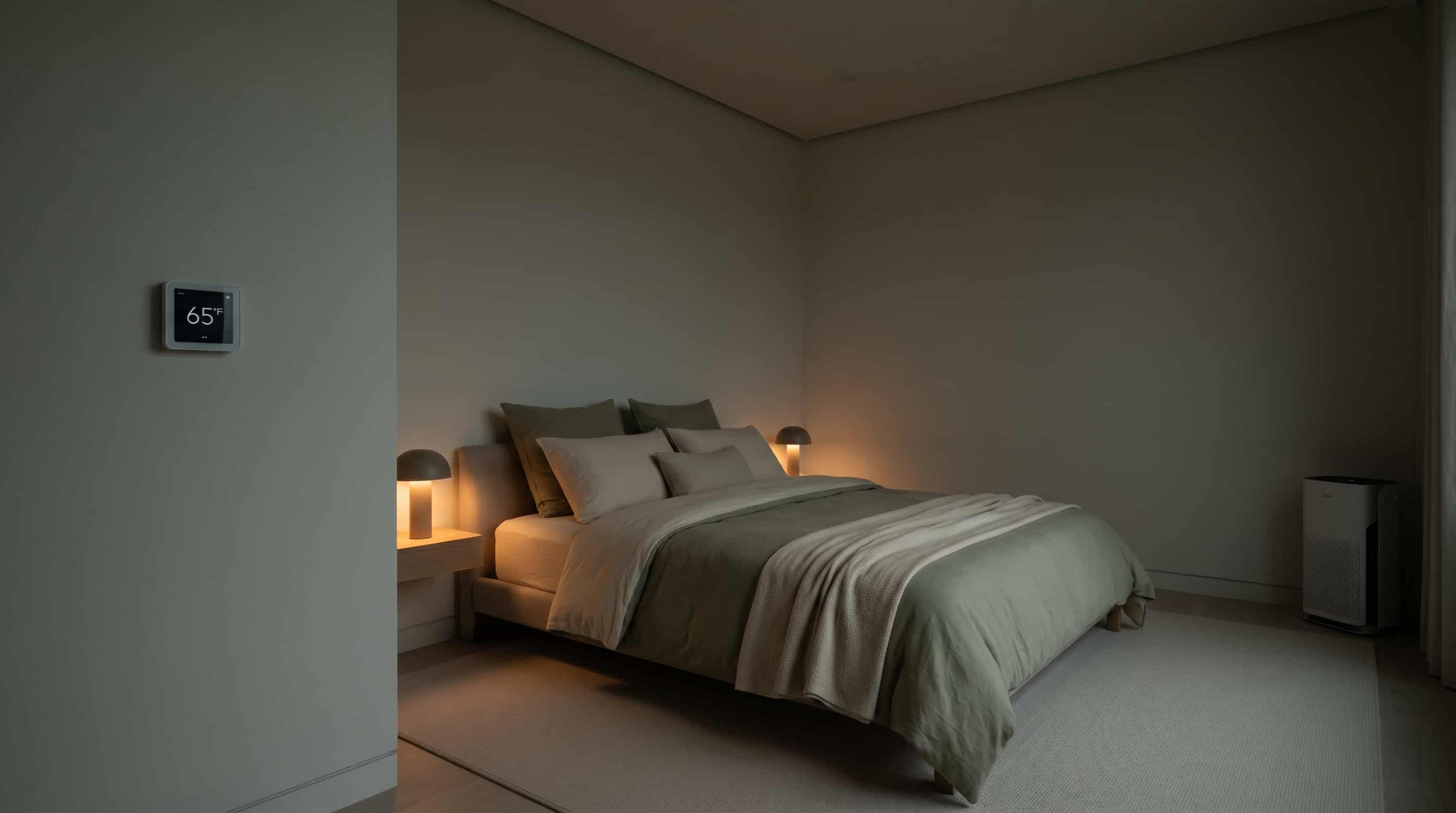
Why does your bedroom air secretly ruin your sleep?
Direct Answer: In a closed bedroom, CO₂ levels spike from 400 ppm to over 2,000 ppm by morning — triple the threshold that impairs cognitive restoration.
The Science: You breathe 7,000-9,000 liters of air every night. A typical sealed bedroom traps exhaled CO₂, causing it to accumulate rapidly. When CO₂ crosses 1,000 ppm, your respiratory rate increases by 20%, triggering micro-awakenings that fragment your sleep architecture without you ever becoming conscious of them. Particulate matter (PM2.5) above 12 μg/m³ — common even in “clean” urban bedrooms — increases inflammatory markers and reduces deep sleep by 30%.
What to Do Tonight: Open your bedroom window for 30 minutes before bed. This single action drops CO₂ by 80% inside 30 minutes. If external air quality is poor, run a HEPA air purifier rated for your room size.
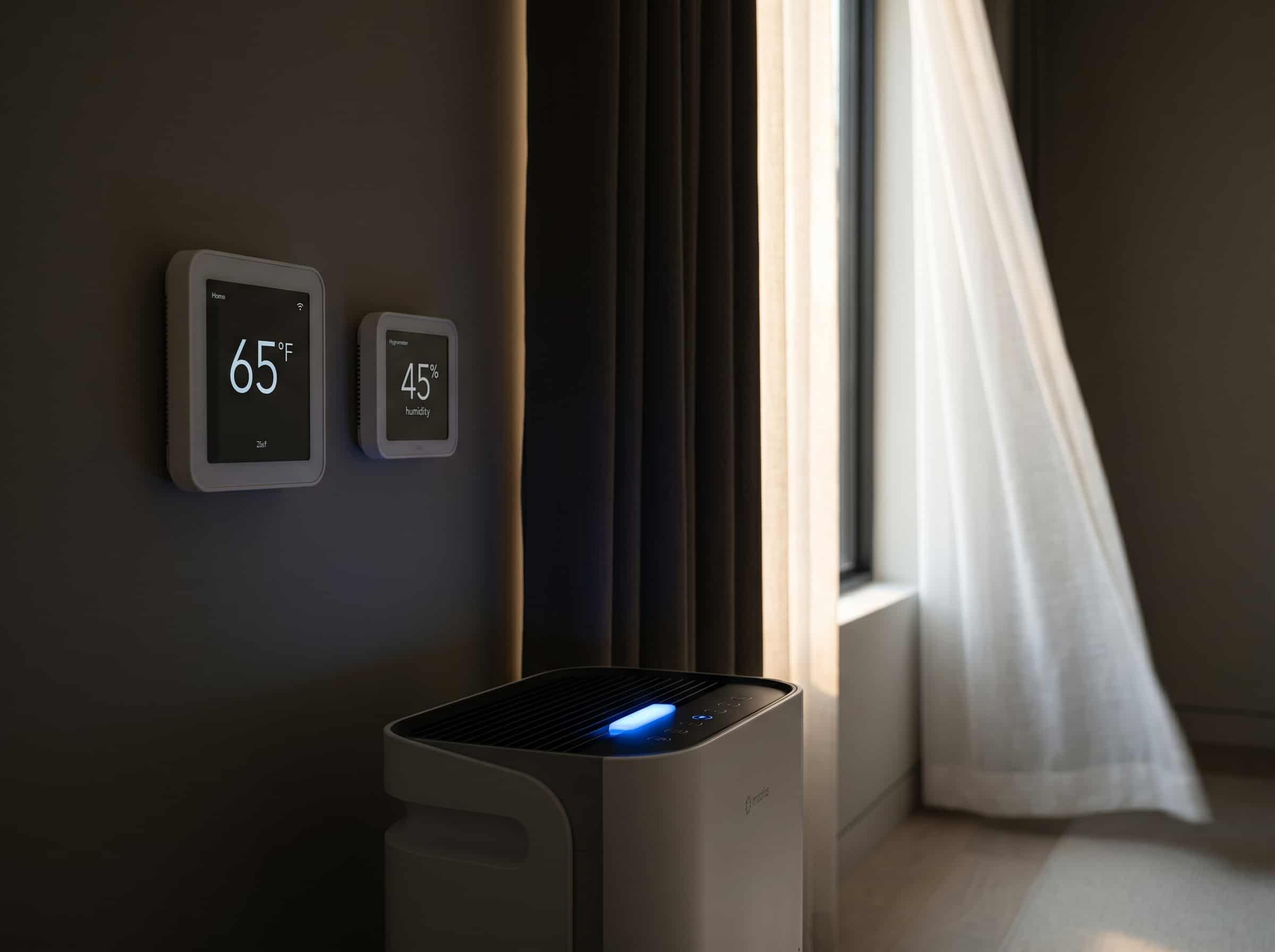
Humidity matters more than most people realize. Below 30% relative humidity, your airways dry out, triggering nighttime coughing and throat irritation. Above 50%, you incubate dust mites and mold. Target 30-50% humidity — a simple hygrometer costs under ten dollars and tells you instantly whether your air is working for or against your sleep.
What is the exact temperature that forces deep sleep?
Direct Answer: Your bedroom must sit between 65°F and 68°F (18-20°C). Your core body temperature needs to drop by 2-3°F for sleep onset, and the ambient air temperature is the primary driver of that drop.
The Science: Sleep onset requires vasodilation — the widening of blood vessels in your hands, feet, and face to dump heat into the environment. If your room is above 70°F, your body fights a losing battle against thermodynamics. The heat stays trapped in your core, and your brain cannot transition into slow-wave sleep. Research shows bedrooms above 70°F reduce deep sleep by 40% and increase nighttime awakenings by 50%.
What to Do Tonight: Set your thermostat to 67°F one hour before bed. Wear minimal clothing to bed — your hands and feet are your body’s primary heat radiators, and insulating them traps heat in your core.
A warm shower 90 minutes before bed sounds counterintuitive, but it works. The hot water triggers blood to rush to your skin’s surface. When you step out, that heat rapidly dissipates, causing a sharp core temperature drop — exactly the signal your brain needs to initiate sleep. It is the simplest bio-hack in your arsenal, and it costs nothing.
Why does any light — even from an LED — suppress melatonin?
Direct Answer: Your brain does not perceive light as an inconvenience. It perceives light as a signal that it is daytime. Even 1 lux — the glow from a single LED across the room — can suppress melatonin by 50%.
The Science: The suprachiasmatic nucleus (your master biological clock) sits in your hypothalamus and communicates directly with your pineal gland. When photoreceptors in your retina detect light — especially blue and green wavelengths — they instruct the pineal gland to stop secreting melatonin immediately. This is not a gradual effect. It is a binary switch: light on, melatonin off.
What to Do Tonight: Tape over every LED indicator in your bedroom with black electrical tape. Install true blackout curtains and seal the gap at the bottom with a draft stopper. Your bedroom must be as dark as a sensory deprivation tank.
If you must have a nightlight, use amber or red wavelength light. Amber LEDs (590nm+) suppress melatonin at roughly 1/10th the rate of blue light (460nm). Place it low — below bed level — so it does not hit your eyes while lying down. The goal is absolute darkness for the first four hours of the night, when your melatonin levels are highest.
What sound environment actually helps you sleep?
Direct Answer: Either complete silence (below 35 dB) or consistent background noise (50-60 dB). What destroys sleep is sudden variation — a car door, a barking dog, a phone notification.
The Science: Your brain evolved to treat unexpected sound spikes as potential threats. A sudden noise above 10 dB above baseline triggers a cortisol spike, even if you do not fully wake up. The fragmentation happens in the microseconds between noise and arousal response. Research shows that pink noise (a balanced frequency distribution) reduces the disruptive impact of traffic sounds on sleep by 45% and improves next-morning blood metabolome markers.
What to Do Tonight: Run a white noise or pink noise machine every night. Consistency is the key — your brain learns to tune out a steady sound. Variability is what triggers cortisol. Close interior doors, weatherstrip the bedroom entry, and eliminate any sudden sound sources you can control.
How do you psychologically hardwire your bedroom for sleep?
Direct Answer: Strict stimulus control — you must teach your brain that the bed means exactly one thing: unconsciousness. Nothing else.
The Science: Your brain forms powerful associative pathways through repetition. If you work in bed, scroll your phone in bed, watch Netflix in bed, and argue in bed, your brain has no idea what to do when you lie down. It prepares for stimulation, not sleep. Stimulus control therapy is 85% effective for chronic insomnia — it works by erasing the old associations and rebuilding a single, unambiguous signal: bed equals sleep.
What to Do Tonight: The bed is for sleep and sex only. If you are awake for more than 20 minutes, get out of bed, go to another room, read a physical book under dim light, and only return when you feel drowsy. Every night. No exceptions.
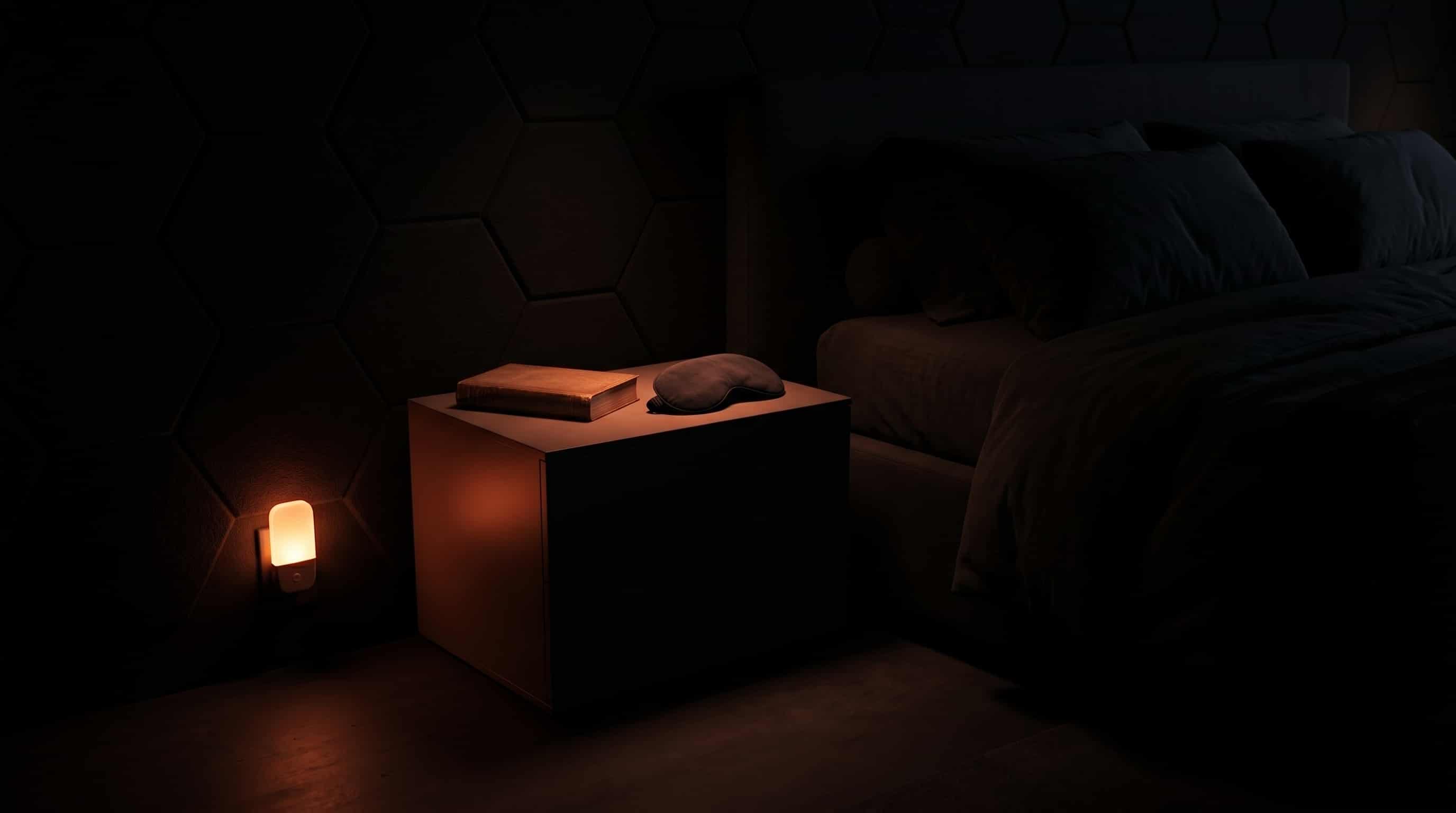
The brutal truth: you cannot have it both ways. You cannot work from your bed on Tuesday and expect your brain to immediately trigger sleep onset on Wednesday. Neural pathways are not reformed overnight. But within two weeks of strict stimulus control — no exceptions — your brain will begin to associate the mattress with unconsciousness automatically. The moment your head hits the pillow, sleep onset begins. That is the target.
What does a 30-day sleep sanctuary protocol actually look like?
Direct Answer: A phased, progressive transformation — not a weekend project. This takes three weeks to fully encode, and results compound over time.
Week 1: Purge and Purify
- Remove every non-sleep item from your bedroom: television, work materials, exercise equipment, clutter
- Set thermostat to 65-68°F one hour before your target bedtime
- Open windows for 30 minutes before bed to flush CO₂, or run a HEPA air purifier
- Check your hygrometer — target 30-50% relative humidity
Week 2: Light and Sound
- Achieve complete blackout — blackout curtains, LED tape over every light source, door sealed
- Introduce a white noise or pink noise machine set at 50-60 dB
- Charge your phone outside the bedroom, or place it face-down with all notifications silenced
- Begin the 20-minute rule: leave the bedroom if you are not asleep within 20 minutes
Week 3: Psychological Encoding
- Bed is for sleep and sex only. Zero exceptions
- Establish a 30-minute pre-bed ritual in a different room: warm shower, light reading, gentle stretching
- Remove all clocks from the bedroom — checking the time in the middle of the night triggers anxiety
- Begin the warm shower protocol: 90 minutes before bed, 10-15 minutes, warm water
Frequently Asked Questions
What if I share a bedroom with someone?
Direct Answer: Prioritize agreement on the five pillars.
Why: Compromise options include separate bedding for different temperature needs, a white noise machine to mask partner movement, a sleep mask for reading light, and clear communication about work or stress boundaries inside the bedroom.
How much does a sleep sanctuary makeover cost?
Direct Answer: Free: remove non-sleep items and establish a consistent pre-bed routine.
Why: $100-$300: blackout curtains, HEPA air purifier, white noise machine $300-$1,000: quality mattress, temperature-regulating bedding, acoustic panels The total value is a 40-60% improvement in sleep quality.
How does Slumbelry’s approach differ from other bedding brands?
Direct Answer: We design specifically for the sleep sanctuary framework.
Why: Our temperature-regulating materials maintain the 65-68 degree optimal range, our acoustic-dampening systems address noise without electronics, and our hypoallergenic covers support air quality It is environmental optimization, not just bedding.
What about small apartments or shared spaces?
Direct Answer: Use vertical solutions like loft beds with workspace underneath, curtain dividers for visual separation, multi-purpose furniture like Murphy beds, and routine separation where pre-bed activities happen in a different space while the bed remains strictly for sleep..
Why:
Can I use my bedroom for relaxing activities?
Direct Answer: Yes, selectively.
Why: Reading a paper book and meditating are acceptable because they promote relaxation Watching TV, scrolling your phone, or working on a laptop are not The rule is simple: if the activity stimulates your brain, relocate it outside the bedroom.
How long until my bedroom feels like a true sanctuary?
Direct Answer: Immediate results from removing clutter and non-sleep items take 1-2 days.
Why: Adjusting to optimal temperature and light conditions takes 3-7 days A strong bed-sleep association develops in 2-3 weeks of strict stimulus control The complete transformation takes 1-2 months.
What if I cannot control my bedroom environment (rental, dorm, shared housing)?
Direct Answer: Use portable solutions: temperature-regulating bedding and a personal fan for thermal control, portable blackout curtains and a sleep mask for light, a white noise machine or earplugs for sound, a portable HEPA filter for air quality, and strict bed-only discipline for psychological conditioning..
Why:
Is sleep sanctuary just marketing hype?
Direct Answer: No.
Why: Every pillar is drawn from published sleep science research The term simply summarizes the evidence-based practice of optimizing your bedroom across five scientifically validated dimensions: air quality, temperature, light, sound, and psychological conditioning We cite peer-reviewed studies for every claim in this guide.
What is the single most important change I can make?
Direct Answer: Remove the television from your bedroom.
Why: Bedroom TVs are the strongest independent predictor of poor sleep in adults Research shows people with a bedroom TV get 20-30 minutes less sleep per night and report 40% lower sleep quality than those who keep screens entirely out of the bedroom.
How do I maintain my sleep sanctuary long-term?
Direct Answer: Weekly: quick tidy and check the air purifier filter.
Why: Monthly: wash bedding and verify temperature settings Seasonally: adjust for temperature and humidity changes Annually: deep clean and reassess all five pillars to ensure your sanctuary is operating at full capacity.
Ready to Transform Your Recovery?
Your bedroom is the most powerful sleep tool you own. Slumbelry designs every product around the five pillars of the sleep sanctuary framework. From temperature-regulating pillows to hypoallergenic bedding systems, we build the tools your biology actually needs.
Take the Free Sleep Assessment Shop the Sleep Sanctuary CollectionThe Slumbelry Commitment
Sleep is the most vulnerable state of human existence. It is where we heal, reset, and grow.
At Slumbelry, we do not just sell sleep products; we advocate for your physiological right to rest. From temperature-regulating materials to psychological conditioning guidance, every solution we offer is designed with one obsession: Respecting your Biology.
Science is our language, but your recovery is our purpose. You take care of everything else in your life — let us take care of your nights.
Rest Deeply,
The Slumbelry Team