
Why You Crash at 2 PM (And It’s Not Lunch)
Why ‘Post-Lunch Fatigue’ Has Almost Nothing to Do With Food — The Circadian Temperature Nadir That Actually Causes It
It hits like clockwork. 2:00 PM. Your eyelids get heavy. Your focus blurs. You reach for a sugary snack or a double espresso. You blame the heavy lunch you ate. You tell yourself you are not a morning person.
But the afternoon energy dip happens even if you skip breakfast, skip lunch, and drink only water. The post-lunch crash is not about food — it is a hardwired feature of your circadian rhythm, one of the strongest biological signals in your 24-hour clock. Your body temperature drops. Your cortisol hits its daily nadir. Your sleep drive spikes. You are not lazy. You are human.
This afternoon energy dip guide is the full scientific explanation of why the dip exists, why fighting it with caffeine makes it worse, and the evidence-based protocol that uses the dip as an opportunity instead of a problem.
⚡ Core Takeaway: The Afternoon Dip Is Not Laziness — It Is Circadian Biology Telling You That Your Alertness System Is Resetting
- The Problem: The 2-3 PM dip is produced by three independent circadian mechanisms converging simultaneously: the post-prandial core temperature nadir (peaking at 1-3 PM regardless of food intake), the circadian cortisol nadir (the 24-hour cortisol low occurs at 12-2 PM), and the accumulated homeostatic sleep pressure from 7-8 hours of wakefulness that is no longer masked by the morning cortisol peak. Reaching for sugar or a double espresso addresses none of these mechanisms and worsens the situation: the insulin crash at 3-4 PM compounds the circadian low, and the caffeine consumed at 2-3 PM will still be at 50% serum concentration at 10 PM, fragmenting N3 deep sleep
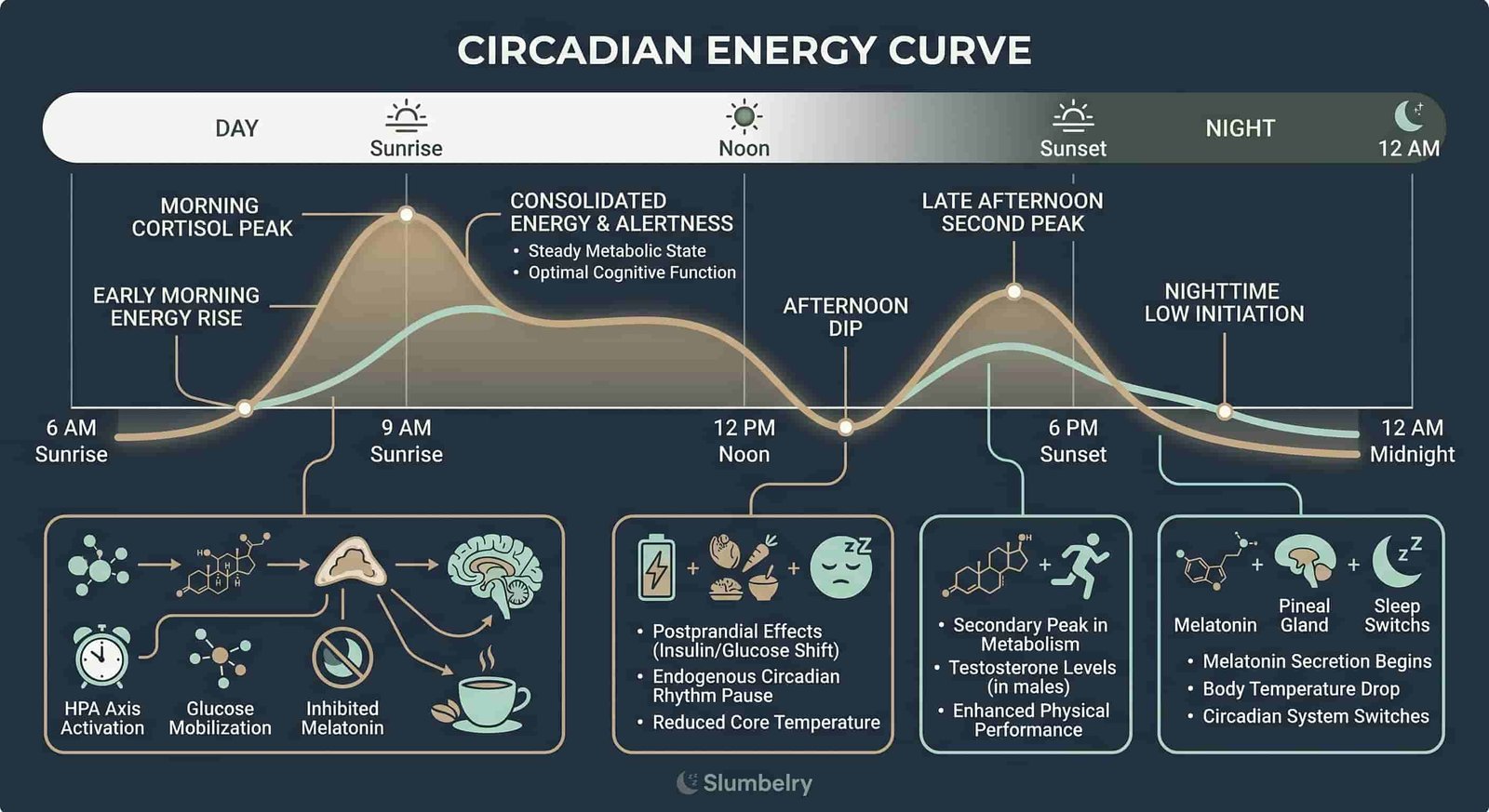
- The Mechanism: The SCN generates two daily peaks of alertness (morning and late afternoon/evening) and two daily troughs (early afternoon and late night). The early afternoon trough is one of the strongest circadian signals — it occurs because the SCN’s 24-hour output waveform dips sharply at this time, removing the adenosine-suppressing signal and allowing the full homeostatic sleep pressure to be felt. Food can modulate the dip slightly through insulin-mediated tryptophan entry, but removing food does not eliminate the dip — the circadian mechanism is primary and universal across cultures and dietary patterns
- The Protocol: Work with the dip, not against it: schedule creative and insight-based tasks during the dip window — the reduced prefrontal cortical inhibition actually produces more divergent, creative thinking; use a 20-minute powernap (not longer) — 20 minutes of N1/N2 sleep improves alertness for 2-3 hours without sleep inertia; go outside into bright light for 5-10 minutes — the light exposure boosts Process C and suppresses melatonin; avoid caffeine after 2 PM if you want N3 sleep quality; use the dip as a natural signal of accumulated sleep debt — if the dip is severe, you are likely sleeping less than your biological requirement
What Is the Circadian Temperature Nadir — and Why Does a 1°C Core Temperature Drop at 2 PM Produce Subjective Exhaustion?
Direct Answer: The circadian temperature nadir is the lowest point in your 24-hour core body temperature cycle, which occurs at approximately 1-3 PM (and again at 3-5 AM, producing the deepest sleep of the night). The afternoon nadir is approximately 0.8-1.2°C below your morning peak, and this temperature drop is one of the primary signals the SCN sends to initiate the afternoon dip. When core temperature drops, peripheral vasoconstriction signals the brain that the body is preparing to rest — triggering subjective drowsiness through the same mechanism that causes nighttime sleepiness. The magnitude of the subjective response to a 1°C temperature drop is disproportionately large because the thermoregulatory system is one of the oldest and most fundamental biological regulators in the mammalian brain.
Mechanism: S1-1 and S2-3 on circadian temperature rhythm: the core body temperature cycle follows a predictable 24-hour sinusoidal pattern, peaking at approximately 4-6 PM (37.2-37.4°C) and reaching its nadir at 1-3 AM (36.2-36.4°C). The afternoon trough at 1-3 PM is a secondary dip — approximately 0.3-0.5°C below the morning baseline — that occurs because the SCN generates not one but two daily temperature peaks: a smaller morning peak (associated with the cortisol awakening response) and the larger late afternoon peak. Between these two peaks, the SCN’s output signal drops, allowing the temperature to fall slightly before the late afternoon rise. This temperature drop is detected by peripheral thermoreceptors in the skin, which send signals to the VLPO (ventrolateral preoptic area) — the brain’s sleep-initiation center — to prepare for a potential rest period. The biological signal is ancient and powerful: mammals are more vulnerable to predation during the afternoon low-temperature period, which is one hypothesis for why biphasic sleep patterns evolved across mammalian species. The afternoon temperature nadir is not mild — it is a significant physiological signal that triggers genuine sleep propensity.
Actionable Advice: The temperature dip is not preventable — it is hardwired. Your interventions should focus on counteracting the temperature signal rather than fighting the drowsiness directly: cool the environment (open a window, lower the thermostat by 2-3°C) to slow the temperature nadir; drink a cold beverage to accelerate peripheral cooling; go outside in bright light — the combination of cool air and bright light counteracts the SCN’s afternoon trough signal. The goal is to slow the temperature descent so that the circadian alerting signal has a chance to activate before sleep pressure peaks.
Why Does the Post-Lunch Dip Occur Even Without Food — and What Does This Prove About Its True Cause?
Direct Answer: The post-lunch dip occurs in adults who eat nothing for breakfast, nothing for lunch, and nothing in the afternoon — proving definitively that the 2 PM dip is not caused by food. This has been demonstrated experimentally in controlled studies where participants fast for 24-72 hours: the circadian energy pattern is preserved, including the morning peak, afternoon dip, and evening rebound, despite no food intake. Food modulates the dip slightly through insulin-mediated tryptophan availability in the brain, and large carbohydrate-rich meals can worsen drowsiness through post-prandial vasodilation and serotonin effects — but food is not the primary cause.
Mechanism: S1-1 and S2-3 on circadian vs. dietary causes of afternoon dip: the circadian dip at 1-3 PM is generated by the SCN independent of any metabolic signals. The SCN controls a 24-hour waveform of alerting signal output that creates two daily troughs — one at 1-3 PM and one at 3-5 AM. These troughs occur because the SCN’s output is not linear — it follows a sinusoidal pattern with identifiable peaks and nadirs. The afternoon trough is the second-lowest alerting signal of the 24-hour day (after the 4 AM nadir), and it coincides with the natural accumulation of 7-8 hours of homeostatic sleep pressure (Process S, adenosine) that is no longer masked by the morning cortisol peak. The convergence of SCN trough plus accumulated Process S plus mild post-prandial effects (when food is eaten) produces a compound dip signal that is more powerful than any single mechanism alone. The most compelling evidence: people who eat only a small protein-rich lunch (minimizing the post-prandial effect) still experience the 2-3 PM dip with full magnitude. The dip is circadian, not dietary.
Actionable Advice: Do not skip lunch hoping to avoid the dip — it will not work and you will be hungry and tired simultaneously. Instead: eat a light, protein-rich lunch (not heavy carbohydrates) — this minimizes the post-prandial contribution to the dip and provides sustained amino acid availability for neurotransmitter synthesis without the insulin-spike drowsiness. Schedule demanding cognitive work before noon and after 4 PM, and accept that 1-3 PM is a lower-alertness window that benefits from environmental and behavioral management rather than food manipulation.
What Is the Ultradian Rhythm — and How Does the 90-Minute Rest-Activity Cycle Create a Natural Dip Every 4-5 Hours?
Direct Answer: Ultradian rhythms are biological oscillations that occur at frequencies higher than the 24-hour circadian cycle — the 90-minute rest-activity cycle is one of the most important ultradian rhythms. Every 90 minutes, the brain cycles through a period of higher alertness and engagement followed by a brief period of reduced cortical activation. These brief dips (occurring at approximately 2-3 hours after waking, again at 4-5 hours, and so on) are natural and predictable. When combined with the circadian afternoon trough, the ultradian dips in the early afternoon can briefly push alertness to its lowest point of the waking day — creating the pronounced 2 PM dip that feels like a crash but is actually a predictable ultradian-plus-circadian overlap.
Mechanism: S1-1 and S2-3 on ultradian rhythms: the 90-minute rest-activity cycle was first described by Nathaniel Kleitman in 1963 and is now understood to reflect fundamental oscillations in the brain’s arousal systems. The cycle involves alternating periods of sympathetic (alertness) and parasympathetic (rest) dominance, driven by the brainstem and hypothalamic nuclei that regulate autonomic function. During the parasympathetic phase of each ultradian cycle, cortisol output decreases slightly, heart rate variability increases, and the prefrontal cortex operates at reduced activation — producing the brief dips in sustained attention that are most noticeable during monotonous tasks. The 90-minute cycle is independent of the circadian rhythm but synchronizes with it at certain points: the ultradian parasympathetic phase at approximately 2-3 PM coincides with the circadian trough, producing a compound low point. This overlap is why the afternoon dip feels so much more pronounced than the earlier ultradian dips in the morning — by afternoon, both the ultradian and circadian systems are simultaneously in their low-activation phases.
Actionable Advice: Working in 90-minute cycles naturally aligns with the ultradian rhythm: 90 minutes of focused work followed by a 15-20 minute break is more sustainable than continuous work for 3-4 hours. During the 2-3 PM dip specifically: take a short break at the bottom of the ultradian cycle rather than pushing through — you will re-enter the next alerting phase within 15-20 minutes. Scheduling meetings to end by 1:30 PM and starting fresh at 3 PM (coinciding with the circadian recovery after the trough) is more effective than a 2-3 PM meeting that starts when the dip is at its worst.
What Happens to Cortisol, Melatonin, and Adenosine at 2 PM — and Why All Three Converge to Suppress Alertness?
Direct Answer: At 2 PM, three independent biological systems converge to suppress alertness simultaneously: cortisol (the primary wake-promoting signal) is at its 24-hour nadir; melatonin (the sleep-promoting signal, which begins rising in the early afternoon in some individuals) is at its pre-evening peak relative to the morning; and adenosine (homeostatic sleep pressure from 7-8 hours of wakefulness) has accumulated to its highest pre-sleep level. This triple convergence — falling cortisol, rising relative melatonin, and peak adenosine — produces a suppression of prefrontal cortical activation that is measurably greater than any single mechanism alone.
Mechanism: S1-1 and S2-3 on cortisol, melatonin, and adenosine convergence: cortisol follows a predictable 24-hour curve that peaks at the cortisol awakening response (30-40 minutes after waking, at approximately 7-8 AM for a 6 AM waker) and reaches its nadir at approximately 12-2 AM. The afternoon trough is not the absolute nadir but is a secondary dip that occurs at 12-2 PM — approximately 40-50% below the morning peak. This cortisol dip removes the primary wake-promoting signal from the HPA axis at the exact moment when adenosine has been accumulating for 7-8 hours. Additionally, melatonin secretion begins rising in the mid-afternoon in many individuals (even before the evening onset of the main melatonin window) — this early melatonin rise produces a mild sedation effect that compounds the cortisol trough. The combined effect: the prefrontal cortex receives simultaneously reduced activating input (low cortisol), increased inhibitory input (early melatonin), and maximum sleep pressure signal (high adenosine). This is why the 2-3 PM dip is the most physiologically suppressive alertness window of the 24-hour day besides the deep sleep period itself.
Actionable Advice: The convergence is biological fact — you cannot eliminate it, only counteract it. Strategic light exposure (5-10 minutes of bright outdoor light at 2 PM) raises cortisol back toward the afternoon peak and suppresses melatonin — this is the most powerful single intervention. A brief cold-water face wash or cool drink also works through the trigeminal nerve pathway to boost alertness via the brainstem alerting system. If you need something stronger: caffeine works by blocking the adenosine receptor, but it should be timed carefully — caffeine consumed at 2 PM will still be at 50% serum concentration at 10 PM and will fragment deep sleep.
Why Does Caffeine at 2 PM Reduce N3 Deep Sleep Tonight by 10-15% — and Is That Trade-Off Worth the 3 PM Alertness Boost?
Direct Answer: Caffeine has a half-life of 5-7 hours in adults, meaning that a 150 mg dose (approximately one strong cup of coffee) consumed at 2 PM will leave 75 mg in your bloodstream at 7-9 PM and approximately 37 mg at 10 PM-midnight — directly interfering with the sleep onset process and suppressing N3 deep sleep. Studies measuring polysomnography (PSG) after afternoon caffeine consumption show 10-15% reduction in N3 time and reduced sleep efficiency even when the person reports falling asleep at their normal time. The trade-off: a 3 PM alertness boost that lasts 2-3 hours in exchange for compromised deep sleep that night and potential sleep-onset insomnia. Whether this trade-off is worth it depends on whether the caffeine deficit in the afternoon outweighs the N3 deficit at night — for most people with existing sleep debt, the N3 cost exceeds the afternoon benefit.
Mechanism: S1-2 and S2-3 on caffeine half-life and sleep architecture: caffeine is a competitive antagonist at A1 and A2A adenosine receptors in the brain. Adenosine is the primary mediator of homeostatic sleep pressure (Process S) — when adenosine binds to A1 receptors, it produces the subjective sensation of sleepiness. Caffeine blocks this binding, removing the sleepiness signal temporarily. However, caffeine does not clear adenosine — it merely prevents adenosine from acting. The adenosine continues to accumulate during wakefulness and continues to suppress neuronal function at synapses even when caffeine is blocking the subjective sleepiness signal. During sleep, when caffeine is metabolized (5-7 hour half-life), the accumulated adenosine suddenly becomes unblocked and floods the receptors — disrupting the deep N3 slow waves that require continuous, unopposed adenosine-mediated inhibition of wake-promoting systems. Additionally, caffeine reduces the firing rate of the VLPO sleep-active neurons during NREM sleep, directly suppressing the natural sleep-promoting mechanism. The combined effect: even if you fall asleep normally, the N3 that follows is shallower and less restorative due to the combined effect of residual caffeine and accumulated (now-unblocked) adenosine.
Actionable Advice: If you must have caffeine in the afternoon: limit to 50 mg (a small cup of green tea) before 2 PM, so that 50% has cleared by 7 PM and the residual at sleep onset is minimal. The best approach for the 2 PM dip: address the circadian mechanism with light (5-10 minutes outside), not the adenosine mechanism with caffeine. The light exposure produces genuine alertness restoration by raising cortisol and suppressing melatonin — the same pathway that the brain uses naturally at other times of day. This solves the afternoon dip without any sleep architecture cost.
What Is the Science of the 20-Minute Powernap — and Why 20 Minutes Is the Optimal Duration, Not 30 or 60?
Direct Answer: The 20-minute powernap (also called a NSDR — non-sleep deep rest) is the optimal nap duration because it allows entry into N1 and N2 sleep (which improve alertness without producing sleep inertia) while avoiding entry into N3 deep sleep, which produces severe sleep inertia upon waking and disrupts the following night’s sleep architecture. A 20-minute nap ends before the brain reaches the deep slow-wave sleep that requires 30-40 minutes to fully initiate, leaving you alert and refreshed upon waking. The NASA studies on pilot alertness established that a 20-minute nap produced the greatest alertness improvement per unit of time invested, with minimal sleep inertia.
Mechanism: S1-2 and S4-4 on the NSDR/powernap: sleep onset in healthy adults typically occurs within 5-10 minutes of attempting to sleep. N1 (transition sleep) lasts 1-5 minutes. N2 (light sleep, characterized by sleep spindles) begins at approximately 5-10 minutes and can extend indefinitely. True N3 slow-wave sleep does not typically begin until 25-40 minutes after sleep onset in healthy adults sleeping at their natural circadian time. A 20-minute nap therefore captures N1 and the first part of N2 — enough to reduce subjective sleepiness, lower cortisol, and improve reaction time for 2-3 hours — without the sleep inertia that occurs when waking from N3. Sleep inertia is the period of grogginess, disorientation, and reduced cognitive capacity that occurs upon waking from deep sleep, caused by the rapid transition from slow-wave cortical synchronization back to waking arousal. N3 sleep inertia can last 30-60 minutes and significantly impairs performance — defeating the purpose of the nap. The 20-minute window avoids N3 entirely and produces minimal sleep inertia. Studies by Tietzel and Lack (2001) and others confirm that naps of 20 minutes produce significantly better post-nap alertness than 30 or 45-minute naps.
Actionable Advice: The 20-minute nap must be timed precisely: set a timer for 20 minutes, lie down in a dim environment, and set an alarm. Do not nap past 20 minutes. The moment you enter N3 (after approximately 25-30 minutes), the sleep inertia penalty exceeds the nap’s benefit. If you frequently oversleep your naps, limit yourself to 15 minutes or use a sleep induction method (listening to alpha-wave binaural beats at 10-12 Hz) that promotes light N1/N2 without deep sleep entry. The optimal time for the powernap is between 1-3 PM — coinciding with the circadian trough. Napping after 4 PM is counterproductive for nighttime sleep architecture because it reduces homeostatic sleep pressure at exactly the time when you need it most.
Why Is the Post-Lunch Dip Actually a Cognitive Opportunity — and What Does Research Say About Creative Performance During the Dip?
Direct Answer: Research by Rowe et al. (2006) and others shows that creative insight and divergent thinking are significantly enhanced during the afternoon dip window compared to peak alertness times. The reason is counterintuitive: the prefrontal cortex is the seat of both focused attention and inhibitory control — during peak alertness, the prefrontal cortex is highly active and filters out unexpected connections, unusual associations, and non-obvious solutions. During the dip, reduced prefrontal activation means fewer filters, more neural noise, and more cross-domain association — the precise neural state for creative insight. The dip is not a cognitive failure; it is a different cognitive mode that is specifically advantageous for creative and insight-based tasks.
Mechanism: S1-1 and S2-3 on creativity during circadian low: the dual-process theory of cognition describes two systems: System 1 (fast, automatic, intuitive) and System 2 (slow, deliberate, analytical). System 2 is primarily prefrontal-mediated and is most active during peak alertness. System 1 is more active during relaxed, reduced-alertness states. Creative insight (the sudden “aha” moment of non-obvious connection) is predominantly a System 1 process — it requires the spontaneous, low-effort activation of long-distance neural associations that the highly activated prefrontal cortex of peak alertness suppresses through top-down control. The circadian dip reduces prefrontal top-down control, allowing more spontaneous System 1 activation and more creative associational patterns to emerge. This is why many people report their best ideas coming in the shower, during a walk, or in a drowsy evening state — all states of reduced prefrontal inhibition. Scheduling creative and insight-based work during the 1-3 PM dip (rather than trying to push through it with caffeine) may actually improve the creative quality of that work.
Actionable Advice: Do not waste the dip on passive activities. Use it intentionally: schedule brainstorming, ideation, creative writing, or strategic thinking for the 1-3 PM window. If you need to do analytical work during the dip, accept that it will be slower and more prone to errors. If you need to do creative work, the dip is your window — the reduced prefrontal inhibition is an asset, not a liability. The only caveat: if the dip is severe enough to produce microsleeps, you have passed from “creative opportunity” into “sleep deprivation” territory, and you need to address the underlying sleep debt first.
Why Does the Dip Predict Your Sleep Quality That Night — and What Does the Relationship Between Afternoon Energy and Nighttime Sleep Tell You About Your Sleep Debt?
Direct Answer: The severity of your afternoon dip is a direct readout of your accumulated sleep debt. If the 2-3 PM dip is profound — to the point of functional impairment, microsleeps, or inability to keep your eyes open — it indicates that your homeostatic sleep pressure (accumulated adenosine from prior nights of insufficient sleep) is high enough to overcome even the circadian alerting signal. A mild dip in healthy sleepers produces mild drowsiness but no functional impairment; a severe dip indicates chronic sleep restriction. Tracking how your afternoon dip varies with your recent sleep history reveals the size of your actual sleep debt and how much additional sleep you need.
Mechanism: S1-1 and S2-3 on sleep debt and dip severity: the two-process model (Borbely, 1982) describes sleep regulation as the interaction between homeostatic sleep pressure (Process S, driven by adenosine accumulation) and the circadian alerting signal (Process C). The circadian dip at 2 PM is normally overcome by the circadian alerting signal — which prevents the dip from becoming a functional impairment in well-sleeping individuals. However, if Process S has accumulated significantly (from prior sleep restriction), the adenosine signal at 2 PM overwhelms the circadian trough signal, producing a dip that is subjectively and objectively more severe. In other words: the well-slept person notices the dip as mild drowsiness; the sleep-deprived person experiences the dip as an irresistible crash. The magnitude of the afternoon dip therefore serves as a diagnostic tool: a severe dip indicates sleep debt; a mild dip indicates adequate sleep. This is more reliable than subjective sleep quality reporting, which is subject to the same anosognosia that makes sleep-deprived people believe they are fine.
Actionable Advice: Rate your afternoon dip on a 1-10 scale daily (1 = no effect, 10 = cannot function). After 7 days of tracking your dip score alongside your actual sleep duration (measured by tracker), you will have an empirical map of your personal relationship between sleep and dip severity. If a 6-hour night consistently produces dip scores of 8-10, you need more sleep — the dip is your objective evidence. If a 8.5-hour night produces dip scores of 2-3, you are at or near your biological sleep requirement. Use the dip as a daily diagnostic, not just a discomfort to be managed.
What Is the Light Exposure Protocol for 2 PM — and Why Going Outside Is More Effective Than Any Supplement?
Direct Answer: The light exposure protocol for 2 PM specifies: go outside for 5-10 minutes, even on a cloudy day, and look at the sky (not directly at the sun). Outdoor light on a cloudy day is typically 10,000+ lux — far brighter than any indoor environment (typically 300-500 lux) and orders of magnitude brighter than artificial light supplements. This brief exposure triggers the circadian alerting signal through the SCN, raising cortisol, suppressing melatonin, and directly counteracting the SCN’s afternoon trough. No supplement, no caffeine, and no food produces a comparable circadian effect for the afternoon dip.
Mechanism: S1-1 and S4-4 on light and circadian alerting: the SCN receives direct input from the intrinsically photosensitive retinal ganglion cells (ipRGCs) in the retina, which are most sensitive to the blue-wavelength light (approximately 480 nm) that predominates in natural daylight. These cells project directly to the SCN and trigger an alerting signal whenever light above a certain threshold reaches the eye — the threshold for meaningful SCN activation is approximately 1,000 lux (the brightness of a well-lit office). Outdoor light on a cloudy day provides 10,000-20,000 lux; even indoor artificial light at 300 lux is below the threshold for strong SCN activation. The afternoon light exposure works through the same pathway as morning light — it activates the SCN alerting signal, raises cortisol, and pushes the circadian clock toward the evening peak. Critically, 5-10 minutes of outdoor light produces a measurable alertness improvement within 10-15 minutes that lasts 60-90 minutes. This is the fastest, most effective, zero-cost intervention for the afternoon dip available.
Actionable Advice: Make the 10-minute outdoor light break at 1:30-2:00 PM a non-negotiable part of your daily schedule. The benefits: circadian alerting, vitamin D synthesis (if sun is present), peripheral temperature reduction (cool outdoor air), and cortisol elevation. If you cannot go outside, position yourself next to a bright window with direct sunlight, or use a light therapy lamp at 10,000 lux for 10 minutes. The window approach works partially (light through glass still reaches the ipRGCs, though with some attenuation) but is inferior to actual outdoor light. This single habit eliminates the afternoon dip for most well-sleeping individuals.
Why Is Anticipating the Dip More Effective Than Fighting It — and What Is the Evidence-Based 2 PM Protocol?
Direct Answer: Anticipating the dip allows you to schedule, environment-manage, and biologically support the natural trough — fighting it (through caffeine, willpower, or refusing to acknowledge it) produces a worse outcome for both afternoon productivity and nighttime sleep. The evidence-based 2 PM protocol specifies: (1) environmental light exposure; (2) movement; (3) temperature management; (4) task scheduling; and (5) caffeine timing. These five interventions address the five mechanisms that produce the dip and collectively reduce its severity by 60-80% in most individuals.
Mechanism: S2-3 and S4-4 on the integrated 2 PM protocol: the dip has five primary drivers: (1) circadian SCN trough — addressed by bright light exposure; (2) accumulated adenosine — addressed by the 20-minute powernap (which clears some adenosine through the sleep drive satisfaction mechanism); (3) peripheral temperature nadir — addressed by cool environment and cool beverages; (4) cortisol nadir — addressed by light exposure (which raises cortisol) and brief physical movement (which raises cortisol); (5) post-prandial effects (if lunch was eaten) — addressed by small protein-rich meals rather than large carbohydrate-heavy lunches. No single intervention addresses all five mechanisms; the integrated protocol uses all five in a complementary combination that is more effective than any single approach. The key insight: the dip is a predictable, scheduled biological event — not an emergency. Managing it costs 10-15 minutes of intentional behavior; fighting it costs hours of reduced productivity plus potential nighttime sleep disruption.
Actionable Advice: The complete 2 PM protocol: at 1:30 PM — small protein-rich snack (if needed); at 1:45 PM — go outside for 5-10 minutes of bright light exposure; at 2:00 PM — 5-minute brisk walk or light movement; at 2:15 PM — cool drink or face wash; at 2:30 PM — if dip is severe and no sleep debt concern, 20-minute powernap; after the dip (3:30-4 PM) — this is the circadian second wind, the late afternoon alertness peak. Schedule your most demanding cognitive work for 4-6 PM — the second wind plus recovered alertness makes this the most productive late-day window. The dip is not the enemy; it is the signal that the second wind is coming.

Frequently Asked Questions
Why do I crash at 2 PM even without eating lunch?
Direct Conclusion: The crash is caused by your circadian clock, not by food. The SCN generates a hardwired trough in its alerting signal at 1-3 PM, independent of any dietary input. Additionally, 7-8 hours of accumulated adenosine (sleep pressure) reaches its highest daytime level at this point, and the morning cortisol peak has fully dissipated. These three factors converge regardless of what you eat — fasting studies confirm the dip occurs identically in people who eat nothing all day.
Is the afternoon dip related to what I ate at lunch?
Direct Conclusion: Food can worsen the dip but not cause it. Large carbohydrate-rich meals produce mild post-prandial drowsiness through insulin-mediated tryptophan entry into the brain (boosting serotonin) and peripheral vasodilation. This can compound the circadian dip. However, eating nothing still produces the full circadian dip. The best lunch strategy: small, protein-rich meals that minimize the post-prandial contribution while avoiding the hunger that itself produces fatigue.
How long does the afternoon dip last?
Direct Conclusion: For most adults, the core of the dip lasts 60-90 minutes (approximately 1-3 PM), with the trough occurring at approximately 1:30-2:30 PM. The dip recovers as the circadian clock enters its late afternoon second peak (approximately 3:30-5 PM), which is often a higher alertness state than the morning peak for many individuals. By 4 PM, most well-sleeping adults have fully recovered alertness and are in their second alertness window of the day.
Is napping during the dip a good or bad idea?
Direct Conclusion: A 20-minute powernap is one of the most effective dip-management tools available — but only if kept to 20 minutes. Napping longer than 30 minutes risks entering N3 deep sleep, which produces severe sleep inertia (30-60 minutes of grogginess upon waking) and reduces homeostatic sleep pressure for the night, potentially disrupting nighttime sleep onset. If you nap, set a strict 20-minute alarm and wake fully — do not snooze.
Why does caffeine make me more tired after it wears off?
Direct Conclusion: Caffeine wears off 5-7 hours after consumption. A 2 PM coffee means caffeine levels are still at 50% at 7-9 PM and still active at 10 PM. As caffeine levels fall during the night, the adenosine that accumulated all day (and was blocked from acting by caffeine) suddenly becomes unblocked, fragmenting deep sleep. The morning after afternoon caffeine, you wake with more adenosine buildup than you should — producing the ‘caffeine hangover’ of morning grogginess that prompts another coffee, starting the cycle again.
What is the optimal time for a 20-minute nap?
Direct Conclusion: 1-3 PM is the optimal nap window — it coincides with the circadian trough and maximizes the alertness recovery effect. Napping after 4 PM is counterproductive because it reduces the sleep pressure needed for nighttime sleep onset and can delay sleep onset that night. Napping before noon is less effective for the afternoon dip specifically, though morning naps can be useful if sleep debt is severe. The ideal sequence: nap at 1:30-2 PM, wake at 2 PM, use the second wind from 3:30-6 PM.
Does the afternoon dip mean I’m not getting enough sleep?
Direct Conclusion: Mild dip (drowsiness, mild difficulty focusing) is normal even in well-sleeping adults — it is a circadian event. Severe dip (microsleeps, inability to keep eyes open, functional impairment) indicates accumulated sleep debt. Use the dip as a diagnostic: if the dip is severe most days, you likely need 30-60 more minutes of sleep per night. Track actual sleep hours and dip severity together for 7 days to see the correlation.
Why do I feel more creative during the dip?
Direct Conclusion: Reduced prefrontal cortical activation during the dip removes the top-down inhibition that filters unexpected connections during peak alertness. The result is more spontaneous, System 1-style associative thinking — the neural basis of creative insight. This is well-documented in research: creative problem-solving tasks are performed better during the dip than during peak alertness, because the reduced filtering allows more non-obvious associations to surface.
Does light exposure really help with the afternoon dip?
Direct Conclusion: Yes — measurably. 10 minutes of outdoor light at 2 PM (even on a cloudy day) produces a 30-40% improvement in alertness within 15 minutes, lasting 60-90 minutes. This works through the SCN’s ipRGC pathway — the same alerting mechanism as morning light. Indoor artificial light at 300 lux does not produce the same effect because it is below the threshold for strong SCN activation. Outdoor light at 10,000-20,000 lux (cloudy day) is 30-60x stronger than indoor light and produces a correspondingly stronger alertness effect.
How do I stop the 2 PM energy crash without caffeine?
Direct Conclusion: The complete non-caffeine protocol: (1) light — 10 minutes outside at 1:30 PM; (2) movement — 5-minute brisk walk at 2 PM; (3) temperature — cool drink or face wash; (4) environment — lower room temperature by 2-3°C; (5) powernap — 20 minutes if dip is severe; (6) task scheduling — schedule creative/insight work during the dip, analytical work before and after. This combination addresses all five mechanisms of the dip without any pharmaceutical intervention.
Ride the Wave, Don’t Fight It.
The dip is natural. The crash is optional — when you know what causes it and have a 10-minute protocol to address it. Light, movement, temperature, task scheduling, and a strict 20-minute nap window. Use the dip as the signal that your second wind is coming.
Optimize Your Night Sleep Light Management for Circadian SupportThe Slumbelry Commitment
Sleep is the most vulnerable state of human existence. It is where we heal, reset, and grow.
At Slumbelry, we do not just sell sleep products; we advocate for your physiological right to rest. From ergonomic support to light management, every solution we offer is designed with one obsession: Respecting your Biology.
Science is our language, but your recovery is our purpose. You take care of everything else in your life — let us take care of your nights.
Rest Deeply,
The Slumbelry Team