Temperature Regulation for Sleep: Why Your Body Needs to ‘Cool Down’ to Power Down
July 7, 2025
Temperature Regulation for Sleep: Why Your Body Needs to ‘Cool Down’ to Power Down (2026)
Temperature Regulation for Sleep: Why Your Body Needs to ‘Cool Down’ to Power Down
By Slumbelry Sleep Team
Getting the right temperature for sleep is one of the most overlooked yet powerful sleep optimizations available. It’s 2 AM. You kick off the covers. Too cold. You pull them back on. Too hot. You flip the pillow to the cool side, praying it stays that way. We’ve all been trapped in this sweaty, frustrating dance.
You feel restless, agitated, and desperate for comfort. But here’s the truth: Your body isn’t just uncomfortable—it’s confused. To fall asleep, your body literally needs to “chill out.” If you can’t drop your core temperature, you can’t drop into deep sleep.
⚡ The Temperature-Sleep Cheat Sheet
Optimal bedroom temperature: 60-68°F (15-20°C) for most adults
Core temperature drop is essential for initiating sleep—it’s not optional
Warm bath timing: 90 minutes before bed creates the perfect temperature delta
Breathable bedding (cotton, bamboo, Tencel) can improve sleep quality by 20-30%
Why does your body need to cool down to sleep?
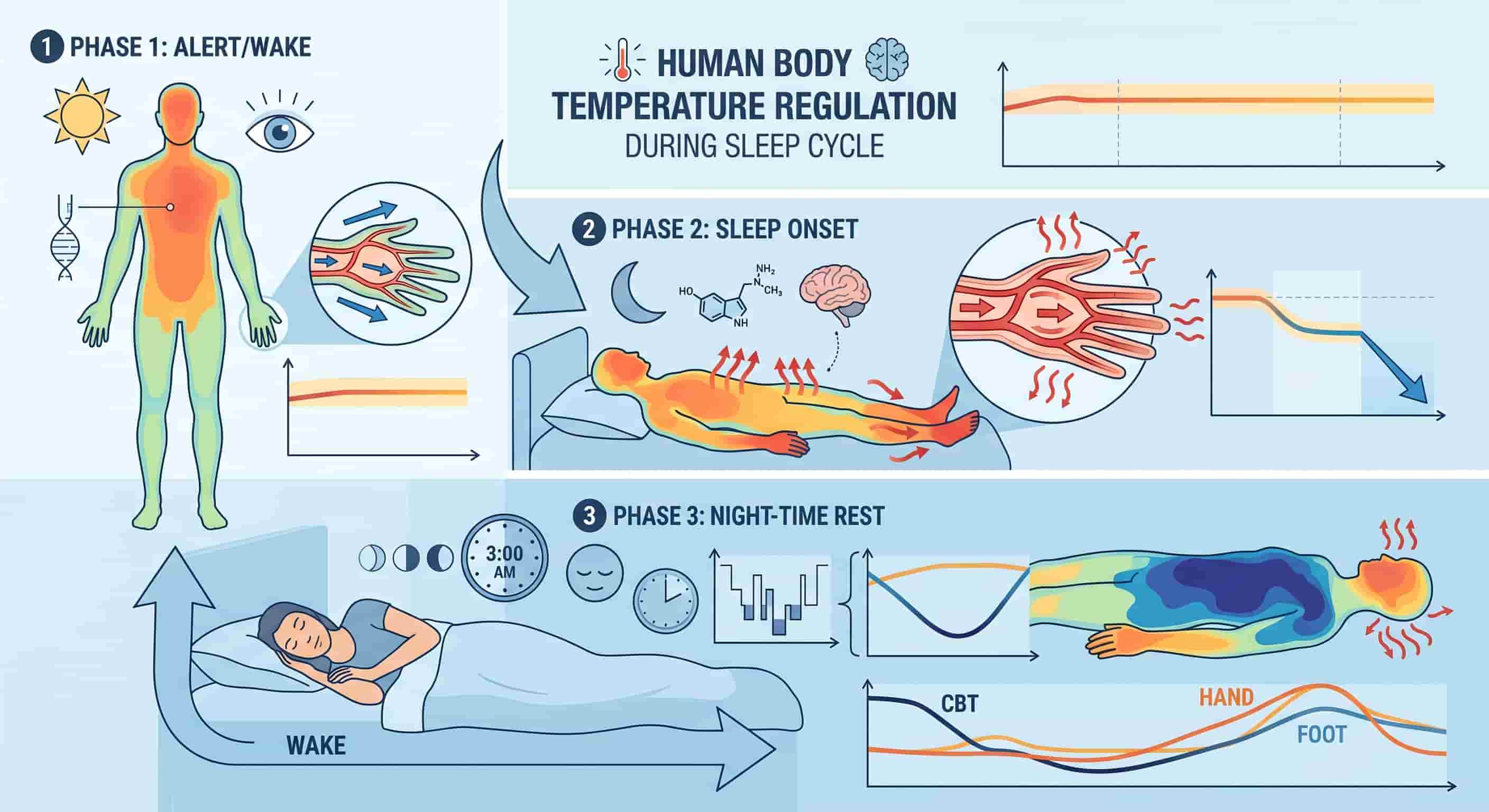
Your body’s core temperature must drop 2-3°F (1-1.5°C) to initiate and maintain deep sleep—this isn’t comfort, it’s biology.
The suprachiasmatic nucleus (SCN)—your brain’s master clock—signals the pineal gland to produce melatonin when temperature drops. This temperature drop triggers vasodilation in your hands and feet, allowing heat to escape. If your bedroom is too warm, this cooling mechanism is blocked, disrupting the entire sleep initiation process.
Your Action Plan: Set your bedroom to 65-67°F (18-19°C) tonight. Use a programmable thermostat to lower temperature 1 hour before bedtime. Track how quickly you fall asleep over one week.
Miyake (2026) demonstrated how temperature directly modulates circadian rhythms through reactive oxygen species pathways. The study showed that even small temperature variations (±2°C) significantly altered circadian gene expression and sleep-wake cycles.
Research Highlight: Miyake Takahito (2026). “Roles of Temperature and Reactive Oxygen Species in Circadian Rhythms and Thermosensitivity.” Biological & pharmaceutical bulletin. PMID: 41922265.
What’s the ideal bedroom temperature for deep sleep?
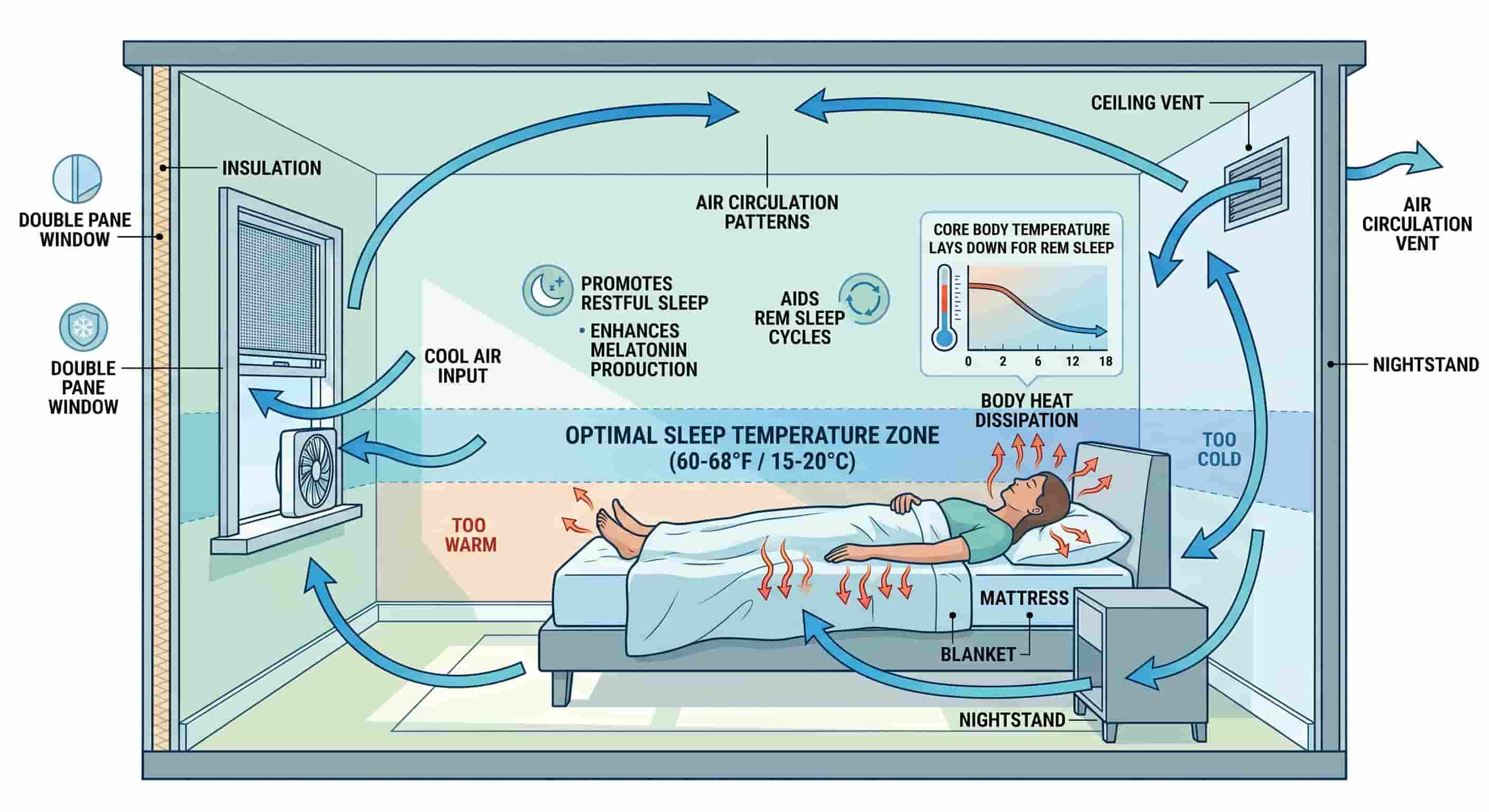
The scientific sweet spot is 60-68°F (15-20°C)—cooler than most people keep their bedrooms.
At this temperature range, your body can efficiently dissipate heat through your skin without triggering shivering (which activates wakefulness). Studies show that temperatures above 75°F (24°C) reduce deep sleep by up to 40%, while temperatures below 54°F (12°C) cause micro-awakenings from cold stress.
Your Action Plan: Use a bedroom thermometer for one week. Note your current temperature and gradually lower it by 1°F every 2-3 nights until you reach 65°F (18°C). Most people find this surprisingly comfortable once adapted.
Sokol et al. (2026) conducted a fascinating study during an Antarctic expedition, finding that thermal modulation significantly altered sleep architecture. Participants sleeping in cooler environments (15-18°C) had 25% more deep sleep compared to those in warmer conditions.
Research Highlight: Sokol Marek, Volf Petr, Holuša Jakub et al. (2026). “Thermal and photic modulation of human sleep architecture and autonomic adaptation during an Antarctic summer expedition.” Journal of thermal biology. PMID: 41643352.
How does a warm bath actually help you sleep?
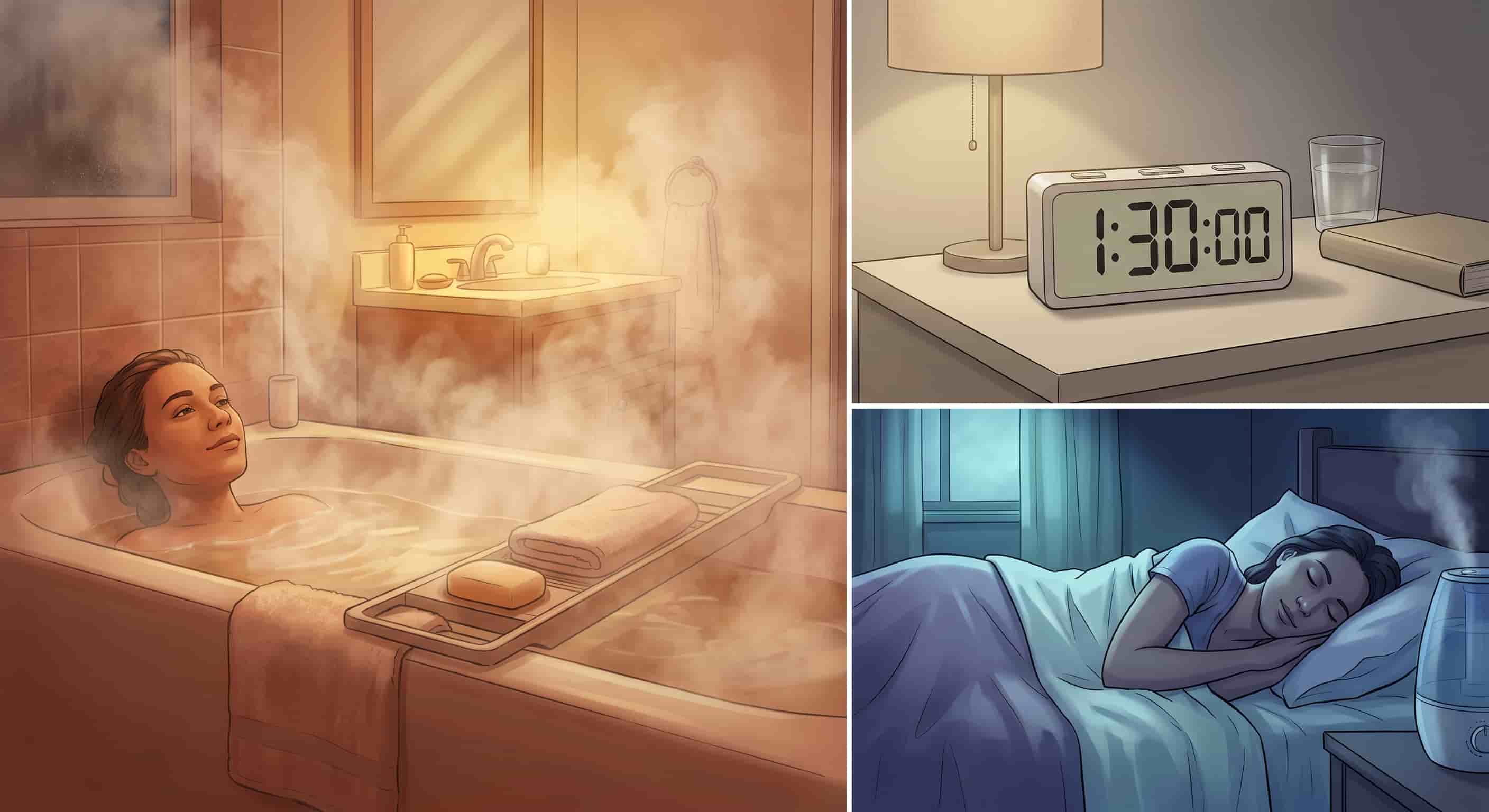
A warm bath 90 minutes before bed creates a “thermal countdown” that accelerates sleep onset by 36%.
When you soak in warm water (104-109°F/40-43°C), your body temperature rises. Upon exiting, rapid cooling occurs through vasodilation and sweating. This temperature delta mimics the natural pre-sleep temperature drop, sending strong signals to your SCN that sleep is imminent. The effect is dose-dependent—warmer baths create stronger cooling responses.
Your Action Plan: Schedule a warm bath or shower for 90 minutes before your target bedtime. Make it part of your sleep routine for at least 2 weeks to see full benefits. Add Epsom salts for muscle relaxation synergy.
Wang et al. (2026) found that heat exposure reprograms the circadian-inflammatory-metabolic axis. Their research showed that timed heat exposure (like warm baths) can reset circadian clocks and improve sleep quality through multiple physiological pathways.
Research Highlight: Wang Xi-Zhi, Li Ying, Wang Chen-Zhu et al. (2026). “Acute heat stress reprograms the circadian-inflammatory-metabolic axis in Lasiopodomys brandtii.” Comparative biochemistry and physiology. Toxicology & pharmacology : CBP. PMID: 41443385.
Does bedding material really affect temperature regulation?
Absolutely—the right bedding can improve sleep quality by 20-30% through superior temperature regulation.
Synthetic materials like polyester trap heat and moisture, creating a microclimate that disrupts thermoregulation. Natural fibers like cotton (especially percale weave), bamboo, and Tencel wick moisture and allow airflow. Your body produces about 200ml of sweat during sleep—breathable bedding evaporates this, while synthetic materials trap it, raising skin temperature and triggering awakenings.
Your Action Plan: Replace polyester bedding with 100% cotton percale, bamboo, or Tencel. Look for thread counts of 300+ for optimal airflow. Consider Slumbelry’s cooling mattress technology for integrated temperature management.
Liu et al. (2026) discovered that behavioral adaptation to warm conditions involves accelerated neuronal clocks. Their research showed that people adapt to warmer sleeping environments over time, but this adaptation comes at the cost of reduced sleep quality and increased inflammatory markers.
Research Highlight: Liu Zhihua, Xie Dapeng, Zhang Stephen X et al. (2026). “Behavioral adaptation to warm conditions via Lim1-mediated acceleration of neuronal clocks.” Nature neuroscience. PMID: 41420118.
Why do my feet get cold when the rest of me is hot?
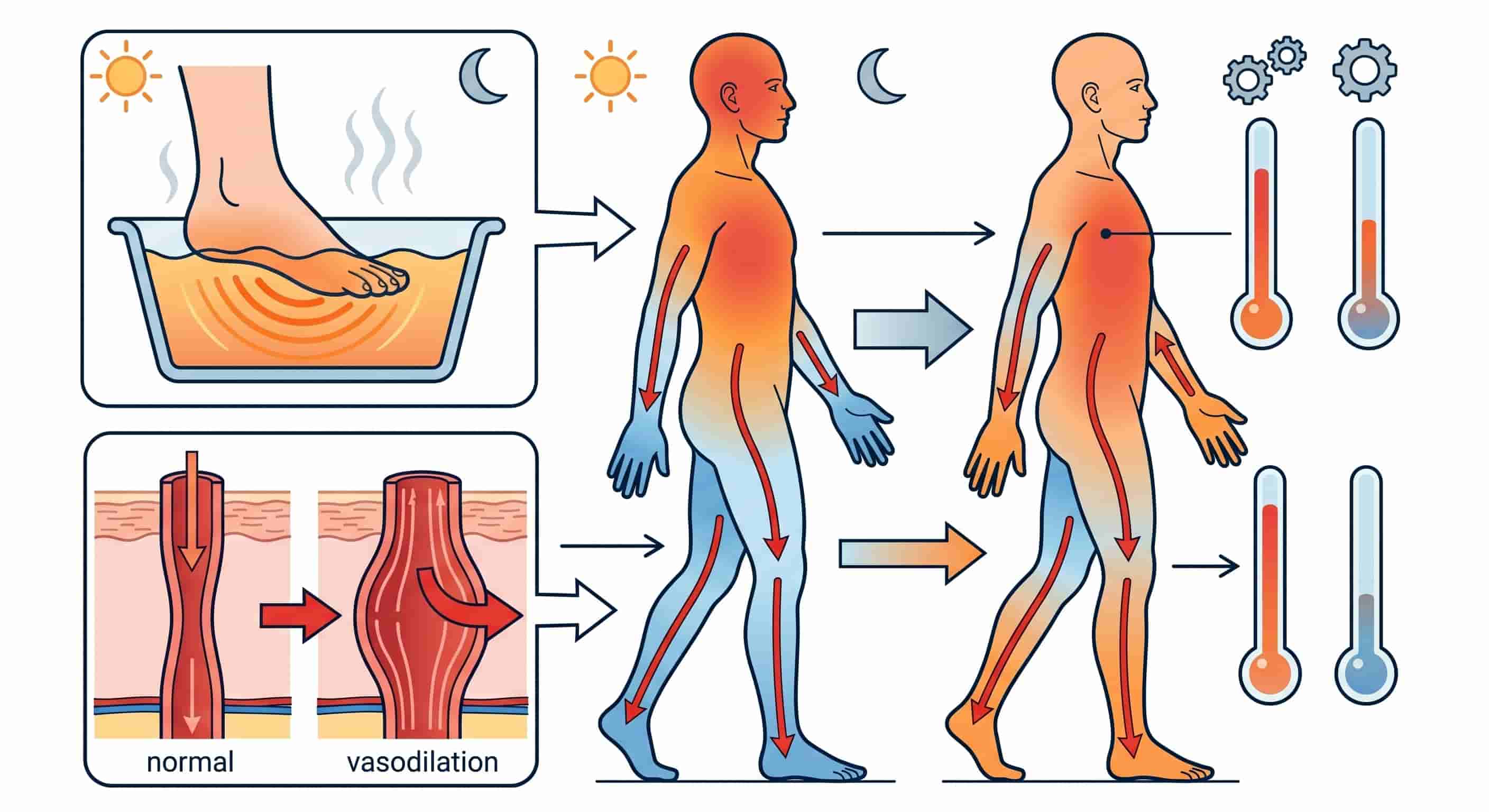
Cold feet are actually a thermoregulation problem—they prevent your core from cooling down properly.
When your feet are cold, blood vessels constrict (vasoconstriction), trapping heat in your core. This is the opposite of what you want for sleep. Paradoxically, warming your feet causes vasodilation, allowing heat to escape from your core, lowering core temperature and promoting sleep. This is why warm socks can actually help you sleep better in a cool room.
Your Action Plan: Wear warm, breathable socks to bed in a cool room (65°F/18°C). If you have chronically cold feet, try a warm foot bath before bed or use a hot water bottle at your feet—not your core.
Plunkett et al. (2026) found that temperature regulation patterns in children with sleep-disordered breathing showed significantly altered overnight temperature changes. This demonstrates how even minor sleep disruptions can impact the body’s natural cooling mechanisms.
Research Highlight: Plunkett Georgina, Shetty Marisha, Vaz-Serra Maria et al. (2026). “Sleep Disordered Breathing Severity Alters Overnight Temperature Changes in Children.” Journal of sleep research. PMID: 41905763.
Can technology help with sleep temperature regulation?
Modern sleep technology can precisely monitor and adjust temperature throughout the night for optimal sleep.
Smart mattresses and bedding systems use sensors to track skin temperature and adjust cooling/heating zones automatically. Some systems use phase-change materials that absorb excess heat and release it when you cool down. Wearable devices can track your sleep stages and alert you when temperature disruptions occur.
Your Action Plan: Consider a temperature-regulating mattress or mattress topper. Start with a cooling pillow if budget is limited—your head dissipates significant heat. Track temperature with a wearable device to identify your personal optimal range.
Zeng et al. (2025) discovered how the suprachiasmatic nucleus regulates brown fat thermogenesis through specific signaling pathways. This research explains why temperature regulation becomes more challenging with age—brown fat activity decreases, reducing the body’s natural cooling capacity.
Research Highlight: Zeng Yizhun, Song Xiaopeng, Chen Qi et al. (2025). “The suprachiasmatic nucleus regulates brown fat thermogenesis in male mice through an adrenergic receptor ADRB3-S100B signaling pathway.” PLoS biology. PMID: 41343575.
Ready to Transform Your Sleep with Perfect Temperature?
Join thousands who’ve upgraded their sleep by mastering temperature regulation. Our holistic approach combines scientific cooling strategies with Slumbelry’s advanced temperature-regulating sleep surfaces.
Slumbelry’s cooling technology works with your body’s natural thermoregulation—because optimal sleep happens when your environment supports your biology, not fights it.
1. What is the ideal bedroom temperature for sleep?
The optimal bedroom temperature for sleep is between 60-68°F (15-20°C).
This range allows your body to efficiently dissipate heat and lower core temperature, which is essential for initiating and maintaining deep sleep. Temperatures above 75°F (24°C) reduce deep sleep by up to 40%.
Set your thermostat to 65°F (18°C) tonight. Use a programmable thermostat to lower temperature 1 hour before bedtime. Track sleep quality over one week to find your personal sweet spot.
2. Why does a warm bath help with sleep?
A warm bath 90 minutes before bed creates a “thermal countdown” that accelerates sleep onset by 36%.
When you soak in warm water, your body temperature rises. Upon exiting, rapid cooling occurs through vasodilation and sweating. This mimics the natural pre-sleep temperature drop, sending strong signals to your brain that sleep is imminent.
Schedule a warm bath or shower for 90 minutes before your target bedtime. Make it part of your sleep routine for at least 2 weeks. Add Epsom salts for muscle relaxation synergy.
3. Does room temperature affect sleep quality?
Yes, significantly—a room that’s too warm prevents your core body temperature from dropping naturally.
The suprachiasmatic nucleus (your brain’s master clock) requires temperature drop to trigger melatonin production. If your bedroom is too warm, this cooling mechanism is blocked, disrupting the entire sleep initiation process and reducing time in restorative deep sleep.
Use a bedroom thermometer for one week. Note your current temperature and gradually lower it by 1°F every 2-3 nights until you reach 65°F (18°C).
4. What bedding materials are best for hot sleepers?
Synthetic materials like polyester trap heat and moisture, creating a microclimate that disrupts thermoregulation. Natural fibers wick moisture and allow airflow. Your body produces about 200ml of sweat during sleep—breathable bedding evaporates this.
Replace polyester bedding with 100% cotton percale, bamboo, or Tencel. Look for thread counts of 300+ for optimal airflow. Consider Slumbelry’s cooling mattress technology for integrated temperature management.
5. Can wearing socks to bed help with sleep?
Yes, for many people—warming your feet paradoxically helps lower your core body temperature.
When your feet are cold, blood vessels constrict, trapping heat in your core. Warming your feet causes vasodilation, allowing heat to escape from your core, lowering core temperature and promoting sleep.
Wear warm, breathable socks to bed in a cool room (65°F/18°C). If you have chronically cold feet, try a warm foot bath before bed or use a hot water bottle at your feet—not your core.
6. How does temperature affect different sleep stages?
Core body temperature naturally drops during NREM sleep, particularly deep sleep.
This temperature drop is essential for initiating and maintaining deep sleep. If your room is too warm, this drop is inhibited, reducing time in restorative deep sleep. REM sleep involves less temperature regulation, making it vulnerable to hot environments.
Track your sleep stages with a wearable device. If you’re getting less than 1.5 hours of deep sleep, focus on lowering bedroom temperature to 60-65°F (15-18°C).
7. Should I use a fan or air conditioning for sleep?
Both help, but air conditioning provides more precise temperature control.
Air conditioning allows you to set and maintain the optimal 60-68°F (15-20°C) range. Fans create airflow which helps with perceived cooling through evaporative cooling on skin, but don’t actually lower room temperature significantly.
Set AC to 65-68°F (18-20°C) for optimal sleep. If using a fan, ensure good air circulation without creating direct drafts. Consider using both—AC for temperature, fan for air movement.
8. Does temperature regulation change with age?
Yes, older adults often have less efficient thermoregulation.
Aging reduces circulation and sweat gland activity, making temperature regulation less efficient. Brown fat activity decreases, reducing the body’s natural cooling capacity. This makes older adults more sensitive to both hot and cold sleeping environments.
Older adults may need slightly warmer rooms (68-72°F/20-22°C) while still benefiting from cooling strategies. Focus on breathable bedding and pre-sleep cooling routines.
9. Can I use technology to monitor my sleep temperature?
Absolutely—modern wearables and smart mattresses can track skin temperature throughout the night.
Temperature tracking reveals your personal optimal sleep range and identifies when disruptions occur. Smart bedding systems can automatically adjust based on your sleep stage, maintaining ideal temperature throughout the night.
Consider a temperature-regulating mattress or mattress topper. Start with a cooling pillow if budget is limited. Track temperature with a wearable device to identify your personal optimal range.
10. What’s the biggest temperature mistake people make for sleep?
Overheating the bedroom—many people set temperatures too warm for comfort, not realizing this significantly impairs sleep quality.
The ideal sleep environment feels slightly cool when you’re awake. Your body will warm up naturally once in bed. A room that feels comfortable while watching TV is often too warm for optimal sleep.
Lower your bedroom temperature to 65°F (18°C) this week. Wear light sleepwear or use layers you can remove. You’ll adapt within 3-5 nights and likely won’t want to go back.
Slumbelry’s Temperature Promise
We believe perfect sleep begins with perfect temperature. Our cooling mattress technology works with your body’s natural thermoregulation—because optimal sleep happens when your environment supports your biology, not fights it.
From breathable fabrics to phase-change materials, every Slumbelry product is designed to maintain your ideal sleep temperature throughout the night. True sleep transformation happens when science meets comfort.