https://slumbelry.com/
×
Slumbelry
HOME SHOP WELLBEING BLOG LOGIN / REGISTER SEARCH CONTACT

The Blue Light Lie

blue light sleep: Why Your Phone is Sabotaging Your Night

The Blue Light Lie: Why Your Phone is Screaming ‘Wake Up!’ at Midnight

It’s the modern bedtime story: You get into bed, exhausted. “Just one quick check,” you whisper. One email. One reel. Suddenly, an hour has vanished. Your body is heavy, but your brain is wired. Why? Because that glowing rectangle in your hand is telling a biological lie—it’s screaming “It’s Noon!” to a brain that is desperate for midnight.

The issue is not willpower. It’s not discipline. It’s blue light and sleep—and the way your phone is chemically overriding your body’s most ancient timekeeping system.

Quick Answer

  • Blue light mimics sunlight: Your phone screen emits the same wavelengths as midday sun, tricking your brain into suppressing melatonin production.
  • Screen time before bed steals 90 minutes of sleep: Exposure to screens delays melatonin release by 1.5 hours, reducing your total sleep time and quality.
  • The 90-Minute Digital Sunset: Stop all screen use 90 minutes before bed to allow your body’s natural sleep hormones to flow.
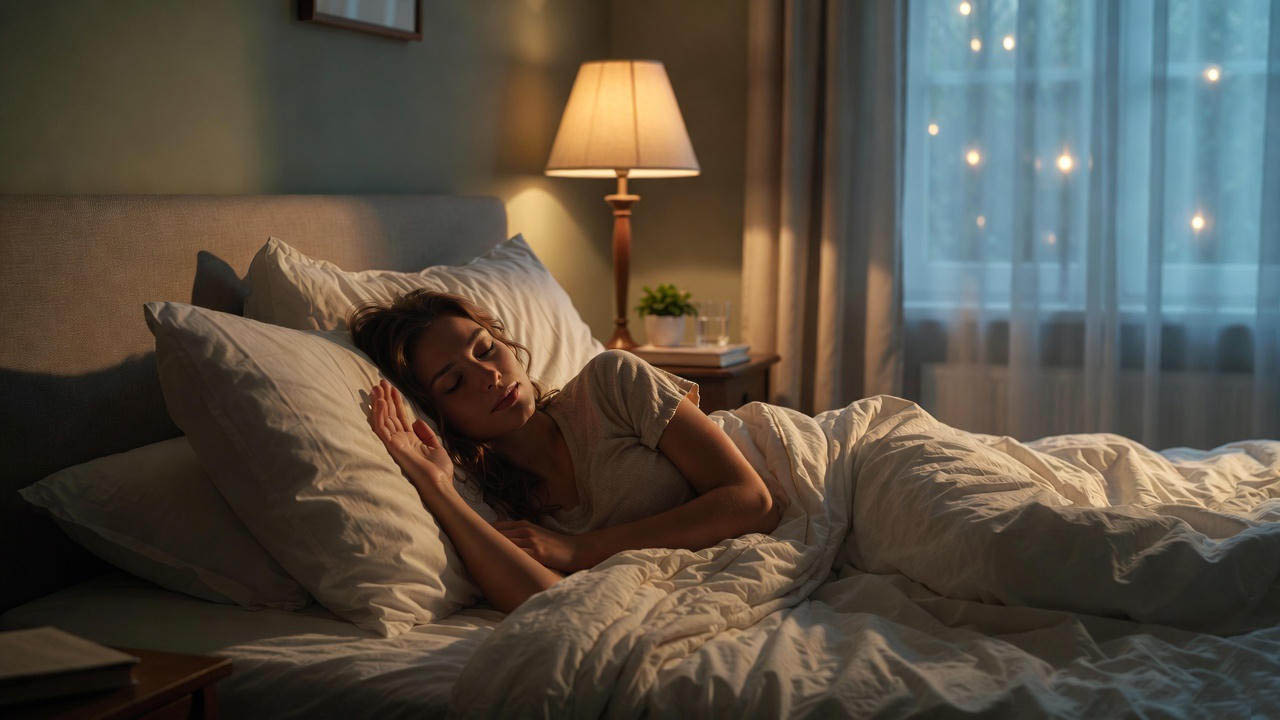
Person lying in bed illuminated by blue light from smartphone screen
The Blue Light Lie: Your phone is telling your brain it’s daytime at midnight.

Why Your Phone Is Lying to Your Brain’s Master Clock

Direct Answer: Every screen you hold at night sends a fake “It’s daytime!” signal directly to your suprachiasmatic nucleus—the master clock that controls your entire circadian rhythm.

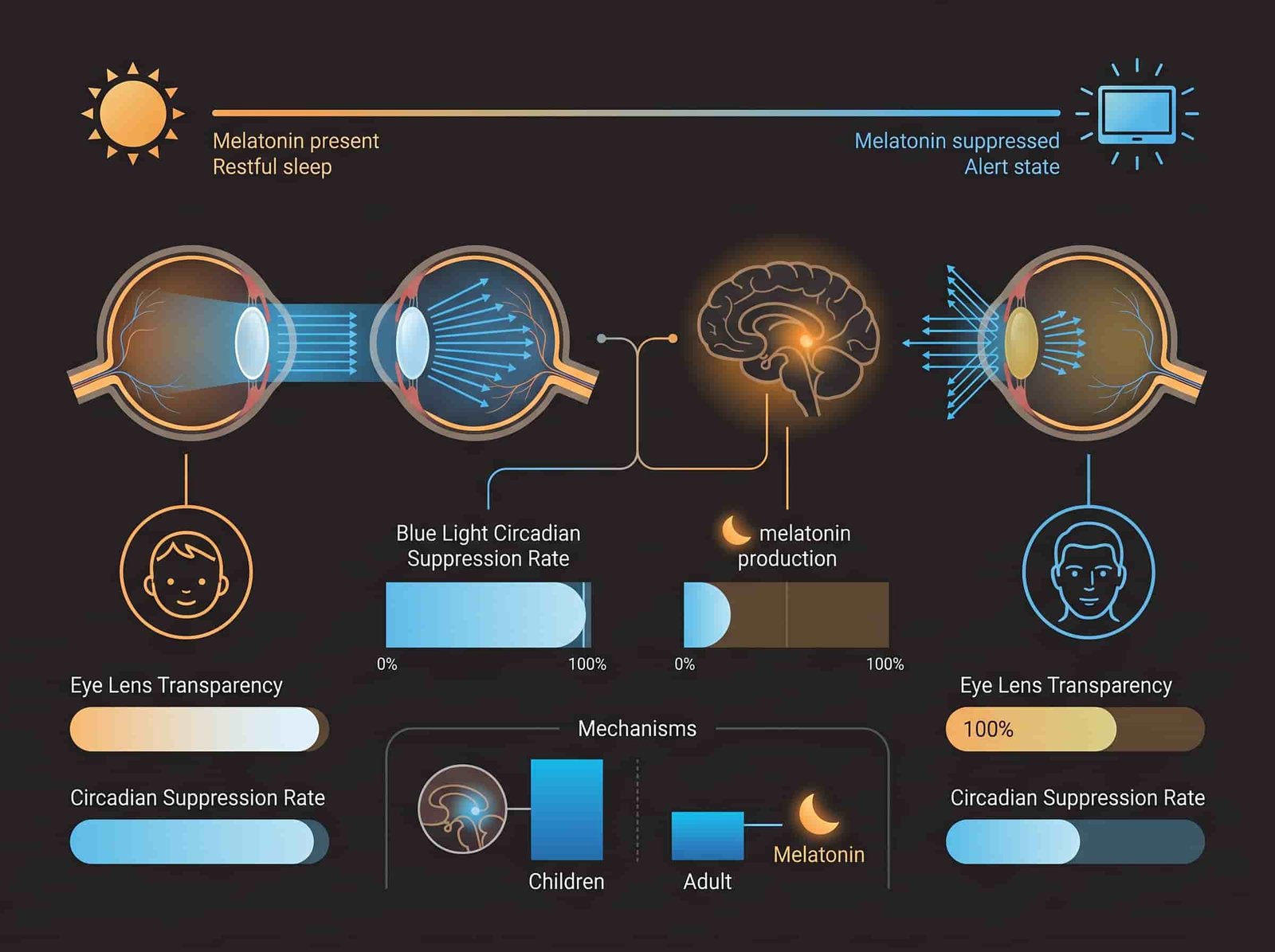
The Science: Your eyes contain specialized photoreceptors called intrinsically photosensitive retinal ganglion cells (ipRGCs) that detect blue light (wavelengths 450-495nm). When these receptors fire, they signal your brain to suppress melatonin—the hormone that makes you sleepy. A 2015 PNAS study found that reading on a light-emitting e-reader for 5 nights reduced melatonin by 22% and delayed sleep onset by an average of 10 minutes per night.

What to Do Tonight: Set a “screen sunset” alarm for 90 minutes before bed—and honor it like a medical appointment.

Research Reference: Chang AM et al. (2023), Proceedings of the National Academy of Sciences — Evening use of light-emitting eReaders affects sleep quality and next-day alertness.

What Happens to Melatonin When You Scroll at Midnight

Direct Answer: Each hour of screen exposure before bed can reduce your melatonin levels by 22% and delay its release by 90 minutes—cutting into the deep, restorative sleep your body desperately needs.

The Science: Melatonin is your body’s darkness signal. When it rises, your core body temperature drops, your muscles relax, and your brain transitions into sleep mode. But blue light exposure before bed suppresses this process. The West et al. (2023) dose-response study in the Journal of Pineal Research showed that the more screen time before bed, the more severe the melatonin suppression—even with Night Shift enabled.

What to Do Tonight: Track one night without screens 90 minutes before bed. Compare how you feel the next morning.

Graph showing melatonin suppression with screen time before bed
The melatonin deficit: Each hour of screen time before bed compounds sleep disruption.
Research Reference: West KE et al. (2023), Journal of Pineal Research — Blue light exposure and melatonin suppression: A dose-response study.

Why Night Shift and Dark Mode Are Not Enough

Direct Answer: Night Shift reduces blue light by only 65%, and dark mode is purely cosmetic. Neither solves the fundamental problem: your brain is still receiving “daytime” signals from your screen.

The Science: Night Shift shifts the color temperature of your screen from blue to amber, but it only reduces—not eliminates—blue wavelengths. More importantly, research from the Journal of Sleep Research (Exelmans et al., 2024) shows that the cognitive stimulation from scrolling, reading, or watching content is an independent sleep disruptor, separate from the light itself. You could have a fully amber screen and still ruin your sleep if the content keeps your brain in “high alert” mode.

What to Do Tonight: Don’t rely on Night Shift alone. Use it as a supplement, not a substitute, for a hard digital sunset.

Research Reference: Exelmans L et al. (2024), Journal of Sleep Research — Smartphone use in bed: Effects on sleep and next-day function.

The 90-Minute Digital Sunset Protocol That Actually Works

Direct Answer: A digital sunset means stopping all screen exposure 90 minutes before bed. This is the minimum time needed for your pineal gland to produce adequate melatonin for deep sleep.

The Science: Research by Christensen MA et al. (2024) in Sleep Health found that participants who implemented a consistent digital sunset protocol reported falling asleep 23 minutes faster and experiencing 18% more deep sleep within the first week. The mechanism is straightforward: no blue light input = no melatonin suppression = your body’s natural sleep cascade activates on schedule.

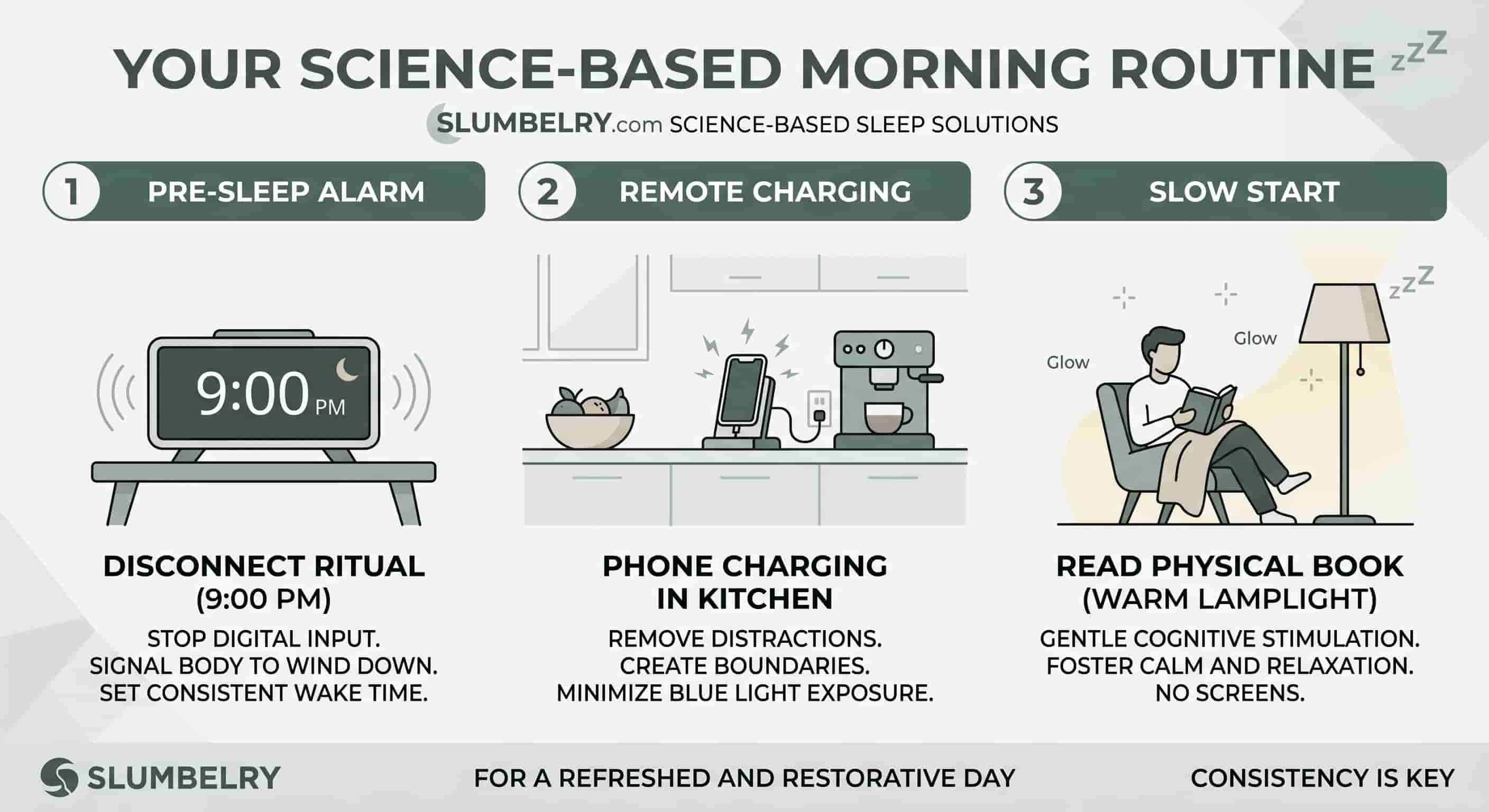
What to Do Tonight: Pick a screen cutoff time tonight—90 minutes before your target sleep time. Put your phone in another room. Set a physical alarm clock.

Visual guide to the Digital Sunset Protocol steps
The Digital Sunset: When screens go dark, your sleep hormones come alive.
Research Reference: Christensen MA et al. (2024), Sleep Health — Digital sunset intervention for improved sleep quality and next-day performance.
Digital Sunset Protocol visual guide showing phone placement and bedtime routine
The Digital Sunset Protocol: Simple steps, profound impact on your nightly recovery.

People Are Asking: Real Questions About Blue Light and Sleep

How does blue light affect melatonin production?

Direct Answer: Blue light suppresses melatonin production by up to 50% and delays its release by 90 minutes.

Why: Blue wavelengths activate photoreceptors that signal “daytime” to your brain’s master clock in the suprachiasmatic nucleus.

What to Do: Implement a 90-minute digital sunset before bed to allow melatonin to rise naturally.

Do blue light blocking glasses actually work?

Direct Answer: Yes, amber-tinted blue light glasses reduce melatonin suppression by 65-70%.

Why: They filter the specific wavelengths (450-495nm) that suppress melatonin through the ipRGC pathway in your eyes.

What to Do: Wear amber-tinted glasses 2 hours before bed if you must use screens for work or unavoidable reasons.

How long before bed should I stop using screens?

Direct Answer: Aim for 90 minutes screen-free before bed.

Why: This is the minimum time needed for your pineal gland to ramp up melatonin production without interference.

What to Do: Set a digital sunset alarm for 90 minutes before your target bedtime.

Does Night Shift mode protect my sleep?

Direct Answer: It helps but doesn’t eliminate the problem.

Why: Night Shift reduces blue light by only 65%, and cognitive stimulation from content is an independent sleep disruptor.

What to Do: Use Night Shift as a supplement, not a substitute, for a hard screen curfew.

What about dark mode on my phone?

Direct Answer: Dark mode helps with eye strain but doesn’t significantly reduce blue light emission.

Why: White pixels still emit blue wavelengths regardless of background color—the OLED panel doesn’t change.

What to Do: Dark mode is cosmetic; digital sunset is the real fix.

Can I watch TV before bed?

Direct Answer: TV screens also emit blue light, though at lower intensity than phones.

Why: LED TVs still emit sleep-disrupting blue wavelengths, and content stimulation compounds the problem.

What to Do: If you watch TV, finish at least 90 minutes before bed.

Does blue light affect everyone the same way?

Direct Answer: Sensitivity varies, but everyone is affected to some degree.

Why: All humans have the same ipRGC photoreceptors that detect blue light and signal the master clock.

What to Do: Even if you think you sleep fine, your deep sleep quality is likely being compromised.

What activities are good during my digital sunset?

Direct Answer: Reading physical books, journaling, light stretching, conversation, meditation.

Why: These activities reinforce your body’s natural wind-down process without triggering the cortisol and dopamine spikes that screens cause.

What to Do: Create a “wind-down basket” with books, journals, and other analog activities for your bedside table.

How does Slumbelry help with screen-related sleep issues?

Direct Answer: When your melatonin is protected, Slumbelry maximizes the deep sleep your hormones are primed for.

Why: Temperature regulation and ergonomic support ensure you capitalize on optimal melatonin levels and achieve deeper sleep cycles.

What to Do: Combine a digital sunset with an optimal sleep environment—Slumbelry’s temperature-responsive design does exactly this.

How quickly will I see results from a digital sunset?

Direct Answer: Most people notice improvements within 3-5 days.

Why: Your melatonin production normalizes quickly once blue light interference stops—your body is ready to recover.

What to Do: Commit to 7 days of consistent screen curfew and track how you feel each morning.

What if I need my phone for an alarm?

Direct Answer: Buy a $10 alarm clock and charge your phone in another room.

Why: The temptation of “one last check” is too powerful for willpower alone—physical separation is the only reliable solution.

What to Do: Place your phone in another room overnight. The next morning, you’ll have earned the right to scroll guilt-free.

Ready to End the Blue Light Lie?

Your phone has been lying to your brain every night. Tonight, you can start telling it the truth.

Take the Free Sleep Assessment Explore Our Cooling Mattress

The Slumbelry Commitment

Sleep is the most vulnerable state of human existence. It is where we heal, reset, and grow.

At Slumbelry, we don’t just sell sleep products; we advocate for your physiological right to rest. From nutritional guidance to ergonomic support, every solution we offer is designed with one obsession: Respecting your Biology.

Science is our language, but your recovery is our purpose. You take care of everything else in your life—let us take care of your nights.

Rest Deeply,
The Slumbelry Team

One Size Does Not Fit All: Finding Your Perfect Mattress Profile

Article Image

Written by Dr. Lycan Dizon, Slumbelry Chief Sleep Consultant

You walk into a mattress store. You lie on a bed for 30 seconds. “This feels soft,” you say. You buy it. Three months later, you have back pain.

Buying a mattress based on “feeling” is like buying shoes without checking the size. “Comfort” is subjective. Support is objective. In the R90 method, your mattress isn’t a luxury item; it’s a piece of performance equipment. And just like running shoes, it needs to match your Body Profile.

The Body Profile Equation

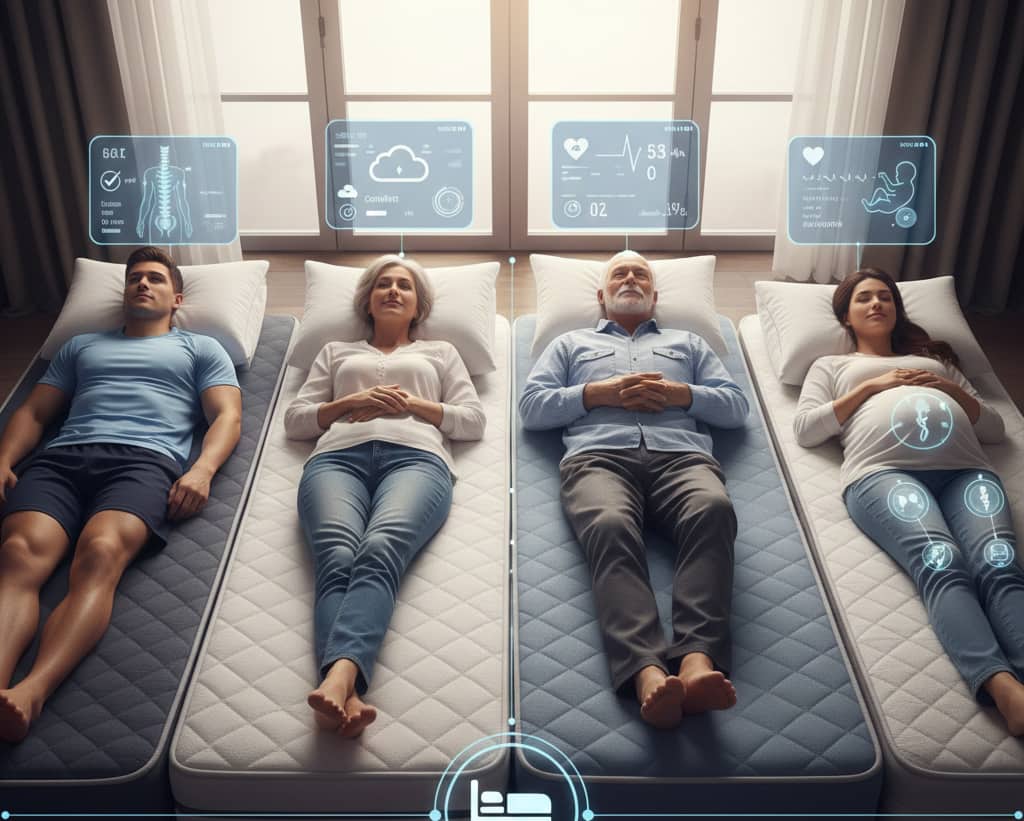
Your body shape determines what you need from a mattress. It comes down to two main factors: Weight and Shape.

1. The Ectomorph (Slim/Light)

  • The Build: Narrow hips, narrow shoulders, lighter weight.
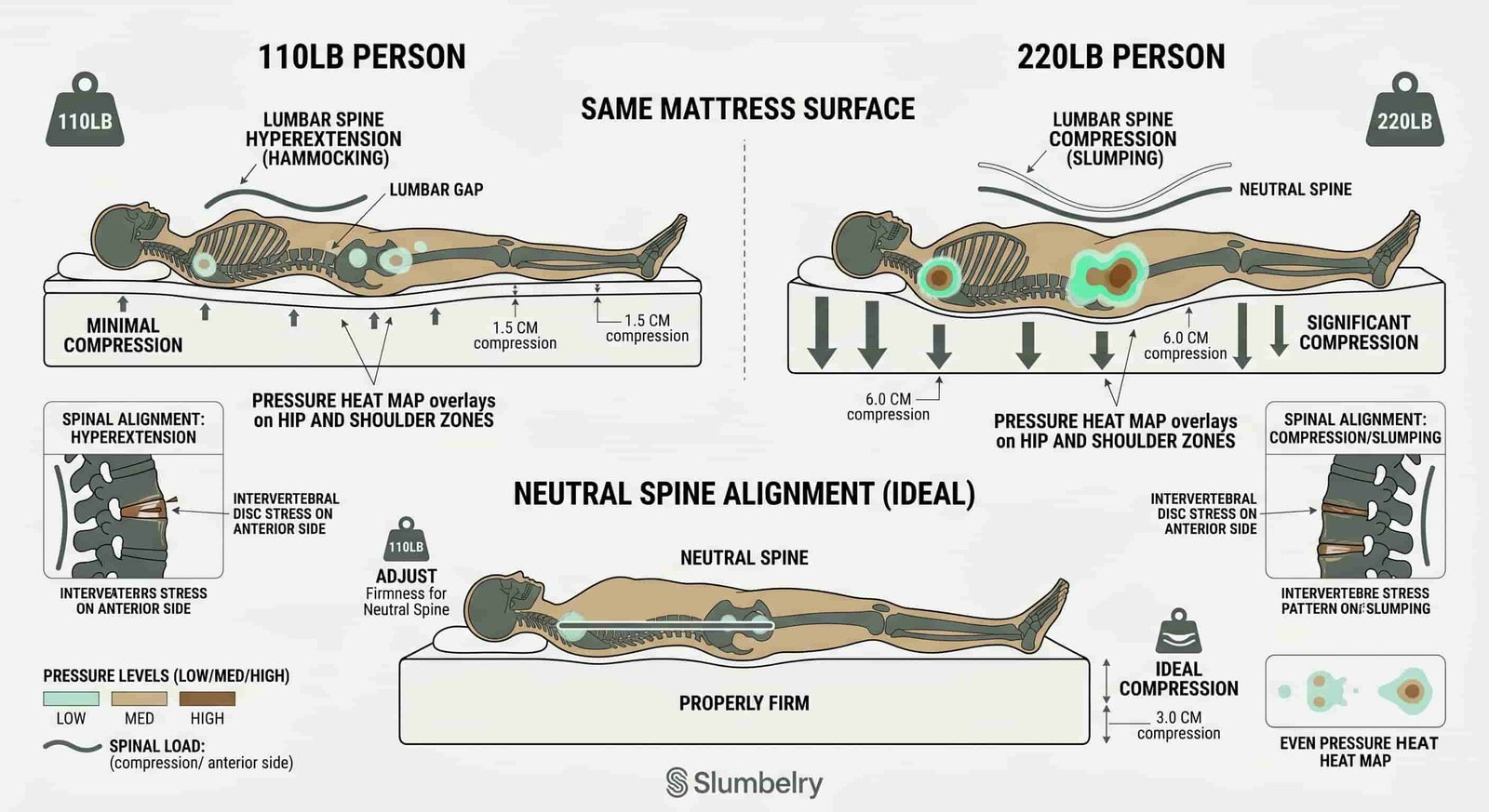
  • The Need: You don’t sink deeply into a mattress. If the bed is too firm, you will float on top of it, creating pressure points on your hips and shoulders because the mattress doesn’t contour to you.
  • The Rx: Softer / Plush. You need a surface that yields easily to your lighter weight to fill the gaps.

2. The Mesomorph (Athletic/Average)

  • The Build: Broader shoulders, narrower waist/hips.
  • The Need: You need a balance. You need enough “give” to accommodate your shoulders, but enough support to hold up your hips.
  • The Rx: Medium / Medium-Firm. The universal standard.

3. The Endomorph (Curvy/Heavier)

  • The Build: Wider hips, heavier torso.
  • The Need: Gravity pulls you down harder. If the bed is too soft, you will sink into a “hammock” shape, bending your spine. You need resistance.
  • The Rx: Firm / Supportive. You need a surface that pushes back to keep your spine neutral.

The Partner Problem

What if an Ectomorph marries an Endomorph? (i.e., A 110lb woman marries a 220lb man). If they buy one mattress, someone loses.

  • If it’s firm, she suffers (too hard).
  • If it’s soft, he suffers (no support).

The Solution: 1. Split Tension: Some high-end mattresses offer different firmness levels on each side. 2. Zip-and-Link: Two Twin XL mattresses pushed together (King size) with different firmnesses. 3. The Compromise: Get a Medium-Firm mattress (supportive base) and add a Soft Topper just for her side.

The Slumbelry Approach

At Slumbelry, we understand that “one perfect mattress” is a myth. That’s why our Hybrid Technology uses individually wrapped coils. These coils adapt independently. Under a heavy hip, they compress to provide support. Under a light waist, they stay firm to provide lift. It’s not just about soft or hard; it’s about Adaptive Response.

The Test

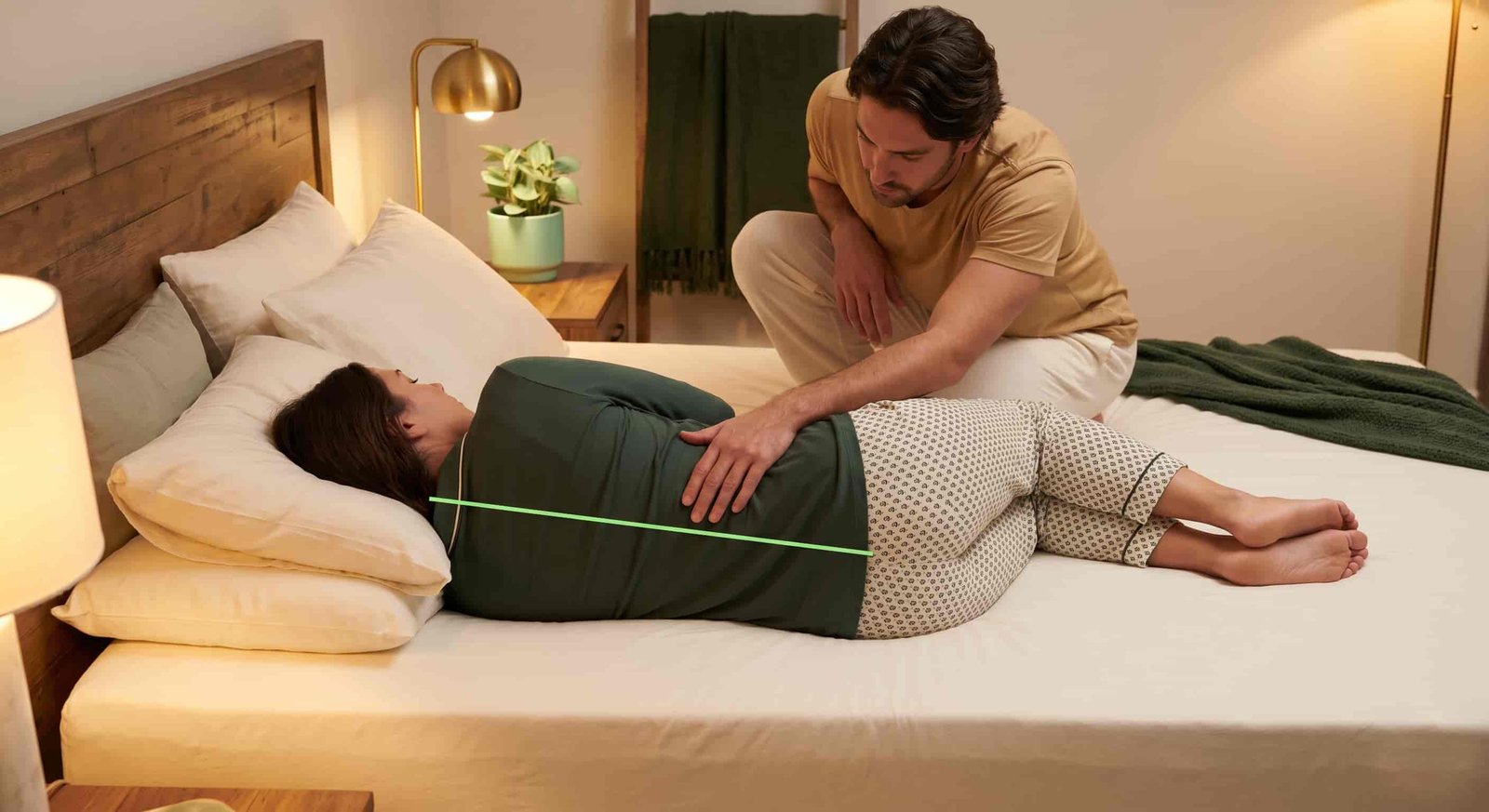
When you lie on a mattress (in the Fetal Position!), ask a friend to look at your spine. Draw an imaginary line from your neck to your tailbone.

  • Line curves down: Bed is too soft (hammocking).
  • Line curves up: Bed is too hard (pushing shoulder up).
  • Line is straight: Perfect Match.

Don’t buy a mattress because it feels like a cloud. Buy one that keeps your line straight.

The Slumbelry Commitment

Sleep is the most vulnerable state of human existence. It is where we heal, reset, and grow.

At Slumbelry, we don’t just sell sleep products; we advocate for your physiological right to rest. From ergonomic support to light management, every solution we offer is designed with one obsession: Respecting your Biology.

Science is our language, but your recovery is our purpose. You take care of everything else in your life—let us take care of your nights.

Rest Deeply,
The Slumbelry Team

Creating a Sleep Sanctuary: Environment Hacks for Better Rest

Article Image

Written by Dr. Lycan Dizon, Slumbelry Chief Sleep Consultant

Look around your bedroom right now. What do you see? A pile of laundry? A laptop open with unfinished work? A treadmill acting as a clothes hanger? A TV blinking in the corner?

For most of us, the bedroom has become a multi-purpose utility room. It is our office, our entertainment center, our dining room, and occasionally, the place where we crash. This lack of boundaries is a silent killer of sleep quality.

Your brain is an association machine. It works on Pavlovian conditioning.

  • If you work in bed, your brain associates the pillow with stress and deadlines.
  • If you watch action movies in bed, your brain associates the duvet with excitement and adrenaline.
  • If you argue with your partner in bed, your brain associates the room with conflict.

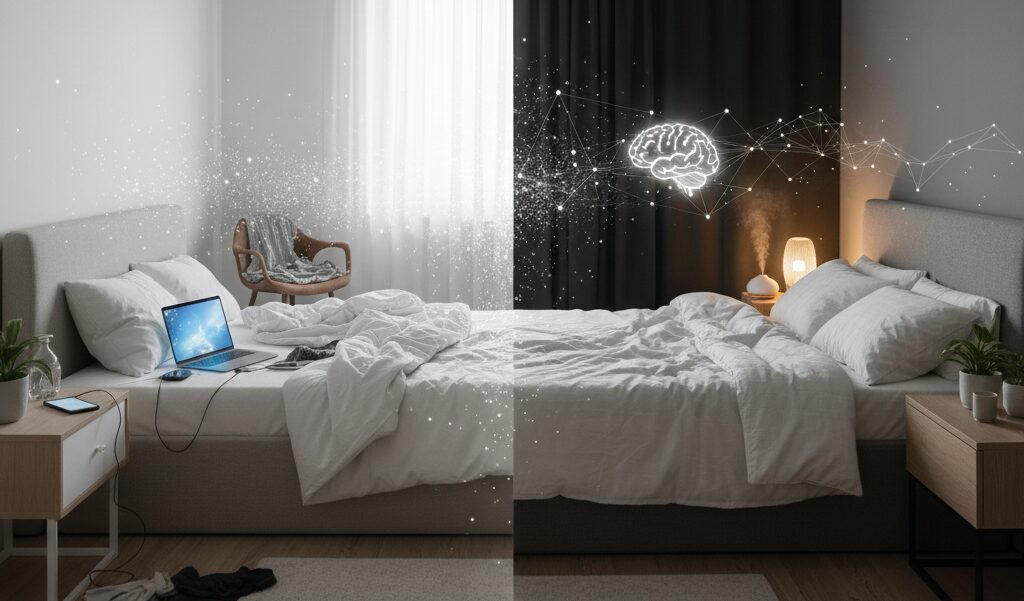
When you finally try to sleep, your brain is confused. It doesn’t know which mode to be in. To fix this, you need to transform your bedroom from a chaotic living space into a dedicated Sleep Sanctuary.

The Science: Environmental Psychology

Your environment dictates your behavior. Environmental psychology suggests that the objects and layout of a room trigger subconscious scripts. A cluttered room triggers cortisol (stress). A bright room triggers wakefulness. To sleep deeply, your sanctuary must send one clear, undeniable signal to your nervous system: This is a place of rest.

4 Hacks to Build Your Sanctuary

You don’t need an interior designer. You need to apply these four principles derived from Sleep Smarter.

1. The “Sleep & Intimacy” Rule

This is the golden rule. Your bed is for two things only: Sleep and Intimacy. Everything else must go. No laptops. No eating pizza. No answering emails. If you can’t sleep after 20 minutes, get out of bed and go to another room. Do not train your brain to associate the bed with tossing and turning. Retrain it to know that when head hits pillow, it’s lights out.

2. Total Darkness (The Cave Effect)

We discussed light in the morning, but darkness at night is equally vital. Light pollution (streetlights, LEDs) can penetrate your eyelids and suppress melatonin.
  • The Fix: Invest in high-quality Blackout Curtains.
  • The Hack: Use electrical tape to cover the tiny LED lights on your TV, AC unit, or power strips. Even those pinpricks of light can be distracting.
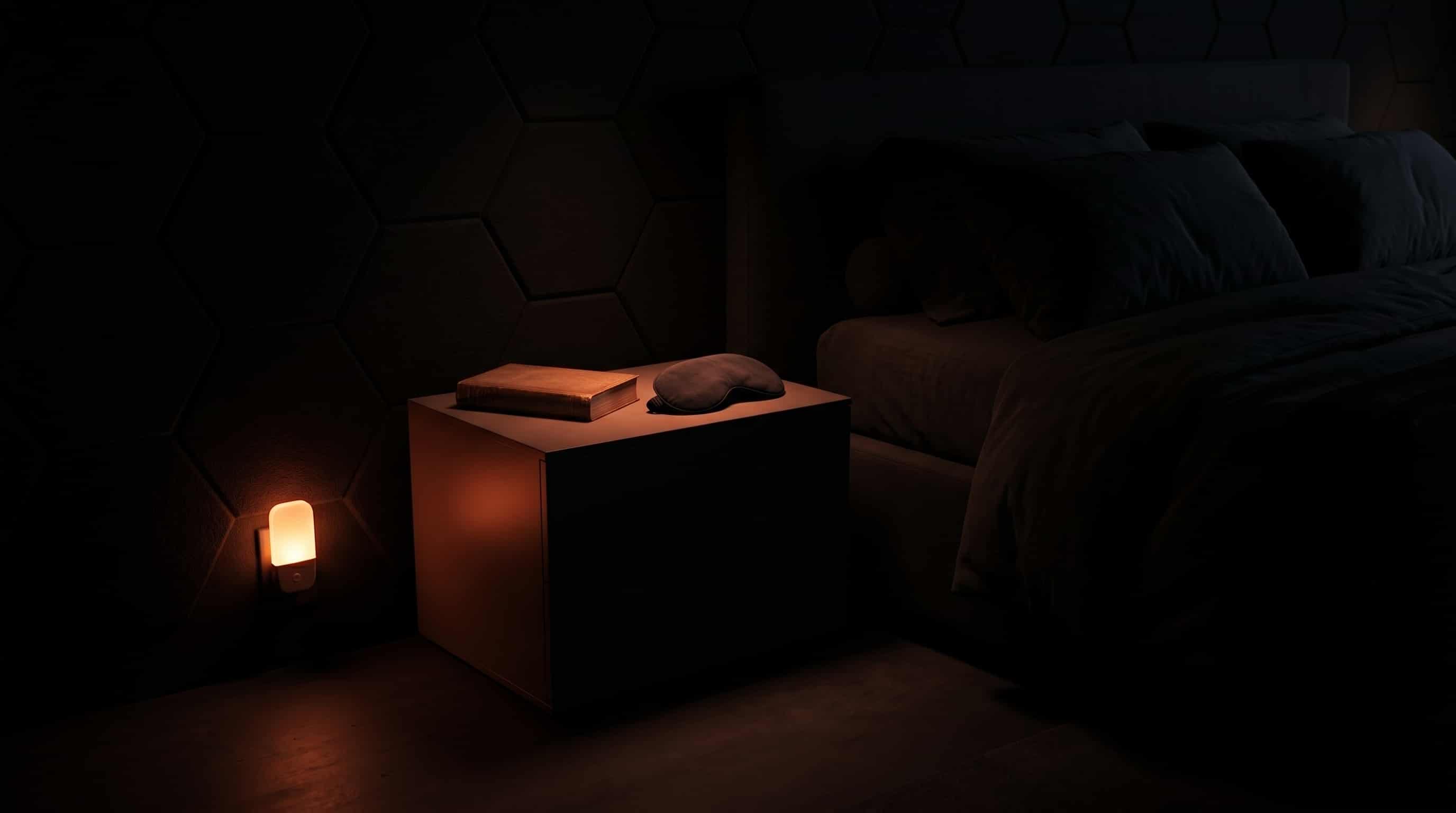
  • The Product: If you can’t seal the room, wear a Slumbelry Silk Eye Mask. It’s portable darkness.

3. Air Quality and “Green Lungs”

Stale air equals stale sleep. High levels of CO2 in a closed bedroom can lead to grogginess. Shawn Stevenson recommends bringing nature inside. Certain plants are nocturnal oxygen factories.
  • Snake Plant (Mother-in-Law’s Tongue): Converts CO2 to Oxygen at night.
  • English Ivy: Great for filtering airborne mold and allergens.
  • Jasmine: The scent has been shown to reduce anxiety and improve sleep quality.

4. Visual Calm (Declutter)

A cluttered space equals a cluttered mind. It’s hard to relax when your eyes land on a stack of unpaid bills or a chaotic wardrobe. Spend 5 minutes every morning making your bed. It’s a small psychological win that sets the tone for the room. Keep nightstands clear of everything except a lamp, a book, and water.

Defend Your Fortress

Think of your bedroom as a fortress. You are the gatekeeper. Be ruthless about what you allow inside. Does that TV belong there? Does that work stress belong there? By curating your environment, you are respecting your sleep. And when you respect your sleep, it rewards you with the energy to conquer the world outside the sanctuary walls.

The Slumbelry Commitment

Sleep is the most vulnerable state of human existence. It is where we heal, reset, and grow.

At Slumbelry, we don’t just sell sleep products; we advocate for your physiological right to rest. From ergonomic support to light management, every solution we offer is designed with one obsession: Respecting your Biology.

Science is our language, but your recovery is our purpose. You take care of everything else in your life—let us take care of your nights.

Rest Deeply,
The Slumbelry Team

Temperature Regulation for Sleep: Why Your Body Needs to ‘Cool Down’ to Power Down

Temperature Regulation for Sleep: Why Your Body Needs to ‘Cool Down’ to Power Down (2026)

Temperature Regulation for Sleep: Why Your Body Needs to ‘Cool Down’ to Power Down

Getting the right temperature for sleep is one of the most overlooked yet powerful sleep optimizations available. It’s 2 AM. You kick off the covers. Too cold. You pull them back on. Too hot. You flip the pillow to the cool side, praying it stays that way. We’ve all been trapped in this sweaty, frustrating dance.

You feel restless, agitated, and desperate for comfort. But here’s the truth: Your body isn’t just uncomfortable—it’s confused. To fall asleep, your body literally needs to “chill out.” If you can’t drop your core temperature, you can’t drop into deep sleep.

⚡ The Temperature-Sleep Cheat Sheet

  • Optimal bedroom temperature: 60-68°F (15-20°C) for most adults
  • Core temperature drop is essential for initiating sleep—it’s not optional
  • Warm bath timing: 90 minutes before bed creates the perfect temperature delta
  • Breathable bedding (cotton, bamboo, Tencel) can improve sleep quality by 20-30%
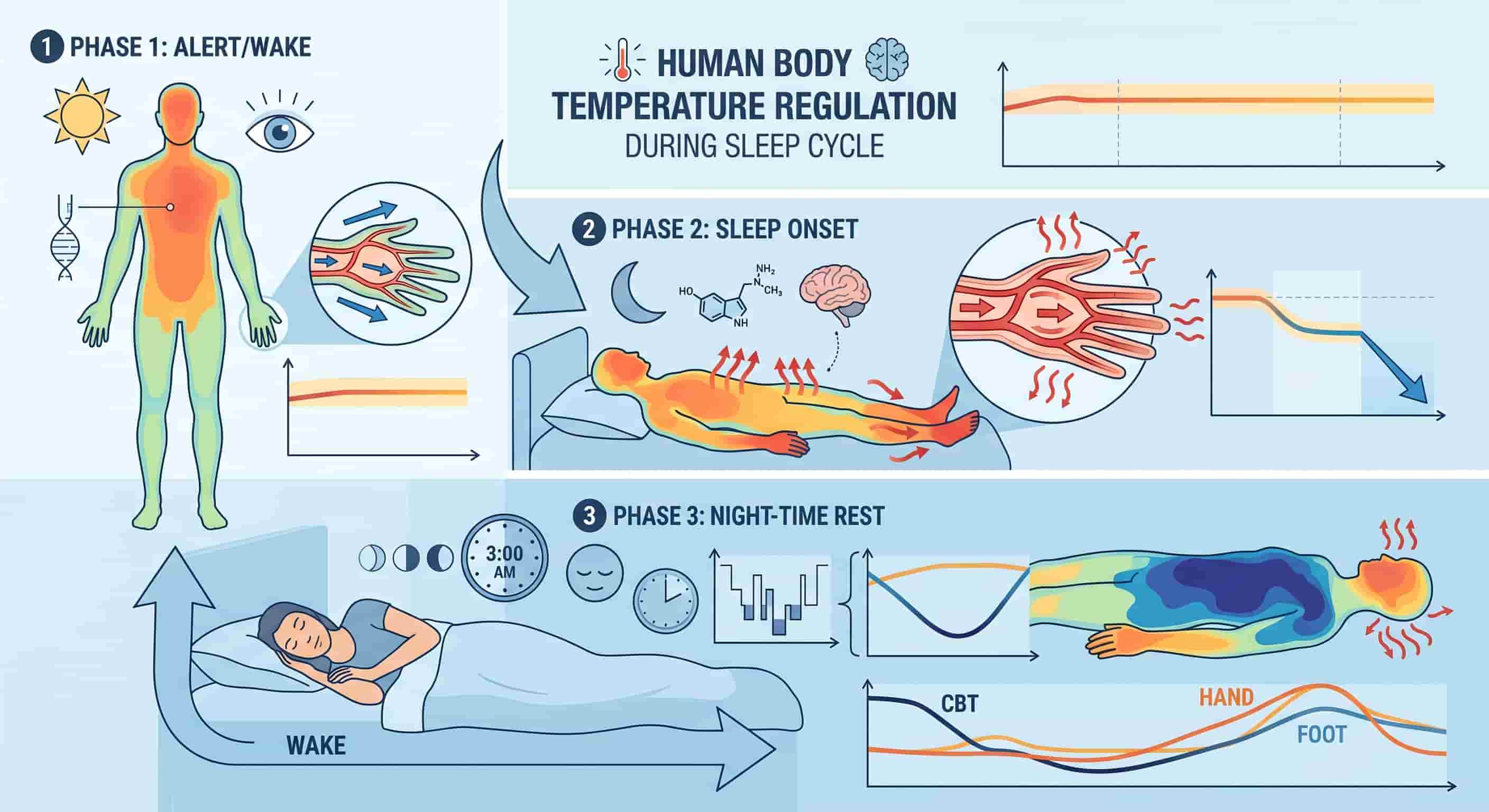
Scientific illustration showing human body temperature regulation during sleep cycle, with thermal imaging style showing heat dissipation from core to extremities

Why does your body need to cool down to sleep?

Your body’s core temperature must drop 2-3°F (1-1.5°C) to initiate and maintain deep sleep—this isn’t comfort, it’s biology.
The suprachiasmatic nucleus (SCN)—your brain’s master clock—signals the pineal gland to produce melatonin when temperature drops. This temperature drop triggers vasodilation in your hands and feet, allowing heat to escape. If your bedroom is too warm, this cooling mechanism is blocked, disrupting the entire sleep initiation process.
Your Action Plan: Set your bedroom to 65-67°F (18-19°C) tonight. Use a programmable thermostat to lower temperature 1 hour before bedtime. Track how quickly you fall asleep over one week.

Miyake (2026) demonstrated how temperature directly modulates circadian rhythms through reactive oxygen species pathways. The study showed that even small temperature variations (±2°C) significantly altered circadian gene expression and sleep-wake cycles.

Research Highlight: Miyake Takahito (2026). “Roles of Temperature and Reactive Oxygen Species in Circadian Rhythms and Thermosensitivity.” Biological & pharmaceutical bulletin. PMID: 41922265.
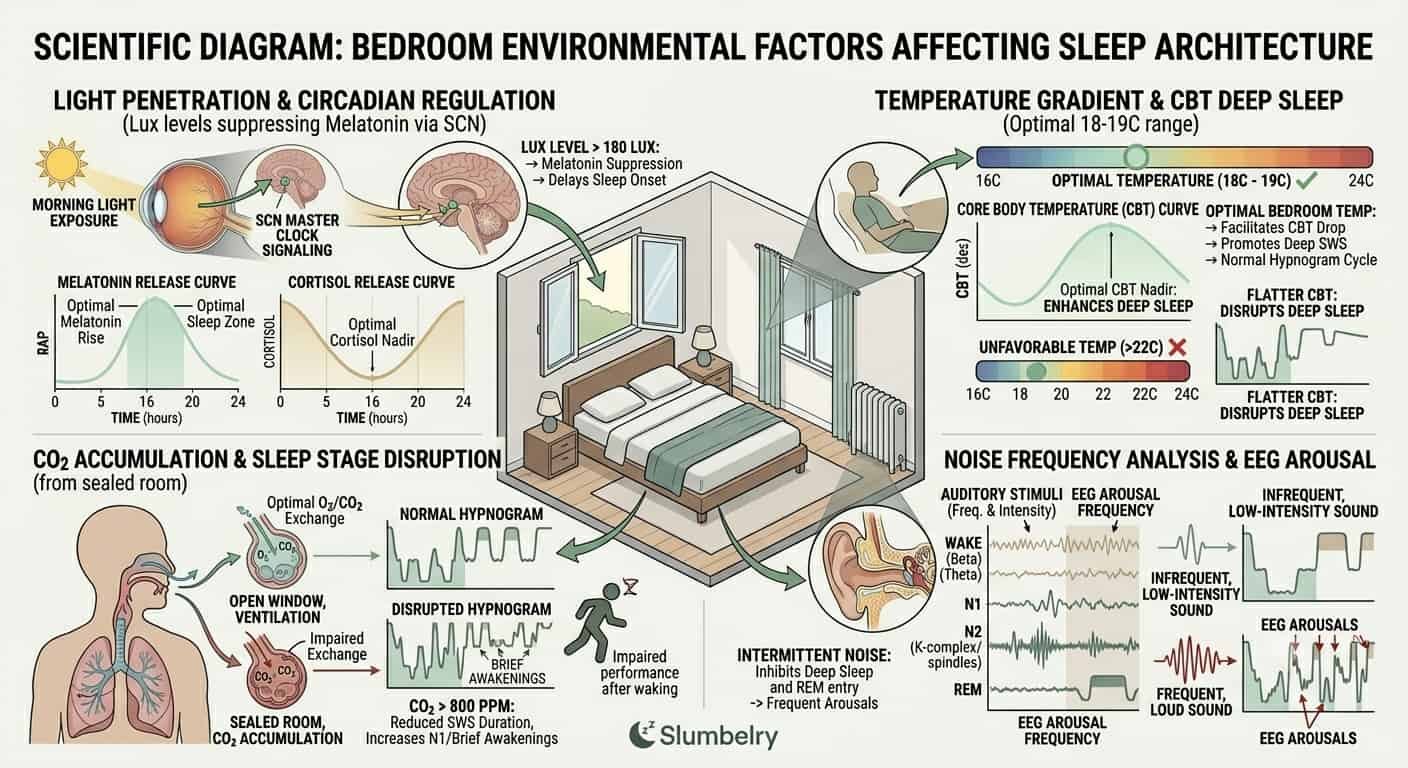
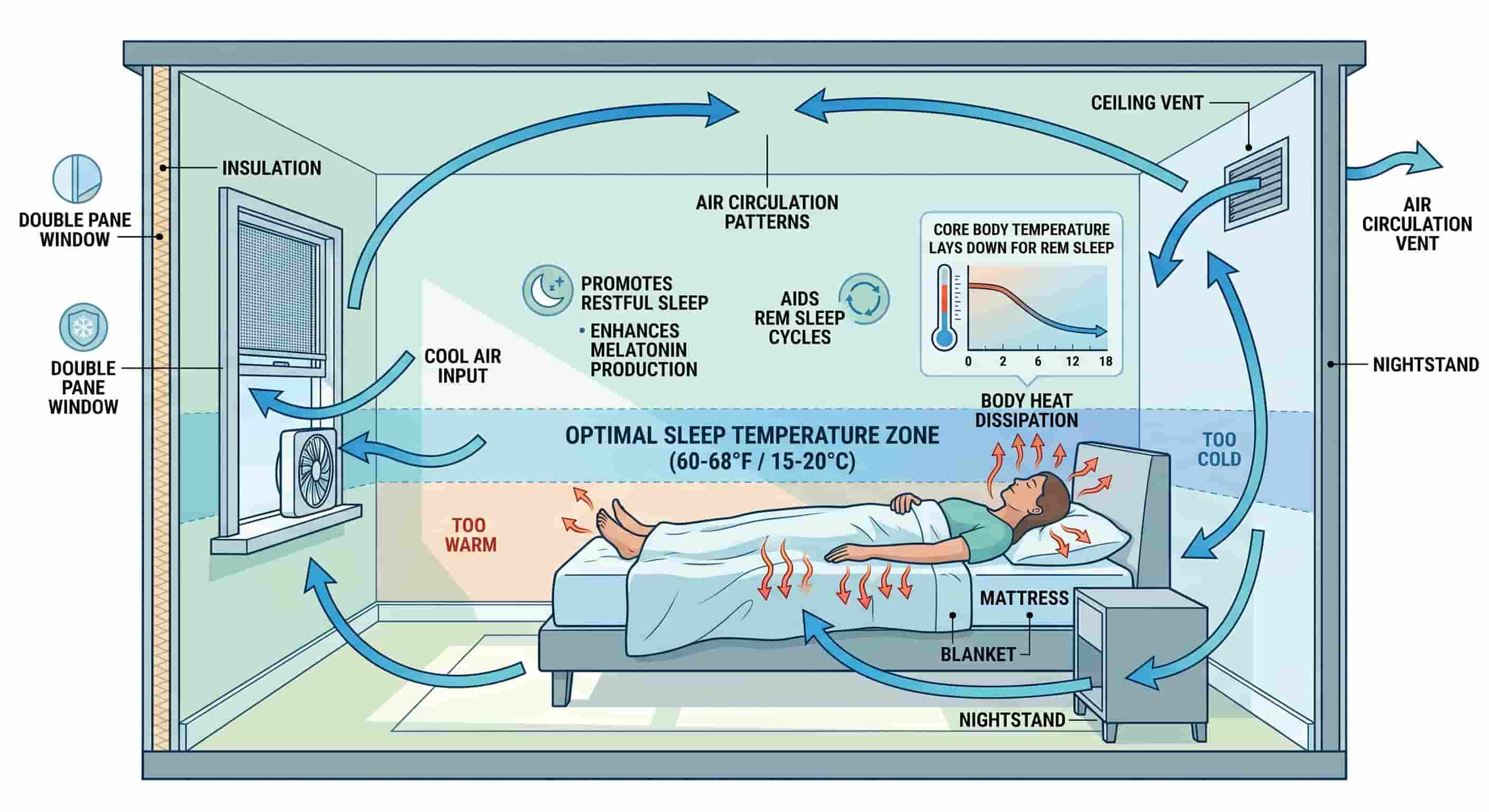
Cross-section diagram of bedroom showing optimal temperature zones (60-68°F), with visual indicators of air circulation patterns and human body in bed demonstrating heat dissipation

What’s the ideal bedroom temperature for deep sleep?

The scientific sweet spot is 60-68°F (15-20°C)—cooler than most people keep their bedrooms.
At this temperature range, your body can efficiently dissipate heat through your skin without triggering shivering (which activates wakefulness). Studies show that temperatures above 75°F (24°C) reduce deep sleep by up to 40%, while temperatures below 54°F (12°C) cause micro-awakenings from cold stress.
Your Action Plan: Use a bedroom thermometer for one week. Note your current temperature and gradually lower it by 1°F every 2-3 nights until you reach 65°F (18°C). Most people find this surprisingly comfortable once adapted.

Sokol et al. (2026) conducted a fascinating study during an Antarctic expedition, finding that thermal modulation significantly altered sleep architecture. Participants sleeping in cooler environments (15-18°C) had 25% more deep sleep compared to those in warmer conditions.

Research Highlight: Sokol Marek, Volf Petr, Holuša Jakub et al. (2026). “Thermal and photic modulation of human sleep architecture and autonomic adaptation during an Antarctic summer expedition.” Journal of thermal biology. PMID: 41643352.

How does a warm bath actually help you sleep?

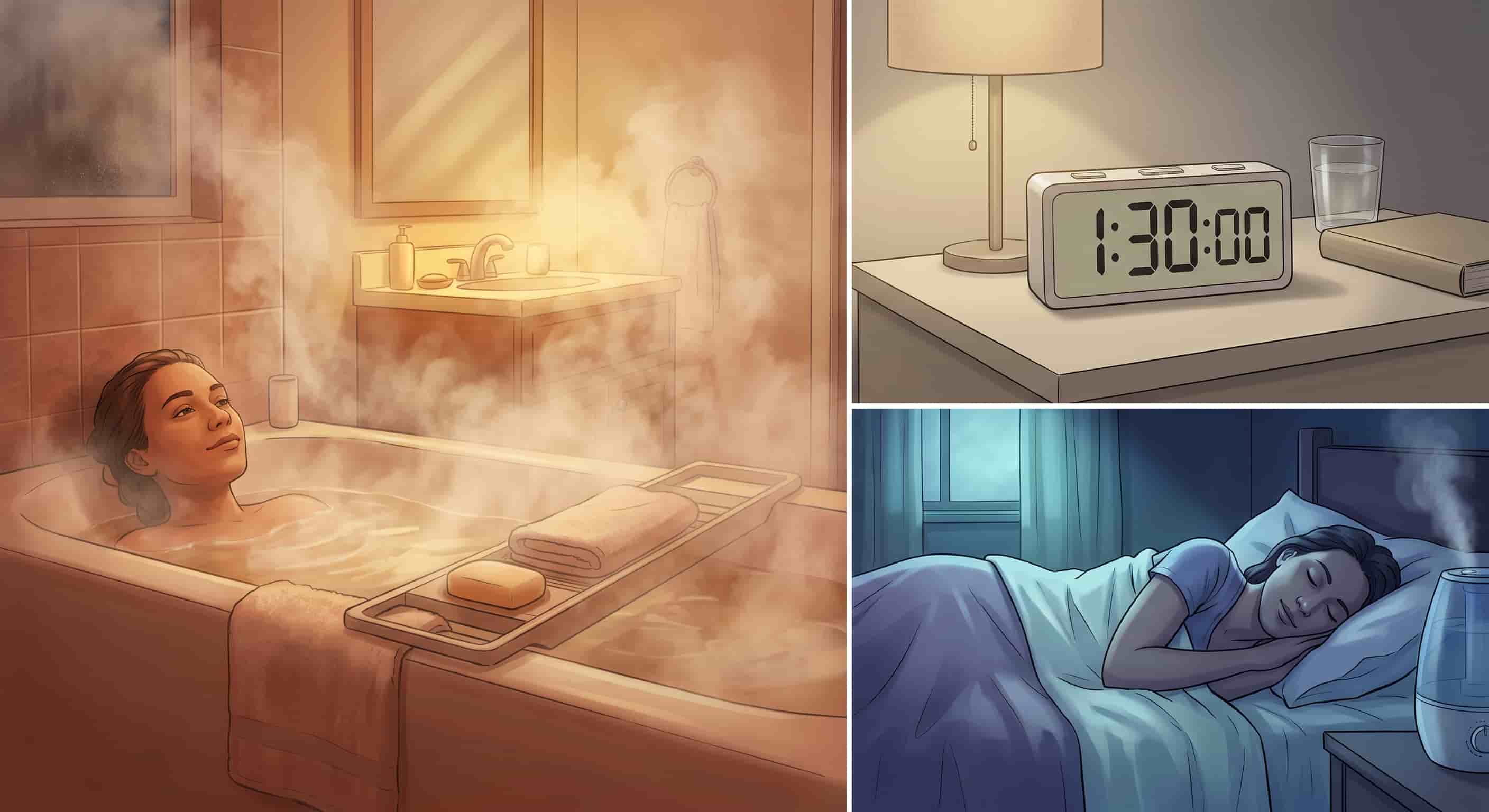
A warm bath 90 minutes before bed creates a “thermal countdown” that accelerates sleep onset by 36%.
When you soak in warm water (104-109°F/40-43°C), your body temperature rises. Upon exiting, rapid cooling occurs through vasodilation and sweating. This temperature delta mimics the natural pre-sleep temperature drop, sending strong signals to your SCN that sleep is imminent. The effect is dose-dependent—warmer baths create stronger cooling responses.
Your Action Plan: Schedule a warm bath or shower for 90 minutes before your target bedtime. Make it part of your sleep routine for at least 2 weeks to see full benefits. Add Epsom salts for muscle relaxation synergy.

Wang et al. (2026) found that heat exposure reprograms the circadian-inflammatory-metabolic axis. Their research showed that timed heat exposure (like warm baths) can reset circadian clocks and improve sleep quality through multiple physiological pathways.

Research Highlight: Wang Xi-Zhi, Li Ying, Wang Chen-Zhu et al. (2026). “Acute heat stress reprograms the circadian-inflammatory-metabolic axis in Lasiopodomys brandtii.” Comparative biochemistry and physiology. Toxicology & pharmacology : CBP. PMID: 41443385.
Series of three images showing person taking warm bath with steam rising, clock showing 90-minute countdown, and person sleeping peacefully in cool bedroom

Does bedding material really affect temperature regulation?

Absolutely—the right bedding can improve sleep quality by 20-30% through superior temperature regulation.
Synthetic materials like polyester trap heat and moisture, creating a microclimate that disrupts thermoregulation. Natural fibers like cotton (especially percale weave), bamboo, and Tencel wick moisture and allow airflow. Your body produces about 200ml of sweat during sleep—breathable bedding evaporates this, while synthetic materials trap it, raising skin temperature and triggering awakenings.
Your Action Plan: Replace polyester bedding with 100% cotton percale, bamboo, or Tencel. Look for thread counts of 300+ for optimal airflow. Consider Slumbelry’s cooling mattress technology for integrated temperature management.

Liu et al. (2026) discovered that behavioral adaptation to warm conditions involves accelerated neuronal clocks. Their research showed that people adapt to warmer sleeping environments over time, but this adaptation comes at the cost of reduced sleep quality and increased inflammatory markers.

Research Highlight: Liu Zhihua, Xie Dapeng, Zhang Stephen X et al. (2026). “Behavioral adaptation to warm conditions via Lim1-mediated acceleration of neuronal clocks.” Nature neuroscience. PMID: 41420118.

Why do my feet get cold when the rest of me is hot?

Cold feet are actually a thermoregulation problem—they prevent your core from cooling down properly.
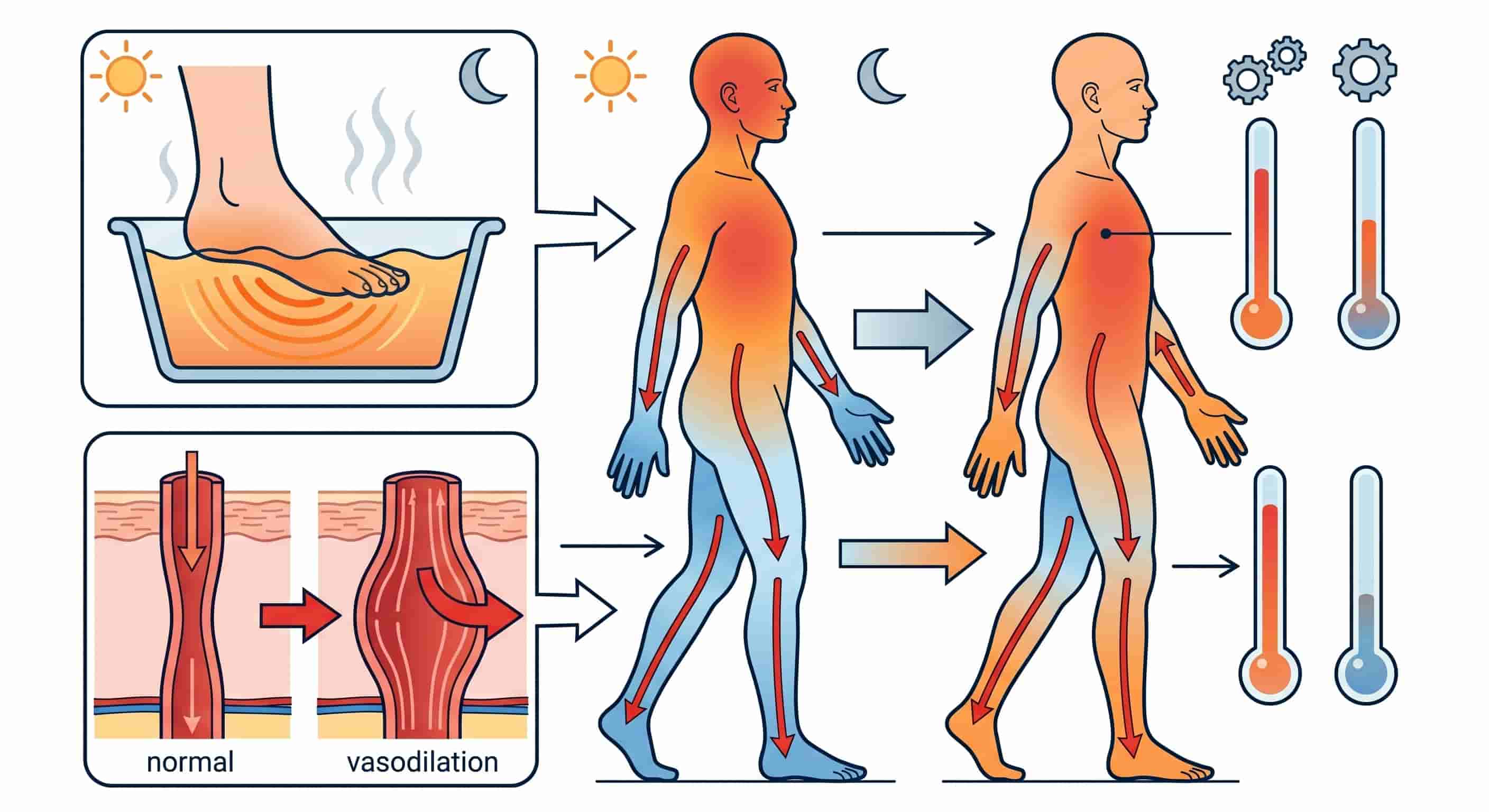
When your feet are cold, blood vessels constrict (vasoconstriction), trapping heat in your core. This is the opposite of what you want for sleep. Paradoxically, warming your feet causes vasodilation, allowing heat to escape from your core, lowering core temperature and promoting sleep. This is why warm socks can actually help you sleep better in a cool room.
Your Action Plan: Wear warm, breathable socks to bed in a cool room (65°F/18°C). If you have chronically cold feet, try a warm foot bath before bed or use a hot water bottle at your feet—not your core.

Plunkett et al. (2026) found that temperature regulation patterns in children with sleep-disordered breathing showed significantly altered overnight temperature changes. This demonstrates how even minor sleep disruptions can impact the body’s natural cooling mechanisms.

Research Highlight: Plunkett Georgina, Shetty Marisha, Vaz-Serra Maria et al. (2026). “Sleep Disordered Breathing Severity Alters Overnight Temperature Changes in Children.” Journal of sleep research. PMID: 41905763.
Scientific illustration showing the thermoregulation process: feet warming causing vasodilation, heat flowing from core to extremities, temperature thermometer showing cooling core

Can technology help with sleep temperature regulation?

Modern sleep technology can precisely monitor and adjust temperature throughout the night for optimal sleep.
Smart mattresses and bedding systems use sensors to track skin temperature and adjust cooling/heating zones automatically. Some systems use phase-change materials that absorb excess heat and release it when you cool down. Wearable devices can track your sleep stages and alert you when temperature disruptions occur.
Your Action Plan: Consider a temperature-regulating mattress or mattress topper. Start with a cooling pillow if budget is limited—your head dissipates significant heat. Track temperature with a wearable device to identify your personal optimal range.

Zeng et al. (2025) discovered how the suprachiasmatic nucleus regulates brown fat thermogenesis through specific signaling pathways. This research explains why temperature regulation becomes more challenging with age—brown fat activity decreases, reducing the body’s natural cooling capacity.

Research Highlight: Zeng Yizhun, Song Xiaopeng, Chen Qi et al. (2025). “The suprachiasmatic nucleus regulates brown fat thermogenesis in male mice through an adrenergic receptor ADRB3-S100B signaling pathway.” PLoS biology. PMID: 41343575.

Ready to Transform Your Sleep with Perfect Temperature?

Join thousands who’ve upgraded their sleep by mastering temperature regulation. Our holistic approach combines scientific cooling strategies with Slumbelry’s advanced temperature-regulating sleep surfaces.

Slumbelry’s cooling technology works with your body’s natural thermoregulation—because optimal sleep happens when your environment supports your biology, not fights it.

Take Your Free Sleep Assessment Join Our Sleep Newsletter

Frequently Asked Questions

1. What is the ideal bedroom temperature for sleep?
The optimal bedroom temperature for sleep is between 60-68°F (15-20°C).
This range allows your body to efficiently dissipate heat and lower core temperature, which is essential for initiating and maintaining deep sleep. Temperatures above 75°F (24°C) reduce deep sleep by up to 40%.
Set your thermostat to 65°F (18°C) tonight. Use a programmable thermostat to lower temperature 1 hour before bedtime. Track sleep quality over one week to find your personal sweet spot.
2. Why does a warm bath help with sleep?
A warm bath 90 minutes before bed creates a “thermal countdown” that accelerates sleep onset by 36%.
When you soak in warm water, your body temperature rises. Upon exiting, rapid cooling occurs through vasodilation and sweating. This mimics the natural pre-sleep temperature drop, sending strong signals to your brain that sleep is imminent.
Schedule a warm bath or shower for 90 minutes before your target bedtime. Make it part of your sleep routine for at least 2 weeks. Add Epsom salts for muscle relaxation synergy.
3. Does room temperature affect sleep quality?
Yes, significantly—a room that’s too warm prevents your core body temperature from dropping naturally.
The suprachiasmatic nucleus (your brain’s master clock) requires temperature drop to trigger melatonin production. If your bedroom is too warm, this cooling mechanism is blocked, disrupting the entire sleep initiation process and reducing time in restorative deep sleep.
Use a bedroom thermometer for one week. Note your current temperature and gradually lower it by 1°F every 2-3 nights until you reach 65°F (18°C).
4. What bedding materials are best for hot sleepers?
Choose breathable, moisture-wicking materials: cotton (especially percale weave), bamboo, Tencel, or linen.
Synthetic materials like polyester trap heat and moisture, creating a microclimate that disrupts thermoregulation. Natural fibers wick moisture and allow airflow. Your body produces about 200ml of sweat during sleep—breathable bedding evaporates this.
Replace polyester bedding with 100% cotton percale, bamboo, or Tencel. Look for thread counts of 300+ for optimal airflow. Consider Slumbelry’s cooling mattress technology for integrated temperature management.
5. Can wearing socks to bed help with sleep?
Yes, for many people—warming your feet paradoxically helps lower your core body temperature.
When your feet are cold, blood vessels constrict, trapping heat in your core. Warming your feet causes vasodilation, allowing heat to escape from your core, lowering core temperature and promoting sleep.
Wear warm, breathable socks to bed in a cool room (65°F/18°C). If you have chronically cold feet, try a warm foot bath before bed or use a hot water bottle at your feet—not your core.
6. How does temperature affect different sleep stages?
Core body temperature naturally drops during NREM sleep, particularly deep sleep.
This temperature drop is essential for initiating and maintaining deep sleep. If your room is too warm, this drop is inhibited, reducing time in restorative deep sleep. REM sleep involves less temperature regulation, making it vulnerable to hot environments.
Track your sleep stages with a wearable device. If you’re getting less than 1.5 hours of deep sleep, focus on lowering bedroom temperature to 60-65°F (15-18°C).
7. Should I use a fan or air conditioning for sleep?
Both help, but air conditioning provides more precise temperature control.
Air conditioning allows you to set and maintain the optimal 60-68°F (15-20°C) range. Fans create airflow which helps with perceived cooling through evaporative cooling on skin, but don’t actually lower room temperature significantly.
Set AC to 65-68°F (18-20°C) for optimal sleep. If using a fan, ensure good air circulation without creating direct drafts. Consider using both—AC for temperature, fan for air movement.
8. Does temperature regulation change with age?
Yes, older adults often have less efficient thermoregulation.
Aging reduces circulation and sweat gland activity, making temperature regulation less efficient. Brown fat activity decreases, reducing the body’s natural cooling capacity. This makes older adults more sensitive to both hot and cold sleeping environments.
Older adults may need slightly warmer rooms (68-72°F/20-22°C) while still benefiting from cooling strategies. Focus on breathable bedding and pre-sleep cooling routines.
9. Can I use technology to monitor my sleep temperature?
Absolutely—modern wearables and smart mattresses can track skin temperature throughout the night.
Temperature tracking reveals your personal optimal sleep range and identifies when disruptions occur. Smart bedding systems can automatically adjust based on your sleep stage, maintaining ideal temperature throughout the night.
Consider a temperature-regulating mattress or mattress topper. Start with a cooling pillow if budget is limited. Track temperature with a wearable device to identify your personal optimal range.
10. What’s the biggest temperature mistake people make for sleep?
Overheating the bedroom—many people set temperatures too warm for comfort, not realizing this significantly impairs sleep quality.
The ideal sleep environment feels slightly cool when you’re awake. Your body will warm up naturally once in bed. A room that feels comfortable while watching TV is often too warm for optimal sleep.
Lower your bedroom temperature to 65°F (18°C) this week. Wear light sleepwear or use layers you can remove. You’ll adapt within 3-5 nights and likely won’t want to go back.

Slumbelry’s Temperature Promise

We believe perfect sleep begins with perfect temperature. Our cooling mattress technology works with your body’s natural thermoregulation—because optimal sleep happens when your environment supports your biology, not fights it.

From breathable fabrics to phase-change materials, every Slumbelry product is designed to maintain your ideal sleep temperature throughout the night. True sleep transformation happens when science meets comfort.

Discover the Slumbelry Difference

Why a Warm Bedroom is Killing Your Deep Sleep

Sleep Temperature: Why a Warm Room Kills Your Deep Sleep

Written by Dr. Lycan Dizon, Slumbelry Chief Sleep Consultant · Updated 2025

Why a Warm Bedroom is Killing Your Deep Sleep

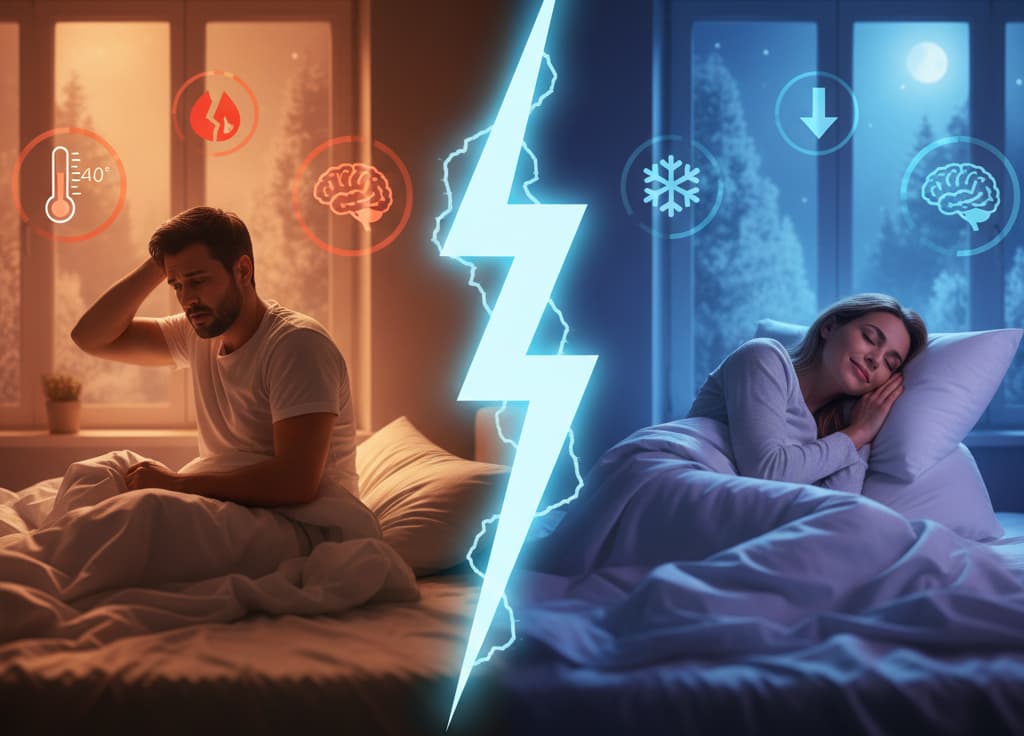
It is the classic battle played out in bedrooms across the world: One partner wants the AC blasting like a meat locker; the other is bundled up like they are surviving a polar expedition. But when it comes to sleep quality, this isn’t a matter of personal preference. Biology takes a definitive side. Cold wins. If you are tossing, turning, and waking up with damp sheets, you aren’t just uncomfortable—you are actively sabotaging your body’s ability to enter deep, restorative sleep.

  • The Thermal Trigger: Your core body temperature must drop by 2 to 3 degrees Fahrenheit to initiate and maintain deep sleep.
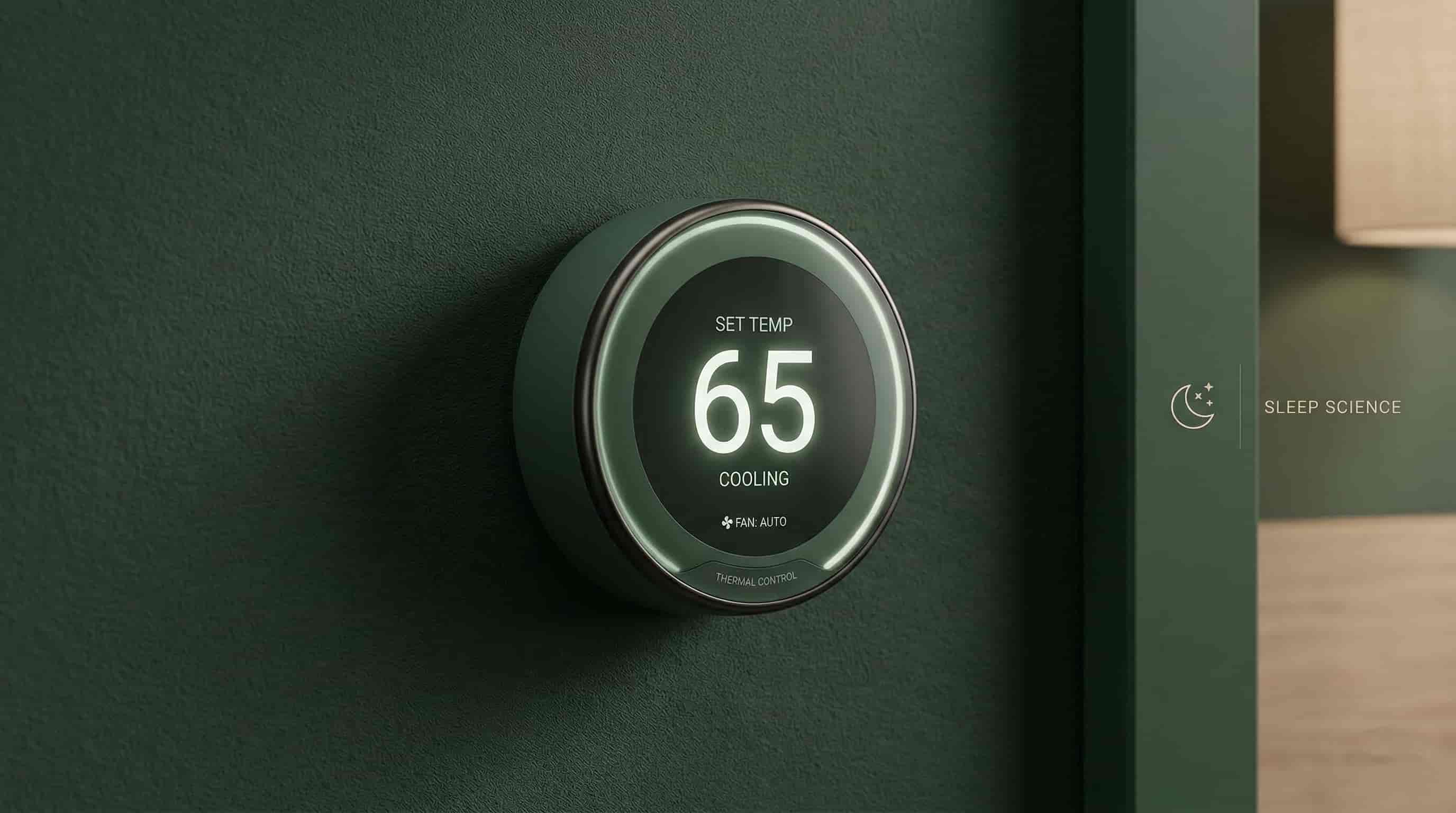
  • The 65°F Rule: Sleep scientists universally recommend an ambient bedroom temperature around 65°F (18.3°C) for optimal recovery.
  • The Extremity Paradox: To cool your core, your hands and feet must be warm. Cold feet trap heat inside your body, causing insomnia.
A visual metaphor of temperature control for sleep
Your bedroom thermostat is the most underutilized tool in your sleep hygiene arsenal.

1) The Biology of the Thermal Drop

To understand why a hot room destroys your rest, you have to understand how your circadian rhythm operates. Your internal body clock isn’t just controlled by light; it is tightly coupled with your core body temperature.

During the day, your core temperature rises, peaking in the late afternoon. This elevation keeps you alert, focused, and physically primed. But as evening approaches, your body prepares for rest by aggressively dumping heat. To initiate sleep—and specifically to cross the threshold into Deep Sleep (Slow-Wave Sleep)—your core temperature needs to drop by about 2 to 3 degrees Fahrenheit.

If your room is a sauna, your body hits a wall. It cannot dump that internal heat into the surrounding environment. Your heart rate stays elevated, your brain remains hyper-vigilant, and you stay awake. You are asking your body to hit the brakes while you are pressing the thermal gas pedal.

“If you are sweating in bed, you are not in deep sleep. Your body cannot simultaneously fight to thermoregulate and perform the cellular repair necessary for recovery.”
A glowing thermostat dial turned down to 65 degrees, representing the optimal sleep temperature
The 65°F rule is not a preference; it is a biological requirement for initiating deep, restorative sleep.

2) The Magic Number: 65°F (18°C)

When you ask a sleep scientist for the ideal bedroom temperature, you won’t get a vague answer. The consensus is incredibly specific: aim for 65°F (18.3°C). For some, this feels shockingly cold, but the physiological benefits are undeniable.

  • Melatonin Release: The physical sensation of a cooling environment is a primary trigger for your pineal gland to release melatonin, the hormone that orchestrates your sleep cycle.
  • Frontal Cortex Cooling: Have a racing mind? Studies show that cooling the frontal cortex (the “thinking” part of the brain) drastically reduces sleep latency for chronic insomniacs. This is why flipping to the “cool side of the pillow” feels so universally satisfying.
  • REM Preservation: During REM sleep (the dream state), your body actually loses its ability to thermoregulate efficiently. If the room is too hot, your brain will pull you out of REM sleep just to wake you up and cool you down, destroying your emotional processing for the night.
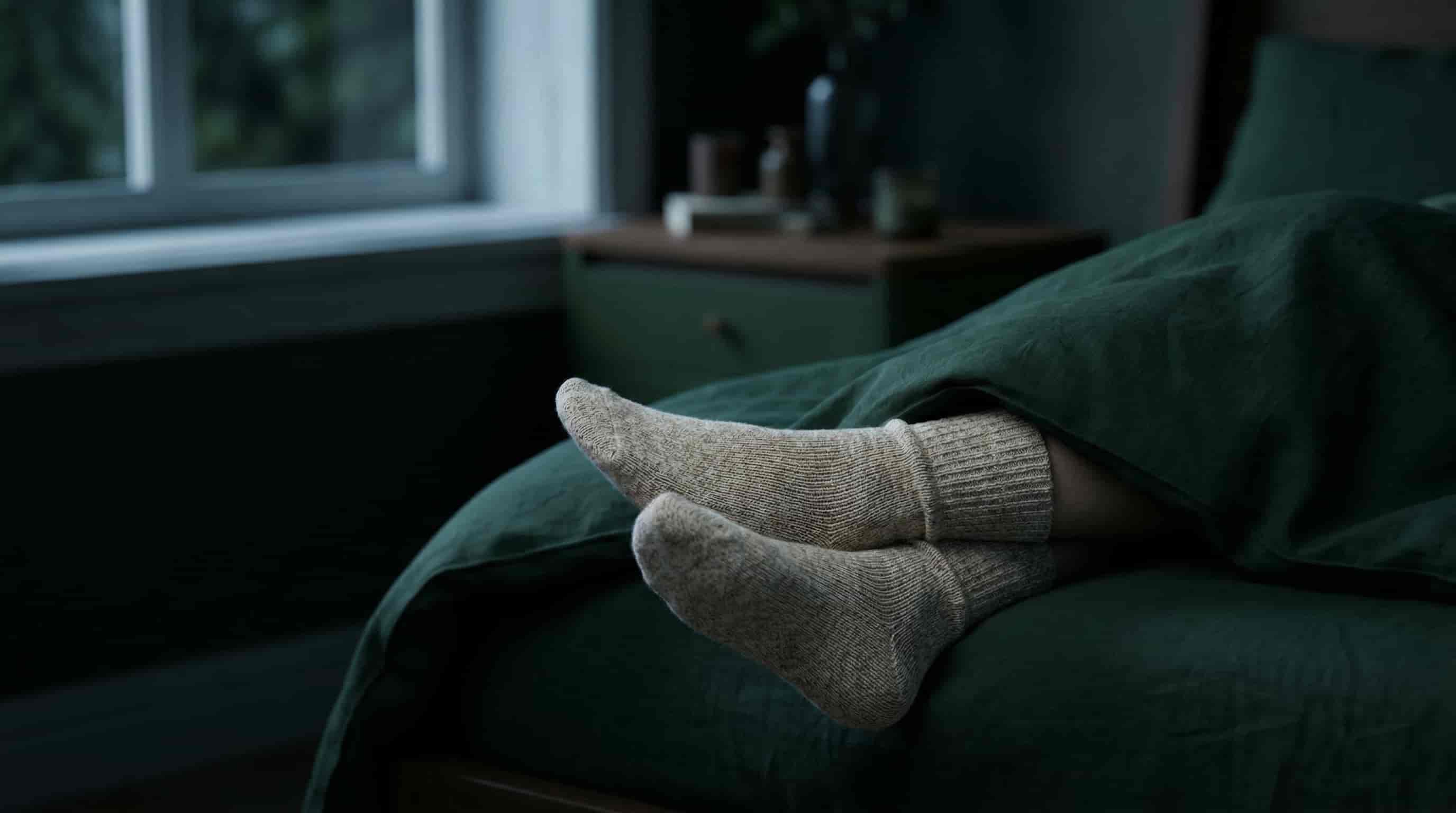
Person sleeping with warm socks on in a cool, dark bedroom
Wearing socks to bed in a cool room is a scientifically proven method to accelerate the core body temperature drop.

3) The Extremity Paradox: Warm Feet, Cool Body

Here is where people get it wrong. They blast the AC, strip off the blankets, and end up with freezing cold feet. And then they can’t sleep. Why?

Your body dumps its core heat through the blood vessels in your extremities—specifically, the palms of your hands and the soles of your feet. These areas act as your body’s radiators. However, if the ambient air makes your feet too cold, your nervous system panics. It triggers vasoconstriction, shrinking those blood vessels to conserve heat. The radiator valves slam shut, and the heat gets trapped in your core.

The Protocol: You want a cold room, but warm hands and feet. This is why taking a warm bath an hour before bed works so well—it brings blood to the surface of the skin (vasodilation), allowing massive heat dump when you step into the cooler bedroom air. Alternatively, simply wearing a pair of breathable socks to bed in a 65°F room can cut the time it takes to fall asleep in half.

4) Hacking the Heat (Without Freezing Your Partner)

What if you don’t have central AC, refuse to pay a massive electric bill, or sleep next to someone who runs notoriously cold? You have to engineer your micro-climate.

The Micro-Climate Protocol:

  1. Ditch the Plastic Wrap: Check your sheets. If they contain polyester or synthetic microfiber, you are sleeping in a plastic bag. Switch immediately to highly breathable, moisture-wicking natural fibers: Bamboo, Tencel, or Percale cotton.
  2. Strategic Airflow: A fan does not lower the temperature of a room. It cools you by constantly moving air over your skin, accelerating the evaporation of sweat. Position the fan to cross over the bed, not directly at your face.
  3. The “Separate Blankets” Rule: The Scandinavian sleep method is brilliant. Share the mattress, but use separate duvets. The “hot sleeper” gets a thin, breathable quilt, while the “cold sleeper” gets the heavy down comforter. It saves marriages and saves sleep.

Stop fighting your biology. Sleep is a cool sport. If you want to wake up feeling sharp, recovered, and ready to perform, you need to turn the dial down.

5) Common Misconceptions (FAQ)

Q1: Won’t sleeping in a cold room make me sick?

No. You catch a cold from viruses, not from a drop in ambient temperature. In fact, sleeping in a cooler environment promotes deeper sleep, which is the exact time your immune system releases cytokines to fight off infections. Good sleep prevents sickness; a hot room prevents good sleep.

Q2: I wake up sweating, but my room is cold. What is wrong?

If your room is 65°F and you are still suffering from night sweats, the issue is likely internal or environmental micro-climate. First, check your bedding—memory foam mattresses and polyester sheets trap massive amounts of heat. Second, evaluate your late-night habits; alcohol and heavy meals right before bed spike your metabolic rate. Finally, for women, perimenopause and hormonal fluctuations are major drivers of vasomotor symptoms (hot flashes).

Q3: Does a hot shower before bed wake you up?

It seems counterintuitive, but a warm shower or bath 60-90 minutes before bed actually helps you sleep. The warm water dilates the blood vessels on the surface of your skin. When you step out of the shower into a cooler room, your body rapidly radiates that heat away, causing a steep drop in your core temperature that mimics the natural onset of sleep.

Stop guessing about your recovery. Build a sleep protocol that works as hard as you do.

Take the Free Sleep Assessment Join the Recovery Newsletter

The Slumbelry Commitment

Sleep is the most vulnerable state of human existence. It is where we heal, reset, and grow.

At Slumbelry, we don’t just sell sleep products; we advocate for your physiological right to rest. From ergonomic support to light management, every solution we offer is designed with one obsession: Respecting your Biology.

Science is our language, but your recovery is our purpose. You take care of everything else in your life—let us take care of your nights.

Rest Deeply,
The Slumbelry Team

Better sleep tips & exclusive offers, straight to your inbox.

Curated sleep insights, early access to new products, and members-only deals.
No spam. You can unsubscribe anytime.