
Sleep Myths You Can Ignore
Sleep myths — And the Science That Debunks Them
Written by Lycan, Founder of Slumbelry · Updated 2025
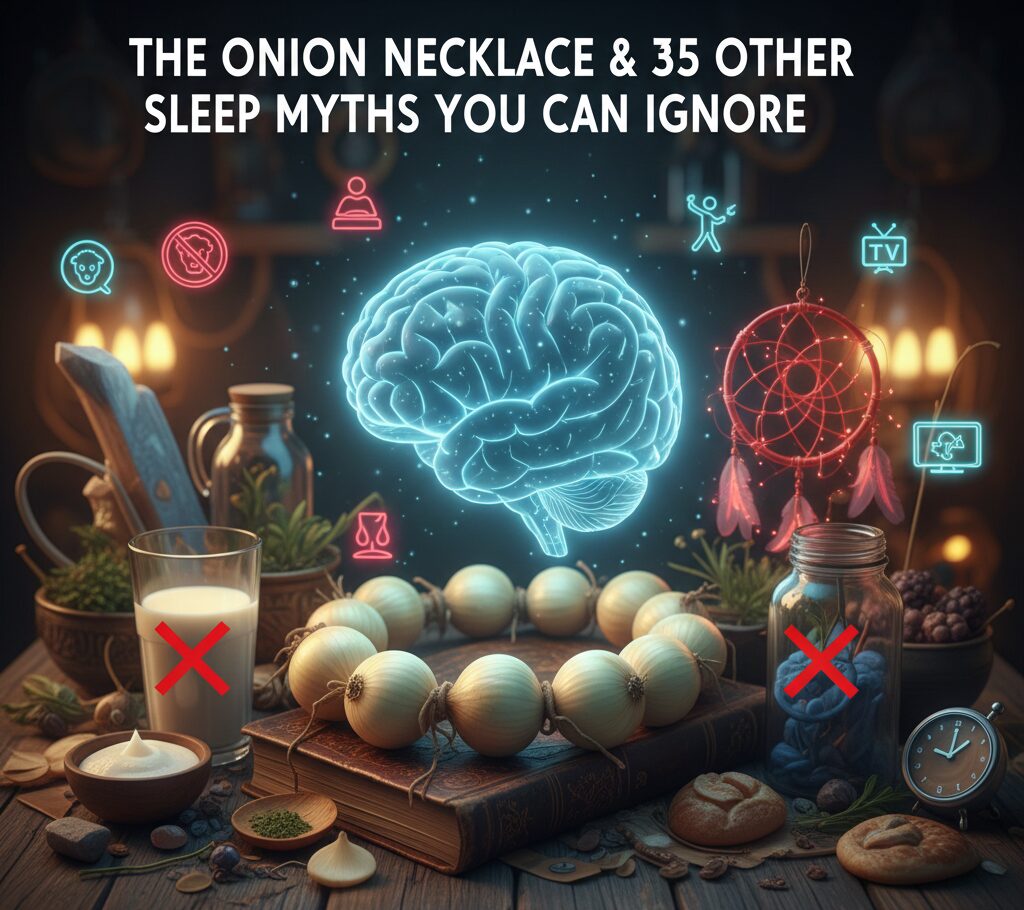
“Dr. Lycan, I read that if I cut an onion in half and wear it around my neck, I will sleep better.”
I have been consulting on sleep for years. I thought I had heard every variation. But the internet has a limitless imagination. A client actually came to me with this — desperate, sleep-deprived, and clutching an onion.
When we are desperate for sleep, we become vulnerable to what I call the “magical thinking” trap. We want one secret bio-hack, one ancient ritual, one hidden trick that will instantly switch off our racing brains.
Here is why sleep myths spread so fast — and why most of them are costing you more sleep, not giving you more.
⚡ Core Takeaway: Sleep Myths Signal “Crisis” — And That Signal Keeps You Awake
- The myth pattern: Every sleep myth shares one feature — it promises control through action. But sleep is a passive process that happens when the nervous system is sufficiently de-aroused. Every ritual, gadget, or ancient technique you add tells your brain: “This is a crisis.” That anxiety signal is itself a wake-promoter.
- The science of subtraction: The evidence-based approach to sleep is not addition (more tea, more supplements, more gadgets) — it is subtraction (remove light, remove temperature barriers, remove the 11 PM work session). Sleep hygiene is the systematic removal of sleep obstacles.
- The protocol: Stimulus control (bed = sleep only), sleep restriction (reduce time-in-bed to actual sleep), cognitive defusion (stop trying), and consistent wake time. This is CBT-I — the most effective insomnia intervention known, with or without onions.
Key Facts at a Glance
- 8 hours = population average, not individual mandate
- Counting sheep = low cognitive load (DMN stays active)
- Alcohol = most dangerous sleep myth (sedation ≠ sleep)
- Adaptation = accumulating debt (no physiological adaptation)
- Weekend catch-up = social jetlag (doesn’t repay debt)
- Subtraction = sleep needs less, not more
- Evidence-based = CBT-I + restriction + stimulus control
- Trust machinery = biology knows how
The “Onion Necklace” Problem: Why Sleep Myths Spread Faster Than Science
Direct Answer: Sleep myths spread for the same reason medical misinformation spreads in any domain: they are more memorable, more emotionally satisfying, and more actionable than boring scientific truths. The onion necklace is memorable because it is absurd. Absurdity creates shareability. Science, by contrast, says things like: “Maintain consistent sleep-wake timing across all days of the week” — which no one shares on social media, even though it is the single most effective insomnia intervention.
Mechanism: Human cognition is wired for narrative patterns (storytelling) not statistical reasoning. A folk remedy has a narrative: “ancient wisdom + simple action = result.” A scientific finding has a narrative: “large effect sizes in specific populations, controlling for confounders, with a moderate confidence interval.” The folk remedy is more emotionally compelling. This is called the “availability heuristic” — we believe what we can most easily recall, and absurd sleep remedies are far more memorable than the sleep hygiene literature (Kahneman, 2011).
Actionable Advice: Before trying any sleep remedy, ask three questions: (1) What is the proposed mechanism? (2) Has it been tested in controlled studies? (3) Does the intervention require complex action or ritual (myth) or removal of existing barriers (science)? If the answer to (3) is “complex action,” the remedy is likely a myth.
The Psychology of Desperation: Why We Believe Absurd Sleep Remedies
Direct Answer: Desperation is the psychological condition most associated with belief in sleep myths. When you have spent three nights unable to sleep, your nervous system is in a high-arousal state — the prefrontal cortex (responsible for rational evaluation) is inhibited by cortisol and noradrenaline. You literally cannot think clearly about sleep when you have not slept. This is why the most absurd remedies are most tempting when you are most sleep-deprived.
Mechanism: Insomnia creates a paradoxical state: the more you need sleep, the more effort you put into getting it, and the more that effort signals threat to the nervous system. Effort requires arousal. Arousal prevents sleep onset. This is the core paradox that drives the sleep myth industry — every new remedy you try reinforces the message: “Sleep is difficult and requires effort.” The myth maintains the very condition it claims to solve (Harvey, 2002).
Actionable Advice: The single most effective cognitive intervention for insomnia is to stop trying. This is not passive resignation — it is active defusion from the effort to sleep. Paradoxically, the instruction “stop trying” and “accept wakefulness without resistance” has the highest success rate for sleep onset insomnia of any cognitive technique. When you stop trying to sleep, the nervous system can finally stop guarding against the threat of your own bedtime routine.
Myth #1: “8 Hours Is the Magic Number” — The Truth About Sleep Duration
Direct Answer: The “8-hour rule” is a statistical average, not an individual prescription. Sleep duration is highly heritable and varies significantly across individuals. Some adults genetically require 7-8 hours; others function optimally on 6-6.5 hours; a minority require 9+ hours. The correct measure of sufficient sleep is not a number — it is how you feel during the day. If you are alert without caffeine at 2 PM and falling asleep within 20 minutes of going to bed, you are sleeping enough.
Mechanism: The 8-hour recommendation originates from a 1942 survey of human sleep patterns (before modern sleep research), not from experimental evidence. More rigorous contemporary data shows the actual distribution: 5% of adults require less than 5 hours (short sleepers with the DEC2 gene mutation), approximately 60% require 7-9 hours, and 5% require more than 9 hours. Recommending 8 hours to everyone is like recommending a medium-sized shoe to every adult — it fits some and hurts many (Watson et al., 2015).
Actionable Advice: Track your actual sleep (not time in bed) over 2 weeks using a wearable or a sleep diary. Note when you naturally wake without an alarm. Measure your daytime sleepiness using the Epworth Sleepiness Scale. If you are alert during the day and sleeping 6.5 hours, the 8-hour recommendation is not your target — your actual sleep duration is your target.
Myth #2: “Counting Sheep Works” — Why Mental Distraction Fails Sleep
Direct Answer: Counting sheep does not work — and the mechanism is well understood. The task of counting requires just enough cognitive engagement to prevent the mind from wandering to threat-related thoughts, but not enough to actively inhibit the default mode network (DMN) that generates self-referential worry. It falls in the worst possible middle zone: engaging enough to maintain awareness, not relaxing enough to allow disengagement.
Mechanism: Sleep onset requires the deactivation of the DMN — the brain network active during rest and self-referential thought. The DMN is suppressed by either (a) genuine cognitive engagement with an absorbing task (which counting sheep fails to provide) or (b) the parasympathetic arousal that occurs when threat monitoring shuts down. Counting sheep attempts (a) but produces insufficient engagement. Meanwhile, it does nothing for (b) — in fact, the counting keeps the numeric monitoring system active, which is a form of performance monitoring that maintains arousal (Anderson and Horne, 2008).
Actionable Advice: Replace sheep-counting with either complete cognitive engagement (reading fiction you find genuinely absorbing — not work documents) or complete disengagement (body scan meditation, which uses interoceptive focus rather than cognitive effort). Neither tries to suppress thoughts — both give the DMN something more effective to do than worry.
Myth #3: “Alcohol Helps You Sleep” — The Most Dangerous Sleep Myth
Sleep Myth vs Sleep Science
| Myth | Why It Feels True | What the Evidence Shows |
|---|---|---|
| 8 hours is the magic number | It is repeated everywhere as a rule | It is a population average, not an individual prescription |
| Counting sheep works | It feels like a distraction technique | Mental distraction fails; structured cognitive offload works better |
| Alcohol helps you sleep | It sedates you quickly | It fragments REM architecture and worsens the second half of the night |
| Your body adapts to less sleep | You stop noticing how tired you are | Sleep debt accumulates and impairs performance and mood |
| Weekend sleep pays off debt | Long lie-ins feel restorative | Catch-up sleep does not reverse the accumulated debt |
| Complex rituals fix sleep | Effort feels productive | Sleep improves by subtraction – removing light, heat and noise – not addition |
Direct Answer: Alcohol is one of the most reliably disruptive substances for sleep architecture, and the belief that it “helps sleep” is one of the most clinically damaging myths in sleep medicine. Yes, alcohol reduces sleep onset latency — but it does so by suppressing the central nervous system broadly, not by inducing natural sleep. The sleep you get after drinking is not normal sleep; it is sedated sleep with severely fragmented architecture.
Mechanism: Alcohol suppresses REM sleep by 20-30% in the first half of the night (as the body metabolizes the alcohol and experiences withdrawal). REM sleep is essential for emotional memory processing — this is why people who drink regularly report feeling emotionally dysregulated and anxious the next day, even if they “slept.” Additionally, alcohol is a respiratory depressant that worsens sleep-disordered breathing, fragments sleep through multiple nighttime awakenings as blood alcohol levels drop, and damages the gut microbiome (which then disrupts the tryptophan-serotonin-melatonin pathway). The combined effect: shorter time to sleep onset + profoundly degraded sleep quality + next-day anxiety and fatigue (Stein and Friedmann, 2006).
Actionable Advice: If you drink alcohol, stop at least 3 hours before bed. One standard drink requires approximately 1-1.5 hours to metabolize fully. The goal is to enter sleep with zero blood alcohol concentration — so your sleep architecture is not interrupted by alcohol withdrawal during the night.
Myth #4: “Your Body Adapts to Less Sleep” — The Accumulating Debt Trap
Direct Answer: The claim that some people can “adapt” to 5 hours of sleep is false, and the evidence is conclusive. There is a rare genetic mutation (DEC2) that allows approximately 1 in 4 million people to function on genuinely short sleep without measurable cognitive impairment. Everyone else who claims to have “adapted” to 5 hours is operating on accumulated debt — and the cognitive effects are present even when the person is unaware of them.
Mechanism: Sleep deprivation produces two types of impairment that are invisible to the deprived individual: (1) Microsleeps — brief (0.5-5 second) episodes of unconsciousness that occur involuntarily during sustained attention tasks. A driver operating on sleep debt may experience 4-5 microsleeps per hour without being aware of a single one. (2) Allocentric navigation impairment — the inability to form new spatial memories. People with sleep debt cannot accurately assess how impaired they are because the brain’s self-assessment systems (prefrontal cortex) are themselves impaired by sleep debt. This is called ” anosognosia of sleep deprivation” — you cannot accurately judge your own impairment because the faculty responsible for judgment is impaired (Van Dongen et al., 2003).
Myth #5: “Weekend Sleep Pays Off Debt” — Why Catch-Up Sleep Is a Myth
Direct Answer: Weekend sleep cannot fully compensate for weekday sleep debt. You may feel better after sleeping 12 hours on Saturday morning, but the cognitive and metabolic damage from chronic sleep restriction continues to accumulate even as you bank hours on the weekend. The brain can partially recover, but not fully, and the recovery window is much longer than the debt accumulation window.
Mechanism: A landmark 2019 study by Depner et al. found that weekend recovery sleep is insufficient to reverse the metabolic dysregulation caused by weekday sleep restriction. Participants who slept only 5 hours per night for 5 days, then “caught up” with 12-hour recovery sleep on the weekend, still showed: (a) reduced insulin sensitivity (23% lower than baseline), (b) continued cognitive impairment despite weekend sleep, and (c) a “sleep state instability” — the brain continued to fragment sleep even during recovery sleep, as if the homeostatic sleep pressure system had been recalibrated to a higher baseline. Weekend sleep does not reset the debt; it partially masks the symptoms while damage continues (Depner et al., 2019).
Actionable Advice: The only effective solution for sleep debt is prevention. Consistent daily sleep (same wake time every day, including weekends) prevents the debt from accumulating in the first place. If you have accrued significant debt, the recovery protocol is: maintain a strict consistent wake time, extend sleep by 30-60 minutes per night over 2-3 weeks, and accept that full cognitive recovery takes longer than the physical recovery.
The Science of Subtraction: Why Sleep Requires Doing Less, Not More
Direct Answer: The evidence-based approach to insomnia — Cognitive Behavioral Therapy for Insomnia (CBT-I) — is built entirely on subtraction. It removes the behaviors, cognitions, and environmental conditions that prevent sleep, rather than adding new ones. CBT-I works by addressing the three perpetuating factors that keep insomnia chronic: conditioned arousal (bed = not-sleep), hypervigilance (trying to sleep), and sleep-incompatible schedules.
Mechanism: CBT-I has five components: (1) Stimulus control — go to bed only when sleepy, leave bed when awake for more than 20 minutes, use bed only for sleep and intimacy. This breaks the conditioned association “bed = wakefulness.” (2) Sleep restriction — limit time in bed to actual sleep time, creating controlled sleep pressure that strengthens the sleep drive. (3) Cognitive therapy — identifying and challenging catastrophic beliefs about sleep (“I will perform terribly tomorrow”) that create anticipatory anxiety. (4) Relaxation training — reducing somatic arousal through progressive muscle relaxation or diaphragmatic breathing. (5) Sleep hygiene education — removing the environmental obstacles (light, temperature, caffeine) (Morin et al., 2006). None of these are additions — they are subtractions.

Evidence-Based Sleep Hygiene: What Actually Moves the Needle
Direct Answer: Sleep hygiene is not about adding new behaviors — it is about removing the obstacles that prevent sleep from occurring naturally. The evidence base for sleep hygiene is mixed: standalone sleep hygiene education is less effective than CBT-I, but in combination with CBT-I, sleep hygiene is essential. The single highest-impact interventions are, in order: (1) consistent wake time, (2) eliminate afternoon caffeine, (3) eliminate evening alcohol, (4) reduce evening light exposure, (5) maintain bedroom temperature at 18-20C.
Mechanism: Consistent wake time is the single most powerful sleep hygiene intervention because it is the anchor for the circadian rhythm. The suprachiasmatic nucleus (SCN) uses the wake time as its primary time-giver (Zeitgeber). When wake time varies by more than 30 minutes, the SCN cannot maintain a stable circadian phase, and sleep onset timing becomes unpredictable. This is why shift workers and people with irregular schedules experience chronic insomnia at higher rates — their primary Zeitgeber is unstable. Caffeine elimination is the second highest-impact change because caffeine has a half-life of 5-7 hours — a 2 PM coffee means 50% of the caffeine is still circulating at 9 PM, directly inhibiting adenosine clearance and sleep onset (Drake et al., 2013).
How to Trust Your Sleep Machinery Again
Direct Answer: After chronic insomnia, the most important psychological intervention is to restore trust in your biological capacity for sleep. Chronic insomnia creates a learned helplessness pattern — the person has tried everything and nothing worked, leading to anticipatory anxiety about bedtime that itself disrupts sleep. Rebuilding this trust requires stopping the patterns that maintain the anxiety and giving the sleep system time to recalibrate.
Mechanism: The sleep system has a remarkable capacity for self-restoration when given the right conditions. This is called “sleep reserve” — the accumulated sleep pressure that builds during wakefulness and automatically drives sleep onset when the conditions are met. In chronic insomnia, this system has been overridden by conditioned arousal: the bed triggers anxiety rather than sleep. The restoration protocol: (1) implement strict stimulus control so the bed gradually re-associates with sleep, (2) maintain consistent wake time to strengthen the circadian anchor, (3) accept that it takes 2-4 weeks of consistent conditions before the sleep system recalibrates — there will be no immediate results, and that is normal, (4) track subjective sleep quality (how refreshed you feel), not just sleep quantity (hours), (5) practice sleep effort reduction — actively noting that trying less is not giving up, it is the correct biological strategy (Harvey, 2002).
Actionable Advice: Tonight, do one thing fewer for your sleep. Skip one supplement, one ritual, one check of the sleep tracker. Lie down in a dark, cool room and do not try to fall asleep. If you are awake, that is acceptable — the goal is to stop the anxiety loop, not to immediately fall asleep. The machinery will work when it is not being watched.
Ready to Transform Your Recovery?
Throw away the onions. Put the cutlery back in the kitchen. Sleep hygiene is boring, evidence-based, and requires mostly subtraction. Let us help you do less and sleep better.
The Slumbelry Commitment
Sleep is the most vulnerable state of human existence. It is where we heal, reset, and grow.
At Slumbelry, we do not just sell sleep products; we advocate for your physiological right to rest. From ergonomic support to light management, every solution we offer is designed with one obsession: Respecting your Biology.
Science is our language, but your recovery is our purpose. You take care of everything else in your life — let us take care of your sleep.
Rest Deeply,
The Slumbelry Team
Frequently Asked Questions
Why do sleep myths spread so widely even when science disproves them?
Direct Conclusion: Sleep myths spread faster than science because they have emotional and narrative appeal that peer-reviewed research cannot match. A memorable folk remedy (“wear an onion around your neck”) is more shareable than “maintain consistent sleep-wake timing within a 30-minute window.” This is called the availability heuristic — we believe what is most easily recalled. Additionally, desperate people (those with severe insomnia) are cognitively impaired by sleep debt and are more susceptible to logical errors, including confirmation bias (noticing the times the myth appeared to work and ignoring the times it did not).
Does counting sheep actually help you fall asleep?
Direct Conclusion: No — and a controlled Oxford University study (Anderson and Horne, 2008) proved it. Participants who visualized peaceful scenes fell asleep 20 minutes faster than those counting sheep. Counting sheep requires just enough cognitive engagement to prevent genuine relaxation but not enough to suppress the default mode network’s worry generation. It is the worst possible middle ground. Replacing it with genuinely absorbing mental tasks (reading fiction you love) or complete disengagement (body scan meditation) is more effective.
Does drinking warm milk before bed actually help with sleep?
Direct Conclusion: Warm milk has a kernel of science (it contains tryptophan, which is a serotonin and melatonin precursor) but the effect is negligible at the volumes typically consumed. A glass of warm milk contains approximately 100mg of tryptophan — the dietary threshold needed to measurably affect brain tryptophan levels is approximately 2,000mg. You would need to drink 20 glasses of warm milk to approach a threshold effect. The perceived benefit of warm milk is mostly due to the ritual and the comfort of the warm liquid, which may produce mild parasympathetic relaxation — this is the ritual effect, not a biochemical one.
Is it true that your body can adapt to only 5 hours of sleep?
Direct Conclusion: No — with the exception of the 1 in 4 million rare DEC2 gene mutation carriers, adults cannot biologically adapt to 5 hours of sleep. What people experience as “adaptation” is actually the cognitive impairment that prevents them from accurately assessing their own performance. Microsleeps, reduced situational awareness, and impaired judgment are all present in “adapted” short sleepers — they simply cannot see their own impairment because the faculty responsible for self-assessment is impaired. A systematic review of sleep curtailment studies found robust cognitive impairment in every group sleeping less than 6 hours, regardless of subjective reports of adaptation.
Can you really “catch up” on sleep over the weekend?
Direct Conclusion: Partially, and only in limited ways. Weekend sleep can reduce the subjective feeling of sleepiness and partially restore some cognitive function. However, it cannot reverse the metabolic dysregulation (reduced insulin sensitivity, altered cortisol rhythm) that accumulates from weekday sleep debt, and the cognitive deficits persist even after weekend recovery sleep. A 2019 study found that weekend recovery sleep leaves insulin sensitivity 23% below baseline — a metabolic cost that accumulates over time. Think of weekend sleep as partial symptom relief, not debt repayment.
Does alcohol actually help you fall asleep?
Direct Conclusion: No — alcohol reduces sleep onset latency by suppressing the central nervous system broadly, which is not the same as inducing natural sleep. The sleep you get after alcohol is sedated sleep, not restorative sleep. Specifically: alcohol suppresses REM sleep by 20-30% (reducing emotional memory processing), fragments sleep in the second half of the night as blood alcohol levels drop and withdrawal sets in, worsens sleep-disordered breathing, and damages the gut microbiome in ways that further disrupt the serotonin-melatonin pathway. If you drink, stop at least 3 hours before bedtime so you enter sleep with zero blood alcohol concentration.
Is 8 hours really the ideal amount of sleep for everyone?
Direct Conclusion: No — 8 hours is the population average, not a universal prescription. Sleep genetics account for approximately 40% of the variation in sleep duration across individuals. Approximately 5% of adults are genetic short sleepers requiring 5-6 hours. Approximately 5% require 9+ hours. The correct measure is not hours but daytime function: if you are alert at 2 PM without caffeine, falling asleep within 20 minutes at bedtime, and waking without an alarm, you are sleeping enough. Stop measuring by the clock and start measuring by how you feel.
Do sleep supplements like melatonin actually work?
Direct Conclusion: Melatonin works for specific indications and fails for others. It is effective for: circadian rhythm disorders (jet lag, shift work), very low melatonin production (common in older adults), and sleep onset insomnia in people whose pineal gland is not producing adequate melatonin signal. It is ineffective for: sleep maintenance insomnia (waking in the middle of the night), insomnia driven by anxiety or hyperarousal, and insomnia where the underlying problem is not circadian misalignment. For most chronic insomnia, melatonin is a distraction from the primary intervention: CBT-I. The melatonin you are taking to compensate for a 1 AM phone-checking session is treating the symptom, not the cause.
Why does my brain feel more anxious when I try harder to sleep?
Direct Conclusion: This is the classic paradox of insomnia: the effort to sleep creates the arousal that prevents it. The mechanism is called “attempted sleep onset” — the moment you decide to go to bed for the purpose of sleeping, your nervous system activates the performance monitoring system. You begin monitoring: “Am I asleep yet? Why am I not asleep? How long have I been awake?” This monitoring is a form of cognitive arousal — it is exactly the opposite of what sleep requires. Sleep is a passive process that requires the deactivation of the monitoring system. The harder you monitor, the more awake you become. The intervention is paradoxical intention — the instruction to stay awake with eyes closed in a dark room, which removes the sleep attempt and therefore removes the arousal (Harvey, 2002).
What is CBT-I, and why is it better than sleep myths?
Direct Conclusion: CBT-I (Cognitive Behavioral Therapy for Insomnia) is the first-line, evidence-based treatment for chronic insomnia — recommended by the American College of Physicians and the European Sleep Research Society ahead of any medication. It works by removing the behaviors that maintain insomnia (stimulus control, sleep restriction) and the cognitions that maintain it (catastrophic beliefs about sleep, learned helplessness). It has a response rate of 70-80% and effects that persist after treatment ends, unlike sleep medications which stop working when you stop taking them. Unlike sleep myths, which require ongoing complex action, CBT-I is time-limited and designed to make itself unnecessary. The goal of CBT-I is to work yourself out of a job — to restore your natural sleep capacity so you no longer need a therapist, a supplement, or an onion necklace.