
Want to Sleep? Try to Stay Awake
The Sleep Paradox: Why Telling Yourself to Stay Awake Helps You Fall Asleep
It happens to almost everyone who has ever lain awake at 2 AM, watching the minutes pass: the harder you try to fall asleep, the more awake you become.
There is a name for this — and for the counterintuitive solution that actually works. paradoxical intention for sleep is one of the most evidence-supported techniques in Cognitive Behavioral Therapy for Insomnia (CBT-I). And what it asks you to do sounds like the opposite of what you should be doing: try to stay awake instead.
Here is the science behind why it works — and how to practice it correctly.
⚡ Core Takeaway: Stop Chasing Sleep — Invite It
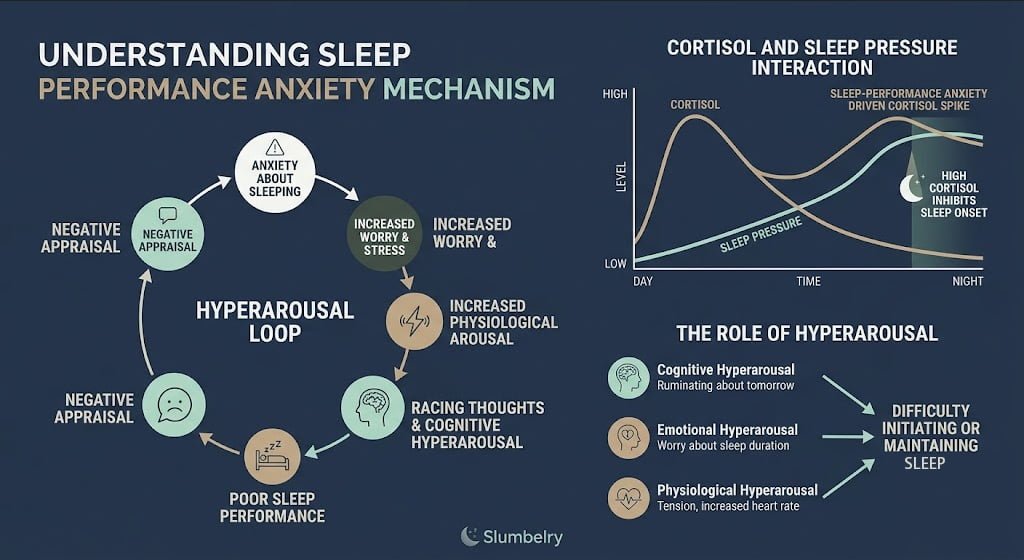
- The Mechanism: Sleep performance anxiety (worrying about falling asleep) activates the same fight-or-flight response that prevents sleep. Paradoxical Intention removes this trigger by changing the goal
- The Switch: By committing to staying awake, you eliminate the anxiety of “failing” at sleep — which paradoxically allows the sleep system to activate without resistance
- The Condition: Works best for psychologically-driven insomnia; less effective for sleep disorders driven by physiological causes (apnea, restless legs, etc.)
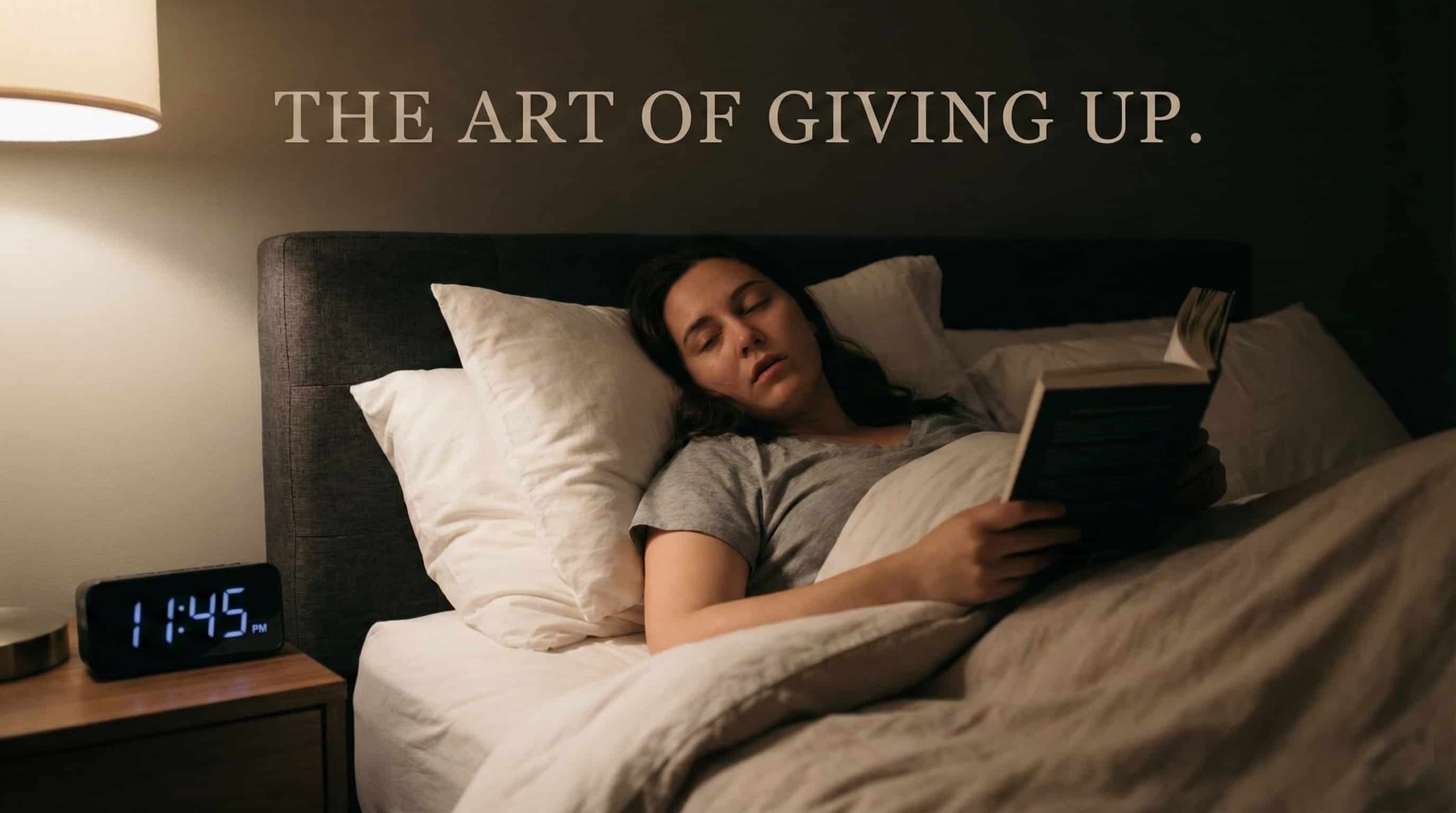
Why Does Trying Harder to Fall Asleep Always Make It Worse?
Direct Answer: Because sleep is not something you can force — it is something that happens to you. The harder you try, the more you activate the wake-promoting systems in your brain, and the further sleep drifts away. This is not a character flaw. It is biology.
Mechanism: Walker (2017), Why We Sleep, documents that effort to sleep triggers the sympathetic nervous system — elevating cortisol, heart rate, and cortical alertness. Sleep requires the opposite state: parasympathetic dominance. When you lie in bed thinking “I must fall asleep, I must fall asleep,” you are engaging the same brain circuits that keep you alert during the day. The result is a paradoxical one: your effort to sleep produces the physiological state most incompatible with sleep. This is why insomnia researchers call efforts to force sleep “counterproductive” — and why the solution to insomnia is almost never “try harder.”
Actionable Advice: The first step is accepting that sleep cannot be forced. Every moment you spend trying to make it happen, you are activating the wake system. Instead, create the conditions for sleep and then remove your attention from it entirely. The moment you stop watching the clock and stop measuring how you are doing, your parasympathetic system can engage.
What Is Paradoxical Intention and Where Does This Technique Come From?
Direct Answer: Paradoxical Intention (PI) is a Cognitive Behavioral Therapy for Insomnia (CBT-I) technique in which a person deliberately intends to stay awake instead of trying to fall asleep. The goal is to remove the anxiety associated with the inability to sleep — and by removing that trigger, allow sleep to occur naturally.
Mechanism: Stanley (2018), How to Sleep Well, traces PI to early behaviorist therapy and documents its formal introduction to sleep medicine by Ascher and Turner (1979). The core principle: most insomnia is maintained by the fear of not sleeping — which creates anticipatory anxiety that prevents sleep. By switching the goal from “falling asleep” to “staying awake,” you eliminate the failure condition. There is no way to fail at staying awake. This cognitive reframing removes the anxiety that was itself the barrier to sleep. The technique sounds counterintuitive precisely because it is — which is why it is called “paradoxical.”
Actionable Advice: When you get into bed tonight, do not say “I must fall asleep.” Say to yourself, quietly: “I am going to stay awake for the next few minutes.” Notice what happens to your eyelids. The relief from performance pressure alone can be enough to allow sleep to arrive.
What Is Sleep Performance Anxiety and Why Does It Create a Self-Fulfilling Cycle?
Direct Answer: Sleep performance anxiety is the fear of failing at sleep — the same way an athlete fears underperforming in a competition. When you lie down and immediately start measuring how fast you are falling asleep, how deep your sleep feels, and how many hours you will get, you have converted sleep into a performance event. And performance requires the prefrontal cortex, alertness, and sympathetic activation — the exact opposite of what sleep requires.
Mechanism: Walker (2017) documents that the amygdala activates whenever the brain perceives a threat or failure condition. For insomniacs, the bed becomes associated with the threat of failing to sleep — which triggers cortisol release every time they lie down. This conditioned arousal response means that the bed itself becomes a trigger for alertness, not sleep. The more you try to perform at sleep, the more activated the amygdala becomes, the less sleep you get, the more anxious you get about sleep — and the cycle reinforces itself. The bed has become a threat, not a sanctuary.
Actionable Advice: The key to breaking this cycle is to remove the failure condition from the bed. Do not go to bed until you are genuinely sleepy. When you are in bed, your only goal is to rest — not to fall asleep. If you fall asleep, that is a pleasant side effect. This subtle reframing removes the threat signal from the bedroom environment.
How Does Paradoxical Intention Actually Break the Hyperarousal Loop?
Direct Answer: By removing the measurement and evaluation from sleep, PI removes the trigger for hyperarousal at the precise moment when it is most counterproductive — the sleep-onset window.
Mechanism: Walker (2017) describes the reticular activating system (RAS) as the brain’s sleep-wake switch. When you set an intention to fall asleep, the RAS reads this as a task — and tasks require wakefulness to complete. The anxiety of failing creates a loop: the more you monitor your sleep, the more activated the RAS becomes, and the further sleep drifts. PI interrupts this loop by changing the task from “fall asleep” to “stay awake.” The RAS can now complete the task without anxiety — staying awake is easy, and it requires no performance monitoring. With performance anxiety gone, the parasympathetic system can activate, and sleep can arrive without resistance. The hyperarousal loop breaks because you have removed its fuel source: the fear of failure.
Actionable Advice: The moment you stop measuring your sleep is the moment your sleep system can engage. PI is not about “trying to stay awake” as a trick — it is about using the act of choosing to stay awake as a way to remove the threat evaluation from the sleep-onset process. When you give yourself permission to stay awake, you simultaneously remove the anxiety of failing to fall asleep.
How Is Paradoxical Intention Different From Simply “Not Thinking About Sleep”?
Direct Answer: PI is more specific and more structured than “not thinking about sleep.” It does not ask you to suppress thoughts — which is nearly impossible for an anxious brain — but to actively redirect the intention.
Mechanism: Simply trying not to think about something activates the same monitoring and suppression circuits that maintain anxiety. Deliberately intending to stay awake, on the other hand, is an active behavioral choice that engages a completely different cognitive frame. You are not suppressing the thought of sleep — you are replacing the goal. This is the critical distinction: PI does not ask you to suppress or avoid anything. It asks you to adopt a different goal. Suppression creates the “white bear” effect (try not to think of a white bear, and you think of nothing else). PI creates a genuine alternative: there is something specific you are doing — staying awake — which occupies the cognitive space without triggering the same anxiety circuits.
Actionable Advice: Do not confuse PI with “just relax and stop thinking about sleep.” PI has a specific behavioral instruction: “Keep your eyes open and intend to stay awake.” The specificity is the mechanism — it gives your brain something concrete to do that is incompatible with sleep performance anxiety, without requiring you to suppress or avoid any thoughts.
What Happens in Your Brain When You “Try to Stay Awake” on Purpose?
Direct Answer: The moment you genuinely commit to staying awake, your brain stops evaluating whether sleep is happening. This removes the cortisol trigger, allowing the parasympathetic system to activate.
Mechanism: Walker (2017) documents that the prefrontal cortex — responsible for evaluation, self-monitoring, and goal-directed behavior — is the primary generator of pre-sleep anxiety. When you set a goal to “stay awake,” the prefrontal cortex has a new, achievable task: staying awake. This is significantly less anxiety-producing than the goal of “falling asleep,” which the prefrontal cortex cannot guarantee. With the evaluation signal turned off, the amygdala deactivates, cortisol drops, and the bed no longer registers as a threatening performance environment. The sleep-onset chemicals — GABA, adenosine, melatonin — can now act without interference. Paradoxical intention works because it removes the prefrontal cortex from the sleep process, allowing the older brain structures that regulate sleep to operate without resistance.
Actionable Advice: When practicing PI, it is normal to feel your eyelids grow heavy within 60–90 seconds of genuine commitment to the stay-awake intention. This is the moment the prefrontal cortex has stopped evaluating and the sleep-onset system has begun to activate. You can confirm this by noticing: you are not trying to close your eyes, but they are closing anyway.
Can Paradoxical Intention Backfire and Increase Anxiety for Some People?
Direct Answer: Yes — PI is not universally appropriate. For people with high baseline anxiety, the instruction to “try to stay awake” can itself become a performance task, creating a new source of pressure.
Mechanism: Stanley (2018) notes that PI works best for people whose insomnia is driven by sleep performance anxiety — not for people whose insomnia has a primarily physiological cause. For someone whose primary issue is a hyperaroused nervous system from chronic stress or trauma, “trying to stay awake” may simply add another thing to feel anxious about. Additionally, some people experience paradoxical excitation from the instruction itself — instead of feeling drowsy, they become more alert in response to the challenge. This is not a failure of PI — it is a sign that the technique may not be the right fit at that moment. The key is genuine commitment to the intention: if you are secretly monitoring whether you are falling asleep while trying to stay awake, the technique is working against you.
Actionable Advice: Before trying PI, do a honest self-assessment: Is my insomnia primarily driven by anxiety about not sleeping, or do I have a genuine physiological barrier (pain, apnea, restless legs)? If it is the latter, address the physiological cause first. If it is anxiety-driven, PI may help — but only if you can genuinely commit to the stay-awake instruction without secretly monitoring whether it is working.
How to Practice Paradoxical Intention: The Stay-Awake Game Step by Step
Direct Answer: PI requires a specific sequence of instructions. The precision of the practice matters — more than the technique itself, it is the genuine commitment to the instruction that determines whether it works.
Mechanism: Stanley (2018) and the American Academy of Sleep Medicine (AASM) guidelines for CBT-I describe PI as an evidence-based behavioral intervention with specific implementation steps: (1)Lie in a comfortable position in the dark. (2)Open your eyes gently and commit to keeping them open for the next few minutes. (3)Say to yourself — either silently or aloud — “I am going to stay awake for the next few minutes. I will not try to fall asleep.” (4)Notice the heaviness in your eyelids. Notice the warmth in your body. You are not trying to produce these sensations — you are simply observing them without intervention. (5)Let sleep arrive on its own. Do not measure whether it is arriving. Do not watch the clock. The goal is only to stay awake — and sleep is the pleasant side effect of genuinely committing to that goal.
Actionable Advice: The most common mistake in PI is secretly checking whether it is working. If you are asking yourself “Is my eyes feeling heavy yet? Am I falling asleep yet?” — you have reactivated the performance monitoring circuit. The instruction only works when you can genuinely commit to the stay-awake goal without any covert evaluation of your progress. Start with 2–3 minutes. You do not need to last longer than that.

When Is Paradoxical Intention Most Effective and When Should You Skip It?
Direct Answer: PI is most effective for sleep-onset insomnia driven by anxiety — the classic “I cannot get to sleep because I am too worried about not sleeping” pattern. It is less effective — and potentially counterproductive — for physiological insomnia or when practiced incorrectly.
Mechanism: Walker (2017) and Stanley (2018) both identify the primary indication for PI as psychologically-driven insomnia, particularly sleep-onset insomnia where the primary maintainer is anticipatory anxiety. The evidence base is strong for this population: multiple randomized controlled trials show PI significantly reduces sleep-onset latency compared to controls. However, for insomnia driven by physiological causes — sleep apnea, restless leg syndrome, chronic pain, irregular circadian rhythms — PI does not address the root cause and may increase frustration. Additionally, PI practiced with covert performance monitoring (constantly checking whether it is working) is counterproductive and can deepen the insomnia.
Actionable Advice: Use PI when you genuinely believe your insomnia is anxiety-driven and you can commit to the instruction without covert monitoring. Skip PI and address the physiological root cause first if: you have been diagnosed with a sleep disorder, you experience significant pain or physical discomfort at night, you have been told you stop breathing during sleep, or you have tried PI several times without any reduction in sleep-onset anxiety.
How Does Paradoxical Intention Fit Into a Complete Sleep Recovery Plan?
Direct Answer: PI is most powerful when used as part of a comprehensive CBT-I program — not as a standalone fix. Alone, it addresses the anxiety component. Combined with sleep restriction, stimulus control, and sleep hygiene, it becomes part of a complete system.
Mechanism: Stanley (2018) and the AASM Clinical Guidelines for CBT-I describe the complete CBT-I protocol as combining stimulus control (bed = sleep only, not a place to try to sleep), sleep restriction (limiting time in bed to actual sleep to increase sleep pressure), sleep hygiene optimization (caffeine, light, temperature), and cognitive restructuring (addressing unhelpful beliefs about sleep). PI fits into the cognitive restructuring layer: it is the behavioral implementation of the cognitive insight that “trying to sleep prevents sleep.” Used in isolation, PI can feel like a trick that may or may not work. Used as part of a complete plan, it is one tool in a system that addresses all the maintainers of insomnia simultaneously. Littlehales (2016) emphasizes that creating a sleep sanctuary — a bedroom environment that signals safety and rest to the nervous system — is the environmental complement to PI’s psychological technique.
Actionable Advice: Build PI into a complete plan: (1) Optimize your sleep environment — dark, cool, quiet, comfortable. (2) Use the bed only for sleep — not for trying to sleep. (3) Apply PI when you lie down — with genuine commitment, not covert monitoring. (4) Use sleep restriction to increase sleep pressure on nights when PI is not enough. (5) Address any physiological contributors (magnesium, breathing techniques, apnea screening). PI alone is a technique. Combined with these steps, it is part of a system that rebuilds your relationship with sleep.
Frequently Asked Questions
Does paradoxical intention really work for insomnia?
Direct Conclusion: Yes — it has strong evidence from multiple randomized controlled trials as a CBT-I technique. The key mechanism: removing the failure condition eliminates the anticipatory anxiety that was itself preventing sleep. It works best for sleep-onset insomnia driven by performance anxiety; it is less effective for insomnia with primarily physiological causes.
Why does trying to stay awake help me fall asleep faster?
Direct Conclusion: Because it removes the goal of falling asleep — which is the source of your anxiety. When you commit to staying awake, you stop monitoring whether sleep is arriving. This removes the cortisol spike caused by performance evaluation, allowing the parasympathetic system to activate and sleep to occur without resistance.
What is sleep performance anxiety?
Direct Conclusion: Sleep performance anxiety is the fear of failing at sleep — the same way an athlete fears underperforming. When you go to bed and immediately start measuring how fast you are falling asleep and how many hours you will get, you have converted sleep into a performance event. Sleep requires the opposite state of performance — no evaluation, no goal, no measurement. Sleep performance anxiety creates the exact physiological state most incompatible with sleep.
Is paradoxical intention the same as just not caring about sleep?
Direct Conclusion: No — PI is more specific. It is not about not caring about sleep; it is about actively redirecting your intention from ‘fall asleep’ to ‘stay awake.’ The act of choosing to stay awake occupies the cognitive space that was previously filled with sleep performance anxiety. Simply trying not to think about sleep is suppression, which backfires. PI gives your brain a concrete, achievable alternative goal.
How long does it take for paradoxical intention to work?
Direct Conclusion: Some people report feeling drowsy within 60–90 seconds of genuinely committing to the stay-awake instruction. However, the full effect accumulates over 2–3 weeks of consistent practice, as the brain learns to associate the bed with rest rather than performance. If you have practiced PI consistently for 3 weeks without any reduction in sleep-onset anxiety, consult a CBT-I specialist.
Can paradoxical intention make my anxiety worse?
Direct Conclusion: Yes — if you secretly monitor whether it is working while trying to stay awake, you have reactivated the performance monitoring circuit and PI will work against you. PI only works when you can genuinely commit to the stay-awake instruction without covert evaluation. If you know you will be unable to resist checking whether you are falling asleep, PI may not be the right technique for you at this time.
What is the difference between paradoxical intention and sleep restriction therapy?
Direct Conclusion: Paradoxical intention addresses the cognitive anxiety component of insomnia — it removes the fear of failing to sleep. Sleep restriction addresses the physiological component — it increases sleep pressure by limiting time in bed to actual sleep. They target different maintainers of insomnia and are often used together in comprehensive CBT-I programs. PI is cognitive; sleep restriction is behavioral-physiological.
Can I use paradoxical intention if I have a sleep disorder like apnea?
Direct Conclusion: PI does not address the physiological causes of sleep disorders. If you have been diagnosed with sleep apnea, restless leg syndrome, or another physiological sleep disorder, address the disorder first with appropriate medical treatment. PI can be used alongside medical treatment for the psychological component of insomnia, but it cannot substitute for treatment of the underlying physiological cause.
How is paradoxical intention used in CBT-I therapy?
Direct Conclusion: CBT-I therapists typically introduce PI after establishing stimulus control (associating the bed with sleep only) and sleep hygiene optimization. PI is typically practiced for 2–4 weeks as part of a multi-component protocol. The therapist ensures the technique is being practiced correctly — with genuine commitment, not covert monitoring — and adjusts the approach if performance anxiety around the technique itself becomes a barrier.
What is the single most important thing to remember about paradoxical intention?
Direct Conclusion: It only works if you genuinely commit to staying awake without secretly monitoring whether you are falling asleep. The moment you start checking — ‘Is my eyes feeling heavy yet? Am I falling asleep yet?’ — you have reactivated the performance circuit and defeated the purpose. Commit fully, or do not do it at all.
Ready to Transform Your Recovery?
If the fear of not sleeping has been running your nights, take action today. Discover science-backed solutions for better rest.
Take the Sleep Assessment Explore Our Cooling MattressThe Slumbelry Commitment
Sleep is the most vulnerable state of human existence. It is where we heal, reset, and grow.
At Slumbelry, we do not just sell sleep products; we advocate for your physiological right to rest. From ergonomic support to light management, every solution we offer is designed with one obsession: Respecting your Biology.
Science is our language, but your recovery is our purpose. You take care of everything else in your life — let us take care of your sleep.
Rest Deeply,
The Slumbelry Team