
The Myth of the “Perfect 8 Hours
Why the ‘8-Hour Rule’ Is Hurting Your Sleep (And What to Do Instead)
“is 8 hours of sleep enough” is the anxiety-inducing question millions ask themselves every morning — often before their feet hit the floor. You woke up at 6, went to bed at 11, and still feel like you got hit by a truck. Your sleep tracker says 7.5 hours, but you are exhausted, foggy, and reaching for caffeine before 9 AM.
Here is what the sleep science actually says: the problem is not you. The problem is a single number — 8 — that was never yours to begin with.
In this guide, we will break down why your sleep need is genetically unique, why the “8-hour rule” is an industrial-age oversimplification, and how to find your personal sleep formula using evidence-based methods — the same ones elite athletes and sleep clinics use.
⚡ Core Takeaway: Sleep Is Personal, Not Arithmetic
- Your Number: 4 to 11 hours — genetics determines your sleep need, not a universal rule
- Sleep Quality: 6 hours of deep, unbroken sleep beats 8 hours of fragmented light sleep
- The Shift: Stop counting hours, start measuring sleep efficiency and cycle completion
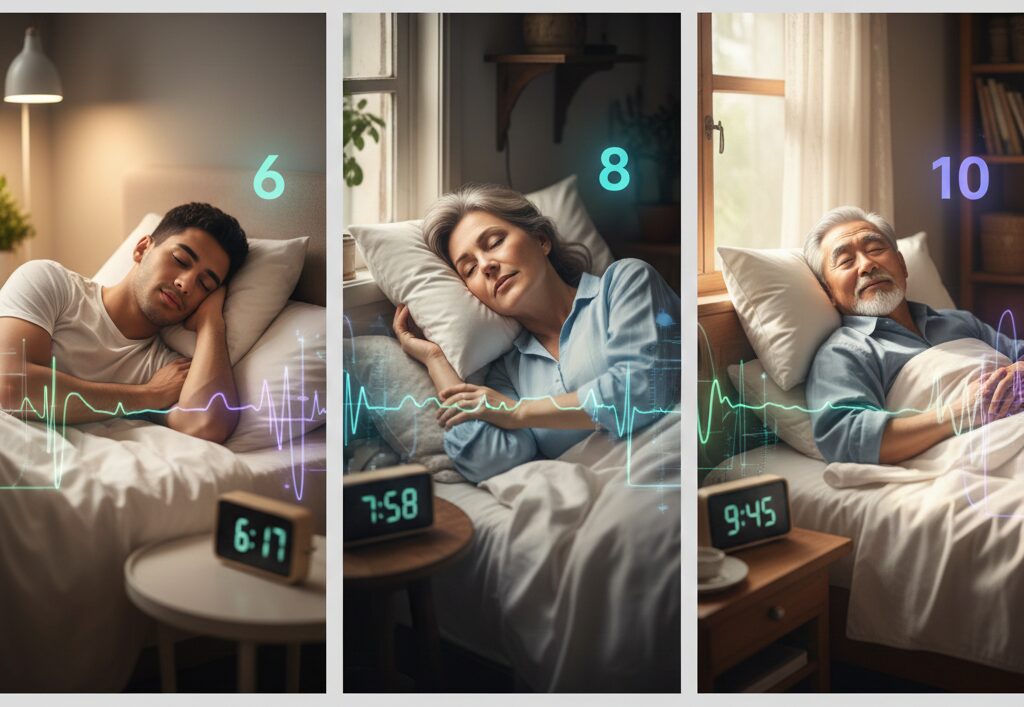
Why Do Some People Thrive on 6 Hours While You Need 9?
Direct Answer: Because sleep duration is largely genetic — like height or shoe size, not a learned behavior.
Mechanism: Stanley (2018), How to Sleep Well describes a bell curve of human sleep need spanning 4 to 11 hours. The “8-hour average” is exactly that — an average. It tells you nothing about where you personally sit on that curve. Some carry the DEC2 gene mutation (nicknamed the “Thatcher Gene” after Margaret Thatcher, who famously slept 4–5 hours and remained highly functional). Others are natural long sleepers who genuinely need 9–10 hours to feel restored.
Actionable Advice: Stop benchmarking yourself against someone else’s sleep number. Instead, use the Vacation Test (see H2-5) to find your biological baseline — that is your real target, whether it is 5 hours or 10.
Is the ‘8-Hour Rule’ Actually Scientifically Proven?
Direct Answer: No. The “8-hour rule” is an oversimplification, not a scientific standard.
Mechanism: Littlehales (2016), Sleep, the R90 strategy architect, argues the 8-hour advice emerged from industrial-era generalizations about human averages — not from sleep science. Sleep researchers think in 90-minute cycles, not clock hours. Most adults need 4–6 complete cycles per night, which translates to 6–9 hours. The number 8 is arbitrary; it is the midpoint of a bell curve, not a target.
Actionable Advice: Reject the clock-based metric. Instead, count sleep cycles. If you need to wake at 6:30 AM and you want 5 cycles, your bedtime should be 11:00 PM — not a round number that “feels right” on a sleep tracker.
What Happens When You Force Yourself to Sleep 8 Hours?
Direct Answer: You risk developing psychophysiological insomnia — a condition where worrying about sleep actually prevents sleep.
Mechanism: Walker (2017), Why We Sleep, explains the brain learns to associate the bed with frustration when you repeatedly lie awake “trying to get your numbers.” This is the 3P Model of insomnia (Predisposing factors + Precipitating events + Perpetuating behaviors). You were fine at 7 hours, but now you have added a layer of sleep anxiety on top — making everything worse. Additionally, sleeping beyond your natural need can fragment sleep architecture, increasing light sleep and reducing deep, restorative stages.
Actionable Advice: If you wake naturally after 7 hours and feel restored, get up. Do not train your brain to dread the bedroom by chaining yourself to a number that was never yours to begin with.
How Does Sleep Quality Actually Beat Sleep Quantity?
Direct Answer: Because the glymphatic system — the brain’s waste-clearance mechanism — only reaches full efficiency during deep, uninterrupted sleep. Surface-level sleep does not clear beta-amyloid, the Alzheimer-related toxin.
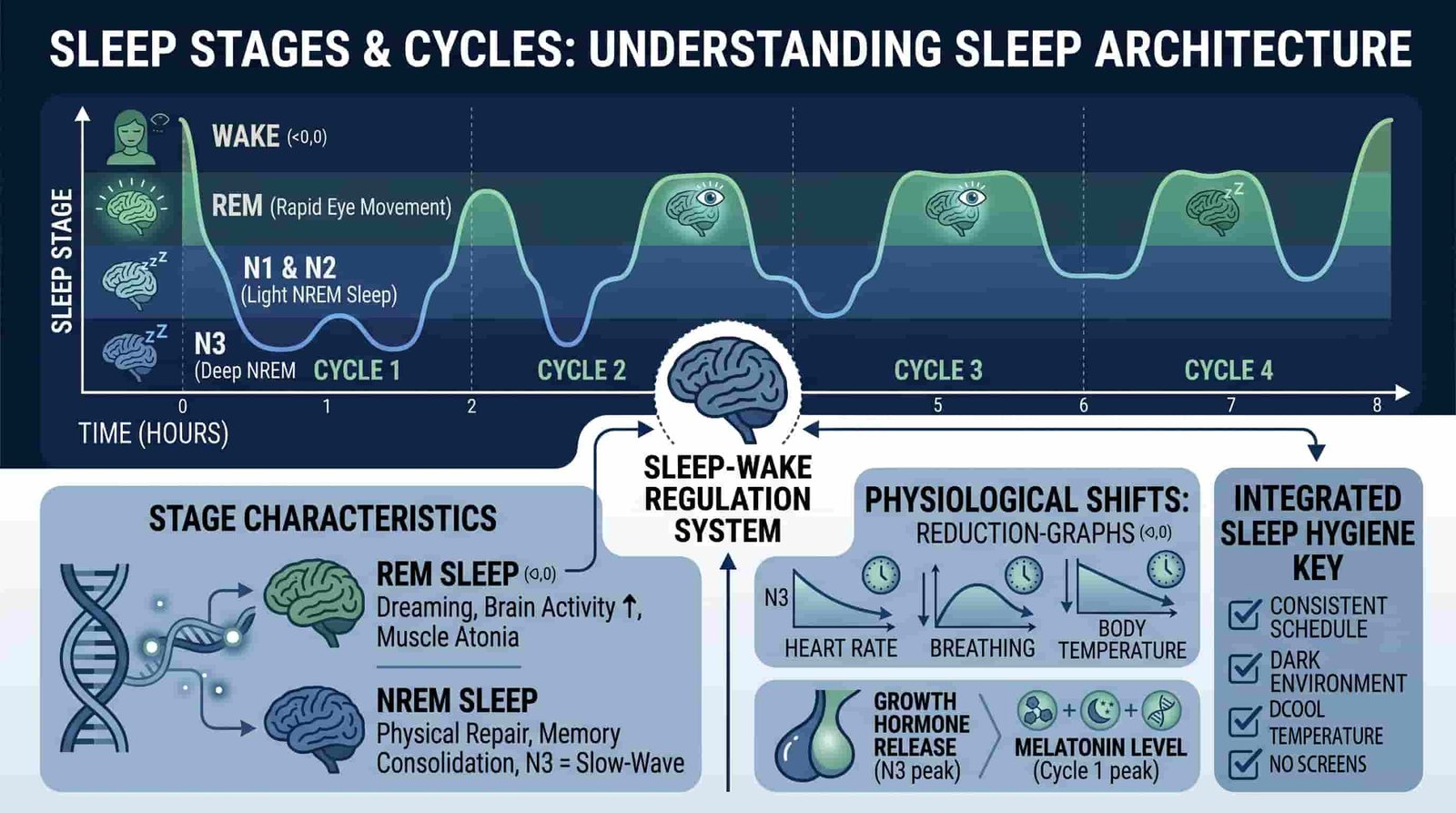
Mechanism: Walker (2017) documents that during deep N3 and REM sleep, glial cells in the brain shrink by 60%, allowing cerebrospinal fluid to flush through neural pathways and clear metabolic waste. Fragmented sleep — even 8 hours of it — interrupts this process. A single night of 4 hours of fragmented sleep reduces natural killer cells by 70%, compromising immune function measurably.
Actionable Advice: Invest in sleep environment optimization — temperature (18–20°C), darkness (complete blackout), and ergonomic support — so the hours you do sleep are deeply restorative, regardless of whether that is 5, 7, or 9 hours.
Can You Measure Your Personal Sleep Need Scientifically?
Direct Answer: Yes — without apps or devices. Use your body’s own feedback signals.
Mechanism: Sleep pressure is driven by adenosine accumulation (Stanley, 2018). adenosine builds up from the moment you wake, creating the sensation of “sleep pressure” that makes you drowsy. Your circadian rhythm — controlled by your chronotype — determines when that adenosine peak coincides with your biological night. Together, these two systems tell you exactly how much sleep you need. Sleep trackers often mislead because they measure movement, not sleep architecture. You are the best instrument.
Actionable Advice: Use the 15-Minute Rule: if you wake during the night and cannot fall back asleep within 15 minutes, get up. Lie-awake bed time is adenosine clearance failure, not insomnia — it trains your brain to associate the bed with wakefulness.
What Is the R90 Sleep Strategy and How Does It Work?
Direct Answer: R90 reframes sleep from “hours of unconsciousness” to “completed 90-minute sleep cycles,” giving you precise control over sleep timing and recovery.
Mechanism: Littlehales (2016) designed R90 for elite athletes, but it works for everyone. Each cycle runs: N1 (dozing) → N2 (light sleep) → N3 (deep sleep) → REM. Deep sleep rebuilds muscle and clears brain waste; REM consolidates memory and emotional processing. Aim for 4–6 complete cycles per night (6–9 hours), and 28–35 cycles per week. If you lose one night, recover with an extra cycle or two the next — never by sleeping until noon.
Actionable Advice: Calculate backwards from your fixed wake time. Example: Wake at 6:30 AM, want 5 cycles → bedtime at 11:00 PM. Want 4 cycles instead? Bedtime at 12:30 AM. Use the cycle count, not the clock, as your unit of measurement.
Why Is Sleep Efficiency More Important Than Duration?
Direct Answer: Because time in bed means nothing if your brain is not cycling through deep sleep and REM. Sleep efficiency — the ratio of time actually asleep versus time in bed — is the true metric.
Mechanism: Stanley (2018) notes that a person in bed for 8 hours but sleeping only 5 efficiently has worse recovery than someone in bed for 6 hours and sleeping 5.5 efficiently. Poor sleep efficiency is also a core symptom of insomnia (S2-4): patients often spend excessive time in bed “trying to sleep,” which paradoxically reduces sleep quality further. Sleep efficiency above 85% is considered healthy; many insomniacs sit at 60–70%.
Actionable Advice: If your sleep efficiency is below 80%, reduce your time in bed intentionally. This raises sleep pressure, improves sleep onset latency, and restores deep sleep proportion — the opposite of what anxiety tells you to do.
How Does Your Sleep Architecture Change With Age?
Direct Answer: Your ability to generate deep sleep (N3/SWS) declines sharply after your late 30s, even though your need for it does not.
Mechanism: Stanley (2018) documents that men see a steep decline in deep sleep starting in their late 30s; women after menopause. By your 70s, deep sleep may be almost absent. This means sleep becomes “lighter” and more easily disrupted — by noise, a partner’s movement, a full bladder, or temperature changes. The consequences are not just fatigue: reduced deep sleep impairs glymphatic clearance, accelerating amyloid plaque accumulation linked to Alzheimer’s (Walker, 2017).
Actionable Advice: As deep sleep declines with age, protecting what you can generate becomes critical. Control every variable you can: bedroom temperature, light pollution, noise, and — most importantly — mattress and pillow ergonomic support to minimize micro-arousals from physical discomfort.
What Environmental Factors Destroy Your Sleep Quality?
Direct Answer: Temperature, light, and伴侣干扰 are the three biggest silent sleep destroyers — and they are all fixable.
Mechanism: Littlehales (2016) identifies bedroom environment as the most under-controlled variable in modern sleep. Core body temperature must drop 1–3°C to initiate sleep — a room above 21°C directly delays sleep onset and fragments N3 deep sleep. Light — even from LED alarm clocks or street lamps — suppresses melatonin onset via the suprachiasmatic nucleus, pushing your circadian clock later. A partner’s snoring, movement, or different chronotype can cost you 30–60 minutes of sleep per night without you realizing it (the “social snuggling” effect — you move toward your partner, they disrupt your sleep).
Actionable Advice: Set bedroom temperature to 18–20°C. Use blackout curtains or a quality sleep mask. If partner disruption is significant, consider separate blankets or a split-calendar mattress. Slumbelry’s ergonomic support products are specifically designed to reduce micro-arousals caused by pressure points — one of the most controllable environmental factors.
How to Find Your Personal Sleep Formula (Step-by-Step)
Direct Answer: Follow this three-phase protocol: establish your biological baseline, optimize your environment, and lock in a cycle-based routine that respects your genetics.
Mechanism: This mirrors CBT-I (Cognitive Behavioral Therapy for Insomnia, the first-line clinical treatment per AASM guidelines) combined with the R90 strategy (Littlehales, 2016) and chronotype alignment (Stanley, 2018). Phase 1 removes all artificial sleep debt. Phase 2 eliminates environmental disruptors. Phase 3 builds a consistent cycle-count routine anchored to your fixed wake time.
Actionable Advice: Step 1: Vacation Test — take 3–4 nights without an alarm to reveal your biological sleep duration. Step 2: 15-Minute Rule — get up if awake 15+ minutes; do not “chase the number.” Step 3: Calculate your cycle count from your fixed wake time, not the other way around. Step 4: Control environment — 18–20°C, complete darkness, minimal noise. Step 5: Use Slumbelry ergonomic support to protect the cycles you have from physical micro-arousals.
Frequently Asked Questions
Is 7 hours of sleep enough for me?
Direct Conclusion: Your personal sleep need is genetic, not averaged. 7 hours may be your biological perfect number or it may leave you sleep-deprived — it depends entirely on where you fall on the 4-to-11-hour bell curve documented in healthy adults. The only reliable test is the Vacation Test (see H2-10).
Can I actually survive on less than 6 hours of sleep?
Direct Conclusion: If you are a genetic short sleeper (carrying the DEC2 mutation), yes — you genuinely need 4–6 hours and feel fine. If you are NOT a short sleeper and are running on 5 hours, you are accumulating adenosine sleep debt that produces microsleeps, impaired judgment, and weakened immunity. Most people who claim they “only need 5–6 hours” are actually mildly sleep-deprived.
Why do I feel worse after sleeping longer?
Direct Conclusion: Sleeping beyond your biological need often means more time in light sleep (N1/N2) and more time in the lighter phases of each cycle — leading to more awakenings and less restorative deep sleep. It can also push you into a later wake time that misaligns with your circadian rhythm, causing grogginess regardless of total hours.
How many sleep cycles do I actually need?
Direct Conclusion: Most adults need 4–6 complete 90-minute sleep cycles per night, totaling 6–9 hours. Athletes or those recovering from sleep debt may benefit from 6 cycles. The minimum for basic function is 4 cycles (6 hours). Count cycles, not hours — a disrupted 8-hour night may deliver only 3–4 effective cycles.
What is the ideal bedtime if I need to wake at 6 AM?
Direct Conclusion: Work backwards in 90-minute cycle increments. To wake at 6:00 AM refreshed: 5 cycles → 11:00 PM bedtime (recommended); 4 cycles → 12:30 AM (minimum). The quality of those cycles matters more than the round number — and a consistent bedtime rhythm trains your circadian clock.
Does napping count toward my sleep total?
Direct Conclusion: Strategically, yes — but only if you manage it correctly. A 20-minute nap provides only light sleep recovery without deep sleep inertia. A 90-minute nap can deliver one complete cycle. However, napping after 3 PM risks delaying your nighttime sleep onset and reducing your main sleep drive. Nap before 2 PM, and keep it under 30 minutes if you want nighttime sleep quality intact.
How do I know if I am a short sleeper or just sleep-deprived?
Direct Conclusion: Take the Vacation Test (see H2-10). After the first two nights of catch-up sleep, if you naturally wake after only 5–6 hours without an alarm and feel fully restored, you are a short sleeper. If you still need 8–9 hours after several nights of recovery and feel foggy without it, you are chronically sleep-deprived — most adults are.
Does sleeping more on weekends fix weekday sleep debt?
Direct Conclusion: Partially and dangerously. You can repay some sleep debt with longer weekend sleep, but oversleeping on Saturday and Sunday pushes your circadian rhythm later — making Monday morning jet lag worse (“social jet lag”). Better strategy: add one or two 90-minute cycles on the weekend, not a 3-hour lie-in. Consistency beats compensation.
At what age does deep sleep start declining?
Direct Conclusion: Deep sleep (N3/SWS) begins declining measurably in men from their late 30s and in women after menopause, per Stanley (2018). By your 60s, deep sleep may represent less than 5% of total sleep (compared to 20%+ in your 20s). This is why older adults are more easily woken by noise, temperature, or a partner’s movements — their sleep is structurally lighter, not psychologically different.
What is the single most effective way to improve sleep quality tonight?
Direct Conclusion: Control your bedroom temperature to 18–20°C. This is the single most powerful environmental intervention. It lowers core body temperature faster, accelerates melatonin onset, and increases N3 deep sleep proportion in a single night. Combine with blackout curtains, a consistent bedtime within a 30-minute window, and Slumbelry ergonomic support to minimize physical micro-arousals.
Ready to Transform Your Recovery?
If you have been counting hours instead of cycles, take action today. Discover science-backed solutions for better rest.
Take the Sleep Assessment Explore Our Cooling MattressThe Slumbelry Commitment
Sleep is the most vulnerable state of human existence. It is where we heal, reset, and grow.
At Slumbelry, we do not just sell sleep products; we advocate for your physiological right to rest. From ergonomic support to light management, every solution we offer is designed with one obsession: Respecting your Biology.
Science is our language, but your recovery is our purpose. You take care of everything else in your life — let us take care of your sleep.
Rest Deeply,
The Slumbelry Team