
The #1 Habit That Kills Your Sleep Drive
Why You Keep Waking Up at 3 AM and Checking the Clock: The Hyperarousal Loop
It is 3:14 AM. You know this because why do i keep waking up at 3 am is the thought that dragged you out of whatever sleep you had managed to get. And now you are doing it: “If I fall asleep right now, I get 3 hours and 46 minutes…”
Sound familiar? You are not broken. You are caught in a loop. And the loop has a trigger: the clock on your nightstand.
In this guide, we unpack exactly what happens to your brain at 3 AM, why looking at the time makes everything worse, and the evidence-based protocol — backed by CBT-I, chronobiology, and sleep neuroscience — that actually breaks the pattern for good.
⚡ Core Takeaway: Stop Counting, Start Sleeping
- The Loop: Clock-watching triggers cortisol spike, making it harder to sleep, which triggers more anxiety, which triggers more clock-watching
- The Misperception: You likely sleep more than you think; the clock amplifies the feeling of wakefulness by 30–50 minutes
- The Fix: Remove all time-checking cues; use the 15-minute rule; rebuild bed = safety through consistent stimulus control
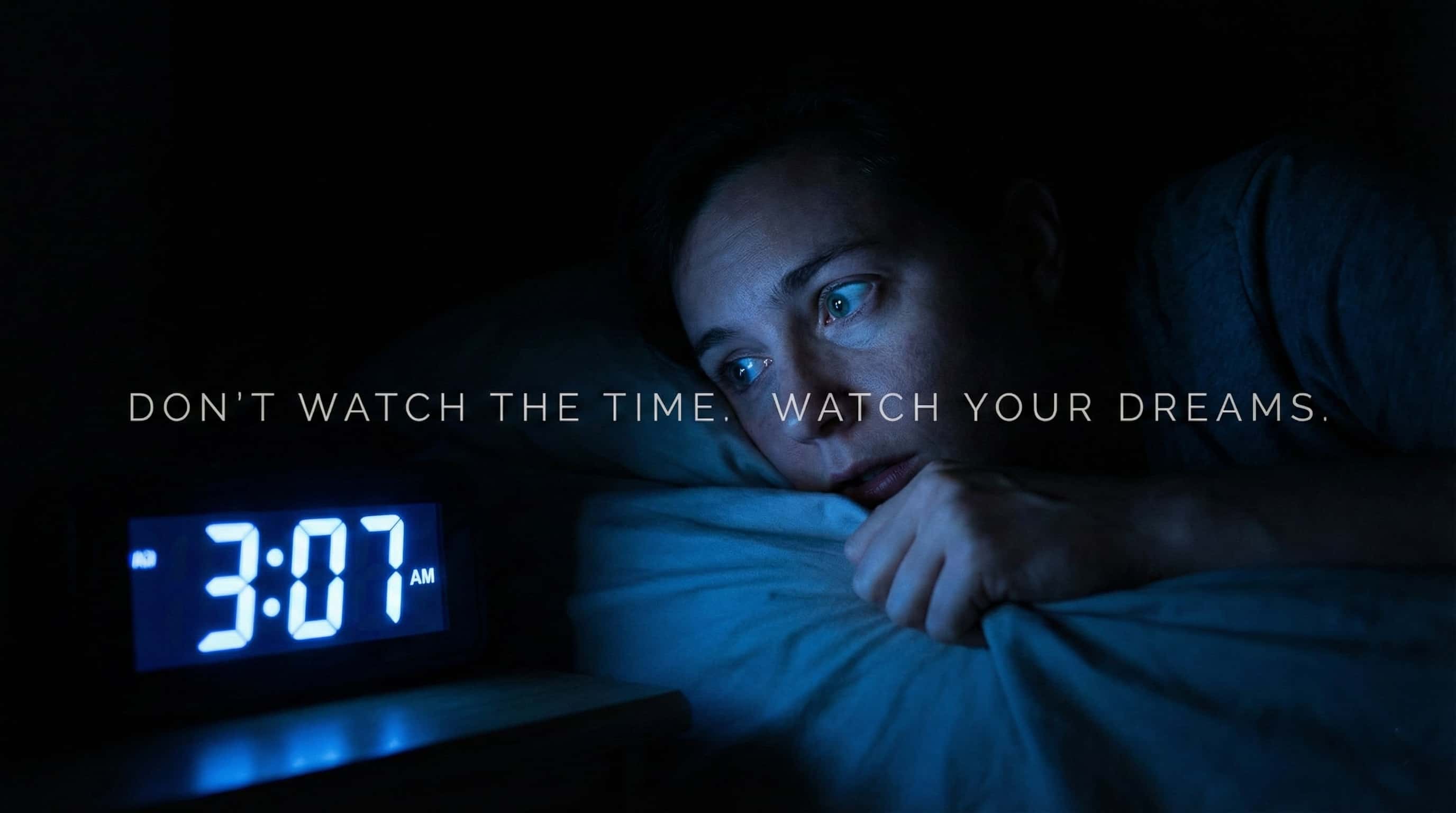
Why Do I Keep Waking Up Exactly at 3 AM?
Direct Answer: Because 3 AM falls at the intersection of your circadian trough and a natural sleep cycle boundary — two forces that make you briefly conscious even on a normal night.
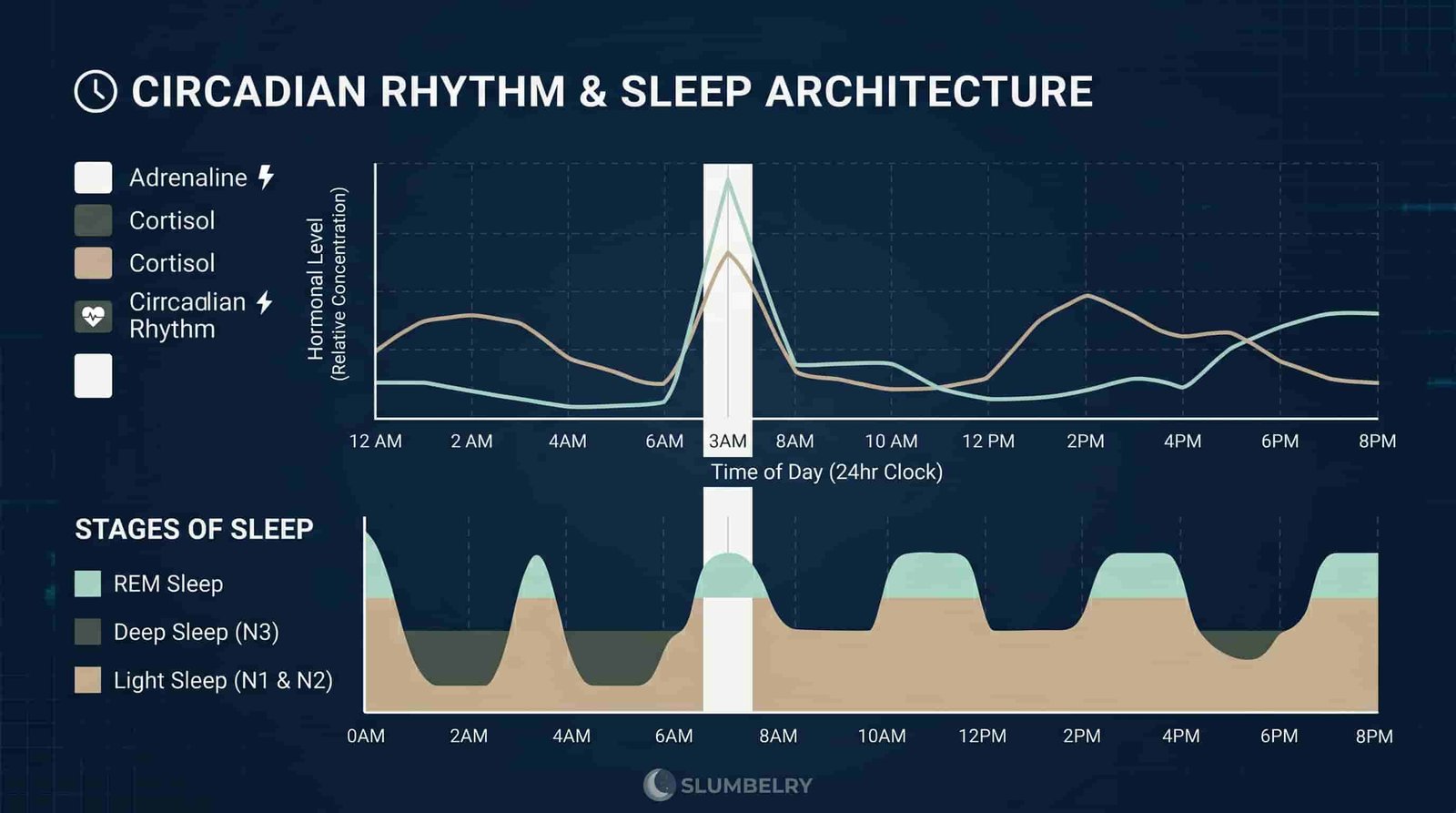
Mechanism: Walker (2017), Why We Sleep, documents that your circadian rhythm creates a trough of alertness around 3–5 AM — the period of lowest core body temperature and highest sleep pressure. This is when REM sleep is most dense and when the boundary between sleep cycles (N3 to N1 to wake) is most permeable. Your brain uses this window to briefly test whether the environment is safe. If you are a light sleeper or have accumulated sleep debt, that micro-check becomes a full awakening. For insomniacs, the fear of 3 AM wakeups has created a conditioned response — the brain anticipates anxiety at exactly this time, guaranteeing it.
Actionable Advice: Understanding that 3 AM wakeups are biologically normal — not pathological — is the first step. Your goal is not to prevent the wakeup; it is to send the brain the signal that there is nothing to fear and it is safe to return to sleep.
What Does Checking the Clock Actually Do to Your Brain?
Direct Answer: Every time you look at the clock, you trigger a cortisol spike that takes 30–60 minutes to subside — guaranteeing you will be more awake than before you looked.
Mechanism: Walker (2017) documents that the fear of not sleeping — anticipatory anxiety — activates the amygdala and the HPA axis, flooding the system with cortisol and adrenaline. This is the same physiological response as a genuine threat. When you look at the clock and see 3:14 AM, your brain computes: “only X hours left” — which the prefrontal cortex interprets as a threat to survival. The bed, which should signal safety, now signals failure. This is the conditioned response of psychophysiological insomnia (Stanley, 2018): every night, the clock strengthens the association between bed and anxiety.
Actionable Advice: The only way to break the association is to never check. Not once. Not even to see what time it is. If you cannot see the clock without anxiety, face it away or remove it entirely.
Why Does the “3 Hours of Sleep” Math Anxiety Make Everything Worse?
Direct Answer: Because doing math at 3 AM requires working memory and logical reasoning — exactly the prefrontal cortex activity that is incompatible with the default-mode network activity required for sleep.
Mechanism: McKenna and Meadows (as cited in sleep science literature) describe how the “if I fall asleep now, I get X hours” calculation activates the prefrontal cortex, the brain region most responsible for keeping you awake. Sleep requires the prefrontal cortex to “hand over” to the limbic system and the sleep-wake switch (via the ventrolateral preoptic area). Anxiety-driven calculation keeps the prefrontal cortex online — which is precisely the opposite of what sleep requires. This is the effort paradox: the harder you try to calculate your way out of poor sleep, the less likely sleep becomes.
Actionable Advice: Replace the calculation with a behavioral rule: if you wake and the time matters, you have already lost. Do not calculate. Get up if awake 15+ minutes, do something boring in dim light, and return only when genuinely sleepy — this is the CBT-I stimulus control protocol.
What Is Hyperarousal and Why Does 3 AM Trigger It?
Direct Answer: Hyperarousal is a state of heightened emotional and physiological alertness — it is the biological switch that keeps you awake when safety is uncertain. And 3 AM is the moment your brain is most sensitive to threat cues.
Mechanism: Walker (2017) documents that hyperarousal is not simply “feeling alert” — it is a measurable state of sympathetic nervous system activation: elevated heart rate, cortisol release, elevated galvanic skin response, and increased brainwave frequency (beta waves replacing theta). The 3 AM vulnerability is a feature of your circadian biology: your cortisol nadir (lowest point) is at midnight, and cortisol begins rising from around 2–3 AM to prepare you for wakefulness. When you wake during this rising phase, the cortisol spike is steeper and harder to overcome. Your brain interprets the wakefulness + rising cortisol combination as “something is wrong” — triggering the full fight-or-flight cascade.
Actionable Advice: Accept that 3 AM is the hardest time to return to sleep — not because you are broken, but because your biology is preparing you to wake. Work with this, not against it: a brief wakeful period at 3 AM is normal and expected, even in good sleepers.
Can You Actually Fall Asleep When You Are Anxious About Sleep?
Direct Answer: Only if you stop trying. Paradoxically, accepting wakefulness and switching your goal from “falling asleep” to “resting peacefully” is the only path to sleep at 3 AM.
Mechanism: McKenna’s sleep hypnosis research demonstrates that sleep cannot be forced — it is a process of relinquishing control. The moment you shift from “trying to sleep” to “I am resting my body, which is also valuable,” the prefrontal cortex quiets and the sleep-onset pathways activate. This is why acceptance-based approaches (Meadows’ ACT-based sleep therapy) outperform relaxation techniques in clinical trials for chronic insomnia. Stanley (2018) notes that the insomniac who says “I don’t care if I sleep tonight, I am just resting” often falls asleep faster than the one who employs progressive muscle relaxation or counting — because the former has genuinely deactivated the threat-response system.
Actionable Advice: When you wake at 3 AM, say to yourself: “My body is resting. That is enough for now. Sleep will come when it is ready.” This is not positive thinking — it is accurate: rest is physiologically valuable, and the anxiety of “needing” sleep is the obstacle, not the solution.
How Does Sleep State Misperception Keep You Trapped at 3 AM?
Direct Answer: Because your perception of how long you were awake is amplified by anxiety — studies show insomniacs consistently overestimate wake time by 30–50 minutes while PSG data shows they were asleep most of that time.
Mechanism: Dr. W. Chris Winter (The Sleep Solution) documents that Sleep State Misperception (SSM) — also called paradoxical insomnia — means the brain fails to register sleep that has actually occurred. At 3 AM, an insomniac’s brain is often in N1 or light N2 sleep but reports being “completely awake.” This happens because the threat-detection system stays partially online, tagging each micro-arousal as a full wake event. The result: you feel more awake and more sleep-deprived than you actually are. This misperception drives more clock-watching, which triggers more cortisol, which fragments real sleep, which creates more misperception — the self-reinforcing SSM loop.
Actionable Advice: Stop using your subjective feeling of wakefulness as data. The only reliable metric is how you feel when you wake without an alarm on vacation. If you feel rested despite believing you “only slept 4 hours,” you were likely asleep for 6+.
What Is the Clock Ban and Why Does It Work?
Direct Answer: The Clock Ban removes all time-reference cues from the bedroom, preventing the cortisol spike that clock-watching triggers and training the brain to stop using time as a sleep-performance metric.
Mechanism: Stanley (2018), How to Sleep Well, identifies stimulus control therapy (SCT) as one of the most evidence-based interventions for insomnia — and the Clock Ban is SCT’s most immediate application. The principle: you are training a conditioned response. For years, looking at the clock at 3 AM has been paired with anxiety. That pairing is so strong that the clock itself — before you even read the numbers — now triggers a cortisol response in anticipation. The only way to break the pairing is extinction: complete removal of the cue. In CBT-I clinical protocols, stimulus control requires not just hiding the clock but also leaving the bed if you do not return to sleep within 15 minutes — both are essential, neither alone is sufficient.
Actionable Advice: Tonight: face all clocks away or cover them. Charge your phone across the room. Remove any visible time displays from the bedroom. If you wake and feel the urge to check the time, get up and go to another room — do not stay in bed calculating.
How Does Sleep Efficiency Beat Sleep Duration at 3 AM?
Direct Answer: Because counting hours gives you anxiety; counting cycles gives you control. Sleep efficiency — the ratio of time asleep to time in bed — is the metric that matters, not the number on the clock.
Mechanism: Walker (2017) notes that a person who sleeps 5.5 hours with 6 hours in bed (91.7% efficiency) will outperform someone in bed for 8 hours but sleeping only 5.5 (68.8% efficiency). The time in bed doing nothing is actively counterproductive for insomniacs — it extends the window for anxiety, conditions the bed as a place of frustration, and reduces sleep pressure for the following night. At 3 AM specifically, staying in bed calculating hours fragments the first part of the next sleep cycle, reducing deep sleep and REM proportion — the restorative stages. The goal is fewer, deeper, more efficient sleep cycles — not longer, more anxious time in bed.
Actionable Advice: If you consistently wake at 3 AM and return to sleep slowly, consider whether your time-in-bed is too long. Reduce it by 30–60 minutes (go to bed 30 min later, or get up 30 min earlier). More sleep pressure = faster sleep onset = higher sleep efficiency.
Why Does Your Chronotype Make 3 AM Worse for Some People?
Direct Answer: Because wolves and lions have fundamentally different circadian architectures at 3 AM — and wolves (night chronotypes) experience a secondary alertness peak that makes 3 AM wakefulness feel more “normal” but also harder to suppress.
Mechanism: Stanley (2018) describes the four chronotypes: Lions (morning), Bears (intermediate), Wolves (evening), Dolphins (light-sleeping). Wolves, in particular, experience a cortisol rise earlier in the night than other types, making early-morning wakefulness more likely. Lions, whose sleep pressure dissipates earlier due to an advanced circadian phase, may find 3 AM wakeups particularly frustrating because they are physiologically ready to wake but socially constrained to sleep later. The 3 AM experience is not uniform — it is filtered through your chronotype, your accumulated adenosine, and your sleep debt from the previous day. Knowing your type allows you to set realistic expectations: a Wolf’s 3 AM experience will be fundamentally different from a Lion’s.
Actionable Advice: Identify your chronotype (Slumbelry’s sleep assessment can help) and set realistic 3 AM expectations for your biology. Wolves should not try to be Lions — and Lions should not catastrophize a 3 AM wakeup that is simply their advanced circadian rhythm expressing itself.
How to Break the 3 AM Clock-Watching Habit Permanently (Step-by-Step)
Direct Answer: Follow this CBT-I-informed protocol: remove cues, manage the 15-minute window, and rebuild the bed-safety association across 3–6 weeks of consistent practice.
Mechanism: This integrates stimulus control therapy (Stanley, 2018), sleep restriction (Walker, 2017), and attention bias modification (McKenna). The key insight: you cannot think your way out of 3 AM insomnia, but you can engineer your behavior around it. Each night you wake, check the clock, and return to sleep without anxiety, you are rebuilding the neural pathway: bed = safety = sleep. Each night you check the clock and catastrophize, you are reinforcing the opposite. Neuroplasticity works both ways — and 3 weeks of consistent stimulus control can measurably change the conditioned response.
Actionable Advice: Step 1 (tonight): remove all clocks and phone from the bedroom. Step 2: if you wake and cannot return in 15 minutes, get up to another room in dim light. Do not stay in bed. Step 3: return to bed only when genuinely sleepy. Step 4: no caffeine for 8 hours before target bedtime. Step 5: same wake time every day, including weekends, for 21 days minimum — this trains your circadian rhythm to reduce the 3 AM vulnerability window. Combine with Slumbelry ergonomic support to minimize physical micro-arousals from discomfort.
Frequently Asked Questions
Why do I always wake up at 3 AM and cannot fall back asleep?
Direct Conclusion: 3 AM is the intersection of your circadian trough, the natural boundary between sleep cycles, and the beginning of the cortisol rise that prepares you for morning. Most adults experience brief micro-wakeups at this time; insomniacs experience them as full awakenings because anxiety has conditioned the 3 AM window as a threat period. This is not a disease — it is a predictable biological phenomenon that can be managed with stimulus control and circadian alignment.
Does checking the clock really make it harder to fall asleep?
Direct Conclusion: Yes — measurably. Every clock check triggers a cortisol spike that takes 30–60 minutes to subside, elevating heart rate and prefrontal cortex activity incompatible with sleep onset. This is not psychological; it is the same fight-or-flight response triggered by any threat. The clock at 3 AM tells your brain there is not enough time — and time pressure is one of the most powerful activators of the arousal system.
How much sleep do I actually need if I wake up at 3 AM?
Direct Conclusion: The honest answer is: as much as your biology requires, which is personal. Use the Vacation Test — 3–4 nights without an alarm, after initial catch-up sleep, reveals your biological sleep duration. Most adults land between 7–9 hours, but the quality of that sleep (cycle completion, sleep efficiency) matters more than the clock hours. If you wake at 3 AM after 5–6 hours of efficient sleep, you may have already gotten what you need for that night.
What is the 15-minute rule for falling back asleep?
Direct Conclusion: If you wake and cannot return to sleep within 15 minutes, get out of bed. This is stimulus control therapy: staying in bed awake trains your brain that bed equals wakefulness. Go to another room in dim light, do something boring (not screens), and return only when genuinely sleepy. Most people who implement this rule find that their total sleep time initially drops but sleep efficiency dramatically improves — and within 2–3 weeks, the 3 AM wakeups shorten or disappear.
Is it better to just stay in bed when I wake up at 3 AM?
Direct Conclusion: No — staying in bed awake without sleeping is the single most counterproductive thing insomniacs do. It extends the window for anxiety to operate, trains the brain that bed is for wakefulness, and reduces sleep pressure for the following night. The clinical evidence for stimulus control (leaving bed when awake >15 minutes) is stronger than almost any pharmacological or supplementation intervention for chronic insomnia.
Why does sleep feel like it vanishes after 3 AM?
Direct Conclusion: Because your deepest sleep (N3) occurs in the first half of the night, and the second half is dominated by REM and light N2. As the night progresses, your sleep architecture naturally becomes lighter and more easily disrupted. Additionally, cortisol begins rising from around 2–3 AM to prepare your body for morning, which increases your baseline arousal just as you are most vulnerable. This is normal — what is not normal is the anxiety that makes the natural lightening of sleep feel catastrophic.
Can anxiety about not sleeping actually prevent sleep?
Direct Conclusion: Yes — and this is the core mechanism of psychophysiological insomnia. Anticipatory anxiety about 3 AM wakeups creates a self-fulfilling prophecy: the fear of wakefulness activates the arousal system, which prevents sleep onset, which creates more fear, which activates the arousal system further. The brain cannot distinguish between the anxiety of “I must sleep” and the anxiety of a real threat. The only way to break this cycle is to stop trying — paradoxically, accepting a wakeful 3 AM as neutral, not catastrophic, is the fastest path to returning to sleep.
Does the clock ban really work for middle-of-the-night insomnia?
Direct Conclusion: Yes — it is one of the most effective single-behavior interventions in sleep medicine. The Clock Ban works because it removes the primary conditioned trigger for the cortisol spike at 3 AM. Clinical studies of stimulus control therapy (which includes clock removal) show that 70-80% of chronic insomnia patients improve within 3-6 weeks of consistent application. The key is consistency: doing it once and then checking the clock ‘just this once’ resets the conditioning entirely.
How do I stop doing the math when I wake up at 3 AM?
Direct Conclusion: Replace the calculation with a behavioral rule. The calculation is: “if I fall asleep now, I get X hours” — which requires prefrontal cortex activity. The replacement rule is: “if I have been awake more than 15 minutes, I get up.” This rule requires no math, no time awareness, and removes the decision point entirely. You are not calculating your way out of poor sleep — you are following a preset protocol. The 15-minute rule is more effective than any relaxation technique because it bypasses the cognitive loop that is keeping you awake.
What is the single most effective thing to do when you wake up at 3 AM?
Direct Conclusion: Get out of bed. Not after 15 minutes of trying to fall back asleep — immediately upon realizing you are awake and cannot return. The attempt to fall back asleep while lying in bed is what trains your brain to associate bed with frustration. Every minute you spend in bed awake is strengthening the wrong pathway. Get up, go to another room in dim light, sit quietly, and wait until genuine drowsiness returns — then return to bed. The goal is not to maximize time in bed; it is to maximize efficient sleep.
Ready to Transform Your Recovery?
If you have been counting hours instead of cycles, take action today. Discover science-backed solutions for better rest.
Take the Sleep Assessment Explore Our Cooling MattressThe Slumbelry Commitment
Sleep is the most vulnerable state of human existence. It is where we heal, reset, and grow.
At Slumbelry, we do not just sell sleep products; we advocate for your physiological right to rest. From ergonomic support to light management, every solution we offer is designed with one obsession: Respecting your Biology.
Science is our language, but your recovery is our purpose. You take care of everything else in your life — let us take care of your sleep.
Rest Deeply,
The Slumbelry Team