
How to use the R90 sleep method — Why Counting Hours Is the Wrong Framework for Sleep, The R90 Cycle System, Why Sleep Debt Is a Weekly Not Daily Concept, and Why Fixing Your Wake Time Is the Single Most Effective Intervention for Chronic Insomnia
Most people measure sleep in hours. This is the wrong unit. Sleep is not a homogeneous block — it is a sequence of 90-minute cycles, each containing specific stages that serve distinct recovery functions. Waking mid-cycle produces more sleep inertia than sleeping less total time but completing cycles. The R90 framework — Recovery in 90 Minutes — replaces the hours framework with the cycles framework. how to use the R90 sleep method is the protocol that treats sleep as a weekly financial model rather than a nightly pass/fail. Fixed wake time. Cycles per week. Controlled recovery periods. And the end of the anxiety that comes from judging every night in isolation.
⚡ Core Takeaway: The R90 Sleep Method Replaces Hours With Cycles as the Unit of Sleep Measurement — 35 Cycles Per Week Is the Target (5 Cycles x 7 Days), Sleep Debt Accumulates Weekly Not Nightly, Fixed Wake Time Is the Primary Circadian Entrainment Tool, and Naps Are Controlled Recovery Periods That Replace Specific Missed Cycles; the Framework Eliminates the Anxiety of Nightly Sleep Failure by Making Sleep a Weekly Financial Model
- The Problem: Most people measure sleep in hours, which is the wrong unit. Sleep is not a homogeneous block — it is a sequence of 90-minute cycles, each containing specific stages (light N1/N2, deep SWS, REM) that serve distinct recovery functions. Waking mid-cycle produces more sleep inertia than waking at the cycle boundary, even if the total time is the same. Judging sleep night-by-night creates anxiety that disrupts the very sleep you are trying to optimize. The R90 framework replaces the hours framework with the cycles framework: your goal is 35 cycles per week, not 8 hours per night. Missing one cycle Tuesday is not ‘ruined sleep’ — it is a 1-cycle deficit that can be recovered Thursday. This reframing eliminates the most common source of sleep anxiety and allows rational cycle management across the week
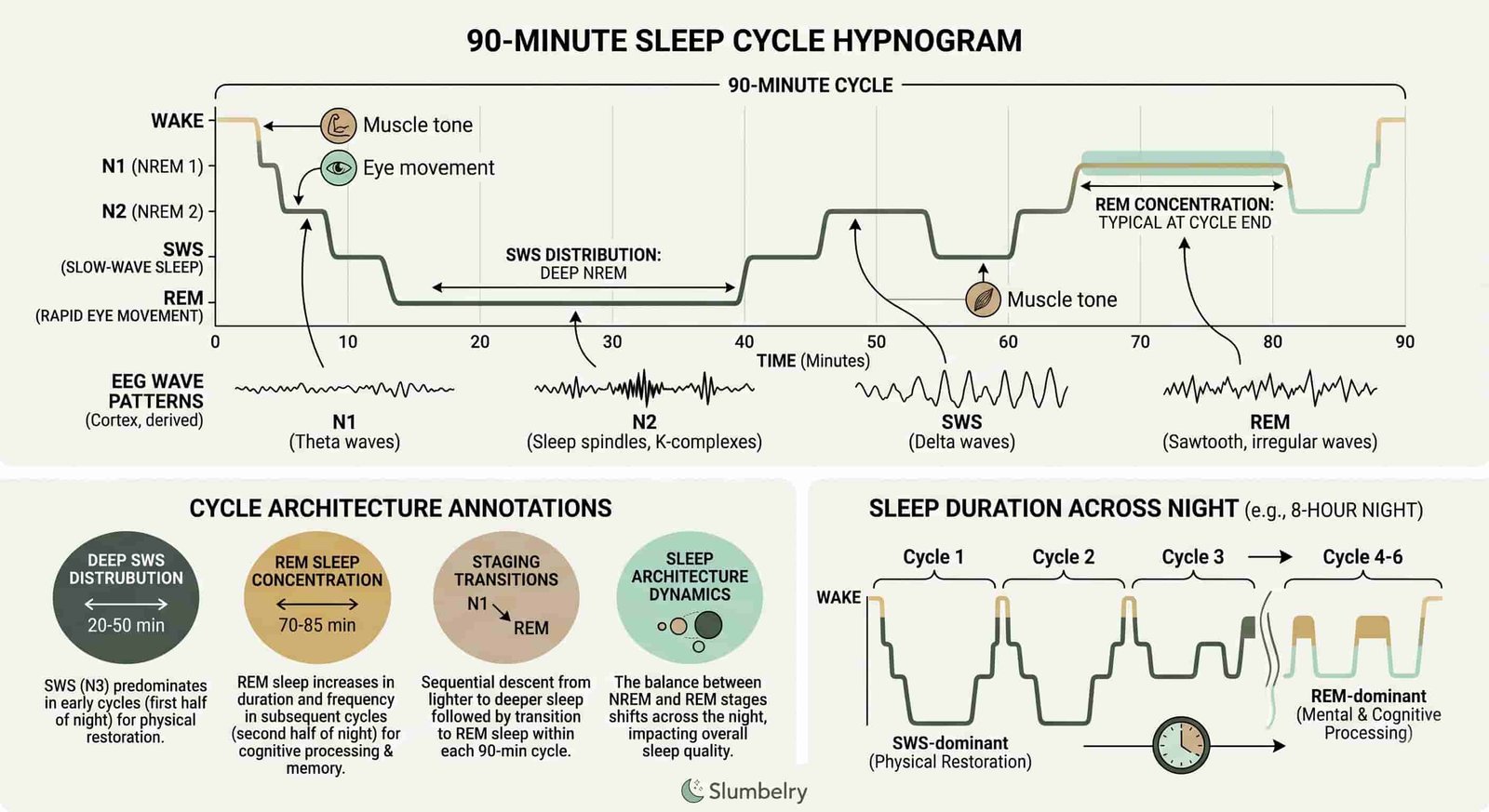
- The Mechanism: S1-1, S1-2, and S2-3 on sleep cycles and circadian entrainment: each 90-minute sleep cycle progresses through N1 (transition), N2 (light sleep, memory consolidation), SWS (deep sleep, growth hormone, glymphatic clearance, physical recovery), and REM (emotional processing, procedural memory, creativity). SWS is most abundant in the first half of the night; REM is most abundant in the second half. Waking mid-cycle (especially mid-SWS) produces severe sleep inertia. The fixed wake time principle: the SCN sets circadian phase based on the wake signal, not the bedtime. Waking at the same time every day (including weekends) produces the most powerful circadian entrainment signal. Social jetlag — the weekly shift between weekday and weekend wake times — is equivalent to a 2-3 hour time zone change every Monday
- The Protocol: Step 1: set fixed wake time (same every day, including weekends). Step 2: count backwards in 90-minute cycles from wake time to determine bedtime. Step 3: aim for 35 cycles per week (5 cycles x 7 days). Step 4: use 90-minute naps as controlled recovery periods when you fall short. Step 5: 90-minute pre-sleep wind-down routine (dim lights, cool room, offload tomorrow’s decisions, no screens). Step 6: 90-minute post-sleep upload (water, sunlight, movement, no tech for first 15 minutes). Measure in cycles per week, not hours per night

Why Is Counting Hours the Wrong Framework for Sleep — and Why Does the R90 Cycle System (90-Minute Sleep Cycles) Provide a More Accurate Measurement of Sleep Architecture Than Hours, and What Specific Physiological Events Occur in Each 90-Minute Cycle That Make Incomplete Cycles More Damaging Than Shorter Total Sleep?
Direct Answer: Sleep is not a homogeneous block measured in hours — it is a sequence of 90-minute cycles, each containing distinct physiological stages that serve specific recovery functions. Measuring sleep in hours ignores the architecture of sleep and misses the most important variable: whether you completed full cycles or woke mid-stage. Incomplete cycles (waking mid-deep sleep) produce more sleep inertia and less effective recovery than shorter but complete cycles.
Mechanism: S1-2 and S2-3 on sleep cycle architecture: each 90-minute sleep cycle progresses through four stages: N1 (transition from wakefulness, 1-5 minutes), N2 (light sleep, sleep spindles and K-complexes appear, memory consolidation occurs, 20-25 minutes), SWS (slow-wave deep sleep, growth hormone pulse, glymphatic clearance at peak, physical recovery, 15-20 minutes), and REM (dreaming sleep, emotional memory processing, procedural memory consolidation, creativity, 20-25 minutes). SWS is most abundant in the first half of the night (when sleep pressure is highest); REM is most abundant in the second half (when circadian drive for wakefulness is rising). Waking mid-SWS (as happens when an alarm goes off during deep sleep) produces severe sleep inertia — the cognitive impairment, grogginess, and physical disorientation that can last 30-120 minutes. The hour framework ignores this: 6 hours of sleep with one interrupted cycle can feel worse than 5.5 hours of completed cycles. The R90 framework’s unit is the complete cycle, not accumulated hours.
What Is the Weekly Sleep Banking Concept — and Why Is Sleep Debt a Cumulative Weekly Metric Rather Than a Nightly One, and Why Does the R90 Framework’s 35 Cycles Per Week Target Allow Flexibility for Individual Variation While Providing Enough SWS and REM for Full Recovery?
Direct Answer: Sleep debt is cumulative across the week, not reset each night. The R90 framework targets 35 complete sleep cycles per week (5 cycles x 7 days), which provides approximately 87.5 hours of sleep — slightly more than conventional recommendations because it accounts for individual variation, cycle completion overhead, and the fact that SWS requirements do not scale linearly with total sleep time. The weekly framework allows flexibility: missing 1-2 cycles on a busy Tuesday does not ‘ruin’ sleep — it creates a recoverable deficit that can be addressed Thursday with a controlled recovery nap.
Mechanism: S1-2 and S2-3 on sleep banking: the concept of sleep banking (or sleep debt as a weekly metric) comes from sleep restriction research showing that partial sleep deprivation accumulates across days and that recovery sleep, while not fully compensating for lost sleep, significantly attenuates the performance deficits. Missing 1 cycle (90 minutes) per night for 5 days creates a 7.5-hour deficit. Research by Klerman and Davis (and subsequent studies on sleep restriction and recovery) shows that recovery sleep partially restores cognitive performance and that the deficit can be managed when viewed as a weekly balance rather than a nightly failure. The 35-cycle target (5 per day x 7 days = 35) is slightly above the absolute minimum to allow for individual variation, night-to-night fluctuation, and cycle completion overhead (the last cycle of the night is often incomplete, so 5 cycles requires approximately 7.5 hours of time in bed). Acceptable range: 28-30 cycles per week. Optimal: 32-35 cycles.
What Is the Fixed Wake Time Principle — and Why Is Waking at the Same Time Every Day (Including Weekends) the Most Circadian-Entraining Behavior and Why Does Social Jetlag (Weekend Sleep In) Actively Destroy the Circadian Clock Each Week and Produce Monday Morning Impairment Equivalent to Mild Jet Lag?
Direct Answer: The fixed wake time is the most powerful circadian entrainment tool because the SCN sets circadian phase based on the wake signal, not bedtime. Waking at the same time every day (including weekends) produces a robust and consistent SCN signal that stabilizes the circadian clock. Social jetlag — the practice of sleeping in 2-3 hours later on weekends — is equivalent to a 2-3 hour time zone shift every Monday: the SCN cannot adapt to a one-day shift, producing the measurable Monday morning syndrome of impaired cognitive performance, reduced reaction time, and elevated error rates.
Mechanism: S1-1 and S2-3 on fixed wake time and social jetlag: the SCN (suprachiasmatic nucleus) generates the master circadian rhythm and is entrained primarily by light exposure, but the wake time acts as a secondary zeitgeber that consolidates the circadian phase. When wake time varies significantly between weekdays and weekends, the SCN receives conflicting signals — the natural light-dark cycle expects one phase, but the delayed wake time signals a different one. Wittmann et al. (2006) coined the term ‘social jetlag’ and showed that it is associated with increased obesity, metabolic dysfunction, and academic underperformance. The mechanism: a 2-3 hour weekend sleep shift requires a similar shift in meal times, activity patterns, and social schedules, all of which are zeitgebers that the SCN is trying to coordinate. When they conflict, the result is circadian misalignment, which elevates cortisol, impairs glucose metabolism, and reduces cognitive performance — all measurable on Monday morning. The R90 fix is simple: same wake time every day, including weekends. If you are short on sleep midweek, address it with a controlled recovery nap, not by sleeping in.

What Is the Controlled Recovery Period (Nap Protocol) — and Why Does a 90-Minute Nap Contain a Full Sleep Cycle (SWS + REM) and Acts as a Complete Recovery Unit That Can Replace One Missed Nightly Cycle, and Why Does a 20-Minute Power Nap Fail to Provide Full SWS Recovery Despite Subjective Reports of Feeling Rested?
Direct Answer: The Controlled Recovery Period (CRP) is the R90 name for the nap — but it is a specific, time-limited intervention of exactly 90 minutes, not a casual lie-down. A 90-minute nap contains a full sleep cycle (N2 + SWS + REM) and can functionally replace one missed nightly cycle. A 20-minute power nap provides only N1 and N2, which reduces sleep pressure but does not provide SWS recovery or REM consolidation — the subjective feeling of restedness is from reduced sleep pressure (N2 is less restorative than SWS but better than wakefulness).
Mechanism: S1-1 and S2-3 on the nap protocol: the 90-minute nap timing is strategic: it is long enough to complete one full cycle (including SWS) but not so long that it intrudes into the afternoon and creates sleep inertia for the evening. The ideal CRP placement is 1-3 PM — this is the afternoon circadian dip (the post-lunch slump that reflects the natural circadian low point between the morning and evening peaks), which makes it the easiest time to fall asleep and the time when a nap will least disrupt nighttime sleep onset (because 6+ hours remain before the target bedtime). Napping after 3 PM risks delaying nighttime sleep onset. A 20-minute power nap provides only the N2 portion of the cycle and reduces adenosine (sleep pressure) without providing the SWS recovery functions (growth hormone, glymphatic clearance, physical tissue repair) or the REM functions (emotional memory processing, procedural learning). The subjective feeling of refreshment from a 20-minute nap is real but incomplete — it addresses alertness but not recovery. For athletes or people under high physical stress, the 90-minute CRP provides SWS for growth hormone release (which occurs primarily during SWS) and physical recovery that a shorter nap cannot.
What Is the Pre-Sleep Wind-Down Routine — and Why Does Dimming Lights 90 Minutes Before Bed, Lowering Room Temperature, Offloading Tomorrow’s Decisions, and Avoiding Blue Light All Signal the SCN That Sleep Onset Is Imminent and Maximize Sleep Pressure at the Desired Bedtime?
Direct Answer: The pre-sleep wind-down routine (90 minutes before target bedtime) addresses the mismatch between modern evening behavior (bright lights, screens, cognitive work, decision-making) and the environmental signals that the SCN expects for sleep onset. Each element of the wind-down (dim lights, cool room, decision offloading, no blue light) removes a specific obstacle to sleep onset and provides the SCN with the convergent signals that it is nighttime and sleep should follow.
Mechanism: S1-1 and S2-3 on the wind-down routine: (1) Dim lights — melanopsin retinal ganglion cells are suppressed by dim light, allowing melatonin to rise without the suppression that 100+ lux of light produces. Dimming to < 30 lux in the 90 minutes before bed allows the melatonin concentration to reach sleep-onset levels. (2) Cool room (18-19C) — the SCN controls peripheral vasodilation as part of the temperature regulation for sleep. A cool room accelerates the peripheral vasodilation that the SCN initiates approximately 90 minutes before the CBT nadir, making the temperature drop feel more pronounced and the sleep onset signal stronger. (3) Decision offloading — the prefrontal cortex (PFC) must 'shut down' for the brain to transition from active waking to sleep. Active unresolved decisions keep the PFC engaged, which prevents the transition. Writing tomorrow's to-do list, laying out tomorrow's clothes, and making tomorrow's decisions before bed frees the PFC for the shutdown sequence. (4) Blue light avoidance — 480nm blue light maximally suppresses melatonin via mRGCs. Eliminating screens (or using blue light filtering software) in the final 90 minutes prevents melatonin suppression at the critical window when it should be rising. Each signal is independently validated in sleep science; together, they produce a convergent environmental cue that says 'nighttime = sleep.'
What Is the Post-Sleep Upload — and Why Does the 90-Minute Morning Window After Waking (Hydration, Sunlight, Movement, No Tech) Maximize the Cortisol Awakening Response, Set Circadian Phase for Tonight, and Complete the 24-Hour Circadian Cycle That Prepares the Body for Tonight’s Sleep?
Direct Answer: The Post-Sleep Upload is the R90 name for the morning routine — the first 90 minutes after waking are treated with the same precision as the evening wind-down because they determine the circadian phase for tonight’s sleep. Hydration, sunlight exposure, movement, and no technology in the first 15-90 minutes after waking maximize the cortisol awakening response, advance the circadian clock, and set the biological timer for tonight’s sleep onset.
Mechanism: S1-1 and S2-3 on the post-sleep upload: the 90-minute morning window is when the cortisol awakening response peaks (30-45 minutes after waking), when the SCN sets its daily phase based on light exposure, and when the metabolic system restarts after the overnight fast. Immediate hydration (500ml of water) corrects the overnight fluid deficit (500-750ml lost through breathing and skin) and restores plasma volume for cognitive function. Morning sunlight (within 15 minutes of waking) maximally activates melanopsin retinal ganglion cells, which advance the SCN phase and set the timer for melatonin release 14-16 hours later. Movement elevates core body temperature and activates the sympathetic nervous system for alertness, signaling the transition to daytime metabolic state. Avoiding screens in the first 15-90 minutes prevents the cortisol suppression and dopaminergic interference that digital devices produce before the natural cortisol awakening response has fully activated. The post-sleep upload is not a wellness recommendation — it is a circadian entrainment protocol that directly determines sleep quality tonight.
Why Is Sleep Debt Real but Miscalculated — and Why Does Missing 1-2 Cycles Per Night for 5 Days Produce a Deficit That Cannot Be Fully Repaid in One Weekend (Partial Recovery Only) But Can Be Managed Through the R90 Weekly Framework Without the Anxiety of ‘Ruining’ Sleep?
Direct Answer: Sleep debt is real — partial sleep deprivation impairs cognitive performance in a dose-dependent manner that accumulates across days. But it is miscalculated when framed as a binary (good night/bad night) rather than as a weekly balance. The R90 weekly framework eliminates the anxiety of ‘ruined sleep’ by reframing sleep as a bank account: missed cycles are a deficit, not a failure; recovered cycles are deposits, not a bonus. This framing reduces the sleep anxiety that is itself a primary cause of insomnia.
Mechanism: S1-2 and S2-3 on sleep debt: sleep debt accumulates when sleep is restricted below the individual requirement, and it impairs performance in a cumulative manner. A landmark study by Van Dongen et al. (2003) at the University of Pennsylvania showed that restricting sleep to 4 or 6 hours per night for 14 consecutive days produced cumulative deficits in cognitive performance that did not plateau — the impairment continued to grow across the entire 14-day period. Crucially, recovery sleep on the weekend partially but incompletely restored performance — full recovery required multiple nights of extended sleep. This means that weekend sleep-in (social jetlag) provides partial recovery but also creates the circadian disruption described above. The R90 solution: maintain 28-32 cycles per week as the minimum target, use the CRP (nap) to recover specific missed cycles within 24 hours, and avoid the weekend sleep-in that creates social jetlag. The weekly framework makes the deficit visible and manageable rather than a source of shame and anxiety.
What Is the Mattress as Recovery System Philosophy — and Why Does an Unsuitable Mattress (Too Firm, Too Soft, or Aged) Directly Impair SWS by Causing Micro-Arousals That Fragment Deep Sleep and Reduce the Glymphatic Waste Clearance That Occurs Primarily During SWS?
Direct Answer: The mattress is not a comfort product — it is a recovery system. An unsuitable mattress (too firm causes pressure points and pain; too soft allows spinal misalignment and hyperextension; aged mattresses have compressed support layers) causes micro-arousals (brief awakenings that the sleeper may not consciously remember) that fragment SWS. Since glymphatic waste clearance, growth hormone release, and physical tissue repair all occur primarily during SWS, a poor mattress directly impairs the primary recovery function of sleep.
Mechanism: S1-1 and S2-3 on mattress and SWS: the relationship between mattress firmness and sleep quality is mediated by pressure points, spinal alignment, and thermoregulation. A mattress that is too firm creates pressure points at the shoulders, hips, and pelvis that trigger micro-arousals as the sleeper shifts position to relieve pressure. A mattress that is too soft allows the pelvis to sink, creating lumbar hyperextension that triggers lower back pain and arousal. The Haex & Van Grambez 2014 study on mattress and sleep quality found that medium-firmness mattresses produced the highest sleep quality scores. Aged mattresses (older than 7-10 years) have compressed foam layers that no longer provide adequate support or pressure relief. The micro-arousals caused by these issues specifically fragment SWS because SWS is the deepest sleep stage and the brain is most sensitive to environmental disruptions during it. A person may sleep for 7.5 hours on an unsuitable mattress but achieve only 30-40% of the SWS they would on a suitable one, which explains why subjective sleep quality can be poor despite a long time in bed.
What Is Social Jetlag and Why Does It Undermine Performance Every Monday — and Why Does Waking 2-3 Hours Later on Weekends Shift the Circadian Phase, Reduce Cognitive Performance, Increase Error Rates, and Produce the Monday Morning Syndrome That Has Been Measured in Workplace and Academic Settings?
Direct Answer: Social jetlag is the weekly shift between weekday and weekend sleep timing — the result of sleeping in on weekends. It is called ‘jetlag’ because it produces the same physiological disruption as crossing time zones: the circadian clock is shifted later on weekends, and Monday morning requires an abrupt shift back to the earlier schedule, which the SCN cannot fully accomplish in one night. The Monday morning syndrome (reduced cognitive performance, elevated error rates, increased accident rates) is the measurable consequence of this weekly circadian disruption.
Mechanism: S1-2 and S2-3 on social jetlag: the term was coined by Wittmann et al. (2006) in the journal Chronobiology International, which quantified social jetlag in the German population and found that it was associated with obesity, metabolic dysfunction, and academic underperformance. The mechanism: the SCN requires several days of consistent timing to fully entrain to a new schedule. When the schedule shifts by 2-3 hours on Friday and Saturday nights and then abruptly returns to the early schedule Sunday night, the SCN is caught between the natural light-dark cycle (which expects the early schedule) and the behavioral schedule (which imposed the late schedule). The result is circadian misalignment that is measurable as reduced cognitive performance on Monday mornings. Insurance data shows elevated accident rates on Monday mornings compared to other weekdays — and the effect is strongest in people with the largest social jetlag (those who slept in the most on weekends). The R90 solution: fixed wake time every day, including weekends. If sleep debt exists, address it with a 90-minute controlled recovery period in the afternoon, not by sleeping in.
What Is the Complete R90 Protocol — and How Do You Calculate Your Personal Sleep Cycle Target (35 Per Week), Set a Fixed Wake Time, Use the Wind-Down Routine, Deploy Controlled Recovery Periods (Naps), and Measure Success in Cycles Per Week Rather Than Hours Per Night?
Direct Answer: The complete R90 protocol has six steps: (1) set fixed wake time; (2) count backwards in 90-minute cycles to determine bedtime; (3) target 35 cycles per week (32-35 acceptable); (4) use 90-minute CRP naps for missed cycles; (5) execute 90-minute pre-sleep wind-down; (6) execute the 90-minute post-sleep upload. Measure success in cycles per week, not hours per night. This framework replaces sleep anxiety with sleep management — the difference between feeling like a failure and knowing your account balance.
Mechanism: S1-1 and S4-4 on the complete R90 protocol: Step 1: choose a fixed wake time that allows enough time in bed for your cycle target (if you need 5 cycles and go to bed at 11 PM, you wake at 2:30 AM — not practical). A practical fixed wake time is one that allows 7.5-9 hours in bed (5-6 cycles). Most people: 6:30-7:30 AM works. Step 2: count backwards in 90-minute cycles from wake time to get target bedtime. If wake time is 6:30 AM and you want 5 cycles: 6:30, 5:00, 3:30, 2:00, 12:30 AM — bedtime is 11:00 PM (last cycle ends at 12:30 AM). Step 3: 35 cycles per week (5 x 7) is optimal; 28-32 is acceptable. If you hit 28, that is 7 nights of 4 cycles — you are not failing, you are managing. Step 4: 90-minute CRP nap (1-3 PM window) when you have a cycle deficit. One 90-minute nap replaces one missed cycle. Step 5: wind-down for 90 minutes before bedtime (lights dim, room cool, decisions offloaded, no screens). Step 6: post-sleep upload (water, sunlight, movement, no tech for 15+ minutes). The test: by Sunday night, have you hit 28+ cycles? If yes, you managed your recovery. If yes and you hit 32+, you optimized it. If you hit 35, you are operating at elite athlete level.
Frequently Asked Questions
How do I calculate my sleep cycles with R90?
Direct Conclusion: Count backwards in 90-minute cycles from your fixed wake time. Example: fixed wake time is 6:30 AM. Cycles: 6:30, 5:00, 3:30, 2:00, 12:30, 11:00 PM. If you need 5 cycles, bedtime is 11:00 PM (5th cycle ends 12:30 AM). If you need 6 cycles, bedtime is 9:30 PM. Each cycle is exactly 90 minutes, not approximately. Time in bed = cycles x 90 minutes + approximately 15 minutes to fall asleep = total time in bed. Most people need 5-6 cycles (7.5-9 hours in bed).
What if I cannot get 35 cycles per week?
Direct Conclusion: 28-32 cycles per week is the acceptable range. 35 is optimal. If you get 28, you have 7 nights of 4 cycles — this is not failure, it is management. The key insight of the R90 framework is that 28 cycles is recoverable: you can make up 1-2 cycles per week with a 90-minute afternoon nap (Controlled Recovery Period). 35 is elite; 30 is good; 28 is acceptable. Anything below 25 sustained long-term will produce cumulative cognitive deficits.
Is the R90 method good for insomnia?
Direct Conclusion: Yes, particularly for insomnia driven by sleep anxiety. The R90 framework eliminates the binary ‘good night/bad night’ judgment by reframing sleep as a weekly balance. Insomniacs often catastrophize one bad night and try to ‘catch up,’ which increases sleep anxiety and worsens the next night. R90 reframes the bad night as a 1-cycle deficit that can be recovered Thursday — removing the anxiety that perpetuates insomnia. The fixed wake time also addresses irregular sleep-wake schedules that are common in insomnia.
Can I really make up sleep debt with naps?
Direct Conclusion: Partially. A 90-minute nap (one full sleep cycle) can replace one missed cycle and does provide SWS and REM recovery. However, research shows that weekend sleep-in provides only partial recovery of cognitive performance (Van Dongen et al. 2003) — the deficit is real and recovery is incomplete. The R90 framework addresses this by preventing large deficits from accumulating rather than relying on recovery. The nap is a recovery tool for specific missed cycles, not a substitute for consistent nightly sleep.
Why is waking up at the same time every day so important?
Direct Conclusion: The SCN sets circadian phase based on the wake signal more than the bedtime signal. Waking at the same time every day produces a robust, consistent circadian signal that keeps the master clock entrained. Social jetlag (sleeping in on weekends) disrupts this by shifting the clock later and then requiring an abrupt shift back — which the SCN cannot accomplish in one night, producing the Monday morning syndrome of impaired performance. The fixed wake time is the most powerful circadian entrainment tool you have.
Does social jet lag really affect Monday performance?
Direct Conclusion: Yes, with measurable evidence. Wittmann et al. (2006) coined the term and quantified it across populations. Insurance data shows elevated accident rates on Monday mornings. Academic studies show reduced cognitive performance on Monday in students. The effect is proportional to the magnitude of the weekend sleep shift. The R90 solution is fixed wake time every day including weekends — this eliminates the weekly jet lag cycle entirely.
What happens if I wake up mid-cycle?
Direct Conclusion: Waking during SWS (mid-cycle, particularly in the first half of the night) produces the most severe sleep inertia — the cognitive impairment, grogginess, and physical disorientation that can last 30-120 minutes. This is why setting an alarm during deep sleep is counterproductive: you feel worse upon waking than if you had slept less total time but completed a cycle. The R90 framework structures bedtime based on wake time and cycles to minimize the chance of waking mid-SWS. If you must wake at a specific time, aim to wake at the end of a cycle (90-minute boundaries from your fixed wake time).
How long should a nap be on the R90 method?
Direct Conclusion: Exactly 90 minutes — one full sleep cycle including SWS and REM. The 90-minute duration is critical: shorter naps provide only N2 (reduced sleep pressure) without SWS or REM recovery. Longer naps (2+ hours) may encroach on nighttime sleep onset and can produce sleep inertia if they extend into late afternoon. The ideal placement is 1-3 PM, which aligns with the afternoon circadian dip and leaves 6+ hours before the target bedtime. One 90-minute CRP replaces one missed cycle and is the R90 protocol’s primary recovery tool.
Does the R90 method work for shift workers?
Direct Conclusion: The fixed wake time principle is challenging for rotating shift workers, but the cycles framework still applies. For rotating shifts, the priority is: (1) maintain at least 4 complete cycles in every 24-hour period; (2) use 90-minute naps strategically before or after shifts to add recovery cycles; (3) use blackout conditions and bright light appropriately to shift the circadian clock toward the new schedule. For permanent night shift workers, the fixed wake time principle applies to their daytime schedule — same wake time every day (including weekends) to maintain circadian stability in the reversed schedule.
What is the ideal bedroom temperature for the R90 method?
Direct Conclusion: 18-19C (64-66F) is the ideal bedroom temperature for sleep. The SCN initiates peripheral vasodilation as part of the temperature regulation for sleep — a cool bedroom accelerates this process and strengthens the sleep onset signal. Above 24C (75F) disrupts sleep onset and reduces SWS. Below 15C (59F) can cause discomfort that fragments sleep. The wind-down routine includes lowering the room temperature to this range as part of the pre-sleep signal to the SCN. A slightly cool room (18-19C) with appropriate bedding is optimal.
Count Cycles. Not Hours.
Set your fixed wake time. Count backwards in 90-minute cycles. Target 35 per week. Miss one? Shrug it off and make it up Thursday with a 90-minute CRP nap. Sleep is not a pass/fail test. It is a recovery account. Manage it weekly. The framework that elite athletes use is available to everyone.
Recovery System: Mattresses and Bedding for Elite Sleep. The Complete R90 Protocol.The Slumbelry Commitment
Sleep is the most vulnerable state of human existence. It is where we heal, reset, and grow.
At Slumbelry, we do not just sell sleep products; we advocate for your physiological right to rest. From ergonomic support to light management, every solution we offer is designed with one obsession: Respecting your Biology.
Science is our language, but your recovery is our purpose. You take care of everything else in your life — let us take care of your nights.
Rest Deeply,
The Slumbelry Team