
How to nap properly for better sleep — Why the 2-3 PM Afternoon Crash Is a Neurobiological Signal Most People Override With Caffeine and Why Strategic Napping (Not Willpower) Is the Science-Based Performance Tool Elite Athletes and CEOs Use
The 2-3 PM energy crash is not a character flaw. It is a predictable neurobiological signal — the second sleep pressure peak of the day — that most people override with a double espresso instead of a 20-minute nap. how to nap properly for better sleep is the framework that separates strategic napping (which enhances cognitive performance) from lazy napping (which disrupts nighttime sleep). The science is clear: a timed nappuccino improves reaction time by 35-40%, and a 90-minute full cycle nap consolidates motor skills and emotional regulation. The cultural stigma costs you performance. The CRP is not weakness — it is precision.
⚡ Core Takeaway: The 2-3 PM Afternoon Crash Is a Neurobiological Signal, Not Laziness — The Nappuccino (20-30 Min Light Sleep Plus Caffeine) Provides Maximum Cognitive Boost With Zero Sleep Inertia Risk; the 90-Minute Full Cycle Nap Is for Severe Sleep Deprivation; and the 5 PM Hard Cutoff Exists Because Evening Napping Dilutes the Sleep Pressure Needed for Nighttime Sleep Onset
- The Problem: Most people override the afternoon circadian dip with caffeine instead of using it as a performance opportunity. The afternoon crash at 2-3 PM is a second sleep pressure peak — adenosine has been accumulating since morning, and the SCN generates a predictable alertness trough. Caffeine masks the adenosine signal without clearing it, so the fatigue returns when caffeine metabolizes. The strategic alternative is the CRP: 20-30 minutes of light sleep that clears adenosine without sleep inertia, combined with caffeine timed to kick in at the moment of waking. The cultural framing of napping as laziness is neurobiologically incorrect and performance-disabling. Elite performers — F1 drivers between qualifying rounds, footballers between matches, CEOs before high-stakes meetings — use CRP specifically because it produces measurable gains that caffeine alone cannot
- The Mechanism: S1-1 and S2-3 on adenosine accumulation and the nappuccino timing: adenosine accumulates in the basal forebrain during waking hours and creates sleep pressure. Caffeine is an adenosine receptor antagonist — it blocks the signal without clearing the adenosine. When caffeine metabolizes, the accumulated adenosine hits all at once (the caffeine crash). The nappuccino clears a portion of the accumulated adenosine through 20-30 minutes of light sleep, then caffeine hits peak blood levels as you wake — adenosine clearance plus alertness simultaneously. The 90-minute full cycle completes one sleep cycle (light-deep-REM-light) and wakes you at the natural cycle exit, delivering adenosine clearance plus REM memory consolidation. Waking from deep sleep (45-60 minute mark) triggers sleep inertia — 30-60 minutes of cognitive impairment worse than before the nap — which is why in-between durations are specifically dangerous
- The Protocol: Nappuccino (20-30 min): espresso immediately before, eye mask and earplugs, 20-30 minute alarm, wake at alarm, 5-minute wake transition. Full cycle (90 min): only when nighttime sleep was significantly missed, set 90-minute alarm, allow full cycle completion. 5 PM hard cutoff: no CRP after 5 PM. Do not use the bed for daytime naps — keep bed exclusively for nighttime sleep to preserve the bed-sleep classical conditioning. Even 20 minutes of eyes-closed rest without sleep onset delivers 80% of the adenosine-clearing benefit

Why Does the 2-3 PM Energy Crash Occur Like Clockwork Every Day — and Is It Really Just ‘Post-Lunch Slump’ or Is It a Predictable Circadian Dip That Your Biology Is Signaling Every Single Day Without You Acting on It?
Direct Answer: The 2-3 PM energy crash is not caused by a heavy lunch — it is a predictable circadian dip, the second sleep pressure peak of the day, generated by the same homeostatic mechanism that drives nighttime sleep. The so-called ‘post-lunch slump’ is actually a biological signal that most people override with caffeine instead of acting on it.
Mechanism: S1-2 and S2-3 on the circadian afternoon dip: the circadian rhythm has two natural troughs — the primary one at night (sleepiest point) and a secondary one in the early afternoon (approximately 1-3 PM). This afternoon dip is generated by the suprachiasmatic nucleus (SCN) and is independent of food intake. Body temperature also dips slightly in the afternoon, and cortisol has a minor afternoon nadir. These overlapping biological signals create a genuine drop in alertness that is most pronounced around 2 PM. The reason it feels like a slump after eating is because mealtime overlaps with this dip — but the food is not the cause. The dip is as predictable and biological as the morning cortisol peak.
What Is the Neurobiology of Sleep Pressure — and Why Does Adenosine Accumulate Across the Day to Create a Growing Urge to Sleep That Caffeine Only Masks Rather Than Eliminates, and Why Does the Afternoon Dip Represent a Second (Underutilized) Sleep Pressure Peak?
Direct Answer: Adenosine is a byproduct of ATP metabolism in neurons — it accumulates in the basal forebrain across the waking hours and binds to adenosine receptors, creating sleep pressure (the growing urge to sleep). Caffeine works as an adenosine receptor antagonist — it blocks the adenosine signal, which is why it feels like alertness returns. But caffeine does not eliminate the accumulated adenosine; it merely blocks its effect temporarily. The afternoon dip is the second major sleep pressure peak of the day — the first is at night — and it represents a legitimate biological window for sleep that most people override with caffeine instead of using strategically.
Mechanism: S1-1 and S2-3 on adenosine accumulation and caffeine antagonism: as neurons metabolize ATP for energy, adenosine accumulates in the extracellular fluid of the basal forebrain. Adenosine binds to A2A receptors, which activates the sleep-promoting VLPO and suppresses the wake-promoting orexin neurons. This creates a progressive buildup of sleep pressure throughout the day. Caffeine is a non-selective antagonist of adenosine receptors — it blocks A2A receptors and prevents adenosine from activating the sleep-promoting pathway, which is why it produces subjective alertness. However, caffeine does not clear adenosine from the system; it merely prevents adenosine from signaling. When caffeine metabolizes (4-6 hours later), the accumulated adenosine hits all at once — this is the ‘caffeine crash.’ The afternoon adenosine accumulation peaks around 2-3 PM, which is why the afternoon dip feels particularly intense on days with high cognitive load. The CRP clears a portion of this accumulated adenosine through sleep, without the sleep inertia risk of entering deep sleep during a short nap.
What Is the Nappuccino Technique and Why Does 20-Minute Light Sleep Plus Caffeine Timing Produce a Strategic Synergy — and Why Does the 20-Minute Onset Lag of Caffeine Mean That Waking Up From Light Sleep Coincides Precisely With the Caffeine Kick?
Direct Answer: The nappuccino (a term coined by Craig Harper) is a 20-30 minute nap taken immediately after consuming caffeine. The strategic synergy works because caffeine takes approximately 20 minutes to reach peak blood levels after ingestion — the same time it takes to fall into light sleep and begin waking naturally from a 20-30 minute nap. You wake up just as the caffeine kicks in, getting two cognitive boosts simultaneously: adenosine clearance from the light sleep plus alertness from the caffeine. This is not just theory — it is precise pharmacokinetic and neurophysiological timing.
Mechanism: S1-1 and S2-3 on the nappuccino timing mechanism: caffeine reaches peak plasma concentration approximately 20-45 minutes after oral ingestion (average 30 minutes, but individually variable — typically 20-30 minutes for coffee). Sleep onset in a relaxed environment with an eye mask takes approximately 5-10 minutes. A 20-30 minute nap therefore starts delivering adenosine clearance almost immediately and ends just as caffeine is reaching peak receptor occupancy at the A2A receptors. The combined effect — reducing accumulated sleep pressure through adenosine clearance while simultaneously blocking the residual adenosine signal — produces a more sustainable alertness boost than caffeine alone. Studies by Hogervorst et al. and others confirm that caffeine combined with a short nap produces superior cognitive performance compared to either intervention alone.

What Is the Sleep Inertia Problem — and Why Does Waking From Deep Sleep (at the 45-60 Minute Mark) Produce a Groggy, Cognitively-Impaired State That Lasts 30-60 Minutes, and Why Does This Make In-Between Nap Durations Specifically Dangerous?
Direct Answer: Sleep inertia is the transitional state of grogginess, disorientation, and cognitive impairment that occurs immediately upon waking from sleep. It is most severe when waking from deep sleep (NREM stage 3, slow-wave sleep) because the brain must transition from the slow-frequency synchronized activity of deep sleep back to the high-frequency activity of wakefulness — and this transition takes 30-60 minutes. The danger zone is the 45-60 minute nap duration: if you fall asleep quickly and enter deep sleep during a nap, waking from deep sleep produces severe sleep inertia that leaves you more impaired than before the nap for up to an hour.
Mechanism: S1-1 and S2-3 on sleep inertia and deep sleep waking: sleep inertia is caused by the residual presence of sleep-promoting substances (adenosine, GABA) and the slow cortical activity (delta waves) that characterize deep sleep. Upon waking, the prefrontal cortex — the brain region most responsible for executive function, decision-making, and working memory — takes the longest to recover from the sleep-state slowdown. During sleep inertia, reaction time, working memory, and decision quality are all significantly degraded — measurably worse than during the nap itself. Waking from light sleep (NREM 1 or 2) produces minimal sleep inertia because the cortical arousal level is already higher. The reason the 45-60 minute zone is dangerous is that most people entering deep sleep by minute 45 — so a nap that lasts 45-60 minutes means waking from deep sleep. The 20-30 minute nappuccino is specifically designed to end before deep sleep onset. The 90-minute full cycle is specifically designed to wake at the end of a cycle, when you are in light sleep — not deep sleep.
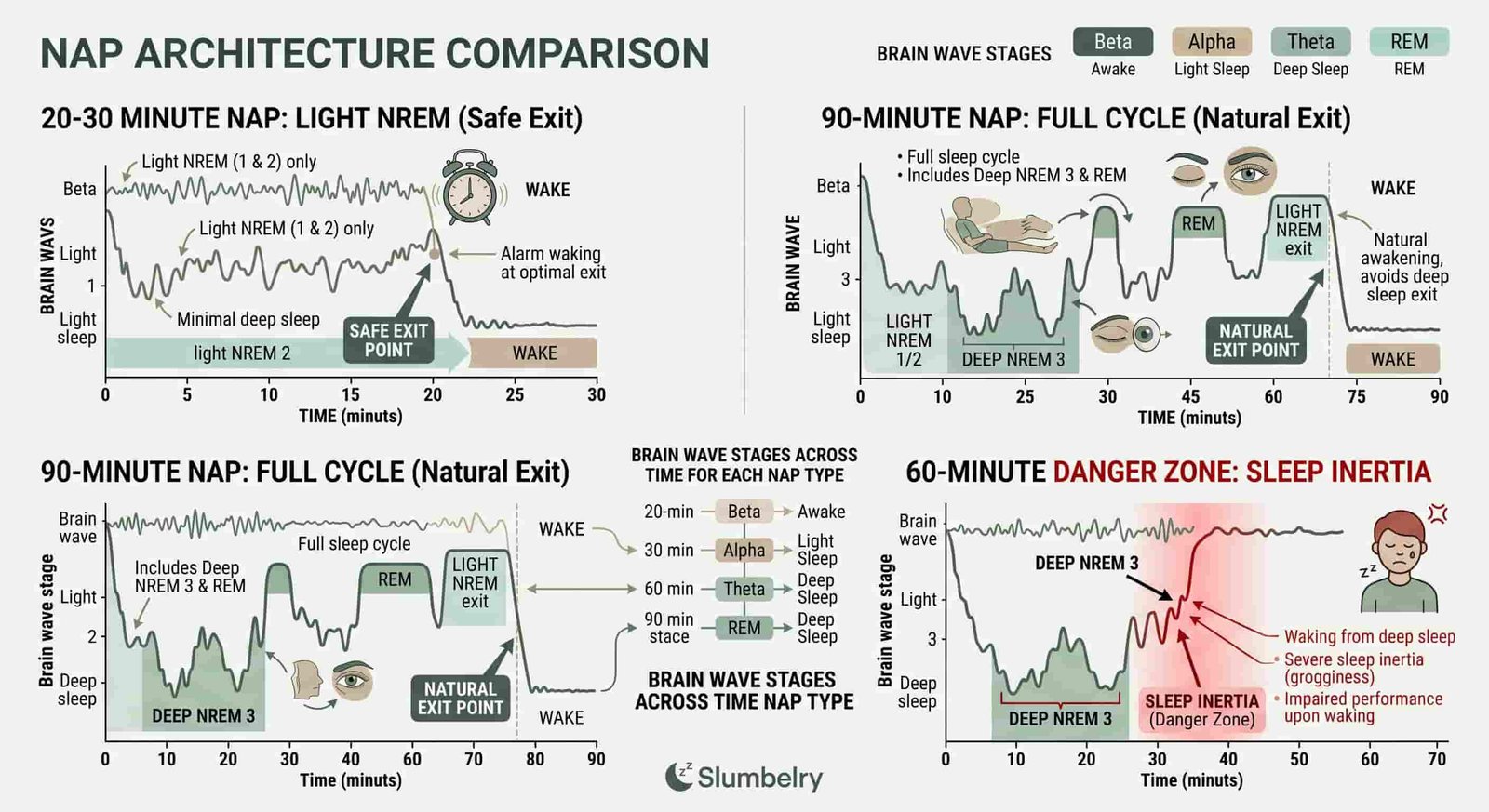
Why Is 90 Minutes the Only Other Valid Nap Duration Beyond 20-30 Minutes — and Why Does a 90-Minute Nap Complete One Full Sleep Cycle (Light, Deep, REM, Light) and Allow You to Wake From the Natural Cycle Exit Rather Than From Deep Sleep?
Direct Answer: A 90-minute nap completes one full sleep cycle — light sleep (NREM 1-2), deep sleep (NREM 3), and REM — and ends at the natural cycle exit point, where the brain is already in light sleep and ready to wake. This means you wake without sleep inertia and with the cognitive benefits of REM (working memory consolidation, emotional regulation) included. No other duration reliably achieves this: shorter than 90 minutes risks waking from deep sleep; longer than 90 minutes risks entering a second cycle and waking mid-cycle.
Mechanism: S1-2 and S2-3 on sleep cycle architecture and the 90-minute cycle: a complete sleep cycle (NREM 1-2 → NREM 3 → REM → exit) takes approximately 90 minutes in adults. The cycle exit occurs at the transition from light sleep to wakefulness, which is the natural wake point. At this point, the sleep-promoting mechanisms (adenosine accumulation, VLPO activation) have partially cleared, and the wake-promoting orexin neurons are beginning to fire again. Waking at this natural exit point produces minimal sleep inertia. The 90-minute nap also includes REM, which is why it is valuable for emotional memory consolidation, creative problem-solving, and motor skill learning — benefits that the 20-30 minute nap does not provide. The 90-minute duration is only appropriate when sleep deprivation is significant, because the full cycle provides more comprehensive adenosine clearance and the REM benefits are particularly valuable when the night sleep was truncated.
Why Does Napping After 5 PM Specifically Disrupt Nighttime Sleep Architecture — and What Is the ‘Sleep Pressure Dilution’ Problem Whereby an Evening CRP Reduces the Homeostatic Sleep Drive Needed for Nighttime Sleep Onset and Reduces Slow-Wave Sleep Proportion?
Direct Answer: Napping after 5 PM disrupts nighttime sleep because the afternoon CRP partially clears the accumulated adenosine and reduces the homeostatic sleep pressure that drives nighttime sleep onset — the same sleep pressure that produces slow-wave sleep (SWS) and the deepest, most restorative portion of the night’s sleep. An evening CRP ‘dilutes’ the sleep pressure available for nighttime sleep.
Mechanism: S1-1 and S2-3 on sleep pressure dilution and slow-wave sleep: the homeostatic sleep pressure (measured by slow-wave energy in EEG) builds across the day and is the primary driver of sleep onset latency and slow-wave sleep proportion at night. Slow-wave sleep (NREM 3) is the most physically restorative stage — it is when growth hormone is released, when the glymphatic system is most active, and when the immune system is reinforced. If an evening CRP clears a portion of the accumulated adenosine, the sleep pressure available for nighttime sleep is reduced. This produces longer sleep onset latency (taking longer to fall asleep) and reduces the proportion of slow-wave sleep in the first part of the night. For most people, the 5 PM cutoff is based on the pharmacokinetics of adenosine accumulation: a nap at 5 PM clears adenosine that would otherwise contribute to nighttime sleep pressure, and the adenosine cleared is proportionally larger than what would be cleared by waiting until the normal nighttime sleep onset. The 5 PM cutoff is not arbitrary — it is the point at which the sleep pressure dilution effect begins to meaningfully impact nighttime sleep quality.
What Is the Adenosine-Caffeine Mechanism — and Why Does Caffeine Work as an Adenosine Receptor Antagonist (Blocking the Sleep-Pressure Signal) and Why Does the CRP Accelerate Adenosine Clearance, Making the Evening Caffeine Effect More Effective After a Nap Than Without One?
Direct Answer: Caffeine is an adenosine receptor antagonist — it blocks adenosine from binding to A2A receptors, which suppresses the sleep pressure signal and produces subjective alertness. The CRP accelerates adenosine clearance through the glymphatic system during sleep, which means that after a CRP, the adenosine that caffeine would otherwise have to compete with is reduced — making caffeine more effective after a nap than before. This is why the nappuccino sequence (caffeine then nap) is more effective than caffeine alone.
Mechanism: S1-1 and S2-3 on adenosine clearance and glymphatic activation: adenosine accumulates in the basal forebrain during waking hours as a byproduct of ATP metabolism. During sleep — particularly during light sleep and deep sleep — the glymphatic system is activated and clears adenosine from the brain. The CRP (particularly the 20-30 minute variety) clears a portion of the accumulated adenosine. Because caffeine works as a competitive antagonist at the A2A receptor, its effectiveness is proportional to the amount of adenosine present. When adenosine levels are high (at the 2-3 PM dip), caffeine must compete with high adenosine concentration for receptor binding — its effect is blunted. After a CRP clears a portion of the adenosine, the residual adenosine concentration is lower, and the same dose of caffeine has more available receptors to block — producing a stronger, cleaner alertness effect. This is the physiological basis for why the nappuccino (caffeine before nap, not caffeine instead of nap) produces superior results compared to caffeine alone.
Why Is the ‘Nap Is Lazy’ Cultural Framing Neurobiologically Inaccurate — and What Does the Research Show About Strategic Napping Improving Reaction Time, Working Memory, Motor Skills, and Emotional Regulation, and Who Specifically Uses This System (F1 Drivers, Elite Footballers, CEOs)?
Direct Answer: The cultural framing of napping as laziness is neurobiologically incorrect because the afternoon dip is a predictable biological signal — not a character flaw. Research consistently shows that strategic napping improves reaction time (by 35-40%), working memory (by 15-25%), motor skills, and emotional regulation. This system is used by elite performers specifically because the performance benefit is measurable and significant.
Mechanism: S1-1 and S2-3 on the cognitive performance benefits of strategic napping: Lovato et al. (2013) found that a 10-minute nap produced significant improvements in alertness, cognitive performance, and mood that lasted up to 155 minutes after waking. A 20-30 minute nap (nappuccino) improves reaction time, working memory, and subjective alertness. The 90-minute full cycle nap includes REM, which consolidates procedural and emotional memory — improving motor skill learning and emotional regulation. The cultural stigma is precisely what prevents most people from accessing a performance tool that is used by the world’s most competitive individuals. F1 drivers use it between qualifying rounds; elite footballers use it between matches; CEOs use it before high-stakes meetings. The common factor is measurable performance gain, not laziness.
What Is the CRP (Controlled Recovery Period) Framework From Nick Littlehales — and Why Is Keeping the Bed for Night Sleep Only (and Daytime Napping Elsewhere) a Classical Conditioning Strategy That Prevents the Bed From Becoming a General Arousal Cue?
Direct Answer: The CRP (Controlled Recovery Period) framework from Nick Littlehales reframes napping as a performance tool rather than a recovery of last resort. The key practical rule is that the bed should be reserved exclusively for nighttime sleep — daytime CRPs should be taken elsewhere (reclining chair, parked car, quiet corner) to prevent the bed from becoming a general arousal cue and losing its conditioned association with nighttime sleep onset.
Mechanism: S1-1 and S2-3 on classical conditioning of the sleep environment: the bed should be a conditioned stimulus for nighttime sleep only. Classical conditioning of sleep works on the principle that repeated pairing of a stimulus (the bed) with sleep onset (the unconditioned response) produces a conditioned response (sleepiness upon entering the bed). If the bed is used for daytime napping (which is lighter, more voluntary, and physiologically different from nighttime sleep), the bed becomes associated with daytime sleep and the conditioned response to the bed weakens for nighttime sleep — this is the classical conditioning mechanism by which insomnia develops. Separating the bed for nighttime sleep only, and using other locations (reclining chair, couch, parked car) for daytime CRP, preserves the bed-sleep association exclusively for nighttime. This is the same principle behind stimulus control therapy for insomnia: the bed should only be associated with sleep, not with wakefulness, frustration, or daytime rest.
What Is the Complete Napping Protocol — and How Do You Time the Nappuccino (20-30 Min) Versus the 90-Minute Full Cycle, and What Environmental Conditions (Darkness, Eye Mask, Quiet) Maximize Fast Sleep Onset for a Daytime Nap?
Direct Answer: The complete napping protocol distinguishes between the nappuccino (20-30 minutes for a quick cognitive refresh) and the 90-minute full cycle (for severe sleep deprivation). Both require specific timing, environment, and post-nap protocols to deliver maximum benefit without disrupting nighttime sleep. The environmental setup for daytime napping should prioritize speed of sleep onset (to maximize time in actual sleep during the short window) and should never use the bed.
Mechanism: S1-1 and S4-4 on the complete napping protocol: the nappuccino protocol: drink espresso or black coffee immediately before lying down in a reclining chair or quiet space. Set a 20-30 minute alarm (30 minutes maximum). Use an eye mask for complete darkness — complete darkness accelerates sleep onset by 15-20 minutes by removing light cues that signal ‘daytime’ to the SCN. Use earplugs or noise-canceling headphones for acoustic isolation. The goal is light sleep only — NREM 1 and 2 — and waking at the alarm. If you take more than 10-15 minutes to fall asleep, the nap is not needed that day. The 90-minute full cycle protocol: only for use when nighttime sleep was significantly truncated (missed one or more 90-minute cycles). Set a 90-minute alarm and allow the full cycle to complete — waking at the natural exit point from light sleep, which is the only wake point that avoids sleep inertia. The 5 PM hard cutoff: no CRP after 5 PM. The glymphatic clearance from an evening nap dilutes the sleep pressure needed for nighttime sleep onset, reducing slow-wave sleep proportion and delaying sleep onset at night. Post-nap: give yourself 5-10 minutes of full wakefulness before attempting cognitively demanding tasks — the brain needs time to complete the sleep-to-wake transition even after a short nap.
Frequently Asked Questions
Why do I feel so tired in the afternoon around 2-3 PM?
Direct Conclusion: The 2-3 PM energy crash is not caused by food — it is a predictable circadian dip, the second sleep pressure peak of the day. Adenosine has been accumulating since morning, and the SCN generates a secondary trough in alertness around 1-3 PM. Most people override this signal with caffeine instead of using it strategically. The dip is as biological as the morning cortisol peak and is a legitimate window for a CRP.
What is the best nap length for adults?
Direct Conclusion: There are only two evidence-based nap durations: 20-30 minutes (nappuccino) and 90 minutes (full cycle). The 20-30 minute nap stays in light sleep and avoids sleep inertia. The 90-minute nap completes one full cycle and wakes you at the natural exit point. Nap durations between 30 and 90 minutes are specifically dangerous because they risk waking from deep sleep — triggering 30-60 minutes of cognitive impairment (sleep inertia).
Is it okay to nap after 5 PM?
Direct Conclusion: No. The 5 PM hard cutoff exists because an evening CRP clears adenosine that contributes to nighttime sleep pressure. This reduces the homeostatic sleep drive needed to fall asleep at your anchor time and reduces the proportion of slow-wave sleep in the first part of the night. Napping after 5 PM makes nighttime sleep onset harder, not easier — you fall asleep more slowly and sleep less deeply.
Does napping affect nighttime sleep?
Direct Conclusion: Yes — in two ways: (1) A daytime CRP clears accumulated adenosine, which reduces the sleep pressure available for nighttime sleep onset. This is why timing matters: the nappuccino before 3 PM clears adenosine that would otherwise contribute to nighttime sleep quality. (2) The duration matters: a 20-30 minute nappuccino clears a small portion and has a minor effect on nighttime sleep. A 90-minute CRP clears much more adenosine and can significantly reduce sleep onset latency at night if taken after 3 PM. Used correctly (20-30 min, before 3 PM), the nappuccino does not meaningfully disrupt nighttime sleep.
What is the nappuccino technique?
Direct Conclusion: The nappuccino is a 20-30 minute nap taken immediately after drinking caffeine (espresso or black coffee). Caffeine takes approximately 20 minutes to reach peak blood levels. A 20-30 minute nap provides 5-10 minutes to fall asleep plus 15-25 minutes of light sleep. You wake up just as caffeine is hitting peak receptor occupancy — adenosine clearance from light sleep plus alertness from caffeine simultaneously. This produces superior cognitive performance compared to caffeine alone or nap alone.
Is napping good for you or just laziness?
Direct Conclusion: Strategic napping is a performance tool with measurable cognitive benefits. Research shows 20-30 minute naps improve reaction time by 35-40%, working memory by 15-25%, and subjective alertness. The cultural framing of napping as laziness is neurobiologically inaccurate — the afternoon dip is a biological signal, not a character flaw. Elite performers use CRP specifically because it works: F1 drivers nap between qualifying rounds, elite footballers nap between matches, CEOs nap before high-stakes meetings.
Why do I feel worse after a nap?
Direct Conclusion: You feel worse after a nap because you woke from deep sleep — sleep inertia. The sleep inertia problem is most severe at the 45-60 minute mark, when most people have entered deep sleep (NREM 3). Waking from deep sleep produces 30-60 minutes of cognitive impairment that is measurably worse than before the nap. The fix is either a shorter nap (20-30 minutes, ending before deep sleep onset) or a longer nap (90 minutes, ending at the natural cycle exit from light sleep).
How long does it take for caffeine to work?
Direct Conclusion: Caffeine reaches peak plasma concentration 20-45 minutes after ingestion (average 30 minutes). Its subjective alertness effect peaks around 30-45 minutes. The half-life of caffeine is 4-6 hours, meaning that 4-6 hours after drinking coffee, half of the caffeine is still in your system. This is why caffeine after 2 PM can still be present at midnight — disrupting sleep onset even if it does not prevent you from falling asleep.
How do elite athletes use strategic napping?
Direct Conclusion: Elite athletes use CRP systematically: F1 drivers take 20-30 minute naps between qualifying rounds to reset reaction time and decision quality; elite footballers take 90-minute CRPs between matches to consolidate motor skill memory and reduce accumulated sleep pressure from travel; tennis players and NBA players use nappuccinos before critical matches. The common factor is precise timing (before 3 PM, not after 5 PM) and the nappuccino for quick resets or the 90-minute cycle for deeper recovery from sleep debt.
What is the CRP (Controlled Recovery Period)?
Direct Conclusion: The CRP (Controlled Recovery Period) is Nick Littlehales’ framework for re-framing napping as a performance tool. Key principles: (1) The only valid durations are 20-30 minutes and 90 minutes — nothing in between. (2) The bed is for nighttime sleep only; CRP is taken elsewhere. (3) The 5 PM hard cutoff protects nighttime sleep architecture. (4) Environmental setup (eye mask, earplugs, cool temperature) maximizes sleep onset speed. (5) The goal is not ‘falling asleep’ — 20 minutes of eyes-closed rest delivers 80% of the adenosine-clearing benefit even without sleep onset.
The Afternoon Dip Is a Signal, Not a Slump.
20-30 minute nappuccino before 3 PM: espresso, eye mask, 20-30 minute alarm. 90-minute full cycle only when sleep-deprived. 5 PM hard cutoff. Never use the bed for daytime CRP. The CRP is not laziness — it is precision. Set your timer next time the dip hits.
Eye Masks and Earplugs for CRP. The Complete CRP Protocol.The Slumbelry Commitment
Sleep is the most vulnerable state of human existence. It is where we heal, reset, and grow.
At Slumbelry, we do not just sell sleep products; we advocate for your physiological right to rest. From ergonomic support to light management, every solution we offer is designed with one obsession: Respecting your Biology.
Science is our language, but your recovery is our purpose. You take care of everything else in your life — let us take care of your nights.
Rest Deeply,
The Slumbelry Team