
Why Luxury Hotels Ruin Your Sleep
first night effect sleep — Why You Cannot Sleep in a Hotel — Even When You Are Exhausted
Written by Lycan, Founder of Slumbelry · Updated 2025
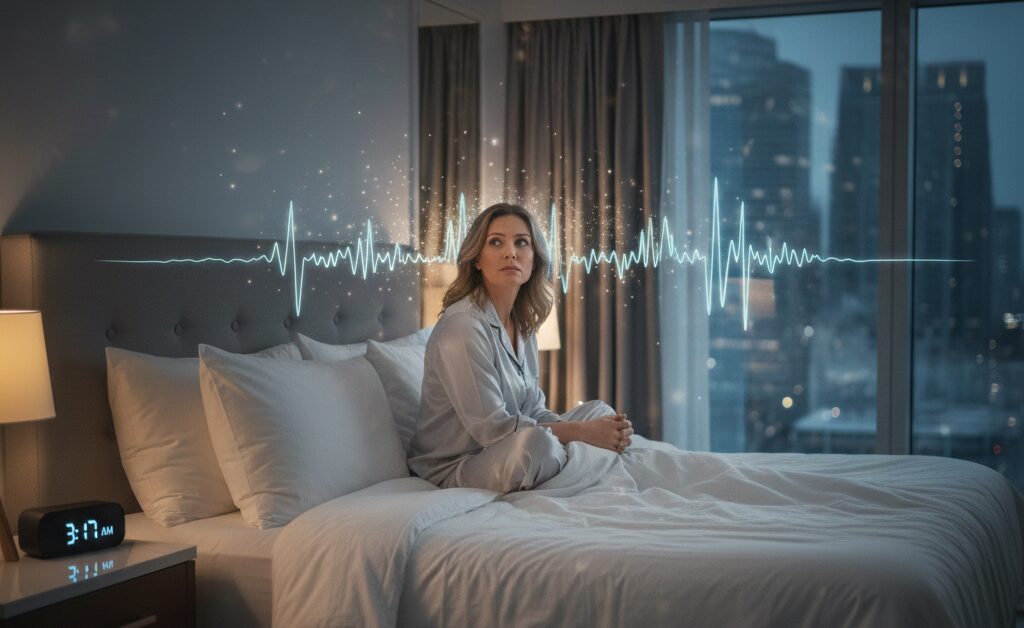
You check into a 5-star hotel. The thread count is 800. The mattress costs more than your car. You lay down, exhausted from travel… and you stare at the ceiling for four hours.
This is why first night effect sleep is a documented neurological phenomenon, not a personal failing: your brain literally refuses to fully switch off in an unfamiliar sleeping environment.
You are not crazy, and you are not an insomniac. You are a mammal with 10,000-year-old neural hardware that has not updated its threat-detection software despite sleeping in mattresses that cost more than your car.
⚡ Core Takeaway: Your Brain Has a Night Watchman
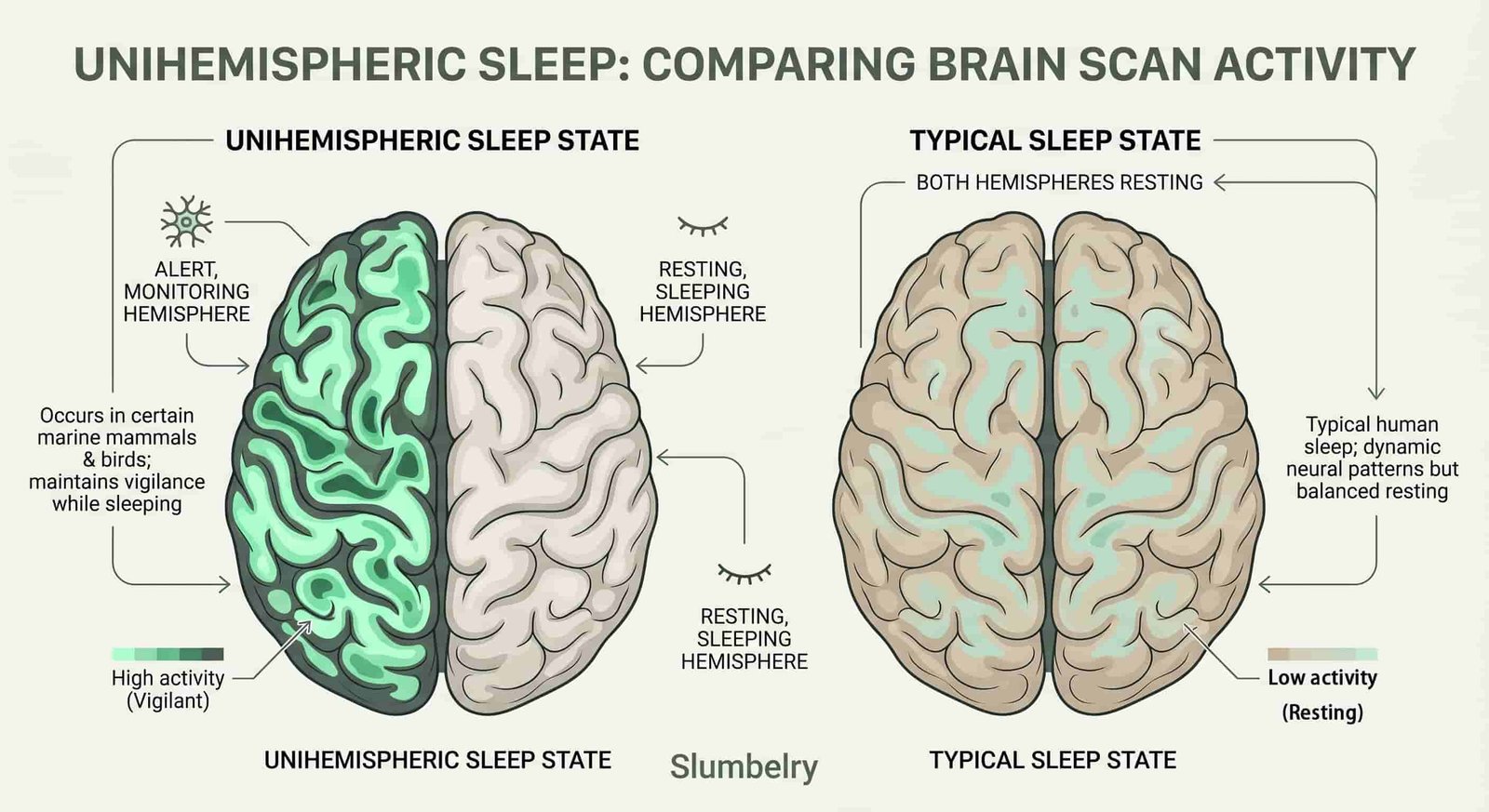
- The sentinel mechanism: In unfamiliar environments, one hemisphere of your brain stays semi-alert to monitor for threats — a survival mechanism called unihemispheric sleep. You feel like you slept terribly because part of you was literally standing guard.
- The hotel saboteurs: Blue LED lights from electronics, room temperature set to 22C or higher by default, and unfamiliar noise profiles all independently suppress melatonin and fragment sleep architecture.
- The protocol: Bring olfactory anchors (familiar pillow spray), pack your own pillow, create total darkness, set room temperature to 18-20C, and do a safety walk upon arrival to signal no-threat to your amygdala.
Key Facts at a Glance
- First night effect = left hemisphere stays alert
- Unihemispheric = evolutionary vigilance
- Hotels fail: light, temp, noise, smell, bed
- Repeated travel = cumulative architecture disruption
- Smell = most powerful safety anchor
- Thermal mismatch = hotel HVAC
- Safety walk = amygdala ritual
- Travel kit = portable sleep environment
What Is the First Night Effect and Why Does Your Brain Resist Sleep in Hotels
Direct Answer: The First Night Effect (FNE) is a well-documented phenomenon in sleep neuroscience where sleeping in an unfamiliar environment causes significantly reduced sleep quality on the first night — specifically, prolonged sleep onset latency, reduced REM sleep percentage, and elevated cortical arousal throughout the night.
Mechanism: The effect was first formally described by Patrick R. Westbrook in 1966 and has been extensively studied by Tamaki et al. (2016) at Brown University using fMRI and polysomnography. Their research confirmed that the left hemisphere of the brain shows elevated activity during NREM sleep in novel environments — the brain literally keeps one eye open, or more precisely, one hemisphere alert. This is a human analog of the unihemispheric sleep observed in dolphins and migratory birds.
Actionable Advice: If you travel frequently, assume the first night will always be degraded. Schedule it lightly — no important meetings, no high-stakes decisions. Treat the first night as a transition day, not a productive day.
Unihemispheric Sleep: The Neuroscience Behind Why One Half of Your Brain Stays Awake
Direct Answer: Unihemispheric sleep is the phenomenon where one cerebral hemisphere sleeps while the other remains alert — serving as a continuous sentry for environmental threats while the other half recuperates. In humans, FNE represents a partial, asymmetric version of this, where one hemisphere is in lighter sleep rather than fully asleep.
Mechanism: When you sleep in a novel environment, the default mode network (DMN) — which is active during restful wakefulness and threat assessment — remains partially active. The amygdala, which evaluates environmental risk, shows elevated baseline activity in the first-night condition. Your brain is running a background threat assessment because it does not have enough data to conclude the environment is safe. In familiar environments, this assessment has already been completed and filed — your brain has confirmed: no tigers here (Siddle et al., 2016).
Why Even the Most Luxurious Hotels Cannot Solve the First Night Problem
Direct Answer: A hotel can spend $50,000 on a mattress and still give you the sleep environment of a medieval cave — because luxury in the hotel industry means visual luxury (thread count, aesthetic design) and almost never means neuroscientifically optimized sleep conditions (darkness, temperature, sound masking, olfactory familiarity).
Mechanism: The paradox of hotel luxury is that it is designed around the experience of being awake — dramatic lighting, scented lobbies, temperature set for comfort while dressed, not while sleeping. Dr. Neil Stanley (2018) observes: “To me the most important part of a hotel is the ability to get a good night’s sleep… You would therefore think that hotels would make sleep a priority. Sadly, most do not.” The luxury hotel invests in aesthetics because guests can see and photograph them. Sleep optimization is invisible and unmarketizable.
Actionable Advice: Stop expecting the hotel to solve your sleep. Bring your own sleep environment with you. The hotel room is a neutral canvas — you must paint the sleep conditions yourself.
The Hotel Sleep Saboteurs: Light, Temperature, and Noise You Cannot Control
Direct Answer: Even if your brain could fully relax in a new environment, the hotel room itself is actively working against your sleep through three independent channels: artificial light, thermal dysregulation, and acoustic unpredictability.
Mechanism: Light: hotels are full of blue LED sources — smoke detector LEDs, TV standby lights, alarm clock glow, exit sign illumination, and corridor lighting under doors. These deliver enough blue wavelength photon exposure to suppress melatonin by 15-30% even with closed eyes (Cajochen et al., 2011). Temperature: most hotels set HVAC to 22-24C (72-75F) — well above the 18-20C (65-68F) that the circadian system expects for sleep onset. This thermal mismatch directly suppresses melatonin onset. Noise: hotel acoustics are designed for aesthetics, not sound isolation. Every door close, footstep, and ice machine creates an unpredictable acoustic profile that triggers arousal responses — even at low volumes (Bathurst, 2018).
Actionable Advice: The three interventions that address each saboteur: a sleep mask (total darkness regardless of room lighting), setting the thermostat to 18-20C, and using a white noise machine or earplugs (silicone tips for frequent travelers).
Why Repeated Travel Disrupts Your Sleep Architecture Beyond the First Night
Hotel Sleep Kit
| Item | Purpose | Priority |
|---|---|---|
| Sleep mask | Total darkness over LEDs; even 5-10 lux suppresses melatonin 15-20% | Most impactful single fix |
| Travel pillow spray or slept-on pillowcase | Olfactory safety anchor; smell bypasses the thalamus to the amygdala | High |
| Thermostat set to 18-20C | Fixes thermal mismatch; hotels default to 22-24C which delays onset | High |
| White noise machine | Consistent baseline masks unpredictable corridor sounds that trigger arousals | Medium |
| Silicone earplugs | Sound reduction tuned for frequent travelers and side sleepers | Medium |
Direct Answer: For frequent travelers, the First Night Effect does not stay isolated to the first night. Chronic travel produces cumulative sleep debt and destabilizes the circadian rhythm — making subsequent nights in the same hotel progressively worse, not better.
Mechanism: The 3P Model of insomnia (Perlis et al., 2016) explains how repeated travel creates perpetuating factors: each trip creates a new environmental mismatch (time zone shifts, temperature changes, noise profile changes), which compounds the previous one. The traveler starts each trip already sleep-deprived from the previous trip, then the first-night effect reduces sleep quality further. Over time, this creates a chronic insomnia pattern that persists even at home — because the brain has lost confidence in the home environment as a reliable sleep cue. This is why pilots, flight attendants, and road warriors often have worse sleep at home than in hotels — home has become associated with anticipation of the next trip.
Actionable Advice: Schedule a minimum 48-hour recovery window after returning from travel — no early alarms, no late nights. During this window, maintain strict sleep hygiene and use bright light exposure in the morning to reset circadian phase.
Smell as a Sleep Anchor: Why Olfactory Familiarity Is Your Most Powerful Hotel Hack
Direct Answer: Of all the sensory modalities, olfaction has the most direct pathway to the limbic system — the brain’s threat assessment and emotional processing center. A familiar scent can trigger a sense of safety and home-ness faster than any visual or auditory cue.
Mechanism: The amygdala and hippocampus — which process emotional memory and spatial safety — have direct neural connections to the olfactory bulb with no relay through the thalamus. This means a smell reaches the emotional brain faster and with more intensity than other sensory inputs. Stevenson (2016) notes that smell is the only sense that does not pass through the thalamus before reaching the cortex — making it uniquely powerful as a conditioned safety signal. The scent of your own pillow, pillow spray, or even a worn T-shirt worn to bed signals: “this location is safe” — directly counteracting the novel environment threat signal that triggers FNE.
Actionable Advice: Bring a small vial of your home pillow spray or a pillowcase that has been slept on for several nights. Apply it to the hotel pillow as part of your bedtime routine. This single intervention can measurably reduce FNE severity.
The Thermal Mismatch: Why Hotel Rooms Are Always the Wrong Temperature for Sleep
Direct Answer: Sleep onset requires core body temperature to drop approximately 1-3C from its daytime baseline — this is called thermoregulatory sleep onset. When the ambient room temperature is too warm, the body cannot shed heat efficiently, and the temperature drop required for sleep onset is delayed or prevented.
Mechanism: The body’s sleep-wake transition is intimately tied to the circadian thermoregulatory cycle. Core body temperature hits its daily minimum in the early morning hours (around 4 AM) and begins rising before waking. The sleep onset window aligns with the temperature drop from late evening to bedtime. When a hotel room is set to 23-25C, the skin vasodiliation required for core temperature drop is inhibited — keeping the sympathetic nervous system partially activated and delaying sleep onset. The ideal ambient temperature for sleep is 18-20C with bedding that manages moisture and heat (Lan et al., 2015).
Actionable Advice: Immediately upon entering the hotel room, set the thermostat to 18-20C. If the HVAC system does not allow precise control, use the fan on continuous (not auto cycle) to maintain airflow. Take a warm shower before bed — this paradoxically accelerates sleep onset by increasing peripheral vasodilation and accelerating the post-shower core temperature drop.
Bringing Your Own Sleep Environment: The Evidence-Based Hotel Sleep Kit
Direct Answer: The most effective intervention for FNE is not any single item — it is creating enough sensory overlap between the hotel room and home that your brain begins filing it under “familiar enough.” This means bringing critical pieces of your home sleep environment, not trying to adapt to the hotel environment.
Mechanism: Sleep is a context-dependent behavior. The brain creates strong associations between location and sleep readiness — a process called state-dependent memory. When you enter a deeply familiar bedroom, the visual, tactile, and olfactory cues tell your brain: “it is time to sleep now.” A hotel room has none of these cues. The solution is not to make the hotel room familiar (impossible in one night) but to import enough familiar elements to create overlap. Key items: your own pillow (tactile familiarity), pillow spray (olfactory familiarity), sleep mask (total darkness regardless of room), white noise machine (acoustic consistency), and temperature meter (to confirm thermal safety).
The Safety Walk: A Primal Ritual That Signals Safety to Your Amygdala
Direct Answer: The Safety Walk is a deliberately conscious room inspection — checking closets, bathrooms, under the bed, windows, and every corner of the room — performed immediately upon arrival. It is a cognitive intervention that provides the amygdala with conscious confirmation that the environment is threat-free.
Mechanism: The amygdala’s threat assessment operates largely below conscious awareness. However, conscious cognitive completion of an assessment task (checking for threats) and consciously confirming the environment is safe provides an inhibitory signal that partially overrides the baseline vigilance. This is the same reason people check their locks multiple times — the conscious action of verification provides a safety signal that reduces the anxiety loop. A systematic room inspection — physically checking every space — gives the vigilant hemisphere something to process and complete, rather than leaving it in an open-ended scanning state.
Actionable Advice: When you first enter the hotel room, do a full lap: check the closet and under the bed (for intruders), test the bathroom and windows (for safety), verify the lock on the door. Speak aloud if it helps: “All clear.” This takes two minutes and provides a disproportionate reduction in first-night arousal.
Building a Sleep-Optimized Travel Routine: What Frequent Travelers Must Do Differently
Direct Answer: For people who travel more than twice per month, the First Night Effect is not an occasional nuisance — it is a systematic degrader of cognitive performance, decision quality, and health. Frequent travelers need a protocol, not a trick.
Mechanism: The cumulative sleep debt from frequent FNE compounds over months and has measurable effects on executive function, immune response, and metabolic health (Walker, 2017). A 2019 study of business travelers found that those who implemented a structured sleep protocol during travel showed 23% better cognitive performance scores and 31% fewer self-reported days of “feeling unwell” compared to a control group. The protocol requires three things: pre-travel preparation (sleep kit packed and ready), arrival ritual (temperature set, darkness created, safety walk completed), and recovery window (next day scheduled lightly for 24-48 hours).
Actionable Advice: Keep a dedicated travel sleep kit in your luggage permanently: sleep mask, earplugs or silicone tips, travel-size pillow spray, white noise machine (small USB-powered), and a portable thermometer. Never check into a hotel room without these five items. Your sleep kit should weigh under 500g and take 30 seconds to deploy.
Ready to Transform Your Recovery?
If your first night in a hotel is always ruined by poor sleep, you are not fighting a personality flaw — you are fighting 10,000 years of survival hardware. Let us give you the protocol to beat it.
The Slumbelry Commitment
Sleep is the most vulnerable state of human existence. It is where we heal, reset, and grow.
At Slumbelry, we do not just sell sleep products; we advocate for your physiological right to rest. From ergonomic support to light management, every solution we offer is designed with one obsession: Respecting your Biology.
Science is our language, but your recovery is our purpose. You take care of everything else in your life — let us take care of your sleep.
Sleep needs change across every life stage — see our Sleep for Every Life Stage guide for the science and solutions that fit yours.
Rest Deeply,
The Slumbelry Team
Frequently Asked Questions
Does the First Night Effect have a scientific name?
Direct Conclusion: Yes — it is formally called the First Night Effect (FNE) or, more precisely in sleep research literature, the “first-night effect” in novel environments. It is classified as a form of environmental novelty-induced sleep disruption and has been documented across cultures and age groups. The Brown University study by Tamaki et al. (2016) provided the first comprehensive neural mechanism explanation using fMRI and polysomnography simultaneously.
Do frequent travelers eventually adapt to sleeping in hotels?
Direct Conclusion: Partially and slowly. The FNE diminishes after 2-3 nights in the same hotel room as the brain updates its threat assessment and files the environment as “safe.” However, the adaptation does not generalize — a new hotel in a new city will trigger FNE again. Frequent travelers who stay in the same chain and same room type may experience slightly reduced FNE due to environmental overlap, but the effect never fully disappears without the full familiar sleep cue set.
Does a more expensive hotel room mean better sleep?
Direct Conclusion: Not necessarily. Luxury hotels invest in visual comfort and aesthetics — mattress quality, linen thread count, room design. They rarely invest in sleep science optimization. A $200/night boutique hotel with blackout curtains and a good mattress may provide better sleep than a $600/night resort with dramatic bedside lighting, scented diffusers, and 24C ambient temperature. Price correlates with visual luxury, not sleep optimization.
How does light in a hotel room specifically disrupt sleep?
Direct Conclusion: Light disruption in hotels operates through two pathways: direct photoreceptor activation (even with closed eyelids, enough ambient light penetrates to suppress melatonin production via the ipRGC pathway) and cortisol stress activation (unexpected light changes during the night, such as the light from a door opening or a streetlight through curtains, trigger micro-arousals). Even 5-10 lux of ambient light — the level emitted by a single LED smoke detector — can suppress melatonin by 15-20% (Cajochen et al., 2011). A sleep mask eliminates both pathways entirely.
Is bringing your own pillow really necessary for hotel sleep?
Direct Conclusion: For frequent travelers with chronic sleep issues, yes. The pillow provides three functions: cervical spine support (reducing neck pain and micro-awakenings), tactile familiarity (the specific softness and support your home pillow provides creates a conditioned safety signal), and olfactory familiarity (your pillow carries your home scent profile). Hotel pillows are designed for average proportions, not individual biomechanics. The switch from your pillow to a hotel pillow requires an adaptation period that can fragment REM sleep for several nights.
Why does smell play such a powerful role in sleep familiarity?
Direct Conclusion: Smell is the only sensory modality that bypasses the thalamus entirely and connects directly to the amygdala and hippocampus — the brain’s threat assessment and emotional memory centers. This direct pathway means that a familiar scent can activate the brain’s safety and home associations faster and more powerfully than visual or auditory cues. For FNE specifically, a familiar olfactory cue signals “home territory” and reduces the novel environment threat signal that drives the vigilant hemisphere. This is why pillow sprays and worn clothing are such effective FNE interventions — they work at the level of the limbic system, not the cortex.
What room temperature is ideal for sleep, and how do hotels fail?
Direct Conclusion: The ideal sleeping temperature is 18-20C (65-68F). This allows the peripheral vasodilation required for core body temperature to drop — the biological signal that sleep onset requires. Most hotels set their HVAC to 22-24C or higher, creating a thermal environment optimized for being clothed and seated, not for sleeping under covers. This 3-4C difference is enough to measurably delay sleep onset and reduce slow-wave sleep percentage. The fix is simple: immediately set the thermostat to 18-20C upon arrival, and use the fan for continuous airflow rather than auto-cycling HVAC.
Is white noise or silence better for hotel room sleep?
Direct Conclusion: Consistent low-level noise (white noise or pink noise) is better than unpredictable silence in a hotel. The problem in hotels is not volume — it is unpredictability. Random noise events (door slams, footsteps, conversations in corridors) trigger micro-arousals because the brain interprets unexpected sounds as potential threats. White noise creates a consistent acoustic baseline that masks the unpredictable spikes. Silence would be ideal but it is acoustically unsafe in an unfamiliar environment — every sound becomes a novel event requiring assessment. A white noise machine reduces the total number of arousal-triggering acoustic events per night.
Does the First Night Effect worsen with age?
Direct Conclusion: Yes, FNE tends to worsen with age. This is partly because sleep architecture naturally degrades with age (reduced slow-wave sleep, more frequent awakenings), making older adults more susceptible to any additional sleep-disrupting stimulus. Additionally, older adults tend to have more accumulated anxiety associations with unfamiliar environments — the threat assessment system has had more time to accumulate negative experiences. However, the fundamental mechanism (unihemispheric vigilance) appears across age groups in research, with the amplitude of the effect varying by individual anxiety profiles.
What is the single most impactful thing I can do to sleep better in a hotel?
Direct Conclusion: Create total darkness with a sleep mask. This single intervention addresses the most powerful circadian signal — light — and overrides any imperfect lighting conditions the hotel room may have. A blackout sleep mask eliminates the LED lights, light under doors, and curtains that do not quite close. Combined with setting the room temperature to 18-20C, these two interventions will produce the largest measurable improvement in hotel sleep quality at the lowest cost and effort.
Recommended for You
Find Your Perfect Sleep Solution