
screen time and sleep — Why Your Phone Is the Worst Thing in Your Bedroom — And It Is Not Just the Notifications
You brush your teeth, climb into bed, and reach for your phone to set the alarm. Then a notification pops up. Or you just want to check the weather. Or send one last text. Suddenly it is 11:45 PM and you are wide awake, scrolling through a feed of news, memes, and other people’s vacations.
This is why screen time and sleep is a modern epidemic: the blue light from your screen is biologically tricking your brain into believing the sun is still up — every single night.
Sleep specialists now consider screen use the primary precipitating and perpetuating factor for chronic insomnia in adults under 50. And unlike caffeine, you cannot simply avoid it — it is woven into the fabric of modern evening life.
⚡ Core Takeaway: The Dopamine Trap
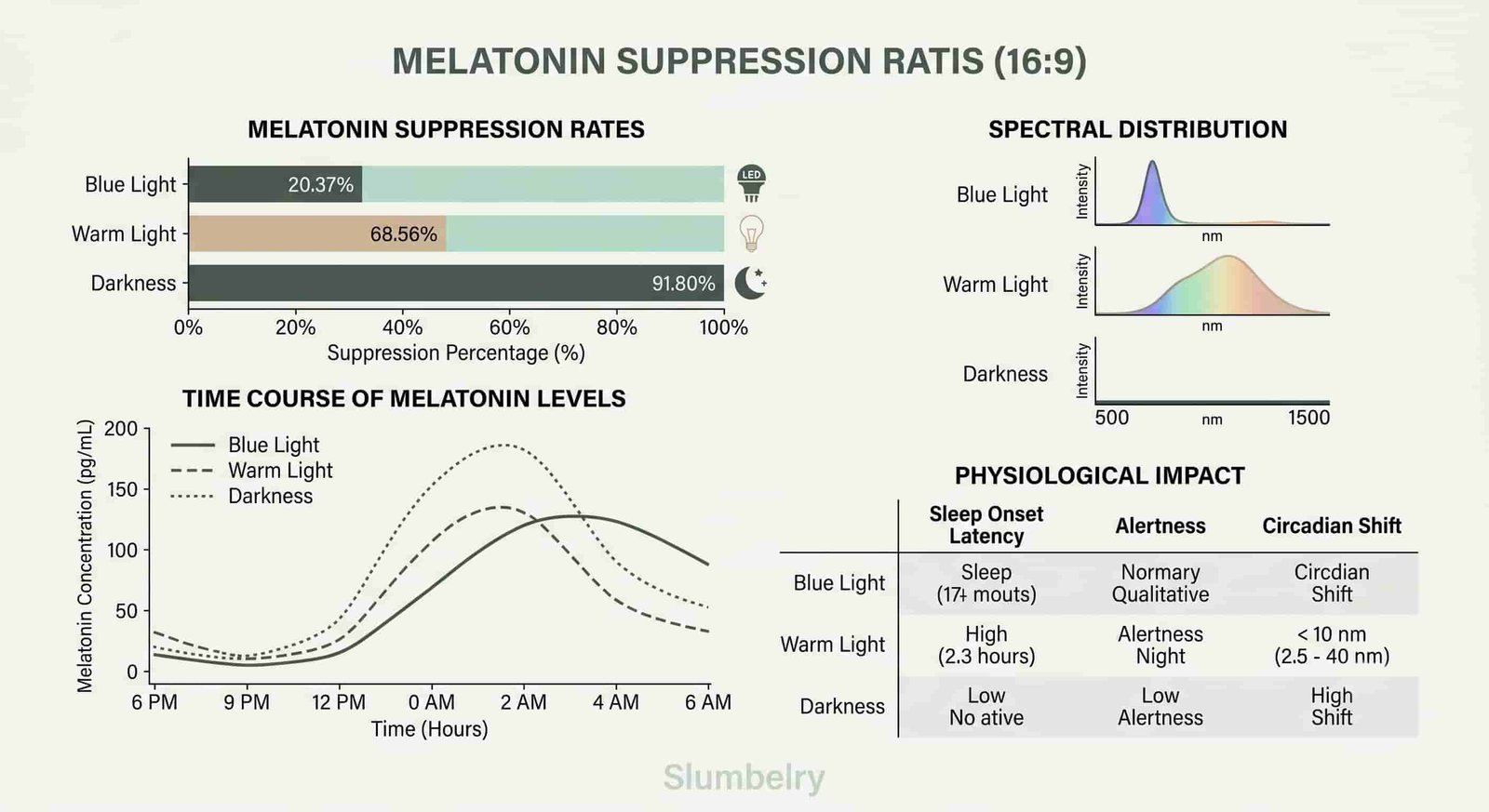
- The melatonin effect: Blue light at 460-480nm suppresses melatonin production twice as effectively as other wavelengths. Thirty minutes of screen use at 11 PM can delay sleep onset by up to 90 minutes.
- The content problem: Social media and news trigger cortisol and dopamine spikes. Scrolling is neural wind-up; sleep requires wind-down. You are revving your engine while parking the car.
- The protocol: A 60-minute pre-bed digital blackout, Night Shift mode after sunset, charging phones outside the bedroom, and blue light blocking glasses if evening screen use is unavoidable.
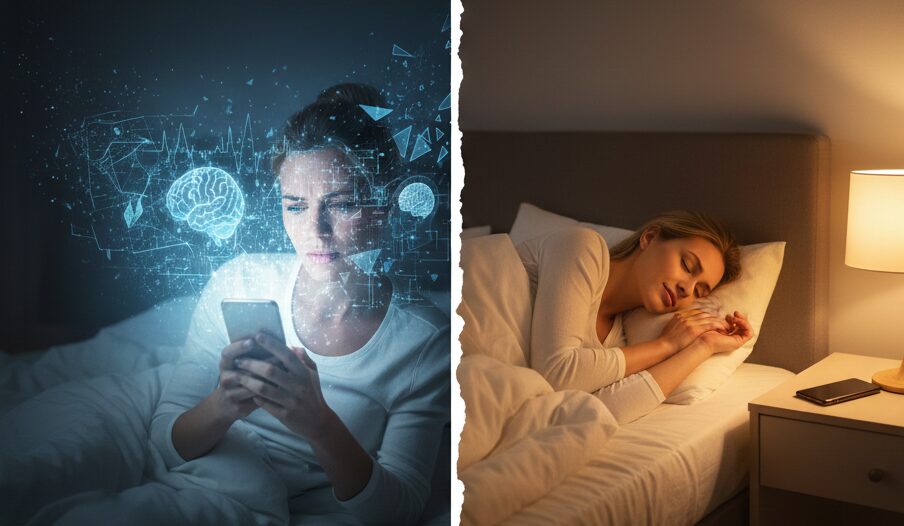
What Happens to Your Brain When You Use a Phone Before Bed
Direct Answer: When you use a phone, tablet, or laptop in the 60-90 minutes before sleep, you are not just delaying your bedtime — you are actively disrupting the neurological signal that tells your brain it is nighttime.
Mechanism: Your suprachiasmatic nucleus (SCN) — the master clock in the hypothalamus — uses light as its primary input signal. It receives input from specialized photoreceptor cells in the retina (intrinsically photosensitive retinal ganglion cells, or ipRGCs) that are most sensitive to blue light at 460-480nm. When these cells detect blue-wavelength photons, they signal the SCN to suppress melatonin production and release cortisol, effectively telling your body: “The sun is up, stay alert” (Cajochen et al., 2011).
Actionable Advice: Track when you use your phone on two consecutive nights without changing anything. Most people are surprised to find they use it for 40-70 minutes in bed — time that is directly subtracted from their sleep opportunity.
The Melatonin Hijack: Why Blue Light Is More Damaging Than Caffeine
Direct Answer: Caffeine keeps you awake by blocking adenosine receptors — a temporary masking effect that wears off within hours. Blue light, by contrast, actively suppresses the production of the hormone that makes sleep possible in the first place. Caffeine is a workaround; blue light is a biological override.
Mechanism: Studies at the University of Toronto found that blue light at 460nm suppresses melatonin production twice as effectively as light of equal photon density at longer wavelengths. A 2015 study by Chang et al. found that reading on a light-emitting e-reader before bed reduced melatonin secretion by 55% and reduced sleep quality by 20%, compared to reading a printed book. Walker (2017) notes that a single night of blue light exposure can shift your circadian phase by 3+ hours — equivalent to traveling three time zones westward.
Actionable Advice: Treat your phone like a pair of sunglasses after sunset. Just as you would not wear dark sunglasses at noon, you should not expose your eyes to blue light when your brain needs darkness signals.
It’s Not Just Light — Why the Content You Consume Is Keeping You Awake
Direct Answer: Even if you eliminate the blue light entirely, the information entering your brain through screens — social media, news, work emails — is neurologically incompatible with sleep onset.
Mechanism: The 3P Model of insomnia (Perlis et al., 2016) identifies precipitating and perpetuating factors that maintain sleep disruption. Screens deliver both simultaneously: a work email spikes cortisol (precipitating factor), while social media’s infinite scroll triggers dopamine anticipation loops (perpetuating factor). The result is heightened physiological arousal at a time when the autonomic nervous system needs to shift into parasympathetic dominance. This is why sleep specialists call evening screen use a behavioral wake-up signal — a trigger that keeps the nervous system in alert mode.
Actionable Advice: Separate the light problem from the content problem. If you must read the news, do it in the morning. If you must use social media, do it in blocks during the day, not as a pre-sleep wind-down ritual. Treat screens as daytime tools only.
Blue Light Blocking Glasses: Do They Actually Work?
Direct Answer: Yes — with caveats. The evidence for amber-tinted blue light blocking glasses is surprisingly strong. Glasses that filter wavelengths below 500nm have been shown to preserve melatonin production and improve sleep quality in evening screen users.
Mechanism: A 2019 randomized controlled trial by Lawrance et al. published in Sleep found that wearing blue-blocking glasses for three hours before bed reduced cortisol levels before sleep and increased melatonin by 58% compared to clear lenses. The effect was strongest when worn for the full pre-sleep window, not just the last 30 minutes. This is not a substitute for digital sunset protocols — it is a harm reduction tool for people who cannot fully disconnect.
Actionable Advice: If you have any evening screen use, invest in amber-tinted glasses that filter at least 80% of blue light. Put them on when you start your wind-down routine, not when you get into bed.
The Circadian Rhythm Disruption: Why One Late Night Can Spiral Into Days of Poor Sleep
Direct Answer: A single episode of late-night screen use does not just cost you one night’s sleep. It can shift your circadian rhythm by hours, creating a cascading effect that lasts for days.
Mechanism: The circadian clock is not just a daily timer — it is a seasonal one as well. Light exposure, particularly in the evening, shifts the phase of your circadian rhythm (St Hilaire et al., 2012). When you stay up late scrolling on Sunday night, you shift your circadian phase later. Monday morning you wake up at the same time but your biology thinks it is still Sunday night — producing the “social jet lag” phenomenon. This explains why one late night of screen use can make you feel out of sync for the entire week.
Actionable Advice: Keep a consistent wake time within 30 minutes, even on weekends. Use bright light exposure first thing in the morning (within 30 minutes of waking) to reset your circadian phase. One morning session of sunlight or a 10,000-lux light box can counteract an evening of late screen use.
The Dopamine Loop: Why You Cannot Stop Scrolling Even When Exhausted
Direct Answer: The infinite scroll is architecturally designed to prevent you from stopping. Each piece of content triggers a small dopamine release — and each pause creates anticipation for the next hit. Exhaustion does not override this because the dopamine system operates independently of the sleep pressure system (adenosine).
Mechanism: Adenosine (sleep pressure) and dopamine (motivation/reward) are separate neurochemical systems that both influence behavior but through different pathways. You can be deeply sleep-deprived (high adenosine) and still scroll compulsively (dopamine-driven). This is why willpower is ineffective against the scroll: you are not fighting tiredness, you are fighting a neurological reward loop that is literally designed to override conscious control (Montague et al., 2012).
Actionable Advice: Change the environment, not the willpower. Remove the scroll app or the phone from reach. Use app timers (iOS Screen Time / Digital Wellbeing) with hard daily limits that you cannot override after 9 PM. Physical removal is more effective than any intention-based strategy.
Screen Time and Cortisol: Why Bad News at Night Hits Harder Than Morning
Direct Answer: Emotional content — especially negative news — triggers cortisol release. Cortisol is meant to be at its daily lowest in the hour before sleep. Evening screen use that includes news, social conflicts, or work emails elevates cortisol at precisely the wrong time, directly opposing sleep onset.
Mechanism: The hypothalamic-pituitary-adrenal (HPA) axis activates cortisol in response to perceived threats or emotional stimulation. Evening news — designed around conflict, crisis, and fear — is one of the most efficient triggers of this activation. A 2013 study published in Journal of Communication found that participants who watched negative news in the evening showed significantly higher cortisol responses and took longer to fall asleep than those who watched neutral content or no news (Sorensen, 2013). Your brain processes evening news as a threat, not information.
Actionable Advice: Make evening screen time purely recreational and low-stakes: music, comedy, cooking videos — not news, not work emails, not social comparisons. If you must check the news, do it once in the morning, not at night.
Creating Your Digital Sunset: The Evidence-Based Protocol
Direct Answer: A digital sunset is a deliberate, pre-scheduled transition from screen-based activities to analog ones, mirroring the natural loss of sunlight that historically signaled the brain to produce melatonin. It is not about willpower — it is about architecture.
Mechanism: The optimal digital sunset targets the 60-90 minutes before your target bedtime. During this window, all screens should be powered down or placed in another room. The goal is to let your suprachiasmatic nucleus register the absence of blue light and begin melatonin production without interruption. Studies on circadian entrainment show that the longer and more complete the digital blackout, the stronger the melatonin response (Wright et al., 2013). Even one night of full compliance produces measurable improvements in sleep onset latency.
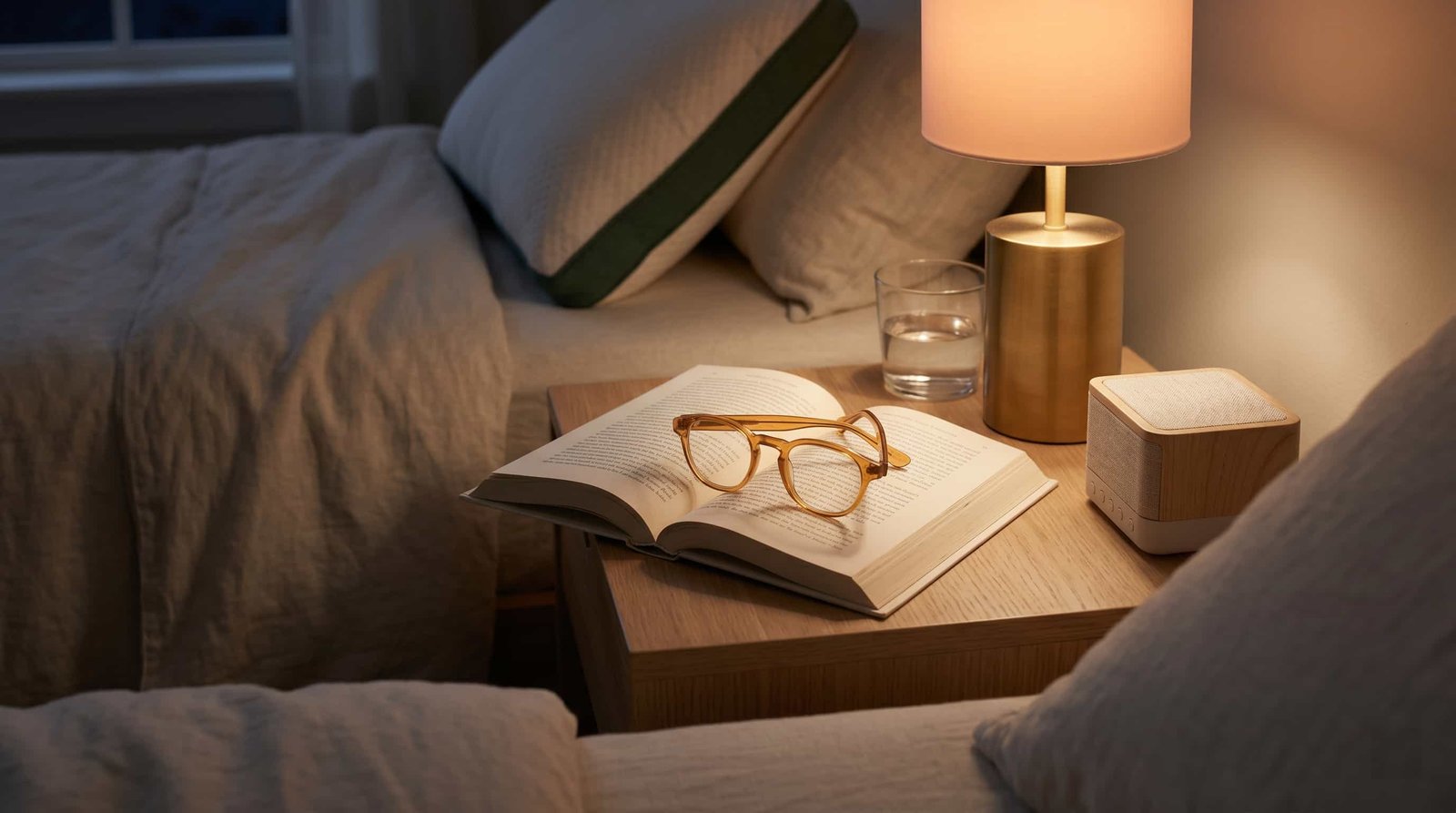
Actionable Advice: Set a daily alarm labeled “Digital Sunset” that triggers your wind-down protocol. Replace screen time with: reading physical books, journaling, gentle stretching, partner conversation, or a warm shower. These activities activate the parasympathetic nervous system and facilitate sleep onset.
What If You Must Use a Screen Late? The Harm Reduction Guide
Direct Answer: Complete abstinence from evening screens is the ideal — but if you have genuine evening work requirements or caregiving responsibilities, a layered harm reduction approach reduces the damage significantly.
Mechanism: Layer 1: Enable Night Shift mode (iOS) or Eye Comfort Shield (Android) — these shift the color temperature toward amber, reducing blue wavelengths by 40-60%. Layer 2: Reduce screen brightness to the lowest tolerable level — brightness directly correlates with ipRGC activation. Layer 3: Wear amber-tinted blue light blocking glasses over the screen. Layer 4: Increase the distance between your eyes and the screen — doubling the distance quarters the light intensity. Layer 5: Limit use to essential tasks only, with a hard 30-minute maximum.
Actionable Advice: Treat these as temporary bridges, not permanent solutions. If you consistently need evening screen use for work, consider whether your work schedule can shift earlier — your biology has not adapted to the 9-5 schedule and never will.
Reclaiming Your Bedroom as a Sleep Sanctuary
Direct Answer: The bedroom evolved as the location of two activities: sleep and intimacy. Every object in your bedroom — including devices — signals to your brain what that space is for. A phone in bed signals: “this is a waking, alert space.” A bedroom without devices signals: “this is for sleep.”
Mechanism: Classical conditioning — the same mechanism by which a bed becomes a place you associate with alertness (work, scrolling, stress) rather than sleep — can be reversed through environmental control. The stimulus control component of CBT-I specifically targets this: the bed is for sleep and sex only. No reading, no TV, no scrolling. When you get into bed and reach for your phone, you are teaching your brain that bed equals wakefulness (Trauer et al., 2015).
Actionable Advice: Buy a dedicated analog alarm clock. Charge your phone in another room — not the bedroom, not even on the nightstand. Keep your bedroom exclusively for sleep and intimacy. Within 2-3 weeks, your brain will re-associate the bedroom with sleep, and you will find it easier to fall asleep within minutes of getting into bed.
Frequently Asked Questions
Does blue light really suppress melatonin, or is this exaggerated?
Direct Conclusion: It is not exaggerated — it is one of the most well-replicated findings in sleep science. Blue light at 460-480nm suppresses melatonin more effectively than any other wavelength. Chang et al. (2015) found a 55% reduction in melatonin in e-reader users compared to print readers. This is not marginal; it is a fundamental disruption of the sleep-onset signal.
How long before bed should I stop using my phone?
Direct Conclusion: Sixty to 90 minutes before your target bedtime is the evidence-based minimum. The goal is to allow your suprachiasmatic nucleus to register the absence of blue light and initiate melatonin production before you enter the sleep-onset window. If you must use a screen, use amber-tinted glasses and Night Shift mode — but this is harm reduction, not the ideal.
Do blue light blocking glasses actually help with sleep?
Direct Conclusion: Yes, for evening use. Randomized controlled trials show that amber-tinted blue light blocking glasses worn for 2-3 hours before bed preserve melatonin production and improve sleep quality. The key is starting them early enough — not just at bedtime — and ensuring they block at least 80% of blue light below 500nm. Clear “computer glasses” without the amber tint are significantly less effective.
Is reading on a Kindle or e-reader better than a phone?
Direct Conclusion: It depends on the e-reader type. E-ink Kindles (without front lighting) emit no blue light and are essentially equivalent to reading a physical book. Tablets and backlit e-readers like the Kindle Paperwhite’s front light still emit blue light, though less than phones. For maximum sleep compatibility, a physical book or an e-ink device with no backlight is the best choice. If you must read on a device, enable Night Shift and wear amber glasses.
Does Night Shift or f.lux actually reduce blue light enough to matter?
Direct Conclusion: Yes, but partially. Night Shift and f.lux shift the color temperature of the screen toward amber, reducing blue wavelengths by approximately 40-60% at maximum setting. This is meaningfully better than nothing and is supported by research. However, it is not equivalent to a full digital sunset — the remaining blue light still has some melatonin-suppressing effect. Think of it as partial harm reduction, not full protection.
Why do I feel more anxious after reading news at night?
Direct Conclusion: Because negative news triggers the HPA axis and cortisol release — and your brain’s threat detection system is maximally sensitive in low-light conditions. In darkness, without the moderating influence of daylight and social context, emotionally negative content is processed with heightened intensity. Your amygdala responds more strongly at night because the prefrontal cortex (which moderates emotional responses) is already compromised by fatigue.
Can I use my phone as an alarm clock without ruining my sleep?
Direct Conclusion: Only if you keep it out of arm’s reach and put it in airplane mode before bed. The problem is not the alarm function — it is the device. The presence of the phone in the bedroom, even on silent, creates the temptation to check it. Studies on bedroom device presence consistently show that phones in the bedroom are associated with poorer sleep quality, independent of actual usage time. Charge it across the room; use a dedicated alarm clock.
What is the difference between blue light and the content itself in disrupting sleep?
Direct Conclusion: Blue light disrupts the biological signal for sleep (the circadian phase shift and melatonin suppression). Content disrupts the psychological readiness for sleep (cortisol, dopamine, emotional arousal). Both operate independently and synergistically — which is why screens are uniquely damaging compared to other evening light sources. A dim book with a warm lamp has no content-driven arousal. A news article on Night Shift mode has reduced blue light but full content-driven cortisol activation.
How does screen light affect REM sleep specifically?
Direct Conclusion: Blue light exposure before bed reduces the total amount and percentage of REM sleep, not just sleep onset latency. Walker (2017) notes that the circadian timing of light exposure determines which sleep stages are most affected. Light exposure in the early evening specifically suppresses REM in the first part of the night, when REM pressure is highest. Since REM is critical for memory consolidation and emotional regulation, this means that screen use before bed impairs the cognitive functions you rely on most the next day.
What are the best alternatives to screen time before bed?
Direct Conclusion: The best alternatives are activities that activate the parasympathetic nervous system and do not involve information processing or emotional engagement: reading physical books or magazines, journaling or writing, gentle stretching or yoga nidra, taking a warm shower (which raises body temperature and accelerates sleep onset afterward), listening to music or podcasts (with eyes closed), and partner conversation or physical intimacy. These activities lower cortisol, raise adenosine, and facilitate the wind-down that sleep requires.
Ready to Transform Your Recovery?
If your phone is the last thing you touch at night and the first thing you reach for in the morning, you are living in a perpetual state of circadian disruption. Discover how to reclaim your nights.
Take the Sleep Assessment Explore Our Cooling MattressThe Slumbelry Commitment
Sleep is the most vulnerable state of human existence. It is where we heal, reset, and grow.
At Slumbelry, we do not just sell sleep products; we advocate for your physiological right to rest. From ergonomic support to light management, every solution we offer is designed with one obsession: Respecting your Biology.
Science is our language, but your recovery is our purpose. You take care of everything else in your life — let us take care of your sleep.
Rest Deeply,
The Slumbelry Team