
How to clear your mind before sleep — Why Your Brain Has 50 Tabs Open at Night and the Reverse Day Review That Signals to the Hippocampus ‘Today Is Done’
The day is done, but your brain is still replaying snippets of conversations, emails, and regrets. It feels like you have 50 browser tabs open. You cannot just ‘close’ them — you have to review the data to file it. how to clear your mind before sleep is not about suppressing the replay — it is about providing the brain with a conscious closure signal so the replay can proceed as biological memory consolidation rather than cognitive rumination. The reverse day review uses reverse chronological observation of the day’s events to give the hippocampus the ‘all files acknowledged’ signal, closing the Zeigarnik loop and signaling to the prefrontal cortex that the day is filed.
⚡ Core Takeaway: The Reverse Day Review Works by Providing Conscious Closure to the Brain’s Memory Consolidation Process — Reviewing the Day in Reverse Chronological Order Functions as a Manual Filing System That Signals ‘All Tabs Are Closed’ to the Hippocampus, Eliminating the Zeigarnik Loop That Prevents Sleep Onset
- The Problem: When you lie awake at night replaying the day, you are experiencing the Zeigarnik effect — the brain’s monitoring system keeps open goals (unresolved experiences) cognitively active. The hippocampus is also in replay mode, trying to consolidate the day’s memories. Both processes require prefrontal cortex resources, and both block sleep onset. The intervention is not to suppress the replay — it is to provide the ‘file complete’ signal so the replay proceeds as biology rather than as rumination
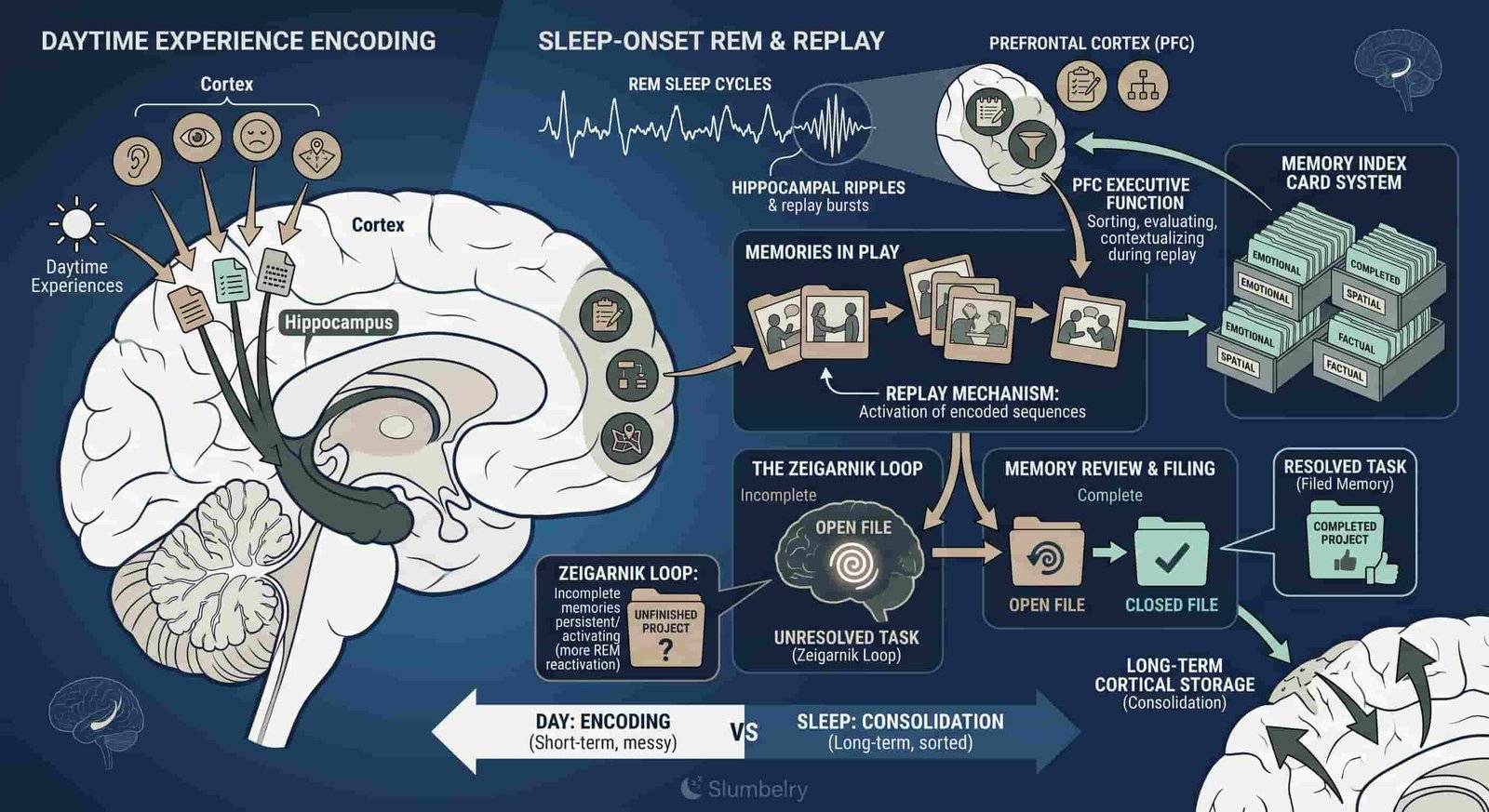
- The Mechanism: S1-1 and S2-3 on the Zeigarnik effect and hippocampal replay: the anterior cingulate cortex (ACC) monitors open goals and generates intrusive attention when goals are unresolved — this is the cognitive intrusion you feel at night. The hippocampus replays the day’s experiences during sleep-onset REM to consolidate them into long-term storage, replaying the most emotionally charged experiences most intensively. The reverse day review addresses both: it provides acknowledgment to the ACC’s open goals (closing the Zeigarnik loop) and it engages the dorsolateral prefrontal cortex in low-arousal observational processing (preventing evaluative engagement). By the time the biological hippocampal replay begins, the prefrontal cortex has already disengaged — the replay can proceed alongside sleep onset rather than blocking it
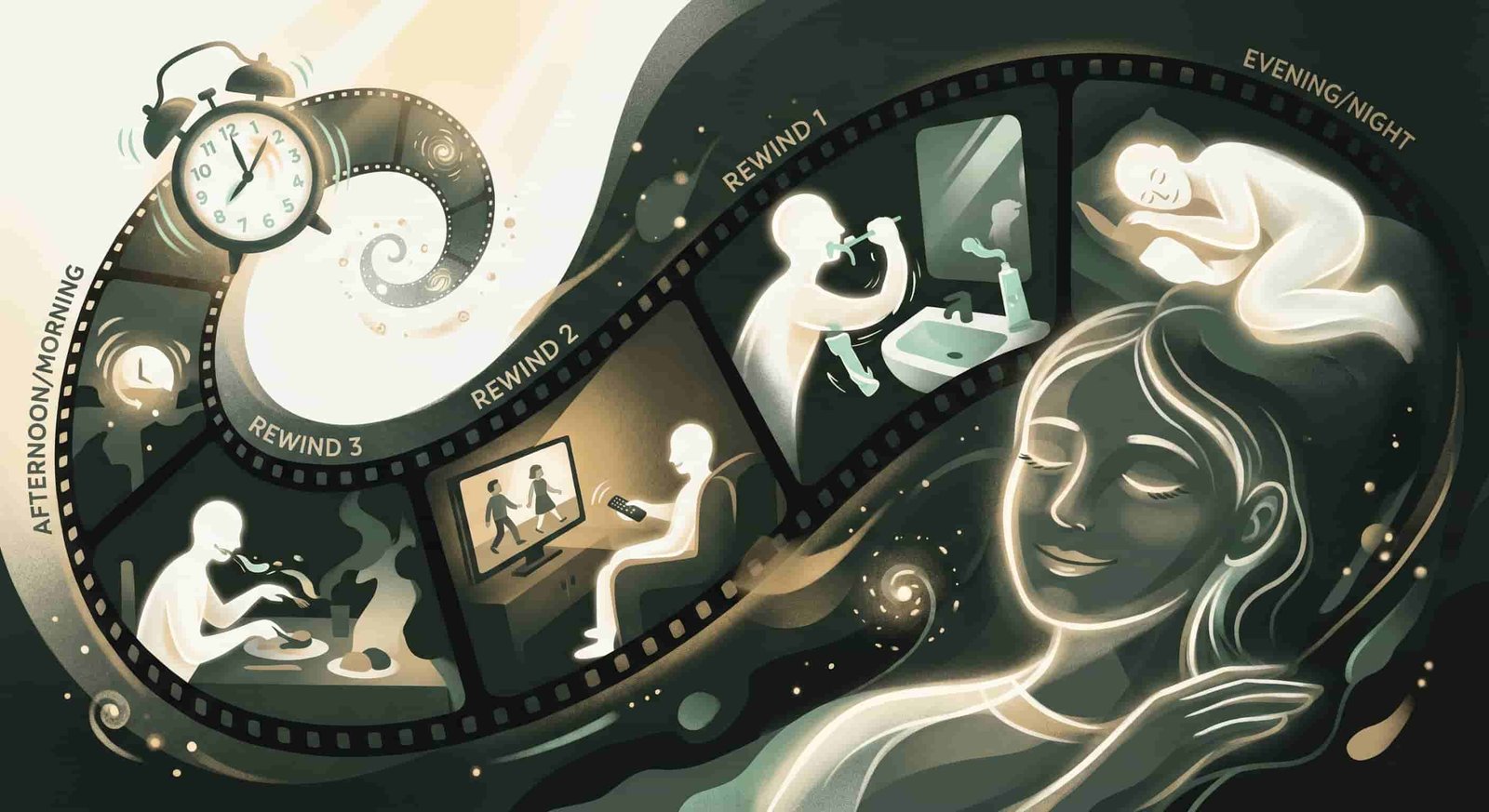
- The Protocol: (1) lie flat on your back, eyes closed; (2) start at this moment — ‘I turned off the light, I got into bed’; (3) go backwards — what did you do before that? (Brushed teeth). Before that? (Watched TV). Before that? (Dinner). Each event is a data point, not a story; (4) stay detached — ‘I ate pizza.’ Not: ‘I shouldn’t have.’ Security camera perspective; (5) most people fall asleep long before reaching the morning — this is the intended effect; (6) practice nightly for 2-3 weeks until the reverse review begins automatically when you close your eyes

Why Does the Brain Replay the Day’s Events at Night — and What Is the Difference Between Memory Consolidation and Rumination in the Sleep Onset Period?
Direct Answer: The brain replays the day’s events at night because this is when the hippocampus — the brain’s memory index — processes and consolidates daily experiences, replaying them during the sleep-onset period to transfer them from short-term to long-term storage. The difference between memory consolidation and rumination is crucial: consolidation is a biological, non-emotional filing process (the brain replaying experiences to store them); rumination is an emotional, evaluative loop (the brain re-engaging with experiences to resolve feelings about them). When you lie awake at night replaying a conversation with your boss, you are not doing memory consolidation — you are doing rumination, which is an entirely different process that generates arousal rather than sleep onset.
Mechanism: S1-1 and S2-3 on hippocampal replay and memory consolidation: during sleep-onset and early sleep, the hippocampus is highly active, replaying the day’s experiences through sharp-wave ripples in the hippocampus and thalamocortical pathways. This replay is how memories are transferred from the hippocampus (short-term storage) to the neocortex (long-term storage). This process is automatic and biological — it is happening whether you are asleep or awake. The problem arises when the prefrontal cortex (which should be going offline for sleep onset) stays engaged with the replay because it is evaluating, judging, and trying to resolve the emotional content of the experiences. This is rumination: the prefrontal cortex has not received the ‘file complete’ signal, so it stays active. The reverse day review gives the prefrontal cortex the closure signal it needs — all files have been acknowledged, the replay can stop, and sleep onset can proceed.
Actionable Advice: Distinguish between the biological memory replay (which you cannot control) and the emotional rumination loop (which you can redirect). The reverse day review is not designed to stop the memory replay — it is designed to give the prefrontal cortex the closure signal so that the replay does not trigger continued cognitive engagement. When you have consciously reviewed and acknowledged each event, the prefrontal cortex has received the ‘file complete’ signal and can disengage, allowing the biological replay to proceed without cognitive arousal.
What Is the Hippocampal Replay Mechanism — and Why Does the Brain Re-activate Today’s Experiences During Sleep-Onset REM Cycles to Transfer Them to Long-Term Memory?
Direct Answer: The hippocampal replay mechanism is the process by which the hippocampus re-activates the day’s experiences during sleep-onset REM cycles, replaying them through the same neural patterns that were active during the original experience, to strengthen and transfer them to long-term neocortical storage. During wakefulness, the hippocampus is the site of episodic memory formation — it binds the sensory, emotional, and contextual details of an experience into a single memory trace. During sleep, the hippocampus replays these traces in sequence, and with each replay, the connection between the hippocampus and the relevant neocortical networks is strengthened, until the memory is ‘consolidated’ — it no longer depends on the hippocampus for retrieval and can be accessed directly from the neocortex.
Mechanism: S1-2 and S2-3 on hippocampal replay and memory consolidation: the hippocampus replays experiences in compressed time during sleep-onset REM — a full day’s events can be replayed in minutes during the first REM period of sleep. This replay is driven by sharp-wave ripples in the CA3 region of the hippocampus, which propagate to the entorhinal cortex and from there to the neocortex. The content of the replay is determined by the strength of the original encoding — the more emotionally charged or frequently activated a memory is, the more likely it is to be replayed during sleep onset. This is why the day’s most emotionally charged experiences are the ones that ‘play’ in your mind when you are trying to fall asleep — they have the highest replay priority. The reverse day review addresses this by providing a conscious, low-arousal review that acknowledges the emotionally charged experiences before the biological replay begins, reducing the replay’s emotional charge and the prefrontal cortex’s drive to stay engaged with it.
Actionable Advice: Do not try to suppress the memory replay — it is a biological process that happens regardless. Instead, use the reverse day review before the biological replay period (immediately upon lying down) to provide the closure signal to the prefrontal cortex, so that when the biological replay begins, the prefrontal cortex has already disengaged and sleep onset can proceed alongside the replay rather than being blocked by it.
What Is the Zeigarnik Effect — and Why Do Unfinished and Unresolved Experiences Demand More Cognitive Attention Than Completed Ones, Keeping the Brain’s ‘Tabs’ Open?
Direct Answer: The Zeigarnik effect is the psychological phenomenon (first documented by Bluma Zeigarnik in 1927) that incompleted or interrupted tasks are remembered more accurately and for longer than completed tasks, and they generate more mental intrusion and cognitive attention than completed ones. Unresolved experiences keep the brain’s ‘tabs’ open because the brain has a cognitive system that monitors open goals and incomplete actions — when a goal is incomplete, this monitoring system stays active, continuously drawing attention back to the open item. This is the same system that makes you unable to stop thinking about the email you forgot to send, the argument you did not finish, the problem you did not solve.
Mechanism: S1-1 and S2-3 on the Zeigarnik effect and open loop monitoring: the brain’s monitoring system is located in the anterior cingulate cortex (ACC) and prefrontal cortex — these areas maintain a list of open goals and incomplete actions and generate an intrusive attention signal when items on the list are unresolved. This is an evolutionarily adaptive system — it ensures that important unfinished tasks are not forgotten. But at night, it is a problem: the day’s unresolved interactions, unsaid words, and unfinished conversations are all on the open goals list, and the monitoring system is generating intrusive cognitive attention to each of them. The reverse day review works by providing conscious acknowledgment to the unresolved items on the open goals list — not solving them, but acknowledging them. Acknowledgment is the signal that the monitoring system uses to close a goal. When you have consciously reviewed ‘the argument with my colleague’ during the reverse day review, the monitoring system registers that the item has been processed, and the intrusive attention signal stops.
Actionable Advice: Do not try to solve the unresolved experiences during the reverse day review. Resolution is not the mechanism — acknowledgment is. The question ‘what happened with my boss’ does not need to be answered; it needs to be acknowledged as ‘done for today.’ The monitoring system closes a goal when it receives acknowledgment, not when it receives a solution.
Why Does Reviewing the Day in Reverse Chronological Order Work — and How Does Moving Backward From the Present Moment Create a Temporal Distance That Prevents Emotional Rumination?
Direct Answer: Reviewing the day in reverse chronological order works because it requires sustained concentration on a concrete, sequential task (tracking backward through the day’s events), which prevents the prefrontal cortex from engaging in the evaluative loops that constitute rumination. Moving backward from the present moment specifically works because the anxiety of an unresolved experience is highest in the present — by moving backward into the neutral territory of the morning, you create temporal psychological distance from the day’s emotionally charged events, which reduces their cognitive arousal charge.
Mechanism: S1-1 and S2-3 on reverse chronology and temporal distance: the brain processes events in temporal order — forward review naturally connects events causally (‘I said X, which led to Y, which caused Z’), which activates the evaluative prefrontal networks that assess and judge those connections. Reverse review breaks the causal chains: you encounter the evening’s events without the morning’s context, the afternoon without the morning’s causes, which prevents the brain from engaging in causal evaluation. The reverse review also exploits the brain’s natural time-traversal bias: the mind is very good at going backward in time (recollection) but less practiced at going forward in emotional space, because going forward in emotional space means engaging with future projections and contingencies, which is more arousing. By going backward, you engage only the recollection networks, not the projection networks. The concentration required to track backward through the day also engages the anterior cingulate cortex in a structured task, which reduces its availability for generating intrusive thoughts about unresolved experiences.
Actionable Advice: The reverse chronological order is not incidental — it is the mechanism. Do not reorganize the review into a logical forward narrative. Stay in reverse. If you notice yourself starting to think forward (‘and then I realized I should have said…’), consciously redirect to the next backward step: ‘what did I do before that?’
What Is the Difference Between Memory Review and Rumination — and Why Does the Reverse Day Technique Provide Closure While Forward Review Generates More Arousal?
Direct Answer: Memory review is a detached, observational process — you observe the day’s events without evaluating their meaning or trying to change them. Rumination is an evaluative, emotionally engaged process — you re-experience the emotions associated with events and try to problem-solve or resolve them. The reverse day technique provides closure because it is memory review (detached observation) rather than rumination (evaluative engagement), while forward review tends to generate rumination because it naturally connects events causally and invites evaluative judgments (‘what should I have done differently?’).
Mechanism: S1-1 and S2-3 on memory review vs rumination: rumination is specifically characterized by the prefrontal cortex’s continued evaluative engagement with emotional material — it is the anterior cingulate and medial prefrontal cortex trying to resolve an emotional conflict, which activates the limbic system and generates arousal. Memory review (the security camera perspective) is a dorsolateral prefrontal cortex function — it observes and catalogs without evaluating. The reverse day technique specifically engages the dorsolateral prefrontal cortex (observational function) and avoids engaging the medial prefrontal cortex (emotional evaluative function), which is why it provides closure without generating arousal. The key distinguishing feature is judgment: when you review ‘I ate pizza’ without the judgment ‘I shouldn’t have,’ you are doing memory review; when you add the evaluative layer, you shift into rumination, which is counterproductive.
Actionable Advice: Treat each scene as a data point, not a story. ‘I ate pizza at 7pm’ is a data point. ‘I shouldn’t have eaten that’ is a judgment. Data points close files; judgments reopen them. If you notice a judgment arising, acknowledge it and return to the next backward step without following the judgment’s logic.
How Does the Hippocampal Index Card Metaphor Work — and Why Does the Reverse Review Function as a Manual Filing System That Signals to the Brain ‘All Documents Are in Order’?
Direct Answer: The hippocampal index card metaphor compares the hippocampus to a filing cabinet with one card per day’s experiences — during sleep, the brain tries to file the day’s experiences by replaying them through the hippocampus. The reverse review functions as a manual acknowledgment of each card: by consciously reviewing each event, you are telling the filing system ‘this card has been processed,’ which signals the hippocampus that the replay can stop and the filing process can proceed without further cognitive supervision.
Mechanism: S1-1 and S2-3 on the hippocampal index card system and memory filing: the hippocampus processes each day’s experiences as a single episodic trace — it does not file individual events separately but binds them into a temporal sequence (the day’s narrative). The reverse day review acknowledges the day’s narrative as a whole: each scene you review is a subset of the day’s episodic trace, and by acknowledging all the subsets, you are effectively acknowledging the whole trace. This prevents the hippocampus from keeping the trace ‘active’ for further processing — it has been acknowledged and can be filed. The manual filing analogy is particularly apt: when a computer is doing a background file operation, you cannot start a new task until the current one is complete. The reverse day review signals to the hippocampal system that the current file operation (today’s memory consolidation) has been acknowledged, so the background process can complete without the foreground (your conscious mind) staying engaged.
Actionable Advice: Think of the reverse day review as physically flipping through the day’s index cards, not as writing new content on them. You are acknowledging the existing data, not generating new data. The filing cabinet is doing its work; you are simply confirming receipt of the files.
What Is Stoic Negative Visualization — and Why Did the Ancient Stoics Specifically Use Reverse Review to Dissociate From the Day’s Events and Enter the Evening in a State of Completion?
Direct Answer: Stoic negative visualization is the practice of contemplation exercises designed to reduce emotional attachment to outcomes and increase psychological resilience — the Stoics (Marcus Aurelius, Seneca, Epictetus) specifically used evening review practices to dissociate from the day’s events and enter the evening in a state of completion. The Stoic evening review was conducted in a specific format: rather than evaluating the day’s events morally (‘did I act rightly?’), they reviewed them analytically (‘what happened, and what was its nature?’). This distinction between moral evaluation and analytical observation is the core mechanism — moral evaluation generates guilt and anxiety, while analytical observation provides closure without generating emotional arousal.
Mechanism: S1-2 and S2-3 on Stoic negative visualization and evening review: Marcus Aurelius’s ‘Meditations’ contains extensive evening review practices — he would review the day’s events every night before sleep, specifically to achieve a state of detachment from the day’s outcomes. The Stoic practice of ‘melete thanatou’ (contemplation of death) was also used at night — by reviewing the day as if it were complete and imagining the perspective of the evening’s end, the Stoics created the psychological state of closure that the reverse day review also creates. The Stoics understood what modern neuroscience confirms: the brain needs a conscious closure signal to disengage from the day’s unfinished business. Without that signal, the monitoring system stays active, and sleep onset is blocked. The reverse day review is the secular, neuroscientifically-grounded descendant of this ancient practice — it achieves the same state of analytical closure without the moral framework.
Actionable Advice: Read Marcus Aurelius’s evening review practice before your first attempt at the reverse day technique. The security camera perspective he describes is identical to the reverse day review: ‘observe without being carried away by the narrative.’ The ancient practice is evidence that this mechanism has been known and used for two millennia — it works because it engages the brain’s natural closure systems.
Why Is the Reverse Day Technique Boring by Design — and What Is the Difference Between Rhythmic Low-Arousal Processing and Cognitive Problem-Solving That Makes This Technique Sleep-Inducing?
Direct Answer: The reverse day technique is boring by design because boredom is the neurological signature of low prefrontal cortex activation — when the prefrontal cortex is engaged in effortful problem-solving, the brain is in a high-arousal state that is incompatible with sleep onset. The rhythmic, repetitive backward tracking of the day’s events is specifically designed to engage the brain in low-arousal processing (sustained concentration on a simple, repetitive task) rather than high-arousal processing (problem-solving, evaluation, emotional engagement). Boredom, in this context, is not a failure of the technique — it is the mechanism of success.
Mechanism: S1-1 and S2-3 on boredom and low-arousal processing: the prefrontal cortex has a limited capacity for high-arousal tasks. When that capacity is consumed by a simple, rhythmic, repetitive task (tracking backward through the day), there is insufficient capacity left for the evaluative and emotional processing that constitutes rumination. This is the same principle behind counting sheep — the rhythmic, low-arousal task occupies the prefrontal cortex just enough to prevent it from engaging in more arousing processing, but not so much that it generates new arousal. The difference between the reverse day technique and counting sheep is that the reverse day technique has a specific, meaningful content (the day’s events) that provides the closure signal, while counting sheep provides only occupation. The reverse day technique is both boring AND productive — it occupies the prefrontal cortex in a low-arousal state while simultaneously providing the closure signal that stops the Zeigarnik loop.
Actionable Advice: If the reverse day review feels boring, you are doing it correctly. The boredom is the evidence that the prefrontal cortex is disengaging from high-arousal processing. Do not interpret the boredom as a sign that the technique is not working — it is working precisely because it is boring. The fact that you are not engaged in an interesting evaluation of the day’s events is the mechanism, not a side effect.
What Is the Role of the Prefrontal Cortex in Memory Filing — and Why Does Conscious Pre-Sleep Review Reduce the Brain’s Nocturnal Processing Load and Free Up the Prefrontal Resources Needed for Sleep Onset?
Direct Answer: The prefrontal cortex plays a supervisory role in memory filing — it determines which memories get replayed during sleep and how much processing resources they receive. When the prefrontal cortex has received conscious acknowledgment of the day’s events (through the reverse day review), it reduces the processing priority of those events during sleep, freeing up resources for sleep onset. When the prefrontal cortex has NOT received acknowledgment, it maintains high processing priority for the unacknowledged events, which consumes prefrontal resources and prevents the disengagement required for sleep onset.
Mechanism: S1-2 and S2-3 on prefrontal cortex and memory prioritization: the prefrontal cortex modulates hippocampal replay through top-down projections — it can increase or decrease the replay intensity of specific memories during sleep. Memories that the prefrontal cortex has marked as ‘important’ or ‘unresolved’ receive more replay cycles and more processing resources during sleep. When the reverse day review consciously acknowledges the day’s events, the prefrontal cortex marks them as ‘processed,’ which reduces their replay priority during sleep. This means: (1) fewer intrusive cognitive events during the sleep-onset period; (2) less prefrontal cortex engagement during sleep onset (because the high-priority replay items have been cleared); (3) faster transition from wakefulness to Stage 1 and Stage 2 sleep. Without the reverse day review, the prefrontal cortex’s unprocessed items remain at high priority and continue to demand cognitive attention throughout the sleep-onset period, blocking the disengagement required for sleep.
Actionable Advice: Do the reverse day review immediately upon lying down, before the biological sleep-onset period begins. The goal is to clear the prefrontal processing queue before the hippocampus begins its biological replay. If you do the review after you have already been lying awake for 30 minutes, you are clearing the queue after the unprocessed items have already demanded cognitive attention — the review will still help, but its effect will be reduced.
What Is the Complete Reverse Day Protocol — and How Do You Practice It to Build the Automatic End-of-Day Closure Response That Signals to the Brain ‘The Day Is Filed, Sleep Now’?
Direct Answer: The complete reverse day protocol has six steps that take approximately 5-10 minutes and are designed to engage the prefrontal cortex’s supervisory function to close the day’s memory files and signal completion to the hippocampal system. The goal is to practice every night until the reverse review begins automatically when you close your eyes in bed — the brain learns that the bedtime posture predicts the end-of-day filing, and the closure response activates proactively, before the memory consolidation period begins.
Mechanism: S1-1 and S4-4 on the complete protocol and neural consolidation: the reverse day review is a procedural skill — the more it is practiced in the same context (lying in bed in the dark), the more automatic it becomes. After 2-3 weeks of consistent practice, the reverse review sequence is consolidated in the dorsolateral prefrontal cortex and can be activated without conscious effort — closing your eyes triggers the reverse review automatically, and the brain has learned that the bedtime posture predicts end-of-day filing, which triggers sleep onset. This is the same consolidation mechanism by which all睡前 routines become automatic — the neural pathway is carved through repetition in a consistent context.
The Protocol: (1) position — lie flat on your back in bed, eyes closed, as the final ritual of the day. This is not a relaxation exercise — it is a cognitive filing exercise. Treat it as a task, not as a way to relax; (2) start at this moment — what did you just do? (Turned off the light, got into bed). This anchors you in the present and the physical act of ending the day. State the action plainly, without narrative: ‘I turned off the light.’ ‘I got into bed.’; (3) go backwards — what did you do before that? (Brushed teeth). Before that? (Watched TV). Before that? (Had dinner). Keep moving backwards. Do not skip steps. Do not reorganize into a narrative. Each event is a data point, not a story; (4) stay detached — view the scenes like a security camera. ‘I ate pizza.’ Not: ‘I shouldn’t have.’ If a judgment arises, note it and return to the next backward step. The detachment is the mechanism; (5) reach the morning — continue until you reach the moment you woke up. Most people fall asleep long before they get there. If you reach the morning and are still awake, the filing is complete and sleep is simply the remaining task; (6) nightly practice — this is a ritual, not an emergency intervention. Practice every night, even on uneventful days. The ritual builds the automatic closure response. After 2-3 weeks, the reverse review begins the moment you close your eyes.
Frequently Asked Questions
Why does my brain replay the day at night?
Direct Conclusion: Your brain replays the day at night because this is when the hippocampus consolidates memories — it replays the day’s experiences during sleep-onset REM cycles to transfer them from short-term to long-term storage. The most emotionally charged experiences (open tabs) are replayed most intensively. The reverse day review acknowledges these experiences before the biological replay begins, reducing their cognitive charge.
What is the Zeigarnik effect?
Direct Conclusion: The Zeigarnik effect is the psychological phenomenon that incompleted or unresolved tasks are remembered more accurately and generate more mental intrusion than completed ones. The brain has a monitoring system that keeps open goals active — it generates intrusive attention to unresolved items. The reverse day review acknowledges the unresolved items, giving the monitoring system the closure signal it needs to close the goal.
How does the reverse day review work?
Direct Conclusion: The reverse day review works by providing conscious closure to the brain’s memory filing system: by reviewing each event in reverse chronological order, you signal to the hippocampus and prefrontal cortex that the day’s files have been acknowledged. The reverse order specifically prevents causal evaluation — you encounter events without their narrative context, which engages the observational networks rather than the evaluative networks.
Why does reviewing the day backwards help more than forward review?
Direct Conclusion: Forward review naturally connects events causally and invites evaluative judgments (‘what should I have done differently?’), which activates the prefrontal cortex’s emotional engagement. Reverse review breaks causal chains and requires sustained concentration on a simple sequential task, which engages low-arousal processing and prevents evaluative loops.
Is the reverse day review the same as rumination?
Direct Conclusion: No. Rumination is evaluative and emotionally engaged — it tries to resolve or judge events. The reverse day review is observational and detached — it notes events without evaluating them. When you say ‘I ate pizza’ without the judgment ‘I shouldn’t have,’ you are doing the reverse day review. When you add the evaluative layer, you have shifted into rumination.
What is Stoic negative visualization?
Direct Conclusion: Stoic negative visualization is the practice of reviewing the day’s events analytically rather than morally — observing what happened without moral judgment. Marcus Aurelius used this practice every evening. The reverse day review is the secular, neuroscientifically-grounded descendant of this ancient practice.
Why do I always fall asleep before reaching the morning?
Direct Conclusion: This is the intended effect. The reverse day review provides closure efficiently. By the time you reach the emotionally charged events of the day, you have often already provided enough closure that the Zeigarnik loop has closed and sleep onset has arrived. If you reach the morning and are still awake, you have successfully closed all the day’s files.
What if I get stuck on an emotional event during the review?
Direct Conclusion: If you start arguing with your boss in your head again or judging an event emotionally, stop. Rewind further — skip ahead to the next scene without engaging with the emotional content. The instruction is to observe, not to process. Acknowledge the event briefly (‘the meeting happened’) and move to the next backward step.
How long does the reverse day technique take to work?
Direct Conclusion: Most people notice a direct calming effect during the first practice. For the automatic closure response to build (the review beginning automatically when you close your eyes), 2-3 weeks of consistent nightly practice are required. Do not evaluate results before 2 weeks — the neural consolidation period is non-negotiable.
Can I do this if I have PTSD or trauma?
Direct Conclusion: For trauma-related intrusive memories, consult a trauma-informed therapist before using this technique — reverse review of traumatic events without professional guidance can be counterproductive. For general day-to-day emotional residue (work stress, interpersonal conflicts), the technique is safe and effective.
The Day Is Filed. Sleep Now.
The reverse day review is a cognitive filing exercise, not a relaxation exercise. You are closing the day’s tabs — providing the brain with the acknowledgment signal it needs to stop the Zeigarnik loop and disengage the prefrontal cortex. Practice every night for 2-3 weeks. After the consolidation period, the review begins automatically when you close your eyes — the brain has learned that bedtime means filing is complete.
Make Your Pillow the Filing Trigger. Build Your Pre-Sleep Ritual.The Slumbelry Commitment
Sleep is the most vulnerable state of human existence. It is where we heal, reset, and grow.
At Slumbelry, we do not just sell sleep products; we advocate for your physiological right to rest. From ergonomic support to light management, every solution we offer is designed with one obsession: Respecting your Biology.
Science is our language, but your recovery is our purpose. You take care of everything else in your life — let us take care of your nights.
Rest Deeply,
The Slumbelry Team