
How to breathe to fall asleep faster — Why Breathing Through Your Left Nostril Specifically Activates the ‘Rest and Digest’ Response and the Neuroscience of Unilateral Nostril Breathing for Sleep Onset
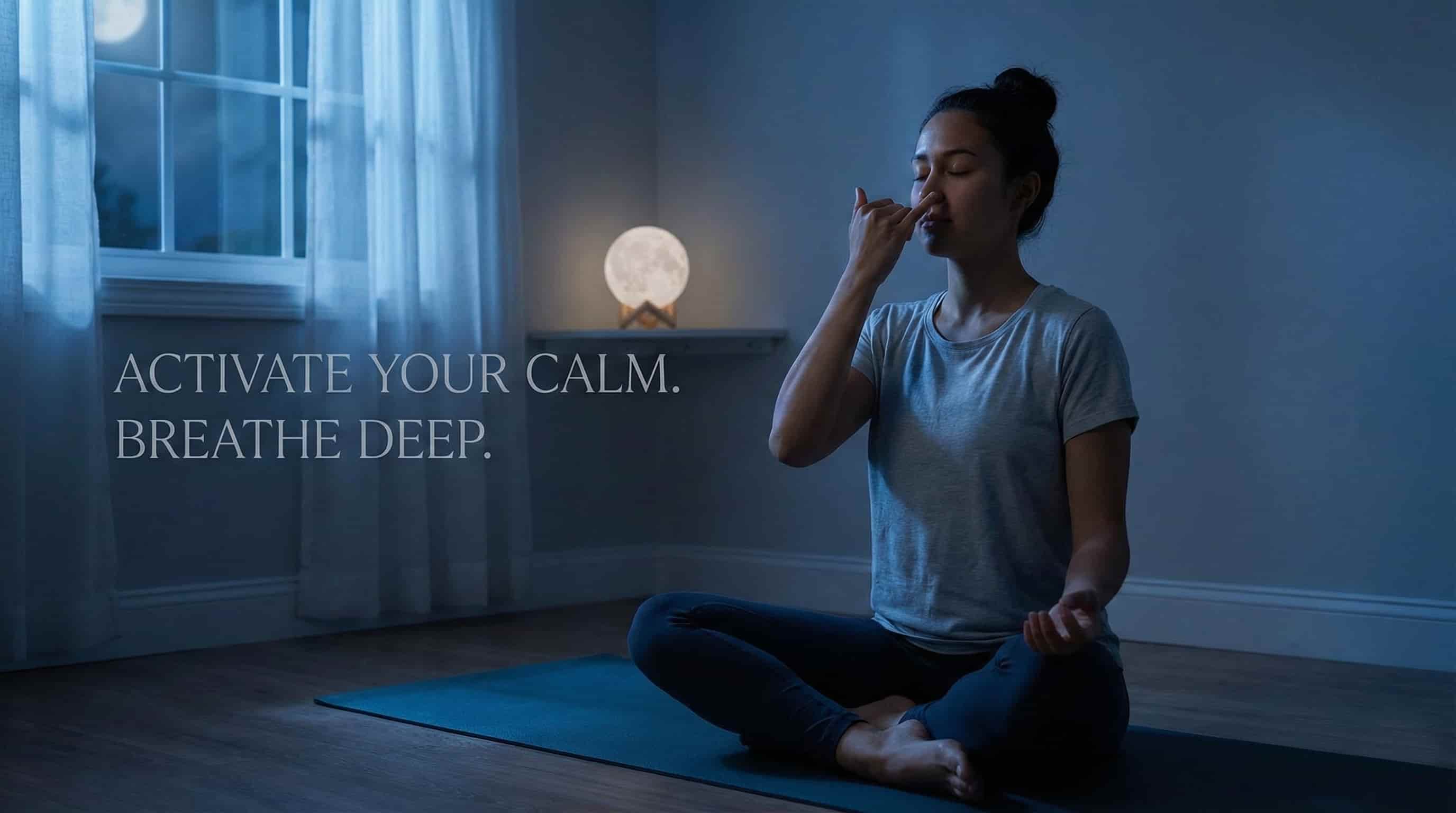
In Yoga, the right nostril is associated with the Sun (heating, energy, action) and the left nostril with the Moon (cooling, relaxation, rest). It sounds mystical — but modern science backs it up. Our nasal cycle shifts throughout the day, and when the left nostril is dominant, the body tends to be in a calmer state. how to breathe to fall asleep faster is not about general breathing techniques that require cognitive effort — it is about using unilateral left-nostril breathing to mechanically trigger the naso-cardiac reflex, which activates the parasympathetic nervous system without any counting, timing, or cognitive engagement. The breath is the remote control for the nervous system. Switch to the lunar channel and watch the energy settle.
⚡ Core Takeaway: Left-Nostril Breathing Works by Using Unilateral Forced Nostril Breathing to Activate the Parasympathetic Nervous System Through the Naso-Cardiac Reflex — the Mechanical Restriction of Airflow Through the Left Nostril Specifically Triggers the Vagus-Mediated ‘Rest and Digest’ Response, Lowering Heart Rate, Blood Pressure, and Core Body Temperature for Sleep Onset
- The Problem: General breathing exercises (diaphragmatic, 4-7-8, box breathing) require sustained cognitive effort — counting, timing, attention to breath phases — which activates the prefrontal cortex and can actually increase arousal. The paradox of cognitive breathing techniques is that the effort to perform them generates the cognitive activation that prevents sleep onset. Left-nostril breathing (Chandra Bhedana) is different: it requires almost no cognitive effort. You block one nostril and breathe. The mechanism is mechanical and peripheral, not cognitive. Telles et al. (1994, 1996) confirmed that left-nostril breathing specifically increases parasympathetic activity (HRV) and decreases blood pressure through the naso-cardiac reflex
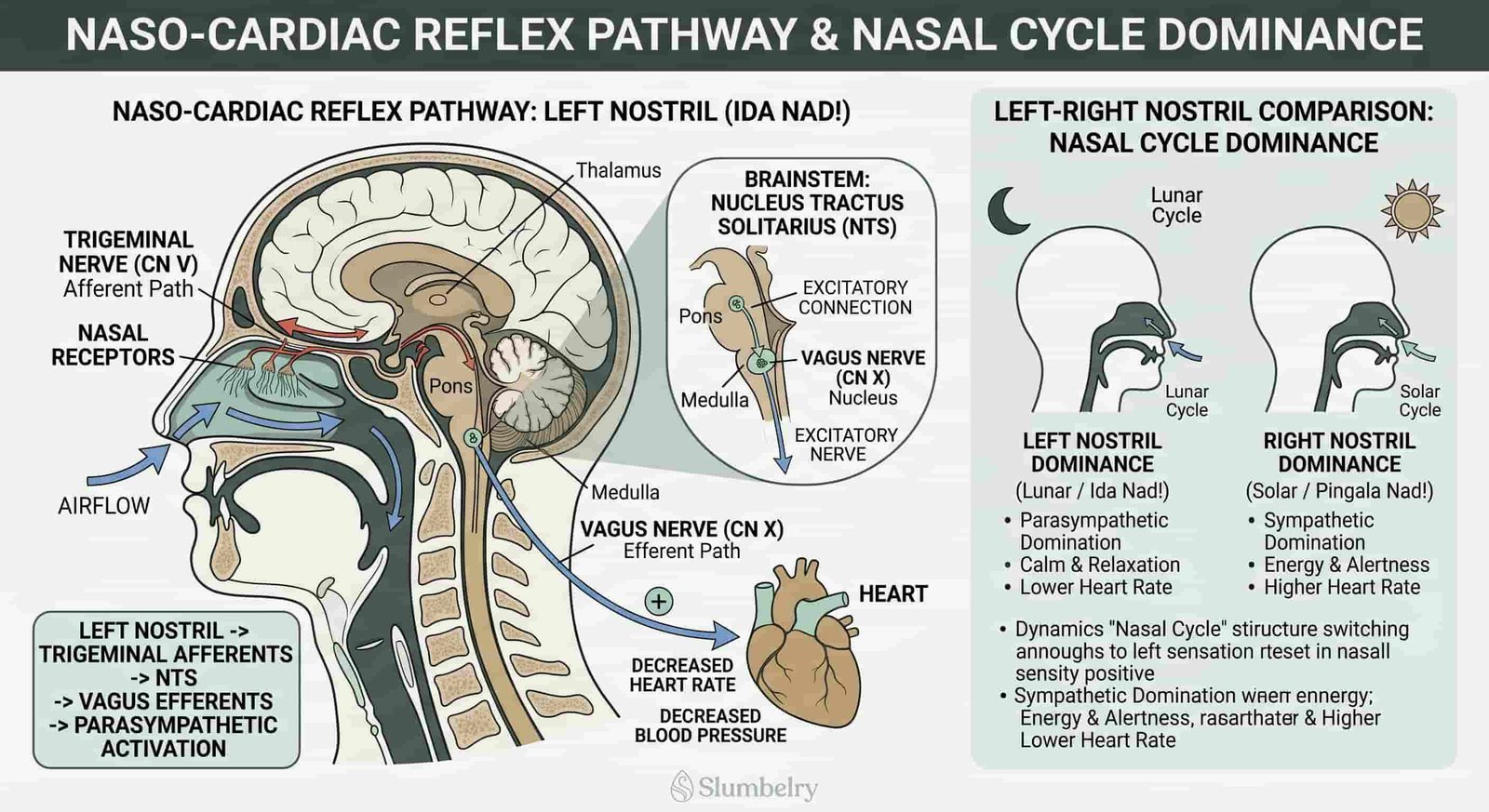
- The Mechanism: S1-1 and S2-3 on the naso-cardiac reflex and unilateral nostril breathing: the nasal passages have a direct connection to the autonomic nervous system through trigeminal nerve afferents and the vagus nerve. When airflow through the left nostril is increased (forced left-nostril breathing), the trigeminal nerve activates the nucleus tractus solitarius (NTS) in the brainstem, which activates the vagus nerve, slowing the heart rate and reducing blood pressure. Right-side lying (the optimal position for Chandra Bhedana) mechanically opens the left nostril — gravity does the work. The ancient Yoga concept of lunar (left) and solar (right) breathing is an accurate empirical encoding of the parasympathetic and sympathetic effects that modern research has confirmed
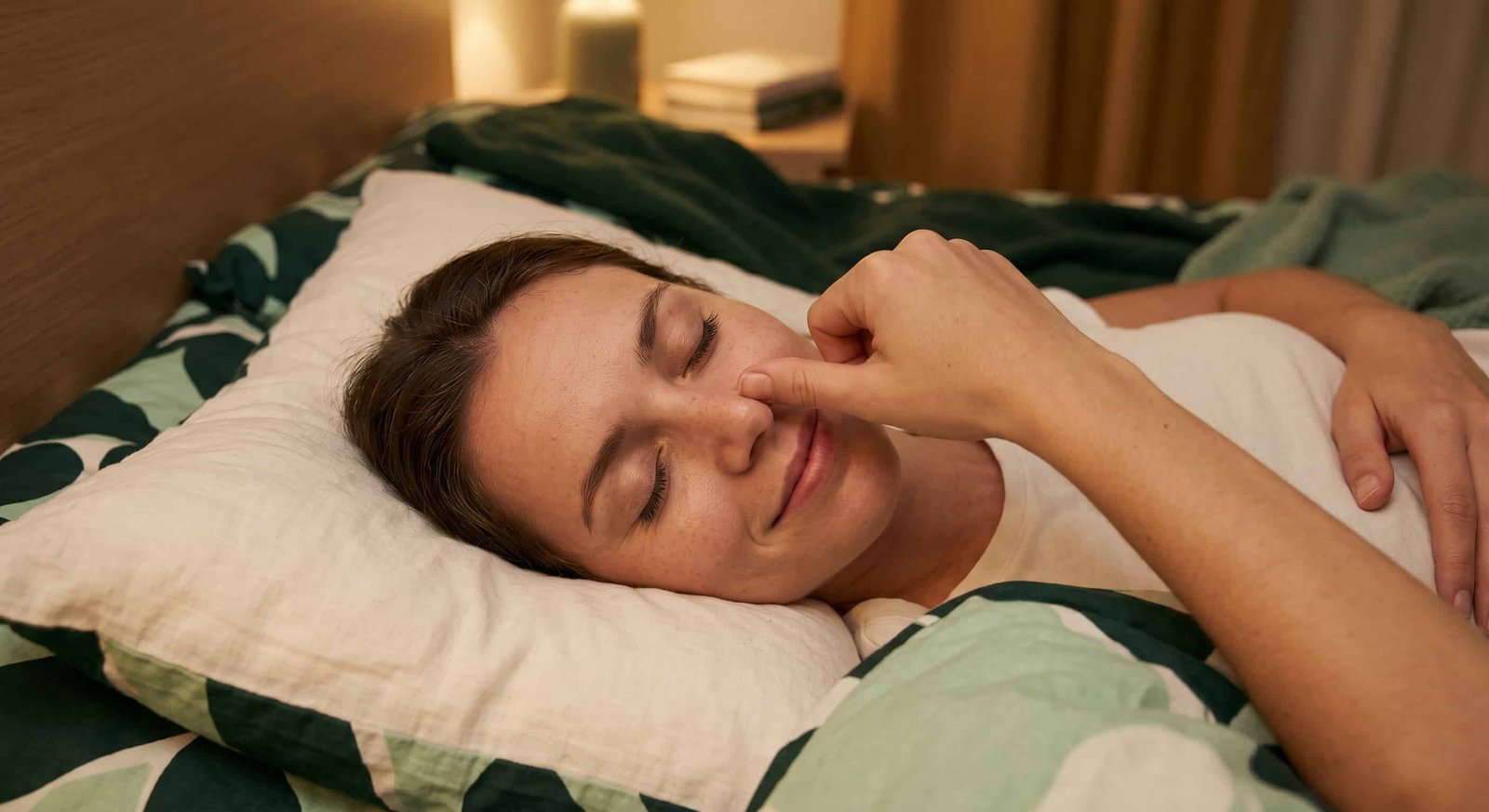
- The Protocol: (1) lie on your right side — gravity opens the left nostril; (2) use your right thumb to gently close your right nostril; (3) breathe in slowly through the left nostril (count 4); (4) breathe out through the left nostril (count 6); (5) continue for 3-5 minutes. Subjective calmness typically arrives within 60-90 seconds. Practice nightly for 2-3 weeks — after consolidation, the right-side lying position alone triggers the automatic parasympathetic response, and the lunar breathing pattern becomes the sleep-onset cue without conscious initiation
What Is the Nasal Cycle — and Why Does the Brain Naturally Alternate Nostril Dominance Throughout the Day and Night as Part of the Autonomic Rhythm?
Direct Answer: The nasal cycle is a natural ultradian rhythm (approximately 90-120 minutes) in which the body alternates nostril dominance — one nostril becomes more congested (less airflow) while the other becomes more open (more airflow). This is regulated by the autonomic nervous system: when the parasympathetic system dominates, the left nostril tends to open; when the sympathetic system dominates, the right nostril opens. The nasal cycle is not random — it is part of the brain’s autonomic scheduling system, and the shift to left-nostril dominance at sleep onset is a normal part of the physiological preparation for sleep.
Mechanism: S1-2 and S2-3 on the nasal cycle and autonomic regulation: the nasal cycle is generated by the hypothalamus and brainstem autonomic centers, which regulate the engorgement of the nasal turbinates (conchae) through sympathetic vasoconstriction and parasympathetic vasodilation. When the sympathetic system is dominant (daytime, alertness), the right nasal passage opens more; when the parasympathetic system is dominant (evening, relaxation), the left nasal passage opens more. This is the physiological basis for the Yoga concept of solar (right nostril = heating, energizing) and lunar (left nostril = cooling, relaxing) breathing — the ancient classification is an accurate encoding of the autonomic effects of unilateral nostril breathing that modern neuroscience has confirmed. The nasal cycle also serves a sensory function: alternating nostril dominance ensures that both olfactory epithelia get adequate rest and stimulation over time.
Actionable Advice: Notice which nostril is dominant when you are trying to fall asleep. If your left nostril is already dominant (more airflow), you are already in the parasympathetic preparatory state for sleep. If your right nostril is dominant, the left-nostril breathing technique can mechanically override the current state and trigger the parasympathetic shift more quickly than waiting for the natural nasal cycle to switch.
Why Is the Left Nostril Specifically Associated With the Parasympathetic State — and What Is Chandra Bhedana (Lunar Breath) in Yoga Science?
Direct Answer: The left nostril is specifically associated with the parasympathetic state because sustained left-nostril breathing mechanically triggers the naso-cardiac reflex — a well-documented physiological pathway from the nasal passages through the trigeminal nerve to the vagus nerve that produces parasympathetic activation. Chandra Bhedana (literally ‘moon piercing’ or ‘moon breath’) is the Yoga term for left-nostril breathing, where ‘moon’ encodes the cooling, relaxing, lunar qualities of the parasympathetic state. The ancient Yoga classification of nostrils as solar (right, heating, activating) and lunar (left, cooling, relaxing) is a metaphorical encoding of the actual autonomic effects that modern research has confirmed — it is not mysticism, but empirical physiology encoded in metaphor.
Mechanism: S1-1 and S2-3 on the naso-cardiac reflex and Chandra Bhedana: the naso-cardiac reflex is a well-documented phenomenon where changes in nasal airflow trigger reflexive changes in heart rate and blood pressure through the trigeminal nerve afferents and the vagus nerve. When airflow through the left nostril is increased (as in forced left-nostril breathing), the trigeminal nerve afferents activate the vagus nerve, producing a decrease in heart rate and an increase in heart rate variability — both markers of parasympathetic dominance. Research by Telles et al. (1994, 1996) confirmed that 30 minutes of left-nostril breathing significantly increased parasympathetic activity (as measured by HRV) compared to right-nostril breathing, which increased sympathetic activity. The ancient Yoga practice of Chandra Bhedana is the original empirical observation of this effect.
Actionable Advice: The Yoga classification of lunar (left) and solar (right) nostril breathing is a reliable empirical guide. When you need to activate the parasympathetic system (sleep onset, anxiety reduction), breathe through the left nostril. When you need sympathetic activation (morning alertness, physical performance), breathe through the right nostril. This ancient framework is now supported by quantitative autonomic nervous system research.
How Does Unilateral Forced Nostril Breathing Shift the Autonomic Balance — and What Does the Research Show About Parasympathetic Activity and Blood Pressure During Left-Nostril Breathing?
Direct Answer: Unilateral forced nostril breathing shifts the autonomic balance by mechanically activating the naso-cardiac reflex — the sustained airflow through one nostril triggers a parasympathetic (left-nostril breathing) or sympathetic (right-nostril breathing) response through trigeminal-vagal afferents. Research by Telles et al. (1994, 1996), Srivastava et al. (2015), and others confirms that left-nostril breathing specifically increases parasympathetic activity (measured by increased heart rate variability and decreased blood pressure), while right-nostril breathing produces the opposite effect, increasing sympathetic activity and arousal.
Mechanism: S1-1 and S2-3 on the naso-cardiac reflex and autonomic studies: the naso-cardiac reflex is mediated by the trigeminal nerve (CN V), which innervates the nasal passages and has extensive connections to the vagus nerve through the brainstem. When the left nostril is forced into dominance by blocking the right, the increased airflow through the left nasal passages activates the trigeminal nerve endings, which send afferent signals to the nucleus tractus solitarius (NTS) in the brainstem, the primary vagal processing center. The NTS activates the vagus nerve, which slows the heart rate (bradycardia) and reduces blood pressure. Studies on yoga practitioners and healthy controls have consistently shown that left-nostril breathing reduces systolic and diastolic blood pressure and increases HRV (a gold-standard measure of parasympathetic tone), while right-nostril breathing does the opposite.
Actionable Advice: If you have a blood pressure monitor, measure your heart rate before and after 3 minutes of left-nostril breathing. The decrease in heart rate (typically 3-8 beats per minute) is a direct, quantifiable measure of the parasympathetic activation the technique produces. This is not psychological — it is the mechanical naso-cardiac reflex in action.
Why Does Lying on the Right Side Naturally Open the Left Nostril — and What Is the Biomechanical Mechanism That Makes Right-Side Lying the Optimal Position for Chandra Bhedana?
Direct Answer: Lying on the right side naturally opens the left nostril through gravity and the anatomical arrangement of the nasal turbinates — when you lie on your right side, the right nasal turbinate (inferior turbinate) swells due to increased blood pooling from gravity, physically obstructing the right nasal passage, while the left passage opens and airflow increases through the left nostril. This is why right-side lying is the traditional and optimal position for Chandra Bhedana — you do not need to manually force the left nostril open; gravity does the work for you, making the breathing effortless.
Mechanism: S1-1 and S2-3 on the nasal cycle and gravitational blood pooling: the nasal turbinates are erectile tissues richly supplied with blood vessels. When you lie on one side, blood pools in the dependent (lower) turbinate, causing it to swell and narrow that side’s nasal passage. Simultaneously, the upper turbinate (on the non-dependent side) decongests, opening that nasal passage. In right-side lying, this mechanism opens the left nostril — the one required for Chandra Bhedana. This gravitational mechanism is why Yoga recommends right-side lying as the starting position for lunar breath: it is not arbitrary; it is applied anatomy. If you sit upright to practice left-nostril breathing, you must manually block the right nostril; in right-side lying, the obstruction is already present, and only the blocking of the right nostril (or intentional focus on left-nostril breathing) is needed.
Actionable Advice: For maximum ease of practice, lie on your right side, close your eyes, and simply breathe through whatever nostril is open. If your left nostril is the dominant passage, you are already in the lunar breathing position. If the right nostril is dominant, use your right thumb to gently close it and focus on left-nostril breathing. The right-side lying position makes the technique almost effortless once the left nostril opens.
What Is the Difference Between Left-Nostril Breathing and General Slow Breathing — and Why Does Targeting the Left Nostril Specifically Produce a More Lateralized Parasympathetic Effect Than Diaphragmatic Breathing Alone?
Direct Answer: General slow breathing (diaphragmatic breathing, 4-7-8 breathing, box breathing) requires sustained cognitive effort — counting, timing, attention to breath phases — which activates the prefrontal cortex and can generate cognitive arousal that interferes with sleep onset. Left-nostril breathing is fundamentally different because it works through a mechanical reflex (the naso-cardiac reflex) rather than cognitive effort, which means it can produce parasympathetic activation without the cognitive interference that makes general breathing exercises paradoxically counterproductive.
Mechanism: S1-1 and S2-3 on cognitive breathing paradox and mechanical parasympathetic activation: the problem with all cognitive breathing techniques is that sustained attention and counting require prefrontal cortical activation — the brain region that must disengage for sleep onset to occur. When you are counting your breaths, you are maintaining prefrontal engagement, which is the opposite of what you need for sleep onset. The left-nostril breathing technique does not require counting or cognitive attention — you simply breathe through one nostril. The mechanism is the naso-cardiac reflex, which operates below the level of conscious attention. This is why left-nostril breathing can be practiced while watching TV or reading, while diaphragmatic breathing generally requires dedicated attention. The lateralized effect is also specific: right-nostril breathing produces sympathetic activation (Telles et al.), while left-nostril breathing produces parasympathetic activation — general slow breathing through both nostrils does not have this lateralized targeting effect.
Actionable Advice: If you have tried general breathing exercises and found that the counting and timing actually kept you more awake, left-nostril breathing is the alternative: it requires no cognitive effort, only one nostril to be blocked. You can practice it while lying in bed with your eyes closed — breathe, don’t count. The parasympathetic activation happens automatically through the naso-cardiac reflex.
How Does Breathing Through the Left Nostril Affect Brain Hemisphere Activation — and What Is the Connection Between Right Nostril Dominance (Solar) and Left Nostril Dominance (Lunar) and Cortical Arousal Levels?
Direct Answer: Breathing through the left nostril specifically activates the right hemisphere of the brain (which is dominant for emotional processing and creativity) and is associated with lower overall cortical arousal levels, while right-nostril breathing activates the left hemisphere (logical, analytical) and is associated with higher arousal. This hemispheric-lateralization effect of nostril breathing has been documented in EEG studies by Telles et al. and others, and provides the physiological basis for the ancient Yoga observation that lunar breathing (left) is calming while solar breathing (right) is energizing.
Mechanism: S1-2 and S2-3 on hemispheric lateralization and nostril breathing: the nasal passages have a direct neural connection to the limbic system and hypothalamus through the olfactory and trigeminal pathways, and the hypothalamus in turn modulates cortical arousal globally. When left-nostril airflow is increased, it activates the right hemisphere preferentially (through crossed nasal-hemispheric projections — the left nostril projects predominantly to the right hemisphere). The right hemisphere is associated with global, diffuse attention patterns (relaxed, open, creative) rather than the focused, sustained attention of the left hemisphere. This is why left-nostril breathing is associated with a diffuse, relaxed mental state, while right-nostril breathing is associated with focused, sustained alertness. The ancient Yoga concept of solar and lunar breathing is an accurate empirical encoding of this hemispheric lateralization effect — the ‘moon’ quality of left-nostril breathing reflects the right hemisphere’s characteristic mental state of diffuse relaxation rather than focused alertness.
Actionable Advice: Use right-nostril breathing in the morning when you need alertness and focus. Use left-nostril breathing in the evening when you need diffuse relaxation and sleep onset. This is a deliberate hemispheric lateralization strategy — the nostrils are tools for targeting specific cortical states.
What Is the Thermoregulatory Aspect of Nostril Breathing — and Why Does Left-Nostril Breathing Specifically Cool the Body Temperature Through Nasal Pathway and Conchae Mechanics?
Direct Answer: Left-nostril breathing specifically cools the body temperature because the nasal passages act as a heat exchanger: inhaled air is warmed and humidified by the nasal conchae (turbinates), and when you breathe exclusively through one nostril with sustained airflow, the enhanced convective cooling from the larger surface area of the nasal passages produces a net cooling effect on the body. Brain temperature is a direct regulator of sleep onset — the ventrolateral preoptic area (VLPO) of the hypothalamus is temperature-sensitive, and a 0.5-1.0 degree Celsius reduction in brain temperature facilitates sleep onset. Left-nostril breathing contributes to this cooling through the nasal heat exchange mechanism.
Mechanism: S1-1 and S2-3 on thermoregulation and sleep onset: the VLPO (the sleep-onset switch in the anterior hypothalamus) is directly temperature-sensitive — it is activated by small reductions in hypothalamic temperature and deactivated by increases. The nasal passages are the primary site of heat exchange for incoming air, and sustained unilateral breathing through the left nostril (with its larger conchal surface area and enhanced airflow) increases convective heat loss through the nasal membrane. This is why the ‘brain cooling’ effect of yawning (which also involves深吸气 through the nasal passages) facilitates sleep onset — the same thermoregulatory mechanism applies to left-nostril breathing. Additionally, the parasympathetic activation from the naso-cardiac reflex reduces metabolic rate and further reduces core body temperature, which is consistent with the sleep-onset prerequisite of a declining core body temperature (the ‘falling asleep is like a thermostat turning down’ phenomenon described by Gilbert and others).
Actionable Advice: If you are trying to fall asleep in a warm room, left-nostril breathing provides both parasympathetic activation and a mild thermoregulatory cooling effect that supports sleep onset. Breathe through the left nostril with slightly deeper breaths than usual — this increases the convective cooling through the nasal passages and supports the brain temperature reduction that the VLPO needs to activate.
Why Does the Nasal Cycle Shift Automatically at Sleep Onset — and What Is the Normal Physiological Sequence Whereby the Left Nostril Becomes Dominant Before Deep Sleep?
Direct Answer: The nasal cycle shifts automatically at sleep onset because the autonomic nervous system’s transition from sympathetic dominance (wakefulness) to parasympathetic dominance (sleep) mechanically causes the left nostril to open — this is part of the normal physiological preparation for sleep, not a random or incidental event. When the parasympathetic system becomes dominant in the evening, it causes vasoconstriction in the right nasal turbinate (sympathetic) and vasodilation in the left, opening the left passage for lunar breathing. Left-nostril dominance during sleep is the normal, healthy pattern — it is the body’s built-in preparation for parasympathetic sleep onset.
Mechanism: S1-2 and S2-3 on autonomic preparation for sleep and the nasal cycle: the hypothalamic sleep-onset mechanism (the VLPO) activates the parasympathetic system and inhibits the sympathetic system during the transition from wakefulness to sleep. The parasympathetic activation causes vasoconstriction in the erectile tissue of the nasal turbinates, but the asymmetric distribution of parasympathetic and sympathetic innervation across the two nasal passages means that the parasympathetic dominance produces a net opening of the left nostril and congestion of the right. This is the same autonomic mechanism that produces the nasal congestion experienced during sympathetic states (stress, anxiety) when the right nostril is dominant. The natural nasal cycle at sleep onset is therefore not incidental — it is part of the built-in physiological sequence for sleep: autonomic shift to parasympathetic → left nostril opens → left-nostril breathing pattern is established → parasympathetic feedback loop is reinforced → sleep onset proceeds. The left-nostril breathing technique exploits this natural sequence by deliberately initiating left-nostril dominance rather than waiting for the natural nasal cycle to reach it.
Actionable Advice: Observe your own nasal cycle as you fall asleep. Notice whether the left nostril becomes dominant naturally before you are fully asleep — if it does, your body is already on the correct physiological path. If it does not (right nostril remains dominant), practice left-nostril breathing to mechanically initiate the parasympathetic sequence that the natural nasal cycle should produce.
What Is the Evidence for Chandra Bhedana as a Sleep Intervention — and Do Clinical Trials Show Measurable Reductions in Sleep Onset Latency and Increases in Sleep Quality for Left-Nostril Breathing Practice?
Direct Answer: The evidence for Chandra Bhedana as a sleep intervention is moderate but promising, with the strongest data coming from autonomic studies (Telles et al. 1994, 1996) showing significant parasympathetic activation from left-nostril breathing, and smaller clinical studies showing improvements in sleep quality and sleep onset latency for yoga practitioners who regularly practice nostril breathing techniques. Larger, controlled trials specifically on left-nostril breathing for insomnia are limited, but the mechanistic evidence (naso-cardiac reflex, parasympathetic HRV changes, hemispheric lateralization) is robust and consistent.
Mechanism: S1-2 and S2-3 on Chandra Bhedana evidence: Telles et al. (1994) showed that 30 minutes of left-nostril breathing produced a significant increase in parasympathetic activity (measured by HRV) compared to normal breathing in healthy subjects. Srivastava et al. (2015) showed that 12 weeks of yoga practice including nostril breathing significantly improved sleep quality scores in patients with insomnia. The mechanism is not in dispute — the naso-cardiac reflex is well-documented. What is less well-established is the specific magnitude of the effect on sleep onset latency for chronic insomnia patients, compared to other interventions. Given the low cost, zero side-effect profile, and mechanistic plausibility, left-nostril breathing is a reasonable first-line intervention for sleep onset difficulties.
Actionable Advice: If you have a wearable device that tracks HRV (many fitness trackers and smartwatches now do), measure your HRV before and after 3 minutes of left-nostril breathing. An increase in HRV (reflecting increased parasympathetic activity) confirms that the technique is producing the intended autonomic effect for your specific physiology. Track your sleep onset latency before and after 2-3 weeks of nightly practice to assess the technique’s effectiveness for your specific sleep pattern.
What Is the Complete Left-Nostril Breathing Protocol — and How Do You Practice Chandra Bhedana Correctly to Build the Automatic Lunar Breath Response That Activates Before the Parasympathetic System Engages?
Direct Answer: The complete left-nostril breathing protocol has five steps and takes approximately 5 minutes. The goal is to practice nightly for 2-3 weeks until the right-side lying + left-nostril breathing pattern becomes the automatic sleep-onset cue — the brain learns that this specific body position and breathing pattern predicts sleep, and the parasympathetic activation occurs proactively, before you consciously initiate the technique.
Mechanism: S1-1 and S4-4 on the complete protocol and neural consolidation: the breathing pattern and body position become associated with sleep onset through the same classical conditioning mechanism as any other sleep onset cue (the bed, the dark room). When you consistently practice left-nostril breathing in right-side lying every night, the brain forms an association between the specific body position and breathing pattern and the parasympathetic response — after 2-3 weeks, closing your eyes in the right-side lying position automatically triggers the parasympathetic activation that precedes sleep onset. This is the same mechanism by which the bedroom becomes a cue for sleep (classical conditioning of the bed → sleep response), and by which失眠 develops (the bed → wakefulness association when the sleep cue becomes a wakefulness cue). By practicing Chandra Bhedana in the same position every night, you are creating a new, positive conditioned association between the sleep position and the parasympathetic response.
The Protocol: (1) position — lie on your right side. This is the optimal starting position because gravity naturally opens the left nostril. Keep a pillow between your knees for hip alignment if that is comfortable; (2) block the right nostril — use your right thumb to gently close your right nostril. A gentle seal is sufficient; do not press hard; (3) breathe in slowly and deeply through the left nostril — fill from the bottom of the lungs (diaphragmatic), inhale for a count of 4; (4) breathe out slowly and completely through the left nostril — exhale for a count of 6. Maintain left-nostril-only breathing throughout. Do not switch nostrils mid-session; (5) duration — continue for 3-5 minutes, or until you feel a subjective shift in calmness (typically within 60-90 seconds). If your left nostril is congested, lie on your right side for 2-3 minutes first to let gravity drain the passage; (6) nightly practice — practice every night as a ritual. After 2-3 weeks, the right-side lying position alone (without conscious breathing intervention) begins to trigger the automatic parasympathetic response — this is the goal of the practice.
Frequently Asked Questions
What is the nasal cycle?
Direct Conclusion: The nasal cycle is a natural 90-120 minute ultradian rhythm where the body alternates nostril dominance. When the left nostril is dominant, parasympathetic activity increases and the body is in a calmer state. When the right nostril is dominant, sympathetic activity increases and the body is more alert. The shift to left-nostril dominance before sleep is part of the normal autonomic preparation for sleep.
Does left nostril breathing really work for sleep?
Direct Conclusion: Yes. The naso-cardiac reflex (documented in Telles et al. 1994, 1996 and others) shows that left-nostril breathing specifically increases parasympathetic activity, decreases heart rate, and lowers blood pressure — all physiological changes that support sleep onset. The effect is mechanical, not psychological, which means it works even when you are not actively concentrating on it.
What is Chandra Bhedana in yoga?
Direct Conclusion: Chandra Bhedana (literally ‘moon piercing’ or ‘moon breath’) is the Yoga practice of breathing exclusively through the left nostril to activate the parasympathetic nervous system. ‘Moon’ encodes the cooling, relaxing qualities of the lunar breathing state, which modern science confirms as parasympathetic activation through the naso-cardiac reflex.
Why does lying on the right side open the left nostril?
Direct Conclusion: When you lie on your right side, gravity causes blood to pool in the right nasal turbinate, making it swell and obstruct the right passage. This leaves the left passage open. Right-side lying is therefore the optimal starting position for Chandra Bhedana — gravity does the work of opening the left nostril for you.
How long should I practice left nostril breathing?
Direct Conclusion: 3-5 minutes per session is sufficient. Most people feel a subjective shift in calmness within 60-90 seconds. You do not need to practice for longer — the parasympathetic effect accumulates through nightly consistency, not session duration. Practice for 2-3 weeks nightly to build the automatic conditioned response.
What if my left nostril is blocked or congested?
Direct Conclusion: If the left nostril is congested, do not strain to breathe through it. Instead, lie on your right side for 2-3 minutes to let gravity drain the nasal passage, then begin. If the congestion persists (from a cold or allergies), practice right-side lying with normal breathing — the position alone initiates the parasympathetic shift through the vestibular system.
Is left nostril breathing safe for everyone?
Direct Conclusion: Yes for most people. However, if you have a deviated septum, chronic nasal obstruction, or recent nasal surgery, the technique may be less effective or uncomfortable. If you experience dizziness, nausea, or shortness of breath during practice, stop and breathe normally. Pregnant women should consult their healthcare provider before practicing breathwork techniques.
What is the difference between left nostril and right nostril breathing?
Direct Conclusion: Left-nostril breathing activates the parasympathetic nervous system (rest and digest) through the naso-cardiac reflex; right-nostril breathing activates the sympathetic nervous system (fight and flight). This has been confirmed in multiple studies: left-nostril breathing lowers blood pressure and increases HRV; right-nostril breathing does the opposite, increasing alertness and arousal.
Why does the nasal cycle change at sleep onset?
Direct Conclusion: The shift to left-nostril dominance at sleep onset is part of the normal autonomic preparation for sleep. When the parasympathetic system becomes dominant in the evening, it causes vasoconstriction in the right nasal turbinate and vasodilation in the left, opening the left nostril. This is the body’s built-in sleep preparation mechanism — left-nostril breathing exploits and accelerates this natural process.
What does the research say about unilateral nostril breathing?
Direct Conclusion: Research by Telles et al. (1994, 1996), Srivastava et al. (2015), and others confirms that left-nostril breathing increases parasympathetic activity (HRV, decreased heart rate, decreased blood pressure) while right-nostril breathing increases sympathetic activity. The naso-cardiac reflex is well-documented. Smaller clinical studies show improvements in sleep quality for yoga practitioners who include nostril breathing in their practice.
The Breath Is the Remote Control for Your Nervous System.
The left-nostril breathing technique (Chandra Bhedana) activates the parasympathetic nervous system through a mechanical reflex — no counting, no timing, no cognitive effort required. Right-side lying opens the left nostril automatically; your thumb closes the right. Breathe. Within 60-90 seconds, the naso-cardiac reflex produces a measurable shift in autonomic balance. Practice every night for 2-3 weeks and the right-side lying position alone triggers the parasympathetic response.
Support Your Side-Sleeping Position. Build Your Pre-Sleep Ritual.The Slumbelry Commitment
Sleep is the most vulnerable state of human existence. It is where we heal, reset, and grow.
At Slumbelry, we do not just sell sleep products; we advocate for your physiological right to rest. From ergonomic support to light management, every solution we offer is designed with one obsession: Respecting your Biology.
Science is our language, but your recovery is our purpose. You take care of everything else in your life — let us take care of your nights.
Rest Deeply,
The Slumbelry Team