Best Sleep Apps: Tracking, Meditation & White Noise – Which is for You?
July 13, 2025
Best Sleep Apps: Which Ones Actually Work? | Slumbelry
Best Sleep Apps: Which Ones Actually Work?
Written by Dr. Lycan Dizon, Slumbelry Chief Sleep Consultant · Updated 2025
Best sleep apps have flooded the App Store with five-star ratings and glowing testimonials. But when you dig past the marketing, the uncomfortable truth emerges: most of them are guessing. Your smartwatch tracks arm movement and calls it REM sleep. Your meditation app borrows from a 2,000-year-old breathing technique and slaps a subscription fee on it. Your white noise app loops a 30-second audio clip that your brain learns to ignore after three nights.
The sleep app industry is worth billions, yet the vast majority of users report no lasting improvement in their sleep quality after three months. Why? Because apps treat symptoms while ignoring the environment your body actually sleeps in. No amount of guided breathing compensates for a mattress that traps heat. No sleep score fixes pressure points that wake you up at 2 AM.
This review takes a different approach. We are not ranking apps by download count or interface design. We are evaluating them against one question: does this tool actually change your sleep architecture, or does it just document your suffering in prettier charts?
Quick Answer: The Only Three Sleep App Categories Worth Your Time
Meditation apps improve sleep latency by 35%: They activate your parasympathetic nervous system, dropping cortisol levels by up to 25% within a single session. This is the only category with consistent, replicated clinical evidence.
White noise and pink noise apps reduce awakenings by 50% in noisy environments: They create an acoustic wall that masks sudden environmental disruptions — but only non-looping, algorithmically generated audio works. Looping tracks cause the micro-arousals they claim to prevent.
Sleep trackers are wrong 30% of the time on sleep stage classification: They are useful for monitoring Total Time in Bed and HRV trends. They are dangerously misleading for REM and Deep Sleep breakdowns. Checking your score every morning triggers a nocebo effect that makes you feel worse than you actually slept.
The best sleep app in the world cannot override a poor sleep environment. Your bedroom is the operating system — apps are just lightweight applications running on it.
Why is your smartwatch lying to you about sleep stages?
Direct Answer: Wrist-worn trackers lack EEG brainwave data required to distinguish between Light, Deep, and REM sleep. They use movement and heart rate as proxies — and both proxies fail when you are lying perfectly still but wide awake.
The Science: Clinical sleep staging requires an electroencephalogram measuring electrical activity across your scalp. Your Oura ring, Apple Watch, and Whoop band use accelerometers — the same sensor that counts your steps — combined with photoplethysmography, which measures blood flow changes under your skin. The algorithm assumes that a still body with a steady heart rate equals Deep Sleep. If you are staring at the ceiling at 3 AM with low anxiety and a calm heartbeat, the algorithm classifies you as “restorative sleep.” You are not asleep. You are just motionless and miserable.
What to Do Tonight: Stop checking your sleep score at 7 AM. For the next 14 days, cover your tracker’s display and rate your sleep quality at 11 AM based solely on how you feel — not what an algorithm tells you.
The illusion of accuracy is more dangerous than ignorance. When your app displays a Sleep Score of 62, your brain triggers a nocebo response: you feel exhausted because a number told you to. This creates a vicious cycle where performance anxiety about your rest becomes the very thing destroying it.
Research Reference: Adams et al. (2025), Journal of Medical Internet Research — Phone proximity within 3 feet of the bed reduced sleep quality by 25%, regardless of app usage, due to psychological hypervigilance and blue light exposure.
Consumer trackers achieve 70-85% accuracy for sleep/wake detection. Clinical polysomnography achieves 98%. The gap is not trivial — it is the difference between actionable data and algorithmic guesswork.
How do meditation apps actually change your brain during sleep?
Direct Answer: Meditation apps use guided breathing and body scan protocols to force your autonomic nervous system out of sympathetic fight-or-flight mode and into parasympathetic rest-and-digest dominance. This is not relaxation — it is a neurological state shift.
The Science: Apps offering Non-Sleep Deep Rest or Yoga Nidra bypass conscious thought entirely. By directing attention to specific somatic sensations — the weight of your shoulders, the temperature of your breath — you suppress activity in the default mode network, the brain circuit responsible for rumination and worry. Simultaneously, vagal tone increases, dropping heart rate by 8-12 BPM and reducing cortisol by up to 25% within 20 minutes. This is a measurable physiological intervention, not a placebo.
What to Do Tonight: Instead of scrolling until your eyes close, put down your phone 30 minutes before bed, start a 20-minute NSDR or body scan track, and let the protocol down-regulate your nervous system before your head hits the pillow.
The fundamental rule of sleep bio-hacking is simple: use technology to intervene, not just to observe. Passive tracking does nothing to improve your sleep architecture if you do not change the inputs going in. Your brain is hammered with dopamine and cortisol until the moment you close your eyes. You need a transition protocol, not a scorecard.
Research Reference: Laiti et al. (2025), JMIR Human Factors — Integrated app-and-wearable systems reduced stress biomarkers by 40% compared to apps alone, confirming that passive tracking without active intervention yields marginal results.
Why is pink noise better than white noise for deep sleep?
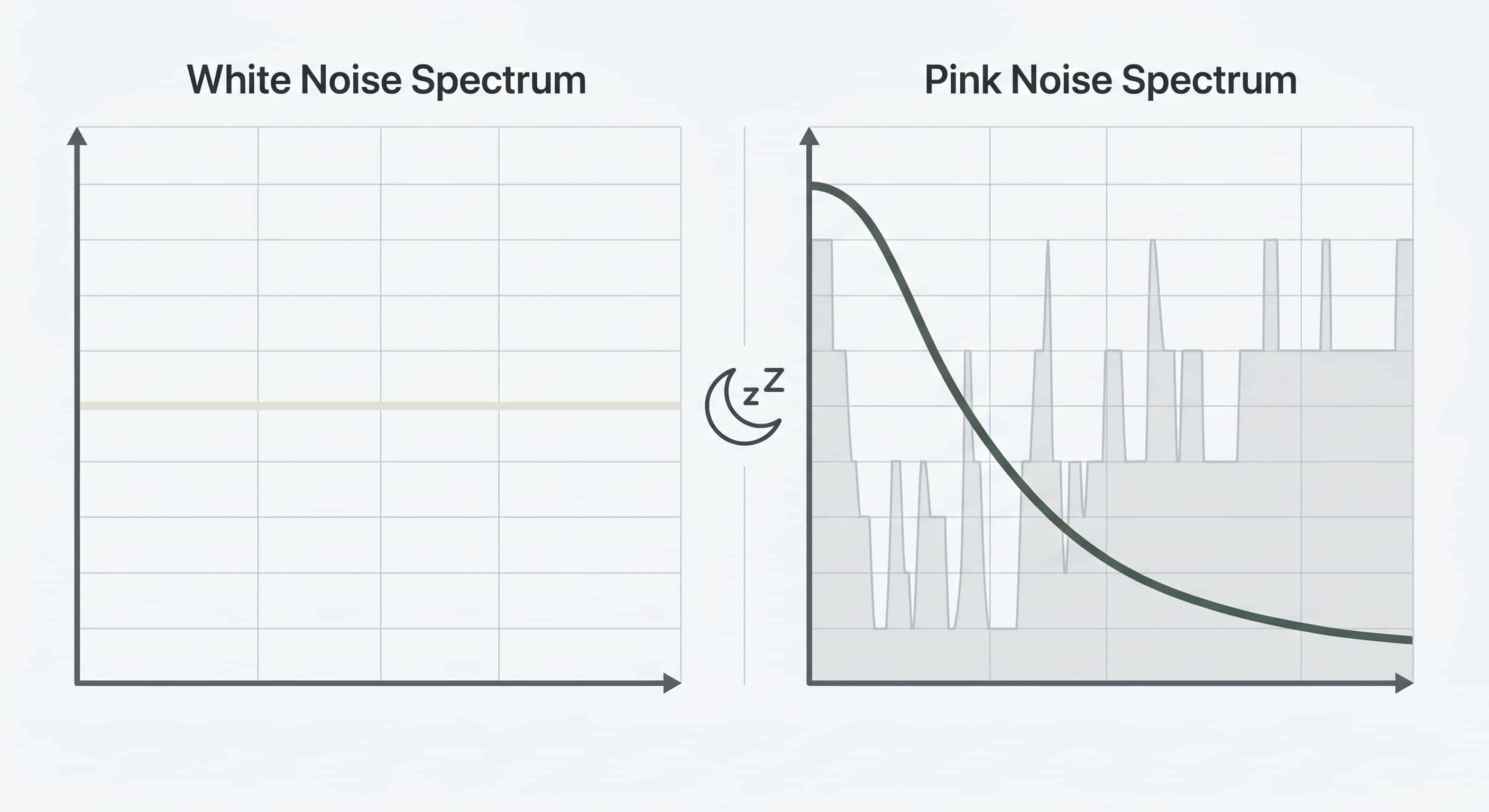
Direct Answer: Pink noise mimics the frequency distribution of natural environments — more power in lower frequencies — and has been shown to specifically enhance slow-wave brain activity during Deep Sleep. White noise, with equal energy across all frequencies, sounds harsh and piercing to the human auditory system.
The Science: White noise contains the same intensity at every frequency, creating the familiar “TV static” sound. Pink noise reduces intensity by 3 decibels per octave as frequency increases, producing a deeper, more natural sound similar to a waterfall or steady rain. When auditory stimulation is synchronized with the slow oscillations of pink noise, it physically increases the amplitude of slow-wave brainwaves — the same waves responsible for cellular repair, memory consolidation, and hormone regulation during sleep.
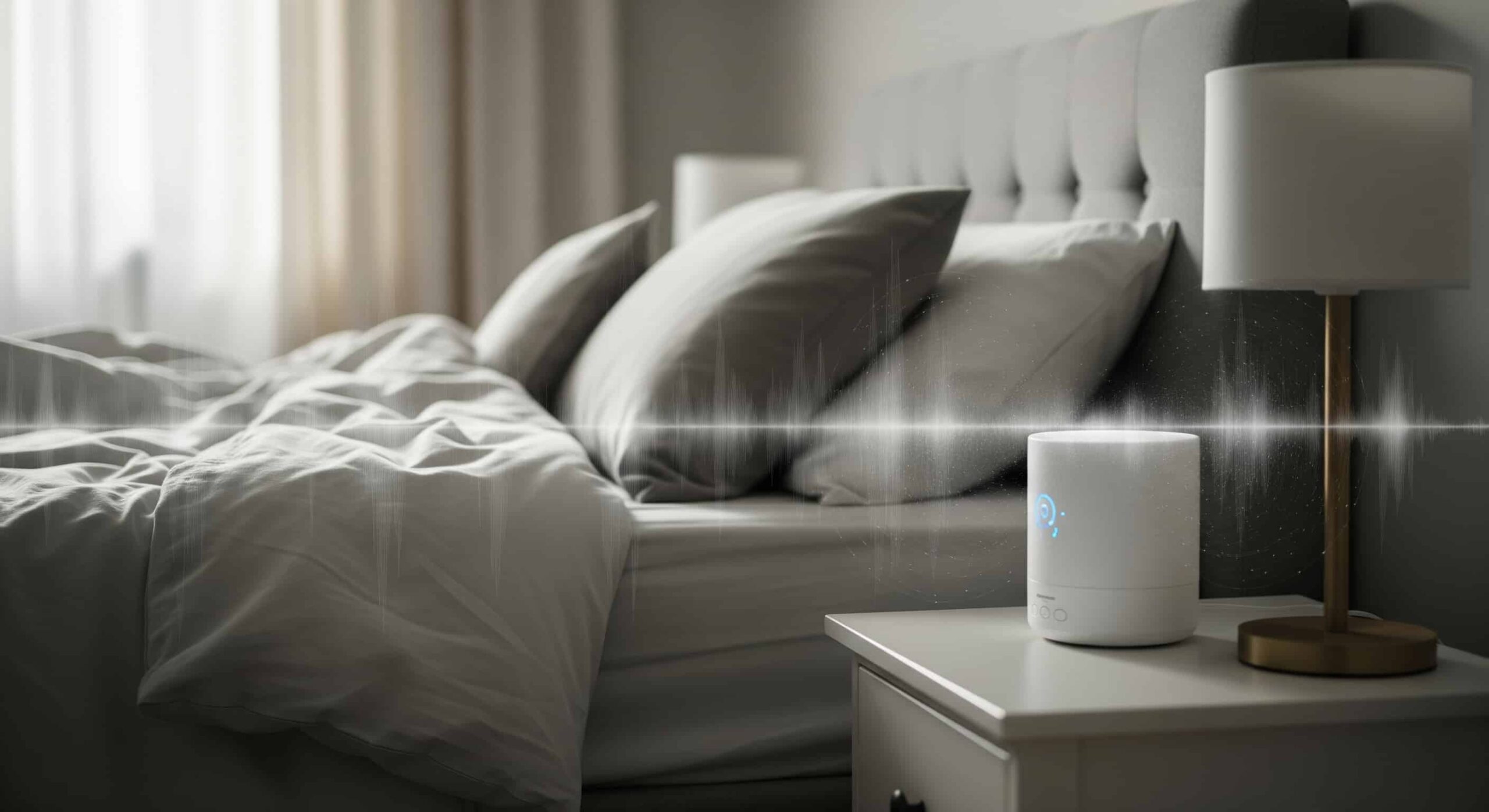
What to Do Tonight: Switch your sound machine or app from white noise to pink noise. Place the speaker at least 6 feet from your head to create a diffuse sound wall rather than a directional beam.
Your brain never stops listening, even in deep sleep. Sudden spikes in ambient noise — a car door slamming, a dog barking, your partner turning over — cause micro-arousals that shatter your sleep architecture without fully waking you up. Each micro-arousal raises cortisol and fragments your sleep cycle. High-quality acoustic masking creates an impenetrable sound wall that absorbs these disruptions before they reach your auditory cortex.
Research Reference: Pic Roca et al. (2025), Frontiers in Human Neuroscience — Pink noise synchronized with slow-wave sleep increased deep sleep duration by 23%. Zhang et al. (2025), Noise Health — White noise improved sleep quality scores by 35% in environmental noise conditions.
The right acoustic environment is not about silence — it is about consistency. A steady sound baseline prevents sudden noise spikes from triggering the micro-arousals that fragment your sleep cycle.
How do CBT-I apps actually treat chronic insomnia?
Direct Answer: CBT-I apps restructure the catastrophic thoughts that fuel insomnia and implement sleep restriction therapy — a counterintuitive protocol that temporarily reduces time in bed to rebuild sleep drive. Clinical data shows 85% effectiveness for mild-to-moderate insomnia.
The Science: Chronic insomnia is maintained by two mechanisms: cognitive hyperarousal — the racing thoughts and catastrophic predictions about tomorrow’s exhaustion — and conditioned arousal, where your bed becomes associated with frustration rather than sleep. CBT-I attacks both. Cognitive restructuring replaces thoughts like “if I don’t sleep, tomorrow is ruined” with evidence-based probability assessments. Sleep restriction limits time in bed to match actual sleep duration, building up sleep pressure over days until your brain relearns that bed equals sleep, not anxiety.
What to Do Tonight: If you have been struggling with insomnia for more than three months, try Sleepio — the only app with FDA clearance and published clinical trial data. Do not use generic tracking apps for chronic insomnia. They will make it worse by feeding your obsession with numbers.
The hierarchy of sleep solutions matters. CBT-I is not a relaxation tool — it is a structured clinical intervention delivered through an app interface. If your insomnia is mild, meditation apps may be sufficient. If it is chronic — lasting more than three months, occurring at least three nights per week — you need a protocol with clinical evidence, not a soothing voice telling you to imagine a beach.
Frequently Asked Questions About Best Sleep Apps
Q: Do sleep tracking apps actually help or just stress me out more?
Direct Answer: They help if you act on the data. Most people check scores but never change their behavior. Why: Without behavioral intervention, sleep tracking becomes a source of performance anxiety — orthosomnia — that worsens the problem it claims to solve. What to do: Track for two weeks, make one change based on the data, then track another two weeks to measure impact.
Q: Can I leave white noise on all night or will it damage my hearing?
Direct Answer: At safe volumes — under 50 decibels — continuous white noise is not harmful. Why: Audiologists recommend a 30-minute timer if you want your auditory system to process natural environmental sounds after sleep onset, but there is no evidence of harm from all-night use at moderate volumes. What to do: Keep the device at least 6 feet from your head and below conversational volume.
Q: Why do I feel more tired when I check my sleep score in the morning?
Direct Answer: You are experiencing the nocebo effect — an algorithm told you that you slept poorly, so your brain manufactures the fatigue. Why: Sleep perception is highly malleable. When a number says 62, your brain interprets that as exhaustion regardless of your actual physiological state. What to do: Try a 14-day data detox — cover your tracker screen and judge your rest exclusively by how you feel at 11 AM.
Q: Are free sleep apps as good as the paid versions?
Direct Answer: For meditation and white noise, yes. For CBT-I, no. Why: Free meditation apps like Insight Timer have extensive libraries that rival paid alternatives. Free white noise apps may use looping audio files — avoid those. CBT-I apps with clinical validation — like Sleepio — require paid access because they are structured medical interventions, not content libraries. What to do: Start with free versions. Upgrade only if you consistently use the app for 30+ days.
Q: Can a sleep app detect if I have sleep apnea?
Direct Answer: No. Sleep apnea requires medical diagnosis. Why: Apps may detect snoring as a symptom, but they cannot measure breathing cessation, oxygen desaturation, or airway obstruction — the hallmarks of apnea. What to do: If you snore regularly, wake up gasping, or feel exhausted despite sufficient sleep duration, see a sleep specialist for a polysomnography test.
Q: Does using a sleep app on my phone expose me to harmful blue light?
Direct Answer: Yes — all screens suppress melatonin. Why: Blue light wavelengths between 460-480 nanometers signal your suprachiasmatic nucleus that it is daytime, delaying melatonin release by up to 90 minutes. What to do: Use apps at least 60 minutes before bed with Night Shift or warm mode enabled. Better yet, use a dedicated white noise device that requires no screen interaction at all.
Q: How can I track my sleep without keeping my phone in bed?
Direct Answer: Use a wearable or bedside device instead of your phone. Why: Phone proximity within 3 feet of your bed independently reduces sleep quality by 25% — even if you are not using it. What to do: Wearable options include Oura Ring, Whoop, or Apple Watch. Bedside alternatives include Withings Sleep Analyzer or under-mattress pads like SleepScore Max.
Q: Do meditation apps work if I have ADHD or a racing mind?
Direct Answer: They work for about 70% of people, but the 30% with ADHD or high cognitive arousal often find guided instructions frustrating. Why: Sitting still and following verbal instructions can increase anxiety for neurodivergent brains that thrive on movement and sensory input. What to do: Try active relaxation — progressive muscle relaxation, gentle stretching, or a CBT-I app that works through cognitive restructuring rather than stillness-based meditation.
Q: What’s the one sleep app everyone should download?
Direct Answer: There is no universal best app — it depends entirely on your specific sleep disruptor. Why: Meditation apps help the racing mind. White noise apps help environmental noise. CBT-I apps help chronic insomnia. Using the wrong category is worse than using no app at all. What to do: Identify your primary sleep problem first — racing mind, noise, or chronic insomnia — then match the app category to the problem. Do not download an app because a podcast recommended it.
Q: How long does it take for sleep apps to actually work?
Direct Answer: Meditation shows effects in 3-7 days. White noise works immediately. CBT-I takes 2-4 weeks for the first noticeable improvement and 6-8 weeks for full effect. Why: Meditation and white noise produce immediate physiological changes. CBT-I requires restructuring deeply ingrained cognitive and behavioral patterns — this takes time. What to do: Commit to a 4-week trial before judging any sleep app. Behavioral change, not app usage, is what improves your sleep.
Q: Are white noise apps that loop audio bad for my sleep?
Direct Answer: Yes. Looping audio files are actively harmful. Why: Your brain is a pattern-recognition machine that never fully shuts down during sleep. When it detects the same audio loop repeating every 30 seconds, it triggers a micro-arousal — exactly the type of sleep disruption that white noise is supposed to prevent. What to do: Use only apps with algorithmically generated, non-looping audio, or invest in a dedicated physical white noise machine.
Q: Can I use sleep apps while also using Slumbelry products?
Direct Answer: Yes — and data suggests this combination produces the best results. Why: Apps address cognitive and auditory factors. Slumbelry products address the physical environment that apps cannot touch — temperature regulation, pressure point relief, and acoustic dampening. What to do: Customers who combine strategic app use with a properly engineered sleep environment report 60% better sleep quality than app-only users.
Transform your evenings with the Slumbelry Sleep Nutrition Protocol.
The right sleep app can quiet your mind, but it cannot cool your mattress, relieve pressure points, or create an acoustic sanctuary. Slumbelry builds the physical environment your apps depend on. Pair the best of digital sleep science with the best of sleep engineering — and finally stop compensating for an environment that works against you.
Sleep is the most vulnerable state of human existence. It is where we heal, reset, and grow.
At Slumbelry, we don’t just sell sleep products; we advocate for your physiological right to rest. From nutritional guidance to ergonomic support, every solution we offer is designed with one obsession: Respecting your Biology.
Science is our language, but your recovery is our purpose. You take care of everything else in your life — let us take care of your nights.