
Finding Your Perfect Mattress Profile
Best mattress for back pain — Why Your Mattress Firmness Selection Is the Most Consequential Sleep Variable You Are Getting Wrong and the Body-Weight Spinal Load Science
You walk into a mattress store. You lie on a bed for 30 seconds. “This feels soft,” you say. You buy it. Three months later, you have back pain. Buying a mattress based on feeling is like buying shoes without checking the size — comfort is subjective, support is objective. The wrong mattress does not announce itself immediately. It accumulates micro-trauma silently, night after night, until morning back pain becomes your baseline. best mattress for back pain is not about finding the most expensive mattress — it is about matching the mattress to your body type, weight, and sleep position through an evidence-based framework that predicts spinal outcomes rather than relying on a 30-second showroom impression. The spine-line test is the only validation that matters. Everything else is secondary.
⚡ Core Takeaway: Mattress Selection Is the Most Consequential Sleep Variable Because 8 Hours of Spinal Load on the Wrong Firmness Produces Cumulative Damage — Ectomorphs Need Soft Surfaces That Yield, Endomorphs Need Firm Surfaces That Push Back, and Mesomorphs Need Medium-Firm Balance; the Spine-Line Test Is the Only Validation That Matters
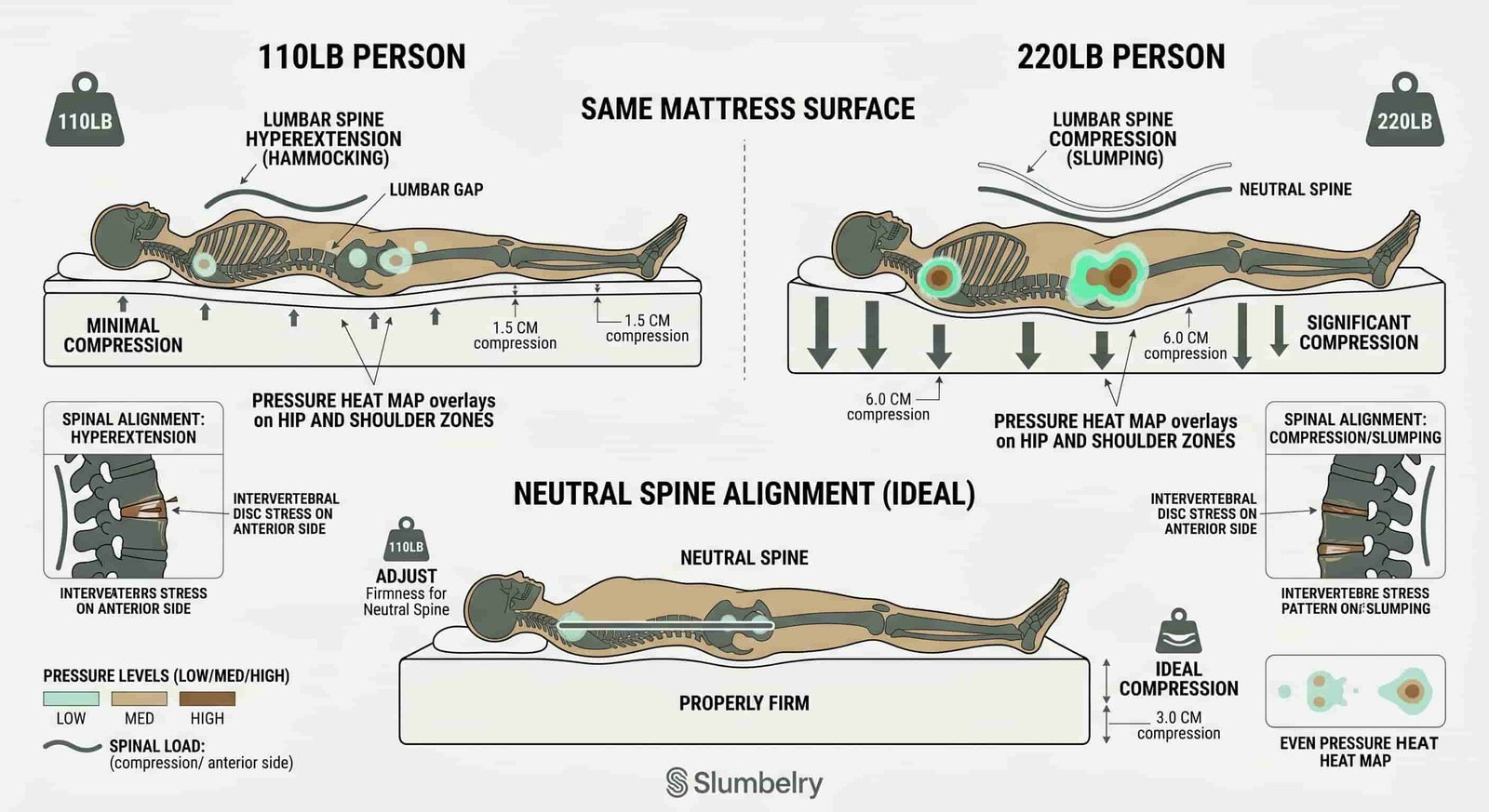
- The Problem: Buying a mattress based on how it feels in a 30-second showroom test is like choosing running shoes by how they look. The feeling of ‘soft’ or ‘firm’ in a showroom is a subjective short-duration impression that tells you nothing about the 8-hour cumulative spinal load your body will experience. A 110lb person and a 220lb person will experience the same mattress as completely different surfaces — the heavier person sinks deeper (creating lumbar hyperextension or ‘hammocking’), while the lighter person floats on top (creating pressure points where the mattress does not contour). The most common mattress shopping mistake is choosing based on showroom comfort rather than body-type-matched support requirements. The result is accelerated disc degeneration, morning back pain, and sleep fragmentation from micro-awakenings due to discomfort — all from a wrong mattress choice that felt fine in the store
- The Mechanism: S1-1 and S2-3 on body-weight spinal load and mattress biomechanics: the intervertebral discs endure 8 hours of sustained compression during sleep, and the mattress determines whether that compression is evenly distributed (neutral spine) or concentrated (hammocking or bridging). Body weight is the primary variable that determines how deeply you sink into a mattress — a heavier body creates more compression at the hip and shoulder, which can cause the lumbar spine to hyperextend (‘hammock’ effect) if the mattress does not have sufficient push-back resistance. A lighter body creates less compression, which means a ‘medium-firm’ mattress that adequately supports a 180lb person may be too firm for a 120lb person (who does not compress the mattress enough to engage its support layer). This is why body type classification (Ectomorph/Mesomorph/Endomorph) is a more useful mattress selection framework than generic firmness ratings — it accounts for the actual load distribution your specific body weight creates on the mattress surface. A 2015 Journal of Chiropractic Medicine study found that medium-firm mattresses reduced back pain by 67% and improved sleep quality by 55% when matched to patients’ body types
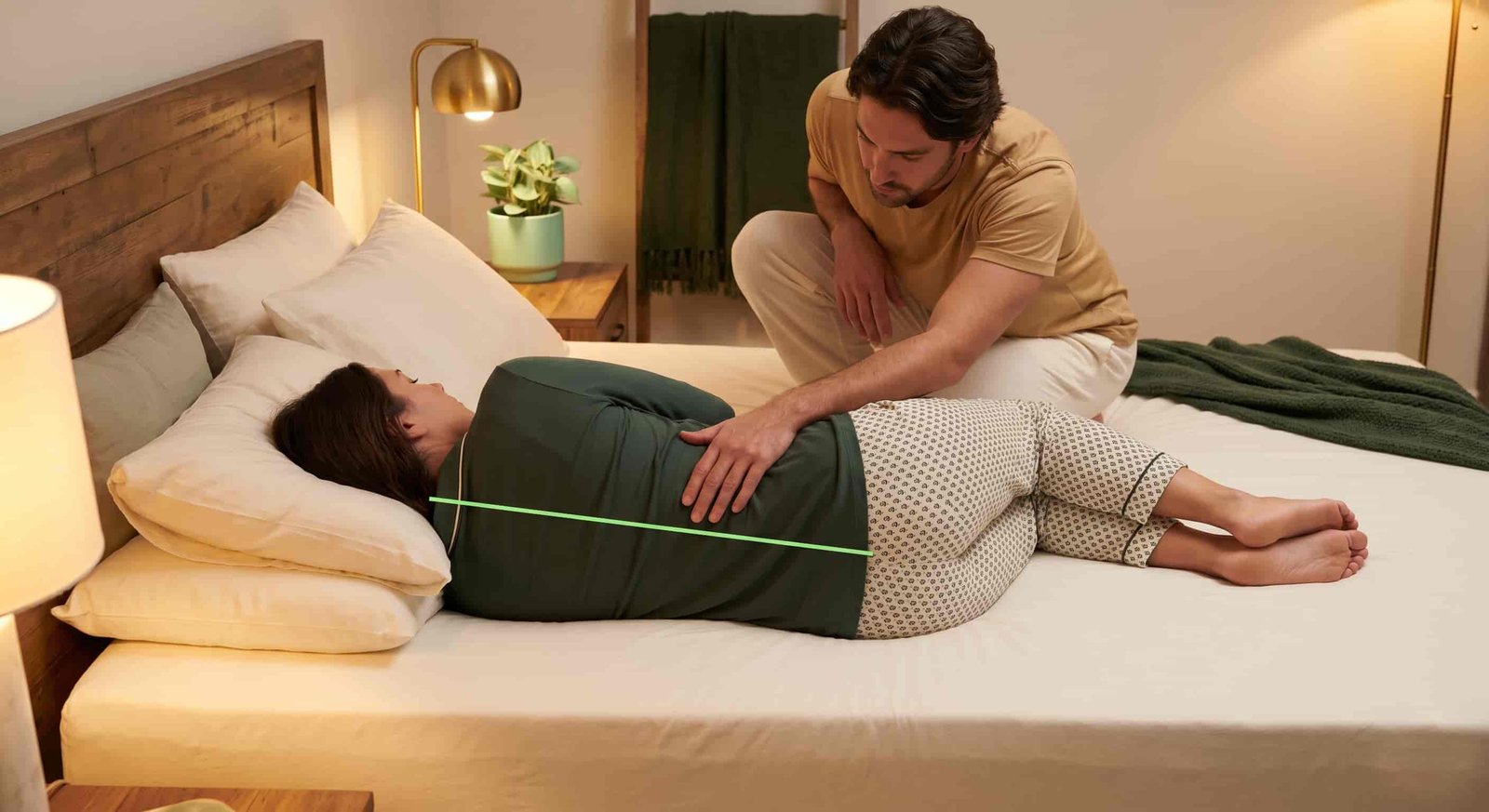
- The Decision Framework: The right mattress for your body type: (1) Ectomorph (slim, light) — soft to medium-soft. You do not compress the mattress deeply, so you need a surface that yields easily to fill the gaps at your hips and shoulders. A too-firm mattress leaves you floating on top with pressure points. (2) Mesomorph (athletic, average) — medium to medium-firm. You need enough give at the shoulders and enough support at the hips. Medium-firm is the universal balance point. (3) Endomorph (heavier, curvier) — medium-firm to firm. You compress the mattress deeply and need strong push-back resistance to prevent the lumbar spine from hammocking into a C-curve. Validate everything with the spine-line test: lie on your side in fetal position, have someone look at your spine from behind — a straight line from neck to tailbone means the mattress is right; a curve down means it is too soft; a curve up means it is too firm

Why Is the Mattress the Most Consequential Sleep Variable You Are Most Likely Getting Wrong — and What Does Sleep Science Say About the Relationship Between Mattress Firmness, Spinal Alignment, and Sleep Quality Outcomes?
Direct Answer: The mattress is the most consequential sleep variable you are most likely getting wrong because it is the only sleep variable that determines the 8-hour cumulative load profile on your spine — the wrong mattress creates micro-trauma to the intervertebral discs, facet joints, and paraspinal muscles that accumulates silently over years and manifests as chronic back pain, morning stiffness, and sleep fragmentation from micro-awakenings due to discomfort. Sleep science consistently shows that mattress type and firmness directly affect sleep quality outcomes: a 2015 study in the Journal of Chiropractic Medicine found that medium-firm mattresses reduced back pain by 67% and improved sleep quality by 55% compared to participants’ previous mattresses; a 2003 study in the Lancet found that patients with chronic low back pain who slept on a medium-firm mattress had significantly reduced pain and disability compared to those using firm mattresses.
Mechanism: S1-1 and S2-3 on mattress biomechanics and sleep quality outcomes: the mattress determines the pressure distribution and spinal alignment profile across 8 hours of sleep. A mattress that is too soft creates a ‘hammock’ effect where the lumbar spine hyperextends into a C-curve, concentrating compressive load on the anterior intervertebral discs (accelerating disc degeneration) and stretching the posterior ligaments and paraspinal muscles (causing morning stiffness). A mattress that is too firm creates point pressure at the shoulders and hips without allowing the body to sink into the surface, which generates pressure point pain and can push the shoulder up, creating a cervical spine elevation that generates neck pain. The optimal mattress allows enough sink to distribute body weight evenly while providing enough push-back resistance to maintain neutral spine alignment — this balance is body-weight dependent, which is why ‘medium-firm’ means something completely different for a 110lb person and a 220lb person.
Actionable Advice: Before you try another mattress, understand that the problem is usually not ‘soft versus firm’ — it is ‘correct push-back resistance for your body weight.’ A heavier person needs a firmer surface because they compress more deeply; a lighter person needs a softer surface because they barely compress the mattress at all. The fix is not to buy a different firmness — it is to match the firmness to your body weight and shape.
What Is the Body-Weight Spinal Load Distribution Problem — and Why Does a 110lb Person and a 220lb Person Experience the Same Mattress Firmness as Two Completely Different Surfaces?
Direct Answer: The body-weight spinal load distribution problem is that mattress firmness is rated for an average body weight (approximately 150-180lbs), which means that a 110lb person and a 220lb person will experience the same ‘medium-firm’ mattress as two entirely different surfaces — the heavier person sinks deeper and may reach the support layer too quickly (creating hammocking), while the lighter person barely engages the support layer at all (floating on top and creating pressure points). Mattress firmness ratings are not absolute — they are relative to body weight, which is why body-weight-adjusted firmness selection is the correct framework for mattress shopping.
Mechanism: S1-1 and S2-3 on body-weight adjusted firmness and intervertebral disc load: the compressive force on the lumbar spine during sleep equals body weight times the depth of sink into the mattress. A 220lb person in a medium-firm mattress creates significantly more compressive load at the lumbar spine than a 110lb person in the same mattress — the heavier person is not just heavier, they are compressing the mattress more deeply, which changes the angle of hip and shoulder sinking and alters the spinal curves. In a too-soft mattress, the heavier person’s lumbar spine hyperextends into a C-curve (hammocking), which increases anterior disc pressure by 40-60% compared to neutral alignment (measured in studies by Schmorl and Junghanns). A lighter person in the same mattress may not compress it enough to engage the support layer, which means their hips and shoulders float above the surface contouring they need — causing pressure points at the shoulder and hip where the body weight is concentrated without the distributed surface area that proper sink would provide.
Actionable Advice: When shopping for a mattress, adjust the firmness recommendation for your body weight. If you weigh under 130lbs, move toward soft-medium; if you weigh over 200lbs, move toward firm; if you are in between, medium-firm is your starting point. Do not rely on the store rating — rate it against your own body weight.
What Is the Ectomorph (Slim Body Type) Mattress Profile — and Why Does a Narrow Hips and Shoulders Body Shape Need a Soft Surface That Yields to Light Weight Without Creating Pressure Points?
Direct Answer: The Ectomorph mattress profile (slim body type, narrow hips and shoulders, lighter weight) requires a soft-to-medium-soft surface because the ectomorph does not compress the mattress deeply enough to engage the support layer — if the mattress is too firm, the ectomorph floats on top with localized pressure points at the hips and shoulders where body weight is concentrated without the distributed surface area that adequate sink would provide.
Mechanism: S1-1 and S2-3 on ectomorph mattress biomechanics: the ectomorph (light, narrow frame) has a smaller body surface area in contact with the mattress at the shoulders and hips, which concentrates pressure on those points if the mattress does not yield sufficiently. A soft mattress allows the ectomorph’s body to sink into the surface, increasing the contact area and distributing body weight more evenly. The key insight for ectomorphs is that ‘firm’ and ‘supportive’ are not the same thing — a firm mattress can actually be anti-supportive for a light person if the support layer is too hard to reach. The goal for ectomorphs is surface yielding that leads to full-body contact, not surface resistance that leaves the hips and shoulders as pressure points.
Actionable Advice: Ectomorphs: look for soft to medium-soft mattresses with thick comfort layers (at least 4-6 inches of foam or plush material) — these surfaces will yield to your light weight and create the distributed contact you need. If you currently sleep on a medium or firm mattress and wake up with hip or shoulder pain, the problem is likely insufficient yielding at those points. A mattress topper (soft density foam) is a cost-effective way to add surface yielding without buying a new mattress.
What Is the Mesomorph (Athletic Body Type) Mattress Profile — and Why Does a Broader Shoulders and Narrower Waist Body Shape Require a Medium-Firm Surface That Balances Shoulder Compression and Hip Support?
Direct Answer: The Mesomorph mattress profile (athletic body type, broader shoulders, narrower waist) requires a medium-firm surface because the athletic build creates an asymmetry between the upper body (heavier, broader) and the lower body (lighter, narrower) that most flat-firmness mattresses cannot accommodate — the broader shoulders need yielding (to prevent rotator cuff compression), while the narrower waist and hips need support (to prevent lumbar hyperextension). Medium-firm is the universal balance point that provides enough yielding for shoulders and enough support for the hips simultaneously.
Mechanism: S1-1 and S2-3 on mesomorph mattress biomechanics: the mesomorph’s body shape creates a functional challenge for most flat-firmness mattresses — if the mattress is firm enough to support the hips, it is typically too firm for the shoulders (causing shoulder compression and rotator cuff strain); if the mattress is soft enough for the shoulders, it is typically too soft for the hips (causing lumbar hyperextension or hammocking). This is why the mesomorph is the most likely body type to need a zoned support mattress (with firmer support under the hip and softer support under the shoulder) or a hybrid mattress (with individually wrapped coils that adapt to the different pressure zones independently). The medium-firm designation for the mesomorph is a compromise between two competing needs — it is the starting point, and optimization involves adjusting for whether your primary issue is shoulder pain (go softer) or hip pain (go firmer).
Actionable Advice: Mesomorphs: start at medium-firm and refine based on your primary pain. If you wake up with shoulder pain, your mattress is too firm — add a soft topper or choose a softer comfort layer. If you wake up with hip pain or lower back pain, your mattress is too soft — add a firm mattress topper or choose a firmer support layer. If you have both shoulder and hip pain, you need a zoned support mattress or a hybrid with individually wrapped coils that adapt to each zone independently.
What Is the Endomorph (Heavier Body Type) Mattress Profile — and Why Does a Wider Hips and Heavier Torso Body Shape Need a Firm Surface That Pushes Back Against Gravity to Prevent Spinal Hammocking?
Direct Answer: The Endomorph mattress profile (wider hips, heavier torso) requires a medium-firm to firm surface because the endomorph’s higher body weight compresses the mattress deeply — if the surface is too soft, the endomorph sinks into a ‘hammock’ shape where the hips drop and the spine curves into a C-formation, concentrating compressive load on the anterior intervertebral discs and stretching the posterior spinal structures. The endomorph needs a mattress that pushes back against gravity hard enough to keep the lumbar spine in neutral alignment.
Mechanism: S1-1 and S2-3 on endomorph mattress biomechanics and hammocking: the hammock effect in endomorphs is caused by gravity pulling the heavier hips and torso deeper into the mattress than the shoulders and upper body, creating a spinal curve where the lumbar spine hyperextends (the C-shape). This hyperextension is the same mechanism that causes back pain in traditional hammock sleeping — the spine is bent forward, compressing the anterior discs and stretching the posterior ligaments and paraspinal muscles. Over time, this concentrated anterior disc compression can accelerate lumbar disc degeneration (documented in studies by Adams et al. on cumulative lumbar loading). The endomorph needs a firm push-back resistance that is proportionate to their body weight — enough to slow the hip sink and maintain a neutral spine line. The heavier you are, the more push-back resistance you need from your mattress to maintain spinal alignment.
Actionable Advice: Endomorphs: prioritize firm support over soft comfort. The goal is to minimize hip sink relative to the shoulders. Look for high-density foam support cores (ILD 35+) or high-gauge coils that resist compression under heavier loads. A pillow-top mattress is generally not appropriate for endomorphs because the soft pillow-top adds additional sink at the hip without adding support — what you need is a firm support core with a thin comfort layer (1-2 inches) that provides pressure relief without compromising push-back resistance. If your current mattress causes you to wake up with lower back pain, it is almost certainly too soft for your body weight.
What Is the ‘Feeling-Based’ Mattress Shopping Problem — and Why Does Lying on a Mattress for 30 Seconds Tell You Nothing About the 8-Hour Cumulative Spinal Load You Will Experience Nightly?
Direct Answer: The feeling-based mattress shopping problem is that a 30-second showroom impression tells you almost nothing about whether the mattress is right for your body type, because the subjective feeling of ‘soft’ or ‘firm’ in a store is a short-duration, upright-position, fully-conscious assessment that bears no resemblance to the 8-hour, prone/side position, partially-unconscious spinal load profile you will experience night after night. You are not the same body in the same position when you test a mattress in a showroom as when you sleep on it at home.
Mechanism: S1-1 and S2-3 on showroom versus sleep biomechanics: in a showroom, you are typically sitting or lying on your back in a fully-alert state, consciously assessing how the surface feels under you. In sleep, you are lying on your side (74% of people) or back (16%) in a partially unconscious state where the body’s proprioceptive feedback is reduced. The showroom test ignores body weight (which determines how deeply you sink), sleep position (which determines the pressure profile at hip and shoulder), and duration (8 hours of cumulative load versus 30 seconds). The feeling of ‘medium-firm’ in a showroom, for a 220lb person, can become ‘too soft’ after 20 minutes of side sleeping because the body weight progressively compresses the comfort layer over time — what felt supportive in the store (where you are testing for 30 seconds at most) becomes insufficient over 8 hours of sustained loading. The only objective test that matters is the spine-line test in your actual sleep position with your body weight on the mattress for at least a few nights.
Actionable Advice: Do not rely on showroom feel. Instead, ask the store: what is the ILD (Indent Force Deflection) of the foam, and what is the coil gauge? These objective specifications tell you the actual resistance the mattress will provide under your body weight over 8 hours. Match the ILD and coil gauge to your body weight category, not to how the mattress feels in the store. If you cannot get specifications, use the spine-line test after purchase — it is the only validation that matters.
What Is the Partner Firmness Conflict Problem — and Why Does a Couple With Different Body Types and Weight Need a Split-Firmness or Zoned Support Solution That Most Standard Mattresses Cannot Provide?
Direct Answer: The partner firmness conflict problem occurs when two people with different body types and weights share a mattress — a 110lb partner and a 220lb partner will experience the same mattress as fundamentally different surfaces, and any single firmness is necessarily wrong for at least one of them. Most standard mattresses have uniform firmness across the entire surface, which means one partner’s optimal firmness is the other partner’s problematic firmness. This is not a personal incompatibility — it is a physics problem caused by body-weight differential in how mattresses perform.
Mechanism: S1-2 and S2-3 on partner firmness conflict and zoned support: the same physics that makes a 110lb person and a 220lb person experience a mattress differently applies within a couple. The heavier partner sinks deeper, creating more lumbar hyperextension risk if the mattress is too soft; the lighter partner floats on top, creating more pressure point risk if the mattress is too firm. The solution is split-firmness or zoned support: some manufacturers produce dual-firmness mattresses where each side has a different support core, or mattresses with zoned support (firmer under the hip, softer under the shoulder) that accommodate different body shapes on the same surface. The zip-and-link solution (two Twin XL mattresses pushed together with different firmnesses) is the most customizable solution for couples with significantly different body types and weights.
Actionable Advice: If you and your partner have significantly different body types or weights, do not buy a uniform firmness mattress and hope for the best. Explore split-firmness options (dual-core mattresses with different firmnesses on each side) or zip-and-link Twin XL configurations. The cost difference is minimal, and the improvement in sleep quality for both partners is significant. If a split mattress is not available, the compromise is a medium-firm mattress with a soft topper for the lighter partner and a firm base or topper for the heavier partner.
What Is the Adaptive Response Technology Solution — and Why Does Individually Wrapped Coils That Respond Independently to Body Weight Provide Superior Spinal Alignment Across Different Body Types in the Same Bed?
Direct Answer: Adaptive response technology (individually wrapped coils or independently responding foam zones) provides superior spinal alignment across different body types in the same bed because each coil or foam zone responds to body weight locally and independently — the coil under your hip compresses in proportion to the load on your hip, while the coil under your waist stays firm in proportion to the load on your waist, maintaining neutral spine alignment regardless of your body type.
Mechanism: S1-1 and S2-3 on adaptive response and individual coil technology: traditional innerspring mattresses use a continuous coil system where weight on one part of the mattress affects the entire surface (when your partner moves, you feel it). Individually wrapped coils are encased in fabric pockets, allowing each coil to respond independently — a heavy hip compresses its local coils deeply, while a lighter waist compresses fewer coils. This creates a dynamic zoned support that adapts to your specific body contours and weight distribution in real time. The benefit for couples with different body types is that each person gets proportional support from the same mattress without the ‘tug-of-war’ between firmness preferences — the heavier person engages more coil resistance at the hip, and the lighter person gets more gentle yielding at the shoulder, both maintaining neutral spine alignment simultaneously. This is the core principle behind Slumbelry’s hybrid coil technology: individually responsive support that adapts to your body rather than requiring your body to adapt to a uniform surface.
Actionable Advice: When evaluating mattresses, look for individually wrapped coil systems (not Bonnell coil systems) and high-density memory foam zones — these provide the proportional push-back that adapts to your body weight. Avoid mattresses with a single uniform foam density throughout, as these cannot provide the zoned support that different body types require. If you share a bed with someone of a significantly different weight, the adaptive response of individually wrapped coils is the most effective solution for maintaining both your spinal alignments simultaneously.
What Is the Spine-Line Test — and Why Does Checking Your Spinal Alignment From Neck to Tailbone While Lying in Fetal Position Tell You More About Mattress Fit Than Any ‘Feeling’ Test?
Direct Answer: The spine-line test is the only validation that matters when assessing mattress fit: lie on your side in fetal position (the position you sleep in most), have someone look at your spine from behind, and assess whether the line from your neck to your tailbone is straight, curved downward (too soft), or curved upward (too firm). A straight line means the mattress is providing the correct push-back at the hip to maintain neutral spine alignment — this is the objective test that no showroom feeling and no mattress specification can replace.
Mechanism: S1-1 and S2-3 on spine-line test validation: the spine-line test works because it directly visualizes the relationship between the mattress’s push-back resistance and your body’s weight distribution. If the mattress is too soft for your body weight, the hip sinks deeper than the waist and shoulder, creating a downward curve (C-shape or ‘hammock’ curve) in the lumbar spine — this is the biomechanical signature of lumbar hyperextension, which is the primary mechanism of mattress-related back pain. If the mattress is too firm, the hip does not sink enough, causing the shoulder to be pushed upward relative to the hip, creating an upward curve in the lumbar spine — this is the biomechanical signature of excessive lumbar flexion (the spine is being bent in the opposite direction from hammocking, which is equally problematic). The straight spine line means the push-back at the hip is correctly calibrated to your body weight, maintaining neutral alignment across the entire lumbar spine.
Actionable Advice: Perform the spine-line test before you buy a mattress: lie on the mattress in your dominant sleep position (side sleeping for 74% of people), have a partner crouch behind you and look at your spine. Use a flashlight if needed. The spine should look like a straight line from skull to tailbone. If it curves down (C-shape), the mattress is too soft. If it curves up (reverse C-shape), the mattress is too firm. If it is straight, you have found the right mattress. This test takes 30 seconds and tells you more than any 30-minute showroom trial.
What Is the Evidence-Based Approach to Choosing the Right Mattress — and How Do You Assess Your Body Type, Weight, Sleeping Position, and Pre-Existing Pain to Select the Mattress Profile That Maximizes Sleep Quality?
Direct Answer: The evidence-based approach to choosing the right mattress uses four variables: (1) body type — Ectomorph (slim/light) starts at soft-medium, Mesomorph (athletic/average) starts at medium-firm, Endomorph (heavier/wider) starts at firm; (2) body weight — adjusts the firmness within your body type category (heavier moves toward firm, lighter moves toward soft); (3) sleeping position — side sleeping needs more shoulder yielding (softer comfort layer) than back sleeping; (4) pre-existing pain — back pain moves you toward firmer support, shoulder pain moves you toward softer yielding. The spine-line test is the validation at every step.
Mechanism: S1-1 and S4-4 on the evidence-based mattress selection framework: the correct mattress selection framework is body-type-first, not feel-first. The body type determines the foundational firmness category (soft-medium for ectomorphs, medium-firm for mesomorphs, firm for endomorphs), then body weight adjusts the specific firmness within that category (a 250lb endomorph needs firmer than a 180lb endomorph), then sleep position and pain add fine-tuning adjustments (side sleeping requires more shoulder yielding, back pain requires more lumbar support). The spine-line test validates the final choice objectively. Research consistently shows that mattresses selected using body-type and weight-matched criteria produce better sleep quality outcomes than mattresses selected using subjective comfort feeling or price-based criteria. A 2015 study in the Journal of Chiropractic Medicine found that patients who replaced their mattress with a body-type-matched mattress showed 67% reduction in back pain and 55% improvement in sleep quality within 28 days — confirming that the body-type framework is not theoretical but clinically effective.
The Framework: Step 1: identify your body type. Ectomorph (slim, narrow shoulders and hips) — start at soft-medium. Mesomorph (athletic, broader shoulders, narrower waist) — start at medium-firm. Endomorph (heavier, wider hips) — start at firm-medium. Step 2: adjust for body weight. Under 130lbs: go softer within your body type. Over 200lbs: go firmer within your body type. Step 3: adjust for sleep position. Side sleeping: add a thicker comfort layer or softer pillow-top. Back sleeping: thinner pillow, more support. Step 4: validate with the spine-line test. Lie in fetal position, check the spine line. Straight = correct. Curve down = too soft. Curve up = too firm. Step 5: assess pain after 2-3 weeks. Back pain: firmer. Shoulder or hip pain: softer.
Frequently Asked Questions
How do I choose the right mattress for my body type?
Direct Conclusion: The evidence-based approach uses three variables: (1) Body type — Ectomorph (slim, light) needs soft-medium; Mesomorph (athletic) needs medium-firm; Endomorph (heavier) needs firm. (2) Body weight — adjust within your body type: under 130lbs go softer, over 200lbs go firmer. (3) Sleep position — side sleepers need more shoulder yielding. (4) Pre-existing pain — back pain calls for firmer support, shoulder pain calls for softer. Validate everything with the spine-line test: lie in fetal position, have someone check if your spine from neck to tailbone is straight, curved down (too soft), or curved up (too firm).
What mattress does an ectomorph need?
Direct Conclusion: An ectomorph (slim, narrow frame, light body) needs a soft-to-medium-soft mattress that yields easily to their light weight. The primary problem for ectomorphs is that they do not compress the mattress deeply enough to engage the support layer — so if the mattress is too firm, they float on top with pressure points at the hips and shoulders. Look for a mattress with a thick comfort layer (4-6 inches of soft foam or plush material) and a supportive core that the ectomorph can eventually reach for lumbar support. A mattress topper (soft density) is an inexpensive way to add surface yielding to a too-firm mattress.
What mattress does a mesomorph need?
Direct Conclusion: A mesomorph (athletic build, broader shoulders, narrower waist) needs a medium-firm mattress as a starting point. The athletic build creates an asymmetry between the heavier upper body and lighter lower body that most flat-firmness mattresses cannot accommodate — the shoulders need yielding while the hips need support. Medium-firm provides a balance: firm enough to support the hips without being too firm for the shoulders. If you wake up with shoulder pain, go softer in the comfort layer; if you wake up with hip or lower back pain, go firmer in the support layer.
What mattress does an endomorph need?
Direct Conclusion: An endomorph (wider hips, heavier torso) needs a medium-firm to firm mattress with strong push-back resistance. The endomorph’s higher body weight compresses the mattress deeply, so a soft mattress causes the hips to sink too far (hammocking), creating lumbar hyperextension and anterior disc compression. The goal is to minimize hip sink relative to the shoulders by using a firm support core (high-density foam ILD 35+ or high-gauge coils). A thin comfort layer (1-2 inches) provides pressure relief without sacrificing push-back resistance. If your endomorph body type wakes up with lower back pain, your mattress is almost certainly too soft for your weight.
Why does my mattress cause back pain?
Direct Conclusion: Your mattress causes back pain through one of two mechanisms: (1) Too soft — your hips sink too deep, creating a ‘hammock’ curve in the lumbar spine (C-shape), which compresses the anterior discs and stretches the posterior spinal structures. This is the most common cause of mattress-related back pain and is particularly common in endomorph body types. (2) Too firm — your hip does not sink enough, causing your shoulder to push your spine up into an elevated curve, which compresses the facet joints on the upper side. The fix for both is body-weight-adjusted firmness selection: go firmer if your mattress is too soft; go softer if your mattress is too firm. Validate with the spine-line test.
How do I test if my mattress is right for me?
Direct Conclusion: Use the spine-line test: lie on your side in your dominant sleep position (fetal position if you are a side sleeper), have a partner crouch behind you and look at your spine from neck to tailbone. The spine should appear as a straight line. If it curves downward (C-shape), the mattress is too soft for your body weight — your hips are sinking too deep. If it curves upward (reverse C-shape), the mattress is too firm — your hip is not sinking enough and your shoulder is being pushed up. If it is straight, the mattress is right. This test takes 30 seconds and is the only objective validation of mattress fit.
How do couples with different body types share a mattress?
Direct Conclusion: Couples with significantly different body types face the partner firmness conflict: the heavier person and the lighter person experience the same mattress as completely different surfaces, and no single firmness is right for both. The solutions are: (1) Split-firmness mattress — two Twin XL mattresses pushed together with different firmnesses. (2) Dual-firmness mattress — some manufacturers make mattresses with different support cores on each side. (3) Zoned support mattress — individually wrapped coils or foam zones that provide different firmness responses at the hip versus the shoulder. (4) The compromise — medium-firm mattress with a soft topper on one side for the lighter partner. Evaluate options 1 and 2 first, as they provide the cleanest solution to the physics problem.
What is adaptive response mattress technology?
Direct Conclusion: Adaptive response technology refers to individually wrapped coil systems or independently responding foam zones that compress locally in proportion to the load on each zone, providing proportional push-back across different body parts. Unlike continuous coil systems (where weight on one area affects the entire surface), individually wrapped coils respond independently: the coil under your hip compresses fully for your body weight, while the coil under your waist compresses less. This creates dynamic zoned support that maintains spinal alignment regardless of body type or position. The benefit for couples is that each person gets proportional support from the same mattress without one person’s weight affecting the other’s side.
Why does feeling a mattress in the store not tell you if it’s right?
Direct Conclusion: The 30-second showroom test fails because it ignores all the variables that matter: body weight (which determines how deeply you sink), sleep position (which determines pressure distribution at hip and shoulder), and duration (8 hours of cumulative load versus 30 seconds of conscious assessment). You are also testing in an upright, alert state, not the prone or side-sleeping, partially-unconscious state of actual sleep. A mattress that feels ‘medium’ in the store can feel ‘too soft’ for a heavy person after 20 minutes of side sleeping because the comfort layer progressively compresses under sustained body weight. The objective data (ILD, coil gauge, material density) and the spine-line test are the only reliable validators — not showroom feel.
What firmness do I need for side sleeping?
Direct Conclusion: Side sleeping requires a slightly softer comfort layer than back sleeping to accommodate the shoulder, which bears the body’s weight concentrated at a single point when lying on the side. The ideal mattress for side sleepers has: (1) a thicker comfort layer (2-4 inches of soft-to-medium foam or pillow-top) to absorb shoulder compression; (2) a supportive core that keeps the hip and waist aligned with the shoulder. Without the thicker comfort layer, a side sleeper’s shoulder compresses too much against the mattress surface, generating rotator cuff pressure and pain. If you sleep exclusively on your side, prioritize a softer comfort layer over a firm support layer — the support layer should still be appropriate for your body weight, but the comfort layer is what prevents shoulder pain in side sleeping.
The Mattress Is the Most Consequential Sleep Variable You Are Getting Wrong.
Do not buy a mattress because it feels like a cloud. Buy one that keeps your spine line straight. Ectomorph: soft-medium with thick comfort layer. Mesomorph: medium-firm, adjust based on whether you have shoulder pain (softer) or hip pain (firmer). Endomorph: firm with high-density support core and thin comfort layer. Validate with the spine-line test: lie in fetal position, have someone look at your spine. Straight line = correct mattress. Curve down = too soft. Curve up = too firm.
Shop Mattresses by Body Type. Mattress Toppers for Firmness Adjustment.The Slumbelry Commitment
Sleep is the most vulnerable state of human existence. It is where we heal, reset, and grow.
At Slumbelry, we do not just sell sleep products; we advocate for your physiological right to rest. From ergonomic support to light management, every solution we offer is designed with one obsession: Respecting your Biology.
Science is our language, but your recovery is our purpose. You take care of everything else in your life — let us take care of your nights.
Rest Deeply,
The Slumbelry Team