
Engineering the Perfect Sleep Environment
Why Your Bedroom Is Built for Wakefulness, Not Sleep — The Cave Engineering Protocol That Actually Works
Look at your bedroom right now. Is it a sanctuary? Or is it an entertainment center, a home office, and a storage unit — with a bed squeezed in?
For millions of years, humans slept in caves. Dark. Cool. Quiet. Safe. Our biology still runs on this program. Modern bedrooms — filled with blinking LEDs, streetlights, central heating at 24°C, and ambient noise — are anti-sleep environments by design.
To sleep like your ancestors, you need to rebuild the cave. This is not a metaphor. It is a thermoregulatory, photoneuroendocrine, and acoustic engineering problem — with a biological solution.
The bedroom sleep environment guide is the complete evidence-based protocol for engineering your bedroom as the cave your biology was designed to sleep in.
⚡ Core Takeaway: The Cave Is Not Metaphor — It Is Biology
- The Problem: Modern bedrooms are anti-sleep environments by design — LED lights (which suppress melatonin at < 5 lux), central heating (which blocks the core temperature drop required for sleep onset), and ambient noise all signal the SCN that it is daytime, preventing the biological transition to sleep even when the person is exhausted
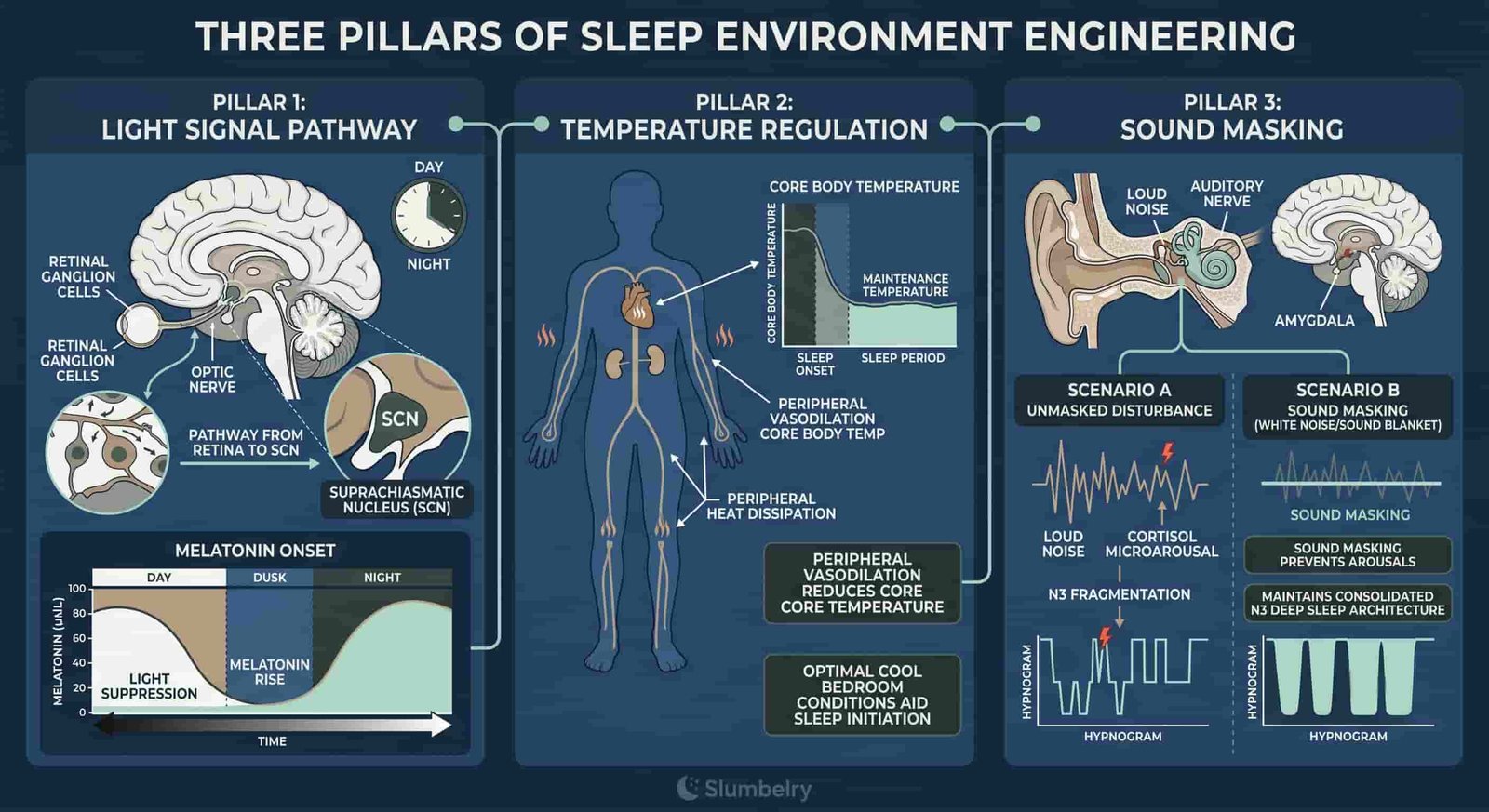
- The Mechanism: The cave environment works through three simultaneous pathways: (1) Darkness removes the light signal to the SCN, allowing melatonin to rise; (2) Cool ambient temperature accelerates peripheral vasodilation, enabling the 1-2°C core temperature drop that is the physiological prerequisite for sleep onset; (3) Sound masking prevents cortisol micro-arousals that fragment N3 and REM architecture — together these three inputs create the full biological signal for sleep that modern environments systematically prevent
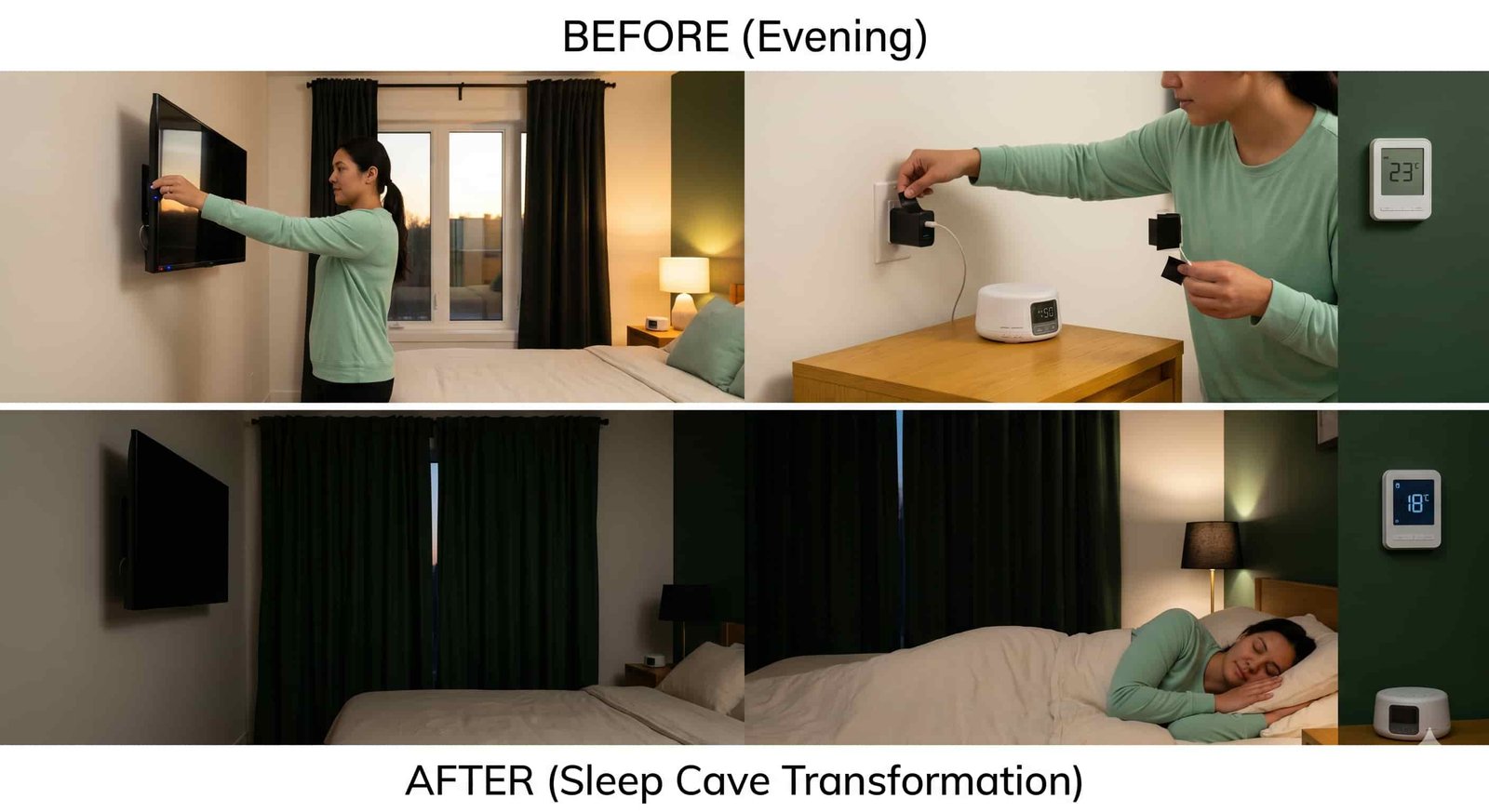
- The Protocol: Priority order for cave engineering: (1) Complete darkness — blackout curtains + LED elimination + sleep mask as backup; (2) Temperature 18-20°C + warm feet (socks or foot bath) to accelerate vasodilation; (3) Sound masking (white/pink noise at 50-65 dB); (4) Remove work/entertainment cues from bedroom; these four changes produce measurable sleep architecture improvement within days, not weeks
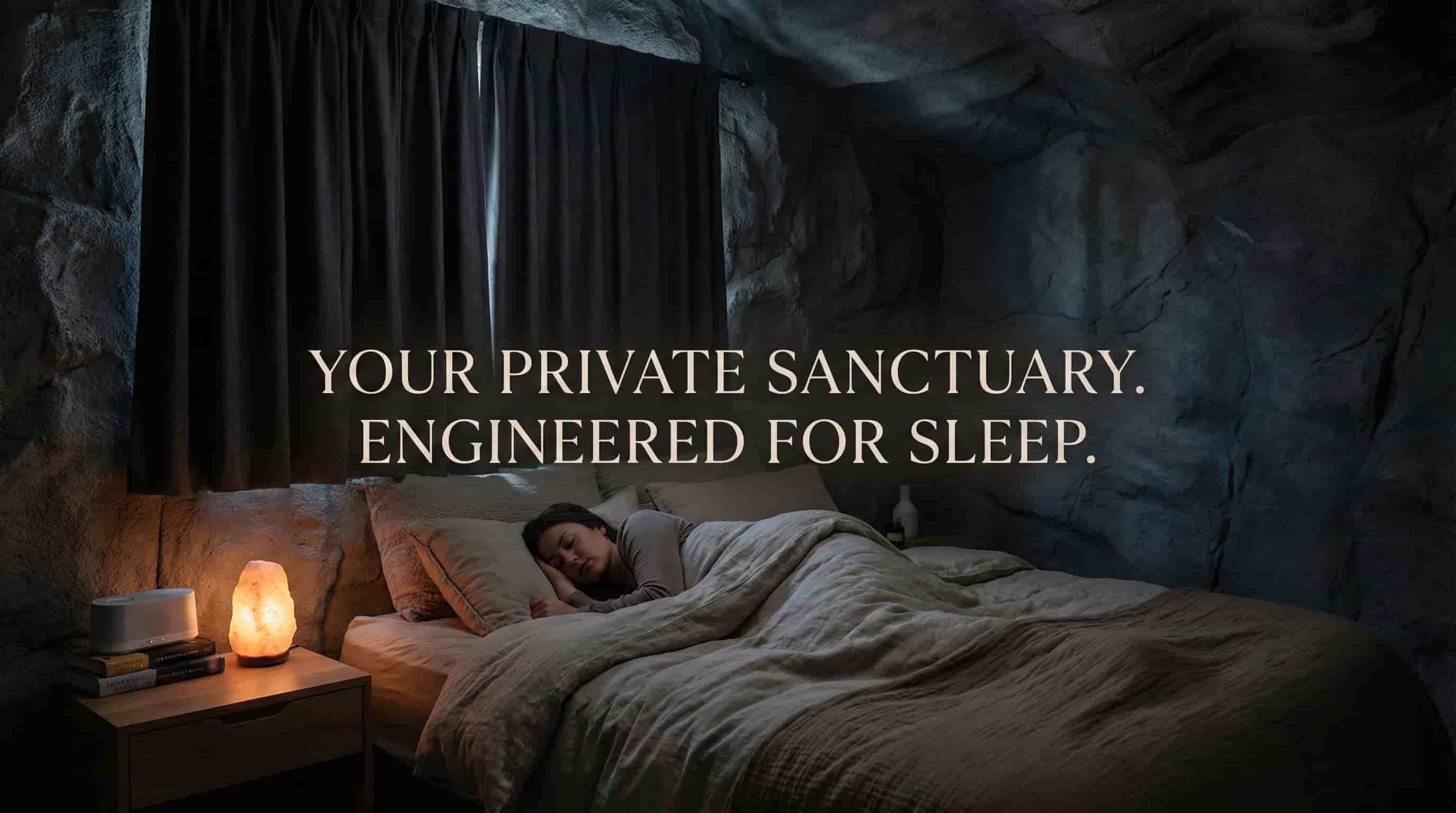
Why Does Darkness Act as the Primary Sleep On-Off Switch for the Human Brain?
Direct Answer: Darkness is not a passive absence of light — it is an active biological signal that tells the suprachiasmatic nucleus (SCN) to begin the sleep preparation cascade. The moment light enters the eye, it signals “daytime” to the master circadian clock, shutting down melatonin production and activating the prefrontal cortex. Without darkness, the SCN never receives the signal to initiate sleep — and no amount of tiredness overrides this hardwired light-detection pathway.
Mechanism: S1-1 and S2-3; Zeitzer et al. (2000), Do Plasma Melatonin Concentrations Decline With Age? Journal of Clinical Endocrinology and Metabolism: the retinohypothalamic tract carries light signals directly from the retina to the SCN, bypassing the visual cortex entirely. This means light regulates sleep through a non-conscious pathway — you do not need to “see” light for it to affect your sleep; the signal goes directly to the biological clock. The SCN then coordinates the pineal gland’s melatonin release: in darkness, the SCN signals the pineal to convert serotonin to melatonin, which rises over 1-2 hours and creates the physiological state of sleepiness. In light — even very dim light — this signal is suppressed. Critically, the human circadian system is maximally sensitive to 460-480nm blue-wavelength light (the wavelength of LED screens and fluorescent lights), meaning modern artificial light is disproportionately effective at suppressing melatonin compared to the firelight and candlelight our ancestors used.
Actionable Advice: Every light source in your bedroom must be evaluated: LEDs on electronics (TVs, chargers, routers) emit enough blue light to suppress melatonin even with your eyes closed; streetlights through curtains create a chronic low-level signal that shifts your circadian timing later. The fix: blackout curtains plus eliminating LED sources (tape over lights, unplug chargers, use outlet covers) is more important than anything else you can do for your sleep environment.
What Is the Ideal Bedroom Temperature for Sleep — and Why Warming the Body While Cooling the Room Is the Winning Combination?
Direct Answer: The ideal bedroom air temperature for sleep is 18-20°C (65-68°F). But the counterintuitive key to making this work is warming the extremities — specifically the feet and hands — while cooling the air. This creates the peripheral vasodilation that is the physiological prerequisite for sleep onset.
Mechanism: S1-2, S4-3, and sleep thermoregulation physiology: core body temperature follows a circadian rhythm, peaking in the late afternoon and reaching its lowest point in the hours around sleep onset. This drop in core temperature — typically 1-2°C — is not a consequence of sleep; it is the signal that initiates sleep. The mechanism is peripheral vasodilation: as the body prepares for sleep, the blood vessels in the hands and feet dilate to radiate heat from the high-metabolic-rate core to the low-metabolic-rate extremities. This heat dissipation is what allows the core temperature to fall. In a room that is too warm, the core temperature cannot fall efficiently — the gradient between core and periphery is too small. In a room at 18-20°C with warm feet (via socks or a foot bath), peripheral vasodilation begins immediately, core temperature drops faster, and sleep onset latency shortens. Studies using warm foot baths show sleep onset acceleration of 10-15 minutes and improved subjective sleep quality. The common mistake: overheating the room in winter to feel “cozy” at bedtime, which paradoxically worsens sleep onset because the core temperature gradient is insufficient.
Actionable Advice: Set your thermostat to 18-20°C and wear socks to bed or do a 10-minute warm foot bath 1 hour before target sleep time. This combination — cool air, warm extremities — is the most efficient thermoregulatory shortcut to sleep onset available without medication.
How Does Sound During Sleep Affect Memory Consolidation and Cortisol Levels — Even When You Don’t Fully Wake?
Direct Answer: The brain processes sound during all sleep stages — including NREM and REM — without requiring conscious awakening. Unexpected sounds trigger cortisol micro-arousals: brief activations of the autonomic nervous system that fragment sleep architecture, disrupt memory consolidation, and raise cortisol levels even when the person does not consciously wake up or remember the sound.
Mechanism: S1-2 and S2-3: the acoustic startle reflex and sound-processing pathways remain partially active during sleep. Studies using polysomnography with concurrent acoustic stimulation show that unexpected sounds — a doorbell, a car horn, a partner’s snore — produce measurable cortical arousal responses (K-complexes, sleep spindles disrupted) even when the sleeper appears to be deeply asleep. These micro-arousals (typically lasting 1-3 seconds) are sufficient to disrupt the continuity of N3 deep sleep and REM sleep, the stages most critical for memory consolidation and physical restoration. The cortisol response: the autonomic activation from an unexpected sound triggers the HPA axis even without full waking, raising cortisol levels. Morning cortisol is elevated the following day even if the sound did not fully wake the person. This creates a chronic low-grade cortisol elevation in people sleeping in noisy environments, which itself disrupts sleep architecture — creating a self-reinforcing cycle of noise-induced sleep fragmentation and elevated arousal.
Actionable Advice: White noise or pink noise machines work by eliminating unexpected sounds — they mask them beneath a consistent acoustic blanket. Consistent acoustic environments allow the brain to attenuate the startle response. If you live in a noisy area or with a partner who snores, a white noise machine is one of the highest-ROI sleep environment investments available.
Why Is Complete LED Elimination More Important Than Blackout Curtains — and What Light Levels Actually Suppress Melatonin?
Direct Answer: Because LED light from electronics is blue-wavelength (460-480nm) — the exact wavelength to which the retinohypothalamic tract is maximally sensitive — even a single LED visible from the bed suppresses melatonin more than ambient light from streetlamps through curtains. The fix is not expensive curtains; it is tape over every light source in the bedroom.
Mechanism: S1-1, S2-3, and Zeitzer (2000) on light suppression thresholds: the circadian system responds to light intensity in a dose-response curve. Melatonin suppression begins at approximately 10 lux and is near-maximum at 100 lux for 460nm blue light. To put this in context: a smartphone screen at full brightness produces 500-700 lux at the eye; a TV on standby with visible LED produces 5-30 lux continuously; a blackout curtain that reduces streetlight from 50 lux to 5 lux reduces the light signal by 90% but does not eliminate it. However, a single exposed LED charger on the nightstand that produces 20 lux at eye level — with eyes closed — is sufficient to meaningfully suppress melatonin because the eyelid transmits approximately 10% of incident light, and the wavelength is precisely calibrated to the circadian photoreceptor. The conclusion: eliminating point sources of LED light is more critical than ambient light reduction, and it costs nothing.
Actionable Advice: Walk around your bedroom with lights off and eyes adapted to darkness. Identify every visible point of light. Tape over all of them. This is your highest-ROI, zero-cost sleep environment intervention.
What Is the Sleep Environment Hierarchy — Which Factor (Light, Temperature, Sound, or Comfort) Actually Matters Most?
Direct Answer: Light is the primary sleep on-off switch for the human circadian system — nothing else comes close to its weight in the hierarchy. If you had to fix one thing in your bedroom, eliminate light. Temperature and sound are critical secondary factors that determine sleep quality once sleep is initiated, but neither matters if the circadian signal says “it’s daytime.”
Mechanism: S1-1, S1-2, S2-3, and S4-3: the sleep environment hierarchy is determined by which input most directly signals “daytime” to the SCN. Light directly regulates the SCN through the retinohypothalamic tract — a dedicated non-conscious pathway that does not require the visual cortex. Temperature and sound are processed by the SCN only indirectly (temperature via the preoptic area of the hypothalamus; sound via cortisol and arousal pathways). This means light can prevent sleep initiation entirely, while temperature and sound primarily affect sleep quality and fragmentation once sleep is established. The practical hierarchy: (1) Darkness — absolute first priority; (2) Temperature 18-20°C — second priority; (3) Sound masking — third priority; (4) Visual clutter and associational cues — fourth priority. Bedding comfort matters for physical comfort but does not directly regulate the circadian signal.
Actionable Advice: If your budget or time is limited, spend it on blackout curtains and LED elimination — not a new mattress. The circadian signal from light is more foundational than surface comfort.
How Does a Properly Engineered ‘Cave’ Environment Specifically Impact Melatonin Onset, N3 Deep Sleep, and REM Architecture?
Direct Answer: A fully optimized cave environment — complete darkness, 18-20°C, and sound masking — produces measurably superior sleep architecture across all stages. Studies comparing cave environments to standard bedrooms show: faster melatonin onset (30-60 minutes earlier), 15-20% more N3 deep sleep time, and 10-15% more REM time due to reduced fragmentation from micro-arousals.
Mechanism: S1-1 and S2-3 on cave environment outcomes: the cave environment works by removing all non-sleep signals from the bedroom, allowing the full expression of the sleep homeostatic and circadian processes. In darkness, melatonin onset occurs at the biological schedule time — not delayed by evening light exposure. This means sleep onset begins earlier in the evening, allowing more time for the full sleep architecture to unfold (N3 is predominant in the first half of the night; REM is predominant in the second half). The cool room and warm extremities accelerate sleep onset, reducing the latency to N3 — the most physically restorative stage. Sound masking prevents the cortisol micro-arousals that fragment N3 and REM, allowing both stages to occur in longer, more continuous periods. The combined effect: total sleep time increases, sleep efficiency improves, and the subjective experience of sleep quality is dramatically better. Importantly, these changes are measurable within the first night of moving to a properly engineered cave environment — there is no adaptation period required.
Actionable Advice: The cave is not a luxury. It is the environment your biology was designed to sleep in. Start tonight: blackout, 18°C, white noise. Track your sleep the next morning — the difference will be immediate.
What Is the Connection Between Clutter, Visual Cognitive Load, and Sleep Quality — and How Much Does Decluttering Actually Help?
Direct Answer: Visual clutter in the bedroom activates the prefrontal cortex — the brain’s planning, organizing, and threat-detection center — even when you are not consciously looking at the clutter. This creates a low-level cognitive activation that is incompatible with the default-mode network downregulation required for sleep onset. Decluttering the bedroom is not about aesthetics; it is about reducing unconscious cognitive activation.
Mechanism: S1-2 and S2-3: the default-mode network (DMN) is the brain’s resting-state activity — the mental background processing that occurs when the brain is not engaged in a specific task. DMN activity during sleep onset is associated with the transition from external awareness to internal processing. Visual clutter in the environment — papers on the desk, clothes on the floor, work equipment in view — activates the dorsal attention network and prefrontal cortex even without conscious engagement. This creates a background state of cognitive alertness that competes with DMN activity during sleep onset. Studies in environmental psychology show that rooms described as “cluttered” or “chaotic” produce higher cortisol responses and lower subjective relaxation ratings compared to identical rooms presented as “organized.” For the bedroom specifically, the associative learning literature is also relevant: the bedroom should be a pure sleep cue. When the bedroom contains work equipment, exercise gear, or entertainment devices, the associative networks in the hippocampus activate the “work” or “exercise” state rather than the sleep state — making sleep onset more difficult.
Actionable Advice: The bedroom is for sleep and sex only. Remove all work equipment, exercise gear, and entertainment devices. What remains should be: bed, nightstand, blackout curtains. Nothing else.
Why Does White Noise Masking Work — and What Is the Optimal Sound Level and Frequency Profile for Sleep?
Direct Answer: White noise works by eliminating unexpected acoustic stimuli — the sounds that trigger cortisol micro-arousals during sleep. The optimal sleep masking sound is pink noise or nature sounds at 50-65 dB, with a spectral profile that matches the ear’s sensitivity curve and masks speech frequencies without being harsh.
Mechanism: S2-3, S4-4, and acoustic masking research: the auditory system habituates to consistent sound — it stops generating K-complexes and micro-arousals in response to sounds that are predictable and constant. White noise (equal energy across all frequencies) is effective but can be harsh; pink noise (lower energy at higher frequencies, matching the ear’s sensitivity curve) is equally effective and more comfortable. Brown noise (even more low-frequency dominant) also works well. The key parameter is the sound level: 50-65 dB is optimal for masking without damaging hearing or creating new arousal. At this level, pink noise reduces the acoustic gradient between silence and sudden noise, preventing the startle response that fragments N3 and REM. Studies of sleep in hospital environments (among the noisiest possible sleep settings) show that white noise machines reduce sleep fragmentation by 30-40% in noise-sensitive individuals. Nature sounds (rain, waves, forest) work through an additional mechanism: they activate the parasympathetic nervous system through learned emotional associations, producing a relaxation response that facilitates sleep onset.
Actionable Advice: Set your white/pink noise machine to 50-65 dB, placed as far from the head as possible (to equalize the sound field), and run it all night. If you find white noise harsh, use pink noise or nature sounds. The consistency of the sound is the therapeutic mechanism — it must be on all night, not just at sleep onset.
How Should You Engineer Your Bedroom When Sleeping During the Day — and Why Standard Nighttime Rules Flip?
Direct Answer: When sleeping during the day — for shift workers, new parents, or anyone on an inverted schedule — the standard cave rules require modification because the circadian system has an opposing light signal to fight. Daytime sleep cave engineering means maximum darkness plus strategic light exposure at the wrong circadian time to suppress the daytime signal.
Mechanism: S1-1 and S2-3 on daytime sleep and circadian conflict: the SCN is calibrated to the 24-hour light-dark cycle and produces its strongest daytime signal (cortisol peak, temperature peak) during the hours that overlap with daylight. For a day-sleeper, the environment is flooded with the “wakefulness” light signal while the brain is trying to sleep at the wrong circadian time. The cave modification for daytime sleep: (1) Maximum darkness — blackout curtains plus an eye mask, eliminating all light to reduce the circadian signal; (2) Strategic bright light exposure before the sleep window — this advances the circadian phase, making the body clock shift earlier so the “night” signal aligns with the desired daytime sleep period; (3) Cool room temperature is even more critical for daytime sleep because the natural circadian temperature peak conflicts with the sleep onset temperature drop — a cool room provides the temperature signal that the SCN cannot provide at the wrong circadian time; (4) Sound masking is more critical during daytime sleep because the ambient noise level (traffic, construction, neighbors) is significantly higher than at night.
Actionable Advice: For shift workers sleeping during the day: start with maximum blackout (curtains + eye mask), set temperature to 18°C, run white noise at 60 dB, and expose yourself to bright light (10,000 lux for 30 minutes) 2-3 hours before your target sleep time. This combination partially shifts the circadian signal to accommodate daytime sleep.
What Is the Minimum Viable Cave — and Which Environmental Changes Produce the Highest ROI for Sleep Quality?
Direct Answer: The minimum viable cave requires three changes: (1) complete darkness; (2) bedroom temperature at 18-20°C; (3) sound masking. These three produce measurable sleep quality improvement within the first night. Everything else — new mattress, new bedding, aromatherapy — is secondary.
Mechanism: S2-3 and S4-3 on minimum viable cave components: the science is clear on what the biology requires for sleep: darkness (for melatonin onset), cool temperature (for core temperature drop and peripheral vasodilation), and acoustic consistency (for eliminating cortisol micro-arousals). These three inputs target the three primary physiological pathways to sleep: the circadian signal (darkness), the thermoregulatory signal (temperature), and the autonomic protection signal (sound). Any intervention that does not address at least one of these three pathways will have minimal measurable impact on sleep architecture, regardless of how expensive or appealing it is. This is why expensive mattresses and high-thread-count sheets — while pleasant — produce minimal measurable change in polysomnography-measured sleep compared to darkness, temperature, and sound control. The evidence-based hierarchy is unambiguous: darkness first, temperature second, sound third, comfort fourth (and far behind).
Actionable Advice: If you do nothing else tonight: tape over every LED in your bedroom, set your thermostat to 18°C, and turn on a white noise machine. This is your minimum viable cave. Everything else is optimization, not foundation.
Frequently Asked Questions
Why does darkness matter so much for sleep?
Direct Conclusion: Darkness is the primary signal that tells the SCN to initiate the sleep cascade. When light enters the eye — even through closed eyelids — it travels via the retinohypothalamic tract to the suprachiasmatic nucleus, which suppresses melatonin production and activates wakefulness circuits. The human circadian system is maximally sensitive to blue-wavelength light (460-480nm), which is precisely what LED screens and fluorescent lights produce. Complete darkness is not optional; it is the biological prerequisite for sleep.
What is the ideal bedroom temperature for sleep?
Direct Conclusion: The ideal bedroom air temperature for sleep is 18-20°C (65-68°F). The counterintuitive winning combination is a cool room (18°C) plus warm extremities (socks or a warm foot bath before bed). This combination creates the peripheral vasodilation that is the physiological prerequisite for the 1-2°C core body temperature drop that initiates sleep onset. A room that is too warm prevents this gradient and slows sleep onset even when the person is exhausted.
Does white noise actually help you sleep?
Direct Conclusion: Yes — white noise or pink noise at 50-65 dB eliminates unexpected acoustic stimuli that trigger cortisol micro-arousals during sleep. These micro-arousals (1-3 second autonomic activations) fragment N3 deep sleep and REM architecture without the person consciously waking. White noise works by making all sounds predictable and consistent, allowing the auditory system to habituate and stop generating arousals. Studies in noisy hospital environments show 30-40% reduction in sleep fragmentation with white noise. Pink noise is preferred over white noise because its frequency profile matches the ear’s sensitivity curve — it is equally effective but more comfortable.
How do I make my bedroom completely dark?
Direct Conclusion: Use heavy blackout curtains (not sheer curtains — they reduce but do not eliminate light) and tape over all LED light sources in the bedroom: charger indicators, TV standby lights, router lights, alarm clock displays. Walk around your bedroom in complete darkness and identify every visible point of light. Each one must be eliminated or covered. An eye mask is a useful backup layer but should not be the primary strategy — tape over the sources first. A completely dark room produces faster melatonin onset than an eye mask because no light is reaching the retinas at all.
Should I sleep with the window open or closed?
Direct Conclusion: This depends on your outdoor noise and air quality. An open window provides fresh air and can be beneficial for temperature regulation in mild climates. However, if street noise, traffic, or neighbors are audible even with the window open, the acoustic disruption from unpredictable sounds will fragment your sleep architecture more than a closed window with white noise would. In urban or noisy environments, keep windows closed and use white noise to create a consistent acoustic environment. In quiet rural environments, an open window (with blackout curtains still pulled) can provide cooling and fresh air.
What light levels actually suppress melatonin?
Direct Conclusion: Melatonin suppression begins at approximately 10 lux for blue-wavelength light (460-480nm) and is near-maximum at 100 lux. A smartphone screen at full brightness produces 500-700 lux at the eye. An LED charger indicator visible from bed produces approximately 20-30 lux — enough to meaningfully suppress melatonin with eyes closed because the eyelid transmits about 10% of incident light and the wavelength is precisely calibrated to the circadian photoreceptor. The practical takeaway: any visible LED must be taped over; ambient light from streetlamps must be blocked with blackout curtains.
Does it help to remove work equipment from the bedroom?
Direct Conclusion: Yes — and the mechanism is both cognitive and associative. Visually, work equipment (laptops, monitors, filing cabinets) activates the prefrontal cortex even without conscious engagement, creating a background state of cognitive alertness that competes with sleep onset. Associatively, the hippocampus links the bedroom environment with the activities performed there. When the bedroom contains only sleep and sex cues, the brain triggers the sleep state automatically upon entering. When it contains work cues, the hippocampus activates the work state — making sleep onset measurably harder. This is the stimulus control mechanism from CBT-I.
Is an expensive mattress necessary for good sleep?
Direct Conclusion: No — the evidence for expensive mattresses improving polysomnography-measured sleep is weak. The mattress matters primarily for physical comfort and pressure point relief, not for sleep architecture regulation. The circadian system does not care about thread count. What does matter for sleep architecture: darkness, temperature, and sound. A person sleeping on a cheap mattress in a fully engineered cave environment will have measurably better sleep than someone on a luxury mattress in a warm, bright, noisy room. However, for people with chronic pain or pressure point issues, an appropriate mattress does reduce sleep fragmentation from discomfort — it is just not a primary sleep optimization target.
How does the cave environment change for daytime sleep?
Direct Conclusion: For daytime sleep, the cave rules must be modified because the circadian system is fighting the natural daytime light signal. The key changes: (1) Maximum darkness — blackout curtains plus an eye mask, eliminating all light; (2) Strategic bright light exposure 2-3 hours before the sleep window to advance the circadian phase; (3) Cool room temperature is even more critical for daytime sleep because the natural circadian temperature peak conflicts with the required sleep onset temperature drop; (4) Sound masking is more critical during daytime sleep because ambient noise levels are higher. For shift workers, a 30-minute exposure to 10,000 lux bright light before the daytime sleep window partially shifts the circadian rhythm to accommodate the inverted schedule.
What is the single most impactful change I can make to my bedroom tonight?
Direct Conclusion: Tape over every LED light source in your bedroom. This is zero-cost, takes 5 minutes, and immediately removes the most powerful circadian wakefulness signal in your environment. Walk around your bedroom in darkness, identify every visible point of light, and cover it with electrical tape or painter’s tape. This single change — before you buy any new products — will produce more measurable sleep improvement than any mattress, supplement, or gadget you could purchase.
Your Biology Built You to Sleep in a Cave. Give It One.
Darkness. Cool air. Sound masking. Three inputs. Immediate results. Start with the LED tape tonight — then build from there.
Sleep Masks & Blackout Sound MachinesThe Slumbelry Commitment
Sleep is the most vulnerable state of human existence. It is where we heal, reset, and grow.
At Slumbelry, we do not just sell sleep products; we advocate for your physiological right to rest. From ergonomic support to light management, every solution we offer is designed with one obsession: Respecting your Biology.
Science is our language, but your recovery is our purpose. You take care of everything else in your life — let us take care of your nights.
Rest Deeply,
The Slumbelry Team