
Why ‘I Slept Fine After a Few Drinks’ Is Your Brain Lying to You — The Sedation vs. Sleep Science
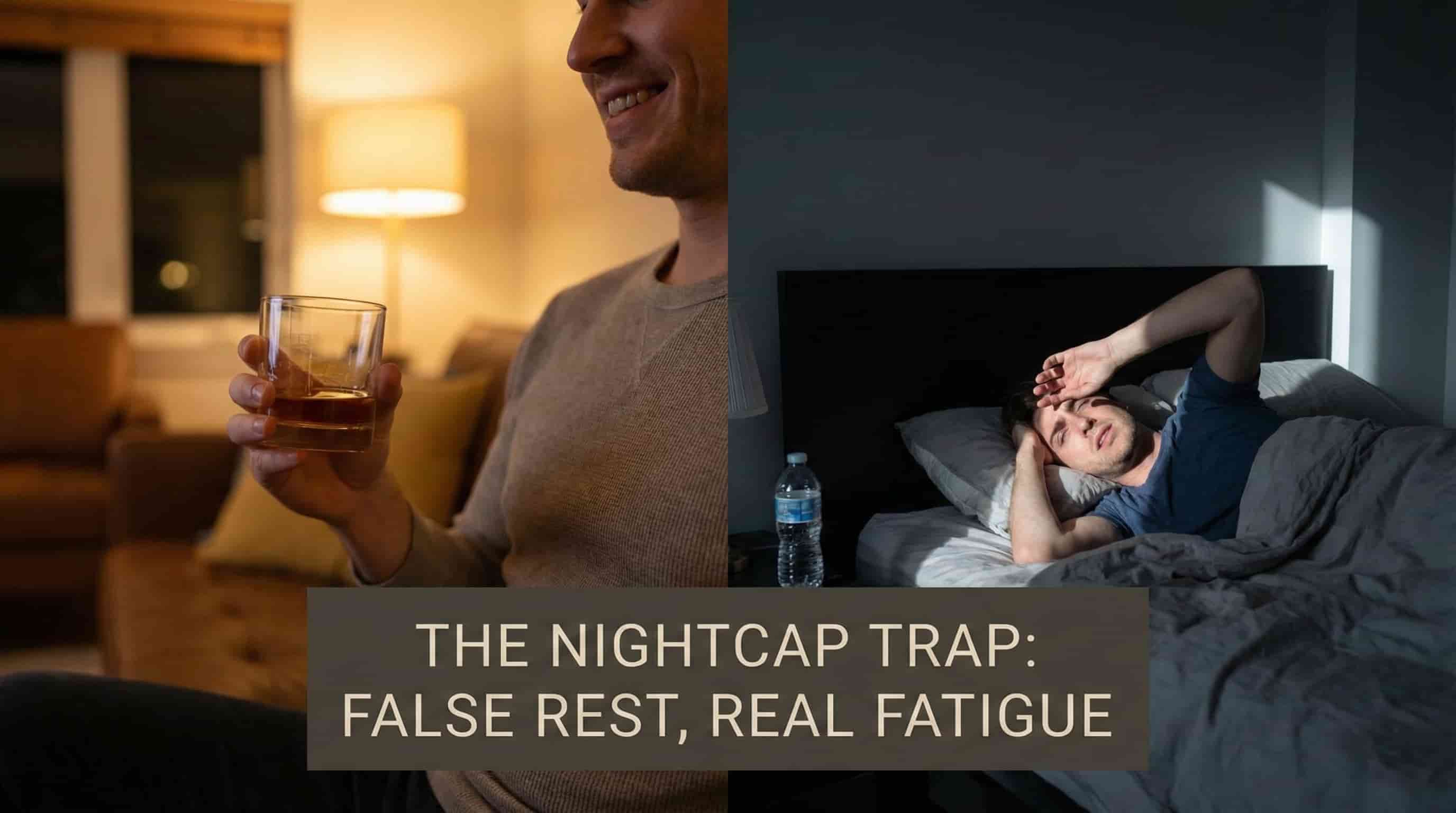
It is a common ritual: a glass of wine to wind down. A nightcap to help you sleep. And it works — you pass out quickly, and you do not remember waking up until morning. You think you slept well.
But let’s be precise: Alcohol does not induce sleep. It induces sedation. And the difference between the two is the difference between waking up genuinely restored and waking up exhausted. Sedation feels like sleep. It is not sleep. The brain on alcohol is chemically paralyzed — not biologically cycling through the recovery stages that define genuine sleep.
The alcohol and sleep guide is the evidence-based breakdown of what is actually happening in your brain when you drink before bed — and the strategy that minimizes the damage without requiring complete abstinence (though that remains the gold standard).
⚡ Core Takeaway: Alcohol Is Not a Sleep Aid — It Is a Sedative That Borrows Tomorrow’s Recovery
- The Problem: Alcohol is a CNS depressant that accelerates sleep onset through cortical suppression, NOT through the biological sleep architecture activation that produces recovery. Within 3-4 hours of falling asleep, as the liver metabolizes alcohol, the nervous system undergoes sympathetic rebound — elevated cortisol, increased heart rate variability disruption, and widespread micro-arousals that fragment N3 deep sleep and REM. A single session of 3+ drinks reduces REM sleep by 20-40% and N3 deep sleep by 30-50%, producing the subjective sensation of ‘sleep’ while actively blocking the recovery processes that sleep is designed to deliver
- The Mechanism: Sedation (alcohol-induced) and sleep (biologically regulated) are neurologically distinct states: sedation suppresses cortical arousal through GABA enhancement, leaving the brain in a passive shutdown without the active memory consolidation (REM), glymphatic clearance (N3 slow waves), or hormone regulation (HPA axis downregulation) that define restorative sleep. The sympathetic rebound triggered by alcohol metabolism specifically elevates evening/nighttime cortisol, which suppresses melatonin onset, disrupts sleep continuity, and leaves the glymphatic system underactive — the brain’s overnight waste clearance is measurably reduced after alcohol even when total sleep time appears normal
- The Protocol: The 3-hour rule is necessary but insufficient — alcohol’s disruption of N3 and REM begins with the first drink, not with bedtime. For those who drink: limit to 1-2 drinks, consume with protein/food to slow absorption, hydrate actively, and accept that even perfect timing does not eliminate REM suppression — only reduces it. Complete sleep architecture preservation requires complete abstinence in the 5+ hours before sleep
What Is the Difference Between Sedation and Sleep — and Why Does It Matter for Recovery?
Direct Answer: Sedation and sleep look similar from the outside — you close your eyes, stop moving, and lose consciousness. But neurologically, they are fundamentally different states. Sleep is an active, biologically regulated process that cycles through NREM and REM stages, each performing specific recovery functions. Sedation, induced by alcohol, is a passive shutdown of cortical arousal through GABA enhancement — it suppresses wakefulness without activating the sleep architecture that produces recovery. This distinction is the key to understanding why a nightcap feels like it helps you sleep but actively destroys the recovery you came for.
Mechanism: S1-2 and S2-3 on sedation vs. sleep: the sleeping brain cycles through distinct stages — NREM Stage 1-2 (light sleep with sleep spindles for memory processing), NREM Stage 3/N4 (slow-wave deep sleep for glymphatic clearance and physical restoration), and REM sleep (emotional memory consolidation and creative problem-solving). Each stage requires specific neurological conditions: cortical synchronization during NREM slow waves, hippocampal-cortical dialogue during REM. Sedative agents like alcohol induce unconsciousness by enhancing GABAergic inhibition — they suppress cortical arousal globally without producing the sequential cycling, slow oscillation coordination, or REM-specific cholinergic activation that defines restorative sleep. The sedated brain is not cycling through recovery stages; it is chemically paralyzed in a light, non-restorative state that merely resembles sleep on the surface.
Actionable Advice: Stop evaluating your sleep by whether you fell asleep quickly. Measure recovery by how you feel upon waking, cognitive performance across the day, and stress resilience. If you rely on alcohol to fall asleep, you are almost certainly sleep-deprived at a biological level — even if you slept 7-8 hours. The quality of those hours is what matters.
How Does Alcohol Specifically Suppress REM Sleep — and What Happens to Your Brain When REM Is Blocked Nightly?
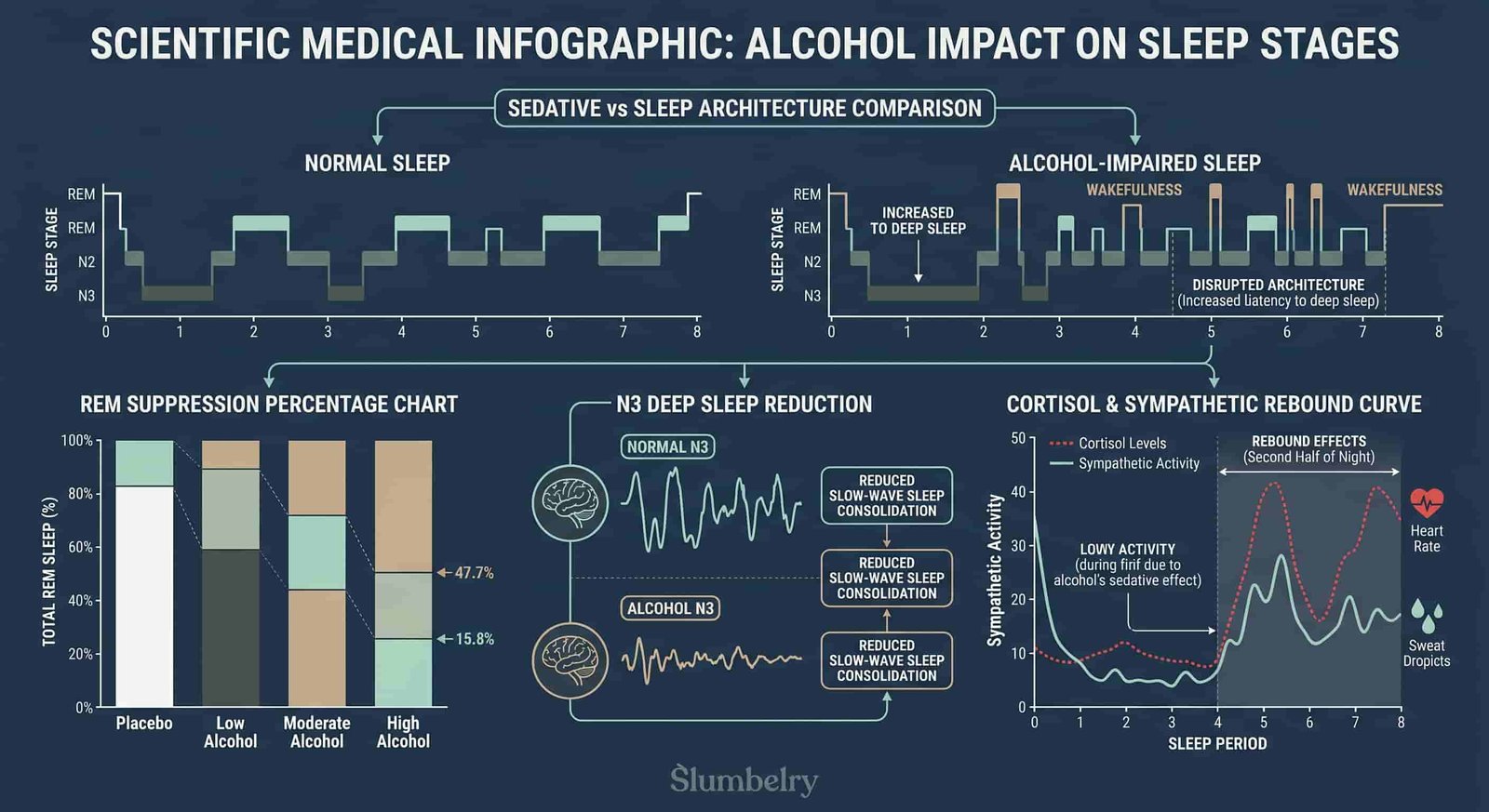
Direct Answer: Alcohol suppresses REM sleep through multiple pharmacological pathways: it reduces acetylcholine release (the primary neurotransmitter driving REM-on neurons in the pons), elevates GABA globally (which inhibits the REM-generating nuclei), and disrupts the pontine brainstem circuits specifically responsible for REM atonia and REM sleep onset. A single session of 3+ standard drinks reduces REM sleep by 20-40% and increases REM latency (the time to first REM period). With repeated nightly use, the brain partially compensates through REM rebound on alcohol-free nights, but chronic alcohol use disorder produces sustained REM suppression that does not fully reverse even after abstinence begins.
Mechanism: S1-2, S2-3, and Feige et al. (2002), Effects of Alcohol on Polysomnographically Recorded Sleep in Healthy Subjects: the study found that even moderate alcohol doses (0.6g/kg — approximately 3-4 drinks for a 70kg adult) produced significant REM suppression in the first half of the night, with a compensatory REM rebound in the second half — but the rebound REM was fragmented, less dense, and associated with increased EEG arousals. The emotional memory consolidation function of REM — which processes the previous day’s emotional experiences and reduces the emotional charge of difficult memories — is specifically impaired. This is why heavy drinkers commonly report emotional flatness and impaired stress processing: the biological mechanism for processing emotion during sleep is being chemically blocked every night. Chronic REM suppression from nightly alcohol is associated with accelerated cognitive decline, mood dysregulation, and impaired emotional intelligence.
Actionable Advice: REM rebound on alcohol-free nights is real but incomplete. The brain cannot fully compensate for multiple nights of REM suppression in a single recovery night. If you drink 3+ nights per week, you are likely operating with a chronic REM deficit. Cutting to 1-2 nights per week allows meaningful REM recovery between sessions.
Why Does the ‘Sympathetic Rebound’ Happen in the Second Half of the Night — and What Cortisol Data Supports It?
Direct Answer: The sympathetic rebound is the physiological consequence of alcohol metabolism: as the liver breaks down alcohol (at a rate of approximately one standard drink per hour), it switches from a metabolizing state to a mobilizing state, releasing accumulated toxins and stress signals that activate the sympathetic nervous system. The result is elevated heart rate, cortisol pulses, and micro-arousals peaking in the 3-5 AM window — precisely when the brain should be in its deepest N3 and REM cycles. This is why heavy drinkers often wake at 3-4 AM with anxiety, racing thoughts, and an inability to return to deep sleep.
Mechanism: S1-2, S2-3, and Ronnenberg et al. (2000) on alcohol and nocturnal cortisol: alcohol disrupts the HPA (hypothalamic-pituitary-adrenal) axis regulation of cortisol, producing elevated nighttime cortisol at a time when cortisol should be at its circadian nadir. Normally, cortisol is highest in the morning (cortisol awakening response) and reaches its lowest point around midnight, allowing the parasympathetic nervous system to dominate and sleep to deepen. Alcohol disrupts this pattern: blood alcohol concentration (BAC) itself suppresses cortisol during the first half of the night (producing the sensation of relaxation), but as BAC drops toward zero in the second half, cortisol surges to compensate — this is the sympathetic rebound. The elevated cortisol suppresses melatonin onset, fragments sleep continuity, and specifically disrupts the slow-wave N3 sleep that requires low cortisol to initiate. Studies measuring cortisol every 20 minutes across the night show a distinct cortisol pulse pattern in drinkers that is absent in non-drinkers — the peak of this pulse occurs at 3-4 AM, exactly the window of deepest sleep.
Actionable Advice: If you wake consistently at 3-4 AM with anxiety or alertness, alcohol is a likely contributor. The fix is not more alcohol (which compounds the problem) but rather eliminating alcohol for at least 5-7 nights to allow the HPA axis to reset its normal circadian rhythm.
How Much Does One Drink Actually Reduce N3 Deep Sleep — and What Is the Dose-Response Curve?
Direct Answer: One standard drink (14g alcohol) reduces N3 deep sleep by approximately 10-15%. Two drinks reduce N3 by approximately 20-30%. Three or more drinks reduce N3 by 30-50% and can eliminate it almost entirely in sensitive individuals. The dose-response relationship is approximately linear for doses up to 3 drinks; beyond that, N3 approaches zero regardless of dose. This matters because N3 is the primary stage for human growth hormone release, glymphatic brain waste clearance, and physical tissue repair — the biological functions that turn a day of physical exertion into recovery.
Mechanism: S1-2 and S2-3 on alcohol dose-response: N3 (slow-wave sleep) is generated by the thalamocortical slow oscillation — a 0.5-1Hz wave of coordinated neuronal depolarization and down-states across the cortex. Alcohol disrupts this oscillation by enhancing GABAergic inhibition in the thalamus, preventing the high-amplitude slow waves that define N3 from emerging. The effect is dose-dependent because GABA enhancement is dose-dependent: a low dose produces mild cortical suppression with some preserved N3; a high dose produces near-total suppression of the thalamocortical synchrony required for slow-wave generation. Polysomnographic studies (EEG during sleep) show that the slow-wave sleep that does occur after alcohol is characterized by lower amplitude, fewer slow oscillations per minute, and reduced coupling between the prefrontal cortex and hippocampus — meaning the quality of N3 is also impaired, not just the quantity.
Actionable Advice: N3 recovery is faster than REM recovery — 1-2 alcohol-free nights typically restore N3 to baseline in moderate drinkers. However, chronic nightly use causes cumulative N3 debt that takes 5-7 nights to fully repay. If you have a high-physical-demand day (exercise, illness, injury recovery), avoid alcohol the night before — the N3 loss will measurably impair your physical recovery.
Why Does Alcohol Fragment Sleep Even When You Don’t Remember Waking Up?
Direct Answer: Sleep fragmentation from alcohol occurs primarily through micro-arousals — brief (3-15 second) awakenings that disrupt sleep architecture without producing full consciousness. These are measured by EEG as brief shifts from deep sleep to lighter NREM stages or brief alpha wave intrusions into NREM, often accompanied by heart rate spikes. They do not produce full waking consciousness, so you do not remember them — but they prevent the brain from spending sufficient time in the consolidated N3 and REM periods required for full recovery.
Mechanism: S1-2 and S2-3 on micro-arousals: alcohol increases the number of micro-arousals per hour of sleep by 30-50% in a dose-dependent manner. The causes are multi-factorial: (1) sympathetic rebound elevates cortisol and norepinephrine, which increase cortical arousal; (2) alcohol-induced diuresis causes bladder distension, triggering autonomic arousal; (3) alcohol relaxes upper airway muscles, increasing the frequency of apneic events and hypopneas that trigger arousals; (4) the shift from high BAC to zero BAC during the night creates a pharmacological withdrawal state that elevates generalized arousal. Studies using EEG/EOG monitoring in people who report “sleeping fine after drinking” consistently find 2-3x more micro-arousals than non-drinking nights, with N3 fragments shorter than 15 minutes occurring between arousals rather than the normal 45-90 minute N3 periods. The subjective experience of “good sleep” despite objective fragmentation is explained by the anterograde amnesia effect of alcohol on memory encoding — you simply do not form memories of the nocturnal arousals, creating a false sense of sleep quality.
Actionable Advice: Use objective sleep tracking (not subjective reporting) to measure your actual sleep quality after drinking. What you remember and what the data shows are often dramatically different. Track your deep sleep minutes specifically — this is the metric most impacted by alcohol.
What Is the 3-Hour Rule for Alcohol and Sleep — and Does Timing Actually Change the Damage?
Direct Answer: The 3-hour rule (stop drinking at least 3 hours before bedtime) is real and useful — it allows partial BAC clearance before sleep, reducing the severity of first-half sleep suppression. However, it is insufficient to prevent alcohol’s sleep damage entirely. Alcohol’s disruption of N3 and REM begins with the first drink, through pharmacological effects on neurotransmitter systems that do not require alcohol to still be present in the bloodstream. The 3-hour rule reduces but does not eliminate the damage. Complete sleep architecture preservation requires 5+ hours of abstinence before sleep.
Mechanism: S2-3, S4-4, and the pharmacokinetics of alcohol: alcohol is metabolized at approximately 0.015-0.020 g/100mL per hour (roughly one standard drink per hour for a 70kg adult). A person who finishes 3 drinks at midnight and goes to bed at midnight has a BAC of approximately 0.06-0.08 g/mL at sleep onset — still significantly elevated. But the more important point: the GABAergic effects of alcohol on sleep architecture are not purely BAC-dependent. Alcohol alters glutamate and GABA receptor expression in ways that persist beyond the clearance of alcohol itself — studies show altered sleep EEG patterns (reduced slow-wave sleep amplitude) persisting for 1-2 nights after alcohol consumption even when no alcohol is present in the blood. The 3-hour rule helps by reducing the acute BAC at sleep onset and the severity of the sympathetic rebound, but it does not address the receptor-level disruption that continues for 24-48 hours after the last drink.
Actionable Advice: If you want to drink and maximize sleep quality: (1) stop at least 3 hours before bed (necessary minimum); (2) ideally stop 5+ hours before bed for near-complete sleep architecture preservation; (3) consume alcohol with food to slow absorption; (4) hydrate actively; (5) accept that even with perfect timing, the receptor-level effects mean 1-2 nights of measurably impaired sleep will follow any drinking session.
Why Does Alcohol Worsen Sleep Apnea and Breathing Disturbances — and Why Does This Matter More Than You Think?
Direct Answer: Alcohol relaxes the pharyngeal dilator muscles (genioglossus and tensor palatini) that keep the upper airway open during sleep. In people with pre-existing anatomical susceptibility (narrow airway, large tongue, recessed jaw), this muscle relaxation can collapse the airway, producing or worsening obstructive sleep apnea (OSA). Even in people without diagnosed OSA, alcohol increases the frequency and severity of snoring and upper airway resistance events by 30-50%. The resulting repeated oxygen desaturations trigger arousals that fragment sleep — often without full waking — creating the “fragmented sleep despite sleeping 8 hours” phenomenon.
Mechanism: S1-2 and S2-3 on alcohol and upper airway mechanics: the pharyngeal airway is a passive structure maintained open by the tone of the pharyngeal dilator muscles, which are controlled by the genioglossus and tensor palatini. During NREM sleep, these muscles naturally relax slightly — but alcohol significantly amplifies this relaxation. Alcohol also suppresses the ventilatory response to hypoxia, meaning that when an airway obstruction occurs and blood oxygen drops, the brain’s reflexive drive to wake up and restart breathing is blunted, prolonging the desaturation event. Studies in OSA patients show that a single evening drink (2-3 drinks) increases the apnea-hypopnea index (AHI) by 25-40% — and since OSA is estimated to affect 15-30% of the adult population (the majority undiagnosed), a large proportion of people who “sleep fine after drinking” are actually experiencing dozens of oxygen desaturations per night that they are entirely unaware of.
Actionable Advice: If you snore or have been told you stop breathing during sleep, alcohol is a specific risk multiplier. Even one drink can significantly worsen breathing events. The combination of alcohol + supine sleeping position + sedatives (including sleep aids) creates a compounding risk for dangerous sleep-disordered breathing events. Get a sleep study if you have risk factors — and eliminate alcohol if you have or are at risk for OSA.
How Does Evening Alcohol Disrupt the Gut-Brain Axis and Glymphatic Clearance During Critical Sleep Windows?
Direct Answer: Alcohol, even at moderate doses, damages the intestinal lining (increasing gut permeability), alters the gut microbiome composition, and triggers systemic inflammation — all of which impair the glymphatic system, the brain’s overnight waste clearance pathway that operates primarily during N3 slow-wave sleep. The glymphatic system relies on the convective flow of cerebrospinal fluid through the brain’s perivascular channels, driven by the slow-wave neuronal firing of N3 sleep. When N3 is suppressed by alcohol, glymphatic flow is reduced by 30-60% per night of alcohol use. Simultaneously, alcohol-induced gut permeability allows bacterial endotoxins (LPS) to enter circulation, triggering low-grade systemic inflammation that further impairs glymphatic function. The long-term consequence of chronic alcohol-related glymphatic impairment is accelerated accumulation of neurotoxic proteins including beta-amyloid — the same protein that accumulates in Alzheimer’s disease.
Mechanism: S2-3 and S1-2 on the glymphatic system: the glymphatic system was first described by Maiken Nedergaard in 2012 — it is the brain’s waste clearance system, active primarily during N3 slow-wave sleep, when the coordinated depolarization-repolarization of cortical neurons creates convective flow of cerebrospinal fluid through the interstitial spaces, flushing metabolic waste products (including beta-amyloid and tau) into the glymphatic vessels for clearance. N3 slow-wave activity is the primary driver of glymphatic flow — without sufficient N3, the convective flow that drives clearance is dramatically reduced. Alcohol, by suppressing N3, directly reduces glymphatic clearance. Animal studies show a 40-60% reduction in glymphatic clearance after alcohol exposure. Additionally, chronic alcohol use increases the production of beta-amyloid precursor protein and impairs the ubiquitin-proteasome system that clears misfolded proteins — creating a double assault on the brain’s protein homeostasis that may explain the association between chronic alcohol use and accelerated cognitive decline.
Actionable Advice: The most direct thing you can do for long-term brain health is to eliminate alcohol’s nightly suppression of N3. The glymphatic system clears the metabolic waste of the day — impairment is cumulative, not reversible in the short term. One night of good N3 sleep does not clear two nights of alcohol-impaired waste accumulation.
What Happens to Your Brain After 2 Weeks of Nightly Alcohol Use — and Is There a ‘Safe’ Amount for Sleep?
Direct Answer: After 2 weeks of nightly alcohol use, measurable changes in sleep architecture are consistently documented: N3 deep sleep is reduced by 20-40%, REM percentage is decreased, and sleep fragmentation is increased — all despite the drinker reporting “I got used to it” or “I sleep fine.” The most insidious part is the psychological adaptation: after 2 weeks of daily drinking, people stop feeling subjectively impaired even when objective PSG data shows continued architecture disruption. There is no truly “safe” amount of alcohol for sleep architecture — any alcohol intake is associated with measurable sleep disruption. However, the dose-response curve is steep: 1 drink causes measurable but minor disruption that most people do not notice; 2-3 drinks cause significant disruption visible in objective data; 3+ drinks produce major disruption that affects next-day cognition and mood.
Mechanism: S1-2 and S2-3: the adaptation to alcohol’s sleep effects is not resolution — it is desensitization of the arousal systems. The brain adapts to chronic alcohol exposure by upregulating glutamate receptors (to overcome constant GABA enhancement), which means that the nervous system is in a state of chronic mild hyperarousal even when alcohol is present. This is the mechanism of alcohol tolerance: over time, the same dose produces less sedation. When alcohol is withdrawn, the upregulated glutamate system produces the characteristic withdrawal symptoms — anxiety, insomnia, tremor — as the nervous system overcorrects without alcohol’s inhibitory influence. For sleep specifically: studies in social drinkers (2-3 drinks per night, 14-21 nights) show persistent alterations in sleep EEG even 1 week after cessation, indicating that the sleep disruption is not fully reversed immediately upon stopping. The brain can recover, but full recovery of sleep architecture takes 2-4 weeks of abstinence in moderate drinkers and longer in heavy drinkers.
Actionable Advice: If you drink nightly, try 14 days completely alcohol-free and compare your objective sleep data (deep sleep minutes, sleep efficiency, wake after sleep onset) before and after. Most people are surprised to discover how dramatically their sleep architecture improves — and how different they feel during the day. The “I sleep fine” feeling when drinking is the impairment talking, not the baseline.
What Is the Evidence-Based Drinking Strategy That Minimizes Sleep Damage — and Why Is the ‘Hydration + Timing’ Protocol Not Enough?
Direct Answer: The full evidence-based strategy for minimizing alcohol’s sleep damage has six components: (1) reduce total consumption per session; (2) consume alcohol with protein/fat to slow gastric absorption; (3) stop drinking 5+ hours before bed (the 3-hour rule is the minimum, not the ideal); (4) hydrate actively with electrolyte water, not plain water; (5) use no more than 1-2 drinking nights per week to allow sleep architecture recovery between sessions; (6) accept that even with perfect implementation, some sleep disruption is inevitable. The hydration + timing protocol alone is insufficient because it addresses only the peripheral (dehydration) and acute (BAC at sleep onset) factors, not the central pharmacologic effects on GABA, glutamate, and the sleep-wake centers that persist beyond alcohol clearance.
Mechanism: S2-3 and S4-4 on the complete alcohol-sleep mitigation protocol: the pharmacologic disruption of sleep architecture from alcohol occurs through GABAergic enhancement of the sleep-wake centers — this effect begins with the first drink and persists through receptor-level changes that outlast BAC clearance. The practical mitigation strategy must address all six pathways: (1) fewer drinks = less total GABA enhancement and less severe REM/N3 suppression; (2) food co-administration slows alcohol absorption, producing lower peak BAC and less acute disruption of sleep onset; (3) 5+ hour pre-sleep abstinence allows near-complete BAC clearance and partial recovery of N3 at sleep onset (the first part of the night is richest in N3); (4) electrolyte hydration (not plain water) corrects the diuretic effect that causes bladder arousal and sodium/potassium imbalances that fragment sleep; (5) 1-2 drinking nights per week allows full sleep architecture recovery (N3 takes 1-2 nights, REM takes 2-3 nights); (6) the acceptance principle recognizes that complete sleep architecture preservation requires complete abstinence — no strategy eliminates the effect entirely, it only reduces the magnitude.
Actionable Advice: The single highest-ROI change most people can make immediately: designate at least 3-4 alcohol-free nights per week. This alone allows both N3 and REM to fully recover between drinking sessions, preventing the cumulative sleep architecture debt that produces chronic sleep impairment. If you currently drink 5-6 nights per week and wonder why you are tired despite sleeping 7-8 hours — this is why.
Frequently Asked Questions
What is the difference between sedation and real sleep?
Direct Conclusion: Sedation and sleep are neurologically distinct: sedation (from alcohol or drugs) suppresses cortical arousal through neurotransmitter manipulation without activating the biological sleep stages that produce recovery. Sleep is a sequential cycling through NREM and REM, each with specific functions (N3 for physical repair and glymphatic clearance, REM for emotional memory consolidation). Sedation produces unconsciousness but does not produce the same recovery architecture. You can be sedated for 8 hours and wake up exhausted — the biological recovery functions of sleep never occurred.
How does alcohol affect REM sleep specifically?
Direct Conclusion: Alcohol suppresses REM sleep through reduced acetylcholine release (the REM-on neurotransmitter), GABA elevation (which inhibits REM-generating brainstem nuclei), and direct disruption of pontine REM circuits. A single 3+ drink session reduces REM by 20-40%. Chronic nightly suppression impairs emotional memory consolidation — the brain’s process for processing the previous day’s emotional experiences. After 2 weeks of nightly drinking, the emotional regulation deficits become measurable in mood and stress-response testing even when the person reports feeling normal.
Why do I feel like I slept but still feel exhausted after drinking?
Direct Conclusion: Two mechanisms: (1) The subjective experience of sleep quality is disproportionately influenced by sleep onset satisfaction — falling asleep quickly is interpreted as ‘good sleep.’ Alcohol helps you fall asleep fast, which feels reassuring, but it does not reflect the N3 and REM content of the subsequent sleep. (2) Alcohol causes partial anterograde amnesia for nocturnal arousals — you do not remember waking up because the arousal events are too brief and too shallow to be encoded as memories. But your brain still registered them and was prevented from entering deep sleep. The data on your sleep tracker (if accurate) will usually show 30-50% less deep sleep than your non-drinking baseline, even when you feel you slept well.
Does the 3-hour rule before bed actually help?
Direct Conclusion: It helps, but it is the minimum necessary — not the ideal. The 3-hour rule allows partial BAC clearance, reducing the severity of first-half sleep suppression. However, alcohol’s pharmacologic effects on GABA and glutamate receptors persist beyond BAC clearance, and the receptor-level disruption continues for 24-48 hours. Additionally, the sympathetic rebound in the second half of the night occurs regardless of timing, because it is triggered by the metabolism of alcohol, not by the presence of alcohol. The ideal pre-sleep abstinence period is 5+ hours, which allows near-complete BAC clearance and reduces the severity of both N3 suppression and the sympathetic rebound.
How much does alcohol reduce deep sleep (N3)?
Direct Conclusion: Dose-response: 1 drink reduces N3 by ~10-15%; 2 drinks by ~20-30%; 3+ drinks by 30-50% and potentially near-elimination in sensitive individuals. N3 is the stage responsible for growth hormone release, physical tissue repair, and the glymphatic clearance of brain metabolic waste. Recovery of N3 after alcohol takes 1-2 nights of abstinence in moderate drinkers — so if you drink 3 nights per week, you may be chronically operating with a 30-40% N3 deficit that never fully recovers.
Can I drink and still have good sleep quality?
Direct Conclusion: Some degree of compromise is unavoidable — complete sleep architecture preservation requires complete abstinence. However: 1-2 drinks, consumed with food, with 5+ hours of pre-sleep abstinence, and limiting to 1-2 drinking nights per week, produces minimal measurable sleep disruption in most people (N3 reduced by 10-15%, clinically insignificant for most individuals). Beyond that threshold — 3+ drinks, drinking close to bedtime, or drinking 3+ nights per week — the sleep architecture disruption becomes clinically significant and cumulative.
Why does alcohol make sleep apnea worse?
Direct Conclusion: Alcohol relaxes the pharyngeal dilator muscles (genioglossus, tensor palatini) that keep the upper airway open during sleep, and suppresses the ventilatory response to hypoxia. In people with pre-existing airway susceptibility, this can collapse the airway, producing or worsening obstructive sleep apnea. Even in people without diagnosed OSA, alcohol increases apneic events and upper airway resistance by 30-50%. The result is repeated oxygen desaturations that fragment sleep without producing full waking consciousness — the person feels unrefreshed and tired but does not know why. A single 2-drink evening can increase the Apnea-Hypopnea Index by 25-40% in OSA patients. Any person with snoring or suspected OSA should eliminate alcohol entirely.
What is sympathetic rebound and how does alcohol trigger it?
Direct Conclusion: Sympathetic rebound is the compensatory activation of the fight-or-flight (sympathetic) nervous system that occurs as the depressant effect of alcohol wears off. Alcohol suppresses sympathetic activity while present — producing relaxation. As the liver metabolizes alcohol, removing this suppression, the sympathetic nervous system temporarily overcompensates, producing elevated cortisol, norepinephrine, heart rate, and blood pressure. The peak of this rebound occurs at 3-4 AM — precisely when N3 and REM are most abundant. This is why people who drink heavily often wake at 3-4 AM with anxiety, racing thoughts, or heart palpitations, unable to return to deep sleep. The sympathetic rebound is also the mechanism of alcohol withdrawal symptoms — anxiety, tremor, insomnia — in heavy drinkers.
Is there a safe amount of alcohol for sleep?
Direct Conclusion: Medically, no amount of alcohol is neutral for sleep architecture — all alcohol intake produces some degree of N3 and REM disruption. However, the clinical significance of 1 drink is small enough that most people will not notice subjective impairment, even if objective sleep data shows 10-15% less N3. The practical threshold for ‘minimal impact’ is approximately 1-2 drinks, consumed early in the evening (not near bedtime), with food, and on no more than 1-2 nights per week. Above this threshold, the disruption becomes cumulatively significant. There is no amount of alcohol that is beneficial for sleep — the apparent relaxation effect is the effect of a CNS depressant masking underlying arousal, not the effect of genuine sleep architecture.
How long does it take for sleep architecture to recover after quitting alcohol?
Direct Conclusion: In moderate drinkers (2-3 drinks per night, 3-4 nights per week): N3 recovers to baseline in 1-2 nights of abstinence; REM recovers to baseline in 2-3 nights; overall sleep efficiency and fragmentation normalize within 1 week. In heavy drinkers (4+ drinks per night, nightly): full recovery of sleep architecture takes 2-4 weeks of abstinence. Sleep onset insomnia during the first 1-2 weeks of abstinence is common and represents the CNS adjustment to the absence of chronic GABA enhancement — it typically resolves within 2 weeks without treatment. The most important finding from abstinence studies: objective sleep quality after 2-4 weeks of alcohol cessation is almost always dramatically better than the drinker believed was possible, indicating that the subjective perception of ‘I sleep fine’ during drinking was significantly biased by the sedative effect.
Choose Sleep, Not Sedation. Your Brain’s Recovery Depends on It.
Alcohol may help you fall asleep faster. But the sleep you get is not the sleep your brain needs. The recovery happens during N3 and REM — and alcohol actively destroys both. One night of real sleep is worth more than three nights of chemically induced unconsciousness.
Ergonomic Sleep Setup Natural Sleep SupportThe Slumbelry Commitment
Sleep is the most vulnerable state of human existence. It is where we heal, reset, and grow.
At Slumbelry, we do not just sell sleep products; we advocate for your physiological right to rest. From ergonomic support to light management, every solution we offer is designed with one obsession: Respecting your Biology.
Science is our language, but your recovery is our purpose. You take care of everything else in your life — let us take care of your nights.
Rest Deeply,
The Slumbelry Team