
Why You Feel Like You’re Falling Asleep (Literally)
Why Do I Feel Like I am Falling When I Sleep? The Science of Hypnic Jerks
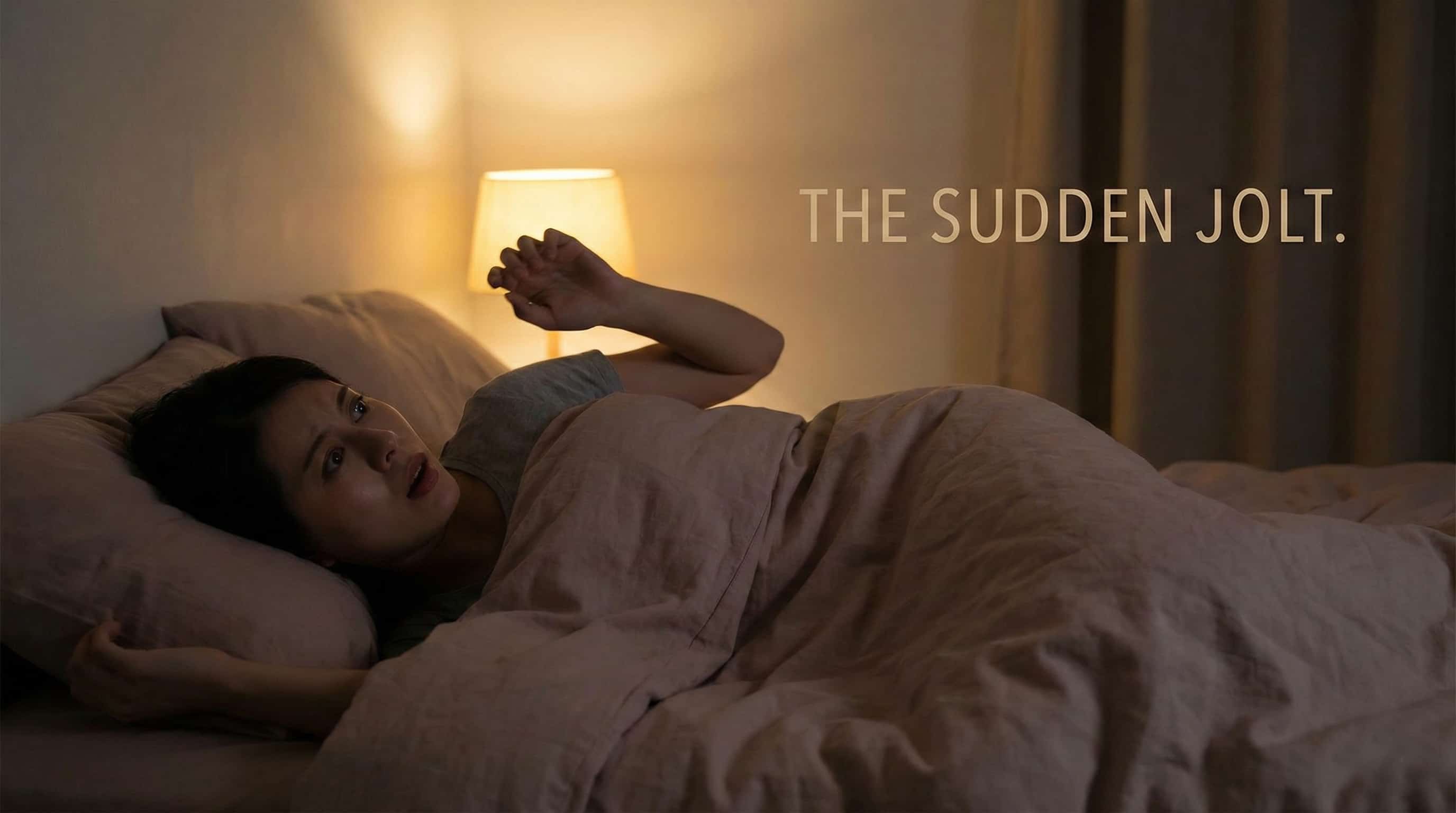
It happens fast. One second you are drifting off. The next, your whole body jolts awake — a sudden, violent muscle twitch that feels exactly like the moment your foot misses a step on a staircase.
why do i feel like im falling when i sleep — more precisely called a hypnic jerk or sleep start — is one of the most universally reported sleep experiences in existence. And almost everyone who has felt it has the same immediate thought: what just happened to my body?
The answer is both simpler and more surprising than you think: your brain just caught you from falling out of a tree. Except you were never falling, and there was never a tree. Here is what is actually going on — and how to make it happen less often.
⚡ Core Takeaway: Normal, But Amplified by Arousal
- The Mechanism: Hypnic jerks are a normal part of sleep onset — a misfiring of the brain’s motor neurons as your muscles relax into sleep
- The Amplifier: Anxiety, stress, caffeine, and sleep deprivation lower the threshold for these jerks, making them more frequent and intense
- The Fix: Reduce overall arousal before bed: magnesium, parasympathetic breathing, no caffeine 6+ hours before sleep
What Is a Hypnic Jerk and Why Does Your Body Do This?
Direct Answer: A hypnic jerk — also called a sleep start or hypnagogic jerk — is a sudden, involuntary muscle twitch that occurs as you are transitioning from wakefulness to sleep. It feels exactly like a falling sensation, often accompanied by the sensation of tripping or stumbling. It is one of the most universally reported sleep phenomena, affecting up to 70% of people, and it is completely normal.
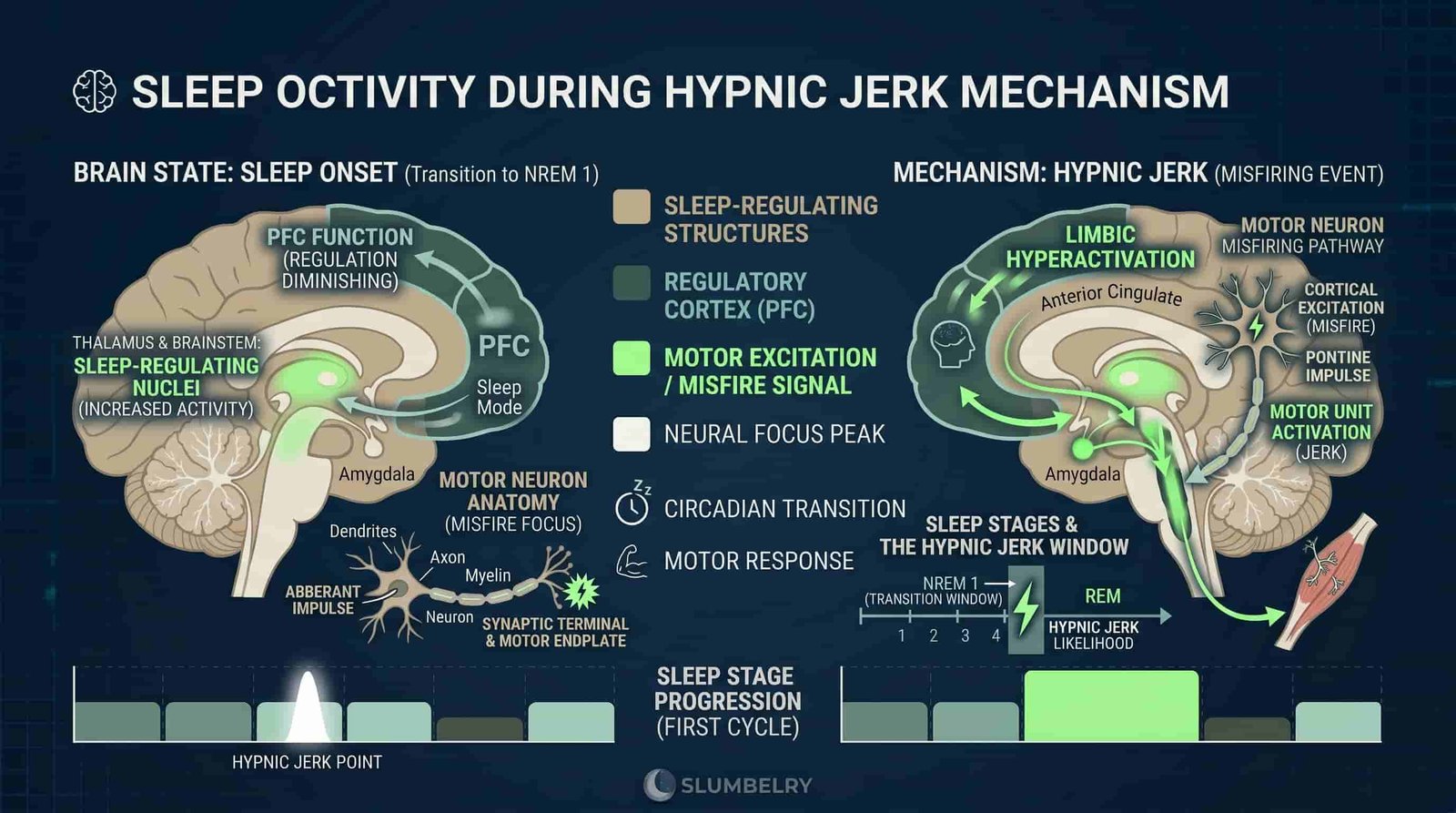
Mechanism: Walker (2017) explains that as you begin to fall asleep, your muscles start to relax — a process called atonia. The brain misinterprets this relaxing muscle state as a signal that the body is actually falling. The reticular formation (the brain’s arousal center) sends a sudden nerve impulse to correct the perceived fall, jerking your muscles awake. This is an ancient reflex: as your body loses grip on consciousness, the nervous system performs one last check. There is no actual falling — only the brain’s misinterpretation of a perfectly normal transition state. Your body thinks you are falling out of a tree, and it is making sure you do not.
Actionable Advice: Understand that a hypnic jerk is your brain’s way of protecting you from a threat that does not exist. This framing alone — knowing it is benign — reduces the anxiety that often accompanies the experience. Each jerk is your brain briefly mistaking relaxation for danger, then overcorrecting.
What Causes the Falling Sensation When Falling Asleep?
Direct Answer: The falling sensation is not a hallucination — it is a misclassified signal. As your body enters the N1 sleep stage (the first phase of sleep), muscle tone decreases rapidly. The brain’s proprioceptive system (which tracks body position) interprets the sudden loss of muscle tension as the body becoming unsupported. The result: a brief panic signal that produces the hypnic jerk to “catch” you.
Mechanism: Littlehales (2016), Sleep, describes two competing evolutionary theories. The first: hypnic jerks are a vestigial reflex from our primate ancestors who slept in trees — the brain keeps one hand on the safety switch until sleep is confirmed. The second: they are simply the result of the nervous system performing a final systems-check during the wake-to-sleep transition. Both theories agree on one point: the phenomenon is an ancient, hardwired neurological mechanism, not a sign of anything wrong. The brain does not fully power down in stages — it switches abruptly, and the hypnic jerk is the sound of that switch flipping.
Actionable Advice: Your brain thinks it is catching you from falling out of a tree. It is not. The more you understand this as a misinterpretation rather than a real event, the less alarming each jerk becomes.
Is It Normal to Feel Like You Are Falling As You Fall Asleep?
Direct Answer: Yes — it is one of the most normal things that can happen to your body during sleep. Up to 70% of people experience hypnic jerks, and they occur in every age group. The feeling of falling — or the sensation of tripping, stumbling, or being jerked awake — is the hallmark of this phenomenon and is not dangerous.
Mechanism: The normal distribution of hypnic jerks means that if you experience them, you are in the majority. What is not normal — and worth investigating — is if the jerks are accompanied by loud gasping, choking, or violent thrashing that disrupts a bed partner. Those symptoms suggest a different phenomenon (confusional arousal or, more rarely, REM behavior disorder). But the classic hypnic jerk — a single twitch or sensation of falling, followed by quick recovery — is as normal as yawning before sleep. The only reason it feels alarming is that it happens at the exact moment you are most vulnerable, in the dark, with reduced cognitive capacity to contextualize it.
Actionable Advice: Keep a simple log: frequency, intensity (single twitch vs. full body jerk), and what you were thinking about right before it happened. Most people find their jerks are worse on nights when they are already anxious — which brings us to the next critical variable.
Why Does Your Brain Misfire This Way During Sleep Onset?
Direct Answer: The misfire happens in the brainstem — specifically in the reticular formation — during the N1 to N2 transition. As the muscles release into atonia and the brain begins shutting down its waking functions, the reticular formation has not fully transitioned yet. It reads the sudden absence of proprioceptive input (body position signals) as an emergency and sends a corrective motor burst.
Mechanism: Walker (2017) describes the reticular activating system (RAS) as the brain’s sleep-wake switch. When you are awake, the RAS keeps the brain alert by filtering sensory input. As you begin to sleep, the RAS begins to power down — but the muscles power down faster. The timing mismatch creates a gap: the RAS briefly interprets the absence of muscle signals as a system failure and fires an emergency corrective signal. The hypnic jerk is that corrective signal. It is not a malfunction — it is the sound of a mostly-accurate system making a minor error. In most cases, the error corrects itself within seconds and sleep proceeds normally.
Actionable Advice: There is no way to prevent the brainstem from running its safety check — but you can reduce the frequency of false alarms by lowering your overall arousal state before bed. The lower your cortisol before sleep, the fewer the false alarms.
Why Does Anxiety Make Hypnic Jerks More Frequent and More Intense?
Direct Answer: Anxiety lowers the threshold for the hypnic jerk — meaning your brain requires less provocation to trigger the alarm. When your baseline arousal is already elevated, the N1 muscle atonia transition is more dramatic, and the reticular formation is more likely to misread it as an emergency.
Mechanism: Stanley (2018), How to Sleep Well, documents that stress and anxiety elevate cortisol and norepinephrine, which increases overall nervous system excitability. The more excitable your nervous system, the lower the threshold for the brain’s startle response — and a hypnic jerk is essentially a controlled startle response. People who are highly stressed, or who are anxious about sleep itself (what therapists call “sleep-related anxiety”), tend to experience more frequent and more intense hypnic jerks because their nervous systems are already on high alert. The anticipation of a hypnic jerk can also trigger one — the fear of falling creates exactly the physiological state that produces a fall.
Actionable Advice: This is why addressing hypnic jerks requires addressing your pre-sleep arousal state, not just the jerk itself. The Worry Journal, parasympathetic breathing, and magnesium supplementation all reduce baseline cortisol — which directly reduces hypnic jerk frequency.
What Triggers Hypnic Jerks: Caffeine, Exercise, or Sleep Deprivation?
Direct Answer: Yes to all three. Caffeine (especially in the afternoon), intense evening exercise, and accumulated sleep deprivation all increase hypnic jerk frequency. The common mechanism: each factor elevates sympathetic nervous system activation, which lowers the threshold for the reticular formation’s false alarm.
Mechanism: Walker (2017) documents that caffeine blocks adenosine receptors — adenosine is the chemical that builds up during wakefulness to produce sleep pressure. When caffeine blocks this signal, your brain thinks it is less tired than it actually is, and your nervous system remains more alert than it should be during the N1 transition. Intense exercise within 2–3 hours of bedtime raises core body temperature and adrenaline, both of which delay the onset of deep sleep and increase motor cortex excitability — making the muscles more prone to a sudden twitch. Sleep deprivation itself compounds all of this: a sleep-deprived brain is more excitable, has higher cortisol, and has a lower threshold for every kind of sleep disruption. The combination of sleep deprivation plus caffeine plus evening exercise is a near-guarantee of frequent, intense hypnic jerks.
Actionable Advice: Cut caffeine by 2 PM at the latest. Avoid vigorous exercise within 3 hours of bedtime. Prioritize getting 7–9 hours of sleep consistently — the sleep-deprived brain is the brain most likely to jerk you awake at the worst possible moment.
What Is the Difference Between a Hypnic Jerk and a Sleep Start?
Direct Answer: There is no clinical difference — “hypnic jerk,” “sleep start,” and “hypnagogic jerk” are synonymous terms describing the same phenomenon. All three refer to the involuntary muscle twitch and sensation of falling that occurs during the N1 to N2 sleep transition.
Mechanism: The different terms arise from different traditions: “hypnic jerk” comes from the Greek “hypnos” (sleep) + “jerk.” “Sleep start” is the more colloquial medical description. “Hypnagogic jerk” comes from “hypnagogic” (the state between wakefulness and sleep). In sleep medicine literature, these are used interchangeably. There is a related phenomenon called a “myoclonic jerk” — but myoclonic jerks can occur during deep sleep (N3) or even during wakefulness, and may indicate a neurological disorder if frequent. A hypnic jerk is specific to the sleep-onset window and is benign.
Actionable Advice: If you experience jerking or twitching during the night — not just at sleep onset, but in the middle of deep sleep — this may be a different phenomenon worth discussing with a doctor. But the classic sleep-onset jerk you are describing is textbook hypnic jerk: normal, benign, and very common.
Why Does This Happen More in an Unfamiliar Bed or New Place?
Direct Answer: The “first night effect” — a well-documented phenomenon in sleep science where the brain stays partially vigilant on the first night in a new environment, keeping one hemisphere of the brain slightly awake to monitor for threats.
Mechanism: Stanley (2018) documents the first night effect as a survival mechanism: when sleeping in an unfamiliar environment, the brain allocates a portion of its capacity to monitoring the new surroundings for danger. This vigilance state elevates baseline arousal during sleep, particularly during the N1 to N2 transition when the brain is most sensitive to environmental changes. The result: more frequent hypnic jerks, lighter sleep, and more awakenings on the first night in a new bed. This is the same mechanism that causes hotel insomnia — your brain is not broken; it is being appropriately cautious in an unfamiliar environment.
Actionable Advice: If you travel frequently, bring something from your own sleep environment that signals safety — a pillow, a blanket, or an eye mask you sleep with at home. Over time, your brain learns that the new bed is safe, and the first night effect diminishes. Give yourself 2–3 nights in a new environment before judging your sleep quality there.
How to Reduce Hypnic Jerks: Evidence-Based Strategies
Direct Answer: Reduce the overall arousal state before bed, minimize stimulants, and support the N1 to N2 transition with parasympathetic nervous system activation. The goal is to make the sleep-onset transition as smooth as possible — which means arriving at bedtime calm, not activated.
Mechanism: Walker (2017) and Littlehales (2016) both recommend a pre-sleep routine that lowers sympathetic activation before the N1 transition begins. Magnesium glycinate (400 mg, 30–60 minutes before bed) supports muscle relaxation and has mild GABA-activating properties that smooth the atonia transition. Parasympathetic breathing — 4-7-8 breathing or box breathing — directly reduces cortisol and activates the parasympathetic nervous system, making the reticular formation less likely to misread muscle relaxation as an emergency. Avoiding screens for 30 minutes before bed reduces blue-light activation of the suprachiasmatic nucleus, which would otherwise delay melatonin onset and increase alertness. Combining these creates a cumulative effect: each step reduces the probability that the reticular formation will send a false alarm at the moment of sleep onset.
Actionable Advice: Start 60 minutes before bed: no caffeine, no screens, no intense exercise. In that window: magnesium supplement, 5 minutes of 4-7-8 breathing, and a reading or journaling session to offload any remaining cognitive load. If you feel a hypnic jerk coming, consciously relax your muscles — do not tense against it. Tensing amplifies the misfiring; relaxing tells the reticular formation the body is intentionally resting.
When Should You See a Doctor About Hypnic Jerks?
Direct Answer: Hypnic jerks are almost always benign — but see a doctor if they are violent (causing injury to yourself or a partner), if they are associated with gasping or choking sounds, if you are falling asleep involuntarily during the day, or if the sensation of falling is replacing your actual sleep rather than interrupting it.
Mechanism: The red flags for pathology are different from the classic hypnic jerk. Sleep apnea often presents with gasping, choking, or snorting sounds at the transition between sleep stages — not the simple muscle twitch-and-recovery of a hypnic jerk. REM behavior disorder (RBD) involves physically acting out dreams — punching, kicking, falling out of bed — which are very different from the brief motor misfire of a hypnic jerk. Narcolepsy involves falling asleep involuntarily during the day, not just hypnic jerks at night. If your experience is limited to the sensation of falling and a brief twitch at sleep onset, it is almost certainly benign. The key distinguishing feature: hypnic jerks last less than one second and resolve immediately; pathological events are sustained, violent, or associated with other symptoms.
Actionable Advice: If you have ruled out the red flags and your hypnic jerks are primarily triggered by anxiety, start with the pre-sleep routine above. If they persist despite lifestyle changes, a sleep study can confirm whether there is an underlying respiratory or movement disorder contributing. In most cases, the answer is simpler: your nervous system needs to be calmer, not your body needs more medication.
Frequently Asked Questions
Are hypnic jerks normal or a sign of something serious?
Direct Conclusion: Completely normal and not a sign of anything serious. Up to 70% of people experience hypnic jerks at some point in their lives. They are a benign neurological misfire at the sleep-onset transition, not a symptom of a disorder. The only times to consult a doctor: if jerks cause injury, if they are associated with gasping or choking sounds, or if you fall asleep involuntarily during the day.
Why do I feel like I am falling when I am falling asleep?
Direct Conclusion: Your brain is misinterpreting the rapid muscle relaxation of the N1 sleep stage as a falling signal. As your muscles release into atonia, the reticular formation detects a sudden absence of proprioceptive input and sends a corrective motor burst. You are not falling — your brain is simply running a faulty safety check at the worst possible moment. It is a misinterpretation, not a real event.
Can anxiety cause more hypnic jerks?
Direct Conclusion: Yes — anxiety lowers the threshold for the hypnic jerk by elevating baseline sympathetic nervous system activation. When your cortisol is already high before bed, the N1 muscle relaxation transition is more dramatic, and the reticular formation is more likely to misread it as an emergency. Reducing pre-sleep anxiety through the Worry Journal, parasympathetic breathing, and magnesium supplementation directly reduces hypnic jerk frequency.
Does caffeine make hypnic jerks worse?
Direct Conclusion: Yes, especially if consumed after 2 PM. Caffeine blocks adenosine receptors, which elevates the brain’s overall alert state. A caffeine-affected nervous system entering the N1 sleep stage is significantly more prone to hypnic jerks than a calm, caffeine-free nervous system. The effect is compounded if you are also sleep-deprived, which most caffeine-dependent people are.
Why do I get hypnic jerks more often when I am stressed?
Direct Conclusion: Stress and sleep deprivation are the two biggest amplifiers of hypnic jerk frequency. Both conditions elevate cortisol and sympathetic nervous system activation, which lowers the threshold at which the reticular formation fires its false alarm. A chronically stressed person will experience more hypnic jerks because their nervous system is already in a high-alert state before they even get into bed.
Is there a link between hypnic jerks and sleep apnea?
Direct Conclusion: Not directly — hypnic jerks and sleep apnea are separate phenomena. However, people with sleep apnea often experience more sleep starts because their breathing interruptions periodically jolt them awake. If you snore, wake gasping, or have been told you stop breathing during sleep, a sleep study is appropriate. If your experience is purely a sensation of falling with a brief muscle twitch at sleep onset, it is almost certainly a hypnic jerk, not apnea.
What supplements or techniques reduce hypnic jerks?
Direct Conclusion: Magnesium glycinate (400 mg, 30–60 minutes before bed) is the most evidence-supported supplement — it supports muscle relaxation and has mild GABA-activating properties. Parasympathetic breathing (4-7-8 breathing: inhale 4 counts, hold 7, exhale 8, repeated 5 times) directly reduces cortisol and smooths the N1 transition. Reducing caffeine, avoiding screens before bed, and consistent sleep times all contribute cumulatively. No single intervention is as effective as reducing your overall arousal load before the sleep-onset window.
Why do hypnic jerks happen more in a new or unfamiliar bed?
Direct Conclusion: The first night effect: when sleeping in an unfamiliar environment, the brain keeps one hemisphere partially awake as a threat-monitoring measure. This elevated vigilance state lowers the threshold for the hypnic jerk during the N1 transition. The phenomenon resolves after 2–3 nights in most people, as the brain learns the new environment is safe.
Are hypnic jerks the same as REM behavior disorder?
Direct Conclusion: No — they are fundamentally different. Hypnic jerks occur at sleep onset (N1 stage), last less than a second, and resolve immediately. REM behavior disorder (RBD) involves acting out dreams during REM sleep — which is deep sleep, hours after onset. RBD can involve violent, sustained movements that can cause injury. Hypnic jerks are benign; RBD requires medical evaluation. If you are physically acting out dreams (hitting, kicking, falling out of bed), see a sleep specialist.
What is the single most effective thing to do when you get a hypnic jerk?
Direct Conclusion: Consciously relax the muscle you just jerked — do not tense against it. Tensing amplifies the misfiring; deliberately softening the muscle signals to the reticular formation that the body is intentionally resting, not falling. The second most effective strategy is addressing your pre-sleep arousal state: the fewer cortisol and anxiety you bring to bed, the fewer false alarms your brain will send at the moment of sleep onset.
Ready to Transform Your Recovery?
If your nervous system has been running on high alert, take action today. Discover science-backed solutions for better rest.
Take the Sleep Assessment Explore Our Cooling MattressThe Slumbelry Commitment
Sleep is the most vulnerable state of human existence. It is where we heal, reset, and grow.
At Slumbelry, we do not just sell sleep products; we advocate for your physiological right to rest. From ergonomic support to light management, every solution we offer is designed with one obsession: Respecting your Biology.
Science is our language, but your recovery is our purpose. You take care of everything else in your life — let us take care of your sleep.
Rest Deeply,
The Slumbelry Team