The CEO’s Delusion: Why Your “Stamina” is Actually Intoxication
sleep deprivation performance — Why High Performers Are Actually Operating Drunk — And What Science Says About It
In boardrooms from New York to Singapore, a dangerous mythology persists. High performers wear their exhaustion like a medal — a visible proof of commitment, drive, and superiority over the mortals who “need” eight hours.
This is why sleep deprivation performance matters: the belief that sleeping less equals performing more is not just wrong, it is a neurological liability that costs executives clarity, capital, and health.
As a sleep specialist who has worked with founders and C-suite leaders for over a decade, I have watched this delusion erode decision quality, damage relationships, and in some cases, end careers entirely.
⚡ Core Takeaway: The Drunk Executive
- The Problem: After 17 hours without sleep, your cognitive impairment matches a BAC of 0.05%. Most CEOs are operating legally drunk during their most critical meetings.
- The Mechanism: Adenosine accumulates every waking hour and clears only during sleep. Caffeine merely blocks the receptors — it does not eliminate the debt.
- The Method: Reframe sleep as a performance protocol. Five R90 cycles per night, strategic 20-minute NASA naps, and strict caffeine cutoffs after 2 PM.

What Does “CEO Delusion” Actually Mean?
Direct Answer: The CEO Delusion is the systematic misbelief that sleeping less is a competitive advantage. It is a form of biological arrogance where high performers confuse subjectively feeling functional with objectively being impaired.
Mechanism: The 3P Model of insomnia (Predisposing, Precipitating, Perpetuating factors) explains why this delusion persists. Perpetuating factors — the beliefs and behaviors that maintain poor sleep — are often mistaken for discipline. When a founder brags about four-hour nights, they are reinforcing the very cycle that degrades their performance (Perlis et al., 2016).
Actionable Advice: The first step is reframing: sleep is not lost productivity time. It is the foundation of cognitive capacity. Every hour of sleep lost is an hour of executive function surrendered.
How Sleep Deprivation Literally Impairs Your Brain Like Alcohol
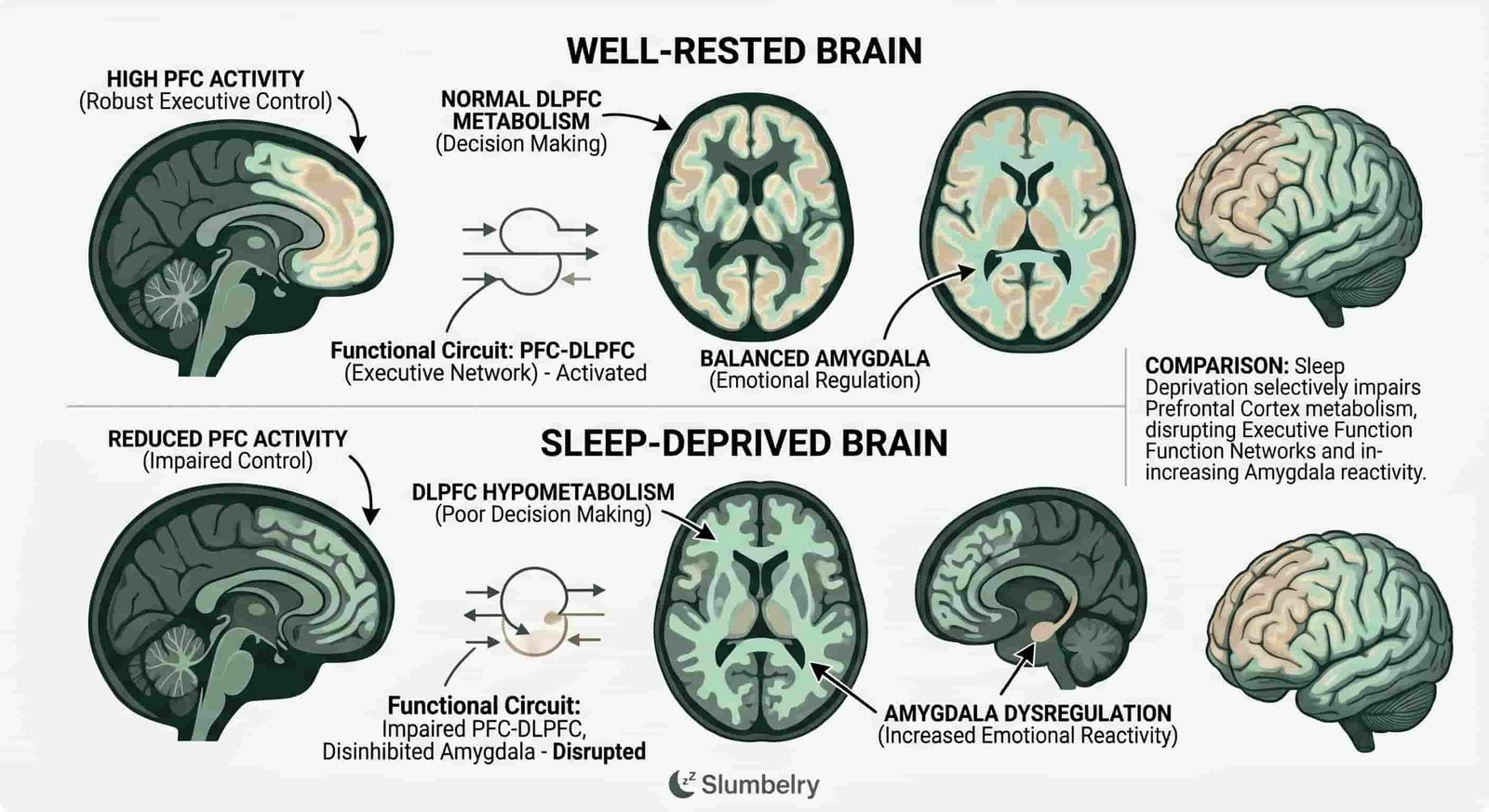
Direct Answer: Sleep deprivation and alcohol intoxication impair the same neural systems — primarily the prefrontal cortex, which governs judgment, impulse control, and strategic thinking.
Mechanism: Research from the AAA Foundation for Traffic Safety found that after 17 hours of sustained wakefulness, cognitive impairment matches a Blood Alcohol Concentration (BAC) of 0.05%. At 24 hours without sleep, impairment reaches 0.10% — nearly double the legal limit in most states. Just one night of four-hour sleep reduces Natural Killer Cell activity by 70%, compromising immune surveillance (Walker, 2017).
The Adenosine Hangover: Why You Feel Fine But Are Actually Compromised
Direct Answer: Adenosine is a neurochemical that builds up in the brain during waking hours, creating sleep pressure — the biological signal that it is time to sleep. This accumulation is why you feel increasingly impaired, even if you subjectively feel “used to” limited sleep.
Mechanism: During sleep, adenosine is cleared from the brain through the glymphatic system. Caffeine works by blocking adenosine receptors — it masks the signal but does not eliminate the debt. When caffeine wears off, the accumulated adenosine hits all at once, producing the classic afternoon crash (Fredholm et al., 1999). The sleep pressure does not go away because you ignore it; it compounds.
Actionable Advice: Track your adenosine clearance window. If you consistently crash after 2 PM, your nightly sleep is not fully clearing adenosine. Prioritize earlier bedtimes and eliminate caffeine after 2 PM to avoid perpetuating the cycle.
The Napoleon Myth: What History’s “Sleepless Genius” Actually Did
Direct Answer: Napoleon Bonaparte is frequently cited as the prototype of the sleepless genius who conquered Europe on four hours per night. The historical record tells a very different story.
Mechanism: Louis Antoine Fauvelet de Bourrienne, Napoleon’s private secretary, documented that Napoleon routinely slept multiple times throughout the day — including long afternoon naps — to compensate for his irregular nocturnal schedule. The “four-hour” narrative was strategic self-branding, not biology. Napoleon understood that portraying himself as tireless made him appear invincible to allies and adversaries alike.
Actionable Advice: When you hear a founder brag about four-hour nights, ask: “What does your afternoon look like?” The answer often reveals the compensated sleep — a two-hour nap that keeps the biology barely functioning.
Cortisol and Decision Fatigue: Why Your 3 PM Board Meeting Is Your Worst
Direct Answer: Cortisol — the body’s primary stress hormone — follows a circadian rhythm, peaking at 8 AM and reaching its daily nadir around midnight. When sleep-deprived, this rhythm flattens, causing cortisol to remain elevated in the afternoon when it should be declining.
Mechanism: Elevated afternoon cortisol impairs the prefrontal cortex’s ability to regulate emotional responses and make strategic decisions. This is why research from the Harvard Business School found that judges issue harsher sentences and more unfavorable rulings after 3 PM — a phenomenon now called “decision fatigue.” For a sleep-deprived executive, 3 PM board meetings are neurologically the worst time to negotiate, make commitments, or resolve conflicts.
Actionable Advice: Schedule your most cognitively demanding decisions for 8–10 AM when cortisol and alertness are naturally elevated. Move routine reviews and low-stakes meetings to afternoon slots when your biology is working against you anyway.
The Cumulative Damage: What 6 Hours vs. 4 Hours vs. 0 Hours Actually Does to You
Direct Answer: The cumulative effect of sleep restriction compounds in ways that are invisible to the sleep-deprived person — which is precisely what makes the delusion so dangerous.
Mechanism: A landmark study by Van Dongen et al. (2003) at the University of Pennsylvania found that after two weeks of six hours per night, subjects showed the same cognitive impairment as 24 hours of total sleep deprivation — and they were completely unaware of their decline. At four hours per night for six nights, impairment matched 48 hours of no sleep. The brain adapts to chronic restriction by creating a new, lower baseline of functioning — the person feels “fine” because their new normal is chronically degraded.
Actionable Advice: Track your sleep across a full week using a journal or wearable. Most executives underestimate their sleep debt by two to three hours. Until you have objective data, you are guessing about your own capacity.
Why “Powering Through” Is a Perpetuating Factor in Your Sleep Problem
Direct Answer: The belief that willpower can overcome sleep deprivation is one of the most damaging perpetuating factors in chronic sleep restriction. Willpower does not reset the prefrontal cortex. Sleep does.
Mechanism: The 3P Model’s perpetuating factors include maladaptive beliefs (“I perform better on less sleep”) and safety behaviors (“I’ll just have another coffee”). These beliefs temporarily reduce anxiety about sleep loss but ultimately maintain the problem by preventing the biological recovery that sleep provides (Perlis et al., 2016).
Actionable Advice: CBT-I (Cognitive Behavioral Therapy for Insomnia) specifically targets these perpetuating beliefs. A 2015 JAMA Internal Medicine randomized controlled trial found that CBT-I was more effective than medication for chronic insomnia — and its effects lasted long after the intervention ended.
The Evidence-Based Recovery Protocol for Chronically Sleep-Deprived Leaders
Direct Answer: Recovery from chronic sleep debt is not about one long sleep session. It is about systematic, disciplined re-establishment of sleep architecture over weeks — using the same principles elite athletes apply to recovery from physical training.
Mechanism: CBT-I provides the framework: stimulus control (bed = sleep only), sleep restriction (reduce time in bed to match actual sleep efficiency), and cognitive restructuring (challenging beliefs about sleep loss). For executives specifically, the R90 protocol (Littlehales, 2016) provides a practical cycle-based framework. Aim for five complete 90-minute sleep cycles per night (7.5 hours), plus 25-30 minutes of wind-down time, totaling an 8-hour window in bed.
Actionable Advice: Start with tonight. Calculate your target wake time, count back 8 hours to find your target bedtime, and protect that window ruthlessly. Move it by 15 minutes maximum per night — trying to recover three hours in one night creates social jet lag and worsens the problem.
How to Know If You Have a Sleep Debt Problem: The Self-Assessment
Direct Answer: Sleep debt is not measured by how tired you feel. It is measured by recovery time and functional capacity. Many executives with severe debt feel “fine” because their baseline is chronically lowered.
Mechanism: The Epworth Sleepiness Scale (ESS) and the NASA Fatigue Self-Test are validated tools for assessing objective daytime sleepiness versus perceived impairment. Track your sleep for two weeks: record time in bed, total sleep time, and wake quality (1–10). Calculate your sleep efficiency (total sleep / time in bed). Above 85% is adequate; above 90% is optimal. Most executives are below 75%.
Actionable Advice: For one week, go to bed at the same time each night (including weekends), remove all screens one hour before bed, and keep your bedroom at 18–20°C. At the end of the week, compare your average sleep efficiency to your baseline. Improvement indicates recoverable sleep debt.
Stop Negotiating With Your Biology — This Is What Elite Recovery Looks Like
Direct Answer: Your biology does not negotiate. Adenosine does not care about your quarterly earnings call. Cortisol does not adjust for your launch deadline. These systems operate on ancient biological imperatives — and they will always win.
Mechanism: The only recovery from sleep debt is sleep itself. No amount of cold exposure, no supplement stack, no productivity hack replaces the biological function of sleep. The brain consolidates memories, clears metabolic waste via the glymphatic system, and resets hormonal regulation during sleep — none of which can occur during waking rest (Walker, 2017).
Actionable Advice: Treat sleep scheduling with the same discipline you apply to your board meetings. Block eight hours of sleep opportunity on your calendar every night. Set a wind-down alarm 30 minutes before bed. Keep your last hour of screen time for the next morning’s review, not tonight’s scroll. These aren’t luxuries — they are the infrastructure of sustainable high performance.
Frequently Asked Questions
Why do I feel like I function fine on 4-5 hours of sleep?
Direct Conclusion: Your brain has down-regulated its adenosine sensitivity and adjusted to a new, chronically impaired baseline. You do not feel impaired because the impairment is now your normal. Research shows people with six hours of sleep for two weeks perform the same as 24 hours of total sleep deprivation yet rate themselves as only “slightly impaired” (Van Dongen et al., 2003).
How is sleep deprivation actually similar to being drunk?
Direct Conclusion: Both alcohol and sleep deprivation impair the prefrontal cortex — the brain region responsible for judgment, impulse control, and strategic thinking. After 17 hours without sleep, your cognitive impairment is equivalent to a BAC of 0.05%. The difference is that a drunk person knows they are impaired. A sleep-deprived executive believes they are sharper than ever.
What is the difference between feeling tired and being sleep-deprived?
Direct Conclusion: Feeling tired is a transient state — it comes and goes with caffeine, novelty, or stress. Sleep deprivation is a cumulative neurobiological deficit that impairs performance even when you feel alert. Many executives are chronically sleep-deprived but mistake baseline alertness for adequate sleep.
Did Napoleon really run on four hours of sleep?
Direct Conclusion: No. Napoleon’s private secretary documented that he slept multiple times throughout the day, including extended afternoon naps. The “four-hour genius” narrative was his deliberate self-branding — a political tool to project invincibility. In reality, Napoleon negotiated with his biology constantly, just like anyone else.
How does cortisol affect decision-making in sleep-deprived leaders?
Direct Conclusion: Sleep deprivation flattens the cortisol circadian rhythm, keeping cortisol elevated into the afternoon when it should be declining. Elevated afternoon cortisol impairs prefrontal cortex function, reducing strategic thinking and increasing reactive decisions. This is why judges issue harsher sentences after 3 PM and executives make worse deals in afternoon meetings.
Is it possible to “catch up” on sleep debt over the weekend?
Direct Conclusion: Partially. Weekend sleep can reduce the subjective feeling of sleepiness but cannot fully reverse the cognitive impairment from chronic restriction. The brain cannot fully restore glymphatic clearance, memory consolidation, or hormonal regulation through weekend sleep alone. Consistent nightly sleep is the only reliable solution.
What is the fastest scientifically proven way to recover from a sleepless night?
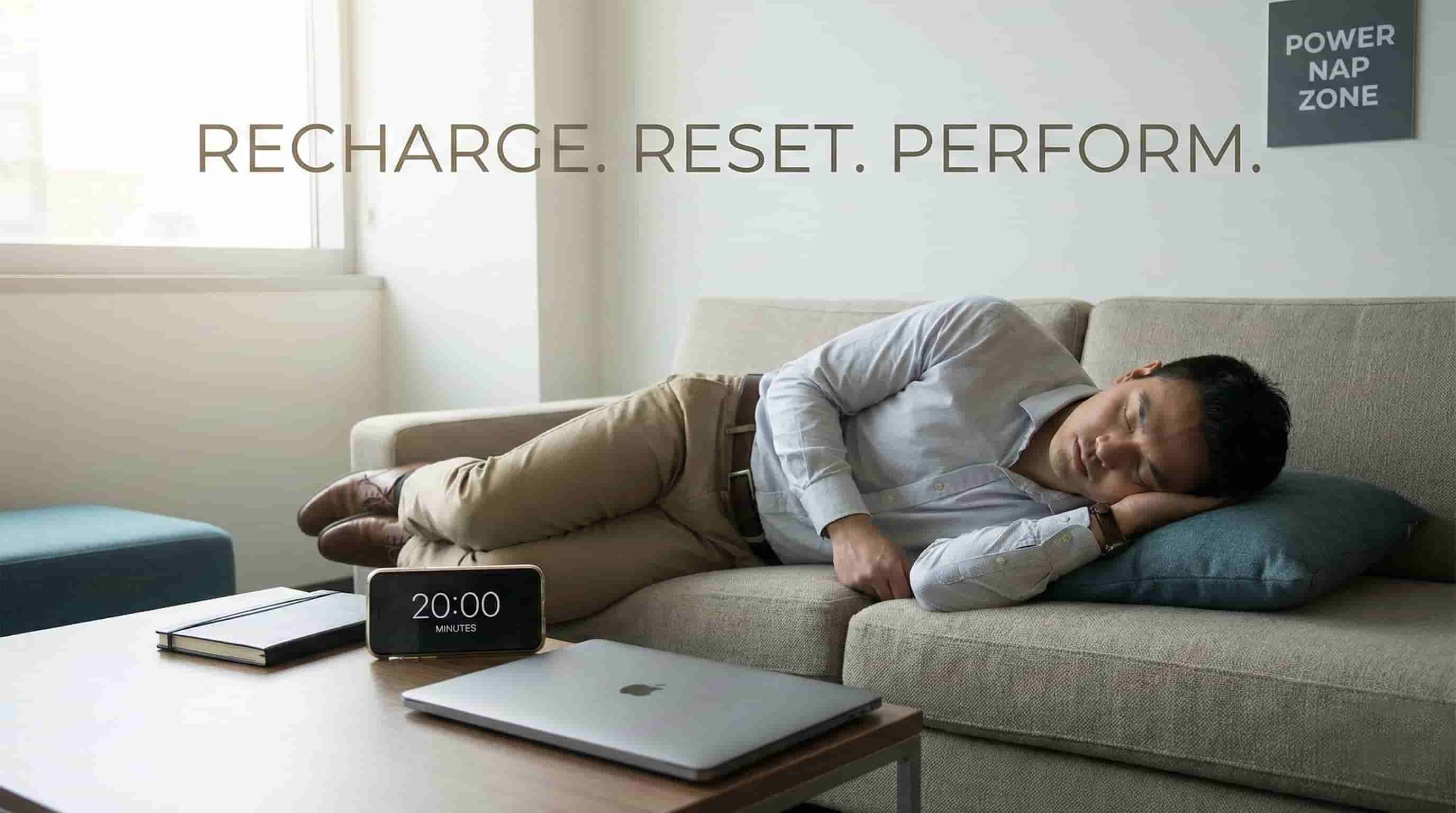
Direct Conclusion: A 20-minute NASA nap (not longer, to avoid sleep inertia) taken 6-8 hours after waking, combined with 100-200mg of caffeine immediately upon waking, provides the fastest temporary restoration. This combination was validated in NASA studies and remains the standard for fatigued medical professionals and military personnel.
Should I take naps during the workday, and if so, how long?
Direct Conclusion: Yes — but the length matters critically. A 10-20 minute power nap improves alertness and motor function for approximately 2.5 hours afterward. A 30-60 minute nap includes sleep inertia — the groggy period after waking from deeper sleep — which can last 30-60 minutes. A 90-minute nap completes a full sleep cycle and can restore performance for up to 8 hours. For executives, the 20-minute power nap taken in the early afternoon (1-3 PM) is the most practical and effective option.
How do I know if my performance issues are actually sleep-related?
Direct Conclusion: Track two metrics for two weeks: your average sleep efficiency (total sleep / time in bed) and your average afternoon decision quality (rate 1–10 for each major decision made after 2 PM). If your afternoon decisions are consistently rated lower than morning decisions, and your sleep efficiency is below 85%, your performance issues are very likely sleep-related.
What role does adenosine play in sleep pressure and daytime fatigue?
Direct Conclusion: Adenosine is the primary neurochemical driver of sleep pressure — the biological signal that builds with each waking hour and signals the need for sleep. It accumulates through adenosine triphosphate (ATP) breakdown in neurons, and is cleared exclusively during sleep via the glymphatic system. Caffeine works by blocking adenosine receptors, masking the signal but not eliminating the debt. The only real clearance mechanism is sleep itself (Fredholm et al., 1999).
Ready to Transform Your Recovery?
If you are operating on four hours of sleep, you are not outworking the competition — you are outrunning your biology. Discover the science-backed path to sustainable high performance.
Take the Sleep Assessment Explore Our Cooling MattressThe Slumbelry Commitment
Sleep is the most vulnerable state of human existence. It is where we heal, reset, and grow.
At Slumbelry, we do not just sell sleep products; we advocate for your physiological right to rest. From ergonomic support to light management, every solution we offer is designed with one obsession: Respecting your Biology.
Science is our language, but your recovery is our purpose. You take care of everything else in your life — let us take care of your sleep.
Rest Deeply,
The Slumbelry Team