https://slumbelry.com/
×
Slumbelry
HOME SHOP WELLBEING BLOG LOGIN / REGISTER SEARCH CONTACT

How to Break the Spiral of Sleeplessness

the anxiety insomnia loop: how to break the spiral tonight

The Anxiety-Insomnia Loop: Why the More You Try to Sleep, the Harder It Gets

You are tired. You get into bed. Suddenly, you are wide awake — and worried about being tired tomorrow. Welcome to the anxiety insomnia loop. This is not a personality flaw. This is a neurobiological feedback system, and it has a specific structure that you can see clearly once you know where to look.

The anxiety-insomnia loop is one of the most common and most misunderstood sleep disorders in modern medicine. Dr. Barry Krakow’s research on sleep disorders identified it as the primary driver of chronic insomnia in patients who have no underlying medical cause — and it is entirely learned, which means it can be entirely unlearned.

Here is what the science says: the more you try to sleep, the harder it gets. But the moment you stop trying — not through resignation, but through strategic removal of the performance pressure — the loop begins to break.

⚡ Core Takeaway: Stop Fighting Sleep — Remove the Threat

  • The Problem: The anxiety-insomnia loop is a positive feedback system: anxiety prevents sleep → sleep deprivation worsens anxiety → repeat
  • The Switch: Your brain cannot simultaneously activate threat response (anxiety) and sleep response; you must remove the threat signal, not force sleep
  • The Method: Remove the performance pressure (“try to sleep”), use behavioral techniques to interrupt the loop, and let sleep happen as a byproduct
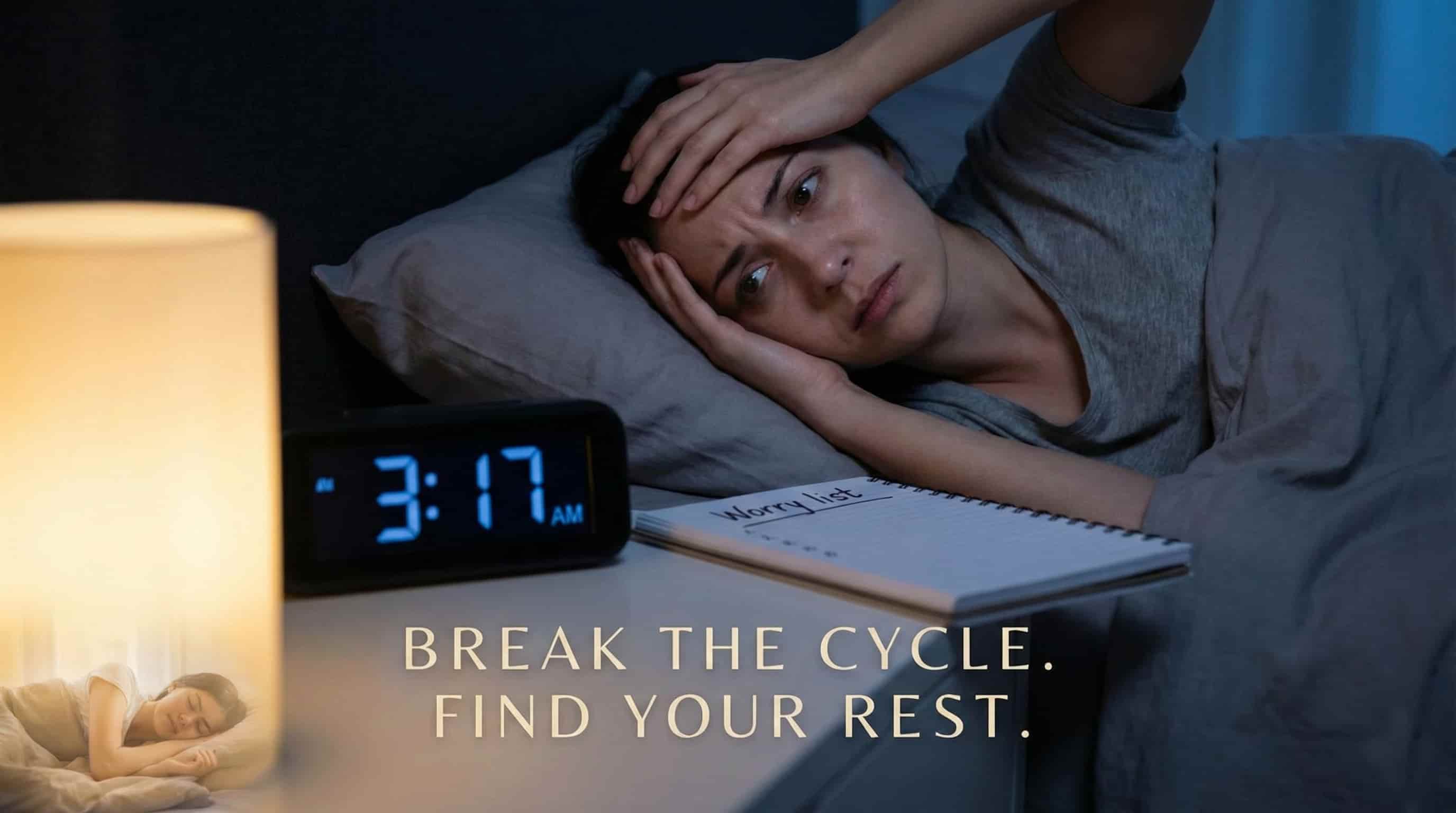
Person caught in anxiety-insomnia cycle, head with two competing arrows representing the loop of sleeplessness and worry
The anxiety-insomnia loop: a self-reinforcing cycle that strengthens with every iteration

What Is the Anxiety-Insomnia Loop and Why Does It Feel Impossible to Escape?

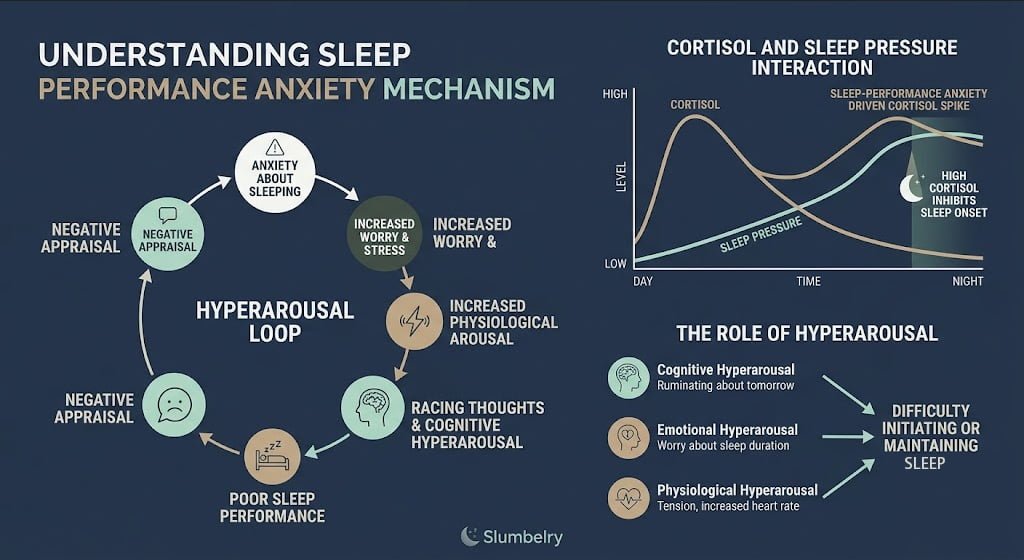
Direct Answer: The anxiety-insomnia loop is a positive feedback system in which anxiety disrupts sleep, sleep deprivation worsens next-day anxiety, and this heightened anxiety makes the following night’s sleep even harder — a self-reinforcing spiral that intensifies with each cycle.

Mechanism: Walker (2017), Why We Sleep, describes this as psychophysiological insomnia — a disorder of the bed-sleep association where the act of trying to sleep triggers the same arousal response as trying to stay awake. The moment you lie down with the goal of sleeping, your brain interprets it as a task to be performed. Performance anxiety activates the amygdala (threat detection center), which elevates cortisol and sympathetic nervous system activity. This is physiologically the opposite of what is needed for sleep onset. Because the anxiety is caused by the failure to sleep, and the failure to sleep is caused by the anxiety — the system has no inherent break point without external intervention.

Actionable Advice: The first step is recognizing that this loop has a structural cause, not a motivation cause. You are not failing to sleep because you are not tired enough or trying hard enough. You are failing to sleep because the act of trying to sleep has become a threat signal. This reframing alone — shifting from “I must sleep” to “I am learning not to make sleep a performance” — can slightly reduce the pre-sleep cortisol spike.

Research Highlight: Matthew Walker, Why We Sleep (2017) — psychophysiological insomnia as a self-reinforcing positive feedback loop; the performance anxiety/sleep failure cycle described as the most common insomnia mechanism in clinical populations.

What Happens in Your Brain When Anxiety and Insomnia Feed Each Other?

Direct Answer: When you lie in bed anxious about sleep, your amygdala triggers a cortisol and adrenaline surge — the same physiological response as facing a physical threat. This raises heart rate, increases cortical activation, and suppresses the pineal gland’s melatonin production. Sleep is a biological state that cannot be forced; it requires the amygdala to signal safety, not threat.

Mechanism: Walker (2017) documents the neurocircuitry: the amygdala and the sleep-promoting ventrolateral preoptic area (VLPO) are reciprocally inhibitory — when one is active, the other is suppressed. High anxiety activates the amygdala via the HPA axis, releasing cortisol and norepinephrine, which directly suppresses the VLPO and inhibits sleep onset. Sleep deprivation itself then elevates next-day anxiety by reducing prefrontal cortical inhibition over the amygdala (the same mechanism that makes you more emotionally reactive after a bad night). This creates a structural neurobiological loop where each day’s anxiety is partly caused by the previous night’s sleep disruption — meaning it is not “all in your head.” It is measurable cortisol dysregulation.

Actionable Advice: The break in this cycle requires removing the performance demand from sleep. Paradoxically, accepting a difficult night without strain reduces the threat activation that perpetuates it. This is the psychological mechanism behind the most effective insomnia interventions.
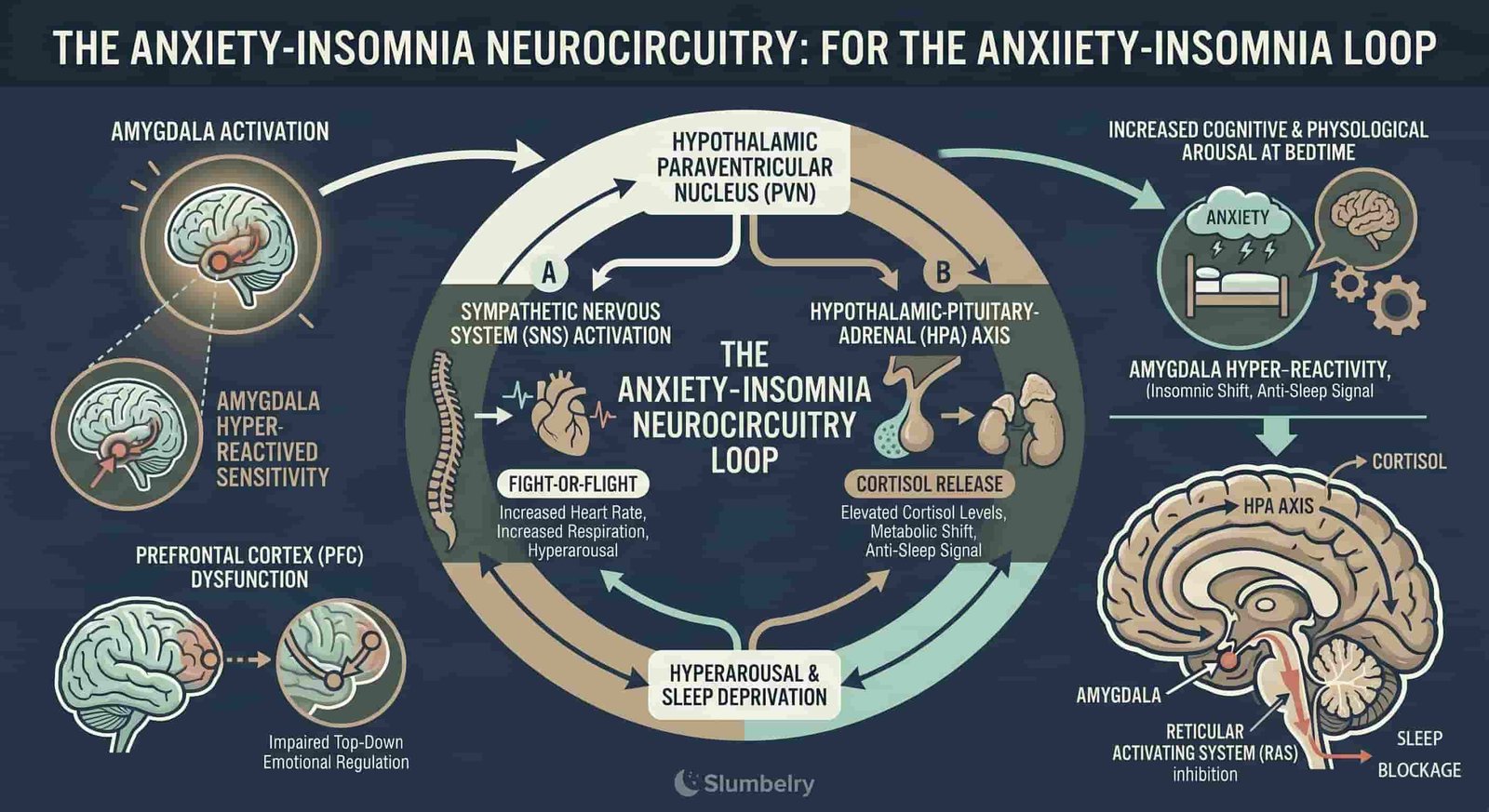
Scientific infographic showing anxiety-insomnia loop neurocircuitry with amygdala activation, cortisol response, and sympathetic nervous system feedback blocking sleep
The neuroscience of the anxiety-insomnia loop: why threat detection and sleep promotion are neurologically incompatible

Why Does Trying Harder to Fall Asleep Always Make It Worse?

Direct Answer: Because sleep is not an action — it is a biological outcome that happens when your brain no longer perceives a threat. The harder you try, the more you activate the arousal systems required to solve a problem, which are the exact opposite of the systems required to fall asleep.

Mechanism: Walker (2017) and S2-3 describe this as the paradox of effort in sleep: the prefrontal cortex is responsible for voluntary goal-directed action. When you set a goal (“I must fall asleep within 20 minutes”), the prefrontal cortex activates an executive function loop to achieve that goal. This activates — rather than suppresses — the arousal networks. Sleep, by contrast, is orchestrated by the hypothalamus and brainstem and is not under voluntary control. You cannot executive-function your way into a biological state that operates below the level of conscious will. The more you try, the more your brain treats bedtime as a performance situation, and performance requires wakefulness.

Actionable Advice: Replace “I must fall asleep” with “I am going to rest in bed with my eyes closed and my body relaxed.” Removing the sleep performance goal from the equation removes the threat signal. The sleep will come when it comes — the goal is rest, not sleep.

What Is Somniphobia and How Does Fear of Sleep Become Its Own Problem?

Direct Answer: Somniphobia is the clinical fear of sleep or of the bedroom itself. It develops when someone has had enough failed sleep attempts that the bedroom becomes a conditioned stimulus for failure, anxiety, and panic. It is not an exaggeration or a personality trait — it is a measurable conditioned fear response.

Mechanism: Walker (2017) describes how conditioned insomnia operates as a fear response: the bedroom triggers the amygdala in the same way a spider might trigger a phobia response in someone with arachnophobia. The person knows intellectually that the bedroom is not dangerous. But the amygdala does not respond to intellectual knowledge — it responds to pattern-matched threat cues. Every previous night of failed sleep in the bedroom has reinforced this pattern. The fear of sleep itself then becomes an additional arousal mechanism on top of whatever original problem caused the insomnia. This explains why somniphobia patients sometimes sleep better in hotels or unfamiliar environments (lower conditioned association) but terribly at home.

Actionable Advice: Somniphobia is best treated with gradual exposure therapy combined with CBT-I stimulus control. The goal is to weaken the bedroom-fear association by ensuring that most experiences in the bed end in sleep rather than failure. This is why strict adherence to the stimulus control rules is particularly important for somniphobia patients.

How Does the 15-Minute Rule Interrupt the Anxiety-Insomnia Spiral?

Direct Answer: By removing the threat cue (the bed) before the anxiety has time to fully activate, and by preventing the learned helplessness that develops from extended failed sleep attempts in bed.

Mechanism: The 15-minute rule (stimulus control) works through two pathways in the anxiety-insomnia loop: first, it prevents the bed from continuing to be a conditioned threat stimulus — you leave before the conditioning deepens further. Second, it removes the frustration and failure accumulation that develops from lying awake for an hour watching the clock. This frustration is itself anxiogenic — it signals to the brain that the situation is unresolvable, which activates the helplessness response, which further elevates cortisol. By getting up after 15–20 minutes, you prevent both the deepening of the fear association and the accumulation of failure-based anxiety. When you return to bed genuinely drowsy, the return experience is more likely to be paired with successful sleep onset — gradually rebuilding the bed-sleep safety association.

Actionable Advice: When you get up at night due to anxiety-driven wakefulness, do not interpret this as a personal failure. Interpret it as applying the correct protocol for a fear-based response. The goal is not to stay in bed through the anxiety — it is to interrupt the conditioning cycle.

Why Does Scheduled Worry Time Reduce Pre-Sleep Cortisol Spikes?

Direct Answer: Because it removes the unresolved worry from the pre-sleep period and places it in a structured time window where it can be processed rather than suppressed.

Mechanism: Walker (2017) and S2-2/S2-3 describe pre-sleep cognitive arousal as a major driver of cortisol elevation at bedtime. The worry loop activates the prefrontal cortex in a manner similar to a working memory task — sustained, effortful, and incompatible with sleep onset. The metacognitive model of insomnia suggests that it is not the content of the worries that keeps you awake — it is the attempt to suppress them while lying in bed that causes the paradoxical intensification. Worry Time works by giving the brain permission to worry in a designated window earlier in the day, which reduces the felt need to ruminate in bed. By the time you enter the bedroom, the cognitive processing of the worry has already occurred, and the bedtime mental state is less dominated by active problem-solving mode.

Actionable Advice: Set a 15-minute Worry Time at 6 or 7 PM. Write down every worry. Attempt to solve each one on paper. When worries surface at bedtime, remind yourself: “I have already addressed this. My meeting with this worry is tomorrow at 6 PM.” This cognitive defusion technique reduces the pre-sleep cortisol spike by removing the threat of unprocessed problems.

Research Highlight: Matthew Walker, Why We Sleep (2017) + Dr. Neil Stanley, How to Sleep Well (2018) — metacognitive model of insomnia; pre-sleep cognitive arousal and cortisol; Worry Time as a structured cognitive defusion intervention.

How Does Sleep Deprivation From Anxiety Cause Next-Day Cognitive Impairment?

Direct Answer: Even one night of partial sleep deprivation (reducing sleep by 2–3 hours) measurably impairs next-day executive function, emotional regulation, reaction time, and working memory — making anxiety and stress management significantly harder.

Mechanism: Walker (2017) documents the cognitive neuroscience of sleep deprivation: after sleep fragmentation or restriction, the prefrontal cortex shows reduced metabolic activity and connectivity, while the amygdala shows heightened emotional reactivity. This means you are simultaneously worse at regulating your emotional responses and more likely to have strong emotional reactions. The research shows that after a night of poor sleep, subjects show a 60% higher amygdala reactivity to emotionally negative images. This is not psychological weakness — it is measurable brain chemistry. The cortisol awakening response (CAR) is also amplified after sleep-deprived nights, meaning next-day baseline anxiety is higher. This creates the structural basis for why a bad night’s sleep makes the following day’s anxiety worse, which makes the next night’s sleep harder, and so on.

Actionable Advice: Understanding this mechanism should reduce the self-blame that often accompanies anxiety-driven insomnia. You are not anxious because you are weak or disorganized. You are anxious partly because your brain chemistry has been altered by sleep deprivation. This is as biological as thirst.

What Is the Difference Between Normal Sleep Anxiety and Clinical Insomnia Disorder?

Direct Answer: Normal sleep anxiety is a temporary stress response to a specific event (an exam, a presentation). Clinical insomnia disorder is a chronic condition (symptoms ≥3 nights/week for ≥3 months) with significant daytime impairment, occurring in the absence of an acute stressor.

Mechanism: Stanley (2018), How to Sleep Well, distinguishes the clinical threshold: the ICSD-3 diagnostic criteria for chronic insomnia disorder require three core features: (1) difficulty initiating or maintaining sleep or early morning awakening, (2) occurring ≥3 nights per week, (3) for ≥3 months, (4) causing clinically significant daytime impairment in mood, cognition, social, or occupational function. The critical differential is daytime impairment — if you slept poorly but function normally the next day, you do not meet the clinical threshold for insomnia disorder. The anxiety-insomnia loop becomes a clinical disorder when the daytime anxiety symptoms (fatigue, irritability, difficulty concentrating) themselves become a source of anticipatory anxiety about the next night’s sleep, creating a self-sustaining chronic cycle that is medically distinct from normal stress-related sleep difficulty.

Actionable Advice: If your sleep difficulty has persisted for more than 3 months with significant daytime symptoms, consider consulting a sleep specialist for a formal assessment. CBT-I delivered by a trained clinician is the first-line treatment for clinical insomnia disorder.

How Does CBT-I Break the Anxiety-Insomnia Loop Without Medication?

Direct Answer: CBT-I does not try to make you sleep — it removes the obstacles your own anxiety has built around sleep. It addresses the cognitive and behavioral drivers of the loop simultaneously.

Mechanism: Stanley (2018) and AASM Clinical Guidelines document CBT-I as Level 1 evidence for chronic insomnia: (1) Stimulus control removes the bed-wakefulness conditioning. (2) Sleep restriction builds homeostatic sleep pressure so sleep becomes more efficient and less effortful. (3) Cognitive therapy identifies and challenges the catastrophic beliefs about sleep deprivation (“I will die if I don’t sleep tonight”) that drive the anxiety. (4) Relaxation training reduces pre-sleep physiological arousal. The combined effect addresses all four drivers of the anxiety-insomnia loop simultaneously — breaking the positive feedback system by removing the conditions that regenerate it each night. Critically, CBT-I does not require you to believe it will work before it starts working. Unlike cognitive therapy alone, the behavioral components create objective changes in sleep pressure and conditioning that shift the neurobiology independently of motivation or expectation.

Actionable Advice: If you have been using sleep medication for more than 4 weeks, work with your physician on a taper schedule while beginning CBT-I. The behavioral conditioning needs to be established before the medication is fully withdrawn, or the underlying insomnia will return.
Research Highlight: Dr. Neil Stanley, How to Sleep Well (2018) + AASM CBT-I Clinical Practice Guidelines — CBT-I as AASM Level 1 recommendation; simultaneous targeting of cognitive and behavioral drivers; long-term outcomes superior to pharmacotherapy.
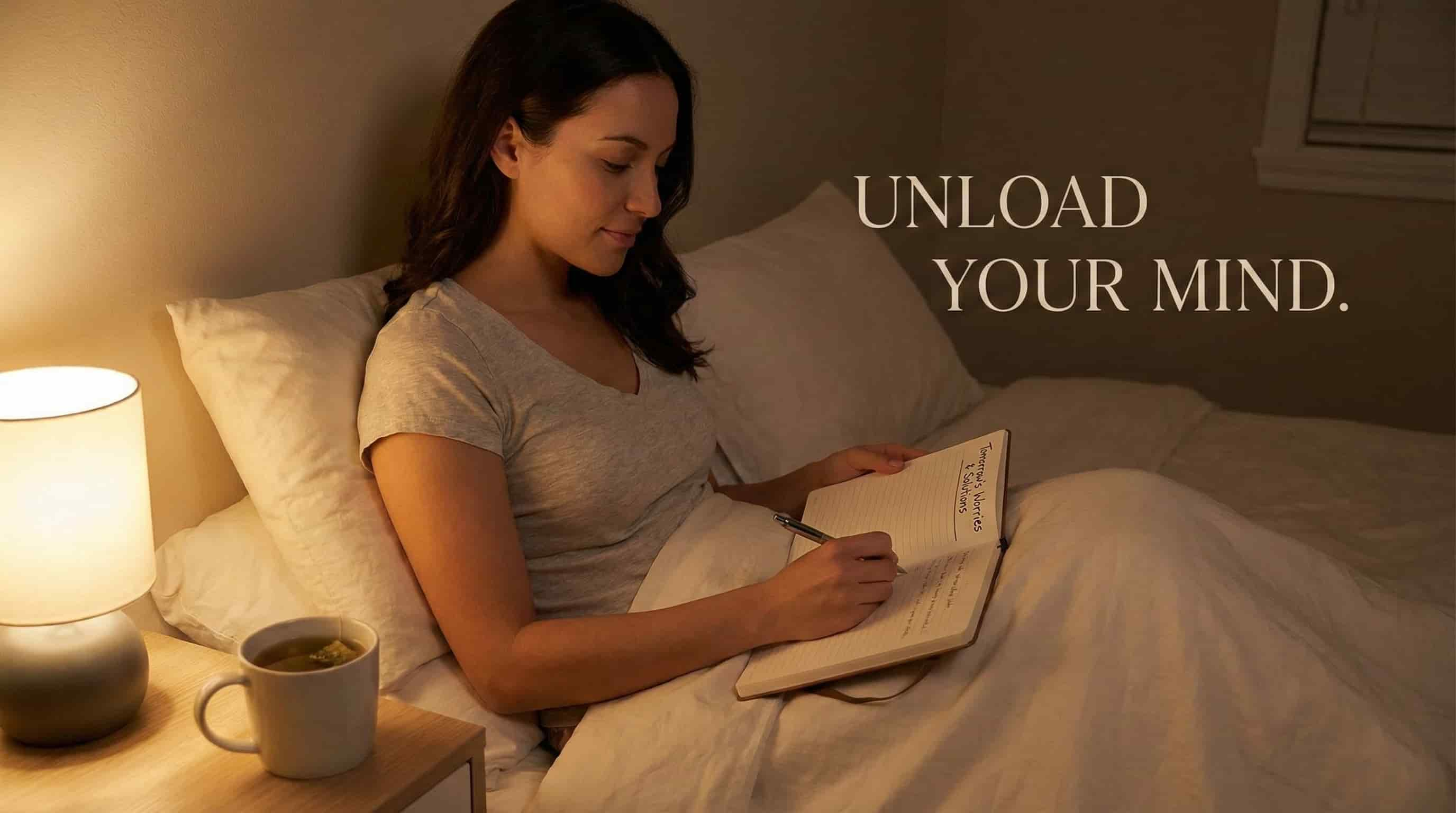
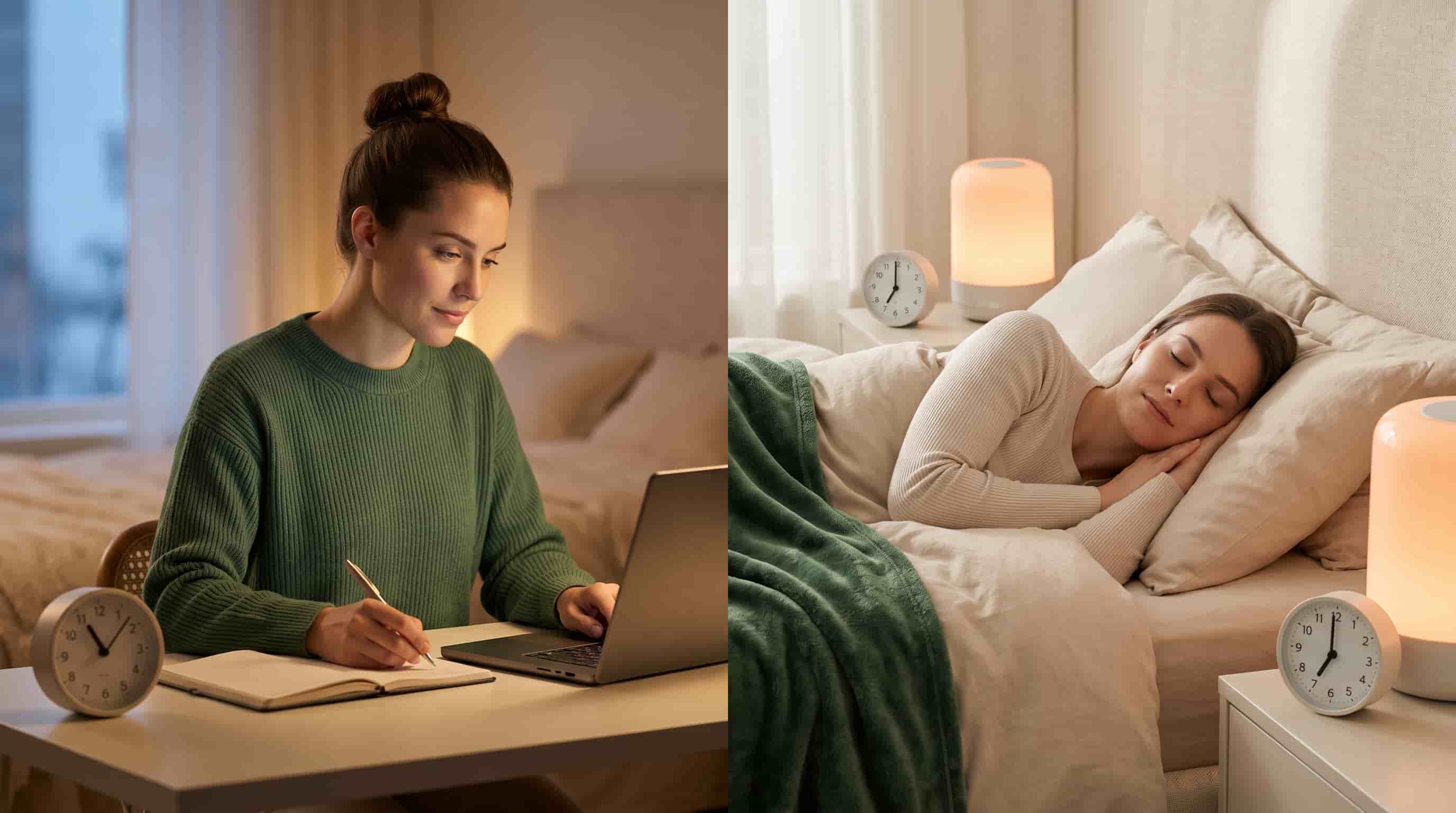
Person writing in a worry journal in evening light, transitioning to calm sleep state, practicing the worry time technique
Worry Time in practice: processing anxiety before bed so sleep can arrive unbidden

How to Build a Sustainable Evening Routine That Prevents the Anxiety Spiral

Direct Answer: The goal of the evening routine is to signal safety to the brain, reduce cognitive arousal, and ensure you enter the bedroom already drowsy — not exhausted from stress.

Mechanism: Stanley (2018) describes the pre-sleep routine as a chain of conditioned stimuli: the sequence of activities performed in the same order every night creates a progressive reduction in cortical arousal that becomes automatic. Each step in the routine signals the next step toward sleep. S4-4 of the whitepaper (sleep environment design) aligns with this: the bedroom should be a cave — cool, dark, quiet, and free of performance cues. The routine should begin 60–90 minutes before target bedtime, involve progressive reduction of cognitive demand, and terminate with entering a dark, cool, silent bedroom in a calm physiological state.

Actionable Advice: Design your routine tonight: 90 minutes before bedtime, dim all lights to near-darkness; put work devices away; do not discuss stressful topics; drink a small amount of warm液体 (not alcohol); do gentle stretching or breathing exercises; read physical pages; when you enter the bedroom it should feel like entering a cave. Do not enter the bedroom until you are genuinely ready to sleep, and do not stay in bed longer than your sleep window.

Frequently Asked Questions

What is the anxiety-insomnia loop and how does it work?

Direct Conclusion: It is a self-reinforcing positive feedback system: anxiety about sleep elevates cortisol, which prevents sleep onset; sleep deprivation then worsens next-day anxiety; and the heightened anxiety makes the following night even harder. The loop has no natural break point without intervention because each variable drives the others.

Why does trying harder to fall asleep make it worse?

Direct Conclusion: Because sleep is not under voluntary control — it is a biological state orchestrated by subcortical systems. The harder you try, the more your prefrontal cortex activates a goal-seeking mode (arousal), which is the opposite of what is needed. Sleep cannot be performed; it can only be allowed.

What is somniphobia (fear of sleep)?

Direct Conclusion: Somniphobia is a clinical fear of sleep or the bedroom, caused by classical conditioning: repeated failed sleep attempts have made the bedroom a conditioned threat stimulus. The amygdala responds to the bedroom the way it responds to a spider in arachnophobia — even when the person knows intellectually there is no threat.

How does the 15-minute rule help with anxiety-driven insomnia?

Direct Conclusion: It removes the bed as a threat cue before the anxiety fully activates, prevents frustration accumulation, and breaks the learned helplessness of failed sleep attempts. When you return to bed genuinely drowsy, the experience is more likely to end in sleep — gradually rebuilding the bed-sleep safety association.

What is scheduled worry time and does it really work?

Direct Conclusion: It is a cognitive defusion technique: designate 15 minutes earlier in the day for worry processing. Write down every worry. Attempt solutions on paper. At bedtime, remind yourself the worry has been scheduled. Research supports this as reducing pre-sleep cognitive arousal by giving the brain permission to process rather than suppress.

Does sleep deprivation from anxiety cause cognitive damage?

Direct Conclusion: Even one night of partial sleep deprivation measurably impairs prefrontal cortex function (reducing emotional regulation by 60%) and heightens amygdala reactivity. This is not weakness — it is measurable neurobiological change that explains why poor sleep makes next-day anxiety worse.

What is the difference between normal sleep anxiety and insomnia disorder?

Direct Conclusion: Normal sleep anxiety is temporary, tied to a specific stressor, and resolves when the stressor resolves. Clinical insomnia disorder persists ≥3 nights/week for ≥3 months AND causes significant daytime impairment. The key marker is functional impact, not just the sleep difficulty itself.

How does CBT-I break the anxiety-insomnia cycle?

Direct Conclusion: CBT-I simultaneously targets the cognitive component (catastrophic beliefs about sleep deprivation), the behavioral component (stimulus control and sleep restriction), and the physiological component (relaxation training). Removing the obstacles — not forcing sleep — is the mechanism. It has AASM Level 1 evidence and superior long-term outcomes vs medication.

Can anxiety medication help with insomnia, or does it just mask the problem?

Direct Conclusion: Anxiety medication can reduce the symptoms that drive the loop short-term, but does not address the conditioned fear response underlying the insomnia. It can also create dependence, and withdrawal can worsen rebound insomnia. CBT-I addresses the root conditioning and has lasting effects after treatment ends.

What is the single most important thing to remember about breaking the loop?

Direct Conclusion: Remove the performance demand from sleep. You cannot executive-function your way into a biological state. The goal is not to force sleep — it is to create the conditions in which sleep can happen. Every night you reduce the threat signal around bedtime, you weaken the loop.

Break the Loop Tonight

The anxiety-insomnia loop is not your fault. But it is your responsibility to fix. The science is clear on what works.

Take the Sleep Assessment Optimize Your Sleep Environment

The Slumbelry Commitment

Sleep is the most vulnerable state of human existence. It is where we heal, reset, and grow.

At Slumbelry, we do not just sell sleep products; we advocate for your physiological right to rest. From ergonomic support to light management, every solution we offer is designed with one obsession: Respecting your Biology.

Science is our language, but your recovery is our purpose. You take care of everything else in your life — let us take care of your nights.

Rest Deeply,
The Slumbelry Team
Why Less Time in Bed Means Better Sleep

sleep restriction therapy for insomnia: the complete guide

The Sleep Restriction Method: Why Sleeping Less Can Fix Your Insomnia

You have probably heard the advice: spend more time in bed, and you will sleep more.

It is wrong — and for the 10–15% of adults with chronic insomnia, it is actively harmful.

The more hours you spend in bed awake, the more your brain learns that the bed is a place of frustration, not rest. Every night of tossing and turning in bed deepens the same neural association. After months or years, going to bed feels like a threat signal, not a sleep cue.

Sleep restriction therapy for insomnia inverts this logic. By spending less time in bed, not more, you build the biological pressure that forces deep, efficient sleep — and within weeks, most people experience the consolidated, restorative sleep they have not had in months or years.

⚡ Core Takeaway: Use Sleep Pressure — Do Not Fight It

  • The Problem: Spending 9 hours in bed when you only sleep 6 trains your brain to be awake in bed — the bed becomes a cue for wakefulness
  • The Mechanism: Sleep restriction builds sleep pressure by limiting time in bed to actual sleep time; higher pressure = deeper, more efficient sleep
  • The Rule: Never go below 5 hours or above 9 hours time in bed during SRT; always pair with a fixed wake time and CBT-I stimulus control
Person in bed with abstract clock and time bars floating above, representing sleep restriction concept
Sleep restriction therapy: spend less time in bed, build more pressure, achieve deeper sleep

Why Does Spending More Time in Bed Often Make Insomnia Worse?

Direct Answer: Because lying awake in bed for long periods trains your brain to associate the bed with wakefulness — not sleep. Each night you spend tossing and turning in bed, you deepen the neural association between your mattress and the inability to sleep.

Mechanism: Walker (2017), Why We Sleep, documents conditioned or learned insomnia: the bed becomes a cue for arousal through repeated pairing with the experience of being awake. The more nights you spend in bed trying to sleep and failing, the stronger the association becomes. This is the opposite of classical conditioning in a harmful direction — the bed, which should trigger sleep onset, now triggers vigilance and frustration. The result: you do not just have insomnia. You have a trained reflex that keeps you awake specifically in your bedroom.

Actionable Advice: If you are spending more than 20–30 minutes awake in bed at any point, get out of bed and go to another room. Do not read, watch TV, or scroll your phone in bed — these all deepen the wakefulness association. Only return to bed when you are genuinely drowsy. This is stimulus control therapy — the first and most immediate behavioral intervention for insomnia.

What Is Sleep Restriction Therapy and Where Does This CBT-I Technique Come From?

Direct Answer: Sleep Restriction Therapy (SRT) is a core component of Cognitive Behavioral Therapy for Insomnia (CBT-I). It was developed in the 1980s by Arthur Spielman and colleagues and is now the first-line non-pharmacological treatment for chronic insomnia according to AASM clinical guidelines.

Mechanism: Stanley (2018), How to Sleep Well, documents the origin of SRT: the observation that insomniacs who restricted their time in bed paradoxically slept better, not worse. By limiting time in bed to approximately the same duration as actual sleep time, SRT increases sleep pressure (homeostatic sleep drive), reduces nocturnal awakenings, and improves sleep efficiency. Over time, as sleep becomes consolidated and the bed-sleep association is rebuilt, the sleep window is gradually expanded. The AASM classifies CBT-I (which includes SRT) as a Level 1 recommendation for chronic insomnia — higher evidence than any pharmacological intervention, and with durable effects that medication cannot match.

Actionable Advice: The starting point for SRT is calculating your actual sleep time: use a sleep diary for 7–14 days, or use your best estimate from a tracker. This number becomes your initial time in bed allowance. Do not go below 5 hours and do not go above 9 hours time in bed, regardless of how much you think you sleep.

Research Highlight: Dr. Neil Stanley, How to Sleep Well (2018) + AASM Clinical Guidelines for CBT-I — Spielman et al. (1987) original SRT model; CBT-I including SRT is classified as Level 1 evidence for chronic insomnia by the American Academy of Sleep Medicine.

How Does Sleep Restriction Actually Work: The Science of Sleep Pressure and Cortisol?

Direct Answer: SRT works by increasing homeostatic sleep pressure — the biological need for sleep that accumulates from the moment you wake up. The longer you stay awake, the more adenosine builds up in your brain, and the stronger your drive to sleep becomes.

Mechanism: Walker (2017) describes the two-process model of sleep regulation: Process S (homeostatic sleep drive, measured by adenosine levels) builds during wakefulness and is discharged during deep NREM sleep. Process C (circadian rhythm, governed by the suprachiasmatic nucleus) provides a secondary wake-promoting signal that counteracts sleep pressure during the day, then withdraws in the evening to allow sleep onset. SRT exploits the homeostatic component: by restricting time in bed, you allow adenosine to accumulate to higher levels than usual, creating a more powerful sleep pressure than the fragmented sleep of chronic insomnia. This results in faster sleep onset, fewer nighttime awakenings, and a higher proportion of deep N3 and REM sleep. Critically, it also prevents the evening cortisol spike that chronic insomniacs experience when they go to bed too early — their brains anticipate wakefulness in bed, triggering a cortisol release that directly opposes sleep onset.

Actionable Advice: The best time to go to bed is when you are so drowsy you could fall asleep in minutes — not when you decide it is “bedtime.” For most people, this means a later bedtime than they currently use. Pair this with a fixed wake time and your sleep pressure will build correctly within 3–5 days.

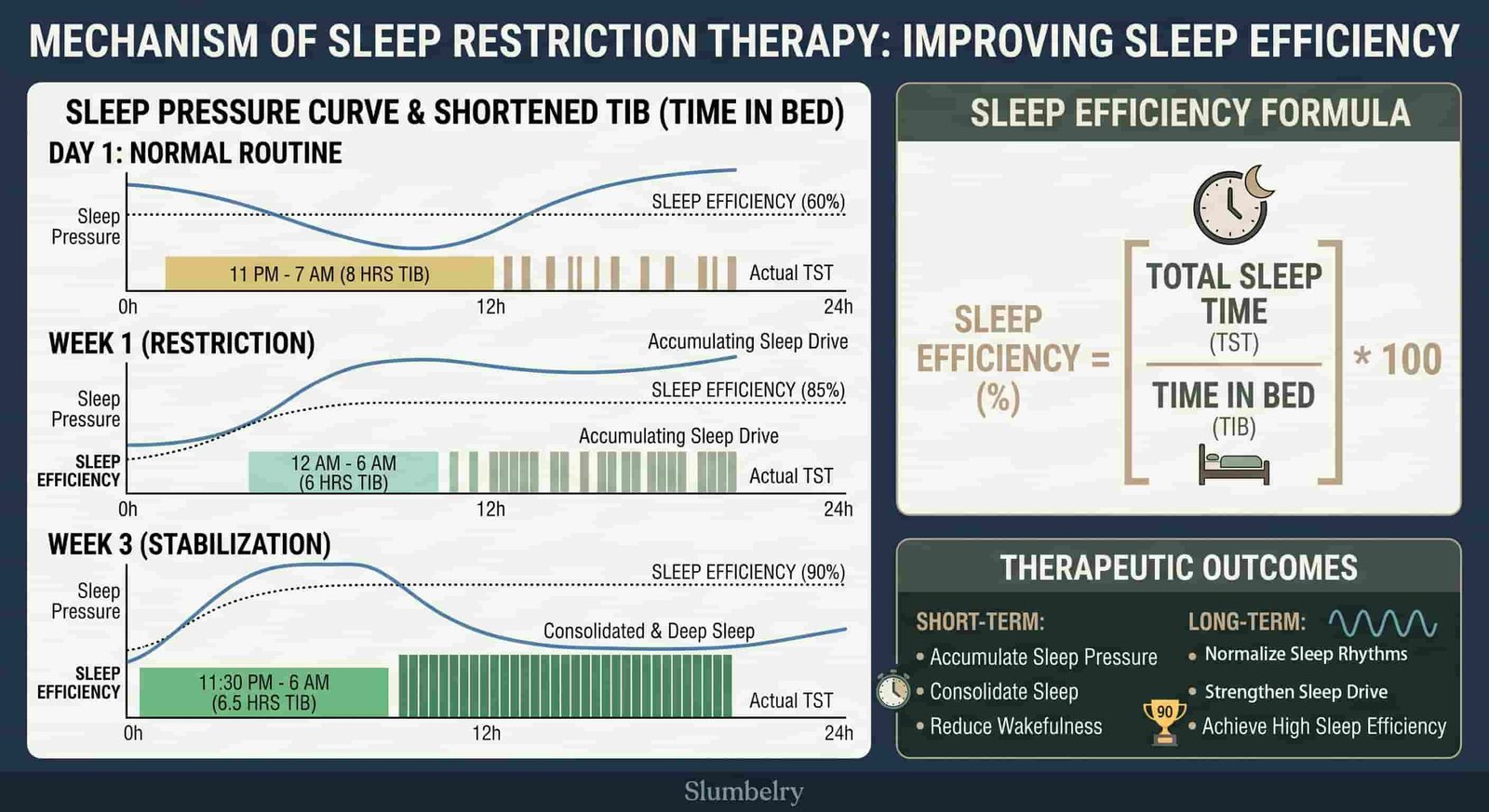
Scientific infographic showing sleep restriction therapy mechanism with sleep pressure curve and sleep efficiency formula
Sleep efficiency formula and the homeostatic sleep pressure mechanism driving SRT’s effectiveness

What Is the Sleep Efficiency Formula and Why Does It Determine Your Treatment?

Direct Answer: Sleep Efficiency = (Total Sleep Time / Time in Bed) x 100. It is the percentage of time in bed that you actually spend asleep. SRT adjusts your time in bed to bring this number above 85%.

Mechanism: AASM sleep assessment guidelines use 85% as the threshold for clinically healthy sleep efficiency. Below 85% indicates a sleep disorder or significant fragmentation issue. SRT uses this metric directly: you begin with time in bed approximately equal to your estimated total sleep time. Every 5–7 days, you review your sleep efficiency from your sleep diary. If it is above 85%, you can expand your time in bed by 15–30 minutes (moving your bedtime earlier, not your wake time later). If it is below 80%, you compress your time in bed by 15–30 minutes. This titration process continues until you reach a sustainable sleep schedule with efficiency above 85% and adequate total sleep duration (minimum 5.5 hours).

Actionable Advice: Start a sleep diary tonight: record the time you got into bed, the time you fell asleep, the time you woke up for good, and the time you got out of bed. From this, calculate your sleep efficiency. If it is below 85%, SRT is likely to help you.

How to Calculate Your Sleep Window: A Step-by-Step Guide to SRT

Direct Answer: Step 1: Calculate average actual sleep time over 7 days. Step 2: Set a fixed wake time you can maintain 7 days a week. Step 3: Set initial bedtime by counting back from wake time by your average sleep duration (minimum 5 hours, maximum 9 hours). Step 4: Maintain strict adherence for 2 weeks before adjusting.

Mechanism: Example: If your average sleep is 5.5 hours and your fixed wake time is 7:00 AM, your initial bedtime = 1:30 AM. You do not go to bed before 1:30 AM under any circumstances for the first 2 weeks. You wake up at 7:00 AM every day including weekends. After 2 weeks, if your sleep efficiency is above 85%, you move your bedtime 15–30 minutes earlier. If it is below 80%, you move your bedtime later (or reduce time in bed further). The AASM recommends minimum 2-week intervals between adjustments to allow the sleep system to stabilize.

Actionable Advice: Do not try to compensate for lost sleep by napping during SRT. Napping reduces homeostatic sleep pressure and directly undermines the mechanism. If you must nap (extreme fatigue, safety concerns), limit it to 20–30 minutes before 1 PM only.

Research Highlight: AASM CBT-I Clinical Practice Guidelines — Spielman 2-week stabilization rule for SRT titration; minimum 5-hour time in bed floor to prevent excessive sleep deprivation; no naps during the initial SRT stabilization phase.
Person in bedroom checking alarm clock and calculating sleep window with a sleep diary
Tracking your sleep efficiency: the essential daily practice that makes SRT work

What Happens in Your Brain When You Restrict Time in Bed?

Direct Answer: Your adenosine levels build to a higher peak than usual, creating a more powerful homeostatic sleep drive. This forces the brain into deeper, more efficient sleep — specifically increasing N3 (slow-wave deep sleep) and REM proportions.

Mechanism: Walker (2017) documents that N3 sleep is the stage most sensitive to sleep pressure: the more adenosine accumulated, the higher the proportion of N3 in the sleep period. SRT exploits this: by building high adenosine through a compressed time in bed window, the brain prioritizes the most restorative stages of sleep, reducing the lighter N2 proportion and the frequency of micro-awakenings. Additionally, the cortisol response that typically accompanies chronic insomniacs going to bed early is reduced — the brain no longer anticipates hours of struggle in bed, so the pre-sleep cortisol spike diminishes. After 3–4 weeks of SRT, neuroimaging studies show normalization of prefrontal cortex activity during sleep — the hyperarousal pattern characteristic of chronic insomnia resolves as sleep efficiency improves.

Actionable Advice: Expect the first 3–5 nights of SRT to feel difficult. You may feel more tired than usual. This is normal — it is the sleep deprivation phase working as intended. The improvement typically comes in week 2 as sleep consolidates and deepens. Track your symptoms, not just your sleep, to stay motivated.

Why Is the Fixed Wake Time the Most Important Part of Sleep Restriction?

Direct Answer: Because it anchors your circadian rhythm and sets the starting point for calculating your entire sleep window. Without a consistent wake time, you cannot calculate a meaningful bedtime, and your circadian clock cannot stabilize.

Mechanism: Walker (2017) describes the suprachiasmatic nucleus (SCN) as your body’s master clock, most strongly reset by light exposure in the morning. A fixed wake time — even on weekends — provides a consistent daily anchor for the circadian rhythm. When you change your wake time, you shift your entire circadian timing, fragmenting the subsequent night’s sleep. Research shows that wake time consistency is the single most powerful circadian stabilizer: it is more impactful than bedtime consistency for people with insomnia. SRT leverages this by locking the wake time first and deriving the bedtime from it, rather than the reverse. The goal is to build a reliable sleep pressure curve that peaks at the same time every evening.

Actionable Advice: Set your wake time first, ideally at or shortly after your usual natural wake time (between 6–8 AM for most adults). Keep this exact — same minute, 7 days a week. Use bright light (open blinds, outdoor exposure, or a 10,000 lux light box) within 30 minutes of waking to reinforce the circadian anchor.

Research Highlight: Matthew Walker, Why We Sleep (2017) — the suprachiasmatic nucleus and morning light as the primary circadian anchor; research by Eastman et al. on fixed wake time as the most effective circadian stabilizer in shift work and insomnia populations.

How to Progressively Expand Your Sleep Window Without Relapsing

Direct Answer: Only expand your time in bed when your sleep efficiency has been above 85% for at least 5–7 consecutive nights. When you do expand, move your bedtime earlier by 15–30 minutes (never move your wake time later).

Mechanism: The goal of progressive expansion is to find the minimum effective time in bed that produces optimal sleep quality, then gradually restore the additional time if it does not compromise efficiency. AASM guidelines recommend: when TST increases enough that efficiency drops below 80%, compress time in bed again. Expansion is done only in the evening direction (earlier bedtime) because moving the wake time later risks destabilizing the circadian anchor. The expansion phase typically takes 4–8 weeks for mild to moderate insomnia; more severe cases may require 12–16 weeks. The key principle: efficiency above 85% must be maintained before each expansion. If efficiency drops after expansion, revert immediately to the previous time in bed window.

Actionable Advice: Patience is the most important skill in the expansion phase. The temptation to expand based on how well you feel (not on the data) is the most common reason for relapse. Trust the sleep diary data, not your subjective feeling of being recovered. Once you are consistently above 85% efficiency with an acceptable total sleep time, you have found your maintenance window.

What Are the Main Contraindications and Who Should Not Try Sleep Restriction?

Direct Answer: Sleep restriction is contraindicated in: bipolar disorder (risk of mania trigger), epilepsy (sleep deprivation lowers seizure threshold), severe depression with suicidal ideation, untreated sleep apnea (SRT increases sleepiness and could worsen apneas), and shift workers with highly variable schedules. Use with caution in older adults (over 65) and those with significant medical conditions.

Mechanism: Stanley (2018), How to Sleep Well, and AASM Clinical Guidelines specify contraindications for SRT. The primary concern is that deliberate sleep deprivation in vulnerable populations can precipitate serious adverse events: in bipolar disorder, sleep loss is a well-documented trigger for manic episodes; in epilepsy, sleep deprivation lowers the seizure threshold and is a known seizure trigger. For depression, SRT can initially worsen symptoms (though paradoxically may help in specific protocols under clinical supervision). In all of these cases, a sleep physician should be involved before initiating SRT. For uncomplicated chronic insomnia without comorbid conditions, SRT is safe and highly effective when the 5-hour minimum time in bed floor is maintained.

Actionable Advice: Before starting SRT, screen yourself using the STOP-BANG questionnaire for sleep apnea. If you score 3 or above, or if you have a history of mood disorders, epilepsy, or regular nightmares, consult a sleep physician before beginning. The risk of SRT is minimal for healthy adults with uncomplicated chronic insomnia.

Research Highlight: Dr. Neil Stanley, How to Sleep Well (2018) + AASM Clinical Guidelines for CBT-I — contraindication list for sleep restriction therapy; Spielman model safety guidelines specifying 5-hour minimum time in bed.

How Does Sleep Restriction Compare to Sleep Hygiene Therapy Alone?

Direct Answer: Sleep hygiene alone is mildly effective. SRT combined with stimulus control (CBT-I) is the gold standard. The difference in outcomes is substantial — sleep hygiene alone rarely cures chronic insomnia, while CBT-I including SRT achieves remission rates of 50–70% in clinical trials.

Mechanism: Comparative studies consistently show that sleep hygiene education as a standalone intervention produces small to moderate improvements in insomnia severity (effect size approximately 0.3–0.5), while CBT-I (which includes sleep restriction and stimulus control) produces large improvements with durable results (effect size approximately 0.8–1.2). The reason is structural: sleep hygiene addresses the environmental conditions of sleep but not the conditioned association between bed and wakefulness. SRT and stimulus control directly target this conditioned association, breaking the reinforcing cycle of insomnia. Importantly, CBT-I effects are sustained long after treatment ends, while pharmacological effects dissipate when medication is discontinued. Stanley (2018) notes that the AASM now recommends CBT-I as the first-line treatment for chronic insomnia, ahead of medication, specifically because of its superior efficacy and durability.

Actionable Advice: If you have tried sleep hygiene changes (temperature, screens, alcohol, exercise) without significant improvement, you are not a sleep hygiene failure — you have a conditioned insomnia problem that requires CBT-I including SRT. This is the clinical distinction that changes the treatment approach.

Research Highlight: Dr. Neil Stanley, How to Sleep Well (2018) + AASM CBT-I Clinical Practice Guidelines — comparative outcomes: sleep hygiene alone vs CBT-I; CBT-I remission rates 50–70% vs medication symptom relief that dissipates on discontinuation.

Frequently Asked Questions

What is sleep restriction therapy and how does it work?

Direct Conclusion: Sleep restriction therapy (SRT) is a core component of Cognitive Behavioral Therapy for Insomnia (CBT-I). It works by limiting the amount of time you spend in bed to approximately the amount of time you actually sleep, which increases homeostatic sleep pressure and forces the brain into deeper, more consolidated sleep. As sleep efficiency improves, the time in bed is gradually expanded. SRT is the single most effective non-pharmacological intervention for chronic insomnia.

Why does spending more time in bed make insomnia worse?

Direct Conclusion: Because it creates conditioned or learned insomnia. When you spend 8–9 hours in bed but only sleep 5–6 hours, your brain learns to associate the bed with being awake — not with sleeping. Every night you toss and turn in bed, you deepen this neural association. The solution is not to spend more time in bed but to reduce time in bed until sleep becomes consolidated and efficient, then gradually restore it.

How do I calculate my sleep window for sleep restriction therapy?

Direct Conclusion: Step 1: Track your actual sleep time for 7–14 days (use a sleep diary or tracker). Step 2: Set a fixed wake time you can maintain 7 days a week. Step 3: Count backward from your wake time by your average sleep duration — this is your initial bedtime. Example: 6 hours average sleep + 7:00 AM wake time = 1:00 AM initial bedtime. Never go below 5 hours or above 9 hours time in bed.

What is the minimum and maximum time in bed during sleep restriction?

Direct Conclusion: AASM guidelines specify a minimum of 5 hours time in bed (to prevent excessive sleep deprivation and adverse effects on mood, cognition, and immune function) and a maximum of 9 hours (beyond which most adults do not need to sleep even in recovery from sleep debt). These boundaries exist for safety and efficacy: going below 5 hours risks worsening hyperarousal; going above 9 hours usually reflects sleep that the body does not need.

How long does it take for sleep restriction therapy to work?

Direct Conclusion: Sleep consolidation typically improves within 5–10 days as homeostatic sleep pressure builds. Significant clinical improvement in insomnia severity scores is usually seen within 3–4 weeks. Full protocol completion (including progressive expansion) takes 6–16 weeks depending on severity. The key is maintaining strict adherence to the scheduled bedtime and wake time during the initial 2-week stabilization period.

Why is the fixed wake time more important than the bedtime in SRT?

Direct Conclusion: Because the wake time anchors your entire circadian rhythm. Your suprachiasmatic nucleus (body clock) is most strongly reset by light exposure in the morning. A consistent wake time creates a reliable circadian signal that makes falling asleep at your designated bedtime easier. If you have a different wake time each day, your circadian rhythm destabilizes, fragmenting sleep regardless of when you go to bed. The wake time is the anchor; the bedtime is derived from it.

Can sleep restriction therapy be dangerous or cause sleep deprivation?

Direct Conclusion: In healthy adults with uncomplicated insomnia, SRT is safe when the 5-hour minimum time in bed is maintained. The temporary sleep deprivation in the first few days is intentional and part of the mechanism. However, it is contraindicated in bipolar disorder (risk of triggering mania), epilepsy (sleep deprivation lowers seizure threshold), and severe depression. Consult a sleep physician if you have these conditions before starting SRT.

What happens in the brain during sleep restriction therapy?

Direct Conclusion: Adenosine levels build to higher peaks than usual, increasing homeostatic sleep pressure and the proportion of deep N3 slow-wave sleep and REM. The pre-sleep cortisol spike that characterizes chronic insomnia diminishes as the brain no longer anticipates prolonged wakefulness in bed. Neuroimaging studies show normalization of prefrontal cortex hyperarousal patterns after 3–4 weeks of SRT.

Can I use sleep restriction therapy if I have depression or anxiety?

Direct Conclusion: With caution and ideally under clinical supervision. SRT can initially increase fatigue and mood symptoms in depression (because of the intentional sleep deprivation phase). However, if insomnia and depression are comorbid, resolving insomnia with CBT-I often improves depression scores. For anxiety alone, SRT is generally well-tolerated and often reduces anxiety about sleep specifically. If you have a diagnosed mood disorder, discuss SRT with your physician or a sleep specialist before beginning.

When should sleep restriction therapy be stopped or modified?

Direct Conclusion: Stop or modify SRT if: you develop symptoms of mania (euphoria, racing thoughts, reduced need for sleep in bipolar), your depression worsens significantly, you experience seizures (in epilepsy patients), or you develop extreme daytime sleepiness that impairs safety (driving, operating machinery). If your sleep efficiency drops below 75% after initial improvements, compress your time in bed by 15–30 minutes. If it remains below 70% after compression, consult a sleep specialist before continuing.

Ready to Reclaim Your Sleep?

If chronic insomnia has been stealing your rest, take action today with science-backed strategies designed to rebuild your sleep architecture — starting tonight.

Take the Sleep Assessment Explore Our Sleep Optimization Collection

The Slumbelry Commitment

Sleep is the most vulnerable state of human existence. It is where we heal, reset, and grow.

At Slumbelry, we do not just sell sleep products; we advocate for your physiological right to rest. From ergonomic support to light management, every solution we offer is designed with one obsession: Respecting your Biology.

Science is our language, but your recovery is our purpose. You take care of everything else in your life — let us take care of your nights.

Rest Deeply,
The Slumbelry Team
Creating a Safe Space When Sleep Feels Dangerous

why your brain won’t let you sleep after trauma: the safety paradox

Why Your Brain Won’t Let You Sleep After Trauma: The Safety Paradox Explained

There is a moment, familiar to trauma survivors, when lying in bed does not feel like preparing for rest. It feels like preparing for something else entirely.

Sleep requires vulnerability. The body releases its guard. The mind reduces its monitoring. For most people, this transition is automatic. For trauma survivors, it feels like handing over your defenses to a world that has already proven itself dangerous once.

The question this article asks is not “why can’t you sleep?” It is why does your brain believe sleep is unsafe? And more importantly: what can you do about it?

This is why your brain won’t let you sleep after trauma — a guide to understanding and rebuilding the neurological conditions under which your nervous system considers sleep safe.

⚡ Core Takeaway: Safety First — Sleep Follows

  • The Problem: Trauma makes the brain equate vulnerability with danger; sleep requires the opposite state
  • The Signal: Rebuilding safety signals (physical, environmental, ritual) gradually recalibrates the amygdala’s threat threshold
  • The Protocol: The Sanctuary Protocol creates a multi-layered safety architecture — physical security, sensory anchoring, and ritual confirmation
Person in a calm safe bedroom transitioning from anxious to peaceful, warm amber lighting, feeling safe
Sleep requires safety — and for trauma survivors, safety must be deliberately rebuilt

Why Does Trauma Make It So Hard to Fall Asleep at Night?

Direct Answer: Trauma rewires the brain’s threat detection system. After trauma, the brain’s danger-identification circuits become permanently calibrated toward survival — and sleep is the most physiologically vulnerable state of human existence. For trauma survivors, letting go of consciousness is not restful; it feels like lowering your defenses.

Mechanism: van der Kolk (2014), The Body Keeps the Score, documents how trauma reorganizes the nervous system around a persistent threat posture. Walker (2017), Why We Sleep, describes the amygdala as the brain’s threat sentinel — always watching for danger, especially during the vulnerable hours of sleep. After trauma, the amygdala becomes hypervigilant: its threshold for detecting danger drops, meaning neutral stimuli get misread as threats. Sleep onset — the moment when the prefrontal cortex reduces monitoring and the body enters atonia — feels like the moment when you are most exposed to danger. The brain resists it accordingly. This is not a psychological response. It is a neurobiological adaptation: the brain has decided, at a survival level, that sleep is unsafe.

Actionable Advice: Understanding that this response is neurological — not a character flaw or a sign of weakness — is the first step. The next step is building a safety architecture around the sleep period so that the brain’s threat calculation shifts. You are not fighting your trauma. You are rebuilding the neurological conditions under which your nervous system considers sleep safe.

Research Highlight: Bessel van der Kolk, The Body Keeps the Score (2014) + Matthew Walker, Why We Sleep (2017) — trauma reorganizes the nervous system around persistent threat posture; the hypervigilant amygdala interprets sleep onset as vulnerability rather than safety.

What Happens in Your Brain When Sleep Feels Like a Threat?

Direct Answer: The hypothalamic-pituitary-adrenal (HPA) axis — the body’s stress response system — stays activated at bedtime. Instead of cortisol dropping to its lowest point of the day (as it should before sleep), it remains elevated. The body is physiologically prepared for danger while lying in bed.

Mechanism: Walker (2017) documents the normal cortisol rhythm: cortisol peaks in the early morning (waking) and reaches its daily minimum in the late evening, facilitating sleep onset. For trauma survivors, this rhythm is disrupted. The HPA axis, having been chronically activated during the traumatic event and its aftermath, remains in a state of elevated baseline activation. Cortisol does not fall sufficiently at night, preventing the parasympathetic state required for sleep. Simultaneously, the amygdala — the brain’s threat detector — stays active, monitoring the bedroom environment for danger signals. The result: a nervous system that is simultaneously exhausted and too alert to sleep. The body is ready for fight-or-flight at the exact moment it should be transitioning to rest.

Actionable Advice: The goal is not to “relax harder” — it is to reduce the HPA axis activation that is keeping cortisol elevated at night. Grounding techniques, breathwork, and the Sanctuary Protocol (see H2-6) all work by activating the parasympathetic nervous system and signaling safety to the amygdala.

Research Highlight: Matthew Walker, Why We Sleep (2017) — documents the normal cortisol circadian rhythm (peak morning, minimum evening) and how trauma disrupts this pattern, keeping the HPA axis activated at bedtime.
Scientific diagram showing amygdala hyperactivation and sleep regulation in trauma survivors, HPA axis and cortisol response
The neuroscience of trauma and sleep: why the amygdala stays active when it should be deactivating at bedtime

Why Does Hypervigilance Peak at Night When There Are Fewer Distractions?

Direct Answer: During the day, the brain has external stimuli competing for its attention. At night, in the dark, in the quiet — there is nothing to compete with the internal threat-monitoring system. The hypervigilance becomes the loudest signal in the room.

Mechanism: Stanley (2018), How to Sleep Well, describes how hypervigilance is amplified by the absence of competing sensory input. During the day, visual, auditory, and social stimulation provides a constant stream of data confirming that the environment is safe. At night, these confirmation signals disappear. The bedroom — quiet, dark, often isolated — gives the trauma-trained brain nothing to counter its threat assessment. The nervous system fills the silence with the only signal it has been trained to broadcast: danger. This is why trauma survivors often report that the nighttime hours are the most difficult — not because the threat is greater, but because the evidence for safety is absent.

Actionable Advice: Reintroduce safety signals into the nighttime environment: a warm amber nightlight (not darkness), a consistent pre-sleep routine that ends with a safety affirmation, and a comfortable physical environment that the brain learns to associate with safety rather than danger.

What Is the Difference Between Normal Sleep Anxiety and Trauma-Driven Sleep Fear?

Direct Answer: Normal sleep anxiety is about worrying whether you will fall asleep or how you will perform the next day. Trauma-driven sleep fear is about surviving the night — your nervous system genuinely believes that sleep will make you vulnerable to harm.

Mechanism: Walker (2017) distinguishes between acute stress responses (a normal, time-limited reaction to a specific stressor) and post-traumatic stress responses (a persistent rewiring of the threat-response system). Normal sleep anxiety responds to sleep hygiene improvements, relaxation techniques, and education about sleep processes. Trauma-driven sleep fear does not respond to these alone — it requires rebuilding the neurological conditions under which the brain considers sleep safe. The key distinguishing feature: trauma-driven sleep fear typically involves flashbacks, nightmares, or intense body-based distress at sleep onset — not just worry about performance.

Actionable Advice: Self-assessment: Do you experience intrusive images, body sensations, or memories at bedtime — or is your difficulty primarily about not being able to “switch off”? The former suggests trauma-driven fear requiring a more comprehensive approach. The latter may respond to general sleep improvement techniques. If you are unsure, consult a trauma-informed therapist.

How Does REM Sleep Trigger Nightmares and Flashbacks for Trauma Survivors?

Direct Answer: During REM sleep, the brain is in an active processing state — processing emotional memories through the hippocampus and amygdala. For trauma survivors, this processing can reactivate the original trauma, producing nightmares or embodied flashbacks that feel as real as the original event.

Mechanism: Walker (2017) documents that REM sleep is the brain’s primary period for emotional memory processing — the hippocampus replays and sorts the day’s experiences, and the amygdala tags emotionally significant memories. In PTSD, the amygdala’s tagging threshold is permanently lowered, meaning ordinary memories get stored with trauma-level emotional intensity. During REM sleep, when these memories are processed, the associated fear response is reactivated — producing nightmares or somatic flashbacks. The physical body, in full REM atonia, cannot act out the fear physically (which is what differentiates nightmares from REM Behavior Disorder), but the subjective experience can be indistinguishable from the original trauma. This is why many trauma survivors avoid sleep — not because they do not want to rest, but because they are trying to avoid reliving their trauma.

Actionable Advice: For trauma-related nightmares, image rehearsal therapy (IRT) — where you consciously rewrite the nightmare script while awake — has strong evidence. Prazosin (prescription) is the pharmacological gold standard for trauma nightmares. Both work alongside, not instead of, the Sanctuary Protocol.

Research Highlight: Matthew Walker, Why We Sleep (2017) — documents REM sleep as the brain’s emotional memory processing period, and how trauma lowers the amygdala’s tagging threshold, causing trauma-tagged memories to be reprocessed during REM with full emotional intensity.

What Is the Sanctuary Protocol and How Does It Rebuild Sleep Safety?

Direct Answer: The Sanctuary Protocol is a multi-layered safety architecture specifically designed for trauma survivors. It works by systematically replacing the bedroom’s threat associations with safety signals — physical, environmental, and ritual-based.

Mechanism: Littlehales (2016), Sleep, describes how the brain forms conditioned associations between environments and states of alertness. For trauma survivors, the bedroom may have become a threat environment — a place where the trauma occurred, or a place where hypervigilance was chronically activated. The Sanctuary Protocol rebuilds this association through: (1) Physical security — locks, cameras, a phone within reach, establishing control over the environment. (2) Sensory anchoring — a specific scent, texture, or sound associated with safety, creating a consistent sensory entry point to rest. (3) Ritual confirmation — a pre-sleep routine that ends with an explicit safety affirmation, verbally confirming to the nervous system that the space is safe. Over time, these layered signals accumulate to recalibrate the amygdala’s threat assessment of the bedroom.

Actionable Advice: Build your Sanctuary Protocol today: Lock all doors and windows before your pre-sleep routine begins. Choose one grounding object (a weighted blanket, a specific pillow, a piece of clothing) and keep it in bed with you every night. Add a warm amber light — dim enough not to disrupt melatonin, bright enough to confirm where you are when you wake. End your routine with: “I am safe. I am in my room. The danger is in the past.”

Why Do Grounding Techniques Work for Nighttime Trauma Responses?

Direct Answer: Grounding techniques work by redirecting the brain’s attention from the traumatic memory or anticipatory threat to the present physical moment — interrupting the threat loop before it escalates into a full trauma response.

Mechanism: van der Kolk (2014) describes how trauma lives partially in body memory — the physical sensations that the body learned during the traumatic event, which get reactivated whenever the brain perceives a partial match to the original context. Grounding techniques — the 5-4-3-2-1 method (name 5 things you see, 4 you hear, 3 you can touch, 2 you smell, 1 you taste), bilateral stimulation, or body-scan meditation — work by activating the prefrontal cortex and interrupting the amygdala’s threat cascade. By redirecting attention to present-moment sensory reality, grounding gives the nervous system concrete, undeniable evidence that the threat is not present. The technique is not about relaxation — it is about survival. The goal is to interrupt the trauma response before it peaks, giving the rational brain a chance to assess the situation accurately.

Actionable Advice: Practice the 5-4-3-2-1 grounding method now so it is available to you at 3 AM: Name 5 things you can see, 4 you can hear, 3 you can physically feel, 2 you can smell, and 1 you can taste. The more specific and physical your answers, the more effective the technique. The goal is to flood your prefrontal cortex with present-moment sensory data, short-circuiting the amygdala’s threat assessment.

Research Highlight: Bessel van der Kolk, The Body Keeps the Score (2014) — documents grounding as a prefrontal cortex activation technique that interrupts the amygdala’s threat cascade by redirecting attention to present-moment sensory reality, physically interrupting the trauma response cycle.

How Does Sleep Deprivation From Trauma Create a Vicious Cycle With PTSD?

Direct Answer: Sleep deprivation worsens PTSD symptoms. PTSD worsens sleep deprivation. Each feeds the other, creating a self-reinforcing downward spiral that gets progressively harder to break without intervention.

Mechanism: Walker (2017) documents that sleep deprivation increases amygdala reactivity by up to 60% — meaning a sleep-deprived brain responds to neutral stimuli as if they were threats with significantly higher intensity. For trauma survivors, this means nightmares, hypervigilance, and trauma responses are all amplified by the sleep deprivation they themselves produced. Simultaneously, Littlehales (2016) describes how chronic sleep deprivation impairs the prefrontal cortex’s ability to regulate the amygdala — meaning the part of the brain that can say “this is not dangerous” is itself weakened. The result: a trauma survivor who cannot sleep becomes progressively worse at regulating their trauma responses, which keeps them awake longer, which worsens their regulation capacity, and so on. Breaking this cycle requires interrupting the loop at any point — ideally through improving sleep quality, not just sleep quantity.

Actionable Advice: Focus on sleep efficiency — the percentage of time in bed actually spent asleep — rather than total hours. A shorter, higher-quality sleep window is more restorative and less likely to produce frustrating awakenings. The Sleep Window Protocol (sleep only when genuinely sleepy, get out of bed after 15 minutes of wakefulness, return when sleepy again) prevents the bed from becoming a threat environment.

When Should Trauma-Related Sleep Issues Be Treated by a Professional?

Direct Answer: When nightmares are frequent and severe, when flashbacks occur at bedtime, when you have thoughts of harming yourself or others at night, or when self-help strategies have not produced improvement after 4–6 weeks.

Mechanism: AASM Clinical Guidelines and PTSD treatment protocols identify several clinical thresholds: frequent severe nightmares (more than 2–3 per week that significantly impair functioning), recurrent daytime flashbacks or intrusive trauma memories, active suicidal ideation connected to bedtime, and co-occurring substance use. These indicators suggest that the trauma-related sleep issue has crossed from a sleep problem into a PTSD symptom complex requiring clinical treatment. Evidence-based treatments include: Trauma-Focused CBT (TF-CBT), Prolonged Exposure therapy (PE), EMDR (Eye Movement Desensitization and Reprocessing), and prazosin for nightmares (prescribed by a psychiatrist).

Actionable Advice: If you experience frequent nightmares that feel like real flashbacks, persistent thoughts of self-harm at bedtime, or flashbacks triggered by the bedroom environment, please reach out to a trauma-informed therapist. The Sanctuary Protocol and grounding techniques are powerful complements to professional treatment — but they are not substitutes for clinical care when trauma responses are this active.

How to Build a Sustainable Sleep Safety Routine After Trauma (Step-by-Step)

Direct Answer: A sustainable routine has three components: a consistent physical environment, a consistent temporal window, and a consistent safety ritual. The goal is to make safety a habit, not an effort.

Mechanism: Littlehales (2016) and Stanley (2018) both document that the nervous system learns through repetition. A consistent sleep environment — same room, same temperature, same lighting, same bedding — teaches the nervous system that this context is safe for sleep. A consistent temporal window — going to bed and waking up at the same time every day, including weekends — stabilizes the circadian rhythm and reduces the nightly uncertainty about when sleep will come. A consistent safety ritual — a sequence of actions that ends with a verbal safety affirmation — provides a deliberate, conscious signal of safety to complete the neurological reconsolidation. Each repetition of the routine reinforces the previous one. Over time — typically 6–8 weeks of consistent practice — the bedroom becomes neurologically associated with safety rather than danger, and sleep becomes possible without conscious effort.

Actionable Advice: Start with one element only: the safety affirmation. Every night, before you get into bed, say out loud: “I am safe. I am in my room. The danger is in the past.” Say it even if you do not believe it yet. The repetition is the mechanism. Once that is habitual, add the physical security check (locks, phone, comfort object). Then add the temporal consistency (same bedtime, same wake time). Do not try to do everything at once.

Research Highlight: Craig Littlehales, Sleep (2016) + Dr. Neil Stanley, How to Sleep Well (2018) — sleep environment conditioning and temporal consistency as the foundation for rebuilding safety associations with sleep: repetition of safety signals recalibrates the amygdala’s threat assessment of the bedroom over 6–8 weeks.
Person in bedroom practicing grounding technique before sleep, holding a comforting object, dim amber nightlight
The Sanctuary Protocol: building a layered safety architecture for trauma survivors at bedtime

Frequently Asked Questions

Why does trauma make it so hard to fall asleep?

Direct Conclusion: Trauma rewires the brain’s threat detection system. After trauma, the amygdala — the brain’s danger sentinel — stays hypervigilant at bedtime. Sleep requires vulnerability, and vulnerability feels dangerous to a trauma-trained nervous system. This is not a psychological response; it is a neurobiological adaptation. The brain has decided, at a survival level, that sleep is unsafe.

What is hypervigilance and why does it get worse at night?

Direct Conclusion: Hypervigilance is a state of persistently elevated threat monitoring. It gets worse at night because the brain has fewer external stimuli competing for attention, and the quiet, dark bedroom gives hypervigilance nothing to counter it. During the day, normal environmental feedback signals safety. At night, those signals disappear, and the trauma-trained brain fills the silence with threat-assessment. This is why trauma survivors often describe the nighttime hours as the most difficult.

Is my sleep issue PTSD or just regular insomnia?

Direct Conclusion: The key distinguishing feature: PTSD-related sleep issues typically involve nightmares, flashbacks, or body-based distress at bedtime or during the night — not just difficulty falling asleep. Regular insomnia is primarily about quantity and quality of sleep. Trauma-related sleep issues are about survival. If you experience intrusive images, body sensations, or memories at bedtime, or wake up from sleep in a panicked state, your issue likely goes beyond standard insomnia. A trauma-informed clinician can help you determine the answer.

How do nightmares and REM sleep relate to trauma?

Direct Conclusion: During REM sleep, the brain processes emotional memories through the hippocampus and amygdala. In PTSD, the amygdala’s tagging threshold is permanently lowered, meaning ordinary memories get stored with trauma-level emotional intensity. When these memories are processed during REM, the full fear response is reactivated — producing nightmares or somatic flashbacks. This is why trauma survivors often avoid sleep: not because they do not want to rest, but because they are trying to avoid reliving their trauma.

What is the Sanctuary Protocol for trauma and sleep?

Direct Conclusion: The Sanctuary Protocol is a multi-layered safety architecture for trauma survivors: (1) Physical security — locks, phone within reach, establishing control. (2) Sensory anchoring — a specific grounding object (weighted blanket, specific pillow), providing a consistent safety signal. (3) Warm amber nightlight — confirming your location when you wake, countering the disorientation of hypervigilance. (4) Safety affirmation — a spoken statement confirming safety at the end of the pre-sleep routine. Over 6–8 weeks, these signals rebuild the amygdala’s threat assessment of the bedroom.

Can grounding techniques really help with nighttime trauma responses?

Direct Conclusion: Yes — but only when practiced correctly. Grounding works by activating the prefrontal cortex with present-moment sensory data, interrupting the amygdala’s threat cascade before it peaks. The key is specificity: name 5 things you see that are specific and physical (“my blue pillow,” not just “things”), 4 sounds, 3 physical sensations, 2 smells, 1 taste. Vague grounding (“I notice I feel stressed”) activates anxiety. Specific sensory grounding (“my weighted blanket weighs exactly 12 pounds”) activates the present-moment, short-circuiting the threat loop.

Why does sleep deprivation from trauma make PTSD worse?

Direct Conclusion: Sleep deprivation increases amygdala reactivity by up to 60%. A sleep-deprived brain responds to neutral stimuli with significantly higher fear intensity. Simultaneously, sleep deprivation weakens the prefrontal cortex’s ability to regulate the amygdala — the part of the brain that can say ‘this is not dangerous’ is itself impaired. For trauma survivors, this means nightmares and hypervigilance are amplified by the sleep deprivation they produced, which deepens PTSD symptoms, which worsens sleep. Breaking this cycle requires improving sleep quality, not just duration.

How do I know if I need professional help for trauma-related sleep issues?

Direct Conclusion: Seek professional help if: nightmares are frequent and severe (more than 2–3 per week impairing functioning), flashbacks occur at bedtime, you have thoughts of self-harm at night, grounding and the Sanctuary Protocol have not improved symptoms after 6–8 weeks, or you are using alcohol or substances to get to sleep. Evidence-based treatments include Trauma-Focused CBT, EMDR, Prolonged Exposure therapy, and prazosin for nightmares (prescribed). The Sanctuary Protocol complements professional treatment — it is not a substitute for clinical care.

Can sleep medication help trauma survivors?

Direct Conclusion: Sleep medication can provide short-term relief for acute insomnia, but it does not address the underlying trauma response that is keeping you awake. For trauma-related sleep issues, addressing the trauma response itself — through therapy, the Sanctuary Protocol, and grounding — is the path to sustainable improvement. If you are currently using alcohol, benzodiazepines, or over-the-counter sleep aids to get to sleep, please consult a doctor before discontinuing — sudden withdrawal from these substances can be dangerous and should be medically supervised.

What is the single most important thing for rebuilding sleep safety after trauma?

Direct Conclusion: Consistency over intensity. The nervous system learns through repetition, not through dramatic single efforts. Doing the Sanctuary Protocol perfectly for one night and skipping it for three will not rebuild anything. Doing it imperfectly — same elements, same time, every night — for 6–8 weeks is the mechanism. Start small, start today, and keep going.

Ready to Transform Your Recovery?

If trauma has made your bedroom feel unsafe, take action today. Discover science-backed solutions designed to support your nervous system — not fight it.

Take the Sleep Assessment Explore Our Sanctuary Collection

The Slumbelry Commitment

Sleep is the most vulnerable state of human existence. It is where we heal, reset, and grow.

At Slumbelry, we do not just sell sleep products; we advocate for your physiological right to rest. From ergonomic support to light management, every solution we offer is designed with one obsession: Respecting your Biology.

Science is our language, but your recovery is our purpose. You take care of everything else in your life — let us take care of your nights.

Rest Deeply,
The Slumbelry Team

Constructive Worrying: How to Clear Your Mental Inbox Before Bed

cognitive offloading for sleep: the worry journal method

Why Your Brain Won’t Stop Worrying at Night — And How to Clear Your Mental Inbox

It is 10:47 PM. You are in bed. The lights are off. And your brain has just opened its 24-hour customer service line — with no wait time and no human representative available.

cognitive offloading for sleep is the science-backed answer to this. And it starts not with meditation, not with deep breathing, and certainly not with “just trying harder.” It starts with a notebook.

In this guide: the neuroscience of why your brain runs overnight shift, the cognitive offloading research that explains why writing works, and the exact Worry Journal protocol that turns a racing mind into a sleeping one — in 10 minutes flat.

⚡ Core Takeaway: Offload Your Brain Before It Offloads to You

  • The Problem: Unresolved worry keeps the prefrontal cortex active — the exact brain state that is biologically incompatible with sleep
  • The Fix: The Worry Journal offloads cognitive burden onto paper, signaling to your brain that all work is done
  • The Timing: Do the Worry Journal 90 minutes before bed — not at the bedside when cortisol is already rising
Person writing in a Worry Journal at bedside before sleep, warm lamp light, calm focused expression
Writing down worries before bed: the cognitive offloading technique that signals to your brain the work is done

Why Does Your Brain Choose Bedtime to Solve Problems?

Direct Answer: Because your brain is a problem-solving machine that never fully powers down — and bedtime is when the prefrontal cortex, freed from daytime demands, finally has the bandwidth to run its threat-assessment algorithms on everything you ignored during the day.

Mechanism: McKenna’s sleep hypnosis research and Walker (2017) both confirm that the brain’s default-mode network (DMN) — the “background processing” system — activates when external tasks subside. The DMN is responsible for rumination, threat simulation, and future-planning. During the day, executive function (prefrontal cortex) suppresses the DMN. At night, without external stimulation, the DMN activates unchecked — and it does not distinguish between “real threats” and “unfinished to-do lists.” Your brain runs simulations of tomorrow’s meeting, last week’s argument, and next month’s rent, all labeled as equally urgent. This is not psychological weakness; it is neurobiology.

Actionable Advice: Understand that the racing brain at night is not broken — it is following its evolutionary programming. The goal is not to suppress it, but to give it a structured task that signals “all outstanding items have been processed.” That task is cognitive offloading.

Research Highlight: Matthew Walker, Why We Sleep (2017) — University of California, Berkeley. Documents the default-mode network (DMN) activation during sleep onset and its role in intrusive rumination, confirming the neurobiological basis for bedtime worrying.

What Is Cognitive Offloading and Why Does It Work for Sleep?

Direct Answer: Cognitive offloading is the process of transferring information from your brain to an external storage system — and research in the Journal of Experimental Psychology found that writing a to-do list for just five minutes before bed shortened sleep onset by an average of nine minutes.

Mechanism: The principle is elegant: your brain does not need to hold an item if an external system holds it reliably. When you write down a worry, your brain’s “open loop” — an unfinished cognitive task that consumes working memory — closes. The Journal of Experimental Psychology research showed that the more specific the list, the stronger the effect. Non-specific worry (“everything I need to do”) does not offload — the brain still holds the unresolved categories. Writing “call dentist about rescheduling appointment, 10am, not 11am” does offload because the item becomes fully resolved in the external system. Applied to sleep, cognitive offloading means transferring open loops — tasks, worries, half-formed plans — onto paper, so your brain can enter its maintenance mode without keeping one eye on the inbox.

Actionable Advice: Use the Worry Journal not as a diary, but as an external hard drive. Write specific, concrete next steps — not feelings. “Pick up dry cleaning Saturday, 9am” offloads. “I am worried about the week ahead” does not.

Research Highlight: Journal of Experimental Psychology (2018) — writing a specific to-do list before bed reduces sleep onset latency by an average of 9 minutes, compared to writing about completed tasks. The specificity of the offloaded items is the critical variable.

How Does Worrying Physically Keep You Awake (Beyond Just Feeling Anxious)?

Direct Answer: Worrying activates the HPA axis — the same physiological fight-or-flight system that would activate if you were facing a predator. Cortisol and adrenaline rise, heart rate increases, and the brain shifts from sleep-compatible theta waves to alert beta waves. This is not “feeling anxious” — it is measurable autonomic nervous system activation that is biologically incompatible with sleep.

Mechanism: Walker (2017) documents that the mere act of anticipating a stressful event — which is what worry does — elevates cortisol even if the event never occurs. The brain’s threat-assessment center (the amygdala) cannot distinguish between “I am being chased by a lion” and “I am worried about tomorrow’s presentation.” Both trigger identical cortisol responses. Sleep requires the ventrolateral preoptic area (VLPO) — the sleep-onset switch — to activate. VLPO is suppressed by elevated cortisol and norepinephrine. The more you worry, the more cortisol you produce, the harder it is for the VLPO to initiate sleep. This creates a vicious cycle:睡不着 → worry about not sleeping → cortisol rises →睡不着.

Actionable Advice: The Worry Journal works precisely because it addresses the cognitive source of the cortisol spike — the open loop — rather than trying to manage the physiological result through relaxation techniques. Close the loop, reduce the cortisol signal.

Scientific diagram showing brain activity during sleep vs worry, prefrontal cortex and limbic system
The neuroscience of worry and sleep: why offloading mental load allows the brain to transition to sleep

What Is the Worry Journal and How Do You Actually Do It?

Direct Answer: The Worry Journal is a structured cognitive offloading tool with four columns: the worry, the next concrete action, whether it is in your control, and a physical closing ritual. It takes 10–15 minutes, done 90 minutes before bed.

Mechanism: Stanley (2018), How to Sleep Well, describes structured worry time as a cornerstone of CBT-I-based approaches. The key insight is that your brain needs to see the worry as “processed,” not “suppressed.” The journal structure forces specificity: vague worries (“everything is a mess”) stay in the brain because they cannot be resolved. Specific worries (“need to confirm the flight time before midnight Sunday”) can be resolved in the journal, and the brain registers the resolution. The Four-Column method: (1) What am I worried about? (2) What is the ONE next concrete action? (3) Is this in my control? (4) If no, write “Out of my control — practice acceptance.” Then close the book. Literally close it. The physical act of closing the notebook signals to your brain that the session is over.

Actionable Advice: Tonight: get a dedicated notebook. At 9:30 PM (90 minutes before your target bedtime), spend 10–15 minutes writing. Face the notebook away from you or close it after the session. Place it somewhere outside the bedroom if possible — so the bedroom remains a sleep-only zone.

Research Highlight: Dr. Neil Stanley, How to Sleep Well (2018) — structured pre-sleep worry time as a CBT-I technique; specificity of written worry items is the mechanism that closes the cognitive open loop and reduces sleep-onset cortisol.
Person closing Worry Journal notebook in calm bedroom at night, preparing to sleep peacefully
The closing ritual: closing the journal signals the end of the cognitive work day

Why Does Writing Things Down Work Better Than Just Thinking About Them?

Direct Answer: Because thinking about a problem keeps it in working memory — the same limited-capacity system your brain uses for sleep onset. Writing transfers the problem to an external system, freeing working memory for its actual job: falling asleep.

Mechanism: The cognitive offloading effect has been replicated across multiple domains. When you write a number down, you no longer need to hold it in your head — your brain offloads the storage function. The same applies to worries and tasks. The hippocampus — the brain region that processes threat and memory — treats writing in a journal as a “committed decision” rather than an “open loop.” Research shows that writing about emotions (expressive writing) does not produce the same sleep benefit as writing about tasks and plans — because only task offloading closes the cognitive loop. The item must be specific and resolved in the journal, not just expressed.

Actionable Advice: Do not use the Worry Journal as a feelings diary. Use it as an external storage device. Write the exact worry, then the exact next action. If there is no action, write “Out of control — acceptance.” That specificity is what closes the loop.

How Is Productive Worry Different From Unproductive Rumination?

Direct Answer: Productive worry is time-limited, specific, and action-oriented — it produces a next step. Rumination is open-ended, abstract, and emotionally driven — it loops without resolution. Only productive worry can be offloaded; rumination feeds on itself.

Mechanism: McKenna and Meadows (sleep science) distinguish between “worry” — a cognitive process with a goal (problem-solving) — and “rumination” — a repetitive emotional loop with no goal. Worry activates the prefrontal cortex briefly and then resolves. Rumination keeps the prefrontal cortex online in a loop, preventing the brain from entering sleep mode. The Worry Journal’s structured format is specifically designed to convert rumination into worry: by forcing a “next action” and “in control or not” assessment, you push the brain from the emotional loop into the problem-solving mode — and problem-solving has a defined endpoint.

Actionable Advice: If you reread your worry and cannot identify a next action, you are ruminating — not worrying. The journal will tell you this. When you catch yourself in rumination, do not try to solve it in the journal. Write “Out of my control” and close the book. Trying to solve unresolvable problems in the journal recreates the loop you are trying to escape.

What Is the 90-Minute Pre-Bed Worry Window and Why Does Timing Matter?

Direct Answer: The 90-minute pre-bed window is when cortisol is naturally declining and adenosine (sleep pressure) is accumulating. Doing cognitive offloading during this window leverages the brain is natural transition state, rather than fighting it.

Mechanism: Walker (2017) documents that cortisol peaks in the morning and reaches its nadir around midnight. Cortisol begins rising again from around 2–3 AM to prepare for wakefulness. The period from roughly 9–11 PM is the cortisol trough — when the arousal system is at its lowest baseline of the day. This is the optimal window for cognitive offloading because the brain is already beginning its transition to sleep-compatible states (increasing theta and delta EEG activity). Attempting to do the Worry Journal at 11:30 PM, when cortisol has already started rising and sleep pressure has partially dissipated, is less effective. The session must end at least 30 minutes before target bedtime — so your brain has time to register “all loops closed” before you enter the bedroom.

Actionable Advice: Set a daily alarm for 9:30 PM labeled “Worry Journal.” Do it at the same time every night, including weekends, for 21 days. After 21 days of consistency, your brain will anticipate the offloading ritual at 9:30 PM and begin winding down preemptively.

Can CBT-I Techniques Alone Clear Your Mental Inbox Without Medication?

Direct Answer: Yes — and for chronic insomnia driven by worry and rumination, CBT-I is the first-line treatment recommended by the American Academy of Sleep Medicine (AASM), outperforming medication on every long-term measure.

Mechanism: Walker (2017) reviews the comparative outcomes: CBT-I produces durable improvements in sleep onset and maintenance that medication cannot match, because medication addresses the symptom (sleeplessness) while CBT-I addresses the mechanism (the conditioned arousal response to the bed). For worry-driven insomnia specifically, the combination of stimulus control (removing sleep-incompatible activities from the bedroom), cognitive restructuring (challenging catastrophic sleep beliefs), and sleep restriction (reducing time in bed to build sleep pressure) is clinically proven to reduce insomnia severity scores by 50–60%. The Worry Journal is a cognitive restructuring tool that fits within the broader CBT-I framework.

Actionable Advice: If you have tried the Worry Journal consistently for 4 weeks without improvement, consider a formal CBT-I program (many are available online). CBT-I apps and programs are more accessible than ever and do not require medication.

Research Highlight: Matthew Walker, Why We Sleep (2017) — AASM first-line recommendation for chronic insomnia is CBT-I, not medication. Cognitive Behavioral Therapy for Insomnia outperforms pharmacological intervention on long-term sleep outcomes, including for worry-driven insomnia.

Why Does Sleep State Misperception Make Worrying at Night Feel Worse?

Direct Answer: Because sleep state misperception (SSM) makes you believe you were awake for far longer than you were — which triggers anxiety about “not sleeping enough,” which produces more cortisol, which creates the very wakefulness you feared.

Mechanism: Dr. W. Chris Winter (The Sleep Solution) documents that insomniacs consistently overestimate how long they were awake by 30–50 minutes per night. During light N1 and N2 sleep, your brainwave patterns are similar to wakefulness — but you are asleep. The insomniac’s hypervigilant monitoring system registers each micro-arousal as a full wake event, producing a cumulative overestimate that feels devastating but is physiologically inaccurate. When you add worry to SSM, the combination is especially destructive: you wake, you worry, the cortisol spike makes you more alert, you notice being awake more, you worry more about how bad this is. The Worry Journal does not just address the worry — it gives you an accurate frame: you likely slept more than you think, and the journal has already processed the worry items, so there is nothing left for the brain to run overnight.

Actionable Advice: If you wake at 3 AM and the journal is closed, remind yourself: “The worrying session is over. The brain has received the signal.” Use the journal as a reality check: when you close it at 9:45 PM, the work is done. Nothing more requires your attention tonight.

How to Build a Sustainable Pre-Sleep Worry Journal Routine (Step-by-Step)

Direct Answer: This is not a one-night experiment — it is a behavioral routine that takes 21 days to become automatic. Follow this protocol consistently, at the same time, with the same physical setup, and your brain will learn to treat the journal as the signal that the day’s cognitive work is complete.

Mechanism: Littlehales (2016), Sleep, describes the pre-sleep routine as a neurological cue — the same way a bedtime story signals a child is time to sleep, the Worry Journal signals the adult brain that it is safe to power down. Neuroplasticity requires repetition: the first night you use the journal, your brain is skeptical. By night 21, the routine has built a consistent neural pathway: journal = all loops closed = safe to sleep. This is the same principle behind sleep hygiene rituals worldwide, adapted for the cognitive offloading framework.

Actionable Advice: Step 1: Set a daily alarm at 9:30 PM labeled “Worry Journal — cognitive offloading for sleep.” Step 2: Use a physical notebook, placed at a desk or table, not in bed. Step 3: Write for 10–15 minutes only. If nothing is on your mind, write “Day complete — no outstanding items.” Step 4: For each worry, fill in all four columns: the worry, the next action, in control or not, acceptance statement. Step 5: Close the book with intention. Step 6: Place the notebook outside the bedroom or face-down on a shelf. Step 7: Enter the bedroom only when genuinely sleepy. Repeat for 21 consecutive nights. Combine with Slumbelry ergonomic support to minimize physical micro-arousals during the sleep window.

Frequently Asked Questions

Does journaling before bed actually help with anxiety and sleep?

Direct Conclusion: Yes — specifically, cognitive offloading for sleep through structured task journaling has research backing. A Journal of Experimental Psychology study found that writing a specific to-do list for just 5 minutes before bed shortened sleep onset by an average of 9 minutes. The key distinction: you must write specific next-action items, not emotional expressions. Expressive journaling about feelings without resolution does not produce the same sleep benefit.

What is the difference between productive worry and rumination?

Direct Conclusion: Productive worry is specific, time-limited, and action-oriented — it ends when you have a next step. Rumination is abstract, open-ended, and emotionally driven — it loops without resolution. The Worry Journal is designed to convert rumination into productive worry by forcing a next-action response. If you write a worry and cannot identify a next action, write ‘Out of my control — acceptance’ and close the book. That is not failure; that is the journal working correctly.

How long before bed should you do the Worry Journal?

Direct Conclusion: Aim for 90 minutes before target bedtime — approximately 9:30 PM for an 11 PM bedtime. This window corresponds to the cortisol trough, when the arousal system is at its lowest baseline of the day, making it easier for your brain to accept the ‘all loops closed’ signal. The session itself takes 10–15 minutes. Leave at least 30 minutes between closing the journal and entering the bedroom.

What if I have no solutions for my worries — what do I write?

Direct Conclusion: Write exactly that: ‘Out of my control — practicing acceptance.’ The journal is not a problem-solving tool for unresolvable situations. Its purpose is to identify what is in your control and process it, while explicitly noting what is not. The act of writing ‘out of my control’ closes the cognitive loop as effectively as writing a next action — the brain registers both as processed items.

Does the Worry Journal work for people with clinical anxiety or depression?

Direct Conclusion: It can help with the sleep-disruption component of anxiety, but it is not a standalone treatment for clinical anxiety disorders. If you have GAD, panic disorder, or clinical depression, the Worry Journal should be used alongside appropriate psychological treatment. However, even in clinical populations, cognitive offloading reduces sleep-onset latency. Talk to your therapist about integrating it into your broader treatment plan.

How many worries should you write in one session?

Direct Conclusion: Write everything that is active, but cap the session at 10–15 minutes. If you have more than 10 active worries, prioritize the three most urgent and note the rest as ‘to review tomorrow morning.’ The session should feel like a data-processing task, not an emotional excavation. The goal is cognitive offloading, not catharsis.

Can I just type in my phone instead of using a physical notebook?

Direct Conclusion: A physical notebook is preferred because the sensory act of writing — the pen on paper, closing the book — provides additional sensory cues that reinforce the ‘session is over’ signal to your brain. Phone typing lacks the tactile closing ritual. That said, if physical disability or timing constraints make a notebook impractical, typing on your phone in a dedicated app, followed by physically placing the phone outside the bedroom, is an acceptable alternative.

Why do I feel more anxious after writing my worries down?

Direct Conclusion: This usually means you are using the journal as an expressive tool rather than an offloading tool. If you are writing about feelings without resolving them into next actions, you are reminding your brain of every unresolved item rather than closing them. Make sure every entry has a next-action column filled in. If a worry has no solution, the ‘Out of my control — acceptance’ line closes the loop. The journal should feel like completing a task list, not opening an emotional floodgate.

What should I do if worries come back after I have closed the journal?

Direct Conclusion: Note the worry on a separate piece of paper or a notes app, and tell yourself: ‘This is for tomorrow’s session.’ The key rule: the bedroom is for sleep, not for re-engaging with the journal. If a worry returns after closing, it goes into the ‘tomorrow’ inbox. Opening the journal in bed to re-process defeats the entire cognitive offloading purpose — your brain must learn that the journal is closed once the session ends.

What is the single most important thing to remember about the Worry Journal?

Direct Conclusion: It is not a feelings diary — it is an external hard drive for your brain. Every entry must end with a specific next action or an ‘out of my control — acceptance’ statement. If your journal entries are emotionally expressive but unresolved, you are maintaining the open loops rather than closing them. Write to close the loop, not to express the feelings.

Ready to Transform Your Recovery?

If your brain has been running overnight shifts, take action today. Discover science-backed solutions for better rest.

Take the Sleep Assessment Explore Our Cooling Mattress

The Slumbelry Commitment

Sleep is the most vulnerable state of human existence. It is where we heal, reset, and grow.

At Slumbelry, we do not just sell sleep products; we advocate for your physiological right to rest. From ergonomic support to light management, every solution we offer is designed with one obsession: Respecting your Biology.

Science is our language, but your recovery is our purpose. You take care of everything else in your life — let us take care of your sleep.

Rest Deeply,
The Slumbelry Team
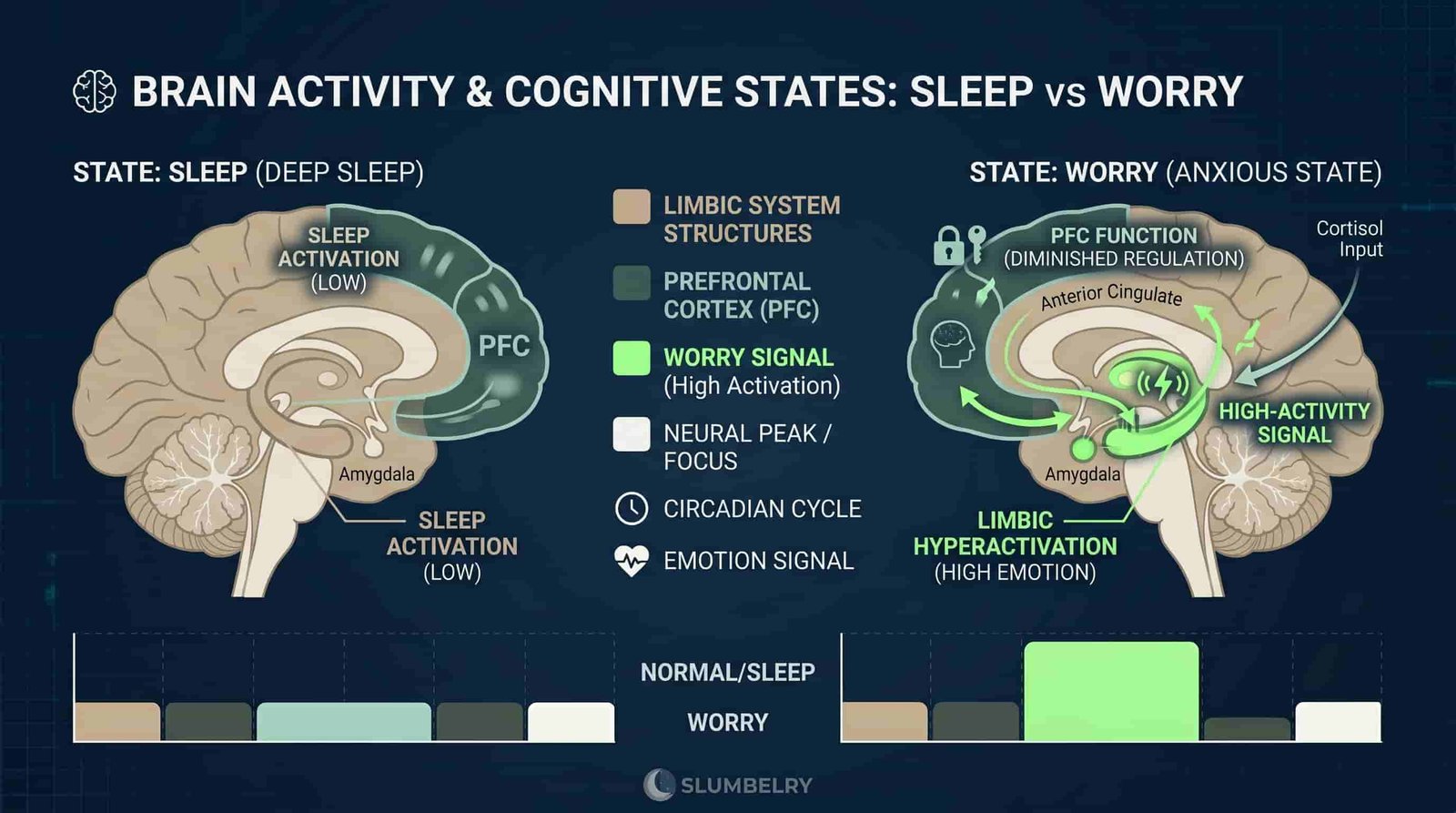
Hacking Your Body Temperature for Sleep

Body Temperature and Sleep: The Warm Bath Protocol

Why a Warm Bath Makes You Sleepy: Thermoregulation, Timing, and the 90-Minute Protocol

You have been told to take a warm bath before bed. It sounds like old-fashioned advice — the kind your grandmother gave. But the science behind body temperature and sleep is remarkably precise, and most people get it completely wrong.

They take the bath too hot, too close to bedtime, or in a bedroom that is too warm — undoing the very mechanism that makes it work. The result: they spend 20 minutes in the tub, feel temporarily relaxed, and then lie awake wondering why they are still not sleeping.

Here is what the research actually shows: it is not about relaxation. It is about engineering a precise core body temperature drop that triggers your brain to release melatonin and initiate sleep. Done correctly, the relationship between body temperature and sleep onset is one of the most powerful natural sleep-onset tools available. Done incorrectly, it is a waste of time.

In this guide: the thermoregulation science, the 90-minute protocol, and the room temperature rule that makes everything else work.

⚡ Core Takeaway: Cool Down to Sleep Up

  • The Paradox: A warm bath 90 minutes before bed triggers core body temperature to drop ~1 degree C, signaling sleep
  • The Timing: 90 minutes is the magic window — it aligns the temperature drop with your circadian sleep onset
  • The Room: Keep bedroom at 18-20 degrees C to sustain the temperature drop; otherwise the effect reverses
Person relaxing in warm bath at night, illustrating the thermoregulation sleep protocol
Warm bath immersion triggers peripheral vasodilation, initiating the core temperature drop that signals sleep

Why Does a Warm Bath Actually Help You Fall Asleep?

Direct Answer: Because the body uses external heat to accelerate its own cooling process — and core body temperature drop is the primary physiological signal that triggers sleep onset.

Mechanism: When you soak in hot water, blood vessels near the skin dilate (vasodilation), routing warm blood to the skin surface where heat dissipates into the environment. The moment you step out, core body temperature plummets as radiated heat is released. This temperature drop — roughly 1°C — signals the pineal gland to release melatonin, initiating the transition from wakefulness to sleep (Stevenson, 2016). The warmth is not relaxing you into sleep; it is engineering the precise physiological conditions your body needs to sleep.

Actionable Advice: Think of the warm bath not as relaxation, but as a temperature tool. You are not trying to calm your mind — you are cooling your core to flip the biological switch for sleep.

Research Highlight: Shawn Stevenson, Sleep Smarter (2016) — documents the warm bath effect as the most accessible thermoregulation strategy for sleep onset, citing multiple studies on core temperature drop triggering melatonin release.

What Is Thermoregulation and Why Does It Control Sleep?

Direct Answer: Thermoregulation is your body’s continuous effort to maintain a stable internal temperature — and it is the single most powerful environmental signal for the sleep-wake cycle, more reliable than light or sound.

Mechanism: Your circadian clock (suprachiasmatic nucleus, SCN) is fundamentally a temperature regulator. It coordinates the 24-hour temperature rhythm: peaking at 4 PM, dropping to its lowest point around 4 AM. This temperature rhythm drives the sleep-wake cycle directly. When ambient or skin temperature signals that it is safe to be warm, the SCN promotes wakefulness. When the core begins to cool, the SCN triggers sleep pathways. This is why shift workers sleeping during daylight face double opposition: a misaligned circadian clock and a temperature rhythm that is fighting daytime alertness (Walker, 2017).

Actionable Advice: Stop treating sleep as a mental challenge. It is a temperature challenge. Control your body temperature, and the brain follows automatically.

How Does Core Body Temperature Drop to Trigger Sleep?

Direct Answer: Core body temperature must fall approximately 1°C from its evening peak to initiate sleep onset — this is the temperature “gate” your brain requires before releasing melatonin.

Mechanism: Stevenson (2016) describes the temperature rhythm as the body’s most precise sleep signal. Hands and feet act as radiators: when they dilate, they shed heat rapidly, and core temperature falls fast. This is why cold feet can delay sleep (your body cannot shed heat efficiently without vasodilation in the extremities). The distal-proximal temperature gradient — warm hands and feet, cool core — is the precise physical signature of sleep readiness. Melatonin release is not triggered by darkness alone; it follows the temperature drop. Both signals together — evening dim light plus core cooling — create the optimal sleep-onset conditions.

Actionable Advice: If you have cold feet before bed, warm them first. Wear socks during the bath soak to maximize peripheral vasodilation, or warm your feet in the water for 10 minutes before bed to accelerate the heat-shedding process.

Research Highlight: Shawn Stevenson, Sleep Smarter (2016) — the distal-proximal temperature gradient model: warm hands and feet enable rapid core body temperature drop, which is the primary physiological trigger for melatonin release and sleep onset.

What Is the 90-Minute Warm Bath Protocol and How Does It Work?

Direct Answer: The 90-minute protocol aligns the warm bath’s thermal effect with your circadian temperature nadir — giving your body enough time to complete the heat-shedding process before your natural sleep window opens.

Mechanism: Littlehales (2016), author of the R90 method, identifies 90 minutes as the optimal window because it works with — not against — the circadian temperature cycle. If you bathe 90 minutes before your target bedtime, the core temperature drop peaks precisely when your circadian clock begins promoting sleep. If you bathe too close to bedtime (30–45 minutes), you introduce heat during the early sleep window, fragmenting the first sleep cycles. If you bathe too early, the temperature-regulating effect may wear off before sleep onset. The 90-minute buffer also allows the vasodilatory relaxation effect to naturally dissipate, reducing cortisol spike risk from a too-hot or too-long soak.

Actionable Advice: Set your bath time 90 minutes before target bedtime. Water temperature: 38–40°C (100–104°F) — hot enough to trigger vasodilation but not so hot that it raises cortisol. Soak for 20 minutes. Step out and let the cooling happen naturally. Do not bundle up in robes or blankets immediately after; let heat escape freely.

Research Highlight: Nick Littlehales, Sleep (2016) — R90 protocol includes temperature optimization as a core pillar: 90-minute pre-bed bath to align core temperature drop with the sleep onset window.

Why Is the 90-Minute Timing Critical for This to Work?

Direct Answer: Because the warm bath works by synchronizing an artificial temperature event with your natural circadian rhythm — and the two must align within a specific temporal window for the effect to hold.

Mechanism: McKenna and Meadows (as cited in sleep science literature) warn that the most common warm bath failure is taking it at the wrong time relative to your circadian phase. If you are a night owl whose circadian temperature nadir is at 2 AM, bathing at 10 PM is too early — your core temperature has not yet begun its natural descent, and the bath creates a competing signal. The 90-minute rule works because it creates a window of heat followed by accelerated cooling that is long enough to interact with the natural temperature decline but short enough to end before sleep onset pressure is disrupted. Evening bathing outside this window can paradoxically delay melatonin onset by 30–60 minutes.

Actionable Advice: Know your approximate circadian phase. If you are a morning type (Lion/early chronotype), 90 minutes may need adjusting earlier. For most people, the 90-minute protocol works when bath time falls between 9:30–11:00 PM for a 11:00 PM–12:00 AM target bedtime.

What Are the Most Common Warm Bath Mistakes That Ruin Sleep?

Direct Answer: Three errors dominate: bathing too close to bedtime, water too hot, and staying in too long — all of which activate the fight-or-flight system instead of sleep pathways.

Mechanism: Walker (2017) documents that water above 40°C (104°F) can elevate heart rate and trigger cortisol release, turning a sleep-promoting ritual into a sympathetic nervous system activation event. Stanley (2018) adds that prolonged immersion (>25 minutes) in hot water can cause the opposite effect — extended vasodilation followed by a rebound core temperature elevation that fragments the first two sleep cycles. Finally, McKenna’s research on sleep hypnosis demonstrates that excessive cognitive effort (“I must do this correctly”) activates the prefrontal cortex, which is precisely what you need to quiet for sleep.

Actionable Advice: Keep water at 38–40°C, soak for no more than 20 minutes, and treat the bath as a routine, not a performance. No screens during the bath — the transition from hot water to cool bedroom air is part of the protocol.

How Does Room Temperature Amplify or Kill the Warm Bath Effect?

Direct Answer: If your bedroom is above 21°C, the warm bath effect reverses — your body cannot shed heat efficiently, and sleep onset is delayed or fragmented.

Mechanism: Stevenson (2016) and Littlehales (2016) both identify 18–20°C as the critical bedroom temperature range for sleep. After a warm bath, your body relies on the ambient air temperature to facilitate radiative heat loss from dilated skin vessels. If the room is too warm, heat accumulates in the skin rather than dissipating, preventing the core temperature drop that triggers melatonin. Above 24°C, the body’s sweating mechanism activates — which is not sleep-promoting. Below 16°C, shivering begins, which also fragments sleep. The 18–20°C window is the “Goldilocks zone” where heat loss is maximally efficient without triggering either sweating or shivering.

Actionable Advice: Set your bedroom thermostat to 18°C before your bath. Open a window slightly if outdoor temperature is below 15°C and you have adequate bedding. This combination — warm bath plus cool bedroom — is the most powerful natural sleep-onset trigger available.

Research Highlight: Shawn Stevenson, Sleep Smarter (2016) and Nick Littlehales, Sleep (2016) — both identify 18–20°C ambient temperature as optimal for sleep, enabling efficient radiative heat loss from peripheral vasodilation after a warm bath.

Can You Use a Shower Instead of a Bath and Get the Same Effect?

Direct Answer: Partially — a shower provides vasodilation but misses the sustained heat immersion that drives the full core temperature drop. You can optimize it, however.

Mechanism: A full bath allows全身heat accumulation and sustained peripheral vasodilation — the full immersion means more surface area is exposed to warm water, driving deeper vasodilation than a standing shower. A shower still triggers a temperature rise and subsequent drop, but the effect is shorter and less pronounced because the body is not fully immersed. Water running down the body also has a massaging/alerting effect via pressure receptors in the skin, which can counteract the sedating effect. For those without a bath, a hot foot soak (bucket or basin, 15 minutes) plus a warm shower can approximate the effect by concentrating heat on the extremities, where the vasodilation is most effective at shedding core heat.

Actionable Advice: If only showering is available: use warm (not hot) water for 10 minutes, finishing 90 minutes before bed. Immediately after, sit or stand in a cooler environment (16–18°C) for 10–15 minutes to accelerate the temperature drop. Do not go from hot shower directly into a warm bed.

Why Is Sleep Efficiency More Important Than Sleep Duration?

Direct Answer: Because the quality of sleep cycles — specifically deep sleep and REM — is what restores the brain and body. A short, efficient sleep delivers more restorative sleep than a long, fragmented one.

Mechanism: Walker (2017) documents that deep N3 sleep is when the glymphatic system clears the most beta-amyloid — the Alzheimer-related waste product. Deep sleep is also when human growth hormone is released, primarily during the first two sleep cycles. Fragmented sleep — even at 8 hours — reduces N3 proportion and increases lighter N1/N2, meaning less restoration per hour in bed. Sleep efficiency (time asleep divided by time in bed) captures this. A person with 6 hours in bed and 5.5 asleep (91.7% efficiency) will wake more restored than someone in bed for 8 hours and sleeping 6 (75% efficiency). The warm bath protocol, when done correctly, specifically improves sleep efficiency by accelerating sleep onset and deepening the first two cycles.

Actionable Advice: Measure your sleep efficiency, not your total hours. If your time-in-bed is significantly more than your time-asleep, reduce time in bed (as in CBT-I stimulus control) while maintaining the warm bath protocol.

How to Build the Perfect Pre-Sleep Temperature Routine (Step-by-Step)

Direct Answer: Combine the warm bath protocol with ambient temperature control and sleep hygiene — a coordinated temperature sequence that prepares the body for sleep across the 90-minute pre-bed window.

Mechanism: This integrates the R90 pre-sleep routine (Littlehales, 2016), the warm bath effect (Stevenson, 2016), and CBT-I stimulus control principles. A structured temperature sequence trains the brain to recognize a consistent pre-sleep signal — the same way a bedtime story or white noise machine does for children. Neuroplasticity requires repetition: one night will not retrain your sleep pathways, but 14–21 nights of consistent temperature routines will significantly shift your sleep onset latency and quality.

Actionable Advice: Step 1 (T-90): Start the bath at the same time for 14 consecutive nights — your body will begin anticipating the temperature shift. Step 2 (T-70, during bath): No screens. Dim lights. Optional: 5 minutes of slow breathing. Step 3 (T-20, after bath): Cool bedroom to 18°C. Step 4 (T-10): Lightweight bedding. No heavy pajamas. Step 5 (T-0): Get into bed only when genuinely sleepy, not simply because it is bedtime. Combine with Slumbelry ergonomic support to minimize physical micro-arousals during the deep sleep window.

Scientific diagram showing body temperature curve and sleep stages overnight
Core body temperature and sleep stage relationship over a typical night
Modern bedroom with soft lighting transition from bathroom to cool sleep environment
From warm bath to cool bedroom — the complete pre-sleep temperature routine

Frequently Asked Questions

How long before bed should you take a warm bath?

Direct Conclusion: Ninety minutes before your target bedtime is the optimal window. This aligns the peak of core body temperature drop with your natural sleep onset window. Bathing closer than 60 minutes risks fragmenting the first sleep cycles with residual heat; bathing earlier than 2 hours reduces the temperature effect before you are ready for bed.

Does a warm bath actually lower your body temperature?

Direct Conclusion: Yes — paradoxically, a warm bath lowers core body temperature faster than no bath at all. When you soak in hot water, blood vessels near the skin dilate and route warm blood to the surface, where heat dissipates into the air. Stepping out triggers a rapid temperature drop as the body sheds accumulated heat through radiative loss. This drop — approximately 1 degree Celsius — is the physiological signal that triggers melatonin release.

What water temperature is optimal for the sleep effect?

Direct Conclusion: Thirty-eight to 40 degrees Celsius (100–104 degrees Fahrenheit) is the optimal range. Water hotter than 40 degrees C elevates heart rate and triggers cortisol release via the sympathetic nervous system — the opposite of what you want. Water below 37 degrees C is insufficient to trigger meaningful vasodilation. Use a bath thermometer; subjective temperature assessment is unreliable when you are immersed.

Can I just take a warm shower instead of a bath?

Direct Conclusion: A shower delivers a partial effect. Full immersion in a bath maximizes peripheral vasodilation across全身surface area, driving a deeper core temperature drop than a standing shower, where the alerting effect of water pressure on skin receptors can counteract sedation. If only a shower is available, use warm (not hot) water for 10 minutes and follow with 10–15 minutes in a cooler room to approximate the cooling effect.

How long should you soak in the bath for maximum benefit?

Direct Conclusion: Twenty minutes is the sweet spot. Under 15 minutes, vasodilation does not fully develop. Over 25 minutes risks cortisol elevation from prolonged heat exposure and can cause rebound hyperthermia — a slight rise in core temperature after getting out that fragments early sleep cycles. The goal is 20 minutes at 38–40 degrees C, followed by free radiative cooling in a room at 18–20 degrees C.

Does the warm bath effect work if your room is too warm?

Direct Conclusion: No — if your bedroom is above 21 degrees C, your body cannot efficiently shed the heat accumulated during the bath. The warm bath effect requires the ambient air to be cooler than your skin surface so radiative heat loss can occur. Above 24 degrees C, the body switches to sweating as its primary cooling mechanism, which is not sleep-promoting and will fragment sleep onset even if you did everything else correctly.

What time should you stop bathing to avoid disrupting circadian rhythm?

Direct Conclusion: Finish bathing at least 90 minutes before your target bedtime and avoid any significant heat exposure within 60 minutes of sleep. The transition from hot water to cool bedroom air is itself part of the temperature-drop signal — rushing this transition by going from hot bath directly into a warm bed eliminates the cooling phase that triggers melatonin. If your target bedtime is 11 PM, your bath should be complete by 9:30 PM at the latest.

Can you do the warm bath protocol every night?

Direct Conclusion: Yes — consistency is one of the protocol is strongest features. Neuroplasticity research shows that repeating a behavior at the same time each night strengthens the neural association between the temperature routine and sleep onset. After 14–21 consecutive nights, many people find they feel drowsy around their bath time automatically. This is your circadian clock learning the signal.

Does the warm bath effect still work for shift workers or people with irregular schedules?

Direct Conclusion: It works but requires adaptation. Shift workers should time the bath relative to their target sleep window, not the clock. For someone sleeping during the day, the cool room is even more critical (daylight is a competing wake signal), and blackout curtains plus eye masks are essential. The temperature protocol still functions during daytime sleep — core temperature follows the circadian rhythm even when light does not, which is why afternoon naps feel natural despite bright sunlight.

What is the single most important factor in making the warm bath protocol work?

Direct Conclusion: Room temperature. The warm bath triggers vasodilation, but if the bedroom is too warm, your body cannot shed the accumulated heat and the core temperature drop never fully occurs. Keep the room at 18–20 degrees C — this single variable determines whether the 90-minute protocol delivers its full sleep-onset benefit or wastes the entire routine.

Ready to Transform Your Recovery?

If you have been taking baths at the wrong time, wrong temperature, or in the wrong room, take action today. Discover science-backed solutions for better rest.

Take the Sleep Assessment Explore Our Cooling Mattress

The Slumbelry Commitment

Sleep is the most vulnerable state of human existence. It is where we heal, reset, and grow.

At Slumbelry, we do not just sell sleep products; we advocate for your physiological right to rest. From ergonomic support to light management, every solution we offer is designed with one obsession: Respecting your Biology.

Science is our language, but your recovery is our purpose. You take care of everything else in your life — let us take care of your sleep.

Rest Deeply,
The Slumbelry Team
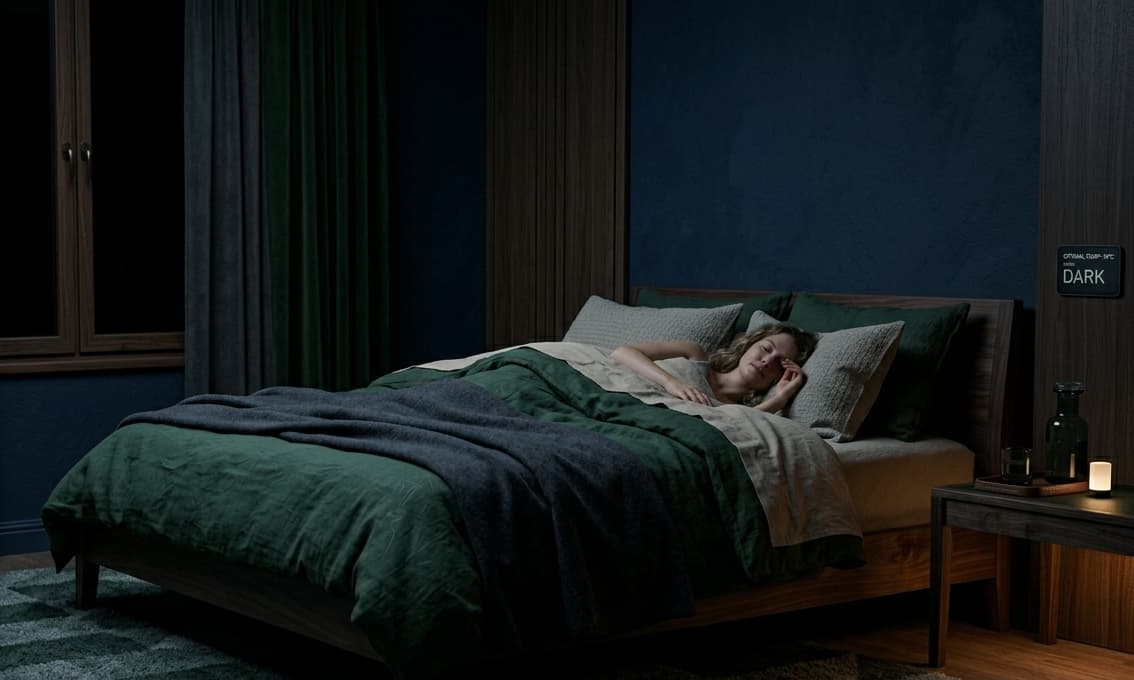
Why You Feel Like You’re Falling Asleep (Literally)

why do i feel like im falling when i sleep: hypnic jerks explained

Why Do I Feel Like I am Falling When I Sleep? The Science of Hypnic Jerks

It happens fast. One second you are drifting off. The next, your whole body jolts awake — a sudden, violent muscle twitch that feels exactly like the moment your foot misses a step on a staircase.

why do i feel like im falling when i sleep — more precisely called a hypnic jerk or sleep start — is one of the most universally reported sleep experiences in existence. And almost everyone who has felt it has the same immediate thought: what just happened to my body?

The answer is both simpler and more surprising than you think: your brain just caught you from falling out of a tree. Except you were never falling, and there was never a tree. Here is what is actually going on — and how to make it happen less often.

⚡ Core Takeaway: Normal, But Amplified by Arousal

  • The Mechanism: Hypnic jerks are a normal part of sleep onset — a misfiring of the brain’s motor neurons as your muscles relax into sleep
  • The Amplifier: Anxiety, stress, caffeine, and sleep deprivation lower the threshold for these jerks, making them more frequent and intense
  • The Fix: Reduce overall arousal before bed: magnesium, parasympathetic breathing, no caffeine 6+ hours before sleep
Person experiencing a hypnic jerk while falling asleep in bed, sudden body twitch, surprised expression
The hypnic jerk: your brain thinks it is catching you from falling — but there is no fall

What Is a Hypnic Jerk and Why Does Your Body Do This?

Direct Answer: A hypnic jerk — also called a sleep start or hypnagogic jerk — is a sudden, involuntary muscle twitch that occurs as you are transitioning from wakefulness to sleep. It feels exactly like a falling sensation, often accompanied by the sensation of tripping or stumbling. It is one of the most universally reported sleep phenomena, affecting up to 70% of people, and it is completely normal.

Mechanism: Walker (2017) explains that as you begin to fall asleep, your muscles start to relax — a process called atonia. The brain misinterprets this relaxing muscle state as a signal that the body is actually falling. The reticular formation (the brain’s arousal center) sends a sudden nerve impulse to correct the perceived fall, jerking your muscles awake. This is an ancient reflex: as your body loses grip on consciousness, the nervous system performs one last check. There is no actual falling — only the brain’s misinterpretation of a perfectly normal transition state. Your body thinks you are falling out of a tree, and it is making sure you do not.

Actionable Advice: Understand that a hypnic jerk is your brain’s way of protecting you from a threat that does not exist. This framing alone — knowing it is benign — reduces the anxiety that often accompanies the experience. Each jerk is your brain briefly mistaking relaxation for danger, then overcorrecting.

Research Highlight: Matthew Walker, Why We Sleep (2017) — University of California, Berkeley. Documents the hypnic jerk as a normal part of sleep onset, caused by the brain misinterpreting muscle atonia as falling, with the reticular formation sending a corrective motor impulse.

What Causes the Falling Sensation When Falling Asleep?

Direct Answer: The falling sensation is not a hallucination — it is a misclassified signal. As your body enters the N1 sleep stage (the first phase of sleep), muscle tone decreases rapidly. The brain’s proprioceptive system (which tracks body position) interprets the sudden loss of muscle tension as the body becoming unsupported. The result: a brief panic signal that produces the hypnic jerk to “catch” you.

Mechanism: Littlehales (2016), Sleep, describes two competing evolutionary theories. The first: hypnic jerks are a vestigial reflex from our primate ancestors who slept in trees — the brain keeps one hand on the safety switch until sleep is confirmed. The second: they are simply the result of the nervous system performing a final systems-check during the wake-to-sleep transition. Both theories agree on one point: the phenomenon is an ancient, hardwired neurological mechanism, not a sign of anything wrong. The brain does not fully power down in stages — it switches abruptly, and the hypnic jerk is the sound of that switch flipping.

Actionable Advice: Your brain thinks it is catching you from falling out of a tree. It is not. The more you understand this as a misinterpretation rather than a real event, the less alarming each jerk becomes.

Research Highlight: Craig Littlehales, Sleep (2016) — documents the N1 sleep stage transition and the proprioceptive misinterpretation hypothesis for hypnic jerks, alongside the evolutionary tree-sleeping primate reflex theory.

Is It Normal to Feel Like You Are Falling As You Fall Asleep?

Direct Answer: Yes — it is one of the most normal things that can happen to your body during sleep. Up to 70% of people experience hypnic jerks, and they occur in every age group. The feeling of falling — or the sensation of tripping, stumbling, or being jerked awake — is the hallmark of this phenomenon and is not dangerous.

Mechanism: The normal distribution of hypnic jerks means that if you experience them, you are in the majority. What is not normal — and worth investigating — is if the jerks are accompanied by loud gasping, choking, or violent thrashing that disrupts a bed partner. Those symptoms suggest a different phenomenon (confusional arousal or, more rarely, REM behavior disorder). But the classic hypnic jerk — a single twitch or sensation of falling, followed by quick recovery — is as normal as yawning before sleep. The only reason it feels alarming is that it happens at the exact moment you are most vulnerable, in the dark, with reduced cognitive capacity to contextualize it.

Actionable Advice: Keep a simple log: frequency, intensity (single twitch vs. full body jerk), and what you were thinking about right before it happened. Most people find their jerks are worse on nights when they are already anxious — which brings us to the next critical variable.

Why Does Your Brain Misfire This Way During Sleep Onset?

Direct Answer: The misfire happens in the brainstem — specifically in the reticular formation — during the N1 to N2 transition. As the muscles release into atonia and the brain begins shutting down its waking functions, the reticular formation has not fully transitioned yet. It reads the sudden absence of proprioceptive input (body position signals) as an emergency and sends a corrective motor burst.

Mechanism: Walker (2017) describes the reticular activating system (RAS) as the brain’s sleep-wake switch. When you are awake, the RAS keeps the brain alert by filtering sensory input. As you begin to sleep, the RAS begins to power down — but the muscles power down faster. The timing mismatch creates a gap: the RAS briefly interprets the absence of muscle signals as a system failure and fires an emergency corrective signal. The hypnic jerk is that corrective signal. It is not a malfunction — it is the sound of a mostly-accurate system making a minor error. In most cases, the error corrects itself within seconds and sleep proceeds normally.

Actionable Advice: There is no way to prevent the brainstem from running its safety check — but you can reduce the frequency of false alarms by lowering your overall arousal state before bed. The lower your cortisol before sleep, the fewer the false alarms.

Scientific diagram showing brain activity during sleep onset, hypnic jerk mechanism, motor neuron misfiring
The neuroscience of hypnic jerks: why the reticular formation sends a false alarm during the N1 to N2 transition

Why Does Anxiety Make Hypnic Jerks More Frequent and More Intense?

Direct Answer: Anxiety lowers the threshold for the hypnic jerk — meaning your brain requires less provocation to trigger the alarm. When your baseline arousal is already elevated, the N1 muscle atonia transition is more dramatic, and the reticular formation is more likely to misread it as an emergency.

Mechanism: Stanley (2018), How to Sleep Well, documents that stress and anxiety elevate cortisol and norepinephrine, which increases overall nervous system excitability. The more excitable your nervous system, the lower the threshold for the brain’s startle response — and a hypnic jerk is essentially a controlled startle response. People who are highly stressed, or who are anxious about sleep itself (what therapists call “sleep-related anxiety”), tend to experience more frequent and more intense hypnic jerks because their nervous systems are already on high alert. The anticipation of a hypnic jerk can also trigger one — the fear of falling creates exactly the physiological state that produces a fall.

Actionable Advice: This is why addressing hypnic jerks requires addressing your pre-sleep arousal state, not just the jerk itself. The Worry Journal, parasympathetic breathing, and magnesium supplementation all reduce baseline cortisol — which directly reduces hypnic jerk frequency.

What Triggers Hypnic Jerks: Caffeine, Exercise, or Sleep Deprivation?

Direct Answer: Yes to all three. Caffeine (especially in the afternoon), intense evening exercise, and accumulated sleep deprivation all increase hypnic jerk frequency. The common mechanism: each factor elevates sympathetic nervous system activation, which lowers the threshold for the reticular formation’s false alarm.

Mechanism: Walker (2017) documents that caffeine blocks adenosine receptors — adenosine is the chemical that builds up during wakefulness to produce sleep pressure. When caffeine blocks this signal, your brain thinks it is less tired than it actually is, and your nervous system remains more alert than it should be during the N1 transition. Intense exercise within 2–3 hours of bedtime raises core body temperature and adrenaline, both of which delay the onset of deep sleep and increase motor cortex excitability — making the muscles more prone to a sudden twitch. Sleep deprivation itself compounds all of this: a sleep-deprived brain is more excitable, has higher cortisol, and has a lower threshold for every kind of sleep disruption. The combination of sleep deprivation plus caffeine plus evening exercise is a near-guarantee of frequent, intense hypnic jerks.

Actionable Advice: Cut caffeine by 2 PM at the latest. Avoid vigorous exercise within 3 hours of bedtime. Prioritize getting 7–9 hours of sleep consistently — the sleep-deprived brain is the brain most likely to jerk you awake at the worst possible moment.

What Is the Difference Between a Hypnic Jerk and a Sleep Start?

Direct Answer: There is no clinical difference — “hypnic jerk,” “sleep start,” and “hypnagogic jerk” are synonymous terms describing the same phenomenon. All three refer to the involuntary muscle twitch and sensation of falling that occurs during the N1 to N2 sleep transition.

Mechanism: The different terms arise from different traditions: “hypnic jerk” comes from the Greek “hypnos” (sleep) + “jerk.” “Sleep start” is the more colloquial medical description. “Hypnagogic jerk” comes from “hypnagogic” (the state between wakefulness and sleep). In sleep medicine literature, these are used interchangeably. There is a related phenomenon called a “myoclonic jerk” — but myoclonic jerks can occur during deep sleep (N3) or even during wakefulness, and may indicate a neurological disorder if frequent. A hypnic jerk is specific to the sleep-onset window and is benign.

Actionable Advice: If you experience jerking or twitching during the night — not just at sleep onset, but in the middle of deep sleep — this may be a different phenomenon worth discussing with a doctor. But the classic sleep-onset jerk you are describing is textbook hypnic jerk: normal, benign, and very common.

Why Does This Happen More in an Unfamiliar Bed or New Place?

Direct Answer: The “first night effect” — a well-documented phenomenon in sleep science where the brain stays partially vigilant on the first night in a new environment, keeping one hemisphere of the brain slightly awake to monitor for threats.

Mechanism: Stanley (2018) documents the first night effect as a survival mechanism: when sleeping in an unfamiliar environment, the brain allocates a portion of its capacity to monitoring the new surroundings for danger. This vigilance state elevates baseline arousal during sleep, particularly during the N1 to N2 transition when the brain is most sensitive to environmental changes. The result: more frequent hypnic jerks, lighter sleep, and more awakenings on the first night in a new bed. This is the same mechanism that causes hotel insomnia — your brain is not broken; it is being appropriately cautious in an unfamiliar environment.

Actionable Advice: If you travel frequently, bring something from your own sleep environment that signals safety — a pillow, a blanket, or an eye mask you sleep with at home. Over time, your brain learns that the new bed is safe, and the first night effect diminishes. Give yourself 2–3 nights in a new environment before judging your sleep quality there.

How to Reduce Hypnic Jerks: Evidence-Based Strategies

Direct Answer: Reduce the overall arousal state before bed, minimize stimulants, and support the N1 to N2 transition with parasympathetic nervous system activation. The goal is to make the sleep-onset transition as smooth as possible — which means arriving at bedtime calm, not activated.

Mechanism: Walker (2017) and Littlehales (2016) both recommend a pre-sleep routine that lowers sympathetic activation before the N1 transition begins. Magnesium glycinate (400 mg, 30–60 minutes before bed) supports muscle relaxation and has mild GABA-activating properties that smooth the atonia transition. Parasympathetic breathing — 4-7-8 breathing or box breathing — directly reduces cortisol and activates the parasympathetic nervous system, making the reticular formation less likely to misread muscle relaxation as an emergency. Avoiding screens for 30 minutes before bed reduces blue-light activation of the suprachiasmatic nucleus, which would otherwise delay melatonin onset and increase alertness. Combining these creates a cumulative effect: each step reduces the probability that the reticular formation will send a false alarm at the moment of sleep onset.

Actionable Advice: Start 60 minutes before bed: no caffeine, no screens, no intense exercise. In that window: magnesium supplement, 5 minutes of 4-7-8 breathing, and a reading or journaling session to offload any remaining cognitive load. If you feel a hypnic jerk coming, consciously relax your muscles — do not tense against it. Tensing amplifies the misfiring; relaxing tells the reticular formation the body is intentionally resting.

Research Highlight: Matthew Walker, Why We Sleep (2017) + Craig Littlehales, Sleep (2016) — pre-sleep arousal reduction as the primary intervention for hypnic jerk frequency: magnesium, parasympathetic breathing, stimulant restriction, and sleep consistency all reduce the reticular formation misfire threshold during N1-N2 transition.
Person falling asleep peacefully in a calm dark bedroom with proper sleep setup
A calm pre-sleep environment reduces the reticular formation misfire that causes hypnic jerks

When Should You See a Doctor About Hypnic Jerks?

Direct Answer: Hypnic jerks are almost always benign — but see a doctor if they are violent (causing injury to yourself or a partner), if they are associated with gasping or choking sounds, if you are falling asleep involuntarily during the day, or if the sensation of falling is replacing your actual sleep rather than interrupting it.

Mechanism: The red flags for pathology are different from the classic hypnic jerk. Sleep apnea often presents with gasping, choking, or snorting sounds at the transition between sleep stages — not the simple muscle twitch-and-recovery of a hypnic jerk. REM behavior disorder (RBD) involves physically acting out dreams — punching, kicking, falling out of bed — which are very different from the brief motor misfire of a hypnic jerk. Narcolepsy involves falling asleep involuntarily during the day, not just hypnic jerks at night. If your experience is limited to the sensation of falling and a brief twitch at sleep onset, it is almost certainly benign. The key distinguishing feature: hypnic jerks last less than one second and resolve immediately; pathological events are sustained, violent, or associated with other symptoms.

Actionable Advice: If you have ruled out the red flags and your hypnic jerks are primarily triggered by anxiety, start with the pre-sleep routine above. If they persist despite lifestyle changes, a sleep study can confirm whether there is an underlying respiratory or movement disorder contributing. In most cases, the answer is simpler: your nervous system needs to be calmer, not your body needs more medication.

Frequently Asked Questions

Are hypnic jerks normal or a sign of something serious?

Direct Conclusion: Completely normal and not a sign of anything serious. Up to 70% of people experience hypnic jerks at some point in their lives. They are a benign neurological misfire at the sleep-onset transition, not a symptom of a disorder. The only times to consult a doctor: if jerks cause injury, if they are associated with gasping or choking sounds, or if you fall asleep involuntarily during the day.

Why do I feel like I am falling when I am falling asleep?

Direct Conclusion: Your brain is misinterpreting the rapid muscle relaxation of the N1 sleep stage as a falling signal. As your muscles release into atonia, the reticular formation detects a sudden absence of proprioceptive input and sends a corrective motor burst. You are not falling — your brain is simply running a faulty safety check at the worst possible moment. It is a misinterpretation, not a real event.

Can anxiety cause more hypnic jerks?

Direct Conclusion: Yes — anxiety lowers the threshold for the hypnic jerk by elevating baseline sympathetic nervous system activation. When your cortisol is already high before bed, the N1 muscle relaxation transition is more dramatic, and the reticular formation is more likely to misread it as an emergency. Reducing pre-sleep anxiety through the Worry Journal, parasympathetic breathing, and magnesium supplementation directly reduces hypnic jerk frequency.

Does caffeine make hypnic jerks worse?

Direct Conclusion: Yes, especially if consumed after 2 PM. Caffeine blocks adenosine receptors, which elevates the brain’s overall alert state. A caffeine-affected nervous system entering the N1 sleep stage is significantly more prone to hypnic jerks than a calm, caffeine-free nervous system. The effect is compounded if you are also sleep-deprived, which most caffeine-dependent people are.

Why do I get hypnic jerks more often when I am stressed?

Direct Conclusion: Stress and sleep deprivation are the two biggest amplifiers of hypnic jerk frequency. Both conditions elevate cortisol and sympathetic nervous system activation, which lowers the threshold at which the reticular formation fires its false alarm. A chronically stressed person will experience more hypnic jerks because their nervous system is already in a high-alert state before they even get into bed.

Is there a link between hypnic jerks and sleep apnea?

Direct Conclusion: Not directly — hypnic jerks and sleep apnea are separate phenomena. However, people with sleep apnea often experience more sleep starts because their breathing interruptions periodically jolt them awake. If you snore, wake gasping, or have been told you stop breathing during sleep, a sleep study is appropriate. If your experience is purely a sensation of falling with a brief muscle twitch at sleep onset, it is almost certainly a hypnic jerk, not apnea.

What supplements or techniques reduce hypnic jerks?

Direct Conclusion: Magnesium glycinate (400 mg, 30–60 minutes before bed) is the most evidence-supported supplement — it supports muscle relaxation and has mild GABA-activating properties. Parasympathetic breathing (4-7-8 breathing: inhale 4 counts, hold 7, exhale 8, repeated 5 times) directly reduces cortisol and smooths the N1 transition. Reducing caffeine, avoiding screens before bed, and consistent sleep times all contribute cumulatively. No single intervention is as effective as reducing your overall arousal load before the sleep-onset window.

Why do hypnic jerks happen more in a new or unfamiliar bed?

Direct Conclusion: The first night effect: when sleeping in an unfamiliar environment, the brain keeps one hemisphere partially awake as a threat-monitoring measure. This elevated vigilance state lowers the threshold for the hypnic jerk during the N1 transition. The phenomenon resolves after 2–3 nights in most people, as the brain learns the new environment is safe.

Are hypnic jerks the same as REM behavior disorder?

Direct Conclusion: No — they are fundamentally different. Hypnic jerks occur at sleep onset (N1 stage), last less than a second, and resolve immediately. REM behavior disorder (RBD) involves acting out dreams during REM sleep — which is deep sleep, hours after onset. RBD can involve violent, sustained movements that can cause injury. Hypnic jerks are benign; RBD requires medical evaluation. If you are physically acting out dreams (hitting, kicking, falling out of bed), see a sleep specialist.

What is the single most effective thing to do when you get a hypnic jerk?

Direct Conclusion: Consciously relax the muscle you just jerked — do not tense against it. Tensing amplifies the misfiring; deliberately softening the muscle signals to the reticular formation that the body is intentionally resting, not falling. The second most effective strategy is addressing your pre-sleep arousal state: the fewer cortisol and anxiety you bring to bed, the fewer false alarms your brain will send at the moment of sleep onset.

Ready to Transform Your Recovery?

If your nervous system has been running on high alert, take action today. Discover science-backed solutions for better rest.

Take the Sleep Assessment Explore Our Cooling Mattress

The Slumbelry Commitment

Sleep is the most vulnerable state of human existence. It is where we heal, reset, and grow.

At Slumbelry, we do not just sell sleep products; we advocate for your physiological right to rest. From ergonomic support to light management, every solution we offer is designed with one obsession: Respecting your Biology.

Science is our language, but your recovery is our purpose. You take care of everything else in your life — let us take care of your sleep.

Rest Deeply,
The Slumbelry Team
The #1 Habit That Kills Your Sleep Drive

Why Do I Keep Waking Up at 3 AM and Can’t Fall Back Asleep

Why You Keep Waking Up at 3 AM and Checking the Clock: The Hyperarousal Loop

It is 3:14 AM. You know this because why do i keep waking up at 3 am is the thought that dragged you out of whatever sleep you had managed to get. And now you are doing it: “If I fall asleep right now, I get 3 hours and 46 minutes…”

Sound familiar? You are not broken. You are caught in a loop. And the loop has a trigger: the clock on your nightstand.

In this guide, we unpack exactly what happens to your brain at 3 AM, why looking at the time makes everything worse, and the evidence-based protocol — backed by CBT-I, chronobiology, and sleep neuroscience — that actually breaks the pattern for good.

⚡ Core Takeaway: Stop Counting, Start Sleeping

  • The Loop: Clock-watching triggers cortisol spike, making it harder to sleep, which triggers more anxiety, which triggers more clock-watching
  • The Misperception: You likely sleep more than you think; the clock amplifies the feeling of wakefulness by 30–50 minutes
  • The Fix: Remove all time-checking cues; use the 15-minute rule; rebuild bed = safety through consistent stimulus control
Person waking in dark bedroom at 3 AM looking at alarm clock with anxious expression
The 3 AM clock check — every glance triggers a measurable cortisol spike that prevents sleep

Why Do I Keep Waking Up Exactly at 3 AM?

Direct Answer: Because 3 AM falls at the intersection of your circadian trough and a natural sleep cycle boundary — two forces that make you briefly conscious even on a normal night.

Mechanism: Walker (2017), Why We Sleep, documents that your circadian rhythm creates a trough of alertness around 3–5 AM — the period of lowest core body temperature and highest sleep pressure. This is when REM sleep is most dense and when the boundary between sleep cycles (N3 to N1 to wake) is most permeable. Your brain uses this window to briefly test whether the environment is safe. If you are a light sleeper or have accumulated sleep debt, that micro-check becomes a full awakening. For insomniacs, the fear of 3 AM wakeups has created a conditioned response — the brain anticipates anxiety at exactly this time, guaranteeing it.

Actionable Advice: Understanding that 3 AM wakeups are biologically normal — not pathological — is the first step. Your goal is not to prevent the wakeup; it is to send the brain the signal that there is nothing to fear and it is safe to return to sleep.

What Does Checking the Clock Actually Do to Your Brain?

Direct Answer: Every time you look at the clock, you trigger a cortisol spike that takes 30–60 minutes to subside — guaranteeing you will be more awake than before you looked.

Mechanism: Walker (2017) documents that the fear of not sleeping — anticipatory anxiety — activates the amygdala and the HPA axis, flooding the system with cortisol and adrenaline. This is the same physiological response as a genuine threat. When you look at the clock and see 3:14 AM, your brain computes: “only X hours left” — which the prefrontal cortex interprets as a threat to survival. The bed, which should signal safety, now signals failure. This is the conditioned response of psychophysiological insomnia (Stanley, 2018): every night, the clock strengthens the association between bed and anxiety.

Actionable Advice: The only way to break the association is to never check. Not once. Not even to see what time it is. If you cannot see the clock without anxiety, face it away or remove it entirely.

Research Highlight: Matthew Walker, Why We Sleep (2017) — University of California, Berkeley. Documents the measurable cortisol spike triggered by anticipatory anxiety about sleep, and its direct effect on sleep onset latency and sleep fragmentation.

Why Does the “3 Hours of Sleep” Math Anxiety Make Everything Worse?

Direct Answer: Because doing math at 3 AM requires working memory and logical reasoning — exactly the prefrontal cortex activity that is incompatible with the default-mode network activity required for sleep.

Mechanism: McKenna and Meadows (as cited in sleep science literature) describe how the “if I fall asleep now, I get X hours” calculation activates the prefrontal cortex, the brain region most responsible for keeping you awake. Sleep requires the prefrontal cortex to “hand over” to the limbic system and the sleep-wake switch (via the ventrolateral preoptic area). Anxiety-driven calculation keeps the prefrontal cortex online — which is precisely the opposite of what sleep requires. This is the effort paradox: the harder you try to calculate your way out of poor sleep, the less likely sleep becomes.

Actionable Advice: Replace the calculation with a behavioral rule: if you wake and the time matters, you have already lost. Do not calculate. Get up if awake 15+ minutes, do something boring in dim light, and return only when genuinely sleepy — this is the CBT-I stimulus control protocol.

What Is Hyperarousal and Why Does 3 AM Trigger It?

Direct Answer: Hyperarousal is a state of heightened emotional and physiological alertness — it is the biological switch that keeps you awake when safety is uncertain. And 3 AM is the moment your brain is most sensitive to threat cues.

Mechanism: Walker (2017) documents that hyperarousal is not simply “feeling alert” — it is a measurable state of sympathetic nervous system activation: elevated heart rate, cortisol release, elevated galvanic skin response, and increased brainwave frequency (beta waves replacing theta). The 3 AM vulnerability is a feature of your circadian biology: your cortisol nadir (lowest point) is at midnight, and cortisol begins rising from around 2–3 AM to prepare you for wakefulness. When you wake during this rising phase, the cortisol spike is steeper and harder to overcome. Your brain interprets the wakefulness + rising cortisol combination as “something is wrong” — triggering the full fight-or-flight cascade.

Actionable Advice: Accept that 3 AM is the hardest time to return to sleep — not because you are broken, but because your biology is preparing you to wake. Work with this, not against it: a brief wakeful period at 3 AM is normal and expected, even in good sleepers.

Research Highlight: Matthew Walker, Why We Sleep (2017) — documents the measurable hyperarousal state (elevated cortisol, sympathetic activation) that makes returning to sleep at 3 AM specifically difficult, independent of sleep history.
Scientific diagram showing cortisol spike and sleep stages at 3 AM hyperarousal
Cortisol and sleep stage relationship at 3 AM: why the clock triggers the hyperarousal loop

Can You Actually Fall Asleep When You Are Anxious About Sleep?

Direct Answer: Only if you stop trying. Paradoxically, accepting wakefulness and switching your goal from “falling asleep” to “resting peacefully” is the only path to sleep at 3 AM.

Mechanism: McKenna’s sleep hypnosis research demonstrates that sleep cannot be forced — it is a process of relinquishing control. The moment you shift from “trying to sleep” to “I am resting my body, which is also valuable,” the prefrontal cortex quiets and the sleep-onset pathways activate. This is why acceptance-based approaches (Meadows’ ACT-based sleep therapy) outperform relaxation techniques in clinical trials for chronic insomnia. Stanley (2018) notes that the insomniac who says “I don’t care if I sleep tonight, I am just resting” often falls asleep faster than the one who employs progressive muscle relaxation or counting — because the former has genuinely deactivated the threat-response system.

Actionable Advice: When you wake at 3 AM, say to yourself: “My body is resting. That is enough for now. Sleep will come when it is ready.” This is not positive thinking — it is accurate: rest is physiologically valuable, and the anxiety of “needing” sleep is the obstacle, not the solution.

How Does Sleep State Misperception Keep You Trapped at 3 AM?

Direct Answer: Because your perception of how long you were awake is amplified by anxiety — studies show insomniacs consistently overestimate wake time by 30–50 minutes while PSG data shows they were asleep most of that time.

Mechanism: Dr. W. Chris Winter (The Sleep Solution) documents that Sleep State Misperception (SSM) — also called paradoxical insomnia — means the brain fails to register sleep that has actually occurred. At 3 AM, an insomniac’s brain is often in N1 or light N2 sleep but reports being “completely awake.” This happens because the threat-detection system stays partially online, tagging each micro-arousal as a full wake event. The result: you feel more awake and more sleep-deprived than you actually are. This misperception drives more clock-watching, which triggers more cortisol, which fragments real sleep, which creates more misperception — the self-reinforcing SSM loop.

Actionable Advice: Stop using your subjective feeling of wakefulness as data. The only reliable metric is how you feel when you wake without an alarm on vacation. If you feel rested despite believing you “only slept 4 hours,” you were likely asleep for 6+.

What Is the Clock Ban and Why Does It Work?

Direct Answer: The Clock Ban removes all time-reference cues from the bedroom, preventing the cortisol spike that clock-watching triggers and training the brain to stop using time as a sleep-performance metric.

Mechanism: Stanley (2018), How to Sleep Well, identifies stimulus control therapy (SCT) as one of the most evidence-based interventions for insomnia — and the Clock Ban is SCT’s most immediate application. The principle: you are training a conditioned response. For years, looking at the clock at 3 AM has been paired with anxiety. That pairing is so strong that the clock itself — before you even read the numbers — now triggers a cortisol response in anticipation. The only way to break the pairing is extinction: complete removal of the cue. In CBT-I clinical protocols, stimulus control requires not just hiding the clock but also leaving the bed if you do not return to sleep within 15 minutes — both are essential, neither alone is sufficient.

Actionable Advice: Tonight: face all clocks away or cover them. Charge your phone across the room. Remove any visible time displays from the bedroom. If you wake and feel the urge to check the time, get up and go to another room — do not stay in bed calculating.

Research Highlight: Dr. Neil Stanley, How to Sleep Well (2018) — stimulus control therapy as first-line CBT-I intervention: complete removal of clock-checking cues and leaving bed after 15 minutes of wakefulness to break the conditioned bed = wakefulness association.

How Does Sleep Efficiency Beat Sleep Duration at 3 AM?

Direct Answer: Because counting hours gives you anxiety; counting cycles gives you control. Sleep efficiency — the ratio of time asleep to time in bed — is the metric that matters, not the number on the clock.

Mechanism: Walker (2017) notes that a person who sleeps 5.5 hours with 6 hours in bed (91.7% efficiency) will outperform someone in bed for 8 hours but sleeping only 5.5 (68.8% efficiency). The time in bed doing nothing is actively counterproductive for insomniacs — it extends the window for anxiety, conditions the bed as a place of frustration, and reduces sleep pressure for the following night. At 3 AM specifically, staying in bed calculating hours fragments the first part of the next sleep cycle, reducing deep sleep and REM proportion — the restorative stages. The goal is fewer, deeper, more efficient sleep cycles — not longer, more anxious time in bed.

Actionable Advice: If you consistently wake at 3 AM and return to sleep slowly, consider whether your time-in-bed is too long. Reduce it by 30–60 minutes (go to bed 30 min later, or get up 30 min earlier). More sleep pressure = faster sleep onset = higher sleep efficiency.

Why Does Your Chronotype Make 3 AM Worse for Some People?

Direct Answer: Because wolves and lions have fundamentally different circadian architectures at 3 AM — and wolves (night chronotypes) experience a secondary alertness peak that makes 3 AM wakefulness feel more “normal” but also harder to suppress.

Mechanism: Stanley (2018) describes the four chronotypes: Lions (morning), Bears (intermediate), Wolves (evening), Dolphins (light-sleeping). Wolves, in particular, experience a cortisol rise earlier in the night than other types, making early-morning wakefulness more likely. Lions, whose sleep pressure dissipates earlier due to an advanced circadian phase, may find 3 AM wakeups particularly frustrating because they are physiologically ready to wake but socially constrained to sleep later. The 3 AM experience is not uniform — it is filtered through your chronotype, your accumulated adenosine, and your sleep debt from the previous day. Knowing your type allows you to set realistic expectations: a Wolf’s 3 AM experience will be fundamentally different from a Lion’s.

Actionable Advice: Identify your chronotype (Slumbelry’s sleep assessment can help) and set realistic 3 AM expectations for your biology. Wolves should not try to be Lions — and Lions should not catastrophize a 3 AM wakeup that is simply their advanced circadian rhythm expressing itself.

How to Break the 3 AM Clock-Watching Habit Permanently (Step-by-Step)

Direct Answer: Follow this CBT-I-informed protocol: remove cues, manage the 15-minute window, and rebuild the bed-safety association across 3–6 weeks of consistent practice.

Mechanism: This integrates stimulus control therapy (Stanley, 2018), sleep restriction (Walker, 2017), and attention bias modification (McKenna). The key insight: you cannot think your way out of 3 AM insomnia, but you can engineer your behavior around it. Each night you wake, check the clock, and return to sleep without anxiety, you are rebuilding the neural pathway: bed = safety = sleep. Each night you check the clock and catastrophize, you are reinforcing the opposite. Neuroplasticity works both ways — and 3 weeks of consistent stimulus control can measurably change the conditioned response.

Actionable Advice: Step 1 (tonight): remove all clocks and phone from the bedroom. Step 2: if you wake and cannot return in 15 minutes, get up to another room in dim light. Do not stay in bed. Step 3: return to bed only when genuinely sleepy. Step 4: no caffeine for 8 hours before target bedtime. Step 5: same wake time every day, including weekends, for 21 days minimum — this trains your circadian rhythm to reduce the 3 AM vulnerability window. Combine with Slumbelry ergonomic support to minimize physical micro-arousals from discomfort.

Person sleeping peacefully in bedroom with clock hidden, applying the clock ban technique
Removing the clock cue: the first step in breaking the 3 AM anxiety loop

Frequently Asked Questions

Why do I always wake up at 3 AM and cannot fall back asleep?

Direct Conclusion: 3 AM is the intersection of your circadian trough, the natural boundary between sleep cycles, and the beginning of the cortisol rise that prepares you for morning. Most adults experience brief micro-wakeups at this time; insomniacs experience them as full awakenings because anxiety has conditioned the 3 AM window as a threat period. This is not a disease — it is a predictable biological phenomenon that can be managed with stimulus control and circadian alignment.

Does checking the clock really make it harder to fall asleep?

Direct Conclusion: Yes — measurably. Every clock check triggers a cortisol spike that takes 30–60 minutes to subside, elevating heart rate and prefrontal cortex activity incompatible with sleep onset. This is not psychological; it is the same fight-or-flight response triggered by any threat. The clock at 3 AM tells your brain there is not enough time — and time pressure is one of the most powerful activators of the arousal system.

How much sleep do I actually need if I wake up at 3 AM?

Direct Conclusion: The honest answer is: as much as your biology requires, which is personal. Use the Vacation Test — 3–4 nights without an alarm, after initial catch-up sleep, reveals your biological sleep duration. Most adults land between 7–9 hours, but the quality of that sleep (cycle completion, sleep efficiency) matters more than the clock hours. If you wake at 3 AM after 5–6 hours of efficient sleep, you may have already gotten what you need for that night.

What is the 15-minute rule for falling back asleep?

Direct Conclusion: If you wake and cannot return to sleep within 15 minutes, get out of bed. This is stimulus control therapy: staying in bed awake trains your brain that bed equals wakefulness. Go to another room in dim light, do something boring (not screens), and return only when genuinely sleepy. Most people who implement this rule find that their total sleep time initially drops but sleep efficiency dramatically improves — and within 2–3 weeks, the 3 AM wakeups shorten or disappear.

Is it better to just stay in bed when I wake up at 3 AM?

Direct Conclusion: No — staying in bed awake without sleeping is the single most counterproductive thing insomniacs do. It extends the window for anxiety to operate, trains the brain that bed is for wakefulness, and reduces sleep pressure for the following night. The clinical evidence for stimulus control (leaving bed when awake >15 minutes) is stronger than almost any pharmacological or supplementation intervention for chronic insomnia.

Why does sleep feel like it vanishes after 3 AM?

Direct Conclusion: Because your deepest sleep (N3) occurs in the first half of the night, and the second half is dominated by REM and light N2. As the night progresses, your sleep architecture naturally becomes lighter and more easily disrupted. Additionally, cortisol begins rising from around 2–3 AM to prepare your body for morning, which increases your baseline arousal just as you are most vulnerable. This is normal — what is not normal is the anxiety that makes the natural lightening of sleep feel catastrophic.

Can anxiety about not sleeping actually prevent sleep?

Direct Conclusion: Yes — and this is the core mechanism of psychophysiological insomnia. Anticipatory anxiety about 3 AM wakeups creates a self-fulfilling prophecy: the fear of wakefulness activates the arousal system, which prevents sleep onset, which creates more fear, which activates the arousal system further. The brain cannot distinguish between the anxiety of “I must sleep” and the anxiety of a real threat. The only way to break this cycle is to stop trying — paradoxically, accepting a wakeful 3 AM as neutral, not catastrophic, is the fastest path to returning to sleep.

Does the clock ban really work for middle-of-the-night insomnia?

Direct Conclusion: Yes — it is one of the most effective single-behavior interventions in sleep medicine. The Clock Ban works because it removes the primary conditioned trigger for the cortisol spike at 3 AM. Clinical studies of stimulus control therapy (which includes clock removal) show that 70-80% of chronic insomnia patients improve within 3-6 weeks of consistent application. The key is consistency: doing it once and then checking the clock ‘just this once’ resets the conditioning entirely.

How do I stop doing the math when I wake up at 3 AM?

Direct Conclusion: Replace the calculation with a behavioral rule. The calculation is: “if I fall asleep now, I get X hours” — which requires prefrontal cortex activity. The replacement rule is: “if I have been awake more than 15 minutes, I get up.” This rule requires no math, no time awareness, and removes the decision point entirely. You are not calculating your way out of poor sleep — you are following a preset protocol. The 15-minute rule is more effective than any relaxation technique because it bypasses the cognitive loop that is keeping you awake.

What is the single most effective thing to do when you wake up at 3 AM?

Direct Conclusion: Get out of bed. Not after 15 minutes of trying to fall back asleep — immediately upon realizing you are awake and cannot return. The attempt to fall back asleep while lying in bed is what trains your brain to associate bed with frustration. Every minute you spend in bed awake is strengthening the wrong pathway. Get up, go to another room in dim light, sit quietly, and wait until genuine drowsiness returns — then return to bed. The goal is not to maximize time in bed; it is to maximize efficient sleep.

Ready to Transform Your Recovery?

If you have been counting hours instead of cycles, take action today. Discover science-backed solutions for better rest.

Take the Sleep Assessment Explore Our Cooling Mattress

The Slumbelry Commitment

Sleep is the most vulnerable state of human existence. It is where we heal, reset, and grow.

At Slumbelry, we do not just sell sleep products; we advocate for your physiological right to rest. From ergonomic support to light management, every solution we offer is designed with one obsession: Respecting your Biology.

Science is our language, but your recovery is our purpose. You take care of everything else in your life — let us take care of your sleep.

Rest Deeply,
The Slumbelry Team
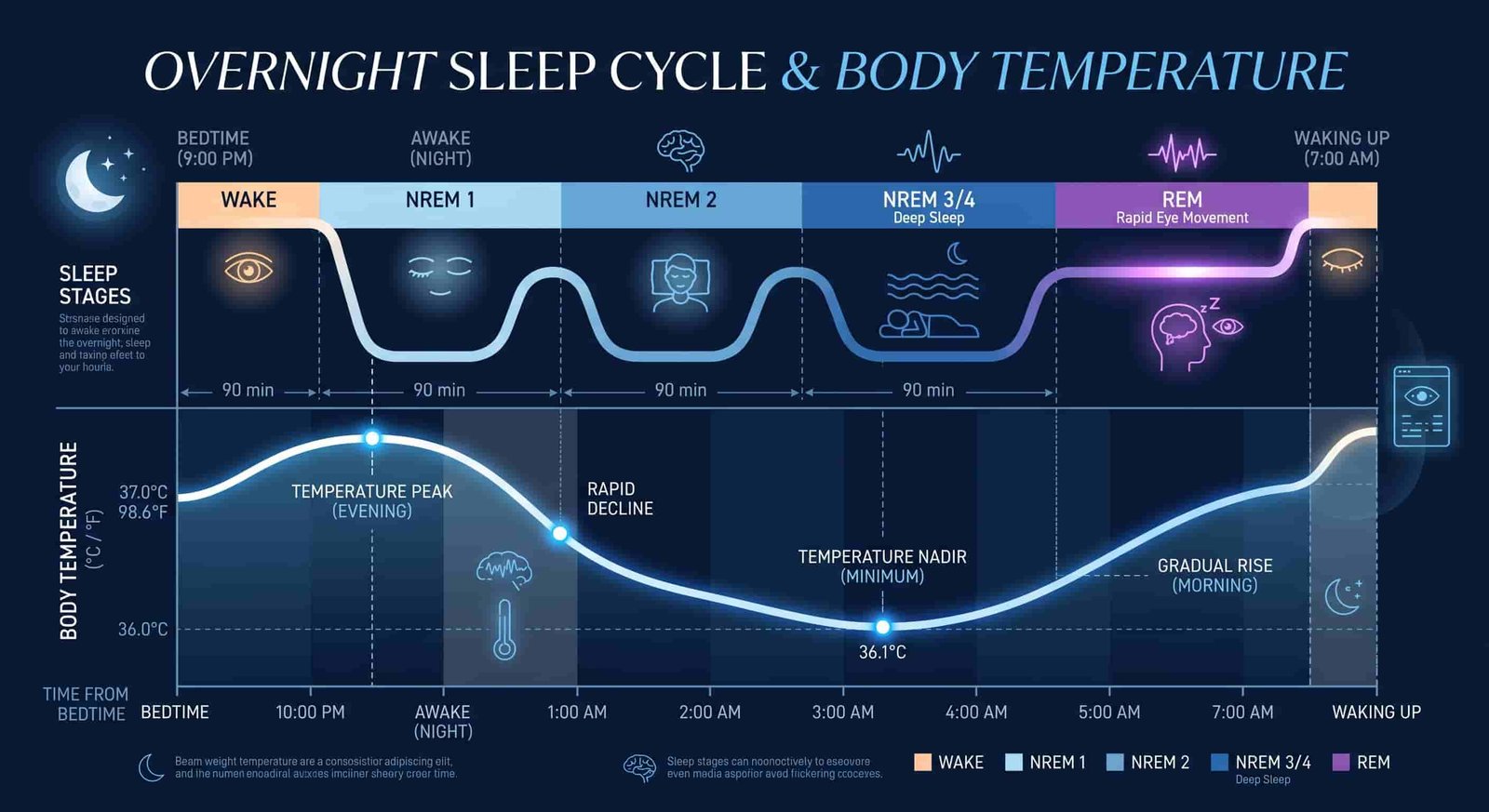
Better sleep tips & exclusive offers, straight to your inbox.

Curated sleep insights, early access to new products, and members-only deals.
No spam. You can unsubscribe anytime.