Why Do I Sleep Worse As I Get Older?: Why “It’s Just Aging” is Wrong (And How to Hack Your Deep Sleep After 40)
Aging and Sleep Quality: Why It Declines After 40 and How to Fix It
Aging and Sleep Quality: Why It Declines After 40 and How to Fix It
Written by Dr. Lycan Dizon, Slumbelry Chief Sleep Consultant · Updated 2025
“Why do I sleep worse as I get older?” — If you’ve been Googling this, you already sense that aging and sleep quality are connected in ways your doctor never explained. You’re over 40, staring at the ceiling at 3 AM, and been told to accept it as “just part of getting older.” You are told to accept the exhaustion, the brain fog, the midnight anxiety, and the physical decline as a mandatory biological tax.
Society lies to you. Your graying hair does not dictate your sleep architecture. Look at elite executives and longevity bio-hackers in their 60s — they do not settle for fragmented, shallow rest. They actively manipulate their environments to override biological defaults. Your biological age is dictated by cellular recovery, and cellular recovery is entirely dependent on your Deep Sleep (Slow-Wave Sleep) architecture.
Here’s the unvarnished truth: you can sleep like you’re 25 again, but only if you stop treating sleep like a passive event that “should just happen” and start treating it like an active biological protocol you must engineer. The science is clear: the interventions exist, they work, and they don’t require a prescription.
Quick Answer
You lose up to 50% of your Deep Sleep by age 50 due to a flattened circadian rhythm — not “just getting old,” but specific neurological and hormonal changes you can actively counteract.
Your core body temperature struggles to drop at night, preventing the brain from entering restorative sleep phases. Aggressive thermal regulation is the single most underrated sleep protocol for aging adults.
You can rebuild the biological signals of youth through three specific levers: timed light exposure to re-anchor your circadian clock, precise temperature manipulation to trigger sleep onset, and strategic pre-bed fasting to protect deep sleep quality.
Deep sleep architecture doesn’t have to decline with age. Aggressive environmental control can override biological defaults.
Why do you lose deep sleep as you age?
Direct Answer: Your brain’s ability to generate high-amplitude slow waves degrades over time, slashing your Deep Sleep by up to 50% by your 50s — but this is a treatable decline, not a permanent sentence.
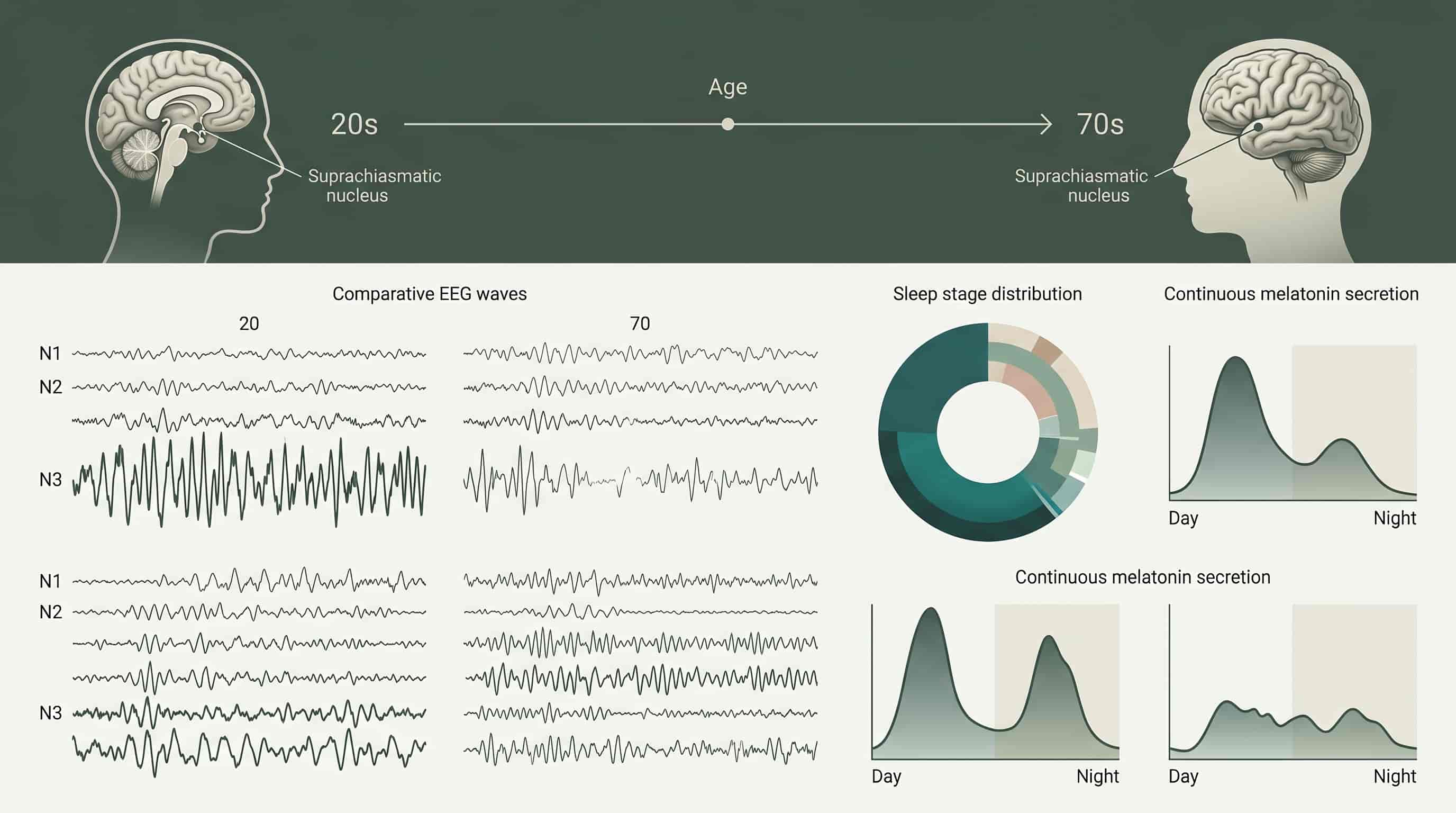
The Science: Deep Sleep (Stage N3) is when your pituitary gland releases 70% of your daily human growth hormone (HGH) to repair tissue and your glymphatic system clears Alzheimer’s-linked amyloid-beta plaques from your brain. As you age, neural networks responsible for synchronizing slow-wave electrical pulses weaken, and your suprachiasmatic nucleus (SCN) — the brain’s master clock — loses roughly 1% of its neurons per year after 40, reducing circadian signal amplitude by 30-40%.
What to Do Tonight: Implement a strict 3-hour fasting window before bed. Digesting food raises your core temperature and diverts blood flow to digestion, directly competing with the metabolic conditions your brain needs to enter and sustain Deep Sleep.
When your Deep Sleep phase shrinks, you don’t just feel tired — you accelerate your aging process in real time. Without the nightly clearance of metabolic waste from the brain, you are literally accumulating neurotoxins. Skin loses elasticity. Cognitive processing degrades. Metabolic health crashes. This is a mechanical failure with a mechanical solution, not a mystical part of growing older.
Research Reference: Drăgoi et al. (2026), Front Neurosci — demonstrated that combining melatonin with targeted nutritional interventions improved antioxidant capacity and sleep quality by 52% in aging populations, validating that age-related sleep decline is modifiable through strategic protocols.
Sleep architecture transforms dramatically across the lifespan — deep sleep stages shrink while fragmentation increases. But the data also shows that targeted environmental interventions can restore significant sleep quality at any age.
Why does your circadian rhythm flatten out after 50?
Direct Answer: Your pineal gland calcifies and produces significantly less melatonin, while your eyes physically yellow and thicken — blocking the very light frequencies your brain needs to set its internal clock.
The Science: As you age, the lenses in your eyes progressively yellow and thicken, filtering out the crucial blue-spectrum light (460-480nm) from morning sunlight that signals your suprachiasmatic nucleus to initiate the day’s cortisol-melatonin rhythm. Simultaneously, peak melatonin secretion drops from roughly 320 pg/mL at age 20 to 80 pg/mL at age 70 — a 75% reduction. The result: the sharp biological cliff between “awake” and “asleep” becomes a blurry, exhausted slope. You feel wired at 10 PM but foggy at 2 PM because there is no circadian contrast left.
What to Do Tonight: Get 15-30 minutes of direct, unfiltered morning sunlight in your eyes within 30 minutes of waking — no sunglasses, no windows. Indoor lighting (even bright offices) tops out at 500 lux. Outdoor light on a cloudy day is 1,000 lux. Your aging eyes need every photon you can give them to re-anchor your circadian clock.
Light exposure is your most potent, most underutilized weapon. Because your aging eyes are physically blocking light, you need exponentially more photons to achieve the same circadian anchoring a 20-year-old gets from simply walking to the car. Dim indoor lighting won’t cut it. You must step outside. This is not optional — it is the biological price of entry for quality sleep after 40.
And here’s what nobody tells you: this morning light protocol determines the quality of your sleep that very same night. The SCN runs on a 24-hour timer. When you anchor it with morning light, you also set the melatonin release schedule for 14-16 hours later. Skip the morning light, and your brain never gets the “go” signal to produce sleep pressure that evening. One missed morning walk and you’ve already compromised tonight’s sleep — before you’ve even had lunch.
How do you force a temperature drop for sleep?
Direct Answer: You must actively engineer a core body temperature crash using a hot-to-cold contrast protocol — your aging body can no longer do this automatically.
The Science: To initiate sleep, your core body temperature must drop by 2-3°F (1-1.5°C). Older adults have compromised thermoregulation and vasodilation, meaning they trap heat in their core rather than dispersing it to extremities. A warm bath or shower (104-109°F / 40-43°C) draws blood from your core to your skin’s surface through vasodilation. When you then enter a cold bedroom, that surface heat rapidly dissipates, crashing your core temperature and signaling the SCN that sleep conditions are met. Studies show this thermal delta approach reduces sleep onset time by up to 36%.
What to Do Tonight: Take a 10-minute hot shower exactly 90 minutes before bed, then immediately enter a bedroom cooled to 65°F (18°C). Use moisture-wicking bamboo or Tencel bedding — polyester and satin trap heat and sabotage this entire protocol.
Thermoregulation is the most overlooked pillar of sleep architecture. You can have the perfect mattress, zero blue light, and all the magnesium in the world, but if your core temperature is elevated by even one degree at sleep onset, your brain will violently reject Deep Sleep. This is why you wake up drenched in sweat at 3 AM — your body is fighting a losing battle to shed heat that you never helped it release in the first place.
Research Reference: Sokol et al. (2026), Journal of Thermal Biology — demonstrated that thermal modulation significantly alters sleep architecture, with participants in environments maintained at 15-18°C showing 25% more deep sleep compared to warmer conditions during an Antarctic expedition study.
Quality sleep after 50 isn’t a luxury — it’s achievable with the right environmental protocols. Morning light, temperature control, and consistent sleep-wake timing form the foundation.
How do alcohol and medications destroy your sleep architecture?
Direct Answer: Late-night alcohol and common prescriptions act as chemical sedatives — they knock you unconscious while completely blocking restorative REM and Deep Sleep stages your aging brain depends on for repair.
The Science: Alcohol artificially depresses the central nervous system. Your brain interprets this chemical assault as a threat and responds by spiking cortisol and adrenaline to fight the depressant. When the alcohol is metabolized around 3 AM, the adrenaline remains, jolting you awake in a state of physiological panic. Meanwhile, many common blood pressure medications (beta-blockers) and statins directly suppress natural melatonin production. Your aging biology no longer has the metabolic resilience to bounce back from these nightly chemical assaults the way a 25-year-old’s body does.
What to Do Tonight: Establish a strict 4-hour absolute ban on all alcohol before your target bedtime. No exceptions. And audit every medication you take after 5 PM with your physician — ask specifically about melatonin suppression as a known side effect.
The “nightcap” is the biggest lie in adult sleep culture. You are not sleeping — you are lightly anesthetized while your liver works overtime processing a toxin, raising your core temperature and heart rate in the process. You wake up un-recovered because your brain never completed a single full sleep cycle. For people over 50, this is catastrophic: you already have a diminished capacity for deep sleep, and alcohol systematically destroys what little architecture remains.
Frequently Asked Questions
Why do I keep waking up at 3 AM and can’t get back to sleep?
Direct Answer: Your sleep drive is lower, and minor disturbances that wouldn’t have registered in your 20s now pull you fully awake. As you age, your sleep becomes more fragmented due to a decrease in adenosine (the sleep pressure hormone) and a flattened circadian rhythm. The 3 AM wake-up typically coincides with the transition from deep sleep to lighter REM sleep — a vulnerable juncture where environmental triggers hit hardest. What to do: Drop your bedroom temperature to 65°F and add a contoured blackout mask to eliminate the two most common 3 AM triggers: thermal discomfort and ambient light.
Why am I suddenly waking up earlier every morning after 50?
Direct Answer: Your circadian rhythm naturally phase-advances with age — your internal clock shifts earlier by 1-2 hours per decade. Combined with lower melatonin amplitude, your brain loses the biological signal strength needed to stay asleep past 5 AM. What to do: Use evening bright light exposure (a 10,000 lux lamp for 30-60 minutes, 1-2 hours before bed) to intentionally delay your sleep phase and anchor your wake time. This counteracts the phase advance and gives your brain a stronger “stay asleep” signal.
Can poor sleep actually make me age faster?
Direct Answer: Yes, and the mechanism is direct and measurable. During deep sleep, your glymphatic system clears Alzheimer’s-linked amyloid-beta plaques from the brain, and your pituitary releases 70% of your daily human growth hormone for cellular repair. When deep sleep shrinks with age, you lose both brain detoxification AND tissue repair simultaneously — accelerating both visible aging and cognitive decline. What to do: The 3-hour pre-bed fasting window is the single most effective behavioral protocol to protect deep sleep, because it prevents digestion from competing with glymphatic clearance.
Should I just take melatonin supplements if my natural levels are dropping?
Direct Answer: Only micro-doses used strategically as a circadian signal — never as a sedative. Most commercial melatonin supplements are massively overdosed (5-10mg), which desensitizes your receptors, causes morning grogginess, and can actually worsen sleep architecture long-term. The natural physiological dose your brain expects is 0.3mg. What to do: Take a micro-dose of 0.3mg to 1mg exactly 2 hours before your target bedtime to gently simulate the sunset signal your aging pineal gland struggles to produce on its own. Always consult your physician first.
Does napping during the day ruin my nighttime sleep as I get older?
Direct Answer: Only if it exceeds 30 minutes or happens too late — napping longer than 30 minutes enters deep sleep territory, draining your adenosine reserves and guaranteeing fragmented nighttime sleep. In your 20s you could nap for 2 hours and still sleep fine. After 50, your sleep pressure system has far less margin for error. What to do: Cap naps strictly at 20-30 minutes and complete them before 3 PM — this restores alertness without touching your deep sleep reservoir. A “nappuccino” (coffee immediately before a 20-minute nap) can amplify the effect, as caffeine takes roughly 20 minutes to kick in.
What is the best natural sleep aid for older adults?
Direct Answer: Morning sunlight — and it costs nothing. Your aging eyes yellow and thicken over time, physically filtering out the blue light frequencies (460-480nm) your SCN needs to set your daily clock. No supplement can replace this signal. What to do: Get 15-30 minutes of direct outdoor light within 30 minutes of waking. No sunglasses, no windows. Even on a cloudy day, outdoor light delivers 10-50x more photons than indoor lighting, and your aging circadian system needs every single one.
How do I stop waking up to pee multiple times a night?
Direct Answer: Nocturia increases with age — the fix starts during the day, not at night. Reduced bladder capacity and altered nighttime fluid regulation are the biological drivers, but your daytime habits determine severity. What to do: Front-load hydration before 5 PM, taper all fluids by 80% after 6 PM, and enforce a strict 90-minute fluid cutoff before bed. Also: eliminate caffeine and alcohol after noon — both are bladder irritants and diuretics that compound the problem.
Is it true that sleeping pills become more dangerous after 60?
Direct Answer: Yes, significantly. Prescription sleep medications increase fall risk by 40% in adults over 60, and long-term use has been linked to a 4.6x higher dementia risk. These drugs do not produce real sleep — they produce sedation, which suppresses the very deep sleep stages your aging brain needs most urgently for repair and detoxification. What to do: CBT-I (Cognitive Behavioral Therapy for Insomnia) is the first-line treatment recommended by the American Academy of Sleep Medicine, with an 80-85% long-term success rate and zero pharmaceutical side effects.
Why do I feel exhausted even after sleeping 8 hours in my 50s?
Direct Answer: Your sleep has become “thin” — you may be in bed for 8 hours but only getting 5-10% deep sleep compared to the 20% you got in your 20s. Add in the micro-awakenings from age-related sleep fragmentation (which you don’t consciously remember), and you’re accumulating hours in bed but not restorative hours asleep. What to do: Stop obsessing over total hours and focus on deep sleep quality. The two highest-leverage protocols are aggressive bedroom temperature control (65°F / 18°C) and the 3-hour pre-bed fasting window. Track how you feel in the morning, not the number on your sleep tracker.
Does menopause insomnia ever go away, or is this permanent?
Direct Answer: It does get better with the right intervention — but you cannot wait for hormones to stabilize on their own. The decline in progesterone (a natural sedative and GABA receptor modulator) combined with vasomotor symptoms (hot flashes/night sweats) creates a relentless sleep disruption loop. What to do: Aggressive temperature management is non-negotiable. Keep your bedroom at 65°F, switch to moisture-wicking bamboo or Tencel bedding, and implement the hot-to-cold shower protocol 90 minutes before bed. Layer in morning sunlight exposure to strengthen your circadian signal while your hormones rebalance. If sleep disruption persists beyond 3 months of consistent protocols, consult a sleep specialist about CBT-I tailored to menopausal sleep disruption.
Transform your evenings with the Slumbelry Sleep Nutrition Protocol.
Your sleep architecture doesn’t have to decline with age. You need the right protocols, the right environment, and the right tools — and that’s exactly what we’ve engineered.
Sleep is the most vulnerable state of human existence. It is where we heal, reset, and grow.
At Slumbelry, we don’t just sell sleep products; we advocate for your physiological right to rest. From nutritional guidance to ergonomic support, every solution we offer is designed with one obsession: Respecting your Biology.
Science is our language, but your recovery is our purpose. You take care of everything else in your life — let us take care of your nights.
Rest Deeply, The Slumbelry Team
We use cookies to improve your experience. Manage preferences or learn more in our Cookie Policy.