
The Simple Shift That Turns Sleep From a Chore Into a Performance Tool
Stop Counting Sleep Hours. Start Counting Sleep Cycles.
⚡ Core Takeaway: The R90 System in 3 Sentences
- The 8-hour rule is a myth: Sleep is measured in 90-minute cycles, not hours. Think 35 cycles per week — not 8 hours per night.
- Wake time is sacred: Your fixed wake anchor — not your bedtime — is the most important sleep commitment you can make. It calibrates your entire circadian rhythm.
- One bad night is meaningless: Cycle debt is managed across a week, not corrected by going to bed early. Maintain the anchor, track weekly, and stop daily catastrophizing.
Key Facts at a Glance
- 90 minutes = one complete sleep cycle
- 35 cycles/week = R90 weekly target (5/night × 7 days)
- 5-6 cycles = typical nightly need (7.5-9 hours)
- 60% = glial cell shrinkage during N3 deep sleep
- 20-40 min = N3 deep sleep stage duration
- 1-3 PM = optimal nap window (circadian dip)
- 14 min = average sleep onset latency to add to bedtime

The R90 sleep method is a cycle-based framework that replaces the arbitrary 8-hour nightly target with a flexible weekly cycle goal of 35 cycles. Developed by British sleep coach Nick Littlehales and used by elite athletes across Premier League football and Olympic training, it is the most evidence-based approach to sleep optimization currently available. This guide covers every element of the R90 system — from calculating your perfect bedtime to timing your training schedule — so you can implement it starting tonight.
What Is the R90 Method — And Why the 8-Hour Rule Is a Myth
R90 is the sleep strategy pioneered by British sleep coach Nick Littlehales, used with elite athletes, that reframes sleep from “hours needed” to “90-minute cycles completed.” The 8-hour recommendation is a statistical average that ignores individual genetics, age, and chronotype — and forces millions of people into anxiety when they wake at 6 AM having “only” gotten 7 hours.
The Science: Why 8 Hours Is Industrial-Era Convention
Littlehales’ R90 research shows the brain operates in 90-minute cycles throughout the day — ultradian rhythms that govern alertness, digestion, and creativity. Applying the same cycle logic to night sleep reveals that waking mid-cycle (during deep sleep or REM) is the real cause of grogginess, not total hours. The 8-hour target is not biology — it is a cultural convention from the industrial era. The glymphatic system does not check a clock; it clears metabolic waste across full sleep cycles regardless of when you started.
Action step: Stop setting your alarm for 7 AM and back-calculating a bedtime. Instead, set your wake time first, then calculate your ideal bedtime by counting back in 90-minute increments: 7:00 AM → 5:30 AM → 4:00 AM → 2:30 AM → 11:00 PM → 9:30 PM.
The 90-Minute Sleep Cycle — What Actually Happens in Each Stage
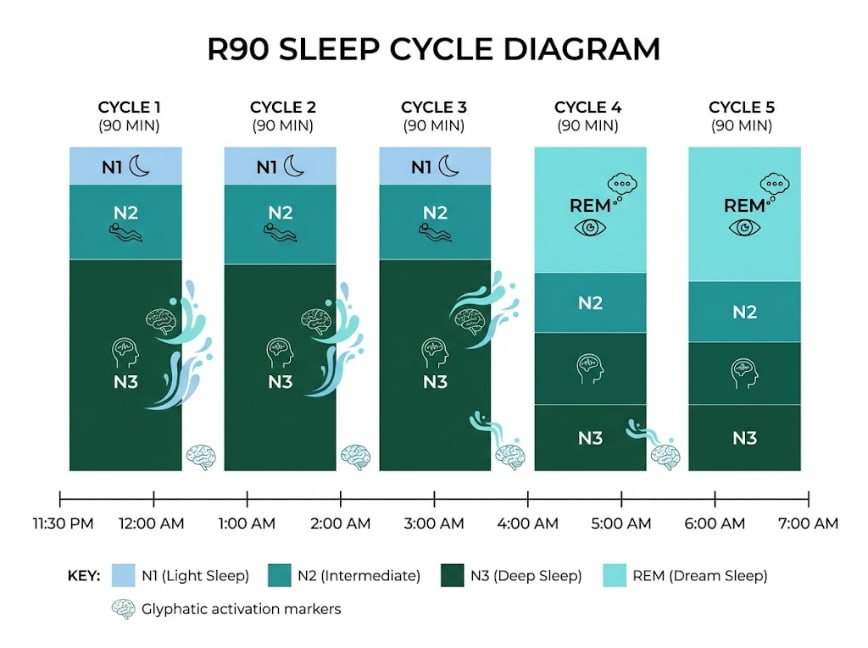
Each 90-minute cycle moves through four stages: N1 (drowsiness), N2 (light sleep with memory consolidation), N3 (deep sleep with glymphatic cleansing), and REM (dream sleep with emotional processing). Waking mid-N3 is the physiological cause of that “concrete limbs” grogginess — not the number of hours you slept.
The Four Stages: A Complete Cycle Breakdown
N1 (1–5 minutes): The transition from wakefulness. Brain waves shift from alpha to theta. Easily disturbed. N2 (10–25 minutes): Light sleep. Heart rate slows, body temperature drops. The brain begins consolidating memories — skills learned during the day are processed here. N3 (20–40 minutes): Deep sleep. Glial cells shrink by 60%, cerebrospinal fluid flushes through the brain clearing beta-amyloid and metabolic waste. This is where physical recovery happens. REM (10–60 minutes): Brain is as active as waking. Noradrenaline completely shut off — the only stress-free state in 24 hours. Emotional memories are processed and stripped of their acute sting.
Action step: Learn to recognize what waking at different cycle points feels like. Waking after 4 full cycles (6 hours) and feeling refreshed means you completed the deep sleep and REM your brain needed. Waking mid-cycle and feeling destroyed means you interrupted it — not that you need more hours.
The Weekly Cycle Target — Why 35 Cycles Changes Everything
R90 replaces the anxiety of nightly 8-hour targets with a forgiving weekly cycle target of 35 cycles (approximately 5 cycles per night × 7 days). This removes the psychological pressure of “I failed tonight” and replaces it with a sustainable long-term average.
Why Weekly, Not Nightly
Littlehales designed this framework from his work with Premier League footballers who travel constantly, play matches at odd hours, and experience disrupted nights. A fixed wake time plus a weekly cycle target accommodates late nights, early mornings, and disrupted nights without the panic of a single bad night. If you miss 2 cycles one night, you have 4 extra to absorb across the week without any biological cost. The glymphatic system and memory consolidation both operate on a weekly cadence, not a nightly judgment.
Action step: Track your cycles for 7 days without changing anything. At the end of the week, add them up. If you are above 35, you are in surplus. If you are below, note which days were short — but do not catastrophize.
R90 vs. The Traditional 8-Hour Method
| Factor | R90 Method | 8-Hour Rule |
|---|---|---|
| Unit of measure | 90-min cycles (5-6/night) | Hours (8/night) |
| Weekly target | 35 cycles/week | 8 hours/night |
| Wake time | Fixed anchor (non-negotiable) | Flexible |
| Missed night | Absorbed into weekly total | Causes panic/compensation |
| Grogginess cause | Waking mid-cycle | Not explained |
| Evidence base | Elite athlete protocols | Population average |
| Adaptability | Shift workers, travelers | Rigid |
| Psychological load | Low (weekly, forgiving) | High (nightly judgment) |
How to Calculate Your Perfect Bedtime Using Backward Math
The most powerful R90 tool is backward calculation from your fixed wake time. If you need to wake at 6:30 AM and want 5 cycles, your ideal bedtime is 10:00 PM. If you want 6 cycles, it is 9:00 PM. Never choose a bedtime arbitrarily — always calculate it.
How to Calculate Your Ideal Bedtime with R90
- Set Your Fixed Wake Time — Choose a wake time you can keep every day, including weekends.
- Count Backward in 90-Minute Blocks — 5 cycles before wake time = ideal bedtime. Example: 6:30 AM wake → 11 PM bedtime.
- Add Sleep Onset Latency — Add ~14 minutes to bedtime to account for time to fall asleep.
The Anchor Night — Why Your Wake Time Is Non-Negotiable
The most counterintuitive R90 rule: even if you go to bed at 3 AM, wake up at your fixed time. Skipping your anchor wake time is the single fastest way to destroy your circadian rhythm and lose the entire week’s cycle target.
The Science of the Wake-Time Anchor
James Maas’ research on circadian rhythm confirms: the wake time signal is the strongest zeitgeber (time-giver) for the suprachiasmatic nucleus (SCN). Every time you sleep in past your anchor, you send a confusing signal that shifts your entire circadian phase — equivalent to traveling across time zones. The SCN uses wake time to calibrate when to release melatonin, when cortisol should peak, and when adenosine should accumulate. Without a consistent anchor, none of these signals can establish a reliable pattern — which is why shift workers who rotate schedules experience chronic jet lag.
Action step: Set your wake time alarm for the same time every day, including Saturdays. If you go to bed late, you still wake on time and absorb the cycle debt into your weekly total. No exceptions.
Napping Strategically — CRP and the Nappuccino
Planned naps are a performance tool, not a sign of weakness. The key is timing them in 90-minute multiples (one full cycle) or 30-minute singles (one-third cycle) to avoid sleep inertia — the grogginess from waking mid-cycle. The ideal nap window is 1–3 PM when the circadian rhythm naturally dips.
⚡ The Three Nap Types
- Power Nap (20 min): Restores alertness for 3-4 hours. Do not enter deep sleep. Best before 3 PM.
- Full Cycle Nap (90 min): Completes one full N1-N2-N3-REM cycle. Use when replacing missed overnight cycles. Afternoon only.
- Nappuccino: Drink coffee, immediately nap 20 minutes. Caffeine kicks in as you wake. One per day max, never after 2 PM.
The Ideal Sleep Position — Fetal Position and the Spinal Alignment Rule
The optimal sleep position for most adults is the fetal position, lying on the opposite side of your dominant hand (right-handed → left side). This protects your instinctual dominant side and, combined with a pillow that maintains spinal alignment, produces the deepest, most restorative sleep.
The Straight Line Rule
Littlehales’ research with elite athletes found that head, neck, and spine must form a straight line in any sleep position. If the pillow is too high or the mattress too soft, the cervical spine bends, causing micro-awakenings from discomfort that fragment deep sleep. The fetal position also naturally restricts airway collapse — beneficial for those with mild snoring. Slumbelry’s pillow and mattress engineering is calibrated to maintain this “Golden Line” across all sleep positions.
Action step: Lie on your non-dominant side with knees slightly bent. Check in a mirror: if your head is tilted, your pillow height is wrong. If your spine looks curved, your mattress lacks proper support.
What Happens When You Miss a Night — Cycle Debt vs. Panic
One bad night of sleep is biologically insignificant if you maintain your weekly cycle target. The panic reaction — going to bed earlier, checking sleep scores, calculating deficits — is what actually causes the second bad night. Sleep debt is real, but it’s managed across weeks, not hours.
Why Panic Is the Real Problem
Walker’s two-process model shows adenosine accumulates with wakefulness and is cleared during sleep. A single disrupted night means you clear less adenosine — but the accumulation resumes at the same rate. What matters is the weekly clearance average, not any single night. The glymphatic system’s efficiency is affected by total sleep time, but it recovers quickly with one full night of good sleep. Anxiety triggered by a bad night activates the sympathetic nervous system — the very state that prevents the next night’s sleep from being restorative.
Action step: If you slept poorly: maintain your fixed wake time, absorb the deficit into your weekly total, and trust the system. Do not go to bed earlier, do not nap excessively, do not track obsessively.
Sleep Cycles and the Gym — How to Time Training Around Your Rhythm
Training too close to your natural sleep window elevates cortisol and body temperature, delaying sleep onset and fragmenting the cycles you need for recovery. Morning and early afternoon training aligns with the circadian peak in muscle temperature, reaction time, and strength.
⚡ Training Timing Guidelines
- Before 3 PM: High-intensity training (HIIT, weights, running). Core body temperature and cortisol are at optimal levels for performance.
- 4–6 PM: Moderate-intensity only. Body temperature peaks here — too late for peak performance but acceptable for maintenance.
- After 7 PM: Light movement only (walking, yoga, stretching). No high-intensity work. Cold shower 30 min before bed to accelerate core temperature drop.

The Slumbelry Framework — R90 as Part of a Complete Sleep System
R90 works best when your bedroom environment fully supports the parasympathetic state. A zero-motion mattress that isolates partner movement, blackout curtains that eliminate light completely, and 18–20°C room temperature all compound the benefits of a well-calculated cycle target.
Why the Schedule Is Only as Good as the Environment Protecting It
Walker confirms that glymphatic activation is most efficient during the deepest N3 stages — which are also the most easily disrupted by light, temperature fluctuations, and physical movement. Slumbelry’s Sleep System protects those cycles at every layer: an ergonomic mattress maintains spinal alignment during the fetal position, cooling technology maintains the core temperature drop required for sleep onset, and sound masking eliminates the auditory triggers for micro-arousals. The schedule tells your brain when to sleep; the environment lets it.
Action step: Calculate your R90 schedule first. Then audit which environmental factor is most disrupting your cycles — and fix it. The schedule optimization is only as good as the environment protecting it.
Looking for the right support? The Zeno Butterfly Pillow is engineered to maintain the Golden Line across all sleep positions — a key part of the R90 protocol.
Frequently Asked Questions About the R90 Sleep Method
What is the R90 sleep method and where did it come from?
The R90 sleep method was developed by British sleep coach Nick Littlehales, author of ‘Sleep: The Myth of 8 Hours, the Power of Naps, and the New Plan to Recharge Your Body and Mind.’ Based on research with elite athletes including Premier League footballers and Olympic teams, R90 reframes sleep from a nightly hour target to a weekly cycle target. The core principle: sleep consists of 90-minute cycles (N1 → N2 → N3 → REM) and waking at the right point in the cycle matters more than total hours. The target is 35 cycles per week.
Why is the 8-hour sleep recommendation a myth?
The ‘8 hours per night’ recommendation is a statistical average from large population studies — it ignores individual genetics, age, chronotype, and activity level. Some adults function optimally on 5 cycles (7.5 hours); others genuinely need 6-7 cycles (9-10.5 hours). What matters is completing full cycles without mid-cycle interruption, not hitting an arbitrary number. Matthew Walker’s research confirms the glymphatic system and memory consolidation functions of sleep are cycle-dependent, not hour-dependent.
How do I calculate my perfect bedtime using R90?
First, set a fixed wake time you can maintain 7 days a week. Second, count backward in 90-minute blocks: if you need to wake at 6:30 AM and want 5 cycles, your ideal bedtime is 10:00 PM (5 cycles: 6:30 AM → 5:00 AM → 3:30 AM → 2:00 AM → 12:30 AM → 11:00 PM). Add 14 minutes for average sleep onset latency. If you want 6 cycles, your bedtime is 9:00 PM. Use this calculation, not intuition, to set your bedtime.
What’s the most important rule in R90?
Your fixed wake time is the single most important commitment. Never skip it — even if you went to bed at 3 AM. The wake time is the anchor that calibrates your entire circadian rhythm. Skipping it sends your SCN a confusing signal equivalent to traveling across time zones. This one rule — never vary your wake time by more than 30 minutes — has more impact on sleep quality than any other habit.
How many cycles do I actually need?
Most adults need 5-6 cycles per night (7.5-9 hours), which translates to 35-42 cycles per week. If you’re new to R90, start at 5 cycles and assess after 2 weeks: do you wake without an alarm feeling refreshed? If yes, stay at 5. If you’re consistently tired, increase to 5.5 or 6 cycles. Athletes in heavy training may need 6-7 cycles for full recovery.
Can I make up missed sleep with naps?
Yes — strategically. A 90-minute afternoon nap (one full cycle) can replace 1-2 missed overnight cycles. A 20-minute power nap before 3 PM restores alertness without affecting nighttime sleep. Never nap after 4 PM. If you missed 3+ cycles overnight, a 90-minute afternoon nap is the most efficient recovery tool.
What’s the Nappuccino and does it work?
The Nappuccino is a performance hack: drink a cup of coffee immediately before taking a 20-minute nap. Caffeine takes approximately 20 minutes to cross the blood-brain barrier and block adenosine receptors. By the time you wake from the nap, the caffeine kicks in, combining the restorative benefit of light sleep with the alertness boost of caffeine. Used by athletes and executives, it provides 3-4 hours of enhanced alertness. Do not exceed one Nappuccino per day, and never after 2 PM.
What’s the best sleep position for R90?
The fetal position on your non-dominant side (right-handed → left side, left-handed → right side) is recommended by Littlehales as the optimal position for most adults. This protects your instinctual dominant side and, combined with a pillow that maintains spinal alignment (head, neck, and spine forming a straight line), produces the deepest, most restorative sleep. Back sleeping is acceptable but not optimal; stomach sleeping actively disrupts the fetal position’s spinal benefits.
Does R90 work for shift workers with irregular schedules?
R90 was specifically designed for shift workers and frequent travelers. The anchor wake time remains the priority, but shift workers can use ‘anchor sleep’ — a consistent 4-hour core sleep period at the same time each day — plus variable supplementary sleep blocks. The key is protecting the circadian anchor while being flexible about total cycle accumulation across a 24-hour window rather than a single night.
How does R90 interact with exercise and training?
High-intensity training within 3 hours of your calculated bedtime raises core body temperature and activates the sympathetic nervous system — directly opposing the parasympathetic state required for sleep onset. For athletes, complete intense training by 4 PM. Light evening exercise (walking, yoga) is acceptable. Post-training, a cold shower accelerates core temperature decline and signals the body toward sleep readiness. Avoid high-glycemic recovery meals within 2 hours of bedtime.
Is the R90 method scientifically backed?
Yes. R90 is built on established sleep science — ultradian rhythms (90-min cycles), Matthew Walker’s research on the glymphatic system and memory consolidation, and chronobiology. It has been validated in practice by elite athletes, particularly Premier League footballers. However, individual results vary, and R90 should complement — not replace — professional medical advice for diagnosed sleep disorders like insomnia or sleep apnea.
How long does it take to see results with the R90 method?
Most people notice reduced morning grogginess within 1-2 weeks of establishing a fixed wake time and tracking cycles. Full adaptation — including stable weekly cycle counts — typically takes 2-4 weeks. The key is consistency: a fixed wake anchor, tracking cycles weekly rather than daily, and trusting the forgiveness of the 35-cycle weekly target.
Ready to Reclaim Your Sleep From the 8-Hour Myth?
The R90 method works best when your environment protects the cycles you’ve calculated. Discover the sleep system that supports your biology — not just your schedule.
Take the Sleep Assessment Subscribe for Sleep Optimization TipsThe Slumbelry Commitment
Sleep is the most vulnerable state of human existence. It is where we heal, reset, and grow.
At Slumbelry, we do not just sell sleep products; we advocate for your physiological right to rest. From ergonomic support to light management, every solution we offer is designed with one obsession: Respecting your Biology.
Science is our language, but your recovery is our purpose. You take care of everything else in your life — let us take care of your sleep.
Rest Deeply,
The Slumbelry Team
Medical References:
1. Littlehales, N. (2016). Sleep: The Myth of 8 Hours, the Power of Naps, and the New Plan to Recharge Your Body and Mind. Da Capo Lifelong Books.
2. Walker, M. (2017). Why We Sleep. Scribner.
3. Maas, J. B. (1998). Power Sleep. HarperCollins.