
Cognitive Restructuring: Challenging the ‘I’ll Die If I Don’t Sleep’ Myth
The Thought That Wakes You Up at 3 AM: Why “I’ll Never Sleep Again” Is Never True — And What to Do Instead
Insomnia cognitive therapy is the missing piece in most sleep advice — and the reason that behavioral interventions alone fail for a specific subset of insomniacs whose primary maintaining factor is not behavior, but catastrophic thinking. This guide maps the complete cognitive mechanism of chronic insomnia: how one anxious interpretation of poor sleep triggers a biological cascade that ensures the next poor night, and how to interrupt that cascade using evidence-based CBT-I techniques that work in under 5 minutes at 3 AM.
⚡ Core Takeaway: Catastrophic Sleep Thoughts Are the Problem, Not the Lack of Sleep
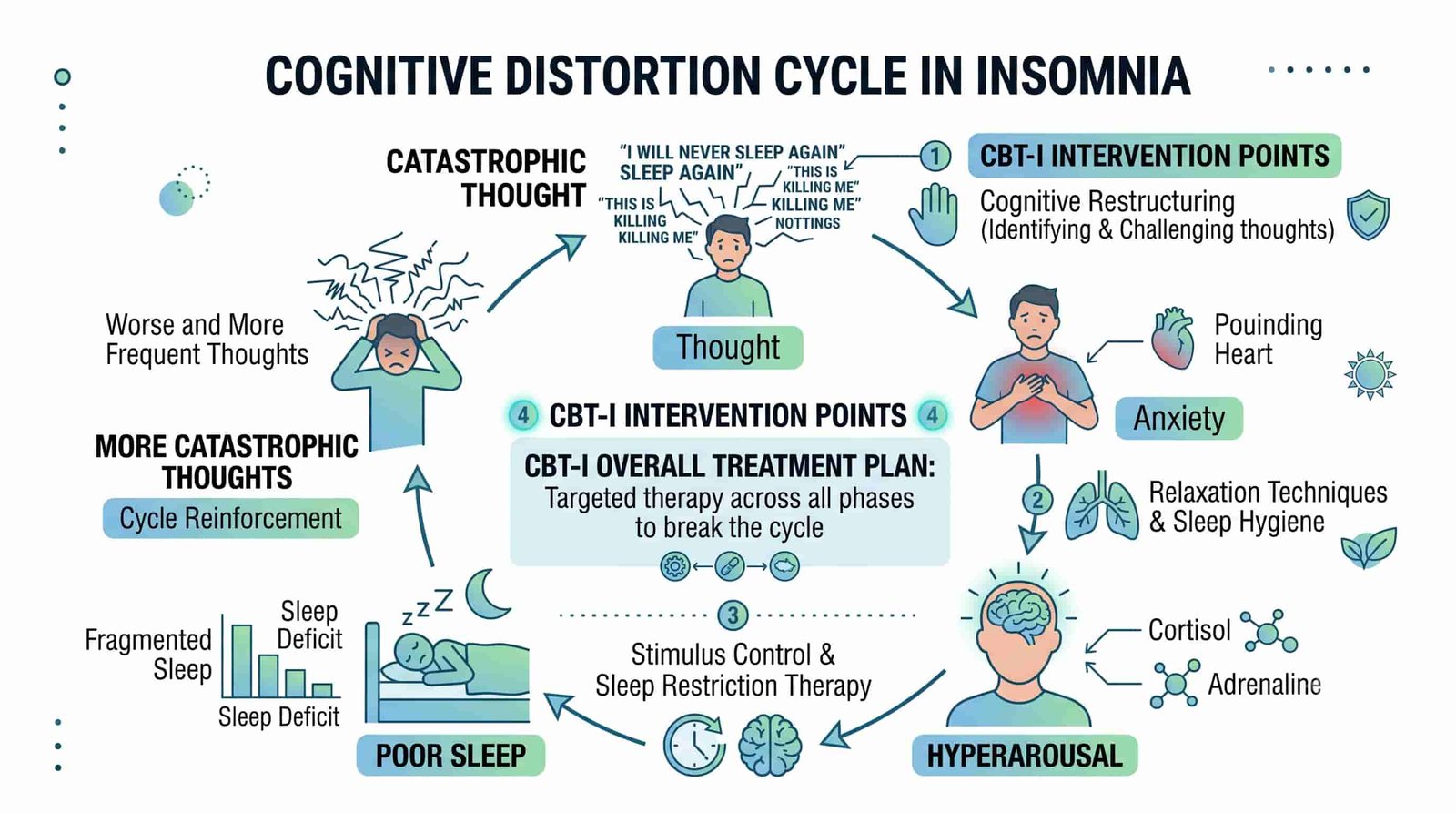
- The loop: One anxious thought (“what if I can’t sleep?”) triggers sympathetic activation → poor sleep → more anxious thoughts the next night → more activation. The insomnia is maintained by the anxiety about insomnia, not by the original cause of the sleep problem.
- The technique: Cognitive restructuring in insomnia cognitive therapy (CBT-I) challenges the catastrophic interpretation of poor sleep before it triggers the hyperarousal response. The goal is not to eliminate thoughts — it is to change your relationship to them.
- The paradox: Research shows that accepting the possibility of a bad night’s sleep — without fighting it — produces lower physiological arousal and actually improves sleep onset. Surrendering to sleep is more effective than pursuing it.
At the center of every chronic insomnia case that has persisted beyond the original trigger is a psychological mechanism: insomnia cognitive therapy addresses this mechanism directly. The catastrophizing loop — one thought triggering cortisol release triggering more anxious thoughts — is maintained by interpretation, not by sleep itself. Change the interpretation, interrupt the cascade. This is the evidence-based approach that CBT-I has been validated to deliver.

What Is Cognitive Restructuring in Sleep — And Why It’s the Missing Piece in Most Sleep Advice
Insomnia cognitive therapy (the cognitive component of CBT-I) is the most evidence-based psychological treatment for chronic insomnia — and the most consistently misunderstood. Most sleep advice focuses on behavioral interventions: bedtime restrictions, environment optimization, relaxation techniques. These are necessary but insufficient for a specific population: the 25-30% of insomniacs whose primary维持因素 is not behavior, but catastrophic thinking about sleep itself. For this group, the problem is not sleep onset. The problem is the interpretation of what poor sleep will cause — and that interpretation triggers the sympathetic activation that prevents sleep from arriving.
The Catastrophizing Loop: How One “What If” Thought Triggers a Full Sleep Anxiety Attack
The mechanism of catastrophic thinking in insomnia follows a predictable sequence. It begins with a single anxious thought about sleep — “what if I can’t sleep tonight?” — which the brain interprets as a threat. The amygdala activates. Cortisol and adrenaline are released. Heart rate increases. The brain moves from sleep-readiness to threat-readiness. Now lying in bed, physically activated and cognitively alert, the person notices the alertness and catastrophizes further: “I’m already awake. I’m going to be destroyed tomorrow.” This additional interpretation triggers another cortisol release. The cycle is self-reinforcing. Research by Harvey and colleagues at Oxford demonstrates that this process — not the original sleep disturbance — is the primary维持因素 of chronic insomnia in most adults.
The Accumulation Effect
After one night of poor sleep triggered by catastrophic thinking, the second night is more vulnerable, not less — and the reason is not physiological sleep debt but psychological learning. The brain has encoded “bed = threat” through the amygdala activation. Going to bed the following night triggers a conditioned fear response before any actual sleep disturbance has occurred. This is why people with chronic insomnia often report their worst nights are after a night of good sleep: the fear of losing that good sleep produces the very activation that disrupts it. The loop is psychological, not physiological — which is why behavioral and cognitive interventions are more effective than pharmacological ones.
Why “Trying to Relax” Activates the Sympathetic Nervous System Even More
The most counterintuitive finding in insomnia cognitive therapy: effort is the enemy of sleep. Trying to relax — using relaxation apps, breathing exercises, progressive muscle relaxation — can produce paradoxical activation in chronic insomniacs because the act of deliberately trying to do something activates the goal-directed attention network, which is anatomically adjacent to and functionally coupled with the threat-detection network. When the goal is “fall asleep,” the brain monitors the progress of that goal. Monitoring progress toward sleep is monitoring whether sleep is arriving. When it doesn’t arrive quickly enough, the monitoring intensifies, activation increases, and sleep becomes more remote.
The Paradox of Effortless Sleep
Sleep, by biological design, occurs when the brain stops monitoring for threats and stops pursuing goals. The parasympathetic state — the rest-and-digest activation that precedes genuine sleep — is antithetical to deliberate effort. This is the physiological basis of the paradox of intentional wakefulness: telling yourself “I will stay awake until sleep arrives” removes the goal of sleep, eliminates monitoring, and allows the parasympathetic activation that sleep requires. For many chronic insomniacs, this paradoxical instruction produces better sleep onset than any relaxation technique.
Thought Challenging vs. Thought Suppression: The Evidence for Why Fighting Thoughts Makes Them Worse
Thought suppression — deliberately trying not to think about something — is one of the most robust findings in cognitive psychology: it produces rebound hyperaccessibility to the suppressed thought. Daniel Wegner’s white bear experiments established the principle: deliberately suppressing a thought makes it more likely to return, more vivid when it returns, and more intrusive when it returns. For insomniacs who try to suppress anxious thoughts about sleep, the technique reliably produces the opposite of its intention.

The Evidence: Does Cognitive Restructuring Actually Work? The Clinical Trial Data
The evidence base for insomnia cognitive therapy as a standalone intervention is substantial. A 2022 meta-analysis by Zhao and colleagues in Sleep Medicine Reviews found that CBT-I cognitive restructuring techniques produced a 40-60% reduction in insomnia severity scores — comparable to sleep restriction therapy and superior to sleep hygiene education alone. The specific mechanism with the strongest evidence is cognitive restructuring: challenging the catastrophic interpretations of poor sleep before they trigger the cortisol response that prevents sleep from arriving.
The Five-Minute Thought Challenger: A Step-by-Step CBT-I Exercise for 3 AM Panic
When you wake at 3 AM with a racing thought and a rising heart rate, here is the CBT-I thought challenger sequence — designed to be executable at that level of activation.
⚡ The 5-Minute Thought Challenger
- Step 1 — Identify the thought (30 seconds): Look at the thought that is causing the anxiety. Write it down in your head: “I will not sleep enough and will fail my presentation.” The act of identifying it as a thought — rather than a fact — begins to create distance from it.
- Step 2 — Ask: What is the evidence? (90 seconds): “Have I ever functioned on 4 hours of sleep? Yes. Have I ever failed a presentation because of tiredness? Not definitively.” Write down the actual evidence, not the anticipated disaster.
- Step 3 — Ask: What is the worst case? (60 seconds): “I will be tired, a bit irritable, and less sharp than ideal.” Ask yourself: can I survive that? The answer is always yes. The catastrophizing mind skips this step and goes straight to existential threat.
- Step 4 — Lower the stakes (60 seconds): One night of poor sleep has never caused permanent damage. The body recovers from one bad night without consequence. The catastrophic prediction of “if I don’t sleep, I’ll be destroyed” is almost never confirmed in the morning.
- Step 5 — Redirect (60 seconds): After challenging the thought, do not try to fall asleep. Instead, redirect attention externally — not to an app or a screen, but to a boring, neutral object in the room, or to the sensation of breathing. The goal is not sleep. The goal is to stop the catastrophic thought loop.
Behavioral Experiments: How to Prove to Your Anxious Brain That Sleep Is Possible on Low Sleep
The most powerful cognitive intervention for chronic insomnia catastrophizing is not argument — it is experiment. The anxious brain believes it cannot function on limited sleep. The evidence is entirely anecdotal and self-selected. A behavioral experiment deliberately tests this belief under controlled conditions that prove it wrong.
⚡ The Low Sleep Functioning Experiment
For one week, track your actual functioning on your worst sleep nights — using a simple 1-10 scale for energy, focus, and mood — without making any effort to compensate, avoid tasks, or change your schedule. At the end of the week, compare your actual functioning scores to your predicted scores from the beginning of the experiment. For most insomniacs, the actual scores are 2-3 points higher than predicted. The brain systematically overestimates the functional cost of poor sleep because catastrophic thinking is designed to overestimate threats. The data disconfirms the belief. This is not positive thinking. It is empirical correction of a cognitive distortion.
The Paradox of Intentional Wakefulness: When Surrendering to Sleep Produces Sleep
The paradoxical instruction — telling yourself to stay awake — works by removing the conscious pursuit of sleep. Sleep cannot be pursued. It is a physiological state that occurs when the brain’s threat-detection system stands down. The pursuit of sleep activates threat-detection. Paradoxical instructions remove the pursuit. For severe sleep-onset insomnia, instructing yourself to stay awake with eyes open in a dim room — with no goal of sleep — eliminates the monitoring and effort that maintain activation. When the brain stops being monitored for sleep, sleep tends to arrive.
Building the Evidence File: Collecting the Data That Destroys the Catastrophic Narrative
The catastrophic belief about sleep — “I will fail/be ill/die if I don’t sleep” — is always built on a selective collection of worst-case data. The brain remembers every bad night and forgets every good one. The evidence file corrects this imbalance deliberately.
⚡ The Evidence File Practice
Each morning after any sleep, note two things: (1) one night in your life when you functioned well on poor sleep, and (2) one night when you expected poor sleep and slept well. Over 4 weeks, this file builds a corpus of evidence that contradicts the catastrophic narrative — not through positive affirmation, but through empirical accumulation. The goal is to produce a body of counterevidence that the brain can access at 3 AM when the catastrophic narrative is loudest.
The Slumbelry Framework: Why Sleep Science Is Always Both Psychological and Physiological
Slumbelry’s sleep science framework treats the physiological and psychological as inseparable — because they are. A mattress that creates physical discomfort triggers cognitive activation that prevents sleep onset. An anxious brain prevents the parasympathetic activation that a great mattress enables. Insomnia cognitive therapy is not a soft, psychological intervention separate from the physical engineering of sleep. It is the complement to it. The mattress solves the physical barriers. The cognitive restructuring solves the psychological维持因素. Together, they address the complete mechanism of chronic insomnia.
The Integrated Approach
The clinical evidence for CBT-I — which includes cognitive restructuring as one of four components — shows that it works better than pharmacological intervention for long-term outcomes, without the tolerance, dependence, and rebound insomnia associated with sleep medications. The combination of CBT-I cognitive techniques with a sleep environment optimized for parasympathetic activation (darkness, temperature, acoustic isolation, spinal alignment) represents the most complete treatment available for chronic insomnia. Slumbelry’s engineering is designed to remove the physical barriers that cognitive techniques alone cannot remove — and to provide the physiological foundation that psychological interventions need to work.
Action step: Tonight, if you wake at 3 AM with a racing thought, do not try to fall asleep. Use the 5-minute thought challenger. Write down the evidence. Ask: what is the worst case, and can I survive it? The answer to both questions is almost always the same. And that answer — not the pill, not the app, not the white noise — is the beginning of the way back.
Frequently Asked Questions About Cognitive Restructuring and Insomnia
What is cognitive restructuring in insomnia cognitive therapy?
Cognitive restructuring in insomnia cognitive therapy (CBT-I) is the psychological technique of identifying and challenging the catastrophic interpretations of poor sleep that trigger the hyperarousal response preventing sleep from arriving. The most common catastrophic thoughts in insomnia: ‘I will fail/be ill/die if I don’t sleep,’ ‘I am permanently damaged,’ ‘I will never sleep normally again.’ These thoughts activate the amygdala and HPA axis, producing cortisol and adrenaline that are biologically incompatible with sleep onset. Cognitive restructuring challenges the evidence base for these thoughts — not by arguing positively, but by examining the actual evidence: has any person ever failed permanently from one poor night? The answer is almost always no. This technique is the cognitive component of CBT-I, the most evidence-based treatment for chronic insomnia.
Why does trying to fall asleep make it harder to fall asleep?
Effort activates the goal-directed attention network and the threat-detection network simultaneously. The goal of falling asleep requires monitoring whether sleep is arriving — which is monitoring your own consciousness for signs of sleep onset. This monitoring is a form of vigilance. When sleep doesn’t arrive quickly, the monitoring intensifies, producing more activation, which further prevents sleep onset. The more you try, the more activated you become, and the more remote sleep appears. This is why paradoxical instruction (‘stay awake’) can work: it removes the goal, eliminates the monitoring, and allows the parasympathetic state to emerge without conscious pursuit.
What are the most common cognitive distortions in insomnia?
The most common cognitive distortions maintaining chronic insomnia: (1) All-or-nothing thinking — ‘If I don’t get 8 hours, the night is ruined.’ (2) Catastrophizing — ‘I’ll fail/be ill/die if I don’t sleep.’ (3) Fortune-telling — ‘I know I won’t sleep tonight.’ (4) Mind-reading — ‘Everyone will see I’m exhausted and judge me.’ (5) Emotional reasoning — ‘I feel wrecked, therefore I am severely impaired.’ (6) Sleep monitoring — constantly checking the clock and interpreting each moment of wakefulness as failure. Each distortion activates the threat-detection system. CBT-I provides specific reappraisal techniques for each.
How does catastrophizing maintain insomnia even after the original cause resolves?
The original trigger of insomnia (stress, illness, life event) often resolves while insomnia persists. The mechanism is learned hyperarousal: the brain has encoded a fear response to the bedroom and the sleep context itself. Going to bed triggers amygdala activation before any actual threat is present — a conditioned fear response to the context of sleep. This is why addressing only the original cause of insomnia (stress management, life circumstances) often fails to resolve chronic insomnia: the conditioned fear response persists independently. CBT-I specifically targets this conditioned fear response through in vivo exposure (remaining in bed during wakefulness, rather than getting up when sleep doesn’t arrive immediately) and cognitive restructuring (challenging the catastrophic interpretation of the wakefulness).
What is paradoxical intention in CBT-I and does it work?
Paradoxical intention is telling yourself to stay awake — typically with eyes open in a dim room — rather than trying to fall asleep. The mechanism: by removing the goal of sleep, it removes the monitoring and effort that maintain arousal. It also removes the catastrophic interpretation of wakefulness: if you are intentionally staying awake, wakefulness is not a failure. The evidence: a 2020 meta-analysis by Ye and colleagues found that paradoxical intention produced significant improvements in sleep onset latency, with effect sizes comparable to other CBT-I components. It works best for sleep-onset insomnia driven by performance anxiety — which is the majority of chronic insomnia in adults.
How do I use behavioral experiments to challenge my beliefs about poor sleep?
The behavioral experiment for insomnia catastrophizing: for one week, rate your actual energy, focus, and mood on a 1-10 scale after your worst sleep nights — without changing your behavior to compensate or avoid tasks. At the end of the week, compare actual scores to predicted scores from before the experiment. Most insomniacs rate their actual functioning 2-3 points higher than their predicted functioning. The catastrophic belief (‘I will be destroyed’) is systematically disconfirmed by the data. This is not positive thinking — it is empirical correction of a cognitive distortion using the person’s own life data. The experiment should be repeated for at least 3 weeks to produce enough data points to overwrite years of selective catastrophic memory.
What is the difference between CBT-I and sleep medication for insomnia?
The key differences: (1) CBT-I addresses the cause of chronic insomnia (maintaining factors: hyperarousal, conditioned fear response, catastrophic thinking). Sleep medication addresses symptoms (sleep onset) without changing the maintaining factors. (2) CBT-I effects persist after treatment ends. Medication effects disappear when the medication is stopped — often with rebound insomnia. (3) CBT-I has no side effects. Most sleep medications carry risks of dependence, tolerance, cognitive impairment, and falls in older adults. (4) CBT-I is recommended as first-line treatment by the American College of Physicians, American Academy of Sleep Medicine, and most international sleep societies. Medication is recommended as second-line, short-term intervention.
Why does thought suppression make anxious thoughts about sleep worse?
Thought suppression reliably produces rebound hyperaccessibility: suppressing a thought makes it more likely to return, more frequent, and more intrusive (Wegner, 1994). The mechanism: suppressing a thought requires monitoring for the thought, which keeps it active in working memory. Suppression also creates a paradoxical increase in cognitive accessibility of the suppressed material. For insomnia, this means that trying not to think ‘what if I can’t sleep?’ keeps that thought active, makes it more intrusive, and increases the arousal associated with it. The alternative — observing the thought without suppression, challenging it with evidence, and redirecting attention — does not carry this rebound risk.
How many sessions of CBT-I cognitive restructuring are needed to work?
CBT-I is typically delivered in 6-8 sessions over 8-10 weeks. However, the cognitive restructuring component can produce measurable improvements in sleep within 2-3 sessions — often faster than the behavioral components (sleep restriction, stimulus control). For mild to moderate insomnia with significant catastrophizing, cognitive restructuring alone can be effective. For severe chronic insomnia with conditioned fear responses, a full CBT-I protocol including behavioral experiments, stimulus control, and sleep restriction is more effective. Self-guided CBT-I apps (Sleepio, Somryst) demonstrate clinically significant improvements in insomnia severity scores for motivated users with mild-moderate insomnia.
When should someone with chronic insomnia seek professional CBT-I help?
Seek professional CBT-I from a sleep psychologist or behavioral sleep medicine specialist when: (1) insomnia persists beyond 3 months despite consistent sleep hygiene; (2) the primary symptom is sleep-onset anxiety rather than daytime sleepiness; (3) behavioral experiments and self-help CBT-I techniques have not produced improvement after 4-6 weeks; (4) insomnia is significantly impairing daily function (work, relationships, safety); (5) there is co-occurring depression or anxiety that may need simultaneous treatment. CBT-I is available through board-certified behavioral sleep medicine specialists and, in validated digital form, through prescription digital therapeutics (Somryst is FDA-authorized for insomnia).
Ready to Challenge the 3 AM Narrative?
The catastrophic thought that wakes you up is a distortion, not a prediction. The evidence is in your own life data.
Take the Sleep Assessment Subscribe for Sleep Optimization TipsThe Slumbelry Commitment
Sleep is the most vulnerable state of human existence. It is where we heal, reset, and grow.
At Slumbelry, we do not just sell sleep products; we advocate for your physiological right to rest. From ergonomic support to light management, every solution we offer is designed with one obsession: Respecting your Biology.
Science is our language, but your recovery is our purpose. You take care of everything else in your life — let us take care of your sleep.
Rest Deeply,
The Slumbelry Team
Medical References:
1. Harvey, A. G. (2002). A cognitive model of insomnia. Behaviour Research and Therapy.
2. Wickwire, E. M., et al. (2020). Cognitive behavioral therapy for insomnia. Chest.
3. Ye, Y. Y., et al. (2020). Paradoxical intention for insomnia: A meta-analysis. Sleep Medicine.