
For Exhausted Parents: Why Your Child’s Bedtime Routine is Failing
For Exhausted Parents: Why Your Child’s Bedtime Routine is Failing (And How to Bio-Hack Their Circadian Rhythm)
⚡ Core Takeaway: Toddler Sleep
- The Standard: Toddlers need 11-14 hours of total sleep and cannot self-regulate their environment — they depend entirely on you to engineer it.
- The Mechanism: A toddler’s brain requires a precise biological sequence: darkness triggers melatonin, cooler body temperature initiates Deep Sleep, and a 90-minute sensory cool-down prevents the overtired cortisol spike.
- The Action: Ban screens 90 minutes before bed, keep the room at 65-68°F, and execute the same bedtime routine in the same order every single night.

For Exhausted Parents: Why Your Child’s Bedtime Routine is Failing (And How to Bio-Hack Their Circadian Rhythm)
If your child isn’t sleeping, you aren’t sleeping. And while the parenting industry is flooded with emotional advice about “cry-it-out” methods or gentle parenting, they often ignore the strict, underlying biology of a developing human brain.
Children are not just small adults. Their sleep architecture is vastly different. A toddler’s brain is undergoing massive neuroplasticity, requiring immense amounts of Deep Sleep to release growth hormones and REM sleep to consolidate new neural pathways. You cannot negotiate with a child’s circadian rhythm. You must engineer their environment to trigger their biological sleep sequence.
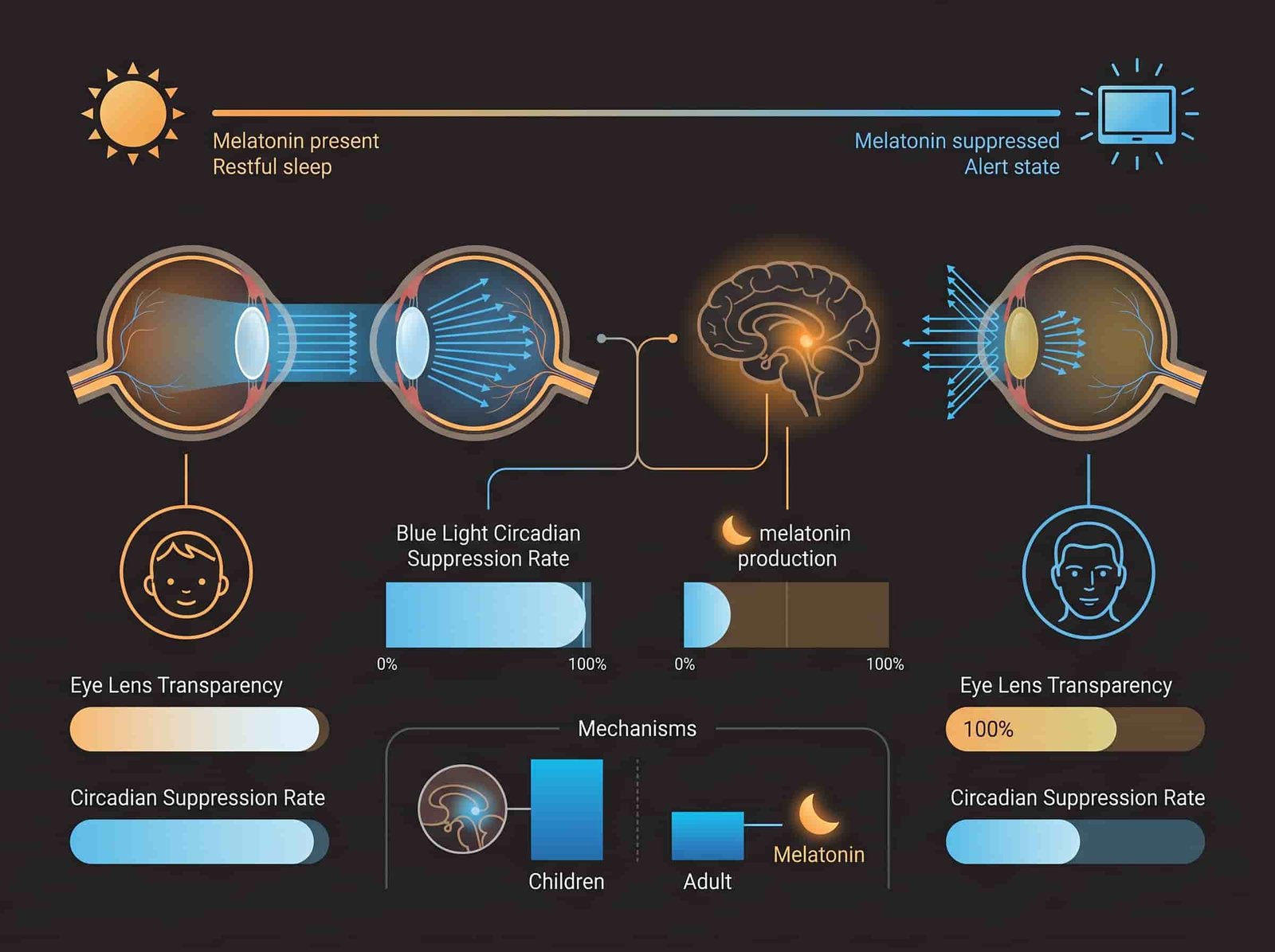
- A child’s eyes are highly transparent to blue light, suppressing their melatonin production at twice the rate of adults.
- Bundling children in heavy pajamas prevents the core body temperature drop required to initiate Deep Sleep.
- Children lack executive function and require a strict 90-minute sensory cool-down to down-regulate their nervous systems.
Why is an iPad destroying your child’s melatonin production?
Direct Answer: A child’s pupils are larger and their eye lenses are more transparent, making them hypersensitive to the melatonin-suppressing effects of blue light.
Mechanism: When you let your child watch cartoons right before bed to “wind down,” you are chemically blasting their brain with a daytime signal. The blue light from the screen hits their suprachiasmatic nucleus, instantly halting the pineal gland’s production of melatonin, leaving them wired, hyperactive, and physically incapable of settling down.
Actionable Advice: Implement an absolute, non-negotiable ban on all screens 90 minutes before their target bedtime. Dim the overhead lights in the house to mimic a sunset.
You are fighting a losing battle if you try to put a chemically stimulated brain to sleep. Melatonin is the hormone of darkness. If the environment is not dark, the hormone will not deploy.
This includes overhead LED lights. Swap out the bright white bulbs in the nursery or bathroom for warm, amber-toned bulbs that do not emit blue spectrum light. You must control the light environment to control the neurochemistry.
Why does a warm nursery cause night terrors?
Direct Answer: Trapping heat prevents the mandatory core body temperature drop required for the brain to transition into Slow-Wave Sleep.
Mechanism: Just like adults, children need a core body temperature drop of 2-3 degrees to initiate sleep. A common mistake parents make is bundling children in heavy fleece pajamas and cranking up the heat to keep them “cozy.” This traps heat, causing thermal stress that fragments their sleep cycles and triggers frequent awakenings or night terrors.
Actionable Advice: Keep the nursery thermostat strictly between 65°F and 68°F, and dress them in breathable, temperature-regulating fabrics like cotton or bamboo.
Your child’s body is a biological furnace running at high metabolic rates. They do not need the same level of thermal insulation as an adult. A cool room with a light blanket provides the optimal thermal gradient.
You can hack this system by giving them a warm bath 90 minutes before bed. The warm water draws blood to the surface of their skin. When they step out into the cool air, their core temperature rapidly plummets, artificially triggering the biological sleep signal.
How do you physically walk a child’s brain down to sleep?
Direct Answer: You must execute a 90-minute sensory cool-down, transitioning from high-dopamine to low-dopamine activities.
Mechanism: Children lack the prefrontal cortex development to transition from high-play to sleep instantly. Their sympathetic nervous system is highly reactive. If they are wrestling or watching high-stimulation TV at 7:00 PM, you cannot expect them to be asleep at 7:30 PM. They need a runway to safely land the plane.
Actionable Advice: Create a rigid 90-minute sequence: Bath time, dim lights, soft instrumental music, and tactile activities like reading physical books or doing puzzles.
Routine is everything for a developing brain. The sequence of events becomes a Pavlovian trigger. Over time, the mere sound of the bathwater running or the specific book you read will automatically signal their brain to begin secreting melatonin and GABA.
Consistency is the bio-hack. You must execute the exact same sequence, in the exact same order, every single night. You are engineering predictability, which equals safety, which equals sleep.
💡 Frequently Asked Questions
Toddler Sleep FAQ: Your Questions Answered
Should I give my child melatonin gummies to help them sleep?
Pediatricians strongly advise against relying on over-the-counter melatonin for healthy children. The supplement industry is poorly regulated, and exogenous melatonin can mask underlying environmental issues. Fix the light exposure and thermal environment first, and consult a pediatrician before introducing hormones to a developing brain.
My child wakes up at 5:00 AM no matter what time I put them to bed. Why?
Pushing bedtime later creates overtiredness, leading to a cortisol surge that causes fragmented sleep and early awakenings. Move their bedtime earlier by 30 minutes to catch their natural sleep gate before the cortisol spike, and ensure their room is pitch black.
Is it okay to let my child watch TV to wind down before bed?
Absolutely not. A child’s eyes are highly transparent to blue light, suppressing melatonin production at twice the rate of adults. Enforce a strict hard stop on all screens 90 minutes before bed and transition to tactile, low-dopamine activities like physical books.
How many hours of sleep does a toddler actually need?
Most toddlers need 11-14 hours of total sleep per day, including naps. Children aged 1-2 need the most sleep of any age group after newborns, driven by rapid brain development and growth hormone release during Deep Sleep.
What is the ideal room temperature for a toddler’s bedroom?
Keep the nursery thermostat strictly between 65°F and 68°F (18-20°C). Children run hotter than adults metabolically. A cool room prevents thermal stress that fragments sleep cycles and triggers frequent awakenings or night terrors.
How long should the bedtime routine actually take?
A minimum of 90 minutes is required for a child’s nervous system to down-regulate from high stimulation to sleep. Shorter routines leave their sympathetic nervous system activated, making it biologically impossible for them to settle.
When should I transition my child from crib to bed?
Most children are ready between 3-3.5 years, or when they start climbing out of the crib. The key indicator is developmental readiness — not age. A premature transition increases safety risks and sleep fragmentation.
Why does my toddler fight sleep even when they’re clearly tired?
Overtiredness triggers a cortisol-adrenaline surge that makes children fight sleep paradoxically. This is the overtired cycle. The fix is an earlier bedtime, not a later one, combined with a strict 90-minute cool-down routine.
Should toddlers still nap, and for how long?
Yes, most toddlers need one nap until age 2.5-3 years. The ideal nap ends by 3:30 PM to avoid interference with nighttime sleep pressure. Late naps push bedtime too late, triggering the overtired cortisol spike.
What if both parents work — how do you maintain a consistent sleep schedule?
Consistency does not require both parents to be present every night. Document the exact sequence (bath, dim lights, book, lights out) and delegate to caregivers with written instructions. The Pavlovian trigger works regardless of who executes it.
Ready to Transform Your Sleep Environment?
Discover the science-backed sleep solutions that Slumbelry recommends for toddler sleep.
Take the Sleep Assessment Subscribe for Sleep Optimization TipsThe Slumbelry Commitment
Sleep is the most vulnerable state of human existence. It is where we heal, reset, and grow.
At Slumbelry, we do not just sell sleep products; we advocate for your physiological right to rest. From ergonomic support to light management, every solution we offer is designed with one obsession: Respecting your Biology.
Science is our language, but your recovery is our purpose. You take care of everything else in your life — let us take care of your sleep.
Rest Deeply,
The Slumbelry Team