
Tired But Can’t Sleep? The Mistake You Make Every Night
Tired But Cannot Sleep: Why Exhaustion Does Not Equal Sleep
Tired but can\’t sleep — even when you are completely exhausted. You are not broken. You are just confused. Tired but can’t sleep — even when you are completely exhausted. You are not broken. You are just confused.
“I am so exhausted, I could sleep for a week.” Sound familiar? You crawl into bed at 8 PM, fully expecting to black out. Instead, you lie there for three hours, staring at the ceiling, feeling wired, frustrated, and completely awake.
If this sounds familiar, you are not broken. You are just confusing two completely different biological signals: fatigue and sleepiness.
Treating them as the same thing is the fastest way to destroy your sleep architecture and create chronic insomnia.
⚡ Core Takeaway: Fatigue vs. Sleepiness
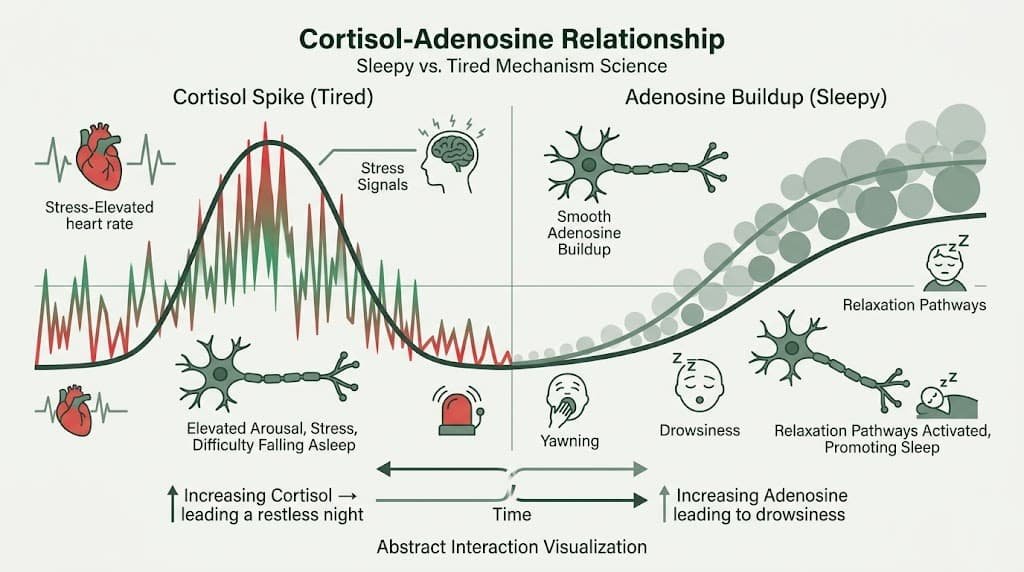
- The Core Problem: Fatigue is high cortisol and nervous system activation. Sleepiness is adenosine buildup. They are opposite signals.
- The Sleep Fix: You must be fatigued AND sleepy to fall asleep. Going to bed tired-but-wired triggers anxiety, not sleep.
- The Protocol: Drop cortisol first, then build adenosine. Sleep follows automatically.

Why am I exhausted but cannot fall asleep?
Direct Answer: You are experiencing fatigue, not sleepiness. These are opposite neurological states. Sleep onset is a biological event, not a mental one.
Mechanism: When you are fatigued, your body is producing high levels of cortisol and adrenaline. These stress hormones keep your sympathetic nervous system activated — the same state you are in during a crisis. Your brain interprets this as “stay alert, danger may be imminent.” Sleep, by contrast, requires parasympathetic dominance (“safe to power down”). You literally cannot initiate sleep while your nervous system thinks it is under attack.
Actionable Advice: Before bed, your only goal is to lower cortisol. No screens (blue light triggers cortisol), no work discussions, no exercise. Try: 10 minutes of slow breathing, stretching, or reading fiction.
What is the difference between fatigue and sleepiness?
Direct Answer: Sleepiness is adenosine accumulation (sleep pressure). Fatigue is cortisol-adrenaline activation (stress response). They operate on different neurological pathways.
Mechanism: From the moment you wake up, adenosine builds up in your brain, creating sleep pressure. By evening, adenosine signals “you have been awake long enough, time to rest.” Sleepiness feels like heavy eyelids, drooping attention, the inability to keep your eyes open. Fatigue feels like emotional heaviness, muscle exhaustion, mental fog — but with a racing mind. You can be deeply fatigued and fully alert simultaneously.
Actionable Advice: Track the actual physical sensation: Are your eyelids heavy? Can you keep your eyes open? Or do you feel emotionally spent but mentally wired? Only the first set of signals means you are sleepy.

The tired but wired protocol: how to finally fall asleep
Direct Answer: You must lower cortisol to baseline, THEN build sleep pressure with relaxed wakefulness.
Mechanism: Step 1: Activate parasympathetic nervous system through breathing, gentle stretching, or warm temperature. Step 2: Keep adenosine building by staying in dim light (not bright light, which metabolizes adenosine). Step 3: When you feel actual sleepiness signals (eyelids drooping), go to bed. Trying to sleep while still in the “wired” state reinforces the anxiety-insomnia loop.
Actionable Advice: (1) 90 minutes before bed: Stop work, dim lights, do relaxation activity. (2) If not sleepy after 90 minutes, extend wake time. (3) When eyelids get heavy, go to bed immediately. (4) If still awake after 20 minutes, get up and repeat the protocol.
The neuroscience of why your brain refuses to sleep
Direct Answer: Your amygdala and prefrontal cortex are fighting each other, and the amygdala is winning.
Mechanism: When you are fatigued but trying to sleep, your amygdala (threat detection center) remains active. It continuously scans for danger, keeping cortisol elevated. Meanwhile, your prefrontal cortex (logical planning center) is exhausted but still running. This creates the “tired but wired” state — your emotional brain refuses to yield control to the sleep centers in your hypothalamus and brainstem.
Actionable Advice: The key is to bore the amygdala, not force it. Gentle stretching, progressive muscle relaxation, or counting backward from 100 in multiples of 7 activates the prefrontal cortex, which then sends “safe” signals to the amygdala. This is why counting sheep sometimes works — it is not the sheep, it is the boring task.
How caffeine makes the tired-but-wired cycle worse
Direct Answer: Caffeine prevents adenosine from binding, which keeps adenosine levels artificially high — and anxiety-inducing.
Mechanism: Adenosine buildup signals sleep pressure, but caffeine blocks these receptors. When caffeine wears off, all that accumulated adenosine hits at once — often at midnight or 2 AM — triggering sudden awakening. Additionally, caffeine elevates cortisol, directly opposing the parasympathetic state needed for sleep onset.
Actionable Advice: If you are struggling with tired-but-wired insomnia, eliminate caffeine after 2 PM (not 6 PM — the half-life is 5-6 hours, meaning 50% remains at midnight). Even one afternoon coffee can fragment your sleep architecture.
How to track whether your fatigue is physical or neurological
Direct Answer: Physical fatigue improves with rest. Neurological fatigue (burnout) worsens with rest.
Mechanism: Physical fatigue (muscle exhaustion, post-exercise) signals your body to rest and repair. Neurological fatigue (decision fatigue, emotional exhaustion, chronic stress) keeps your brain in high-alert mode. Rest helps physical fatigue but can worsen neurological fatigue because the brain, with nothing to occupy it, turns to rumination.
Actionable Advice: Try a 30-minute walk in nature. If you return feeling more energized, your fatigue was physical. If you return feeling more anxious or overwhelmed, your fatigue is neurological. For neurological fatigue, active relaxation (structured hobby, social connection) works better than passive rest.
Additional Protocol: The “clock watching” cure. If you check the time every 30 minutes, you are training your brain to associate the bed with time anxiety. Remove all clocks from view. If you need an alarm, set it and put your phone across the room. The goal is zero time-awareness during sleep attempts.
Tired But Cannot Sleep FAQ: Your Questions Answered
What is the parasympathetic nervous system and why does it matter for sleep?
Direct Conclusion: The parasympathetic system is “rest and digest.” Sleep requires this state, not “fight or flight.”
Why: When your parasympathetic system activates, heart rate drops, digestion begins, and cortisol falls. This is the biological signal that it is safe to power down.
Action: Activate parasympathetics via vagus nerve stimulation: cold water on face, slow diaphragmatic breathing, or gentle humming.
Does magnesium help with tired-but-wired insomnia?
Direct Conclusion: Magnesium can help if you are deficient, but it is not a primary treatment.
Why: Magnesium regulates neurotransmitter production and supports parasympathetic function. However, most people are not deficient enough for magnesium to significantly change sleep.
Action: Try 200-400mg magnesium glycinate 30 minutes before bed. If no improvement after 2 weeks, deficiency is unlikely your cause.
Why am I so tired but cannot fall asleep?
Direct Conclusion: You are fatigued (high cortisol) but not sleepy (low adenosine).
Why: Your nervous system is in “alert mode” despite physical exhaustion. Sleep requires the opposite state.
Action: Lower cortisol before attempting sleep. Try 10 minutes of 4-7-8 breathing.
What is the 90-minute rule for sleep?
Direct Conclusion: Start your sleep ritual 90 minutes before target bedtime.
Why: Cortisol takes 60-90 minutes to drop to baseline after a stress response. Adenosine continues building during this time.
Action: No screens, no work, no exercise in the final 90 minutes. Dim lights and relax.
Does anxiety cause insomnia?
Direct Conclusion: Yes, anxiety perpetuates insomnia through cortisol elevation.
Why: Anxiety about not sleeping increases cortisol, which prevents sleep, which increases anxiety. Vicious cycle.
Action: Accept that one bad night will not harm you. Paradoxical intention (telling yourself to stay awake) often breaks the cycle.
How do I lower cortisol before bed?
Direct Conclusion: Through temperature, breathing, and parasympathetic activation.
Why: Warm bath, slow breathing, and gentle stretching activate the vagus nerve, which signals safety.
Action: Try 4-7-8 breathing: Inhale 4 seconds, hold 7, exhale 8. Repeat 4 times.
What is adenosine and how does it affect sleep?
Direct Conclusion: Adenosine is the molecular signal for sleep pressure.
Why: Adenosine builds up during wakefulness, binding to receptors that create “sleep pressure.” Caffeine blocks these receptors, which is why it keeps you awake.
Action: Accumulate adenosine naturally through extended wakefulness. No naps after 3 PM.
Is lying in bed with eyes closed still rest?
Direct Conclusion: Partially. But not equivalent to actual sleep.
Why: Light sleep stages still provide some restoration. However, extended time in bed without sleep trains your brain to associate the bed with wakefulness.
Action: If not asleep within 20 minutes, get up and do something relaxing. Return when genuinely sleepy.
Does exercise help or hurt sleep?
Direct Conclusion: Exercise helps sleep, but timing is critical.
Why: Moderate exercise raises cortisol temporarily, which then drops below baseline (good for sleep). Vigorous evening exercise elevates cortisol too close to bedtime.
Action: Finish vigorous exercise at least 4 hours before bed. Morning or afternoon is optimal.
What is sleep anxiety?
Direct Conclusion: Anxiety about falling asleep that itself prevents sleep.
Why: The pressure to sleep triggers the same cortisol response as other stressors.
Action: Reframe: Sleep cannot be forced. Remove the pressure by getting up and doing something boring.
Can melatonin help with sleep onset?
Direct Conclusion: Melatonin helps for circadian rhythm alignment, not sleep pressure.
Why: Melatonin signals “it is nighttime” to your brain. It does not create sleepiness — it creates the right conditions for sleepiness to work.
Action: Take 0.5mg-1mg melatonin 2-3 hours before target bedtime, not right before bed.
How long does it take to fix chronic tired-but-wired insomnia?
Direct Conclusion: 4-6 weeks for habit changes to become automatic.
Why: Your nervous system needs time to re-learn that bedtime means safety, not stress.
Action: Be consistent. The protocol works, but only if you execute it nightly. Consistency is the key to breaking this cycle.
Ready to Transform Your Recovery?
Stop forcing sleep. Start creating the biological conditions for it. You deserve to wake up refreshed.
Take the Sleep Assessment Explore Our Cooling MattressThe Slumbelry Commitment
Sleep is the most vulnerable state of human existence. It is where we heal, reset, and grow.
At Slumbelry, we do not just sell sleep products; we advocate for your physiological right to rest. From ergonomic support to light management, every solution we offer is designed with one obsession: Respecting your Biology.
Science is our language, but your recovery is our purpose. You take care of everything else in your life — let us take care of your sleep.
Rest Deeply,
The Slumbelry Team