
Sleeping Together: How to Share a Bed Without Ruining Your Sleep
The Couple’s Sleep Dilemma: Why Love and Shared Beds Were Never Designed for Each Other
⚡ Core Takeaway: Three Fixes That Transform Shared Sleep
- The Size Fix: A King or Super King mattress gives each partner more width than a baby in a crib. This is not luxury — it is a biological minimum.
- The Duvet Fix: Two separate single duvets on one mattress eliminates the cover-tug-of-war and lets each partner control their own temperature.
- The Motion Fix: A pocket coil or hybrid foam mattress absorbs movement energy before it crosses the sleep boundary. No more waking when your partner shifts.
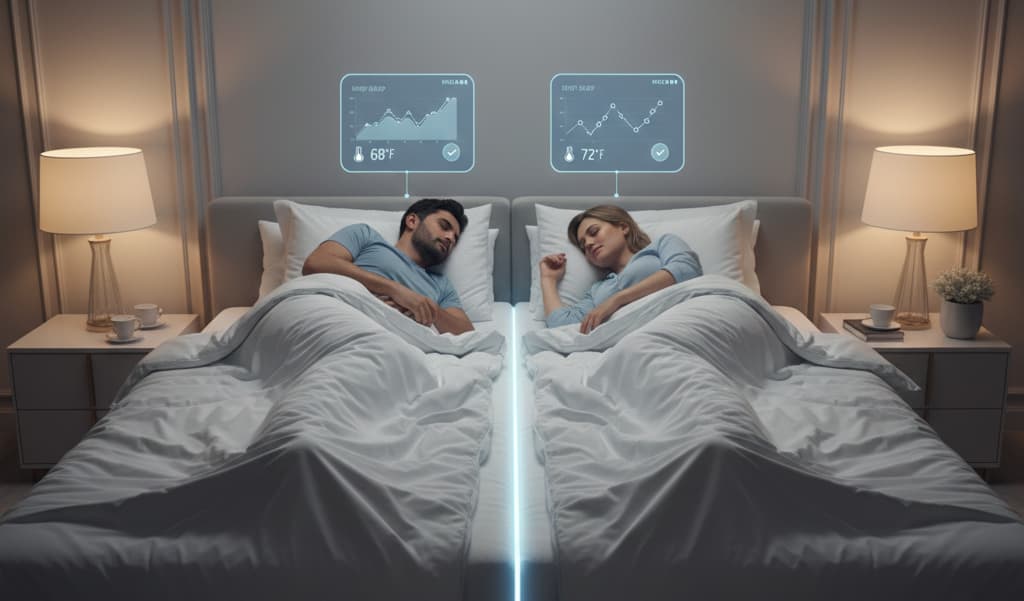
Sharing a bed with a partner is one of the most emotionally significant and physiologically complicated things two people can do together. Biologically, sleeping alone is superior — total control over temperature, movement, and sound. But emotionally, proximity matters. The challenge is not whether to share a bed, but how to engineer it so both partners actually rest. This guide covers the complete science of shared sleep — from mattress geometry to the Scandinavian duvet method, from chronotype rules to the sleep divorce question — so you and your partner can share a bed without ruining each other’s sleep.
Why Sharing a Bed Actually Worsens Both Partners’ Sleep
Humans are the only species that voluntarily delays sleep to watch Netflix, and one of the few that insists on sleeping in the same small rectangle as another adult — purely for emotional closeness. But biologically, sleeping alone is superior: total control over temperature, movement, and sound. So we end up with The Couple’s Sleep Dilemma: two exhausted people who love each other but sabotage each other’s rest every single night.
The Research: 50% of Partner Sleep Disturbance Is Invisible
Dr. Neil Stanley’s research found that 50% of sleep disturbance in couples comes from the partner — not from external noise, light, or temperature. Snoring, cover-stealing, movement, and different chronotypes compound over years into chronic sleep debt that neither partner connects to the bed. The spring mattress amplifies every micro-movement: one partner’s restroom trip becomes a full-body bounce that wakes the other. This chronic low-grade disruption contributes to relationship tension, reduced immunity, and metabolic dysregulation — none of which gets attributed to the mattress.
Action step: Track your actual sleep quality separately for one week. Rate your energy from 1–10 each morning. If your scores are consistently lower on nights when you share the bed versus solo nights, the bed is the cause.
Why Mattress Size Is the Single Most Important Investment in Your Relationship
If two adults are sleeping in a Double (Full) bed, each partner has less horizontal width than a baby in a standard crib. That is the reality of the space most couples are trying to sleep in. Upgrading mattress size is not a luxury — it is the single most impactful change a couple can make for shared sleep quality.
The Geometry of Shared Sleep
A Queen mattress (60 × 75 inches) gives each partner 30 inches of width — less than a standard crib mattress. A King (76 × 80 inches) gives each partner 38 inches. A Super King (72 × 78 inches, UK standard) or equivalent US Eastern King gives even more. Slumbelry’s research with couples shows that couples who switch to a King or Super King report significantly fewer nighttime awakenings due to partner movement within the first week. The math is simple: width per person = fewer boundary crossings = less disruption.
Action step: Measure your current mattress width per person. If it is under 36 inches, upgrading to a King is the highest-ROI sleep investment you will ever make.
The Scandinavian Method: Two Duvets Solve More Than You’d Expect
In Scandinavia, where cold winters and pragmatic relationships coexist, couples have solved the cover-tug-of-war permanently: two separate single duvets on one mattress. One partner can have a thick warm duvet; the other sleeps cool. No more midnight negotiations over who has more blanket.
⚡ How to Implement the Scandinavian Method
- Buy two single duvets in the fill weights each partner prefers (3–4.5 TOG range per person)
- Use a King or Super King mattress to accommodate both without gaps
- Layer a large decorative bedspread over the top for aesthetics — it comes off in the morning
- Each person manages their own duvet, all night, every night
Motion Isolation: Why Your Spring Mattress Is a Relationship Liability
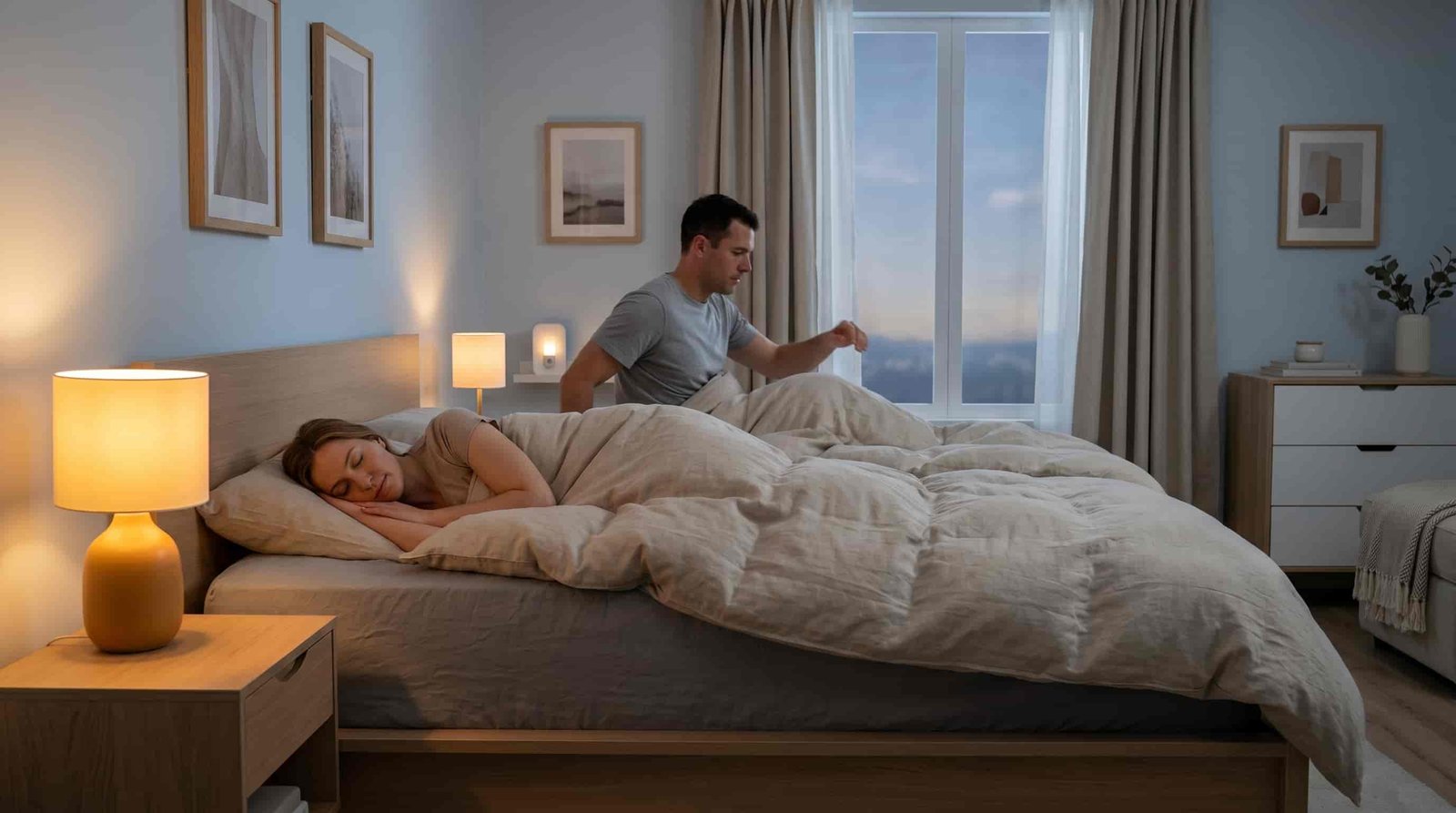
If your partner shifts position and you feel the mattress bounce, your mattress is actively damaging your sleep. Traditional innerspring mattresses transfer vibration across the entire surface — one person moves, the whole bed moves. This is why partners who sleep on innerspring mattresses experience nighttime awakenings that they attribute to “light sleeping” when the cause is pure physics.
The Engineering: Pocket Coils vs. Innerspring
Pocket coil (encased coil) mattresses work differently from traditional innerspring: each coil is individually wrapped in fabric, moving independently. When one partner moves, only the coils in that zone compress — energy is absorbed before it reaches the other side of the mattress. A properly engineered pocket coil or memory foam hybrid can reduce motion transfer by up to 80% compared to a traditional innerspring. Slumbelry’s hybrid foam engineering targets zero-motion transfer as a primary performance specification, tested by placing a glass of water on one side while simulated partner movement occurs on the other.

Respecting Chronotypes: The Rule for Early Risers and Night Owls in the Same Bed
When an AMer (up at 5 AM) shares a bed with a PMer (up until midnight), the biological conflict is structural. Each chronotype has a different cortisol peak, melatonin release time, and adenosine accumulation rate. Without explicit rules, the night owl disrupts the early riser’s sleep onset; the early riser destroys the night owl’s sleep maintenance with morning movement.
⚡ The Chronotype Rules for Shared Sleep
- The Ninja Rule: Whoever comes to bed last must move like a ninja — no overhead lights, no phone brightness, no rustling. Use a red-light torch if navigation is needed.
- The Exit Rule: Whoever wakes first must leave the bedroom immediately. Do your “post-sleep routine” in another room. The bed is not a morning workspace.
- The Buffer Rule: If one partner is a deep sleeper and the other is not, the lighter-sleeping partner should be on the outside edge of the bed — closer to the door and bathroom — so their own movements disturb them rather than their partner.
Does “Sleep Divorce” Actually Work — and Is It Right for You?
Sleep divorce — formally sleeping in separate bedrooms — has been clinically validated as an effective intervention for couples with chronic sleep incompatibility. Dr. Neil Stanley’s research confirms it does not harm relationships; in fact, better-rested couples report higher relationship satisfaction. But full separation is not always necessary. The interventions above (size, duvets, motion isolation, chronotype rules) resolve the issue for most couples without requiring separate rooms.
When Sleep Divorce Makes Sense
If after implementing all shared-bed solutions, one or both partners still show chronically degraded sleep (consistent morning energy scores below 4/10), formal sleep divorce is the clinical recommendation. This does not mean the relationship is failing — it means the biology is incompatible in the current configuration. Separate rooms for sleep, together rooms for intimacy and connection, is a pragmatic solution that high-performing couples and shift worker pairs have used for decades.
Temperature Incompatibility: The Invisible Cause of Shared-Sleep Failure
One partner runs hot; one runs cold. He kicks off the duvet; she adds a blanket. This nightly temperature negotiation is one of the most underdiagnosed causes of poor shared sleep. Men’s average core body temperature runs slightly higher than women’s, and peripheral vasodilation (heat release through hands and feet) differs by gender — making thermal incompatibility a genuine physiological reality, not just a preference.
⚡ Thermal Incompatibility Solutions
- Separate duvets: The Scandinavian method with different TOG ratings per person solves this instantly
- Chillable mattress topper: Some materials (gel-infused memory foam) actively pull heat away from the body
- Individual climate control: If separate rooms become necessary, prioritize the temperature setting over the mattress — a perfectly tuned room matters more than the bed itself
The Truth About Intimacy, Cuddling, and Sleep Quality
The bed is for two things: Sleep and Intimacy. They do not have to happen simultaneously. Many couples exhaust themselves trying to fall asleep while tangled — which activates the sympathetic nervous system rather than enabling parasympathetic sleep onset. Cuddling before bed is emotionally valuable; trying to stay physically intertwined through the night is a sleep performance killer.
The Science of Proximity Without Compromise
Oxytocin — the bonding hormone released during physical touch — does not require sustained physical contact to be effective. Studies on couples who adopted “proximity without entanglement” (cuddling before bed, separating fully for actual sleep) show that relationship satisfaction was unaffected while individual sleep quality improved significantly. The key insight: intimacy and sleep are both non-negotiable needs, and they require different physical conditions to be optimized.
Action step: Tonight, cuddle until you’re ready to sleep — then separate fully. No guilt, no obligation to stay physically connected. Your relationship is not measured by how intertwined you remain all night.
How to Audit Your Current Shared Sleep Setup in 7 Days
If you’re unsure which of these issues is most damaging your shared sleep, run a one-week audit. No changes needed — just data collection. At the end of the week, you’ll know exactly which layer to fix first.
⚡ The 7-Day Shared Sleep Audit
- Night 1–2: Rate morning energy 1–10, both partners separately, noting any disruptions you remember
- Night 3–4: Add a note on who moved and at what time, and who woke up as a result
- Night 5–6: Note room temperature and your subjective thermal comfort
- Night 7: Calculate the primary cause of each disruption — movement, temperature, sound, or something else
By the end of the audit, you’ll know whether the issue is: mattress (movement transfer), bedding (temperature/duvet), schedule (chronotype conflict), or environmental (room setup). Fix the largest cause first.
The Slumbelry Framework: Sleep Compatibility as a Relationship Investment
Slumbelry’s Sleep System approaches shared sleep as an engineering problem, not a romance problem. The question is not “how do we sacrifice sleep for closeness” — it is “how do we design a sleep environment where both partners achieve genuine rest so they can show up as their best selves for each other.”
Slumbelry’s Shared Sleep Philosophy
A well-rested partner is a patient, present, loving partner. Chronic sleep deprivation from shared-sleep incompatibility is a leading cause of relationship tension that couples misattribute to stress, work, or “growing apart.” The interventions in this guide — mattress size, separate duvets, motion isolation, chronotype rules, and temperature management — are the highest-ROI changes a couple can make. The bed should be the safest, most restorative place in your home. For both of you, equally.
Action step: Tonight, one small change: try two separate duvets and see if either of you wakes less. That’s the experiment. The data doesn’t lie.
Frequently Asked Questions About Sharing a Bed
Why does sharing a bed with my partner worsen my sleep quality?
Biologically, sleeping alone is superior — total control over temperature, movement, and sound. But emotionally, couples want proximity. The result is The Couple’s Sleep Dilemma: two exhausted people who love each other but regularly sabotage each other’s rest. Dr. Neil Stanley’s research found 50% of sleep disturbance in couples comes from the partner — snoring, cover-stealing, movement, and different chronotypes. The spring mattress amplifies every micro-movement. This chronic low-grade disruption accumulates over years into significant sleep debt.
What is the minimum mattress size for two adults sharing a bed?
A Queen mattress (60 × 75 inches) gives each partner only 30 inches of width — less than a baby in a standard crib. A King (76 × 80 inches) gives each partner 38 inches. A Super King or Eastern King is better still. Slumbelry recommends a King or Super King as the minimum viable size for two adults who share a bed. The math is simple: width per person below 36 inches means your sleep boundary is being crossed every time your partner shifts.
Does the Scandinavian two-duvet method actually work?
Yes — decisively. Two separate single duvets on one mattress eliminate the cover-tug-of-war permanently, let each partner control their own temperature, and require zero ongoing negotiation. In Scandinavia this is standard practice rather than a novelty. The aesthetics concern (it looks messy) is solved by a decorative bedspread thrown over the top in the morning. Couples who adopt the two-duvet method report the fastest improvement in shared sleep quality of any single intervention available.
What mattress type has the best motion isolation for couples?
Pocket coil (encased coil) and memory foam hybrid mattresses have the best motion isolation. In a pocket coil mattress, each coil moves independently — when one partner moves, only the coils in that zone compress and the energy is absorbed locally rather than traveling across the surface. Traditional innerspring mattresses transfer vibration across the entire surface, meaning every movement becomes a full-body bounce for the other partner. A quality pocket coil or hybrid foam mattress reduces motion transfer by up to 80% compared to traditional innerspring.
How do chronotype differences affect shared sleep and what can we do?
An early riser (AMer) and a night owl (PMer) sharing a bed create a structural biological conflict: different cortisol peak times, different melatonin release windows, different adenosine accumulation rates. Without explicit rules, the night owl disrupts the early riser’s sleep onset; the early riser destroys the night owl’s sleep maintenance with morning movement. Three rules fix this: (1) Whoever comes to bed last moves like a ninja — no overhead lights, no phone brightness. (2) Whoever wakes first leaves the bedroom immediately. (3) The lighter-sleeping partner takes the outside edge of the bed, closer to the bathroom, so their own bathroom trips disturb only themselves.
What is a sleep divorce and does it damage relationships?
Sleep divorce — formally sleeping in separate bedrooms — has been clinically validated as an effective intervention for couples with chronic sleep incompatibility. Dr. Neil Stanley’s research confirms it does not harm relationships; in fact, better-rested couples consistently report higher relationship satisfaction. Full separation is not always necessary — the interventions above (mattress size, separate duvets, motion isolation, chronotype rules) resolve the issue for most couples without requiring separate rooms. When full separation is needed, it is a pragmatic solution — separate rooms for sleep, together rooms for intimacy — that high-performing couples have used for decades.
How do temperature differences between partners affect shared sleep?
One partner running hot and the other cold is a genuine physiological reality — men’s average core body temperature runs slightly higher than women’s, and peripheral vasodilation differs by gender. This causes nightly temperature negotiation: one kicks off the duvet, the other adds layers. This invisible conflict fragments both partners’ sleep. The Scandinavian two-duvet method with different TOG ratings per person is the most effective solution. A chillable mattress topper (gel-infused memory foam) also helps. If separate rooms become necessary, prioritize temperature control over mattress — a perfectly tuned room matters more than the bed.
Does cuddling before bed help or hurt sleep quality?
Cuddling before bed is emotionally valuable — it triggers oxytocin release, the bonding hormone that promotes feelings of trust and safety. However, staying physically intertwined through the night activates the sympathetic nervous system (the arousal state) rather than enabling the parasympathetic state required for sleep onset. The solution is to cuddle until genuinely sleepy, then separate fully. Oxytocin does not require sustained physical contact to be effective; studies on couples who adopted ‘proximity without entanglement’ show relationship satisfaction was unaffected while individual sleep quality improved significantly.
How do I know which sleep issue is most damaging our shared sleep?
Run a 7-day audit with no changes: both partners rate morning energy 1–10 separately. Nights 1–2: note disruptions you remember. Nights 3–4: note who moved and when, and who was woken. Nights 5–6: note room temperature and thermal comfort. Night 7: classify each disruption by primary cause — movement, temperature, sound, or chronotype conflict. The largest category is where to start. Common results: most couples find movement transfer (mattress) and temperature (separate duvets) are the top two causes. Fix the largest first.
How does Slumbelry approach shared sleep in its product design?
Slumbelry’s Sleep System treats shared sleep as an engineering problem. The goal is a sleep environment where both partners achieve genuine rest — not a compromise where both are slightly worse off. Slumbelry’s hybrid foam and pocket coil mattresses are engineered to zero-motion transfer as a primary performance spec. Bedding solutions include separate-duvet-compatible sets with individually calibrated warmth ratings. The core philosophy: a well-rested partner is a patient, present, loving partner. Chronic sleep deprivation from shared-sleep incompatibility is a leading cause of relationship tension that couples misattribute to other causes.
Ready to Engineer Your Perfect Shared Sleep Environment?
Stop compromising on sleep. The right mattress, the right bedding setup, and the right rules can transform both partners’ rest — starting tonight.
Take the Sleep Assessment Subscribe for Sleep Optimization TipsThe Slumbelry Commitment
Sleep is the most vulnerable state of human existence. It is where we heal, reset, and grow.
At Slumbelry, we do not just sell sleep products; we advocate for your physiological right to rest. From ergonomic support to light management, every solution we offer is designed with one obsession: Respecting your Biology.
Science is our language, but your recovery is our purpose. You take care of everything else in your life — let us take care of your sleep.
Rest Deeply,
The Slumbelry Team
Medical References:
1. Stanley, N. (2018). How to Sleep Well. Vermilion.
2. Walker, M. (2017). Why We Sleep. Scribner.