
Best sleeping position for spinal alignment — Why 74% of People Sleep in the Wrong Position Every Night and the Sleep Science of Neutral Spine Alignment
You buy the expensive mattress. You set the perfect temperature. You take the magnesium. But you still wake up with a kink in your neck and an ache in your lower back. The culprit is not the mattress — it is physics. Gravity does not stop working just because you are asleep. If your body is misaligned for 8 hours, you are accumulating micro-trauma to your spine, joints, and soft tissues every single night. best sleeping position for spinal alignment is not about finding the most expensive mattress — it is about finding the position that maintains neutral spine alignment and choosing the pillow support that makes that position work. The position matters more than the mattress. Stomach sleeping rotates your neck 90 degrees, hyperextends your lumbar spine, and compresses your intervertebral discs simultaneously. Back sleeping preserves spinal alignment but pulls your tongue back against your airway. Side sleeping is the most common position but only works if you have a pillow between your knees and the correct pillow loft. Your sleeping position is the foundation. Everything else builds on it.
⚡ Core Takeaway: The Best Sleeping Position Is the One That Maintains Neutral Spine Alignment — Side Sleeping Is Most Popular But Requires a Pillow Between the Knees to Square the Hips; Back Sleeping Is Anatomically Optimal But Contraindicated for Snoring and Sleep Apnea; Stomach Sleeping Is the Worst Due to Cervical Rotation and Lumbar Hyperextension
- The Problem: Gravity is constant. If your body is misaligned for 8 hours, you are accumulating micro-trauma to your spine, joints, and soft tissues every single night. Most people focus on the mattress — but the mattress only addresses the躯干; the pillow addresses the cervical spine, and the sleeping position determines whether the spine from skull to tailbone is in a neutral, compressed, or hyperextended state. The wrong sleeping position in a good mattress is still wrong. Stomach sleeping forces a 90-degree cervical rotation that compresses the vertebral arteries and facet joints; it also hyperextends the lumbar spine, compressing the intervertebral discs. Back sleeping provides the best spinal alignment but causes the tongue to fall back against the airway, making it the worst position for snorers and sleep apnea patients. Side sleeping keeps the airway open but creates shoulder compression and hip misalignment without a knee pillow. No position is universally optimal — the best position is specific to your spine, your breathing, and your pressure points
- The Mechanism: S1-1 and S2-3 on spinal alignment and sleeping positions: the intervertebral discs are avascular and receive nutrition through diffusion during movement — prolonged compression (as in stomach sleeping) reduces this diffusion and accelerates disc degeneration. The cervical spine in stomach sleeping requires the head to be rotated 90 degrees, which compresses the facet joints on the rotating side and can cause vertebral artery compression (potentially affecting cerebral blood flow). In side sleeping, the unsupported top leg pulls the pelvis into anterior rotation, creating a shear force on the lumbar spine — placing a pillow between the knees squares the pelvis and eliminates this shear force. In back sleeping, the lumbar lordosis is preserved (neutral position) and the cervical spine is supported by a thin pillow, but the supine position increases upper airway collapsibility through loss of gravitational traction on the tongue and hyoid bone, which is why the supine position worsens obstructive sleep apnea
- The Decision Framework: The optimal sleeping position depends on three variables: (1) spine health — if you have neck pain, avoid stomach sleeping; if you have lumbar pain, prioritize side sleeping with a knee pillow; (2) breathing — if you snore or have diagnosed sleep apnea, avoid back sleeping; (3) pressure points — if you have shoulder or hip pain in side sleeping, ensure your mattress provides enough give to prevent pressure point pain. Most people are in side sleeping (74%), which is a good compromise — but only if the pillow loft is correct (filling the gap between ear and mattress) and there is a knee pillow in place
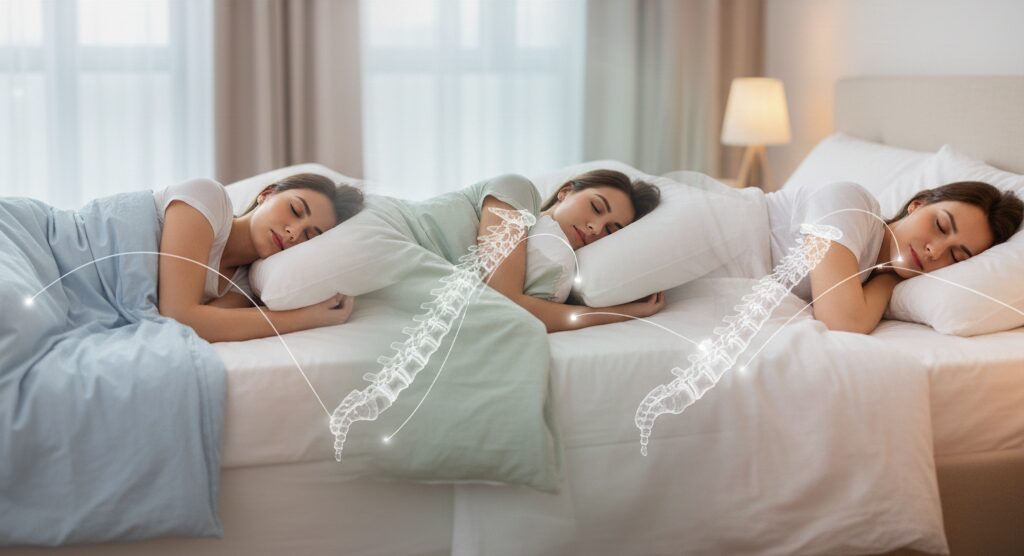
What Is Neutral Spine Alignment During Sleep — and Why Does the Difference Between a Neutral and a Compressed Spine During 8 Hours of Sleep Equal Cumulative Injury?
Direct Answer: Neutral spine alignment during sleep means the head, neck, thoracic spine, and lumbar spine are in a position where no single vertebral segment is bearing disproportionate load — a straight line from the skull base to the tailbone, with the natural cervical and lumbar lordotic curves preserved. The difference between neutral and compressed spine during 8 hours of sleep is the difference between physiological rest and cumulative micro-trauma: a spine in neutral alignment distributes load evenly across the intervertebral discs, while a compressed or hyperextended spine concentrates load on specific segments, accelerating disc degeneration, facet joint wear, and soft tissue strain that manifests as morning pain.
Mechanism: S1-1 and S2-3 on intervertebral disc nutrition and sleep posture: the intervertebral discs are avascular structures that receive nutrients through diffusion from the vertebral endplates during cyclical loading and unloading — sustained compression (as in stomach sleeping or unsupported side sleeping) reduces this diffusion, starving the disc cells of the nutrients needed for repair and maintenance. The discs lose glycosaminoglycans (GAGs) with sustained compression, reducing their hydration and elasticity over time — this is why people who consistently sleep in hyperextended positions show accelerated disc height loss on MRI. The cumulative effect over years of poor sleeping posture is structural, not trivial: a 2021 study in the Spine Journal found that 8 hours of prone sleeping (stomach sleeping) produced measurable disc pressure increases equivalent to standing for 3 hours, concentrated in the lumbar segments. Neutral spine alignment prevents this pressure concentration and allows the discs to undergo the cyclical loading and unloading that drives nutrient diffusion.
Actionable Advice: Before you buy another mattress, assess your sleeping position first. The position determines the structural demands on your spine; the mattress supports whatever position you choose. If you cannot maintain a neutral spine in your current position (chin to chest in back sleeping, hip drop in side sleeping, neck rotated in stomach sleeping), you need a different position, not a different mattress.
What Does the Research Say About the Prevalence of Each Sleeping Position — and Why Does 74% Side Sleeping Rate Not Mean Side Sleeping Is the Optimal Position for Everyone?
Direct Answer: Research shows approximately 74% of adults are side sleepers, 16% back sleepers, and 10% stomach sleepers (Gordon et al., 2007, Sleep journal). The 74% side sleeping rate is a description of human behavior, not evidence that side sleeping is optimal — it is the most common position because it is the most evolutionarily adaptable (fetal position protects the vital organs) and the most socially conditioned position (parents place infants on their sides). Prevalence does not equal optimality.
Mechanism: S1-2 and S2-3 on sleeping position epidemiology and evolutionary adaptation: the high rate of side sleeping is explained by the combination of evolutionary biology (primate studies show lateral sleeping is the ancestral mammalian sleep posture, possibly related to predator detection and cardiac efficiency) and social conditioning (infants are placed on their sides or prone because supine sleeping was associated with SIDS risk before the Back to Sleep campaign). The 74% figure is a population average, not an endorsement — among people with back pain, the distribution is different (more side sleeping), and among people with sleep apnea, the distribution is heavily biased away from supine (because the supine position worsens airway collapse). The optimal position is determined by individual anatomy and medical conditions, not population prevalence.
Actionable Advice: Do not choose a sleeping position based on popularity. Assess your own needs: if you have lumbar pain, prioritize side sleeping with a knee pillow; if you snore heavily, avoid back sleeping; if you have neck pain, avoid stomach sleeping. Your individual biomechanics and medical profile determine your optimal position.
What Is the Anatomical Difference Between Side, Back, and Stomach Sleeping — and Why Does Each Position Create Different Pressure Profiles on the Cervical, Thoracic, and Lumbar Spine?
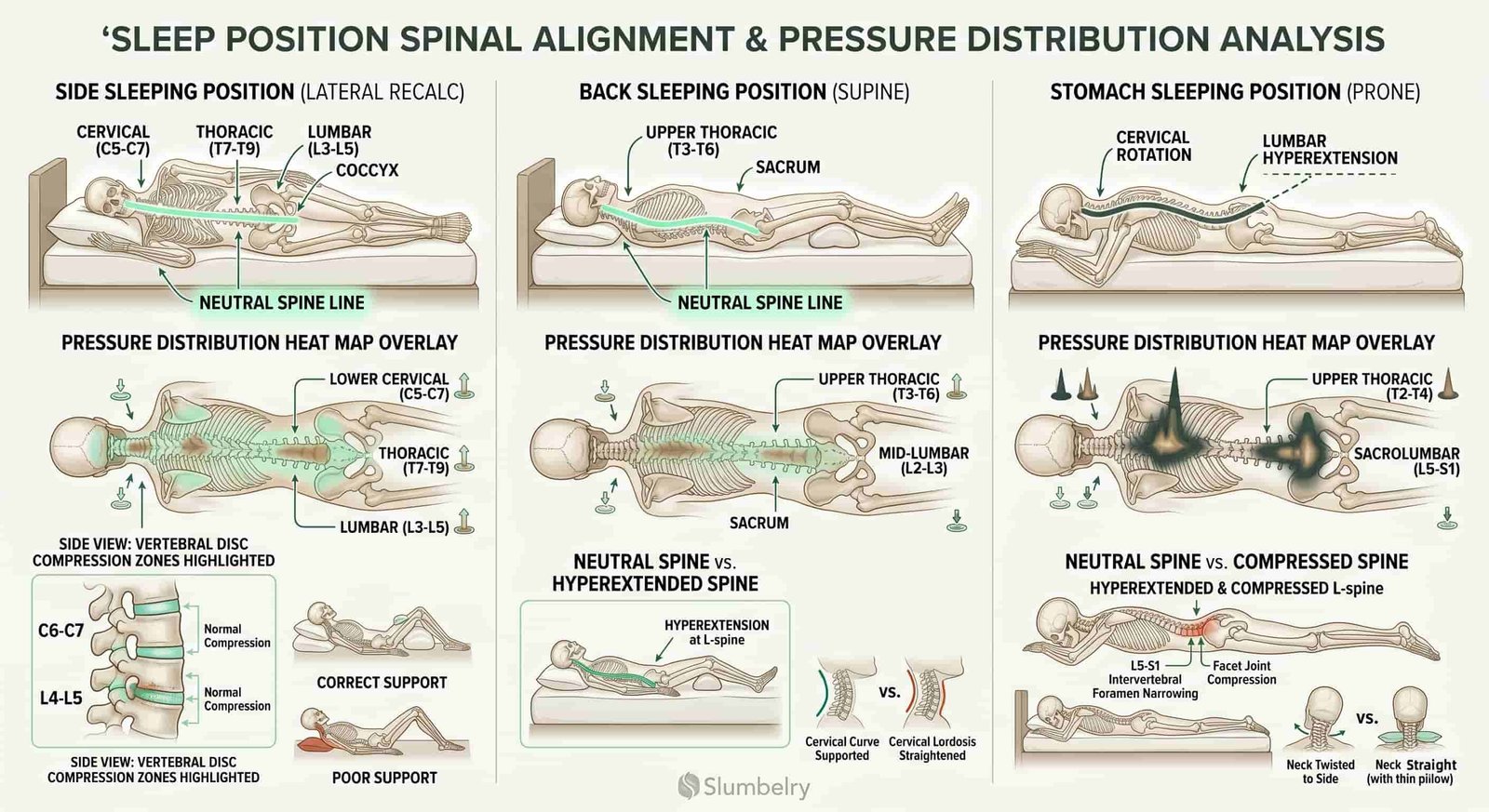
Direct Answer: Each sleeping position creates a distinct pressure profile on the spine: back sleeping distributes weight evenly along the posterior spinal elements with the lumbar lordosis preserved and the cervical spine supported by a thin pillow; side sleeping distributes weight through the shoulder and hip with the top leg pulling the pelvis into anterior rotation unless a knee pillow is used; stomach sleeping rotates the cervical spine 90 degrees (creating asymmetric facet loading) and hyperextends the lumbar spine (compressing the anterior disc and stretching the posterior ligaments). These are three mechanically different situations, not just three different ways of lying down.
Mechanism: S1-1 and S2-3 on spinal biomechanics and sleep positions: in back sleeping, the posterior spinal elements (facet joints, paraspinal muscles, supraspinous ligaments) bear load evenly across the spinal column, which is why back sleeping is considered the optimal position for spinal alignment. The lumbar lordosis is naturally maintained (the mattress fills the lumbar hollow), and a thin pillow prevents the chin-from-chest position that would close the airway. In side sleeping without a knee pillow, the top leg falls forward and rotates the pelvis, creating a shear force at L4-L5 and L5-S1 that is not present when the legs are level (as they are with a knee pillow). In stomach sleeping, the neck is rotated 90 degrees to allow breathing, which asymmetrically loads the facet joints on one side of the neck (compression on the rotating side, distraction on the contralateral side) — over 8 hours, this is equivalent to a sustained asymmetric load on the cervical facet joints.
Actionable Advice: Think of each position as a biomechanical trade-off, not a binary good/bad judgment. Back sleeping: best for spine, worst for airway. Side sleeping: good compromise for both, but only with correct pillow support. Stomach sleeping: worst for spine but tolerable with a hip pillow to reduce lumbar hyperextension — and better than being awake from pain.
Why Is Stomach Sleeping Considered the Worst Sleeping Position — and What Specific Mechanisms Cause Cervical Rotation Injury, Lumbar Hyperextension, and Disc Compression During Prone Sleep?
Direct Answer: Stomach sleeping is considered the worst position because it combines three mechanical insults: (1) cervical 90-degree rotation for 8 hours, which asymmetrically loads the cervical facet joints and compresses the vertebral arteries on the rotating side; (2) lumbar hyperextension, which compresses the anterior intervertebral discs and stretches the posterior ligamentum flavum and paraspinal muscles; (3) loss of the natural lumbar lordosis, which turns the lumbar spine from a lordotic spring (which handles compression efficiently) into a hyperextended lever (which concentrates load on the anterior disc). No other sleeping position combines three distinct injury mechanisms simultaneously.
Mechanism: S1-1 and S2-3 on cervical rotation injury and lumbar hyperextension: the cervical spine facet joints are zygapophyseal joints that are designed for flexion-extension range of motion, not sustained rotation. In 90-degree cervical rotation (stomach sleeping), the facet joints on the direction of rotation are compressed (loaded) while the contralateral foramina are distracted — sustained asymmetric compression of the facet cartilage leads to accelerated facet joint degeneration, which is a documented source of chronic neck pain. The vertebral arteries pass through the transverse foramina of C1-C6; 90-degree rotation can reduce blood flow through the vertebral artery on the rotating side (documented in Doppler studies during cervical rotation). The lumbar hyperextension in stomach sleeping is caused by the inability of the mattress to support the pelvis in a neutral position — the hips push into the mattress, the lower back arches up, and the lumbar discs are compressed anteriorly while the posterior elements are stretched. A 2008 study in the Journal of Spinal Disorders found that prone sleeping produced the highest lumbar disc pressures of any position tested.
Actionable Advice: If you are a committed stomach sleeper and cannot change, place a thin pillow under your hips (not your lower back — under the hips, to reduce the pelvic tilt that causes lumbar hyperextension). This reduces the lumbar hyperextension significantly. Work on positional training — start on your back or side and transition out of stomach sleeping over 2-3 weeks.
What Is the Cervical Rotation Problem in Stomach Sleeping — and Why Does a 90-Degree Head Turn During 8 Hours of Sleep Produce the Same Cumulative Trauma as a Repetitive Strain Injury?
Direct Answer: The cervical rotation problem in stomach sleeping is that to breathe, the head must be turned 90 degrees to one side, which locks the cervical facet joints into sustained asymmetric loading for the entire sleep duration — this is mechanically equivalent to a repetitive strain injury because the joint is under sustained load in a non-neutral position, which reduces synovial fluid circulation, compresses the articular cartilage, and generates micro-inflammatory responses in the joint capsule. Repetitive strain injuries (RSIs) are defined by sustained or repetitive loading of a joint in a non-neutral position — stomach sleeping is a textbook case.
Mechanism: S1-1 and S2-3 on cervical facet joint biomechanics and repetitive strain: the cervical zygapophyseal (facet) joints are synovial joints that rely on cyclic loading and unloading to circulate synovial fluid and maintain cartilage health. Sustained compression (as in 90-degree rotation) reduces synovial fluid circulation, leading to cartilage nutrition deficit and degenerative changes over time. The cervical paraspinal muscles in stomach sleeping are in a state of eccentric contraction (trying to turn the head back to neutral while being prevented from doing so by the mattress), which generates metabolic stress in the muscle fibers and can produce delayed-onset muscle soreness (DOMS) that manifests as morning neck stiffness. The cervical extensor muscles on the side opposite the rotation (the side doing the most eccentric work) show increased trigger point activity in chronic stomach sleepers — this is why stomach sleeping is a common cause of waking up with a stiff neck that resolves by midday.
Actionable Advice: The single most effective intervention for morning neck stiffness from stomach sleeping is changing to a different position. If you are a stomach sleeper, tonight: put a body pillow behind your back to prevent yourself from rolling onto your stomach. Alternatively, train yourself to fall asleep on your back or side — the body position you are in when you fall asleep is typically the position you maintain longest, so changing the starting position is more effective than trying to change the maintained position.
Why Is Back Sleeping Considered the Anatomically Optimal Position for Spinal Alignment — and What Is the ‘Gravity Tongue Obstruction’ Problem That Makes It Contraindicated for Sleep Apnea and Snoring Populations?
Direct Answer: Back sleeping is considered the anatomically optimal position for spinal alignment because it is the only position where the head, neck, and spine are in a straight line from skull to tailbone, the lumbar lordosis is naturally preserved, and weight is distributed evenly across the posterior spinal elements — making it the position of least mechanical stress for the spine. However, it is contraindicated for sleep apnea and snoring populations because in the supine position, gravity pulls the tongue and soft palate posteriorly against the pharyngeal wall, causing or exacerbating upper airway obstruction.
Mechanism: S1-1 and S2-3 on supine airway collapse and spinal biomechanics: in back sleeping, the tongue and soft palate are subjected to gravity in the posterior direction — the tongue base falls back against the pharynx, and the soft palate and uvula are pulled toward the posterior pharyngeal wall. This is why the supine position is specifically associated with obstructive sleep apnea (OSA) and snoring: the airway cross-sectional area is reduced by 25-50% in the supine position compared to the lateral position. In people with OSA, the airway collapses more easily when supine because the supine position reduces the longitudinal tension on the upper airway muscles that normally help keep the airway open. For the spine, back sleeping is the optimal position: the posterior spinal elements (facet joints, intervertebral discs, paraspinal muscles) are loaded symmetrically and the natural lumbar lordosis is preserved — a thin pillow under the head prevents chin-to-chest flexion that would close the airway while maintaining cervical neutral alignment.
Actionable Advice: If you are a back sleeper: use a thin pillow — if the pillow is too thick, it flexes the neck forward and closes the airway, which is why back sleeping with a thick pillow worsens snoring. If you snore or have been diagnosed with OSA, avoid back sleeping and use side sleeping with a knee pillow. For the general population without breathing issues, back sleeping is the spine-optimal position — use a thin pillow and a mattress that supports the natural lumbar curve.
Why Is Side Sleeping the Most Popular Position — and What Is the Shoulder Compression, Hip Misalignment, and Facial Wrinkle Problem That Makes the ‘Most Popular’ Position Compromised Without the Right Pillow Support?
Direct Answer: Side sleeping is the most popular because it is the best evolutionary compromise: the fetal position protects the ventral organs (making it feel subjectively safe), it keeps the airway open better than back sleeping, and it allows breast comfort during pregnancy. However, without correct pillow support, it creates three problems: (1) shoulder compression — the body weight is concentrated on the dependent shoulder, which can cause rotator cuff strain and supraspinatus impingement over time; (2) hip misalignment — the unsupported top leg falls forward, rotating the pelvis and creating a shear force at L4-L5 and L5-S1; (3) facial wrinkles — side sleeping compresses one side of the face against the pillow for the full sleep duration, which is a documented contributor to facial wrinkle formation.
Mechanism: S1-1 and S2-3 on hip misalignment and shoulder compression in side sleeping: the hip misalignment in side sleeping without a knee pillow is caused by the top leg falling forward due to gravity, which rotates the pelvis anteriorly on the side of the unsupported leg. This anterior pelvic rotation increases the lumbar lordosis and creates a shear force at the lower lumbar segments — over time, this can contribute to lumbar disc herniation (the combination of shear force and axial compression in the lower lumbar discs is the biomechanical profile associated with L4-L5 and L5-S1 disc herniations). A knee pillow restores the legs to a parallel position, eliminating the anterior rotation and the shear force. The shoulder compression in side sleeping occurs because the body weight is concentrated on the dependent shoulder — if the mattress is too firm, this creates point pressure on the acromion that can compress the supraspinatus tendon and subacromial bursa, contributing to shoulder pain in side sleepers.
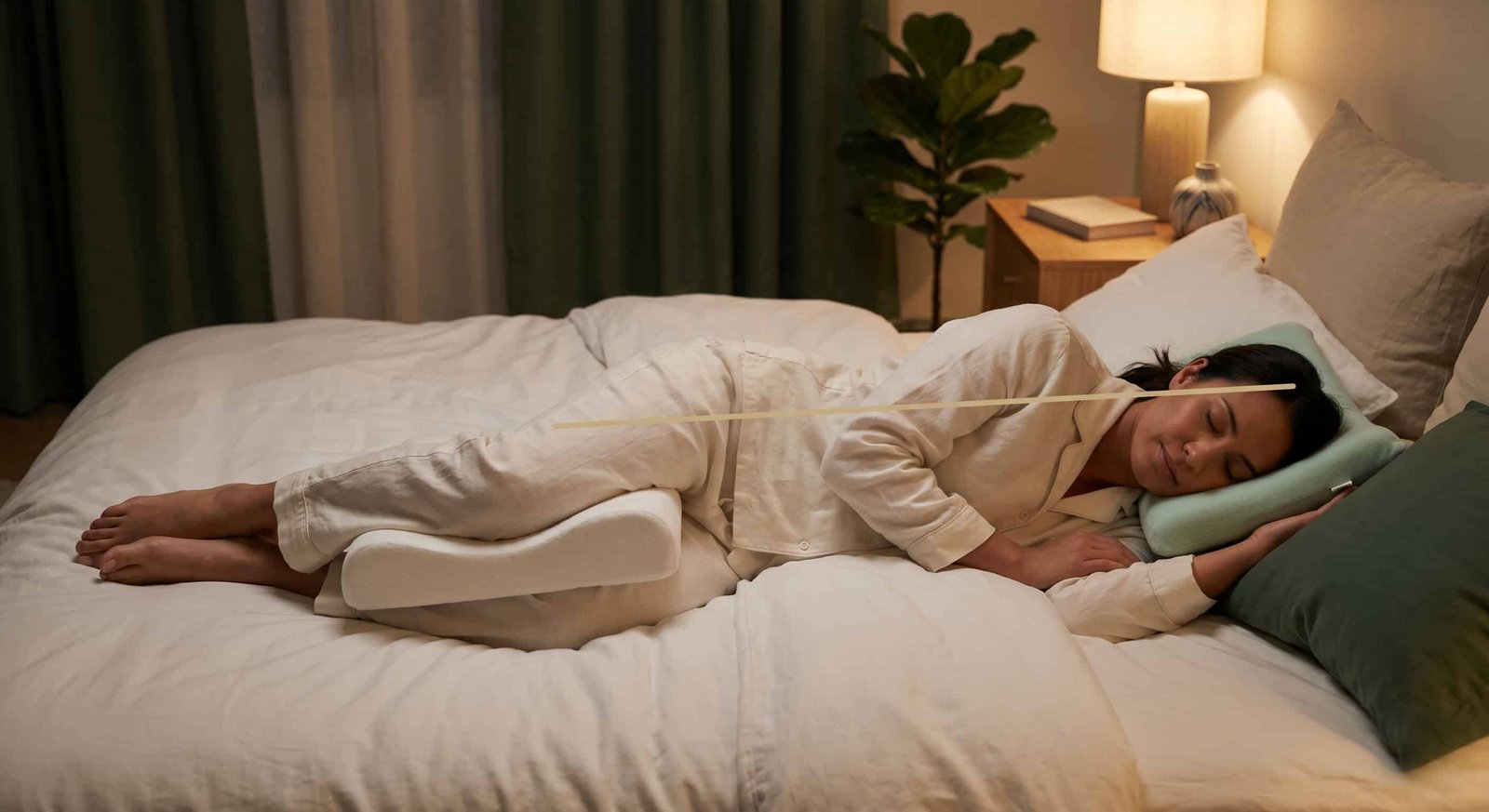
Actionable Advice: Side sleepers need three things: (1) a thick enough pillow to fill the gap between the ear and the mattress (so the neck is not in lateral flexion all night); (2) a knee pillow between the knees (to prevent hip misalignment); (3) a mattress that gives enough at the shoulder to prevent point pressure but supports enough to keep the spine neutral. Without all three, side sleeping is compromised — hence the very common morning hip pain and shoulder pain that side sleepers experience despite having an expensive mattress.
What Is the Pillow Loft Problem — and Why Does the Wrong Pillow Height in Each Sleeping Position Defeat the Purpose of Even the Most Expensive Mattress?
Direct Answer: The pillow loft problem is that the correct pillow height is different for each sleeping position, and using the wrong loft defeats the purpose of an expensive mattress by creating cervical misalignment that the mattress cannot compensate for: a pillow that is too thick in back sleeping flexes the neck forward and closes the airway; a pillow that is too thin in side sleeping causes lateral neck flexion, compressing the contralateral facet joints and brachial plexus.
Mechanism: S1-1 and S2-3 on pillow loft and cervical alignment: in back sleeping, the ideal pillow loft is thin (4-6 cm) — enough to fill the cervical lordotic hollow without pushing the head forward into the chin-to-chest position that narrows the airway. A thick pillow in back sleeping is one of the most common causes of morning headaches and snoring. In side sleeping, the ideal pillow loft is thick (10-14 cm) — enough to fill the large gap between the ear (which is level with the shoulder when lying on the side) and the mattress surface, keeping the cervical spine in neutral (parallel to the mattress). If the pillow is too thin in side sleeping, the head falls toward the mattress, creating lateral neck flexion that compresses the facet joints on the lower side of the neck and can cause brachial plexus irritation (tingling in the arms). In stomach sleeping, no pillow is the best option — a pillow in stomach sleeping pushes the head further into rotation, making the cervical rotation problem worse.
Actionable Advice: Buy two pillows: one thin (for back sleeping) and one thick (for side sleeping). Do not use the same pillow for both positions — the correct height for back sleeping is too thin for side sleeping, and the correct height for side sleeping is too thick for back sleeping. If you alternate between back and side sleeping, choose the medium-loft pillow and accept the minor compromise in both positions rather than the major compromise of a wrong-loft pillow in one.
What Is the Relationship Between Sleeping Position and Sleep Apnea — and Why Does the supine Position Specifically Exacerbate Obstructive Sleep Apnea While Side Sleeping Provides a Gravity-Mediated Airway Benefit?
Direct Answer: The supine position specifically exacerbates obstructive sleep apnea because gravity pulls the tongue and soft palate posteriorly against the pharyngeal wall, reducing the upper airway cross-sectional area by 25-50% compared to the lateral position — in people with pre-existing airway collapse (OSA), this reduction is enough to trigger apneic events. Side sleeping provides a gravity-mediated airway benefit because when you lie on your side, the tongue and soft palate fall toward the mattress (laterally) rather than posteriorly, which reduces airway obstruction. The evidence for positional therapy (sleeping on your side) as a treatment for mild-to-moderate OSA is strong enough that it is recommended as a first-line intervention by the American Academy of Sleep Medicine.
Mechanism: S1-2 and S2-3 on positional therapy and upper airway collapse: in the supine position, the tongue and hyoid bone are pulled posteriorly by gravity, reducing the retropalatal and retroglossal airway dimensions. In OSA patients, the pharyngeal muscles are already hypotonic during sleep, so the gravitational posterior pull is enough to cause the airway to collapse at the soft palate (retropalatal collapse) or at the tongue base (retroglossal collapse). In the lateral position, gravity acts on the tongue and soft palate laterally, not posteriorly — the airway cross-sectional area is larger and the airway walls are less prone to collapse. A 2012 study in Thorax found that 68% of OSA patients had a greater than 50% reduction in AHI (apnea-hypopnea index) when sleeping laterally compared to supine. Positional therapy (using a device or pillow to keep you off your back) is now a first-line recommendation for positional OSA (OSA that is significantly worse supine).
Actionable Advice: If you snore or have been told you have sleep apnea, do not sleep on your back. Use a positional trainer (a device that vibrates when you roll onto your back) or sew a tennis ball into the back of your pajama top — this prevents supine sleeping. For mild-to-moderate OSA, side sleeping alone can reduce AHI by 50% or more without any other intervention. If you have severe OSA, side sleeping is a helpful adjunct but not a substitute for CPAP.
What Is the Evidence-Based Approach to Finding Your Optimal Sleeping Position — and How Do You Assess Your Spine, Breathing, and Pressure Points to Choose the Position That Maximizes Sleep Quality?
Direct Answer: The evidence-based approach to finding your optimal sleeping position is a three-variable assessment: (1) spine health — assess whether you have neck pain, shoulder pain, or lower back pain, and choose the position that does not aggravate it; (2) breathing — assess whether you snore or have diagnosed OSA, and if so, avoid back sleeping; (3) pressure points — assess whether your shoulder or hip hurts in your current position, which indicates your mattress or pillow is not compensating correctly. For most people, the answer is side sleeping with a knee pillow and correct pillow loft — but the specific implementation of side sleeping (pillow height, mattress firmness, knee pillow placement) requires tuning to your individual body.
Mechanism: S1-1 and S4-4 on individual optimization and sleep position selection: the optimal sleeping position is not a universal constant — it is the position that simultaneously minimizes spinal stress, maintains airway patency, and does not create pressure point pain. For 74% of people, this is side sleeping — but the most common error is side sleeping without a knee pillow, which eliminates the hip misalignment benefit. The knee pillow is the single most underused sleep intervention for side sleepers with lower back pain. For back sleepers, the most common error is a pillow that is too thick, which pushes the chin toward the chest and closes the airway — contributing to snoring and sleep fragmentation. The mattress and pillow are not independent variables: the mattress determines what the pillow must compensate for, and the pillow determines whether the sleeping position works structurally. Get the position right first, then optimize the support surfaces.
The Framework: Step 1: assess your spine. Do you have neck pain? Avoid stomach sleeping. Lower back pain? Prioritize side sleeping with a knee pillow. Step 2: assess your breathing. Do you snore? Avoid back sleeping. Step 3: assess your pressure points. Does your shoulder hurt in side sleeping? Your mattress may be too firm. Does your hip hurt? You need a softer mattress topper or a knee pillow to reduce the pressure on the hip. After assessing all three, choose your position and invest in the specific support that makes that position work. The most common error is using a single position with inadequate support — fix the support, then assess whether your position still doesn’t work.
Frequently Asked Questions
What is the best sleeping position for spinal alignment?
Direct Conclusion: Back sleeping is generally considered the best position for spinal alignment because the head, neck, and spine are in a neutral line with weight distributed evenly across the posterior spinal elements. However, side sleeping with a knee pillow (to prevent hip misalignment) is the most practical compromise and the best option for people with snoring or sleep apnea. Stomach sleeping is the worst due to cervical rotation, lumbar hyperextension, and intervertebral disc compression.
Is stomach sleeping really that bad?
Direct Conclusion: Yes. Stomach sleeping combines three mechanical injury mechanisms: (1) 90-degree cervical rotation that asymmetrically loads the cervical facet joints; (2) lumbar hyperextension that compresses the anterior intervertebral discs and stretches the posterior ligaments; (3) sustained compression that reduces intervertebral disc nutrition. Studies show stomach sleeping produces the highest lumbar disc pressures of any sleeping position. If you are a committed stomach sleeper, placing a thin pillow under your hips (not your lower back) can reduce the lumbar hyperextension.
Why does my neck hurt after sleeping?
Direct Conclusion: Morning neck pain is usually caused by cervical misalignment during sleep — either lateral flexion (head bent to one side in side sleeping with a too-thin pillow), flexion (chin-to-chest in back sleeping with a too-thick pillow), or rotation (stomach sleeping). The fix is to adjust pillow loft: in side sleeping, you need a thicker pillow; in back sleeping, you need a thinner pillow; in stomach sleeping, the best intervention is switching positions.
Is back sleeping the best position?
Direct Conclusion: For spinal alignment, yes — back sleeping distributes weight evenly along the spine and preserves the natural lumbar lordosis. However, it is contraindicated for people with snoring or obstructive sleep apnea (OSA), because the supine position causes the tongue to fall back against the airway. If you snore or have been diagnosed with OSA, avoid back sleeping and use side sleeping instead.
Why is side sleeping the most popular?
Direct Conclusion: Side sleeping is the most popular because it is a good evolutionary compromise: the fetal position feels subjectively safe (protecting the ventral organs), it keeps the airway open better than back sleeping, and it is comfortable for most people. Approximately 74% of adults are side sleepers, but many are side sleeping without the correct support (knee pillow, correct pillow loft), which is why side sleepers commonly experience hip pain and shoulder pain.
What pillow height do I need for side sleeping?
Direct Conclusion: For side sleeping, you need a thick pillow (10-14 cm) to fill the gap between your ear and the mattress. This keeps the cervical spine neutral (parallel to the mattress surface). If the pillow is too thin, your head falls toward the mattress, creating lateral neck flexion that compresses the facet joints on the lower side of your neck. In contrast, back sleeping requires a thin pillow (4-6 cm) — a thick pillow in back sleeping pushes the chin toward the chest, closing the airway.
Why do I need a pillow between my knees when side sleeping?
Direct Conclusion: Without a knee pillow, the top leg falls forward due to gravity, which rotates the pelvis anteriorly and creates a shear force at the L4-L5 and L5-S1 lumbar segments. This shear force, combined with the axial compression of body weight, is the biomechanical profile associated with lower lumbar disc herniation. A knee pillow keeps the legs parallel, squares the pelvis, and eliminates the anterior rotation and shear force. This is the single most effective and underused intervention for side sleepers with lower back pain.
Is back sleeping bad if I snore?
Direct Conclusion: Yes — the supine position is specifically associated with increased snoring and obstructive sleep apnea because gravity pulls the tongue and soft palate posteriorly against the pharyngeal wall, reducing airway cross-sectional area by 25-50% compared to the lateral position. If you snore, avoid back sleeping. Use side sleeping or a positional trainer (a device that vibrates when you roll onto your back) to keep you off your supine position.
How do I find the right sleeping position for me?
Direct Conclusion: The evidence-based approach uses three variables: (1) spine health — avoid positions that aggravate neck, shoulder, or back pain; (2) breathing — avoid back sleeping if you snore or have OSA; (3) pressure points — if your shoulder or hip hurts in your current position, adjust mattress firmness or pillow support. For most people, the answer is side sleeping with a knee pillow and correct pillow loft. For back sleepers, use a thin pillow and avoid thick pillows that flex the neck forward.
Can sleeping position affect sleep apnea?
Direct Conclusion: Yes — the supine position significantly worsens obstructive sleep apnea (OSA) because gravity pulls the tongue posteriorly, causing airway collapse. Side sleeping reduces OSA by 50% or more in many patients by shifting the tongue laterally rather than posteriorly. Positional therapy (sleeping on your side or with a supine-avoidance device) is a first-line recommendation for positional OSA (OSA that is worse supine). If you have mild-to-moderate OSA, side sleeping alone can be an effective treatment.
The Position Matters More Than the Mattress.
Before you buy another expensive mattress, assess your sleeping position first. Stomach sleeping: worst for spine, change if possible. Back sleeping: spine-optimal but avoid if you snore — use a thin pillow. Side sleeping: best compromise for most people — but only with a pillow between your knees and the correct pillow loft. The position is the foundation. Everything else builds on it.
Knee Pillows for Side Sleepers. Pillows for Every Position.The Slumbelry Commitment
Sleep is the most vulnerable state of human existence. It is where we heal, reset, and grow.
At Slumbelry, we do not just sell sleep products; we advocate for your physiological right to rest. From ergonomic support to light management, every solution we offer is designed with one obsession: Respecting your Biology.
Science is our language, but your recovery is our purpose. You take care of everything else in your life — let us take care of your nights.
Rest Deeply,
The Slumbelry Team