
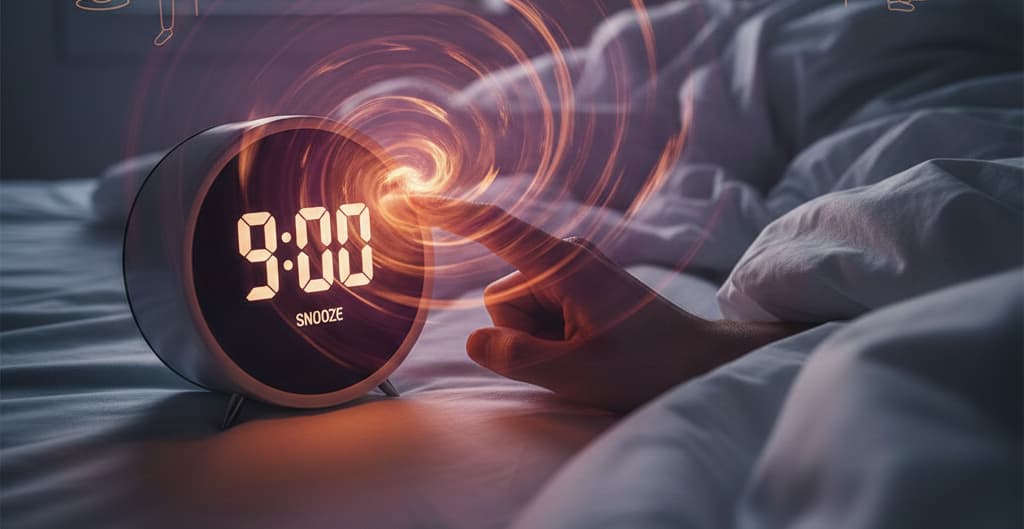
It is the most seductive button in the world. The alarm goes off, pulling you out of a warm dream. The room is cold. The day ahead looks exhausting. You see the option: Snooze. 9 minutes.
You tell yourself, “I just need a few more minutes to finish this sleep. Then I’ll be ready.”
It is a lie. That button is not your friend. It is a mechanism for self-sabotage that virtually guarantees you will feel terrible for the next four hours.
The Biology of Waking Up
To understand why, we need to look at sleep cycles. A full sleep cycle (Light -> Deep -> REM) takes about 90 minutes. When your alarm goes off the first time, ideally, you are near the end of a cycle. Your body has likely already started preparing to wake up by raising your core temperature and releasing cortisol.
When you hit snooze and drift back off, you don’t go into “light” rest. Because you are sleep-deprived (like most of us), your brain often plunges you straight back into the beginning of a new sleep cycle.
Sleep Inertia: The Fog of War
Then, 9 minutes later, the alarm screams again.
This time, you are shocking your brain awake right in the middle of a new cycle. This is called Sleep Inertia.
Imagine a car engine cruising at 60mph on the highway (Deep Sleep). The alarm slams the brakes instantly. The engine shudders, smokes, and stalls. That is your brain on snooze.
Sleep inertia is that heavy, groggy, “zombie” feeling. It affects your decision-making, reaction time, and mood. Typically, natural sleep inertia lasts 15-30 minutes. But when you repeatedly hit snooze—fragmenting your sleep into 9-minute shreds—you can extend this state of grogginess for up to 4 hours.
You are essentially starting your day with a cognitive handicap.
Why 9 Minutes?
A bit of trivia: The 9-minute snooze is a relic of mechanical engineering. In the 1950s, clockmakers had to fit the snooze gear into existing mechanisms. 10 minutes was physically impossible due to the gear teeth alignment, so they settled on 9-ish minutes. It has no biological basis whatsoever.
How to Break the Addiction
Breaking the snooze habit is simple, but not easy. It requires re-training your brain.
1. The “Across the Room” Method
Move your phone or alarm clock to the other side of the room. You must physically get out of bed to turn it off. Once your feet are on the floor, the hardest part is over. Do not get back in.2. Use Light, Not Sound
Our bodies are evolved to wake up with the sun, not a digital siren. Use a sunrise simulation alarm clock or leave your curtains slightly open. Light suppresses melatonin and naturally pulls you out of sleep, often before the sound alarm even goes off.3. The “No Negotiation” Rule
Decide the night before: “I wake up at 7:00 AM.” Treat it as a contract. When the alarm rings, you do not negotiate with yourself. You count “3-2-1” and stand up.If you truly need more sleep, set your alarm for 7:30 AM and sleep solidly until then. 30 minutes of unbroken sleep is restorative. 30 minutes of snoozed, fragmented sleep is torture. Stop micro-dosing your rest and get the real thing.

The Slumbelry Commitment
Sleep is the most vulnerable state of human existence. It is where we heal, reset, and grow.
At Slumbelry, we don’t just sell sleep products; we advocate for your physiological right to rest. From ergonomic support to light management, every solution we offer is designed with one obsession: Respecting your Biology.
Science is our language, but your recovery is our purpose. You take care of everything else in your life—let us take care of your nights.
Rest Deeply,
The Slumbelry Team