
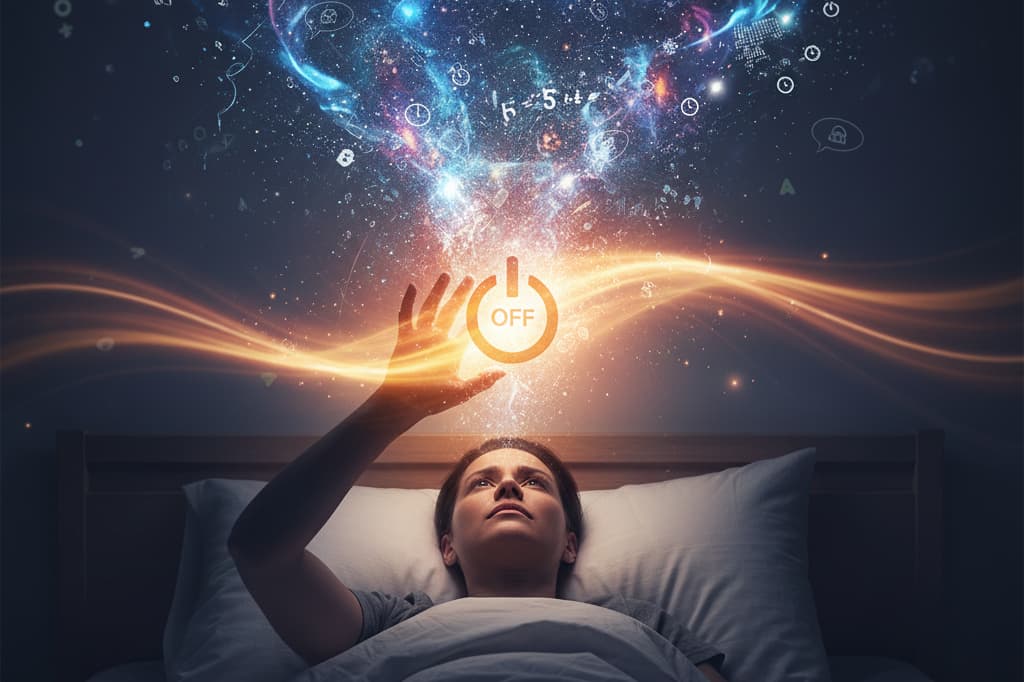
It’s 11:30 PM. Your body is exhausted. Your eyelids feel heavy. You climb into bed, desperate for rest. And then, the moment your head hits the pillow—click.
The lights go on in the factory of your mind.
Suddenly, you’re remembering an awkward email you sent in 2018. You’re rehearsing tomorrow’s presentation. You’re worrying about the global economy, your retirement fund, and whether you locked the back door.
This is the “Tired but Wired” phenomenon, clinically known as cognitive hyperarousal. And for many high-functioning professionals, it is the primary barrier to deep sleep.
The Neurology of the Racing Mind
Why does this happen? During the day, your brain is bombarded with stimuli—notifications, conversations, decisions. It is in “acquisition mode.” When you finally lie down in the quiet dark, the external noise stops, and your brain switches to “processing mode.”
Without distractions, your default mode network (DMN) takes over. This is the part of the brain responsible for self-reflection, planning, and worrying. Essentially, your brain thinks this quiet time is a conference room meeting it scheduled with you to review your anxieties.
The Solution: Do Not “Try” to Sleep
The worst thing you can do is try to force your brain to stop. Trying to sleep is an active process; sleep is a passive release. The more you fight the thoughts, the more cortisol (stress hormone) you release, pushing sleep further away.
Instead, we need to distract the brain with something boring enough to induce sleep, but engaging enough to block the worries.
1. The “Brain Dump” Protocol
Two hours before bed—not right before—take a physical notebook. Write down everything that is worrying you. Next to each item, write the very next step you can take to solve it.
- Worry: “I haven’t finished the Q3 report.”
- Action: “I will spend 30 minutes on the outline tomorrow at 9:00 AM.”
Once it is on paper, your brain feels permission to let it go. You have “outsourced” the worry to the notebook.
2. Cognitive Shuffling (The “Random Word” Game)
This technique, developed by cognitive scientist Dr. Luc Beaudoin, creates a “scramble” in your brain that mimics the onset of sleep.
- Pick a neutral word, like “BEDTIME.”
- For each letter, visualize a series of unrelated words.
- B: Bear, Ball, Bus, Banana. Visualize each one for a few seconds.
- E: Elephant, Egg, Ear.
- D: Dog, Door, Drum.
By forcing your brain to jump between unrelated images, you disrupt the linear narrative of your worries (the “racing” track). This mimics the fragmented, dream-like imagery that occurs naturally as we drift off, signaling to your brain that it’s safe to sleep.
The 4-7-8 Breaker
If the mental noise is too loud, engage the body. Use the 4-7-8 breathing technique: 1. Inhale quietly through the nose for 4 seconds. 2. Hold the breath for 7 seconds. 3. Exhale forcefully through the mouth for 8 seconds (making a whoosh sound).
This forces your nervous system to shift from Sympathetic (fight or flight) to Parasympathetic (rest and digest). You physically cannot be in a panic state while breathing this slowly.
Your mind is a tool, not the master. You wouldn’t leave your laptop running high-intensity software all night; don’t let your brain do it either. Give it a shutdown procedure, and reclaim your nights.

The Slumbelry Commitment
Sleep is the most vulnerable state of human existence. It is where we heal, reset, and grow.
At Slumbelry, we don’t just sell sleep products; we advocate for your physiological right to rest. From ergonomic support to light management, every solution we offer is designed with one obsession: Respecting your Biology.
Science is our language, but your recovery is our purpose. You take care of everything else in your life—let us take care of your nights.
Rest Deeply,
The Slumbelry Team