
The Clinical Perspective
“Dr. Lycan, why am I suddenly waking up at 3 AM?”
I hear this question constantly. And often, the answer isn’t stress or caffeine—it’s biology. In my years of consulting, one truth has become undeniable: sleep guidelines are often written for the “average male,” ignoring the complex hormonal reality of half the population.
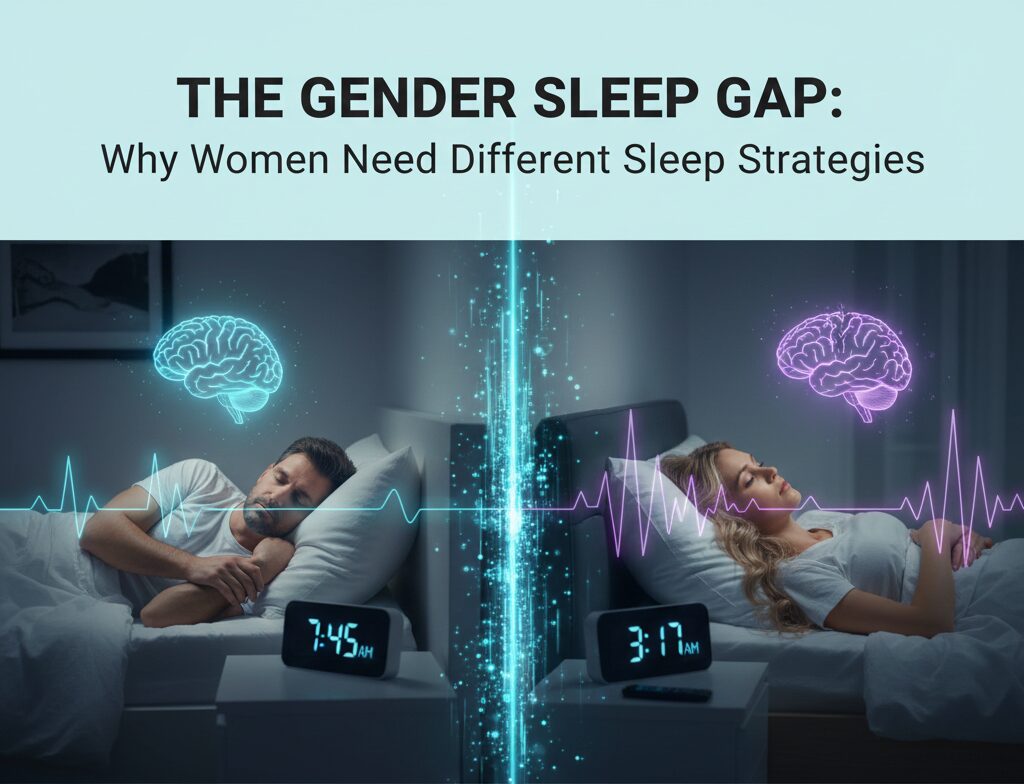
We call this The Gender Sleep Gap.
Women report insomnia at rates significantly higher than men, and it’s not because they worry more. It’s because their physiological baseline for sleep is a moving target, shifting not just over a lifetime, but often over a single month.
The Three Biological Disrupters
If you feel like your sleep quality is a rollercoaster, you aren’t imagining it. Clinical data highlights three distinct phases where the “standard rules” fail women.
1. The Cycle Shift (The “Progesterone Drop”)
Many of my clients report 2–3 days of fragmented sleep every month. Science backs this up. Progesterone is a natural sedative; when it plummets just before menstruation, your body loses that calming influence. Some women experience “hypersomnia” (excessive sleepiness), while others face stark insomnia.- The Symptom: You feel exhausted but “wired,” unable to settle despite fatigue.
- The Fix: This is not the time to push through. I advise clients to treat these days as “recovery days”—lighter workouts, earlier bedtimes, and zero caffeine after noon.
2. The Pregnancy Paradox
During pregnancy, the prevalence of insomnia ranges from 15% to 80%. In the first trimester, progesterone spikes, causing daytime fatigue. By the third trimester, the challenge becomes purely mechanical—finding a position that supports the body without compressing the diaphragm.- The Symptom: Frequent waking due to discomfort, restless legs (RLS), or shortness of breath.
- The Fix: Slumbelry Ergonomic Support isn’t just a luxury here; it’s a medical necessity. Proper alignment of the hips and spine reduces the mechanical load, allowing the nervous system to downregulate.
3. The Menopause Thermal Spike
Hot flushes are the single biggest destroyer of sleep for women in midlife. You might fall asleep fine, only to be jolted awake at 2 AM, drenched in sweat. This isn’t a bad dream; it’s a thermoregulatory failure.- The Symptom: Nocturnal awakenings followed by an inability to cool down.
- The Fix: Temperature control is non-negotiable. I prescribe Slumbelry Light Management tools not just for darkness, but to create a sensory-deprived, cool environment that helps mitigate these thermal spikes.
The “Good Sleep” Protocol for Women
We cannot change biology, but we can engineer the environment to support it. Here is the protocol I use with my female clients:
1. Track Your Cycle: Know when your “insomnia window” is coming. Don’t schedule high-stress meetings for those 3 days if you can avoid it. 2. Thermal Regulation First: For menopausal clients, the bedroom must be a refrigerator—18°C (65°F) or lower. Breathable fabrics are essential. 3. Ergonomic Calibration: Your body shape changes. Your mattress support shouldn’t be static. Use supportive pillows to offload pressure from the hips and lower back.
The Verdict
Stop comparing your sleep to your partner’s. His hormones are likely a flat line; yours are a symphony. The goal isn’t to force your body into a standard mold, but to give it the specific support it needs during each phase. Listen to the signal, not the noise.

The Slumbelry Commitment
Sleep is the most vulnerable state of human existence. It is where we heal, reset, and grow.
At Slumbelry, we don’t just sell sleep products; we advocate for your physiological right to rest. From ergonomic support to light management, every solution we offer is designed with one obsession: Respecting your Biology.
Science is our language, but your recovery is our purpose. You take care of everything else in your life—let us take care of your nights.
Rest Deeply,
The Slumbelry Team