
The Irony of Insomnia: Why Trying to Sleep Keeps You Awake
Here is the cruelest paradox of insomnia: The harder you try to sleep, the further away it gets. Think about the person who drinks a double espresso at 8 PM and falls asleep the second their head hits the pillow. Why can they do it? Because they don’t care. They don’t track their sleep, they don’t optimize their bedroom, and they don’t feel a knot of dread in their stomach as 10 PM approaches. You, on the other hand, have read the books and bought the gadgets. But the original trigger for your insomnia—the stress, the pain, the newborn baby—is long gone. The only thing keeping you awake now is the sheer terror of not sleeping.
- The Tiger in the Bedroom: Sleep anxiety triggers your “fight or flight” response. Your brain literally thinks it is unsafe to lose consciousness.
- Paradoxical Intention: The most effective psychological tool for insomnia is actively trying to stay awake, which instantly removes the performance pressure of sleep.
- The Catastrophe Myth: You must dismantle the belief that a bad night of sleep will ruin your life. You are far more resilient than your anxiety tells you.
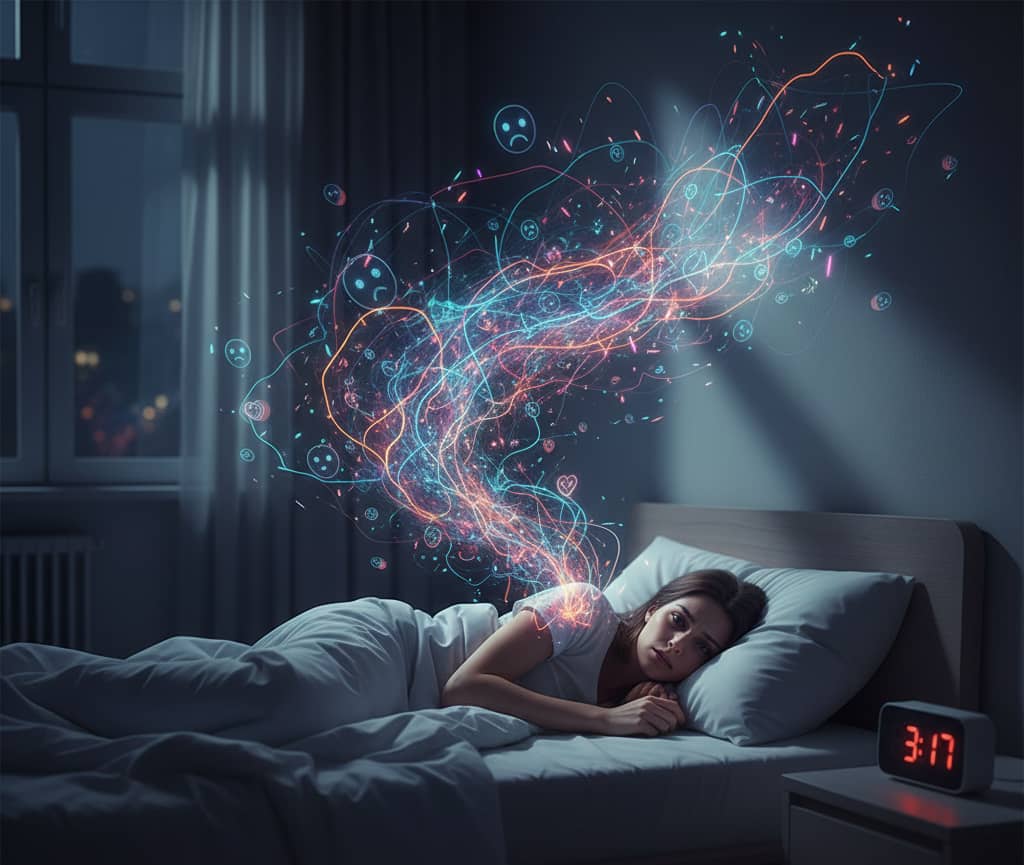
1) The Fight or Flight Response: Why You Cannot Force It
Sleep is a state of profound vulnerability. It requires your nervous system to feel entirely safe. Anxiety, by definition, is a state of hyper-vigilance. It is your brain holding on, scanning the horizon for danger.
When you look at your bed and feel that familiar wave of panic—“What if I don’t sleep tonight? What if tomorrow is ruined?”—your amygdala sounds the alarm. It dumps adrenaline and cortisol into your bloodstream. Your heart rate elevates, and your core temperature rises.
Your biological programming thinks there is a tiger in the bedroom. And from an evolutionary standpoint, you cannot (and should not) fall asleep when you are fighting a tiger. You are asking your body to hit the gas and the brakes at the exact same time.
“Sleep is like a shy animal. If you chase it, it will run away. You have to sit quietly and let it come to you.”
2) Breaking the Cycle: Paradoxical Intention
How do you stop fearing the tiger? You invite it in.
One of the most effective, counter-intuitive tools used in Cognitive Behavioral Therapy for Insomnia (CBT-I) is called Paradoxical Intention. Instead of desperately trying to force sleep, you actively try to stay awake.
The Paradox Protocol:
- Get in Bed with Open Eyes: Lie down in your dark room, but keep your eyes gently open.
- Set the New Goal: Tell yourself: “My only goal right now is to stay awake as long as I can. I am just going to rest my body, but I will not allow my mind to sleep.”
- Embrace the Wakefulness: Do not look at your phone. Just lie there and actively try to remain conscious.
Why does this work? Because it immediately removes the performance anxiety. The moment you stop trying to sleep, the adrenaline drops. The threat is neutralized. And very often, you will fall asleep entirely by accident.

3) The Power of Acceptance (ACT)
Acceptance and Commitment Therapy (ACT) offers another powerful framework for chronic sleep anxiety: stop fighting the wakefulness.
When you are lying awake at 3 AM, your internal monologue is usually a warzone: “I hate this. This is awful. I need to sleep right now.” This resistance fuels the anxiety.
ACT teaches you to drop the rope in this tug-of-war. Instead of fighting, you practice radical acceptance: “Hello, wakefulness. I see you are here again. That is okay. I am just going to lie here and enjoy the physical warmth of the blanket.” It sounds incredibly passive, but it is deeply powerful. By removing the emotional charge from the situation, you starve the anxiety of its fuel.
4) Dismantling the Catastrophe Myth
The root of sleep anxiety is almost always a catastrophic belief about tomorrow: “If I don’t sleep, I won’t be able to function. I’ll get fired. I’ll get sick. I’ll go crazy.”
It is time to challenge that belief with hard evidence. Look back at your life. You have survived every single sleepless night you have ever had. You went to work. You took care of the kids. You drove the car. It wasn’t fun, you felt miserable, but you did it. You did not die.
You are far more resilient than your anxiety tells you. Once you truly internalize the fact that a bad night of sleep is just a bad night—not a life-ending catastrophe—the fear loses its teeth. And when the fear is gone, the sleep naturally returns.
5) Common Misconceptions (FAQ)
Q1: Shouldn’t I get out of bed if I can’t sleep?
Yes, this is a core rule of CBT-I called Stimulus Control. If you have been awake for what feels like 20 minutes and you are feeling anxious or frustrated, get out of bed. Go to a dim room and do something boring (read a physical book, knit) until you feel genuinely sleepy, then return to bed. Your bed must only be associated with sleep, not with tossing and turning.
Q2: Why do I feel so sleepy on the couch, but wide awake in bed?
This is classic conditioned arousal. Your brain has subconsciously linked your bed with the frustration and anxiety of not sleeping. The couch is safe; there is no pressure to sleep there. When you move to the bed, the “performance” begins, and your brain releases adrenaline. Stimulus Control (mentioned above) helps break this negative association.
Q3: Are sleep trackers making my insomnia worse?
For people with sleep anxiety, absolutely. This is called “Orthosomnia”—the unhealthy obsession with achieving perfect sleep data. Checking your app every morning to see if you “failed” or “succeeded” at sleeping only spikes your cortisol and reinforces the performance pressure. If you have sleep anxiety, take off the watch.
Stop fighting the tiger in your bedroom. Learn to work with your nervous system, not against it.
Take the Free Sleep Assessment Join the Recovery NewsletterThe Slumbelry Commitment
Sleep is the most vulnerable state of human existence. It is where we heal, reset, and grow.
At Slumbelry, we don’t just sell sleep products; we advocate for your physiological right to rest. From ergonomic support to light management, every solution we offer is designed with one obsession: Respecting your Biology.
Science is our language, but your recovery is our purpose. You take care of everything else in your life—let us take care of your nights.
Rest Deeply,
The Slumbelry Team