
Don’t Stay in Bed: The Golden Rule of Stimulus Control
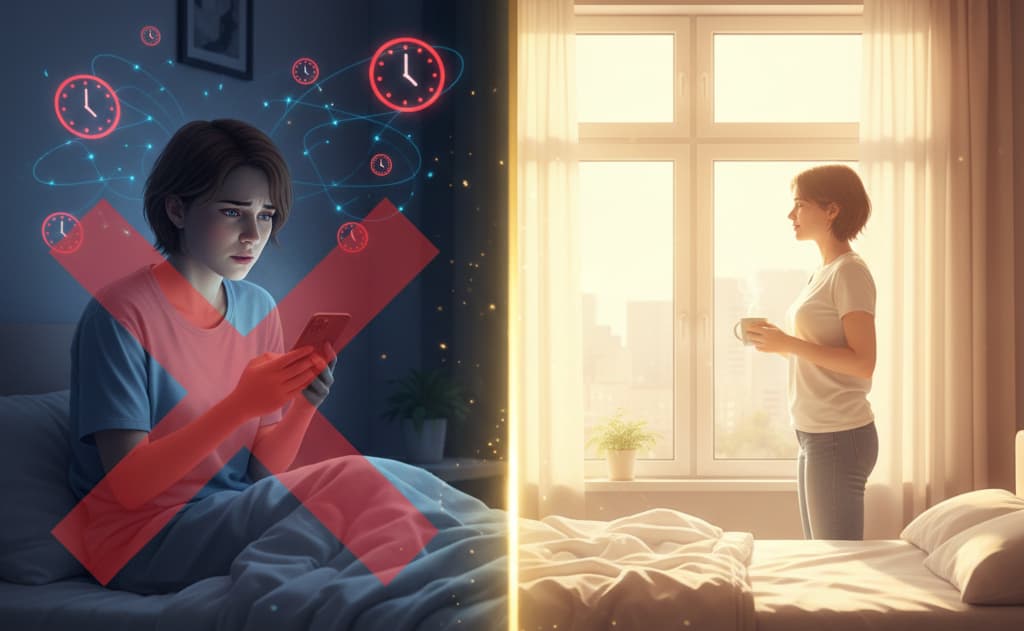
If I put a plate of food in front of you and you weren’t hungry, would you sit at the table for four hours waiting to get hungry? Of course not. You would leave the kitchen and come back when your appetite returned. Yet, this is exactly what millions of people do with sleep every single night. They lie in bed, wide awake, staring at the ceiling, waiting for sleep to happen. This seemingly innocent habit is the fastest way to develop chronic insomnia. If you can’t sleep get out of bed. It sounds counterintuitive, but staying in bed creates a psychological trap known as Conditioned Arousal.
- The Pavlovian Trap: Your brain is an association machine. If you spend hours awake and frustrated in bed, your brain learns that the bed is a place for stress, not sleep.
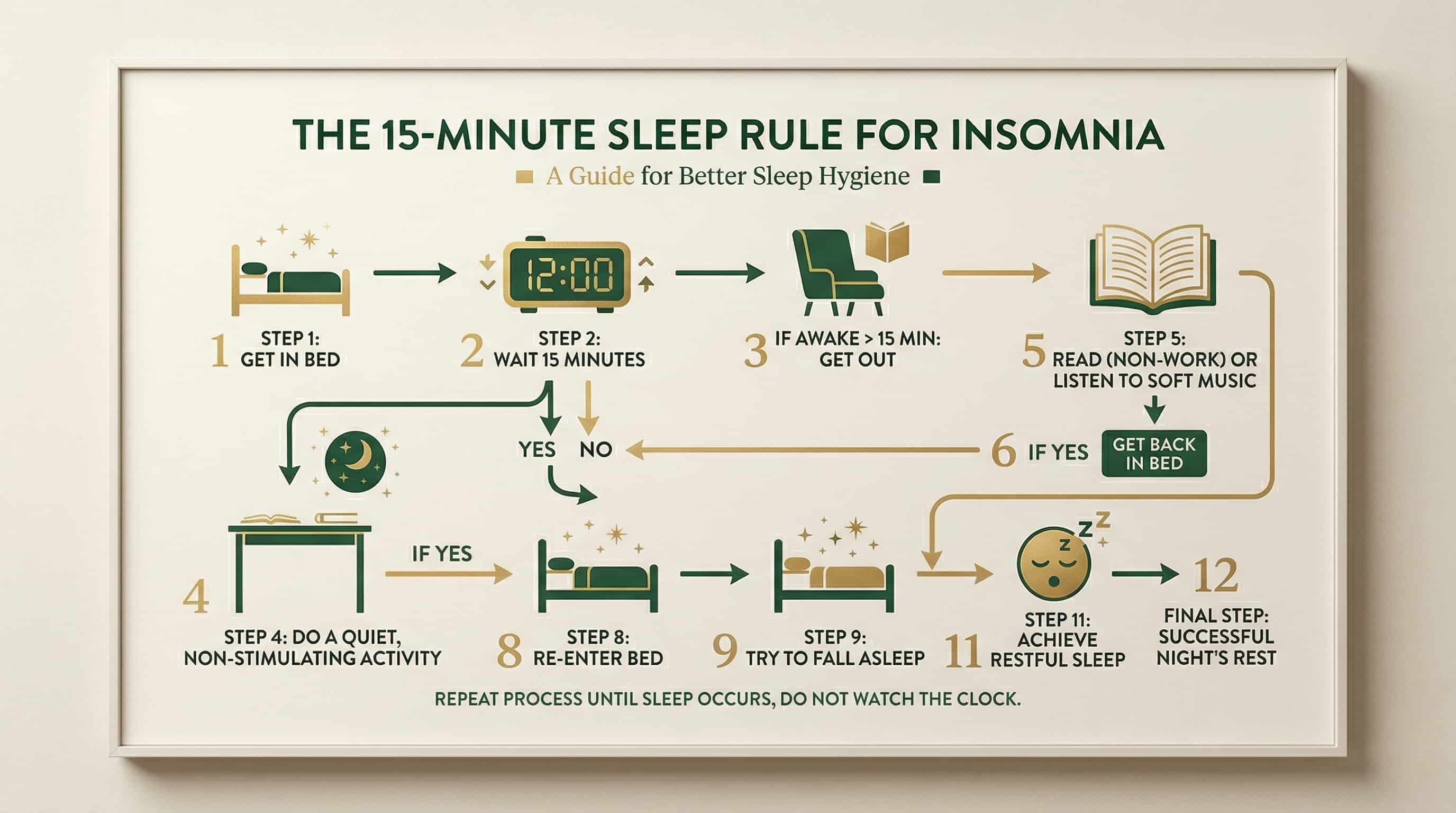
- The 15-Minute Rule: If you cannot fall asleep within approximately 15 to 20 minutes, you must physically leave the bed.
- The Cure (Stimulus Control): By only getting into bed when you are overwhelmingly sleepy, you rebuild the broken association between your mattress and unconsciousness.
1) Pavlov’s Dog… But for Insomnia
To understand why lying awake is so destructive, we have to look at classical conditioning. You likely know the story of Pavlov’s dogs: ring a bell, give the dog food. Eventually, just ringing the bell causes the dog to salivate. The brain forms an automatic, biological association.
Your brain does the exact same thing with your bedroom.
For a “good sleeper,” the association is simple: Pillow = Sleep. The moment their head hits the mattress, their brain releases melatonin, their heart rate drops, and they lose consciousness.
But if you suffer from insomnia, you have likely spent hundreds of hours lying on that exact same pillow doing something else. You do “sleep math” (“If I fall asleep now, I get 4 hours”). You worry about your job. You feel intense frustration. You toss and turn. Your new association becomes: Pillow = Worry, Frustration, and Wakefulness.
This is why you can feel completely exhausted while watching TV on the couch, but the absolute second you walk into your bedroom and lie down, you are wide awake. Your brain recognizes the “Worry Room” and hits the adrenaline switch.
“You cannot force sleep by staying in bed. You are only practicing how to be awake in bed.”
2) The Golden Rule: Stimulus Control Therapy
To fix this, we use the most effective, scientifically proven behavioral treatment for insomnia: Stimulus Control. The goal is to break the negative association and retrain your brain to view the bed strictly as a trigger for sleep.
The Stimulus Control Protocol:
- The Bed is for Sleep Only: No reading, no scrolling on your phone, no watching TV, and absolutely no worrying in bed. If you want to do those things, do them in a chair.
- The 15-Minute Rule: If you get into bed and do not fall asleep within roughly 15 to 20 minutes (do not watch the clock, just estimate), you must get up. Go to a different, dimly lit room.
- Do Something Boring: Read a physical book, knit, or do a crossword puzzle. Do not do anything highly stimulating (no screens, no work emails).
- Return Only When Sleepy: Do not go back to bed after a set amount of time. Wait until your eyelids feel physically heavy and you are struggling to stay awake. Then, and only then, return to bed.
- Repeat as Necessary: If you return to bed and are awake 15 minutes later, get up again. You might do this 5 times a night at first. Be consistent.

3) The Hardest Part is the First Week
I will not lie to you: the first few nights of practicing Stimulus Control are miserable. You will be tired, and getting out of a warm bed to sit in a chilly living room at 3 AM requires massive willpower.
You will likely get less sleep for the first few nights. But this builds up a massive “sleep debt” (adenosine). By night three or four, that sleep debt becomes so powerful that when you finally do get into bed, you will pass out instantly.
You are trading short-term discomfort for a long-term cure. By rigorously defending your bed as a sleep-only zone, you will eventually rewrite your brain’s programming. The pillow will once again become a trigger for rest, not anxiety.
4) Common Misconceptions (FAQ)
Q1: I don’t want to wake up my partner by getting in and out of bed. What should I do?
This is a common concern. However, your tossing, turning, and heavy sighing are likely already disturbing their sleep. Explain to them that you are doing a behavioral reset for a few weeks. If getting out of bed is truly impossible (e.g., mobility issues or severe cold), you must at least sit up, turn your back to the pillows, and turn on a small reading light to change your physical orientation and break the “trying to sleep” posture.
Q2: Can I just look at my phone when I get out of bed?
No. The goal of getting out of bed is to distract your brain with a low-stakes activity until natural sleepiness returns. The blue light from your phone suppresses melatonin, and the content (social media, news) triggers dopamine and cortisol. Stick to analog, physical activities like reading a book or listening to a quiet podcast in the dark.
Q3: What if I feel sleepy on the couch, but wake up as soon as I walk back to the bedroom?
This proves that your conditioned arousal is very strong! If this happens, do not get into bed. The moment you feel the adrenaline hit at the bedroom door, turn around and go back to the couch. Wait for the sleepiness wave to hit again. You have to prove to your brain that you will not lie in that bed while awake.
Stop torturing yourself in the dark. Learn the behavioral tools to reset your sleep drive today.
Take the Free Sleep Assessment Join the Recovery NewsletterThe Slumbelry Commitment
Sleep is the most vulnerable state of human existence. It is where we heal, reset, and grow.
At Slumbelry, we don’t just sell sleep products; we advocate for your physiological right to rest. From ergonomic support to light management, every solution we offer is designed with one obsession: Respecting your Biology.
Science is our language, but your recovery is our purpose. You take care of everything else in your life—let us take care of your nights.
Rest Deeply,
The Slumbelry Team